CUSAT CAT 2017 Question Paper Botany
Finished viewing? Save it for later —
Download CUSAT CAT 2017 Question Paper Botany (PDF · 17 pages)About CUSAT CAT 2017 Question Paper Botany
CUSAT CAT 2017 Question Paper Botany is available here for free download. Published by Cochin University for CUSAT Common Admission Test, this question paper can be viewed online or downloaded as a PDF (17 pages). Candidates preparing for CUSAT Common Admission Test can use CUSAT CAT 2017 Question Paper Botany to understand the exam pattern, the type of questions asked, and the overall difficulty level.
Frequently Asked Questions
How can I download CUSAT CAT 2017 Question Paper Botany?
Open this page and click the Download button to save CUSAT CAT 2017 Question Paper Botany as a PDF. It is completely free on AglaSem Docs.
Is CUSAT CAT 2017 Question Paper Botany free to download?
Yes. CUSAT CAT 2017 Question Paper Botany can be viewed online and downloaded as a PDF free of cost on AglaSem Docs.
How many pages does CUSAT CAT 2017 Question Paper Botany have?
CUSAT CAT 2017 Question Paper Botany contains 17 pages, which you can read online or download together as a single PDF.
Where can I find more CUSAT Common Admission Test study material?
You can find more CUSAT Common Admission Test question papers, sample papers, syllabus, and answer keys on AglaSem Docs.
CUSAT CAT 2017 Question Paper Botany – Text
Read the full text of this question paper below — useful to quickly search, copy and reference the content online without downloading the PDF.
📄 View text version (17 pages)
Page 1
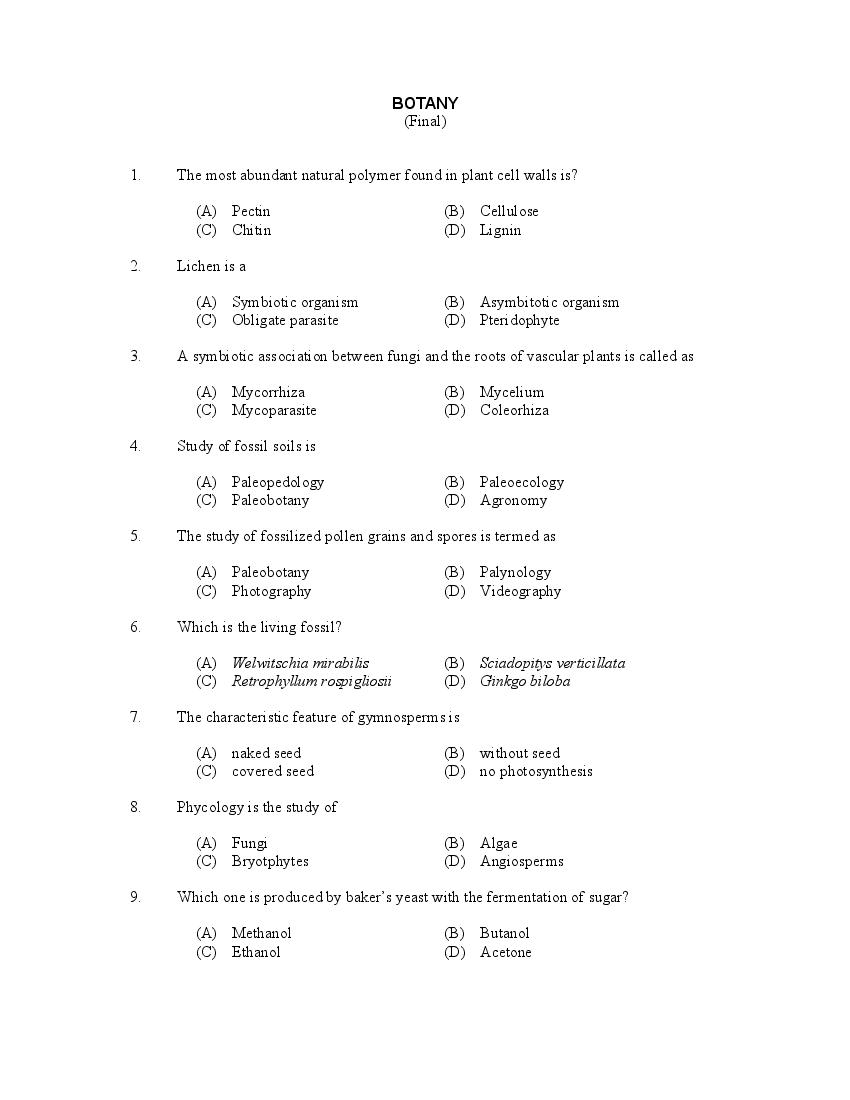
(Final)
1. The most abundant natural polymer found in plant cell walls is?
(A) Pectin (B) Cellulose
(C) Chitin (D) Lignin
2. Lichen is a
(A) Symbiotic organism (B) Asymbitotic organism
(C) Obligate parasite (D) Pteridophyte
3. A symbiotic association between fungi and the roots of vascular plants is called as
(A) Mycorrhiza (B) Mycelium
(C) Mycoparasite (D) Coleorhiza
4. Study of fossil soils is
(A) Paleopedology (B) Paleoecology
(C) Paleobotany (D) Agronomy
5. The study of fossilized pollen grains and spores is termed as
(A) Paleobotany (B) Palynology
(C) Photography (D) Videography
6. Which is the living fossil?
(A) Welwitschia mirabilis (B) Sciadopitys verticillata
(C) Retrophyllum rospigliosii (D) Ginkgo biloba
7. The characteristic feature of gymnosperms is
(A) naked seed (B) without seed
(C) covered seed (D) no photosynthesis
8. Phycology is the study of
(A) Fungi (B) Algae
(C) Bryotphytes (D) Angiosperms
9. Which one is produced by baker’s yeast with the fermentation of sugar?
(A) Methanol (B) Butanol
(C) Ethanol (D) Acetone
Page 2
10. Mushroom is
(A) an algae (B) a fungus
(C) a parasite (D) a bryophyte
11. Chorophyta includes
(A) Photosynthetic eukaryotes
(B) Non photosynthetic eukaryotes
(C) Photosynthetic prokaryotes
(D) Non photosynthetic prokaryotes
12. Vessels are present in all of the following plants except
(A) Pinus (B) Rose
(C) Neem (D) Mango tree
13. Which of the following water conducting element is considered as most advanced?
(A) Tracheids (B) Multiple vessels
(C) Annular tracheids (D) Simple vessels
14. Which of the following are the examples of phloem fibres?
(A) Jute (B) Hemp
(C) Flax (D) All of the above
15. The waxy substance associated with the wall of cork cells is
(A) Cutin (B) Lignin
(C) Hemicellulose (D) Suberin
16. A simple mechanical tissue devoid of lignin is
(A) Parenchyma (B) Sclerenchyma
(C) Collenchyma (D) Chlorenchyma
17. Abnormal secondary growth is found in
(A) Dracaena (B) Triticum
(C) Helianthus (D) Cucurbita
18. External protective tissues of plants are
(A) Cork and cortex (B) Cortex and epidermis
(C) Epidermis and cork (D) Pericycle and cortex
Page 3
19. The bark of a tree comprises
(A) all the tissues outside the cork cambium
(B) all the tissues outside the vascular cambium
(C) only the cork
(D) tissues inside the cork cambium
20. Cork cells are impermeable to water because of the presence of
(A) Lignin (B) Cutin
(C) Suberin (D) Pectin
21. Fusion of male gamete with polar nuclei of embryosac is known as
(A) Pollination (B) Embryogeny
(C) Triple fusion (D) Double fertilization
22. The entry of pollen tube into the ovule through micropyle is called
(A) Isogamy (B) Anisogamy
(C) Porogamy (D) Chalazogamy
23. Development of embryo from gametophyte without the intervention of gamete is
known as
(A) Apospory (B) Apogamy
(C) Apomixis (D) Aposporogamy
24. The exine of mature pollen grain is composed chiefly of
(A) Lipids (B) Cellulose
(C) Pectocellulose (D) Sporopollenin
25. During fertilization, the pollen tube discharges its contents in the
(A) Central cell (B) Egg
(C) Microphyle (D) Synergid
26. The Commelinaceae family is commonly known as the
(A) Spiderwort family (B) Aster family
(C) Grass family (D) Lily family
27. Binomials with identical genus name and specific epithet are called
(A) Homonym (B) Tautonym
(C) Basionym (D) Synonym
Page 4
28. The newly collected specimen which is used as a substitute, when the original type
material is missing in a herbarium, is designated as
(A) Lectotype (B) Holotype
(C) Neotype (D) Isotype
29. Natural system of classification of plants differs from artificial system of
classification in
(A) taking into account only one vegetative character
(B) taking into account only one floral character
(C) taking into account all the similarities between plants
(D) All of the above
30. Which one of the following chemicals is a DNA intercalator?
(A) 5-Bromouracil (B) Ethyl methane sulfonate
(C) Acridine orange (D) UV
31. Which one of the following neurotransmitters is secreted by the pre-ganglionic
neurons of sympathetic nervous system?
(A) Epinephrine (B) Acetylcholine
(C) Dopamine (D) Norepinephrine
32. Which of the following statements about evolution is true?
(A) Evolution is the product of natural selection
(B) Evolution is not goal-oriented
(C) Evolution won’t evolve Prokaryotes
(D) Both (A) and (B)
33. Predominant interactions between phospholipids that stabilize a biological membrane
include
(A) hydrogen bonds and covalent interactions
(B) van der Waal and ionic interactions
(C) hydrophobic interactions and hydrogen bonding
(D) covalent and hydrophobic interactions
34. Entry of enveloped viruses into its host cells is mediated by
(A) only endocytosis
(B) both endocytosis and phagocytosis
(C) both endocytosis and membrane fusion
(D) only pinocytosis
Page 5
35. Which of the following National parks has the highest density of tigers among
protected areas in the world?
(A) Jim Corbett (B) Kaziranga
(C) Keoladeo Ghana (D) Manas
36. Excess oxygen consumed after a vigorous exercise is to
(A) pump out lactic acid from muscle
(B) increase the concentration of lactic acid in muscle
(C) reduce dissolved carbon dioxide in blood
(D) make ATP for gluconeogenesis
37. Which of the following mutagens is most likely to result in a single amino acid
change in a gene product?
(A) Acridine orange
(B) X-rays
(C) Ethylmethane sulphonate (EMS)
(D) Ethidium bromide (EtBr)
38. Green revolution occurred during
(A) 1960 (B) 1940
(C) 1950 (D) 1930
39. Selection of homozygous plant is termed as
(A) Pure line selection (B) Mass selection
(C) Clonal selection (D) Both (A) and (C)
40. A plant bearing both male and female flowers is said to be
(A) Dioecious (B) Monoecious
(C) Polygamous (D) Asexual
41. Wind pollination is also known as
(A) Anemophyly (B) Entomophyly
(C) Zoophyly (D) Hydrophyly
42. Actual petrified remains of ancient plants and animals or impressions left by them in
rocks are called
(A) Models (B) Traces
(C) Fossils (D) Images
Page 6
43. Adjustment of individuals to their environment by means of special structures or of
function is termed as
(A) Mutation (B) Heredity
(C) Variation (D) Adaptation
44. A hybrid is always
(A) Heterozygous (B) Homozygous
(C) Often homozygous (D) Both (A) and (B)
45. One of the following is not a double membranous structure
(A) Mitochondrion (B) Vacuole
(C) Chloroplast (D) Nucleus
46. Mendel formulated some laws which are known as
(A) Laws of germplasm (B) Laws of origin of species
(C) Laws of recapitulation (D) Laws of inheritance
47. The alleles are
(A) a pair of genes governing a specific character such as tallness or dwarfness
(B) multiple forms of genes
(C) genes governing eye characters
(D) genes present in allosomes
48. An organism with two identical alleles for a given trait is
(A) homozygous (B) segregating
(C) dominant (D) a hermaphrodite
49. The resemblance of individuals to their progenitors is called
(A) Heredity (B) Genetics
(C) Evolution (D) Epigenetics
50. Maximum biodiversity can be seen in
(A) Tropical rain forest (B) Temperate forest
(C) Savanna (D) Alpine forest
51. The most important adaptation of mangrove plants is
(A) Vivipary (B) Thick cuticle
(C) Thick Bark (D) Thick leaves
Page 7
52. Tendency of pollutants to become concentrated in successive trophic levels is known
as
(A) Biomagnification (B) Biorhythm
(C) Bioremediation (D) Biopiracy
53. More than half of the Earth’s flora and fauna are found in
(A) Tundra (B) Tropical rain forests
(C) Grasslands (D) Chapparal
54. Two biodiversity hot-spots in India
(A) Eastern Himalayas and Western Ghats
(B) Western Himalayas and Western Ghats
(C) Eastern Himalayas and Eastern Ghats
(D) Western Himalayas and Eastern Ghats
55. Eutrophication is
(A) an improved water quality status of lakes
(B) the result of accumulation of plant nutrients in water bodies
(C) a process in the carbon cycle
(D) a water purification technique
56. The largest reservoir of nitrogen in our planet is
(A) Ocean (B) Atmosphere
(C) Biosphere (D) Fossil fuels
57. Father of medicine is
(A) Aristotle (B) Dioscorides
(C) Hippocrates (D) Galen
58. Flower bud of drug showing medicinal importance is
(A) Saffron (B) Clove
(C) Fig (D) Caraway
59. Vinca rosea belongs to the family
(A) Rubiaceae (B) Solanaceae
(C) Apocyanaceae (D) Erythroxylaceae
60. The important chemical constituent of rauwolfia is
(A) Reserpine (B) Resercinnamine
(C) Ajamalicine (D) Desperidine
Page 8
61. One of the following is the source of rubber
(A) Hevea brasilensis (B) Tectona grandis
(C) Cedrus depdara (D) Michelia chamaca
62. Saffron is produced from
(A) Roots of Indigofera (B) Petals of Rosa
(C) Stamens of Hibiscus (D) Style and Sigma of Crocus
63. ‘Holy basil’ is the synonym for the following drug producing herb
(A) Alpinia officinarum (B) Allium sativum
(C) Nardostachys jatamonum (D) Ocium sanctum
64. Cross pollination is essential in the following type of vegetables
(A) Monoecious (B) Dioecious
(C) Gynoecious (D) Perigynous
65. Maturation of anthers and stigma at the same time refers to
(A) Homogamy (B) Chasmogamy
(C) Cleistogamy (D) Dichogamy
66. In tissue culture medium, the embroyids formed from pollen grains is due to
(A) Cellular totipotency (B) Organogenesis
(C) Double fertilization (D) Test tube culture
67. Indian Institute of Horticulture Research (IIHR) is established at
(A) Bangalore (B) New Delhi
(C) Lucknow (D) Jodhpur
68. Biostatistics is also called as
(A) Biometry (B) Bio-numerology
(C) Biometeorology (D) Algebra
69. The standard deviation is the square of
(A) standard error (SD) (B) mode
(C) variance (D) regression
70. Interference RNA was discovered by
(A) Cohen and Boyer (B) Fire and Mello
(C) Yonath and Ramakrishnan (D) Holley and Khorana
Page 9
71. Which one among the following plants is not a GMO?
(A) Bt cotton (B) Golden rice
(C) Bt Brinjal (D) Pomato
72. The first transgenic plant was
(A) Pea (B) Tobacco
(C) Flax (D) Cotton
73. Which one among the following bacteria has been generally used in genetic
engineering research?
(A) Bacillus (B) E. coli
(C) Pseudomonas (D) Agrobacterium
74. Which one among the following is used as an anionic detergent in SDS-PAGE?
(A) Cetyl trimethylammonium bromide (CTAB)
(B) Sodium chloride (NaCl)
(C) Ethylenediaminetetraacetic acid (EDTA)
(D) Sodium dodecyl sulphate (SDS)
75. Which base in RNA is replaced by uracil?
(A) Thymidine (B) Guanine
(C) Cytosine (D) Adenine
76. Which one among the following enzymes uses ATP to add a phosphate group to the
substrate?
(A) Isomerase (B) Kinase
(C) Aldolase (D) Enolase
77. Sucrose is composed of
(A) Fructose and maltose (B) Glucose and galactose
(C) Fructose and galactose (D) Fructose and glucose
78. Cell without cell wall is termed as
(A) Apoplast (B) Protoplast
(C) Symplast (D) Tonoplast
79. Plant and animal cell possess
(A) Cell walls (B) Mitochondria
(C) Central vacuoles (D) Chloroplast
Page 10
80. Mycorrhizae are symbiotic associations between
(A) algae and fungi (B) bacteria and fungi
(C) bacteria and root (D) root and fungi
81. Which technique is used to introduce genes into dicots?
(A) Ti plasmid infection (B) Microinjection
(C) Particle acceleration (D) Electroporation
82. Which one among the following auxins is a naturally occurring form in plants?
(A) Naphthalenacetic acid (NAA)
(B) 2,4-dichlorophenoxyacetic acid (2,4-D)
(C) Indole-3-acetic acid (IAA)
(D) Picloram
83. Black rust of wheat is caused by
(A) Puccina recondita (B) P.graminis
(C) P.striiformis (D) Alternaria solani
84. Coenocytic mycelium occurs in the members of
(A) Ascomycetae (B) Basidiomycetae
(C) Deuteromycetae (D) Phycomycetae
85. Which of the following species of Agaricus is poisonous?
(A) A campestris (B) A bisporus
(C) A xanthodermus (D) A rodmani
86. The female reproductive structure in many lichens is called as
(A) Carpogonium (B) Oogonium
(C) Ascogonium (D) Ascomata
87. Bacteria in which flagella are found all over the body wall are known as
(A) Gram positive (B) Gram negative
(C) Atrichous (D) Peritrichous
88. The group of plants referred as ‘amphibians’ of plant kingdom is
(A) Bryophytes (B) Mosses
(C) Liverworts (D) Hornworts
Page 11
89. Scientific name of red wood tree is
(A) Cedrus (B) Pinus
(C) Dalbergia (D) Sequoia
90. Scientific name of pigeon pea is
(A) Lens culinaris (B) Cajanus cajan
(C) Pisum arvense (D) Pisum sativum
91. The function of the root cap is
(A) to absorb nutrients
(B) storage of end products
(C) protection of root tip and control of geotropic movement
(D) for stylish look
92. In Bougainvillea large coloured structures are
(A) Bracts (B) Stamens
(C) Petals (D) Sepals
93. The phenomenon of polyembryony was first observed in
(A) Mangifera (B) Cucurbita
(C) Citrus (D) Euphorbia
94. The first and great plant taxonomist is
(A) Hooker (B) Engler
(C) Linnaeus (D) Aristotle
95. The National Botanical Research Institute (NBRI) is located at
(A) Delhi (B) Dehradun
(C) Lucknow (D) Darjeeling
96. The botanical name of cauliflower is
(A) Brassica oleracea var. botrytis
(B) Brassica oleracea var. capitata
(C) Brassica oleracea var. gongylodes
(D) Brassica campestris
97. Which one among the following trees yields valuable timber?
(A) Acacia arabica (B) Dalbergia sisso
(C) Mangifera indica (D) Prosopis specigera
Page 12
98. Which one among the following is the largest family of the plant kingdom?
(A) Compositae (B) Leguminosae
(C) Gramineae (D) Orchidaceae
99. The Indian rubber plant belongs to the family
(A) Euphorbiaceae (B) Moraceae
(C) Asclepiadaceae (D) Sapotaceae
100. From which part of Cinchona, quinine is extracted?
(A) Roots (B) Seeds
(C) Bark (D) Fruits
101. Which one among the following crops occupies higher cultivation acreage in India?
(A) Jowar (B) Wheat
(C) Bajra (D) Rice
102. The characteristic smell in garlic is due to
(A) an alkaloid (B) a symbiotic virus
(C) diallyl disulphide (D) a corticosteroid
103. Fenny is distilled from
(A) Vitis vinifera (B) Juniperus communis
(C) Borassus flabellifer (D) Ancardium occidentale
104. Cilia are produced by
(A) Centrioles (B) Peroxisomes
(C) Dictyosomes (D) Golgi body
105. Auxins are
(A) Phytohormones (B) Proteins
(C) Porphyrins (D) Cell osmophores
106. Thigmotropism is the response of plants to
(A) Gravity (B) Water
(C) Light (D) Touch
107. The term synecology refers to the study of
(A) Plant community (B) Individual organism
(C) Environment (D) Plant-animal interactions
Page 13
108. Building blocks of the nucleic acids are
(A) Amino acids (B) Nucleoproteins
(C) Nucleotides (D) Nucleosides
109. Chromosome of prokaryotes is composed of
(A) DNA (B) Protein
(C) RNA (D) DNA, RNA and proteins
110. The nucleolus is composed of
(A) DNA, RNA and protein
(B) DNA and RNA only
(C) DNA and protein only
(D) Nucleic acids, proteins and phospholipids
111. Which one among the following plants is a millet?
(A) Triticum aestivum (B) Zea mays
(C) Oryza sativa (D) Eleusine coracana
112. Angiosperms are
(A) Open seeded plants (B) Closed seeded plants
(C) Seedless plants (D) Aquatic plants
113. When the calyx and corolla are combined, it is called
(A) Epicalyx (B) Leaf sheath
(C) Bracteole (D) Perianth
114. Botanical name of wheat is
(A) Triticum (B) Oryza
(C) Bambusa (D) Ricinus
115. Radish is a
(A) Bulb (B) Modified root
(C) Tuber (D) Stem
116. Solanum tuberosum is
(A) Tomato (B) Potato
(C) Banana (D) Mango
Page 14
117. The collection of dried plant specimens is called
(A) Vivarium (B) Aquarium
(C) Terrarium (D) Herbarium
118. The smallest gymnosperm is a species of
(A) Ephedra (B) Zamia
(C) Cycas (D) Gnetum
119. Eugenia caryophyllus is the botanical name of
(A) Clove (B) Eucalyptus
(C) Coriander (D) Cardamom
120. Krebs cycle occurs in
(A) Cytoplasm (B) Ribosomes
(C) Mitochondria (D) Chloroplasts
121. Agar is extracted from
(A) Blue-green algae (B) Brown algae
(C) Green algae (D) Red algae
122. Datura belongs to the family
(A) Compositae (B) Cruciferae
(C) Liliaceae (D) Solanaceae
123. Acid rain is due to
(A) Sulphur dioxide pollution (B) Carbon monoxide pollution
(C) Pesticide pollution (D) Dust particles
124. Viruses contain
(A) Only DNA (B) Only RNA
(C) Either DNA or RNA (D) Both DNA and RNA
125. Where is the Sugarcane Breeding Institute located?
(A) Lucknow (B) Mysore
(C) Coimbatore (D) Ludhiana
126. The drug ‘Belladonna’ is obtained from
(A) Atropa (B) Rawolfia
(C) Solanum (D) Capsicum
Page 15
127. Pine and fir are abundant in
(A) Tropical forests (B) Coniferous forests
(C) Temperate forests (D) Polar forests
128. Air pollution effects on plants are mostly found on
(A) Leaves (B) Flowers
(C) Stems (D) Roots
129. As water pollution increases in a stream, the values of BOD and COD change in the
following manner
(A) BOD decreases and COD increases
(B) BOD increases and COD decreases
(C) Both decrease
(D) Both increase
130. Which part of the coconut produces coir?
(A) Seed coat (B) Pericarp
(C) Mesocarp (D) Epicarp
131. A dihybrid ratio according to Mendelian genetics is
(A) 1:1:1:1 (B) 3:1
(C) 9:3:3:1 (D) 9:5:1:1
132. Cotton fibres are made up of
(A) Cellulose (B) Starch
(C) Lignin (D) Protein
133. The embryo in sunflower has
(A) No cotyledon (B) One cotyledon
(C) Two cotyledons (D) Many cotyledons
134. When a plant of F-1 generation is crossed with homozygous dominant plants, it is
termed as
(A) Simple cross (B) Test cross
(C) Backcross (D) Special cross
135. The main function of lysosomes is
(A) Digestion (B) Replication
(C) Translation (D) Translocation
Page 16
136. Mutations are caused due to exposure to
(A) Radioactive mutagens (B) Chemical mutagens
(C) Radiation mutagens (D) Carcinogens
137. Algae found growing attached to soil substratum are called as
(A) Epilithic (B) benthos
(C) Epipelic (D) Sciophytic
138. Tuberculosis is caused due to the infection by
(A) Clostridium (B) Mycobacterium
(C) Salmonella (D) Treponema
139. Pneumatophores are usually present in
(A) Mangrove plants (B) Xerophytes
(C) Hydrophytes (D) Epiphytes
140. Storage leaves are founds in
(A) Trapa (B) Allium
(C) Triticum (D) Maize
141. The fruit of grasses is usually a
(A) Capsule (B) Achene
(C) Nut (D) Caryopsis
142. Which one among the following is a prokaryote?
(A) Spirogyra (B) Rhizopus
(C) Escherichia (D) Amoeba
143. Mitochondria are absent in
(A) Yeast (B) Fungi
(C) Bacteria (D) Green algae
144. Wilting occurs in plants when
(A) Epidermis is peeled off (B) Phloem is blocked
(C) Xylem is blocked (D) Pith is removed
145. Which one among the following is an insectivorous plant?
(A) Cuscuta (B) Orobranche
(C) Drosera (D) Rafflesia
Page 17
146. The flowering responses of plants can be changed by
(A) Induced mutations (B) Photoperiodic treatment
(C) Injection of enzymes (D) Somatic hybridisation
147. RNA is absent in
(A) Plasma membrane (B) Cytoplasm
(C) Chromosome (D) Ribosome
148. Genes control
(A) Heredity but not protein synthesis
(B) Protein synthesis but not heredity
(C) Protein synthesis and heredity
(D) Biochemical reactions of enzyme
149. Mycorrhiza is
(A) a fungus parasitizing root system of higher plants
(B) an association of rhizobium with the roots of leguminous plants
(C) a symbiotic association of plant leaves and certain fungi
(D) an association of algae and fungi
150. Crossing over involves
(A) Deletion of chromosomes
(B) Addition of chromosomes
(C) Exchange of genetic materials
(D) Duplication of chromosomes
***
Document Details
| Board / Org | Cochin University |
| Exam | CUSAT Common Admission Test |
| Type | Question Paper |
| Pages | 17 |
| Updated | 22 Jul 2026 |