Goa Board Class 12 Question Paper Mar 2019 Sociology
Finished viewing? Save it for later —
Download Goa Board Class 12 Question Paper Mar 2019 Sociology (PDF · 4 pages)About Goa Board Class 12 Question Paper Mar 2019 Sociology
Goa Board Class 12 Question Paper Mar 2019 Sociology is available here for free download. Published by Goa Board for Class 12, this question paper can be viewed online or downloaded as a PDF (4 pages). Candidates preparing for Class 12 can use Goa Board Class 12 Question Paper Mar 2019 Sociology to understand the exam pattern, the type of questions asked, and the overall difficulty level.
Frequently Asked Questions
How can I download Goa Board Class 12 Question Paper Mar 2019 Sociology?
Open this page and click the Download button to save Goa Board Class 12 Question Paper Mar 2019 Sociology as a PDF. It is completely free on AglaSem Docs.
Is Goa Board Class 12 Question Paper Mar 2019 Sociology free to download?
Yes. Goa Board Class 12 Question Paper Mar 2019 Sociology can be viewed online and downloaded as a PDF free of cost on AglaSem Docs.
How many pages does Goa Board Class 12 Question Paper Mar 2019 Sociology have?
Goa Board Class 12 Question Paper Mar 2019 Sociology contains 4 pages, which you can read online or download together as a single PDF.
Where can I find more Class 12 study material?
You can find more Class 12 question papers, sample papers, syllabus, and answer keys on AglaSem Docs.
Goa Board Class 12 Question Paper Mar 2019 Sociology – Text
Read the full text of this question paper below — useful to quickly search, copy and reference the content online without downloading the PDF.
📄 View text version (4 pages)
Page 1
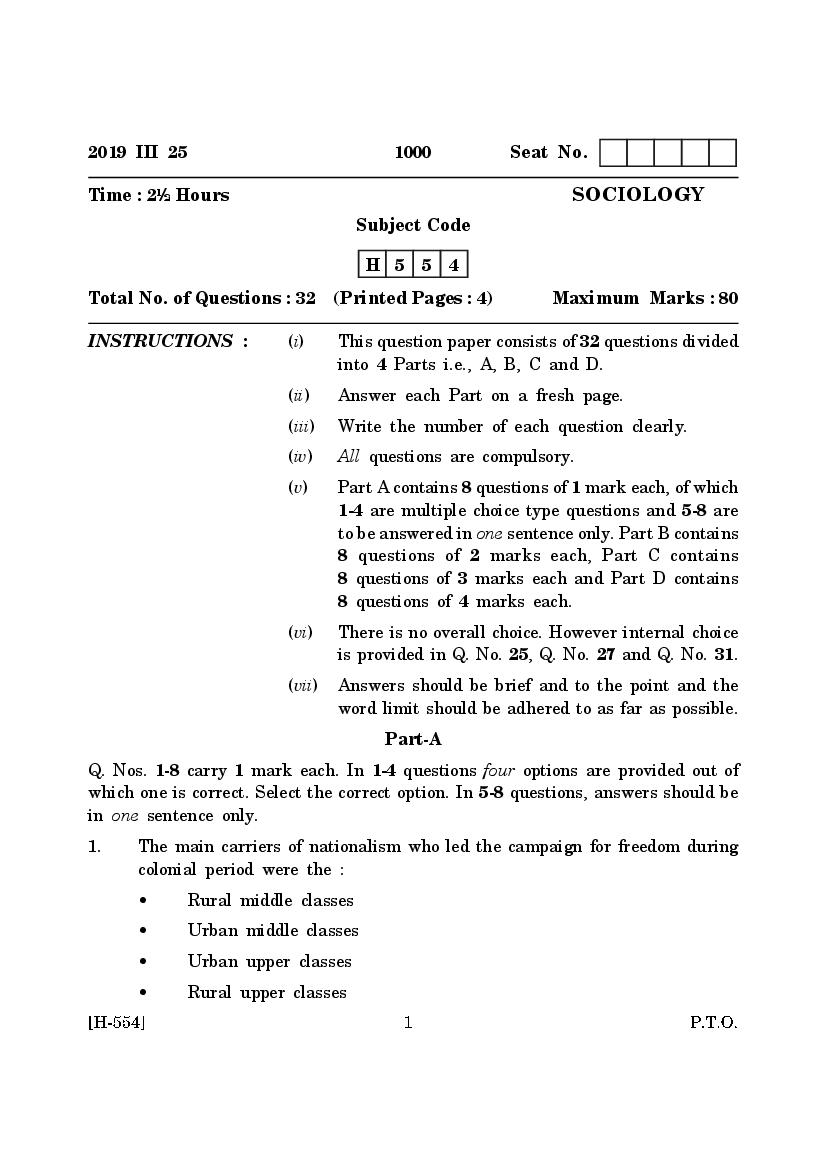
Time : 2½ Hours SOCIOLOGY
Subject Code
H 5 5 4
Total No. of Questions : 32 (Printed Pages : 4) Maximum Marks : 80
INSTRUCTIONS : (i) This question paper consists of 32 questions divided
into 4 Parts i.e., A, B, C and D.
(ii) Answer each Part on a fresh page.
(iii) Write the number of each question clearly.
(iv) All questions are compulsory.
(v) Part A contains 8 questions of 1 mark each, of which
1-4 are multiple choice type questions and 5-8 are
to be answered in one sentence only. Part B contains
8 questions of 2 marks each, Part C contains
8 questions of 3 marks each and Part D contains
8 questions of 4 marks each.
(vi) There is no overall choice. However internal choice
is provided in Q. No. 25, Q. No. 27 and Q. No. 31.
(vii) Answers should be brief and to the point and the
word limit should be adhered to as far as possible.
Part-A
Q. Nos. 1-8 carry 1 mark each. In 1-4 questions four options are provided out of
which one is correct. Select the correct option. In 5-8 questions, answers should be
in one sentence only.
1. The main carriers of nationalism who led the campaign for freedom during
colonial period were the :
• Rural middle classes
• Urban middle classes
• Urban upper classes
• Rural upper classes
Page 2
known as :
• Matrilocal family
• Extended family
• Nuclear family
• Patrilocal family
3. The orthodox members of the Hindu Community in Bengal formed an
organisation is called :
• Gram Sabha
• Lok Sabha
• Rajya Sabha
• Dharma Sabha
4. The traditional political system having its own council known as the ‘Durbar
Kur’ is found among the :
• Khasis
• Bhils
• Gonds
• Mundas
5. What is Social inequality ?
6. Name the broad arena which lies beyond the private domain but outside the
domain of both state and market.
7. Who invented the system of scientific management ?
8. Name the first modern mass media institution.
Part-B
Q. Nos. 9-16 are short answer type questions carrying 2 marks each. Answers to
them should normally not exceed 40 words.
9. Explain the factors responsible for famines.
Page 3
11. Explain any two dimensions of untouchability.
12. Explain any one advantage and disadvantage of the interview method.
13. “Colonialism led to considerable movement of the people from one part of the
country to another within India.” Explain.
14. State the negative impact of contract farming.
15. Write a note on Glocalisation of culture.
16. Explain any two theories of social movements.
Part-C
Q. Nos. 17-24 are also short answer type questions carrying 3 marks each. Answers
to them should normally not exceed 60 words.
17. Explain the Malthusian theory of Population Growth.
18. “The advent of colonialism produced major unheavals in the Indian Economy.”
Explain.
19. Write a note on Other Backward Classes.
20. Analyse survey as a sociological research method.
21. Explain the growth of industrialisation in independent India.
22. Explain the land reform laws passed after independence in India.
23. Elaborate the economic policy of liberalisation.
24. Write a note on Dalit Movement in India.
Part-D
Q. Nos. 25-32 are long answer type questions carrying 4 marks each. Answers
to them should normally not exceed 100 words. Internal choice is provided in
Q. No. 25, Q. No. 27 and Q. No. 31.
25. Analyse the factors responsible for declining sex-ratio in India.
Or
Analyse the Population Policy in India.
Page 4
27. Explain the role of social reformers in the 19th Century towards the struggle
for women’s equality and rights.
Or
Explain the state and non-state initiatives to address caste and tribe
discrimination.
28. Write a note on communalism in Indian context.
29. Critically evaluate the process of Sanskritisation in India.
30. Elaborate the powers and social welfare responsibilities of the Panchayats.
31. Explain the working conditions of workers in mining areas and the measures
adopted by the government.
Or
Explain the working of the contractor system in hiring of casual labour.
32. Analyse the impact of globalisation on print media.
Document Details
| Board / Org | Goa Board |
| Exam | Class 12 |
| Type | Question Paper |
| Pages | 4 |
| Updated | 22 Jul 2026 |