CUSAT CAT 2017 Question Paper Chemistry
Finished viewing? Save it for later —
Download CUSAT CAT 2017 Question Paper Chemistry (PDF · 22 pages)About CUSAT CAT 2017 Question Paper Chemistry
CUSAT CAT 2017 Question Paper Chemistry is available here for free download. Published by Cochin University for CUSAT Common Admission Test, this question paper can be viewed online or downloaded as a PDF (22 pages). Candidates preparing for CUSAT Common Admission Test can use CUSAT CAT 2017 Question Paper Chemistry to understand the exam pattern, the type of questions asked, and the overall difficulty level.
Frequently Asked Questions
How can I download CUSAT CAT 2017 Question Paper Chemistry?
Open this page and click the Download button to save CUSAT CAT 2017 Question Paper Chemistry as a PDF. It is completely free on AglaSem Docs.
Is CUSAT CAT 2017 Question Paper Chemistry free to download?
Yes. CUSAT CAT 2017 Question Paper Chemistry can be viewed online and downloaded as a PDF free of cost on AglaSem Docs.
How many pages does CUSAT CAT 2017 Question Paper Chemistry have?
CUSAT CAT 2017 Question Paper Chemistry contains 22 pages, which you can read online or download together as a single PDF.
Where can I find more CUSAT Common Admission Test study material?
You can find more CUSAT Common Admission Test question papers, sample papers, syllabus, and answer keys on AglaSem Docs.
CUSAT CAT 2017 Question Paper Chemistry – Text
Read the full text of this question paper below — useful to quickly search, copy and reference the content online without downloading the PDF.
📄 View text version (22 pages)
Page 1
(Final)
1. The correct order of electronegativity of hybridized orbitals is
(A) sp > sp2 > sp3 (B) sp < sp2 < sp3
(C) sp3 > sp > sp2 (D) sp3 < sp < sp2
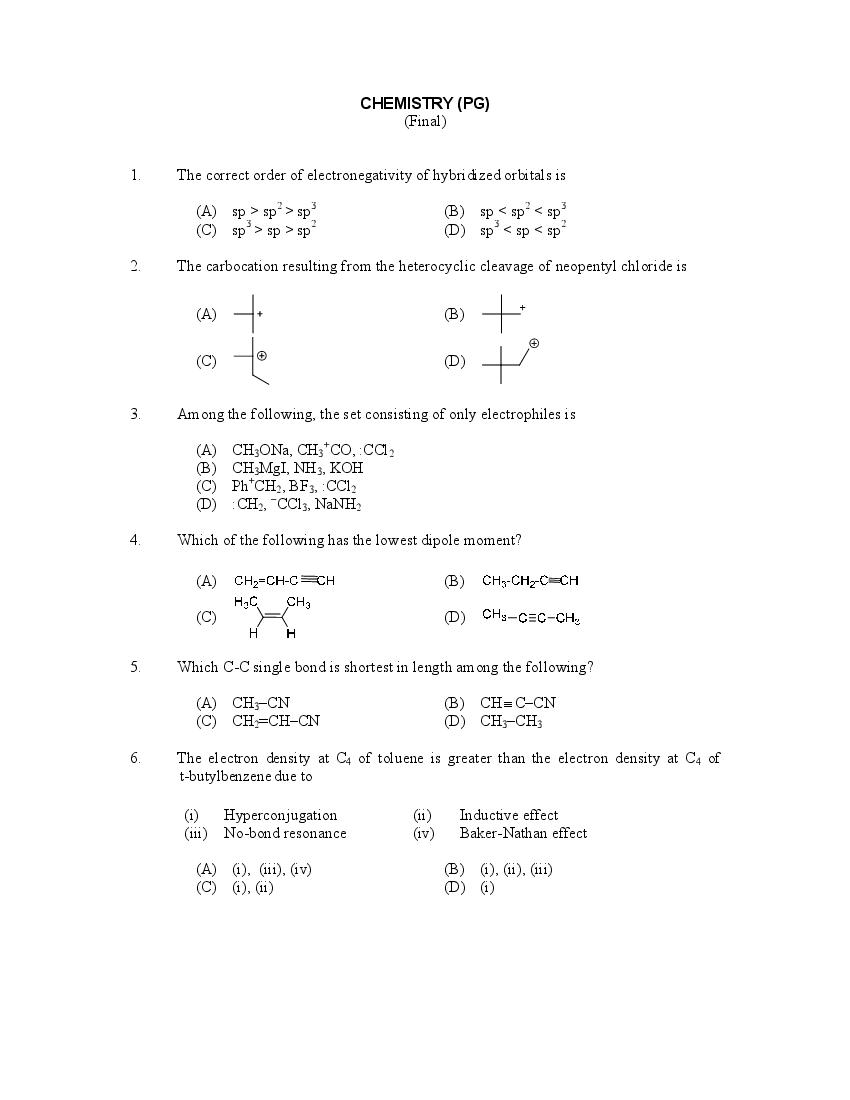
2. The carbocation resulting from the heterocyclic cleavage of neopentyl chloride is
(A) (B)
(C) (D)
3. Among the following, the set consisting of only electrophiles is
(A) CH3ONa, CH3+CO, :CCl2
(B) CH3MgI, NH3, KOH
(C) Ph+CH2, BF3, :CCl2
(D) :CH2, ‒CCl3, NaNH2
4. Which of the following has the lowest dipole moment?
(A) (B)
(C) (D)
5. Which C-C single bond is shortest in length among the following?
(A) CH3‒CN (B) CH C‒CN
(C) CH2=CH‒CN (D) CH3‒CH3
6. The electron density at C4 of toluene is greater than the electron density at C4 of
t-butylbenzene due to
(i) Hyperconjugation (ii) Inductive effect
(iii) No-bond resonance (iv) Baker-Nathan effect
(A) (i), (iii), (iv) (B) (i), (ii), (iii)
(C) (i), (ii) (D) (i)
Page 2
7. The increasing order of stability of following carbocations is
i ii iii iv
(A) ii < iii < i < iv (B) iii < ii < i < iv
(C) iv < ii < I < iii (D) i < iii < ii < iv
8. The product of the following reaction is
(A) (B)
(C) (D)
9. The compound (X) (C5H9Cl3) on hydrolysis with aq. NaOH gives a product Y which
on heating with sodalime gives an alkane (Z). The compound X is
Cl
Cl
(A) (B)
Cl
(C) (D)
10. The repeated Hofmann exhaustive methylation of 3,5-dimethylpiperidine followed by
the reaction with moist silver oxide and then heating to give an unsaturated
hydrocarbon (X). The more stable unsaturated hydrocarbon X is
(A) 2,4-Dimethyl-pent-1-ene
(B) 4-Methyl-hex-1,3-diene
(C) 2,4-Dimethyl-pent-1,3-diene
(D) 2,4-Dimethyl-pent-1,4-diene
11. The ozonolysis of hydrocarbon (A) gives 2,5-hexanedione as one of the products.
Hydrocarbon (A) may be
I. II. III. IV.
(A) I, II, III, IV (B) I, II, III
(C) I, III, IV (D) IV
Page 3
12. Kolbe’s electrolysis of sodium salt of adipic acid results in the formation of
(A) Butane (B) Cyclohexane
(C) Hexane (D) Cyclobutane
13. 2-Butyne on reduction with Na/liq. NH3 followed by Diels-Alder reaction with
butadiene gives
(A) (B)
(C) (D)
14. Which of the following alkenes will react fastest with H2 under catalytic
hydrogenation?
(A) (B)
H3C CH3
(C) (D)
H3C H
15. A hydrocarbon A contains 88.9% of C. It gives red ppt with ammoniacal cuprous
chloride and its isomer B reacts with bromine to form 1,4-dibromo-2-butene. The
compounds A and B respectively are
(A) (B)
(C) (D)
16. If the organic substance contains both nitrogen and sulphur, the SE gives blood red
coloration with FeCl3. The blood red coloration is due to
(A) Ferric thiocyanate (B) Sodium thiocyanate
(C) Ferric ferrocyanide (D) Sodium ferrocyanide
17. The IUPAC name for the following compound is
(A) 2-Cyano-5-oxocyclopentanecarbaldehyde
(B) 3-Cyano-2-formylcyclopentan-1-one
(C) 2-Formyl-3-oxocyclopentanecarbonitrile
(D) 2,3-Dioxocyclopentanecarbonitrile
Page 4
18. The number of sp-hybridised carbon atoms in the molecule
(A) Two (B) Three
(C) Four (D) One
19. The compound with a degree of unsaturation of three has five carbon atoms, one
nitrogen atom and one oxygen atom in a molecule. The number of hydrogen atoms
per molecule is
(A) 4 (B) 5
(C) 6 (D) 7
20. The acetal in the following is
(A) (B)
(C) (D)
21. Alkanediones and alkanedials have the general formula
(A) CnH2nO (B) CnH2nO2
(C) CnH2n-2O2 (D) CnH2n+2O2
22. Which of the following will give a satisfactory yield of ketone on reaction with a
Grignard reagent and subsequent hydrolysis?
(A) An aldehyde (B) Acarboxylic acid
(C) An ester (D) A nitrile
23. The product Y in the reaction is
(A) (B)
(C) (D)
24. Active species in Fehling’s solution is
(A) Sodium ammonium tartarate (B) Cuprous ion
(C) Sulphate ion (D) Cupric ion
Page 5
25. Which of the following will not respond positively to the iodoform test?
(A) CH3CHOHCOOH (B) CH3COCOOH
(C) ICH2COCH2CH3 (D)
26. In the following reaction, the product B is mainly
(A) (B)
(C) (D)
27. In Cannizzaro’s reaction, the intermediate that will be the best hydride donor is
(A) (B)
(C) (D)
28. Which of the following structures is enantiomeric with the molecule (a) given below?
(a)
(A) (B)
(C) (D)
Page 6
29. Which of the following reagents can be used to oxidize primary alcohols to
aldehydes?
i. CrO3 in anhydrous medium
ii. KMnO4 in acidic medium
iii. Pyridinium chlorochromate
iv. Heat in the presence of Cu at 573K
(A) i, ii, iii, iv (B) i, iii, iv
(C) i, ii, iii (D) ii, iii, iv
30. Hoffmann bromamide degradation reaction is shown by
(A) ArNH2 (B) ArCONH2
(C) ArNO2 (D) ArCH2NH2
31. Which of the following amines can be prepared by Gabriel Synthesis?
(i) Isobutylamine (ii) 2-phenylethylamine
(iii) N-methylbenzylamine (iv) Aniline
(A) (i), (ii) (B) (i), (ii), (iii)
(C) (iii), (iv) (D) (iv)
32. Which of the following reactions belong to electrophilic aromatic substitution?
(i) Bromination of acetanilide
(ii) Coupling reaction of aryldiazonium salts
(iii) Diazotization of aniline
(iv) Acylation of aniline
(A) (i), (ii) (B) (i), (ii), (iii), (iv)
(C) (iii), (iv) (D) (i), (ii), (iii)
33. In nucleic acids, between which carbon atoms of pentose sugars of nucleotides are
linked?
(A) 5' and 3' (B) 1' and 5'
(C) 5' and 5' (D) 3' and 3'
34. Which of the following B group vitamins can be stored in our body?
(A) Vitamin B1 (B) Vitamin B2
(C) Vitamin B6 (D) Vitamin B12
Page 7
35. Which of the following reactions of glucose can be explained only by its cyclic
structure?
(A) Glucose forms pentacetate
(B) Glucose reacts with hydroxylamine to form an oxime
(C) Pentacetate of glucose doesnot react with hydroxylamine
(D) Glucose is oxidized by nitric acid to gluconic acid
36. In fibrous proteins, polypeptide chains are held together by
(i) Van der Waals forces
(ii) Disulphide linkage
(iii) Electrostatic forces of attraction
(iv) Hydrogen bonds
(A) (i), (ii), (iii) (B) (ii), (iv)
(C) (i), (iv) (D) (i), (ii), (iii), (iv)
37. Which of the following are not used as food preservatives?
(i) Table salt
(ii) Sodium hydrogen carbonate
(iii) Cane sugar
(iv) Benzoic acid
(A) (i), (ii), (iii), (iv) (B) (i), (ii)
(C) (i), (iii) (D) (i), (iv)
38. The component of blood which functions for blood clotting is
(A) Globulins (B) Albumins
(C) Fibrinogen (D) WBC
39. Stephen reduction converts cyanides to
(A) Amines (B) Aldehydes
(C) Ketones (D) Acids
40. Nitrous acid has no action on
(A) C6H5CONH2 (B) CH3CH2NO2
(C) C6H5N(CH3)2 (D) CH3CH2COOH
41. The product of reaction of alcoholic silver nitrite with ethyl bromide is
(A) Ethane (B) Nitroethane
(C) Ethyl nitrile (D) Ethyl isocyanide
Page 8
42. Compound C4H10O reacts with sodium metal to liberate hydrogen gas. It does not
react with bromine in CS2 but produces immediate cloudiness with Lucas reagent.
The compound
(A) n-butyl alcohol (B) sec-butyl alcohol
(C) iso-butyl alcohol (D) tert-butyl alcohol
43. Compound A C4H8Cl2 is hydrolyzed to compound B, C4H8O which gives an oxime
and a negative Tollen’s test. The structure of A is
(A) CH3CH2CH2CHCl2 (B) CH3CH2C(Cl2)CH3
(C) CH3CH(Cl)CH(Cl)CH3 (D) CH3CH(Cl)CH2CH2Cl
44. Which of the following does not obey Huckel rule?
(A) (B)
(C) (D)
45. Glycerol on heating with excess of HI gives
(A) Allyl iodide (B) 1,2,3-triodopropane
(C) Propene (D) Isopropyl iodide
46. The geometrical isomerism is shown by
(A) (B)
(C) (D)
47. Correct configuration of the following is
(A) 1S, 2S (B) 1S, 2R
(C) 1R, 2S (D) 1R, 2R
Page 9
48. The secondry structure of a protein refers to
(A) α-helical backbone
(B) Hydrophobic interactions
(C) Sequence of α-amino acids
(D) Fixed configuration of the polypeptide backbone
49. The relative resonance energies of thiophene, pyrrole and furan
(A) Furan > Pyrrole > Thiophene
(B) Pyrrole > Furan > Thiophene
(C) Thiophene > Pyrrole > Furan
(D) Thiophene > Furan > Pyrrole
50. The major product X in the following reaction is
(A) (B)
(C) (D) Mixture of (A) and (B)
51. KMnO4 reacts with oxalic acid according to the equation
2MnO4‒ + 5C2O42‒ + 16H+ 2Mn2+ + 10CO2 + 8H2O
So, 20 mL of 0.1 M KMnO4 requires
(A) 20 mL of 0.1 M oxalic acid (B) 50 mL of 0.1 M oxalic acid
(C) 20 mL of 0.5 M oxalic acid (D) 50 mL of 0.5 M oxalic acid
52. 2.5 g of an iron compound upon suitable treatment gave 0.358 g of ferric oxide. The
percentage of iron in the compound is (Atomic masses: Fe = 55.85; O = 16)
(A) 10.01 (B) 20.02
(C) 15.01 (D) 2.5
53. The amount (in grams) of potassium dichromate (MW = 294) present in 200 mL of
0.25M aqueous solution is
(A) 147 (B) 14.7
(C) 1.47 (D) 0.147
Page 10
54. Ilmenite, cassiterite and hematite are, respectively, the ores of
(A) iron, tin and titanium (B) tin, titanium and iron
(C) titanium, iron and tin (D) titanium, tin and iron
55. An aqueous solution of a compound MCl2 (where M is first row transition metal)
produces bright red precipitate with ethanolic solution of dimethylglyoxime. The
compound is
(A) FeCl2 (B) CoCl2
(C) NiCl2 (D) CuCl2
56. From a solution mixture of Zn2+, Cd2+, Mn2+ and Hg2+ ions, H2S in acidic medium
will not precipitate
(A) Hg2+ and Cd2+ (B) Mn2+ and Cd2+
(C) Zn2+ and Cd2+ (D) Zn2+ and Mn2+
57. Sodium salts of pseudohalogens, X and Y, give colourless solutions in water.
Solution of X produces intense red colour with Fe3+ ions, while solution of Y gives
intense blue colour with ferrous and ferric ion mixture. The pseudohalides X and Y
are respectively
(A) CN‒ and SCN‒ (B) N3‒ and SCN‒
(C) N3‒ and CN‒ (D) SCN‒ and CN‒
58. The molecular shapes of CF4 and SF4 are, respectively
(A) tetrahedral and tetrahedral
(B) tetrahedral and square planar
(C) square planar and square planar
(D) tetrahedral and see-saw
59. The number of 90o and 180o F-P-F bonds in PF5 are respectively
(A) 6 and 1 (B) 6 and 2
(C) 3 and 1 (D) 1 and 1
60. Identify the pair which has the identical number of lone pairs
(A) XeF4, ClF3 (B) XeF4 , XeO2F2
(C) XeO4, ICl4‒ (D) XeO4, ClF3
61. Among Ti(IV), Cr(III), Zn(II) and Cu(II) ions, the species which have partially filled
d-orbitals are
(A) Cr(III), Zn(II) (B) Ti(IV), Zn(II)
(C) Cr(III), Cu(II) (D) Ti(IV), Cu(II)
Page 11
62. Separation of lanthanide ions, Lu3+, Yb3+, Dy3+ and Eu3+ can be effected by using a
cation exchange resin using an appropriate eluent. The order in which the ions will be
separated is
(A) Lu3+, Yb3+ , Dy3+, Eu3+ (B) Eu3+, Dy3+ , Yb3+, Lu3+
(C) Yb3+ , Dy3+, Eu3+, Lu3+ (D) Dy3+, Yb3+ , Lu3+, Eu3+
63. The pair of lanthanides having the highest third ionization energy is
(A) Eu, Gd (B) Eu,Yb
(C) Dy, Yb (D) Yb, Lu
64. The order of Lewis acidity of boron halides is
(A) BF3 < BCl3 < BBr3 (B) BCl3 < BF3 < BBr3
(C) BBr3 < BCl3 < BF3 (D) BF3 < BBr3 < BCl3
65. The reaction of BCl3 with NH4Cl at 140○C followed by treatment with NaBH4 gives
(A) Cl3B3N3H3 (B) B3N3H6
(C) B3N3H3 (D) B3N3H12
66. In the following reactions
(i) Cl‒ + nH2O [Cl(H2O)n]‒
(ii) Fe2+ + 6 H2O [Fe(H2O)6]2+
Water behaves as
(A) an acid in both (i) and (ii)
(B) a base in both (i) and (ii)
(C) an acid in (i) and a base in (ii)
(D) a base in (i) and an acid in (ii)
67. Ozone in the upper atmosphere protects life on earth
(A) due to its diamagnetic nature
(B) due to its blue colour
(C) due to absorption of radiation of λ = 255 nm
(D) by destroying chlorofluorocarbons
68. Identify the statement which is not true for diborane
(A) It contains two bridging-and four terminal hydrogens
(B) All the B-H bonds are of equal length
(C) The bridging and terminal hydrogens are in mutually perpendicular plane
(D) Diborane is very air sensitive
Page 12
69. Metal-metal quadruple bonds are known to exist in
(A) Fe3(CO)12 (B) Co2(CO)8
(C) K2Re2Cl8 (D) Cu2(CH3COO)4
70. The reactions of water with CaC2 and Al4C3 yield
(A) methane in both
(B) ethyne in both
(C) methane in the first and ethyne in the second
(D) ethyne in the first and methane in the second
71. Among the pentahalides of group 15, the one which is unlikely to exist due to “inert
pair” effect is
(A) PCl5 (B) AsCl5
(C) SbCl5 (D) BiCl5
72. The first ionization energy increases in the sequence
(A) Be < B < C <N (B) Be > B < C < N
(C) Be > B > C < N (D) Be > B > C > N
73. When a double bond is formed between two atoms, one of the bonds is a sigma bond
and the other is a pi-bond. The pi-bond is created by the overlap of
(A) sp3 hybrid orbitals (B) sp2 hybrid orbitals
(C) sp hybrid orbitals (D) p-orbitals
74. Among the pairs of elements (i) Sc, Y, (ii) Zr, Hf (iii) La, Lu and (iv) Mo, W, the
pairs having almost the same covalent radii are
(A) (i), (ii) and (iii) (B) (i), (ii) and (iv)
(C) (ii) and (iii) (D) (ii), and (iv)
75. The O‒O stretching frequencies were observed at 810, 1100 and 1580 cm‒1 for the
three dioxygen species – O2, O2‒ and O22‒, but not necessarily in the same order. The
correct correlation between them is
(A) O2, 810; O2‒ , 1100 ; O22‒, 1580 (B) O2, 1100; O2‒ , 810 ; O22‒, 1580
(C) O2, 1580; O2‒ , 1100 ; O22‒, 810 (D) O2, 810; O2‒ , 1580 ; O22‒, 1100
76. The magnetic properties of O2 and O22‒ are, respectively
(A) paramagnetic and paramagnetic
(B) diamagnetic and diamagnetic
(C) diamagnetic and paramagnetic
(D) paramagnetic and diamagnetic
Page 13
77. The type of interaction that holds layers of graphite together is
(A) covalent bonding (B) van der Waals forces
(C) hydrogen bonding (D) ionic bonding
78. Consider the following characteristics of the blue solution of sodium in liquid
ammonia
(i) diamagnetic (ii) reducing in nature (iii) conducts electricity
Which of them are true?
(A) (i), (ii) and (iii) (B) (i) and (ii)
(C) (i) and (iii) (D) (ii) and (iii)
79. For tetrahedral complexes which always exhibit high spin states, the maximum CFSE
is
(A) ‒8Dq (B) ‒12 Dq
(C) ‒16Dq (D) ‒6 Dq
80. In general, the magnetic susceptibilities of paramagnetic complexes varies with
temperature as
(A) T2 (B) T
(C) T‒2 (D) T‒1
81. The structures of the complexes, [Cu(NH3)4](ClO4)2 and [Cu(NH3)4](ClO4) are,
respectively
(A) square planar and tetrahedral
(B) square planar and square planar
(C) octahedral and square pyramidal
(D) octahedral and trigonal bipyramidal
82. The d-electron configuration of [Fe(CN)6]3‒ ion and its magnetic moment in B.M. are
(A) d5 and 5(5 + 2) (B) d5 and 1(1 + 2)
(C) d5 and 5(5 + 1) (D) d5 and 1(1 + 1)
83. Among V(CO)6 , Cr(CO)6 , Fe(CO)5 and Ni(CO)4, the compounds which obey EAN
rule are
(A) V(CO)6, Cr(CO)6 and Fe(CO)5 (B) V(CO)6 , Fe(CO)5 and Ni(CO)4
(C) Cr(CO)6, Fe(CO)5 and Ni(CO)4 (D) only V(CO)6 and Cr(CO)6
84. In the compounds, MeCo(CO)4 and NaCo(CO)4, the formal oxidation number and the
coordination number of Co are respectively:
(A) +1, 5 and +1, 5 (B) +1, 4 and +1, 4
(C) +1, 5 and ‒1, 4 (D) ‒1, 5 and +1, 4
Page 14
85. The true statement about [Cu(NH3)6]2+ ion is
(A) all the Cu-N distances are equal
(B) all the Cu-N distances are unequal
(C) the equatorial bonds are longer than the axial bonds
(D) the equatorial bonds are shorter than the axial bonds
86. The octahedral crystal field splitting (Δo) of d orbital energies of the following metal
ions decreases in the order
(A) Co2+ > Co3+ > Rh3+ (B) Rh3+ > Co3+ > Co2+
(C) Rh3+ > Co2+ > Co3+ (D) Co3+ > Co2+ > Rh3+
87. Ignoring the pairing energy, the CFSE of an octahedral high spin Co2+ complex is
(A) –20Dq (B) +20Dq
(C) +8Dq (D) ‒8Dq
88. The crystal field splitting energy Δo and pairing energy, P values (in cm‒1) of
octahedral energy complexes of Fe2+ are : Δo= 10400 for 6 H2O and 33000 for 6 CN‒ ;
P = 17600.
Then the spin states of the complexes would be
(A) both high spin
(B) both low spin
(C) high spin aqua complex and low spin cyanido complex
(D) low spin aqua complex and high spin cyanido complex
89. Ni2+(aq)+ 3 en(aq) [Ni(en)3]2+(aq)
Ni2+(aq)+ 6 NH3(aq) [Ni(NH3)6]2+(aq)
The equilibrium constant for the formation of [Ni(en)3]2+(aq) (where en =
ethylenediamine) is about 1010 times higher than that for [Ni(NH3)6]2+(aq). The
primary explanation for this large difference is
(A) Jahn-Teller effect (B) Macrocyclic effect
(C) Chelate effect (D) Crystal field effect
90. Among CN‒, Cl‒, CO and CH3‒, the ligand with only sigma bonding character is
(A) CN‒ (B) Cl‒
(C) CO (D) CH3‒
91. Consider the complexes, [Co(NH3)5NO2]Cl2 and [Co(NH3)5(ONO)]Cl2. The type of
isomerism exhibited by the complexes is
(A) coordination isomerism (B) ionization isomerism
(C) linkage isomerism (D) optical isomerism
Page 15
92. An Au-Cu alloys crystallizes in a cubic lattice with gold atoms occupying the corners
of the cube and the copper atoms at the centers of the cubic faces. The empirical
formula of the alloy is
(A) Au8Cu6 (B) AuCu3
(C) Au2Cu3 (D) Au3Cu
93. The lattice energies of potassium halides follow the order
(A) KF < KCl < KBr < KI (B) KI < KCl < KF < KBr
(C) KF < KBr < KCl < KI (D) KI < KBr < KCl < KF
94. Band theory predicts magnesium to be an insulator, but in practice it is a good
conductor. This is due to
(A) presence of filled 3s orbital
(B) overlap of filled 2p and filled 3s orbitals
(C) overlap of filled 3s and empty 3p orbital
(D) presence of unfilled 3p orbital
95. The electrical conductivity of a metal
(A) increases with increasing temperature
(B) decreases with increasing temperature
(C) is independent of temperature
(D) shows oscillatory behaviour with temperature
96. In ‘carbon-dating’ applications of radioisotopes, 14C emits
(A) α particle (B) β particle
(C) γ radiation (D) positrons
97. A β-particle followed by an α-particle emission from , the number of neutrons
present in the daughter nucleus is
(A) 130 (B) 128
(C) 127 (D) 129
98. The correct set of biologically essential elements is
(A) Fe, Cu, Zn, Ag (B) Fe, Cu, Zn, Mg
(C) Cu, Mn, Co, Pt (D) Mg, Fe, Co, Ti
99. The enzyme involved in hydration of metabolic carbon dioxide and the metal present
in it are
(A) cytochrome c, Fe (B) hemocyanin, Cu
(C) carboxypeptidase, Zn (D) carbonic anhydrase, Zn
Page 16
100. Redox enzymes involve metal ions which could exist in two different stable oxidation
states. Which of the following is likely to be found in the redox enzyme systems?
(A) Ca, Zn (B) Na, Mg
(C) Al, Ga (D) Cu, Fe
101. The total number of fundamental movements for a molecule consisting of n atoms
(A) 3n + 6 (B) 3n – 5
(C) 3n (D) 3n + 5
2
102. C2 = ?
(A) E (B) C2
(C) σv (D) σvσv'
103. Principal axis means
(A) X axis
(B) Z axis
(C) The rotational axis with the highest order
(D) Y axis
104. The order of the point group C2 is
(A) 2 (B) 0
(C) 1 (D) 3
105. Choose the molecule not belonging to point group C∞v
(A) HCl (B) OCS
(C) HCN (D) CO2
106. Match the following
Molecule Point group
(I) CH3Cl (i) D∞h
(II) H2O (ii) C∞v
(III) H2 (iii) C2V
(IV) HCl (iv) C3V
(A) (I) ‒ (iv), (II) ‒ (iii), (III) ‒ (i), (IV) ‒ (ii)
(B) (I) ‒ (iii), (II) ‒ (ii), (III) ‒ (i), (IV) ‒ (iv)
(C) (I) ‒ (iv), (II) ‒ (iii), (III) ‒ (ii), (IV) ‒ (i)
(D) (I) ‒ (ii), (II) ‒ (iii), (III) ‒ (iv), (IV) ‒ (i)
Page 17
107. Match the following
Region λ(nm)
(I) UV (i) 1011
(II) Visible (ii) 1,000 – 10, 000
(III) IR (iii) 400 - 700
(IV) Radiowave (iv) 200 – 350
(A) (I) – (ii), (II) – (I), (III) – (iv), (IV) – (iii)
(B) (I) – (iv), (II) – (iii), (III) – (ii), (IV) – (i)
(C) (I) – (i), (II) – (iv), (III) – (ii), (IV) – (iii)
(D) (I) – (iii), (II) – (ii), (III) – (iv), (IV) – (i)
108. Unit of reaction rate constant, k for a zero order reaction
(A) dm3 mol s‒1 (B) s‒1
(C) dm3 mol‒1 (D) dm‒3.mol s‒1
109. A harmonic oscillator obeys
(A) Hooke’s law (B) Boyle’s law
(C) Dalton’s law (D) First law of thermodynamics
110. If any two rows or columns are the same, the value of the determinant is
(A) One (B) Zero
(C) Two (D) Half
111. CH4 belongs to the point group
(A) Td (B) D2d
(C) C3v (D) C2h
112. The number of translational, rotational and vibrational degrees of freedom of HCl are
respectively
(A) 3, 3, 3 (B) 3, 2, 4
(C) 3, 2, 1 (D) 1, 1, 1
113. The selection rule in the rigid-rotator approximation is
(A) ΔJ = ± 1 (B) ΔJ = + 2
(C) ΔJ = 0 (D) ΔJ = ± 2
114. In the Beer – Lambert law, = = Қcl. The units of Қ are
(A) m2 (B) m2.mol‒1
(C) mol‒1 (D) Dimensionless
Page 18
115. Triple point of water
(A) 273.16 K (B) 760 K
(C) 0 K (D) 100 K
116. Spherical top molecule
(A) IA = IB = IC (B) IA ≠ IB ≠ I
(C) IB = IC ≠ IA (D) IB ≠ IA = IC
117. Which is used as a catalyst for the hydrogenation of oils?
(A) Ni (B) ZnO
(C) C (D) H2SO4
118. Choose the polar molecule(s)
(I) OCS (II) H2O (III) CO2 (IV) N2
(A) (I) and (II) (B) (III) and (IV)
(C) (III) only (D) (IV) only
119. Choose the molecule not having center of inversion
(A) CO2 (B) Benzene
(C) Regular octahedron (D) H2O
120. de Broglie relation is
(A) p = (B) p =
(C) p = hλ (D) p =
were p is the linear momentum
121. Match the following
Quantum number Function
(I) Principal (i) Governs the axial angular momentum of the electron
(II) Orbital (ii) Governs the direction of an orbital
(III Magnetic (iii) Governs the shape of an orbital
(IV) Spin (iv) Governs the energy of the orbital
(A) (I) – (iv), (II) – (iii), (III) – (ii), (IV) – (i)
(B) (I) – (iv), (II) – (i), (III) – (ii), (IV) – (iii)
(C) (I) – (ii), (II) – (iii), (III) – (iv), (IV) – (i)
(D) (I) – (iii), (II) – (i), (III) – (iv), (IV) – (ii)
Page 19
122. Match the following
Characteristic Properties Instrumental Method
(I) Electrical resistance (i) Isotope dilution method
(II) Electrical charge (ii) Kinetic method
(III) Rate of the reaction (iii) Coulometery
(IV) Radioactivity (iv) Conductometry
(A) (I) – (iv), (II) – (iii), (III) – (ii), (IV) – (i)
(B) (I) – (iii), (II) – (i), (III) – (iv), (IV) – (ii)
(C) (I) – (ii), (II) – (iii), (III) – (iv), (IV) – (i)
(D) (I) – (iv), (II) – (ii), (III) – (i), (IV) – (iii)
123. Molar absorptivity is defined as
(A) (B) Abc
1
(C) (D)
T
where A is absorbance, T is transmittance, b is path length and c is concentration
124. If the absorbance is 0.0510, then the percent transmittance is equal to
(A) 51 % (B) 11.1 %
(C) 88.9 % (D) 9.45 %
125. C = O Stretching frequency region is
(A) 1640 – 1780 cm‒1 (B) 2850 – 2960 cm‒1
(C) 1350 – 1420 cm‒1 (D) 3590 – 3650 cm‒1
126. For a spontaneous reaction, ΔG must be
(A) Negative (B) Positive
(C) Zero (D) Infinity
127. Choose the isotopes suitable for Mossbauer work
(I) 57F (II) 119Sn (III) 129I (IV) 99Ru
(A) I and II only (B) All the four
(C) None (D) IV only
128. For an adiabatic change ΔSsur is equal to
(A) 0 (B) <1
(C) ∞ (D) >1
Page 20
129. Ice has a residual entropy of ………….. JK‒1 mol‒1
(A) 15 (B) 1.0
(C) 0 (D) 100
130. Number of vibrational degrees of freedom for a methane molecule
(A) 10 (B) 9
(C) 15 (D) 1
131. What is the zero-point energy of simple harmonic oscillator?
(A) ωosc (B) ωosc
(C) ωosc (D) Zero
132. Number of infrared active normal modes of CO2
(A) 2 (B) 3
(C) 1 (D) None of the above
133. Choose the molecule(s) showing rotational Raman spectrum
(I) CH4 (II) SF6 (III) CH3 ‒ CH3 (IV) HCl
(A) (III) and (IV) (B) (I) and (II)
(C) (I) only (D) (II) only
134. An orthorhombic cell has the parameters, a = 0.82 nm, b = 0.94 nm, c = 0.75 nm. The
spacing of the (123) plane is
(A) 2.1 nm (B) 0.21 nm
(C) 0.11 nm (D) 0.44 nm
135. Which of the following is known as dry ice?
(A) Solid CO2 (B) Charcoal
(C) NH3 (D) H2O2
136. The root- mean- square velocity (RMS) is given as
(A) 3kT (B) 3kTm
(C) { }1/2 (D)
Page 21
137. ………….. region is the spectral region of rotation of polyatomic molecules.
(A) Visible (B) UV
(C) Microwave (D) IR
138. If number of protons and number of neutrons are even, then the nuclear spin quantum
number, I is equal to
(A) 0 (B) 1
(C) 2 (D) 3
139. Bucky ball is
(A) Pb (B) C60
(C) 13C (D) CH4
140. First one to use the term nanotechnology
(A) Sumio (B) Pauling
(C) Nario Taniguchi (D) Qurie
141. Number of significant figures in 0.0025
(A) 2 (B) 3
(C) 4 (D) 1
14h 2
142. The energy of a particle in a cubical box of length ‘a’ is given as . The
8ma 2
degeneracy associated with the level is
(A) 1 (B) 2
(C) 3 (D) 6
143. The number of radial nodes for 4f atomic orbital is
(A) 0 (B) 1
(C) 2 (D) 3
144. Which of the following properties does not depend on zeta potential?
(A) Electro osmosis (B) Electro phoresis
(C) Sedimentation (D) Donnan membrane equilibrium
145. Which of the following isotherms deals with multilayer adsorption?
(A) Gibbs (B) Langmuir
(C) BET (D) Freundlich
Page 22
146. Unimolecular surface catalysed gas phase reactions follow
(A) first order kinetics at all pressures
(B) first order kinetics at low pressures and zero order kinetics at high pressures
(C) zero order kinetics at all pressures
(D) zero order kinetics at low pressures and first order kinetics at high pressures
147. The absorbance of a solution is 1.0 at 540 nm. What percentage of radiation is
absorbed by the solution?
(A) 10 (B) 50
(C) 90 (D) 100
148. An aqueous solution of CuSO4 is electrolysed between 2 Pt electrodes. The reaction
at anode is
(A) oxidation of Cu (B) oxidation of H2O
(C) oxidation of sulphate ion (D) oxidation of H2
149. In Raman spectroscopy the radiation that is analysed is
(A) scattered (B) reflected
(C) transmitted (D) incident
150. Which of the following statements is not true?
(A) Specific conductance increases with concentration of a strong electrolyte
(B) Equivalent conductance increases with concentration of a strong
electrolyte
(C) Equivalent conductance decreases with concentration of a strong
electrolyte
(D) Equivalent conductance depends on ionic mobility
***
Document Details
| Board / Org | Cochin University |
| Exam | CUSAT Common Admission Test |
| Type | Question Paper |
| Pages | 22 |
| Updated | 22 Jul 2026 |