DUET Question Paper 2019 for M.Phil Ph.D Statistics
Finished viewing? Save it for later —
Download DUET Question Paper 2019 for M.Phil Ph.D Statistics (PDF · 16 pages)About DUET Question Paper 2019 for M.Phil Ph.D Statistics
DUET Question Paper 2019 for M.Phil Ph.D Statistics is available here for free download. Published by NTA for DUET, this question paper can be viewed online or downloaded as a PDF (16 pages). Candidates preparing for DUET can use DUET Question Paper 2019 for M.Phil Ph.D Statistics to understand the exam pattern, the type of questions asked, and the overall difficulty level.
Frequently Asked Questions
How can I download DUET Question Paper 2019 for M.Phil Ph.D Statistics?
Open this page and click the Download button to save DUET Question Paper 2019 for M.Phil Ph.D Statistics as a PDF. It is completely free on AglaSem Docs.
Is DUET Question Paper 2019 for M.Phil Ph.D Statistics free to download?
Yes. DUET Question Paper 2019 for M.Phil Ph.D Statistics can be viewed online and downloaded as a PDF free of cost on AglaSem Docs.
How many pages does DUET Question Paper 2019 for M.Phil Ph.D Statistics have?
DUET Question Paper 2019 for M.Phil Ph.D Statistics contains 16 pages, which you can read online or download together as a single PDF.
Where can I find more DUET study material?
You can find more DUET question papers, sample papers, syllabus, and answer keys on AglaSem Docs.
DUET Question Paper 2019 for M.Phil Ph.D Statistics – Text
Read the full text of this question paper below — useful to quickly search, copy and reference the content online without downloading the PDF.
📄 View text version (16 pages)
Page 1
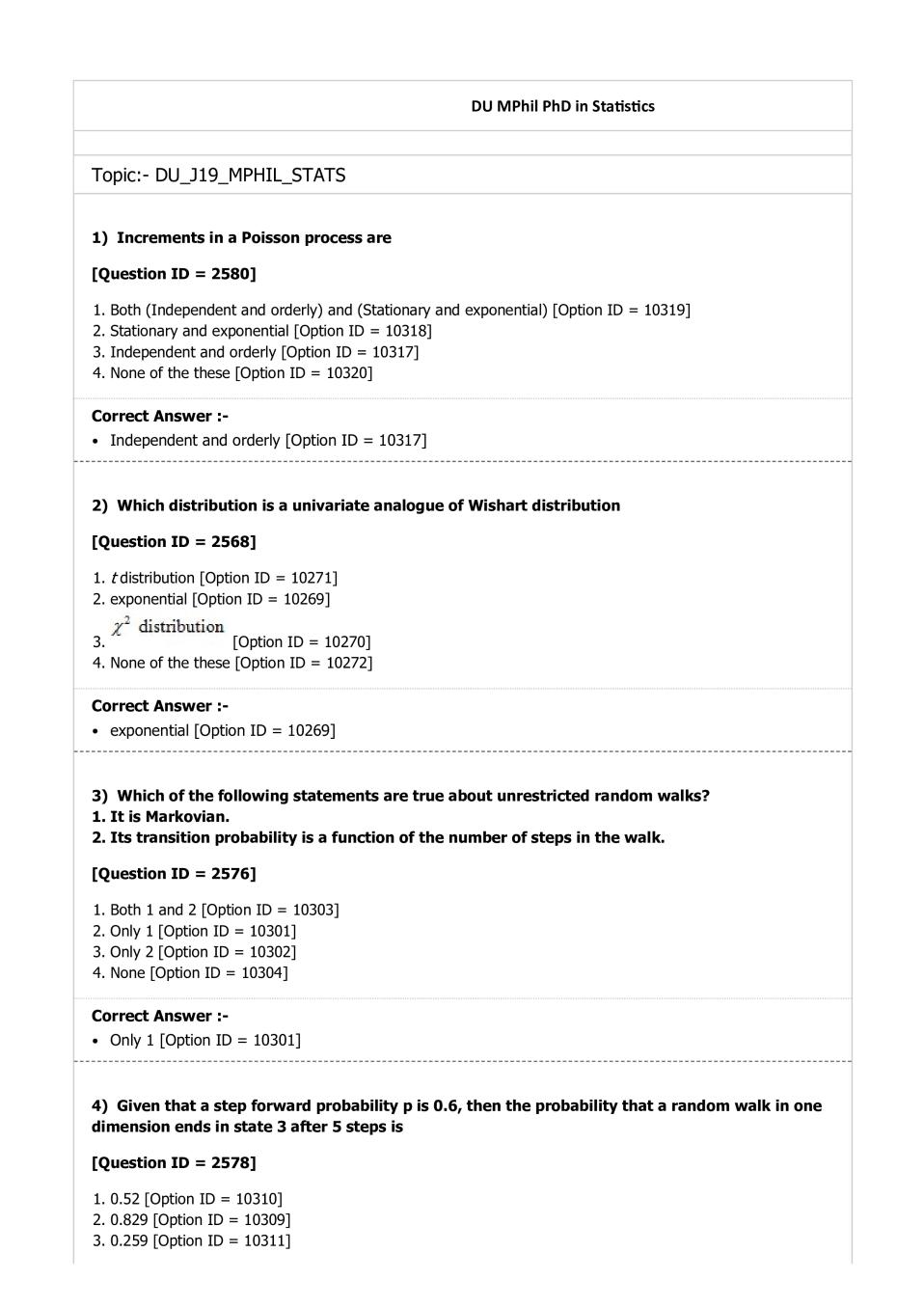
Topic:- DU_J19_MPHIL_STATS
1) Increments in a Poisson process are
[Question ID = 2580]
1. Both (Independent and orderly) and (Stationary and exponential) [Option ID = 10319]
2. Stationary and exponential [Option ID = 10318]
3. Independent and orderly [Option ID = 10317]
4. None of the these [Option ID = 10320]
Independent and orderly [Option ID = 10317]
2) Which distribution is a univariate analogue of Wishart distribution
[Question ID = 2568]
t
1. distribution [Option ID = 10271]
2. exponential [Option ID = 10269]
3. [Option ID = 10270]
4. None of the these [Option ID = 10272]
exponential [Option ID = 10269]
3) Which of the following statements are true about unrestricted random walks?
1. It is Markovian.
2. Its transition probability is a function of the number of steps in the walk.
[Question ID = 2576]
1. Both 1 and 2 [Option ID = 10303]
2. Only 1 [Option ID = 10301]
3. Only 2 [Option ID = 10302]
4. None [Option ID = 10304]
Only 1 [Option ID = 10301]
4) Given that a step forward probability p is 0.6, then the probability that a random walk in one
dimension ends in state 3 after 5 steps is
[Question ID = 2578]
1. 0.52 [Option ID = 10310]
2. 0.829 [Option ID = 10309]
3. 0.259 [Option ID = 10311]
Page 2
0.829 [Option ID = 10309]
5) Net reproduction rate cannot be used as a measure of population growth since [Question ID
= 2584]
1. it gives an overestimate of the population [Option ID = 10333]
2. it gives an underestimate of the population [Option ID = 10334]
3. it is defined for female population only [Option ID = 10336]
4. it is defined for male population only [Option ID = 10335]
it gives an overestimate of the population [Option ID = 10333]
6) Let X1, X2, X3 be random observations from a population with mean M. Some estimators of M
are suggested below:
T1 = (X1 - 2X2), T2 = (2X2 – X3), T3 = (X1 + X2 +X3)/3, T4 = (X1 +3X2 +X3)/5
Which of the above estimators are unbiased? [Question ID = 2587]
1. T1 and T2 only [Option ID = 10345]
2. T1, T2, T3 and T4 [Option ID = 10348]
3. T3 and T4 only [Option ID = 10346]
4. T2, T3 and T4 only [Option ID = 10347]
T1 and T2 only [Option ID = 10345]
7) In a certain region the weather patterns have the following sequence. A day is described as
sunny (S) if the sun shines for more than 50% of daylight hours and cloudy (C) if the sun shines
for less than 50% of daylight hours. Data indicate that if it is cloudy one day then it is equally
likely to be cloudy or sunny on the next day, if it is sunny today then there is a probability 1/3
that it is cloudy and 2/3 that it is sunny on the next day. If it is cloudy today, then the probability
that it is cloudy in three days’ time is
[Question ID = 2579]
1. 43/108 [Option ID = 10315]
2. 29/72 [Option ID = 10314]
3. 29/108 [Option ID = 10316]
4. 43/72 [Option ID = 10313]
43/72 [Option ID = 10313]
8) A cohort life table records the survival experience of a group of individuals [Question ID =
2585]
1. for each year of age [Option ID = 10338]
2. for a short period of time [Option ID = 10337]
3. from birth till the death of last member of the group [Option ID = 10340]
4. for age intervals greater than 1 year [Option ID = 10339]
Page 3
9) Consider a 24 factorial experiment conducted in two blocks of size 8 each. If the contents of
one of the blocks are a, c, d, ab, acd, bd, bc, abcd, the confounded interaction is [Question ID =
2595]
1. BCD [Option ID = 10380]
2. ABD [Option ID = 10377]
3. ACD [Option ID = 10378]
4. ABC [Option ID = 10379]
ABD [Option ID = 10377]
10) In estimating a parameter θ, U is an unbiased estimator of θ and T is a sufficient statistic.
Consider the following statements:
1. E(U|T) is an unbiased estimator of θ which has a variance not exceeding the variance of U.
2. If T is completely sufficient, then E(U|T) is the unique UMVU estimator of θ.
Which of the above statements is/are correct? [Question ID = 2592]
1. 2 only [Option ID = 10366]
2. 1 only [Option ID = 10365]
3. Both 1 and 2 [Option ID = 10367]
4. Neither 1 nor 2 [Option ID = 10368]
1 only [Option ID = 10365]
11) In case of ‘exact identification’ of a simultaneous equation model, the structural coefficients
and the reduced form coefficients : [Question ID = 2571]
1. can not be determined uniquely. [Option ID = 10284]
2. are equal in number [Option ID = 10282]
3. are uncorrelated [Option ID = 10283]
4. are the same [Option ID = 10281]
are the same [Option ID = 10281]
12) Let X1, X2,…, Xn be a random sample of size n taken from the population, where pdf or pmf
is f(x, θ). An estimator T=T(X1, X2,…, Xn) is said to be sufficient for θ if
1. The conditional distribution of X1, X2,…, Xn given T, is independent of θ.
2. It contains all the information in the sample about the parameter θ.
Which of the above is/are correct? [Question ID = 2590]
1. 2 only [Option ID = 10358]
2. 1 only [Option ID = 10357]
3. Both 1 and 2 [Option ID = 10359]
4. Neither 1 nor 2 [Option ID = 10360]
1 only [Option ID = 10357]
13) The average number of samples required to declare a process out of statistical control, when
the probability of a sample point falling between the control limits is half, is [Question ID =
Page 4
1. 2 [Option ID = 10325]
2. 8 [Option ID = 10327]
3. 16 [Option ID = 10328]
4. 4 [Option ID = 10326]
2 [Option ID = 10325]
14) Non-sampling errors are caused due to:
1. Response errors
2. Non-responses
3. Sampling method
4. Processing of data code
Which of the above statements are correct? [Question ID = 2600]
1. 1, 2 and 4 only [Option ID = 10400]
2. 2, 3 and 4 only [Option ID = 10399]
3. 1 and 2 only [Option ID = 10397]
4. 1 and 4 only [Option ID = 10398]
1 and 2 only [Option ID = 10397]
15) For a two-way classified data with p levels of factor A, q levels of factor B and m
observations per cell, the degrees of freedom for error sum of squares is [Question ID = 2596]
1. [Option ID = 10381]
2. [Option ID = 10382]
3. [Option ID = 10383]
4. [Option ID = 10384]
[Option ID = 10381]
16)
[Question ID = 2554]
1. [Option ID = 10213]
2. [Option ID = 10214]
3. [Option ID = 10216]
Page 5
[Option ID = 10213]
17)
[Question ID = 2566]
1. [Option ID = 10261]
2. [Option ID = 10263]
3. [Option ID = 10264]
4. [Option ID = 10262]
[Option ID = 10261]
18)
[Question ID = 2556]
1. 1/6 [Option ID = 10223]
2. ½ [Option ID = 10221]
3. 1/3 [Option ID = 10222]
4. 1/9 [Option ID = 10224]
½ [Option ID = 10221]
19)
[Question ID = 2570]
1. another name for the Ordinary Least Square Estimator [Option ID = 10277]
Page 6
3. is used when the Ordinary Least Square Estimator is not consistent. [Option ID = 10280]
4. used when the Ordinary Least Square Estimator is biased but consistent [Option ID = 10279]
another name for the Ordinary Least Square Estimator [Option ID = 10277]
20)
[Question ID = 2567]
1. [Option ID = 10267]
2. [Option ID = 10265]
3. [Option ID = 10268]
4. [Option ID = 10266]
[Option ID = 10265]
21)
[Question ID = 2561]
1. Both 1 and 3 [Option ID = 10243]
2. Both 1 and 4 [Option ID = 10242]
3. Both 1 and 2 [Option ID = 10241]
Page 7
Both 1 and 2 [Option ID = 10241]
22)
[Question ID = 2558]
1. 1/3 [Option ID = 10231]
2. 2/5 [Option ID = 10232]
3. Does not exist [Option ID = 10229]
4. ½ [Option ID = 10230]
Does not exist [Option ID = 10229]
23)
[Question ID = 2597]
1. [Option ID = 10387]
2. [Option ID = 10388]
3. [Option ID = 10386]
4. [Option ID = 10385]
[Option ID = 10385]
24)
[Question ID = 2593]
1. [Option ID = 10371]
2. [Option ID = 10370]
3. [Option ID = 10372]
Page 8
[Option ID = 10369]
25)
[Question ID = 2572]
1. 2 [Option ID = 10285]
2. 1.78 [Option ID = 10288]
3. 1.5 [Option ID = 10286]
4. 1.28 [Option ID = 10287]
2 [Option ID = 10285]
26)
[Question ID = 2569]
1. is consistent but not unbiased [Option ID = 10274]
2. does not exist [Option ID = 10275]
3. does not depend on the nature of independent variables. [Option ID = 10276]
4. is still unbiased and consistent [Option ID = 10273]
is still unbiased and consistent [Option ID = 10273]
27)
[Question ID = 2588]
1. 2 and 3 only [Option ID = 10351]
2. 1, 2 and 3 [Option ID = 10349]
3. 1 and 2 only [Option ID = 10350]
4. 1 and 3 only [Option ID = 10352]
1, 2 and 3 [Option ID = 10349]
Page 9
[Question ID = 2577]
1. 0.26 [Option ID = 10307]
2. 0.01 [Option ID = 10305]
3. 0.04 [Option ID = 10308]
4. 0.45 [Option ID = 10306]
0.01 [Option ID = 10305]
29)
[Question ID = 2574]
1. consistent for b [Option ID = 10294]
2. needs an adjustment to be unbiased for b [Option ID = 10295]
3. needs an adjustment to be consistent for b [Option ID = 10296]
4. unbiased for b [Option ID = 10293]
unbiased for b [Option ID = 10293]
30)
[Question ID = 2559]
1. [Option ID = 10234]
2. [Option ID = 10235]
3. [Option ID = 10236]
4. [Option ID = 10233]
[Option ID = 10233]
Page 10
[Question ID = 2565]
1. [Option ID = 10259]
2. [Option ID = 10258]
3. [Option ID = 10257]
4. [Option ID = 10260]
[Option ID = 10257]
32)
[Question ID = 2560]
1. [Option ID = 10237]
2. [Option ID = 10238]
3. [Option ID = 10239]
4. None of these [Option ID = 10240]
[Option ID = 10237]
Page 11
[Question ID = 2551]
1. [Option ID = 10204]
2. [Option ID = 10201]
3. [Option ID = 10203]
4. [Option ID = 10202]
[Option ID = 10201]
34)
[Question ID = 2599]
1. an unbiased estimator of population mean [Option ID = 10394]
2. an unbiased estimator of population total [Option ID = 10395]
3. none of the above. [Option ID = 10396]
4. a biased estimator of population mean [Option ID = 10393]
a biased estimator of population mean [Option ID = 10393]
35)
[Question ID = 2555]
1. [Option ID = 10217]
2. [Option ID = 10218]
3. [Option ID = 10220]
4. [Option ID = 10219]
[Option ID = 10217]
36)
Page 12
1. [Option ID = 10289]
2. [Option ID = 10290]
3. [Option ID = 10291]
4. [Option ID = 10292]
[Option ID = 10289]
37)
[Question ID = 2564]
1. Exponential [Option ID = 10253]
2. Gamma [Option ID = 10254]
3. Pareto [Option ID = 10255]
4. None of the above [Option ID = 10256]
Exponential [Option ID = 10253]
38)
[Question ID = 2591]
1. UMVUE of 1/µ [Option ID = 10362]
2. UMVUE of P(X≤ µ) [Option ID = 10364]
3. UMVUE of µ [Option ID = 10361]
4. Unbiased for P(X≤ µ) but not a Minimum Variance Estimator [Option ID = 10363]
UMVUE of µ [Option ID = 10361]
39)
Page 13
1. et [Option ID = 10210]
2. e-2t [Option ID = 10211]
3. e-3t [Option ID = 10212]
4. e-t [Option ID = 10209]
e-t [Option ID = 10209]
40)
[Question ID = 2594]
1. [Option ID = 10376]
2. [Option ID = 10375]
3. [Option ID = 10373]
4. [Option ID = 10374]
[Option ID = 10373]
41)
[Question ID = 2557]
1. 30 [Option ID = 10226]
2. 74 [Option ID = 10228]
3. 37 [Option ID = 10227]
4. 25 [Option ID = 10225]
25 [Option ID = 10225]
42)
[Question ID = 2563]
1. [Option ID = 10251]
Page 14
3. [Option ID = 10249]
4. None of these [Option ID = 10252]
[Option ID = 10249]
43)
[Question ID = 2598]
1. depends on the values of the sample [Option ID = 10390]
2. depends on the size of the sample [Option ID = 10389]
3. none of these [Option ID = 10392]
4. does not depend on the size of the sample [Option ID = 10391]
depends on the size of the sample [Option ID = 10389]
44)
[Question ID = 2552]
1. 0.5 [Option ID = 10206]
2. 0.05 [Option ID = 10207]
3. 0.95 [Option ID = 10205]
4. 0.005 [Option ID = 10208]
0.95 [Option ID = 10205]
45) The OC function of a single sampling plan with N=1000, n=89, c=2, p=0.01 is [Question ID
= 2581]
1. 0.94 [Option ID = 10323]
2. 0.95 [Option ID = 10324]
3. 0.93 [Option ID = 10322]
4. 0.92 [Option ID = 10321]
0.92 [Option ID = 10321]
46) A mobile phone manufacturing company purchases phone batteries in lots of 1000 batteries
each. The lots are accepted up to quality level 0.05 and rejected at more than quality level 0.20.
Acceptance sampling plan is based on a sample of size 25 from each lot and the lot is accepted if
Page 15
consumer risk is [Question ID = 2583]
1. 0.025 [Option ID = 10329]
2. 0.027 [Option ID = 10331]
3. 0.026 [Option ID = 10330]
4. 0.028 [Option ID = 10332]
0.025 [Option ID = 10329]
47) Customers arrive at a store according to a Poisson process of rate 4 per hour. Given that the
store opens at 9 a.m., what is the probability that exactly one customer has arrived by 9.30 a.m.
and a total of 5 have arrived by 11.30 a.m.? [Question ID = 2575]
1. 0.030 [Option ID = 10298]
2. 0.015 [Option ID = 10297]
3. 0.001 [Option ID = 10299]
4. 0.003 [Option ID = 10300]
0.015 [Option ID = 10297]
48) The statements below relate to a sufficient statistic based on ‘n’ random observations from a
uniparametric family of distributions.
1. A sufficient statistic is unique.
2. If T1 and T2 are sufficient statistics, then each is linear function of the other.
3. If T is sufficient and f(T) is a one-one function of T, then f(T) is also sufficient.
Which of the above statements is/are correct?
[Question ID = 2589]
1. 2 only [Option ID = 10354]
2. 1 only [Option ID = 10353]
3. 3 only [Option ID = 10355]
4. 1, 2 and 3 [Option ID = 10356]
1 only [Option ID = 10353]
49) The reliability of a parallel system can be improved by improving the reliability of its
[Question ID = 2586]
1. weakest component [Option ID = 10341]
2. none of these [Option ID = 10344]
3. best component [Option ID = 10342]
4. best as well as weakest component [Option ID = 10343]
weakest component [Option ID = 10341]
50) The cumulative distribution function of the smallest order statistic is given by [Question ID
= 2562]
Page 16
2. [Option ID = 10246]
3. [Option ID = 10245]
4. [Option ID = 10247]
[Option ID = 10245]
Document Details
| Board / Org | NTA |
| Exam | DUET |
| Type | Question Paper |
| Pages | 16 |
| Updated | 30 Apr 2026 |