NID DAT 2027 Sample Paper B.Des Prelims
Finished viewing? Save it for later —
Download NID DAT 2027 Sample Paper B.Des Prelims (PDF · 10 pages)About NID DAT 2027 Sample Paper B.Des Prelims
NID DAT 2027 Sample Paper B.Des Prelims is available here for free download. Published by NID for NID DAT, this sample paper can be viewed online or downloaded as a PDF (10 pages). Candidates preparing for NID DAT can use NID DAT 2027 Sample Paper B.Des Prelims to understand the exam pattern, the type of questions asked, and the overall difficulty level.
Frequently Asked Questions
How can I download NID DAT 2027 Sample Paper B.Des Prelims?
Open this page and click the Download button to save NID DAT 2027 Sample Paper B.Des Prelims as a PDF. It is completely free on AglaSem Docs.
Is NID DAT 2027 Sample Paper B.Des Prelims free to download?
Yes. NID DAT 2027 Sample Paper B.Des Prelims can be viewed online and downloaded as a PDF free of cost on AglaSem Docs.
How many pages does NID DAT 2027 Sample Paper B.Des Prelims have?
NID DAT 2027 Sample Paper B.Des Prelims contains 10 pages, which you can read online or download together as a single PDF.
Where can I find more NID DAT study material?
You can find more NID DAT question papers, sample papers, syllabus, and answer keys on AglaSem Docs.
NID DAT 2027 Sample Paper B.Des Prelims – Text
Read the full text of this sample paper below — useful to quickly search, copy and reference the content online without downloading the PDF.
📄 View text version (10 pages)
Page 1
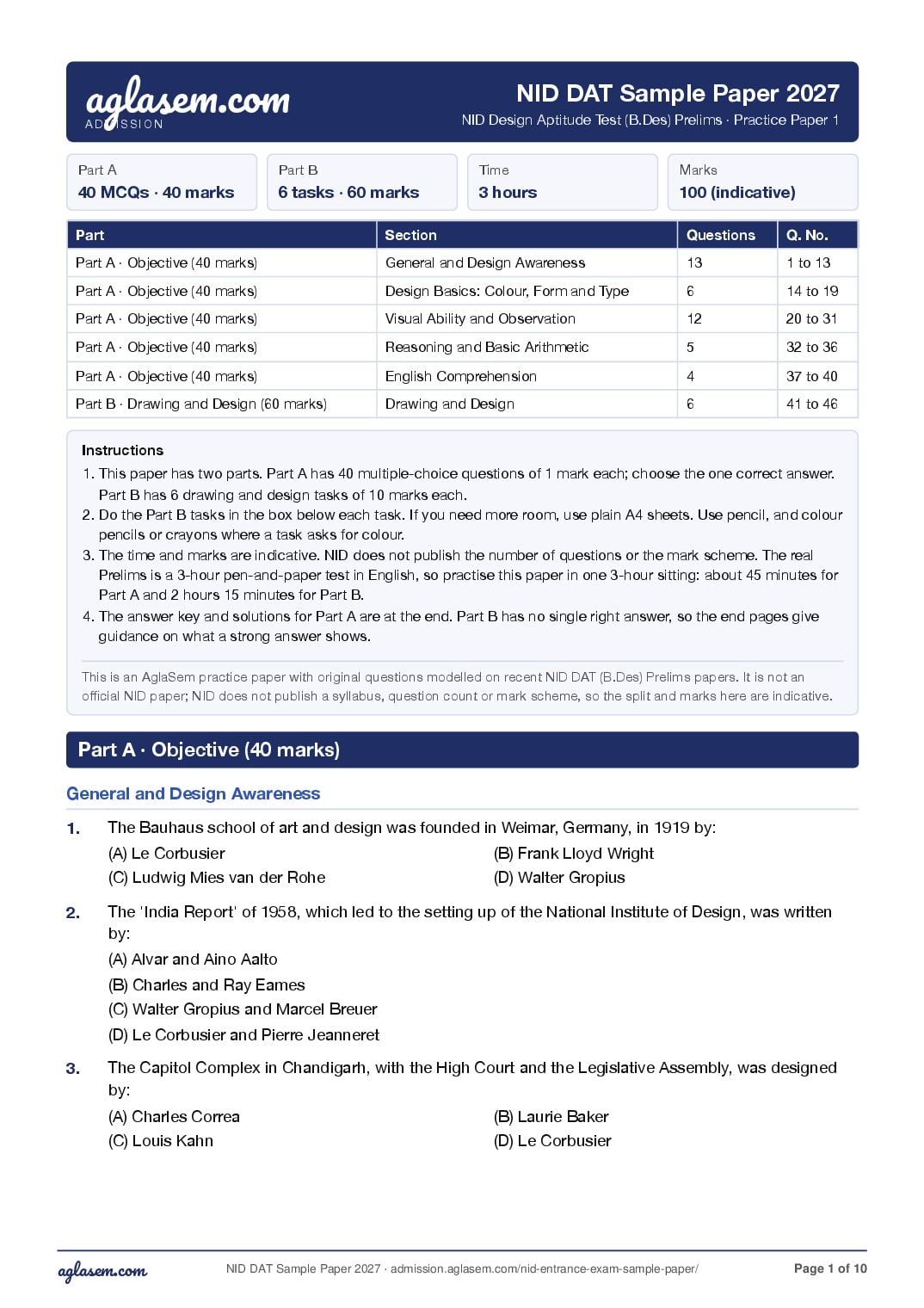
NID DAT Sample Paper 2027
NID Design Aptitude Test (B.Des) Prelims · Practice Paper 1
Part A Part B Time Marks
40 MCQs · 40 marks 6 tasks · 60 marks 3 hours 100 (indicative)
Part Section Questions Q. No.
Part A · Objective (40 marks) General and Design Awareness 13 1 to 13
Part A · Objective (40 marks) Design Basics: Colour, Form and Type 6 14 to 19
Part A · Objective (40 marks) Visual Ability and Observation 12 20 to 31
Part A · Objective (40 marks) Reasoning and Basic Arithmetic 5 32 to 36
Part A · Objective (40 marks) English Comprehension 4 37 to 40
Part B · Drawing and Design (60 marks) Drawing and Design 6 41 to 46
Instructions
1. This paper has two parts. Part A has 40 multiple-choice questions of 1 mark each; choose the one correct answer.
Part B has 6 drawing and design tasks of 10 marks each.
2. Do the Part B tasks in the box below each task. If you need more room, use plain A4 sheets. Use pencil, and colour
pencils or crayons where a task asks for colour.
3. The time and marks are indicative. NID does not publish the number of questions or the mark scheme. The real
Prelims is a 3-hour pen-and-paper test in English, so practise this paper in one 3-hour sitting: about 45 minutes for
Part A and 2 hours 15 minutes for Part B.
4. The answer key and solutions for Part A are at the end. Part B has no single right answer, so the end pages give
guidance on what a strong answer shows.
This is an AglaSem practice paper with original questions modelled on recent NID DAT (B.Des) Prelims papers. It is not an
official NID paper; NID does not publish a syllabus, question count or mark scheme, so the split and marks here are indicative.
Part A · Objective (40 marks)
General and Design Awareness
1. The Bauhaus school of art and design was founded in Weimar, Germany, in 1919 by:
(A) Le Corbusier (B) Frank Lloyd Wright
(C) Ludwig Mies van der Rohe (D) Walter Gropius
2. The 'India Report' of 1958, which led to the setting up of the National Institute of Design, was written
by:
(A) Alvar and Aino Aalto
(B) Charles and Ray Eames
(C) Walter Gropius and Marcel Breuer
(D) Le Corbusier and Pierre Jeanneret
3. The Capitol Complex in Chandigarh, with the High Court and the Legislative Assembly, was designed
by:
(A) Charles Correa (B) Laurie Baker
(C) Louis Kahn (D) Le Corbusier
NID DAT Sample Paper 2027 · admission./nid-entrance-exam-sample-paper/ Page 1 of 10
Page 2
comes from:
(A) Rajasthan (B) Gujarat
(C) Telangana (D) Odisha
5. Warli painting, which uses circles, triangles and lines in white on a mud-coloured wall, is a tribal art form
of:
(A) Bihar (B) Maharashtra
(C) Odisha (D) West Bengal
6. Bidriware, in which silver is inlaid on a blackened alloy made mainly of zinc, takes its name from a town
in:
(A) Karnataka (B) Tamil Nadu
(C) Uttar Pradesh (D) Rajasthan
7. Chikankari, a fine white-on-white embroidery done on light cotton and muslin, is most associated with:
(A) Lucknow (B) Kolkata
(C) Amritsar (D) Srinagar
8. The Sun Temple at Konark, Odisha, is designed in the form of a giant:
(A) Elephant carrying a shrine (B) Boat with carved oars
(C) Chariot with 24 carved wheels (D) Lotus with 108 petals
9. Which 19th-century Indian painter is known for realistic oil paintings of scenes from the epics, and for
printing them as low-cost oleographs?
(A) Nandalal Bose (B) S. H. Raza
(C) Raja Ravi Varma (D) Jamini Roy
10. The artwork that decorates the pages of the original hand-written Constitution of India was made under
the guidance of:
(A) Amrita Sher-Gil (B) Nandalal Bose
(C) Abanindranath Tagore (D) M. F. Husain
11. The Indian rupee symbol, adopted in 2010, was designed by:
(A) Pingali Venkayya (B) D. Udaya Kumar
(C) Satish Gujral (D) Charles Correa
12. Which designer, known for his products for the German company Braun, summed up his approach as
'Less, but better'?
(A) Philippe Starck (B) Jony Ive
(C) Dieter Rams (D) Raymond Loewy
13. The Nike 'Swoosh' logo was designed in 1971 by:
(A) Carolyn Davidson (B) Paul Rand
(C) Saul Bass (D) Milton Glaser
Design Basics: Colour, Form and Type
14. On the traditional red-yellow-blue (RYB) colour wheel, the complementary colour of blue is:
(A) Violet (B) Orange
(C) Red (D) Green
NID DAT Sample Paper 2027 · admission./nid-entrance-exam-sample-paper/ Page 2 of 10
Page 3
(A) Red, yellow, blue and black
(B) Cyan, green, orange and black
(C) Cyan, magenta, yellow and black
(D) Red, green, blue and white
16. Adding white to a pure hue produces a:
(A) Shade (B) Complement
(C) Tint (D) Tone
17. We see a complete circle even when a small part of its outline is missing. This Gestalt principle is called:
(A) Proximity (B) Closure
(C) Similarity (D) Figure-ground
18. In typography, adjusting the space between one particular pair of letters, such as 'A' and 'V', is called:
(A) Tracking (B) Kerning
(C) Justification (D) Leading
19. In a one-point perspective drawing of a straight road, the edges of the road that go away from the
viewer:
(A) Meet at a single vanishing point on the horizon line
(B) Meet at two vanishing points at the sides of the page
(C) Stay parallel and never meet
(D) Meet at a point at the bottom of the page
Visual Ability and Observation
20. A wooden cube is painted red on all faces and then cut into 27 equal smaller cubes. How many small
cubes have exactly two red faces?
(A) 6 (B) 12
(C) 8 (D) 1
21. Which of these words reads exactly the same when its reflection is seen in a vertical mirror placed
beside it?
(A) DEED (B) BOB
(C) TOOT (D) NOON
22. A wall clock shows 3:15. What time will its reflection in a vertical mirror appear to show?
(A) 8:15 (B) 9:15
(C) 9:45 (D) 8:45
23. A square sheet of paper is folded in half from left to right, and then in half again from top to bottom. One
hole is punched through all the layers, away from the folds. How many holes will the sheet have when
opened?
(A) 1 (B) 2
(C) 4 (D) 8
24. A cube net is a cross shape: a vertical column of four squares numbered 1, 2, 3, 4 from top to bottom,
with square 5 joined to the left of square 2 and square 6 joined to the right of square 2. When folded
into a cube, which face is opposite face 2?
(A) 1 (B) 4
(C) 3 (D) 5
NID DAT Sample Paper 2027 · admission./nid-entrance-exam-sample-paper/ Page 3 of 10
Page 4
figure?
(A) 8 (B) 10
(C) 4 (D) 6
26. An arrow points north. It is turned 90 degrees clockwise, then 180 degrees anticlockwise, then 45
degrees clockwise. Which way does it point now?
(A) North-east (B) South-east
(C) South-west (D) North-west
27. Which capital letter (in a plain style such as Arial) has both a vertical and a horizontal line of symmetry?
(A) H (B) E
(C) A (D) N
28. How many spokes does the Ashoka Chakra on the Indian national flag have?
(A) 24 (B) 16
(C) 32 (D) 12
29. On a standard six-sided die, the numbers on any two opposite faces always add up to:
(A) 8 (B) 6
(C) 12 (D) 7
30. On a standard QWERTY keyboard, which letter key is immediately to the right of G?
(A) F (B) J
(C) B (D) H
31. In a vertical road traffic signal in India, which light is at the top?
(A) It differs from city to city (B) Green
(C) Red (D) Amber
Reasoning and Basic Arithmetic
32. In a class of 40 students, 25 like drawing, 20 like music and 8 like neither. How many like both drawing
and music?
(A) 13 (B) 12
(C) 8 (D) 5
33. Five friends A, B, C, D and E sit in a row facing north. C is in the middle, A is immediately to the left of
C, and E is at the right end. B does not sit next to E. Who is at the left end?
(A) A (B) D
(C) E (D) B
34. If COLOUR is written as DPMPVS in a code, how is SHAPE written in that code?
(A) TIBPF (B) RGZOD
(C) TIBQF (D) TJBQF
35. Meera faces east. She turns 90 degrees to her left, then turns around (180 degrees), then turns 90
degrees to her left again. Which direction does she face now?
(A) West (B) North
(C) East (D) South
36. A poster 60 cm wide and 90 cm tall is reduced in proportion so that its width becomes 20 cm. What is
its new height?
(A) 70 cm (B) 45 cm
(C) 50 cm (D) 30 cm
NID DAT Sample Paper 2027 · admission./nid-entrance-exam-sample-paper/ Page 4 of 10
Page 5
Read the passage and answer Questions 37 to 40.
Long before the word 'design' became fashionable, Indian homes used objects that solved problems
quietly. Consider the lota, the round-bellied water vessel found in households across the country. Its
narrow neck is easy to grip and helps reduce spilling, while its rim lets water be poured in a steady
stream. Made in brass, copper or clay, the lota changes with the material and the region, yet keeps its
essential form.
Designers often say that good design is not decoration added at the end but the result of careful
observation of how people live. The lota did not come from a studio. It was refined over generations by
users and makers who kept what worked and discarded what did not. Modern designers can learn from
such objects: watch people closely, respect materials, and let form follow real needs.
37. According to the passage, good design is mainly the result of:
(A) Careful observation of how people live
(B) Using costly materials
(C) Decoration added at the end
(D) Work done only in a studio
38. The writer says the lota 'did not come from a studio' because:
(A) It was improved over generations by users and makers
(B) It was designed by one famous designer
(C) It is now made only by machines
(D) It has no practical use today
39. Which word in the passage means 'improved by making small changes over time'?
(A) Fashionable (B) Essential
(C) Discarded (D) Refined
40. Which statement is NOT supported by the passage?
(A) Designers can learn from everyday objects
(B) The lota is found in homes across India
(C) The lota's form stays similar across materials and regions
(D) The lota is made only of brass
NID DAT Sample Paper 2027 · admission./nid-entrance-exam-sample-paper/ Page 5 of 10
Page 6
Drawing and Design
41. Memory drawing (10 marks): Draw from memory a busy railway platform as seen from the top of a
footbridge (a view looking down from above). Show at least five people doing different things, along
with a train, benches and a tea stall. Use pencil and shading only.
42. Creative composition (10 marks): Using only circles, triangles and straight lines, of any size and number,
make a composition titled 'Festival'. Colour it using not more than three colours plus black. Below it,
write one line on why you chose these colours.
NID DAT Sample Paper 2027 · admission./nid-entrance-exam-sample-paper/ Page 6 of 10
Page 7
Redesign a water bottle for them. Draw at least two views (for example front and top), label the
materials and key features, and write 3 to 4 lines on how your design solves the problem.
44. Comic strip (10 marks): Draw a four-panel comic strip about a child who finds a creative way to save
water at home. Use speech bubbles of not more than six words each.
45. Poster (10 marks): Design an A4 poster for a 'Crafts of India' exhibition at a city museum. It must show
the event name, a date and a venue, and use one craft of your choice as the main image. Plan the
layout so the poster can be read from three metres away.
NID DAT Sample Paper 2027 · admission./nid-entrance-exam-sample-paper/ Page 7 of 10
Page 8
by bus, train or auto-rickshaw, and suggest a design solution for it. Add one small sketch to explain
your idea.
NID DAT Sample Paper 2027 · admission./nid-entrance-exam-sample-paper/ Page 8 of 10
Page 9
1 D 2 B 3 D 4 B 5 B 6 A 7 A 8 C 9 C 10 B
11 B 12 C 13 A 14 B 15 C 16 C 17 B 18 B 19 A 20 B
21 C 22 D 23 C 24 B 25 A 26 D 27 A 28 A 29 D 30 D
31 C 32 A 33 D 34 C 35 C 36 D 37 A 38 A 39 D 40 D
41 — 42 — 43 — 44 — 45 — 46 —
Solutions
General and Design Awareness
1. (D) Walter Gropius founded the Bauhaus in 1919; Mies van der Rohe was its last director.
2. (B) The Government of India invited Charles and Ray Eames, whose 1958 India Report led to NID being set up in
Ahmedabad in 1961.
3. (D) Le Corbusier designed the Capitol Complex; Louis Kahn designed the IIM Ahmedabad campus.
4. (B) Patola is woven in Patan, Gujarat. Odisha (Sambalpuri) and Telangana (Pochampally) are known for other ikats.
5. (B) Warli art comes from the Warli community of the Thane and Palghar region of Maharashtra.
6. (A) Bidriware is named after Bidar in Karnataka.
7. (A) Chikankari is the traditional embroidery of Lucknow, Uttar Pradesh.
8. (C) The temple is built as the chariot of the Sun god, with 24 carved stone wheels pulled by seven horses.
9. (C) Raja Ravi Varma set up a printing press that made his mythological paintings available as oleographs in many
homes.
10. (B) Nandalal Bose and his students from Santiniketan illustrated the original Constitution.
11. (B) D. Udaya Kumar's design, combining the Devanagari 'Ra' and the Roman 'R', was chosen in 2010; Pingali
Venkayya designed an early form of the national flag.
12. (C) Dieter Rams was Braun's head of design and wrote ten principles of good design ending in 'Less, but better'.
13. (A) Carolyn Davidson, then a design student, created the Swoosh in 1971; Milton Glaser designed the 'I love NY'
logo.
Design Basics: Colour, Form and Type
14. (B) Complementary colours sit opposite each other on the wheel; orange (red + yellow) is opposite blue.
15. (C) Printing uses the subtractive CMYK system; red, green and blue are the additive colours of screens.
16. (C) White gives a tint, black gives a shade and grey gives a tone.
17. (B) Closure is the tendency of the mind to fill in gaps and see a complete shape.
18. (B) Kerning adjusts one letter pair; tracking changes spacing across a whole word or line, and leading is the space
between lines.
19. (A) In one-point perspective all receding parallel lines converge at one vanishing point on the horizon (eye level).
Visual Ability and Observation
20. (B) Two-face cubes lie on the edges but not the corners; a 3 x 3 x 3 cube has 12 edges with one such cube each.
21. (C) A mirror reverses both the letter order and each letter. TOOT reads the same backwards and T and O are
symmetric about a vertical line; N, B, D and E are not.
22. (D) Mirror time = 11:60 minus the actual time, so 11:60 - 3:15 = 8:45.
23. (C) Two folds make four layers, so one punch makes four holes.
24. (B) In a column of four squares, alternate squares are opposite: 1 is opposite 3 and 2 is opposite 4, while 5 is
opposite 6.
NID DAT Sample Paper 2027 · admission./nid-entrance-exam-sample-paper/ Page 9 of 10
Page 10
26. (D) North turns to east, then to west, and 45 degrees clockwise from west is north-west.
27. (A) H is symmetric both ways; E has only a horizontal line, A only a vertical line, and N has none.
28. (A) The navy blue Ashoka Chakra at the centre of the flag has 24 spokes.
29. (D) On a standard die, 1 is opposite 6, 2 opposite 5 and 3 opposite 4, so each pair adds up to 7.
30. (D) The middle row reads A S D F G H J K L, so H is next to G.
31. (C) Indian traffic signals follow a fixed order with red at the top, amber in the middle and green at the bottom.
Reasoning and Basic Arithmetic
32. (A) 32 students like at least one, so both = 25 + 20 - 32 = 13.
33. (D) C is 3rd, A is 2nd and E is 5th, so B and D take 1st and 4th; B cannot be 4th (next to E), so B is at the left end.
34. (C) Each letter moves one step forward in the alphabet: S-T, H-I, A-B, P-Q, E-F.
35. (C) East, then left to north, then about-turn to south, then left from south is east.
36. (D) The width is divided by 3, so the height is also divided by 3: 90 / 3 = 30 cm.
English Comprehension
37. (A) The passage says good design is not decoration added at the end but comes from careful observation of how
people live.
38. (A) The passage says it was refined over generations by users and makers who kept what worked.
39. (D) To refine something is to improve it gradually through small changes.
40. (D) The passage says the lota is made in brass, copper or clay, so 'only brass' is not supported.
Drawing and Design
41. (guidance) A strong answer gets the looking-down viewpoint right (heads and shoulders show more than legs;
objects shrink with distance). People are in proportion and clearly doing different things, and shading separates near
and far.
42. (guidance) A strong answer turns the simple shapes into a lively, balanced picture with a clear focal point, rhythm
and variety of size. The limited colours are used with purpose, for example warm colours for celebration, and the one-
line reason matches what is drawn.
43. (guidance) A strong answer starts from the user's small hands and rough handling, and shows a clear idea (a grip
shape, strap, spill-proof spout or attached lid) in two labelled views. The note explains the choices simply and is
realistic about materials and cleaning.
44. (guidance) A strong answer tells a complete story (problem, clever idea, ending) across four panels. Characters
stay recognisable, framing varies between close-up and wide views, and the short dialogue moves the story forward.
45. (guidance) A strong answer has a clear visual hierarchy: a striking main image of a recognisable craft, a large
readable title, and smaller date and venue lines. Lettering is neat and consistent, there is enough empty space, and the
colours suit the chosen craft.
46. (guidance) A strong answer describes a real, specific problem from first-hand observation, names who faces it,
and proposes a practical solution with a clear sketch. It is written in simple, correct English within the word limit and
explains why the solution would work.
NID DAT Sample Paper 2027 · admission./nid-entrance-exam-sample-paper/ Page 10 of 10
Document Details
| Board / Org | NID |
| Exam | NID DAT |
| Type | Sample Paper |
| Pages | 10 |
| Language | english |
| Updated | 24 Oct 2026 |