UGC NET 2021 Question Paper Tourism Administration and Management Shift 1
Finished viewing? Save it for later —
Download UGC NET 2021 Question Paper Tourism Administration and Management Shift 1 (PDF · 82 pages)About UGC NET 2021 Question Paper Tourism Administration and Management Shift 1
UGC NET 2021 Question Paper Tourism Administration and Management Shift 1 is available here for free download. Published by NTA for UGC NET, this question paper can be viewed online or downloaded as a PDF (82 pages). Candidates preparing for UGC NET can use UGC NET 2021 Question Paper Tourism Administration and Management Shift 1 to understand the exam pattern, the type of questions asked, and the overall difficulty level.
Frequently Asked Questions
How can I download UGC NET 2021 Question Paper Tourism Administration and Management Shift 1?
Open this page and click the Download button to save UGC NET 2021 Question Paper Tourism Administration and Management Shift 1 as a PDF. It is completely free on AglaSem Docs.
Is UGC NET 2021 Question Paper Tourism Administration and Management Shift 1 free to download?
Yes. UGC NET 2021 Question Paper Tourism Administration and Management Shift 1 can be viewed online and downloaded as a PDF free of cost on AglaSem Docs.
How many pages does UGC NET 2021 Question Paper Tourism Administration and Management Shift 1 have?
UGC NET 2021 Question Paper Tourism Administration and Management Shift 1 contains 82 pages, which you can read online or download together as a single PDF.
Where can I find more UGC NET study material?
You can find more UGC NET question papers, sample papers, syllabus, and answer keys on AglaSem Docs.
UGC NET 2021 Question Paper Tourism Administration and Management Shift 1 – Text
Read the full text of this question paper below — useful to quickly search, copy and reference the content online without downloading the PDF.
📄 View text version (82 pages)
Page 1
Topic:‐ GP_Set2_C
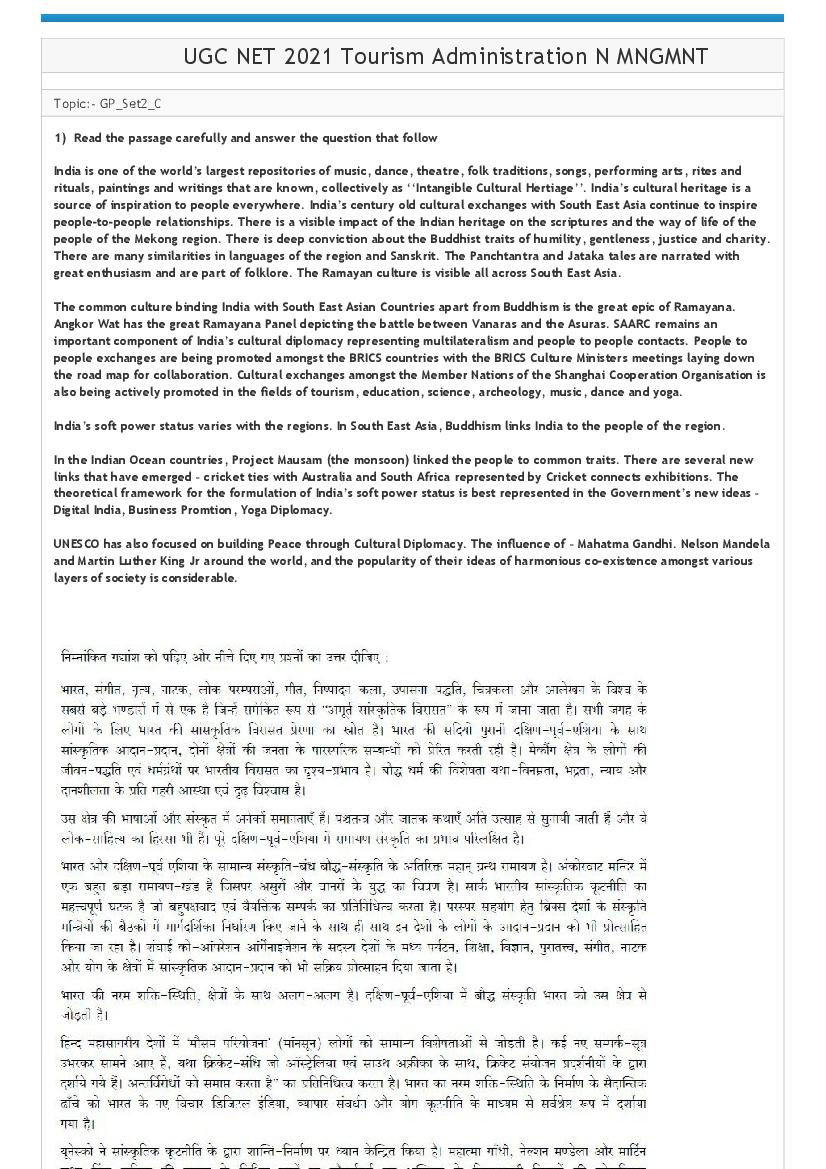
1) Read the passage carefully and answer the question that follow
India is one of the world’s largest repositories of music, dance, theatre, folk traditions, songs, performing arts, rites and
rituals, paintings and writings that are known, collectively as ‘‘Intangible Cultural Hertiage’’. India’s cultural heritage is a
source of inspiration to people everywhere. India’s century old cultural exchanges with South East Asia continue to inspire
people‐to‐people relationships. There is a visible impact of the Indian heritage on the scriptures and the way of life of the
people of the Mekong region. There is deep conviction about the Buddhist traits of humility, gentleness, justice and charity.
There are many similarities in languages of the region and Sanskrit. The Panchtantra and Jataka tales are narrated with
great enthusiasm and are part of folklore. The Ramayan culture is visible all across South East Asia.
The common culture binding India with South East Asian Countries apart from Buddhism is the great epic of Ramayana.
Angkor Wat has the great Ramayana Panel depicting the battle between Vanaras and the Asuras. SAARC remains an
important component of India’s cultural diplomacy representing multilateralism and people to people contacts. People to
people exchanges are being promoted amongst the BRICS countries with the BRICS Culture Ministers meetings laying down
the road map for collaboration. Cultural exchanges amongst the Member Nations of the Shanghai Cooperation Organisation is
also being actively promoted in the fields of tourism, education, science, archeology, music, dance and yoga.
India’s soft power status varies with the regions. In South East Asia, Buddhism links India to the people of the region.
In the Indian Ocean countries, Project Mausam (the monsoon) linked the people to common traits. There are several new
links that have emerged – cricket ties with Australia and South Africa represented by Cricket connects exhibitions. The
theoretical framework for the formulation of India’s soft power status is best represented in the Government’s new ideas –
Digital India, Business Promtion, Yoga Diplomacy.
UNESCO has also focused on building Peace through Cultural Diplomacy. The influence of – Mahatma Gandhi. Nelson Mandela
and Martin Luther King Jr around the world, and the popularity of their ideas of harmonious co‐existence amongst various
layers of society is considerable.
Page 2
(A) Ramayan
(B) Multilateral engagements
(C) Business Promotion
(D) People to people contacts
Choose the correct answer from the options given below :
(1) (A) and (D) only (2) (A), (C) and (D) only
(3) (B), (C) and (D) only (4) (B) and (D) only
[Question ID = 3557][Question Description = Q46_GP_20NOV_S2_SHAAN_Shift2]
1. 1
[Option ID = 13691]
2. 2
[Option ID = 13692]
3. 3
[Option ID = 13693]
4. 4
[Option ID = 13694]
2) Read the passage carefully and answer the question that follow
India is one of the world’s largest repositories of music, dance, theatre, folk traditions, songs, performing arts, rites and
rituals, paintings and writings that are known, collectively as ‘‘Intangible Cultural Hertiage’’. India’s cultural heritage is a
source of inspiration to people everywhere. India’s century old cultural exchanges with South East Asia continue to inspire
people‐to‐people relationships. There is a visible impact of the Indian heritage on the scriptures and the way of life of the
Page 3
There are many similarities in languages of the region and Sanskrit. The Panchtantra and Jataka tales are narrated with
great enthusiasm and are part of folklore. The Ramayan culture is visible all across South East Asia.
The common culture binding India with South East Asian Countries apart from Buddhism is the great epic of Ramayana.
Angkor Wat has the great Ramayana Panel depicting the battle between Vanaras and the Asuras. SAARC remains an
important component of India’s cultural diplomacy representing multilateralism and people to people contacts. People to
people exchanges are being promoted amongst the BRICS countries with the BRICS Culture Ministers meetings laying down
the road map for collaboration. Cultural exchanges amongst the Member Nations of the Shanghai Cooperation Organisation is
also being actively promoted in the fields of tourism, education, science, archeology, music, dance and yoga.
India’s soft power status varies with the regions. In South East Asia, Buddhism links India to the people of the region.
In the Indian Ocean countries, Project Mausam (the monsoon) linkded the people to common traits. There are several new
links that have emerged – cricket ties with Australia and South Africa represented by Cricket connects exhibitions. The
theoretical framework for the formulation of India’s soft power status is best represented in the Government’s new ideas –
Digital India, Business Promtion, Yoga Diplomacy.
UNESCO has also focused on building Peace through Cultural Diplomacy. The influence of – Mahatma Gandhi. Nelson Mandela
and Martin Luther King Jr around the world, and the popularity of their ideas of harmonious co‐existence amongst various
layers of society is considerable.
The common thread binding India and South East Asian Countries is/are
(A) Buddist tenets
(B) Yoga
(C) Cricket
(D) Ramayan
(E) Sanskrit
Choose the correct answer from the options given below :
Page 4
(3) (A) and (D) only (4) (A), (B), (D) and (E) only
[Question ID = 3558][Question Description = Q47_GP_20NOV_S2_SHAAN_Shift2]
1. 1 [Option ID = 13695]
2. 2 [Option ID = 13696]
3. 3 [Option ID = 13697]
4. 4 [Option ID = 13698]
3) Read the passage carefully and answer the question that follow
India is one of the world’s largest repositories of music, dance, theatre, folk traditions, songs, performing arts, rites and
rituals, paintings and writings that are known, collectively as ‘‘Intangible Cultural Hertiage’’. India’s cultural heritage is a
source of inspiration to people everywhere. India’s century old cultural exchanges with South East Asia continue to inspire
people‐to‐people relationships. There is a visible impact of the Indian heritage on the scriptures and the way of life of the
people of the Mekong region. There is deep conviction about the Buddhist traits of humility, gentleness, justice and charity.
There are many similarities in languages of the region and Sanskrit. The Panchtantra and Jataka tales are narrated with
great enthusiasm and are part of folklore. The Ramayan culture is visible all across South East Asia.
The common culture binding India with South East Asian Countries apart from Buddhism is the great epic of Ramayana.
Angkor Wat has the great Ramayana Panel depicting the battle between Vanaras and the Asuras. SAARC remains an
important component of India’s cultural diplomacy representing multilateralism and people to people contacts. People to
people exchanges are being promoted amongst the BRICS countries with the BRICS Culture Ministers meetings laying down
the road map for collaboration. Cultural exchanges amongst the Member Nations of the Shanghai Cooperation Organisation is
also being actively promoted in the fields of tourism, education, science, archeology, music, dance and yoga.
India’s soft power status varies with the regions. In South East Asia, Buddhism links India to the people of the region.
In the Indian Ocean countries, Project Mausam (the monsoon) linkded the people to common traits. There are several new
links that have emerged – cricket ties with Australia and South Africa represented by Cricket connects exhibitions. The
theoretical framework for the formulation of India’s soft power status is best represented in the Government’s new ideas –
Digital India, Business Promtion, Yoga Diplomacy.
UNESCO has also focused on building Peace through Cultural Diplomacy. The influence of – Mahatma Gandhi. Nelson Mandela
and Martin Luther King Jr around the world, and the popularity of their ideas of harmonious co‐existence amongst various
layers of society is considerable.
Page 5
(1) Digital India (2) Skill India
(3) Business Promotion (4) Yoga Diplomacy
[Question ID = 3559][Question Description = Q48_GP_20NOV_S2_SHAAN_Shift2]
1. 1 [Option ID = 13699]
2. 2 [Option ID = 13700]
3. 3 [Option ID = 13701]
4. 4 [Option ID = 13702]
4) Read the passage carefully and answer the question that follow
India is one of the world’s largest repositories of music, dance, theatre, folk traditions, songs, performing arts, rites and
rituals, paintings and writings that are known, collectively as ‘‘Intangible Cultural Hertiage’’. India’s cultural heritage is a
source of inspiration to people everywhere. India’s century old cultural exchanges with South East Asia continue to inspire
people‐to‐people relationships. There is a visible impact of the Indian heritage on the scriptures and the way of life of the
people of the Mekong region. There is deep conviction about the Buddhist traits of humility, gentleness, justice and charity.
There are many similarities in languages of the region and Sanskrit. The Panchtantra and Jataka tales are narrated with
great enthusiasm and are part of folklore. The Ramayan culture is visible all across South East Asia.
The common culture binding India with South East Asian Countries apart from Buddhism is the great epic of Ramayana.
Angkor Wat has the great Ramayana Panel depicting the battle between Vanaras and the Asuras. SAARC remains an
important component of India’s cultural diplomacy representing multilateralism and people to people contacts. People to
people exchanges are being promoted amongst the BRICS countries with the BRICS Culture Ministers meetings laying down
the road map for collaboration. Cultural exchanges amongst the Member Nations of the Shanghai Cooperation Organisation is
also being actively promoted in the fields of tourism, education, science, archeology, music, dance and yoga.
India’s soft power status varies with the regions. In South East Asia, Buddhism links India to the people of the region.
In the Indian Ocean countries, Project Mausam (the monsoon) linkded the people to common traits. There are several new
links that have emerged – cricket ties with Australia and South Africa represented by Cricket connects exhibitions. The
theoretical framework for the formulation of India’s soft power status is best represented in the Government’s new ideas –
Digital India, Business Promtion, Yoga Diplomacy.
UNESCO has also focused on building Peace through Cultural Diplomacy. The influence of – Mahatma Gandhi. Nelson Mandela
and Martin Luther King Jr around the world, and the popularity of their ideas of harmonious co‐existence amongst various
layers of society is considerable.
Page 6
(A) Archeology
(B) Folklore
(C) Tourism
(D) Yoga
(E) Education
Choose the correct answer from the options given below :
(1) (A), (C), (D) and (E) only (2) (A), (B), (C) and (E) only
(3) (A), (B) and (E) only (4) (B), (C), (D) and (E) only
[Question ID = 3560][Question Description = Q49_GP_20NOV_S2_SHAAN_Shift2]
Page 7
2. 2 [Option ID = 13704]
3. 3 [Option ID = 13705]
4. 4 [Option ID = 13706]
5) Read the passage carefully and answer the question that follow
India is one of the world’s largest repositories of music, dance, theatre, folk traditions, songs, performing arts, rites and
rituals, paintings and writings that are known, collectively as ‘‘Intangible Cultural Hertiage’’. India’s cultural heritage is a
source of inspiration to people everywhere. India’s century old cultural exchanges with South East Asia continue to inspire
people‐to‐people relationships. There is a visible impact of the Indian heritage on the scriptures and the way of life of the
people of the Mekong region. There is deep conviction about the Buddhist traits of humility, gentleness, justice and charity.
There are many similarities in languages of the region and Sanskrit. The Panchtantra and Jataka tales are narrated with
great enthusiasm and are part of folklore. The Ramayan culture is visible all across South East Asia.
The common culture binding India with South East Asian Countries apart from Buddhism is the great epic of Ramayana.
Angkor Wat has the great Ramayana Panel depicting the battle between Vanaras and the Asuras. SAARC remains an
important component of India’s cultural diplomacy representing multilateralism and people to people contacts. People to
people exchanges are being promoted amongst the BRICS countries with the BRICS Culture Ministers meetings laying down
the road map for collaboration. Cultural exchanges amongst the Member Nations of the Shanghai Cooperation Organisation is
also being actively promoted in the fields of tourism, education, science, archeology, music, dance and yoga.
India’s soft power status varies with the regions. In South East Asia, Buddhism links India to the people of the region.
In the Indian Ocean countries, Project Mausam (the monsoon) linkded the people to common traits. There are several new
links that have emerged – cricket ties with Australia and South Africa represented by Cricket connects exhibitions. The
theoretical framework for the formulation of India’s soft power status is best represented in the Government’s new ideas –
Digital India, Business Promtion, Yoga Diplomacy.
UNESCO has also focused on building Peace through Cultural Diplomacy. The influence of – Mahatma Gandhi. Nelson Mandela
and Martin Luther King Jr around the world, and the popularity of their ideas of harmonious co‐existence amongst various
layers of society is considerable.
The passage highlights
Page 8
(2) The role of culture for peace and harmonious relations with other countries
(3) India’s cultural hegemony
(4) India’s relations with BRICS countries
[Question ID = 3561][Question Description = Q50_GP_20NOV_S2_SHAAN_Shift2]
1. 1 [Option ID = 13707]
2. 2 [Option ID = 13708]
3. 3 [Option ID = 13709]
4. 4 [Option ID = 13710]
Topic:‐ GP_Set2_A
1)
Page 9
company?
(1) 119 : 145 (2) 116 : 135
(3) 119 : 135 (4) 119 : 130
[Question ID = 3562][Question Description = Q01_GP_20NOV_S2_SHAAN_Shift2]
1. 1 [Option ID = 13711]
2. 2 [Option ID = 13712]
3. 3 [Option ID = 13713]
4. 4 [Option ID = 13714]
2)
If 35% of the PCs sold by Company HP during November were sold at a discount, then how many PCs of Company HP during
that month were sold without a discount?
(1) 882 (2) 1635
(3) 1638 (4) 885
Page 10
1. 1 [Option ID = 13715]
2. 2 [Option ID = 13716]
3. 3 [Option ID = 13717]
4. 4 [Option ID = 13718]
3)
If the dealer earned a profit of Rs. 433 on each PC sold of Company DELL during October, then what was his total profit
earned on the PCs of that company during the same month?
(1) 6,49,900 (2) 6,45,900
(3) 6,49,400 (4) 6,49,500
[Question ID = 3564][Question Description = Q03_GP_20NOV_S2_SHAAN_Shift2]
Page 11
2. 2 [Option ID = 13720]
3. 3 [Option ID = 13721]
4. 4 [Option ID = 13722]
4)
The number of PCs sold of Company HP during July is approximately what percent (%) of the number of PCs sold of Company
HP during December?
(1) 110% (2) 140%
(3) 150% (4) 130%
[Question ID = 3565][Question Description = Q04_GP_20NOV_S2_SHAAN_Shift2]
1. 1 [Option ID = 13723]
2. 2 [Option ID = 13724]
3. 3 [Option ID = 13725]
4. 4 [Option ID = 13726]
5)
Page 12
(1) 10000 (2) 15000
(3) 10500 (4) 9500
[Question ID = 3566][Question Description = Q05_GP_20NOV_S2_SHAAN_Shift2]
1. 1
[Option ID = 13727]
2. 2
[Option ID = 13728]
3. 3
[Option ID = 13729]
4. 4
[Option ID = 13730]
Page 13
1) In which level of teaching promotion of critical thinking is the hall mark?
(1) Memory level (2) Understanding level
(3) Reflective level (4) Autonomous development level
[Question ID = 3567][Question Description = Q06_GP_20NOV_S2_SHAAN_Shift2]
1. 1 [Option ID = 13731]
2. 2 [Option ID = 13732]
3. 3 [Option ID = 13733]
4. 4 [Option ID = 13734]
2) The key behaviour of an effective teacher is marked by which of the following features? (A) Structuring (B) Teacher
task orientation (C) Instructional Variety (D) Lesson clarity (E) Probing Choose the correct answer from the options given
below :
(1) (A), (B) and (C) only (2) (A), (C) and (D) only
(3) (B), (C) and (D) only (4) (C), (D) and (E) only
[Question ID = 3568][Question Description = Q07_GP_20NOV_S2_SHAAN_Shift2]
1. 1
[Option ID = 13735]
2. 2
[Option ID = 13736]
3. 3
[Option ID = 13737]
4. 4
[Option ID = 13738]
3) Match List I with List II gives their characteristic features.
List I List II
(Modes of Evaluation) (Characteristic Features)
(A) Formative Evaluation (I) Compares one student with another student
(B) Summative Evaluation (II) Compares the progress of a student against prespecified standards
(C) Criterion‐referenced Evaluation (III) Used primarily for motivational and monitoring purposes of learning
(D) Norm‐referenced Evaluation (IV) Used primarily for gradation of progress made
Choose the correct answer from the options given below :
(1) (A)‐(IV), (B)‐(III), (C)‐(I), (D)‐(II) (2) (A)‐(III), (B)‐(IV), (C)‐(II), (D)‐(I)
Page 14
[Question ID = 3569][Question Description = Q08_GP_20NOV_S2_SHAAN_Shift2]
1. 1 [Option ID = 13739]
2. 2 [Option ID = 13740]
3. 3 [Option ID = 13741]
4. 4 [Option ID = 13742]
4) Given below are two statements :
Statement I : One of the basic principles of progressive view of teaching is that education should be life itself rather than a
preparation for living.
Statement II : According to reconstructionist view of education the new social order must be ‘genuinely democratic’.
In the light of the above statements, Choose the correct answer from the options given below :
(1) Both Statement I and Statement II are true. (2) Both Statement I and Statement II are false.
(3) Statement I is true but Statement II is false. (4) Statement I is false but Statement II is true.
[Question ID = 3570][Question Description = Q09_GP_20NOV_S2_SHAAN_Shift2]
1. 1 [Option ID = 13743]
2. 2 [Option ID = 13744]
3. 3 [Option ID = 13745]
4. 4 [Option ID = 13746]
5) Given below are two statements : One is labeled as Assertion A and the other is labeled as Reason R.
Assertion (A) : ‘Teaching’ involves critical and creative interchanges between teacher and learner and hence it is different
from ‘instruction’ and ‘training’.
Page 15
In the light of the above statements, Choose the most appropriate answer from the options given below :
(1) Both (A) and (R) are correct and (R) is the correct explanation of (A). (2) Both (A) and (R) are correct but (R) is NOT
the correct explanation of (A).
(3) (A) is correct but (R) is not correct. (4) (A) is not correct but (R) is correct.
[Question ID = 3571][Question Description = Q10_GP_20NOV_S2_SHAAN_Shift2]
1. 1 [Option ID = 13747]
2. 2 [Option ID = 13748]
3. 3 [Option ID = 13749]
4. 4 [Option ID = 13750]
6) In which of the following researches, attempts are made to establish context‐free generalizations?
(1) Phenomenology (2) Grounded theory
(3) Symbolic interactionism (4) Experimental Studies
[Question ID = 3572][Question Description = Q11_GP_20NOV_S2_SHAAN_Shift2]
1. 1 [Option ID = 13751]
2. 2 [Option ID = 13752]
3. 3 [Option ID = 13753]
4. 4 [Option ID = 13754]
7) Identify the main features of ‘qualitative research’ from the following :
(A) It is concerned with understanding the phenomena from the participant’s perspective
(B) It assumes that there are social facts with a single objective reality
(C) Researcher becomes immersed in the situation, present or past
(D) Researcher is detached from the study to avoid bias
(E) There is greater flexibility in both the methods and research process
Choose the correct answer from the options given below :
(1) (A), (C) and (E) only (2) (A), (B) and (C) only
(3) (B), (C) and (D) only (4) (C), (D) and (E) only
Page 16
1. 1 [Option ID = 13755]
2. 2 [Option ID = 13756]
3. 3 [Option ID = 13757]
4. 4 [Option ID = 13758]
8) Match List I with List II :
List I List II
Methods of research Features emphasized
(A) Experimental (I) Primary and secondary sources tapped with emphasis on internal criticism
(B) ExPost Facto (II) Status of facts and conditions are ascertained
(C) Descriptive (III) A variable is manipulated to see its effect on other variable
(D) Historical (IV) The differences are noted and factors causal or otherwise are determined
Choose the correct answer from the options given below :
(1) (A)‐(I), (B)‐(II), (C)‐(III), (D)‐(IV) (2) (A)‐(II), (B)‐(I), (C)‐(IV), (D)‐(III)
(3) (A)‐(III), (B)‐(IV), (C)‐(II), (D)‐(I) (4) (A)‐(IV), (B)‐(III), (C)‐(I), (D)‐(II)
[Question ID = 3574][Question Description = Q13_GP_20NOV_S2_SHAAN_Shift2]
1. 1 [Option ID = 13759]
2. 2 [Option ID = 13760]
3. 3 [Option ID = 13761]
4. 4 [Option ID = 13762]
9) Given below are two statements :
Statement I : Data analysis in research being a technical job, ‘research ethics’ does not matter.
Statement II : ICT is helpful almost at all stages of research.
In the light of the above statements, Choose the correct answer from the options given below :
(1) Both Statement I and Statement II are true. (2) Both Statement I and Statement II are false.
(3) Statement I is true but Statement II is false. (4) Statement I is false but Statement II is true.
Page 17
1. 1 [Option ID = 13763]
2. 2 [Option ID = 13764]
3. 3 [Option ID = 13765]
4. 4 [Option ID = 13766]
10) Given below are two statements : One is labeled as Assertion A and the other is labeled as Reason R.
Assertion (A) : When Null Hypothesis (H0) is rejected, researcher’s hypothesis (H1) is accepted.
Reason (R) : Null Hypothesis (H0) is a chance hypothesis and as such (H1) being true, the researcher’s hypothesis lies in the
domain of acceptability.
In the light of the above statements, Choose the most appropriate answer from the options given below :
(1) Both (A) and (R) are correct and (R) is the correct explanation of (A). (2) Both (A) and (R) are correct but (R) is NOT
the correct explanation of (A).
(3) (A) is correct but (R) is not correct. (4) (A) is not correct but (R) is correct.
[Question ID = 3576][Question Description = Q15_GP_20NOV_S2_SHAAN_Shift2]
1. 1 [Option ID = 13767]
2. 2 [Option ID = 13768]
3. 3 [Option ID = 13769]
4. 4 [Option ID = 13770]
11) Which of the following is an exclusive example of Non‐verbal cue that includes the pitch, rate, volume and use of
pauses?
(1) Linear Model of Communication (2) Interactional Model
(3) Non‐Verbal Cues (4) Para‐Language
[Question ID = 3577][Question Description = Q16_GP_20NOV_S2_SHAAN_Shift2]
1. 1 [Option ID = 13771]
2. 2 [Option ID = 13772]
3. 3 [Option ID = 13773]
4. 4 [Option ID = 13774]
Page 18
Assertion (A) : In the context of communication, the perceptual process creates, semantic‐noise also called word‐noise.
Reason (R) : The various meanings either cannotative or denotative are sources of semantic noise.
In the light of the above statements, Choose the most appropriate answer from the options given below :
(1) Both (A) and (R) are correct and (R) is the correct explanation of (A).
(2) Both (A) and (R) are correct but (R) is NOT the correct explanation of (A).
(3) (A) is correct but (R) is not correct.
(4) (A) is not correct but (R) is correct.
[Question ID = 3578][Question Description = Q17_GP_20NOV_S2_SHAAN_Shift2]
1. 1
[Option ID = 13775]
2. 2
[Option ID = 13776]
3. 3
[Option ID = 13777]
4. 4
[Option ID = 13778]
13) Given below are two statements :
Statement I : Appropriate word choice is an essential of effective oral communication.
Statement II : Facial expression and postures fall under visual communication.
In the light of the above statements, Choose the correct answer from the options given below :
(1) Both Statement I and Statement II are true. (2) Both Statement I and Statement II are false.
(3) Statement I is true but Statement II is false. (4) Statement I is false but Statement II is true.
Page 19
1. 1 [Option ID = 13779]
2. 2 [Option ID = 13780]
3. 3 [Option ID = 13781]
4. 4 [Option ID = 13782]
14) Identify the barriers to communication from the list given below :
(A) Time and distance
(B) By‐passed instructions
(C) Encoding of thoughts and ideas
(D) Decoding of thoughts and ideas
(E) Logical sequence
Choose the correct answer from the options given below :
(1) (A) and (B) only (2) (B) and (C) only
(3) (C) and (D) only (4) (D) and (E) only
[Question ID = 3580][Question Description = Q19_GP_20NOV_S2_SHAAN_Shift2]
1. 1
[Option ID = 13783]
2. 2
[Option ID = 13784]
3. 3
[Option ID = 13785]
4. 4
[Option ID = 13786]
15) Match List I with List II :
List I List II
Types of Communication Main features
(A) Downward Communication (I) Grows primarily to meet organizational/member’s need for communication
(B) Upward Communication (II) It forms a useful link in decision making for task coordination
(C) Horizontal Communication (III) Provides management with feedback about current issues and problems
(D) Grapevine Communication (IV) It is the most common communication system in an organization
Choose the correct answer from the options given below :
(1) (A)‐(I), (B)‐(II), (C)‐(IV), (D)‐(III) (2) (A)‐(II), (B)‐(I), (C)‐(III), (D)‐(IV)
(3) (A)‐(III), (B)‐(IV), (C)‐(I), (D)‐(II) (4) (A)‐(IV), (B)‐(III), (C)‐(II), (D)‐(I)
Page 20
1. 1 [Option ID = 13787]
2. 2 [Option ID = 13788]
3. 3 [Option ID = 13789]
4. 4 [Option ID = 13790]
16) If the cost price is 25% of selling price, then what is the profit percentage?
(1) 100 (2) 200
(3) 300 (4) 400
[Question ID = 3582][Question Description = Q21_GP_20NOV_S2_SHAAN_Shift2]
1. 1 [Option ID = 13791]
2. 2 [Option ID = 13792]
3. 3 [Option ID = 13793]
4. 4 [Option ID = 13794]
17) A seller mixes 26 kg rice of a price of Rs. 20/kg, with 30 kg of different variety rice of a price of Rs. 36/kg. He sells
both the mixed rices at Rs. 30/kg. What will be the profit in percentage?
(1) 5% (2) 10%
(3) 15% (4) 20%
[Question ID = 3583][Question Description = Q22_GP_20NOV_S2_SHAAN_Shift2]
1. 1 [Option ID = 13795]
2. 2 [Option ID = 13796]
3. 3 [Option ID = 13797]
4. 4 [Option ID = 13798]
18) A milk man purchases milk at Rs. X per litre and sells it at Rs. 2X per litre. Still he mixes 2 litres of water with every 6
litre of pure milk. What is his profit percentage?
(1) 33.33 (2) 66.66
(3) 133.33 (4) 166.66
[Question ID = 3584][Question Description = Q23_GP_20NOV_S2_SHAAN_Shift2]
1. 1 [Option ID = 13799]
2. 2 [Option ID = 13800]
3. 3 [Option ID = 13801]
Page 21
19) The average monthly income of P and Q is Rs. 5,050/‐. The average montly income of Q and R is Rs. 6,250/‐ and that
of P and R is Rs. 5,200. What will be the monthly income of P?
(1) Rs. 3,000/‐ (2) Rs. 3,500/‐
(3) Rs. 4,000/‐ (4) Rs. 4,500/‐
[Question ID = 3585][Question Description = Q24_GP_20NOV_S2_SHAAN_Shift2]
1. 1 [Option ID = 13803]
2. 2 [Option ID = 13804]
3. 3 [Option ID = 13805]
4. 4 [Option ID = 13806]
20) The average of 4 terms is 20, and the first term is 1/3rd of sum of the remaining 3 terms. What will be the value of
first term?
(1) 15 (2) 20
(3) 25 (4) 30
[Question ID = 3586][Question Description = Q25_GP_20NOV_S2_SHAAN_Shift2]
1. 1 [Option ID = 13807]
2. 2 [Option ID = 13808]
3. 3 [Option ID = 13809]
4. 4 [Option ID = 13810]
21)
Page 22
1. 1 [Option ID = 13811]
2. 2 [Option ID = 13812]
3. 3 [Option ID = 13813]
4. 4 [Option ID = 13814]
22)
[Question ID = 3588][Question Description = Q27_GP_20NOV_S2_SHAAN_Shift2]
1. 1 [Option ID = 13815]
2. 2 [Option ID = 13816]
Page 23
4. 4 [Option ID = 13818]
23)
[Question ID = 3589][Question Description = Q28_GP_20NOV_S2_SHAAN_Shift2]
1. 1 [Option ID = 13819]
2. 2 [Option ID = 13820]
3. 3 [Option ID = 13821]
4. 4 [Option ID = 13822]
24) ‘‘All radically egalitarian societies are societies that do not preserve individual liberties’’.
Which of the following statements is true with reference to the above statement?
(1) ‘‘No radically egalitarian societies are societies that preserve individual liberties’’ is obverse of the given statement and
it is logically equivalent.
(2) ‘‘No radically egalitarian societies are societies that preserve individual liberties’’ is obverse of the given statement and
it is not logically equivalent.
(3) ‘‘Some radically egalitarian societies are societies that preserve individual liberties’’ is converse of the given statement
and it is logically equivalent.
(4) ‘‘Some radically egalitarian societies are not societies that preserve individual liberties’’ is converse of the given
statement and it is logically equivalent.
Page 24
1. 1 [Option ID = 13823]
2. 2 [Option ID = 13824]
3. 3 [Option ID = 13825]
4. 4 [Option ID = 13826]
25) Two propositions are contradictories if :
(1) One is denial or negation of the other
(2) If they can both be true but cannot both be false
(3) If they have different subject and predicate term and differ from each other in both quality and quantity
(4) If they have the same subject and predicate terms but differ from each other only in quantity but not in quality
[Question ID = 3591][Question Description = Q30_GP_20NOV_S2_SHAAN_Shift2]
1. 1 [Option ID = 13827]
2. 2 [Option ID = 13828]
3. 3 [Option ID = 13829]
4. 4 [Option ID = 13830]
26) What is the binary equivalent of the decimal number 67.625?
(1) 1000010.110 (2) 1000011.110
(3) 1000010.101 (4) 1000011.101
[Question ID = 3592][Question Description = Q31_GP_20NOV_S2_SHAAN_Shift2]
1. 1
[Option ID = 13831]
2. 2
[Option ID = 13832]
3. 3
[Option ID = 13833]
4. 4
[Option ID = 13834]
27) Identify the correct order of the following different types of computer components ranked from fastest to slowest in
terms of access time.
(A) RAM
(B) Optical Drive
(C) CPU Cache
(D) SSD
Choose the correct answer from the options given below :
(1) (B), (D), (A), (C) (2) (C), (D), (A), (B)
(3) (A), (B), (C), (D) (4) (C), (A), (D), (B)
Page 25
1. 1 [Option ID = 13835]
2. 2 [Option ID = 13836]
3. 3 [Option ID = 13837]
4. 4 [Option ID = 13838]
28) Given below are two statements :
Statement I : The abbreviation ‘MOOC’ stands for ‘Massive Open Online Courses’.
Statement II : The abbreviation ‘SWAYAM’ stands for ‘Study Webs of Active‐Learning for Young Academic Minds’,
In the light of the above statements, Choose the correct answer from the options given below :
(1) Both Statement I and Statement II are true. (2) Both Statement I and Statement II are false.
(3) Statement I is true but Statement II is false. (4) Statement I is false but Statement II is true.
[Question ID = 3594][Question Description = Q33_GP_20NOV_S2_SHAAN_Shift2]
1. 1 [Option ID = 13839]
2. 2 [Option ID = 13840]
3. 3 [Option ID = 13841]
4. 4 [Option ID = 13842]
29) Which of the following statements are related to the role of ICT in citizen services?
(A) Access to public documents
(B) On‐line payments
(C) Better medical education across the country
Choose the correct answer from the options given below :
(1) (A), (B) and (C) (2) (A) and (C) only
(3) (B) and (C) only (4) (A) and (B) only
Page 26
1. 1 [Option ID = 13843]
2. 2 [Option ID = 13844]
3. 3 [Option ID = 13845]
4. 4 [Option ID = 13846]
30) Match List I with List II :
List I List II
(Computer Terms) (Description)
(A) HTML (I) Semantic Web
(B) Web 2.0 (II) Use of Internet to make phone calls
(C) Web 3.0 (III) Language used to create web pages
(D) VOIP (IV) Collaborative web
Choose the correct answer from the options given below :
(1) (A)‐(III), (B)‐(IV), (C)‐(I), (D)‐(II) (2) (A)‐(III), (B)‐(I), (C)‐(IV), (D)‐(II)
(3) (A)‐(II), (B)‐(IV), (C)‐(I), (D)‐(III) (4) (A)‐(IV), (B)‐(III), (C)‐(I), (D)‐(II)
[Question ID = 3596][Question Description = Q35_GP_20NOV_S2_SHAAN_Shift2]
1. 1 [Option ID = 13847]
2. 2 [Option ID = 13848]
3. 3 [Option ID = 13849]
4. 4 [Option ID = 13850]
31) Given below are two statements :
Statement I : Noise Pollution has an adverse impact on hearing ability as well as psychological well being of a person.
Statement II : Human perception of noise levels is linear.
In the light of the above statements, Choose the correct answer from the options given below :
(1) Both Statement I and Statement II are true. (2) Both Statement I and Statement II are false.
(3) Statement I is true but Statement II is false. (4) Statement I is false but Statement II is true.
Page 27
1. 1 [Option ID = 13851]
2. 2 [Option ID = 13852]
3. 3 [Option ID = 13853]
4. 4 [Option ID = 13854]
32) Which country is in the process of setting up the largest integrated solar‐wind energy park of 30 GW capacity?
(1) China (2) India
(3) Australia (4) Saudi Arabia
[Question ID = 3598][Question Description = Q37_GP_20NOV_S2_SHAAN_Shift2]
1. 1 [Option ID = 13855]
2. 2 [Option ID = 13856]
3. 3 [Option ID = 13857]
4. 4 [Option ID = 13858]
33) Given below are two statements : One is labeled as Assertion A and the other is labeled as Reason R.
Assertion (A) : There has to be an integrated approach to achieve the targets of Sustainable Development Goals (SDGs).
Reason (R) : Many of the SDGs are interconnected.
In the light of the above statements, Choose the most appropriate answer from the options given below :
(1) Both (A) and (R) are correct and (R) is the correct explanation of (A).
(2) Both (A) and (R) are correct but (R) is NOT the correct explanation of (A).
(3) (A) is correct but (R) is not correct.
(4) (A) is not correct but (R) is correct.
[Question ID = 3599][Question Description = Q38_GP_20NOV_S2_SHAAN_Shift2]
1. 1
[Option ID = 13859]
2. 2
Page 28
3. 3
[Option ID = 13861]
4. 4
[Option ID = 13862]
34) Given below are two statements : One is labeled as Assertion A and the other is labeled as Reason R.
Assertion (A) : Mankind’s interaction with Earth has led to a highly complex and diverse ecosystem to an increasingly
degraded environment.
Reason (R) : Many of the changes taking place in Earth’s environment are irreversible.
In the light of the above statements, Choose the most appropriate answer from the options given below :
(1) Both (A) and (R) are true and (R) is the correct explanation of (A).
(2) Both (A) and (R) are true but (R) is NOT the correct explanation of (A).
(3) (A) is true but (R) is false.
(4) (A) is false but (R) is true.
[Question ID = 3600][Question Description = Q39_GP_20NOV_S2_SHAAN_Shift2]
1. 1
[Option ID = 13863]
2. 2
[Option ID = 13864]
3. 3
[Option ID = 13865]
4. 4
[Option ID = 13866]
35) What percentage of India’s land is vulnerable to earthquakes?
(1) ~ 57% (2) ~ 42%
(3) ~ 37% (4) ~ 28%
[Question ID = 3601][Question Description = Q40_GP_20NOV_S2_SHAAN_Shift2]
1. 1 [Option ID = 13867]
2. 2 [Option ID = 13868]
3. 3 [Option ID = 13869]
4. 4 [Option ID = 13870]
Page 29
(1) Monocultural values (2) Multicultural values
(3) Regionalisation (4) Self centredness
[Question ID = 3602][Question Description = Q41_GP_20NOV_S2_SHAAN_Shift2]
1. 1 [Option ID = 13871]
2. 2 [Option ID = 13872]
3. 3 [Option ID = 13873]
4. 4 [Option ID = 13874]
37) CBCS stands for
(1) Choice Based Central Schemes (2) Choice Based Credit System
(3) Central Board of Credit Schemes (4) Credit Board of Central Sponsors
[Question ID = 3603][Question Description = Q42_GP_20NOV_S2_SHAAN_Shift2]
1. 1 [Option ID = 13875]
2. 2 [Option ID = 13876]
3. 3 [Option ID = 13877]
4. 4 [Option ID = 13878]
38) COVID‐19 acronym stands for
(1) Corona Virus Disease 2019
(2) Corona Virus Disease strain 19
(3) Corona Virus Disaster 2019
(4) Corona Virus Disease 2020
[Question ID = 3604][Question Description = Q43_GP_20NOV_S2_SHAAN_Shift2]
1. 1
[Option ID = 13879]
2. 2
[Option ID = 13880]
3. 3
[Option ID = 13881]
4. 4
[Option ID = 13882]
39) NITI Aayog is
(1) National Institution for Transforming India (2) National Institute of Technology Integration
(3) National Institute of Technological Innovation (4) National Institute of Transformation and Innovation
Page 30
1. 1 [Option ID = 13883]
2. 2 [Option ID = 13884]
3. 3 [Option ID = 13885]
4. 4 [Option ID = 13886]
40) Match List I with List II :
List I List II
(Days Celebrated) (When)
(A) Earth Day (I) 24 January
(B) UNO Day (II) 5th June
(C) Environment Day (III) 24th October
(D) International Day of Education (IV) 22nd April
Choose the correct answer from the options given below :
(1) (A)‐(I), (B)‐(III), (C)‐(II), (D)‐(IV) (2) (A)‐(IV), (B)‐(III), (C)‐(I), (D)‐(II)
(3) (A)‐(II), (B)‐(IV), (C)‐(I), (D)‐(III) (4) (A)‐(IV), (B)‐(III), (C)‐(II), (D)‐(I)
[Question ID = 3606][Question Description = Q45_GP_20NOV_S2_SHAAN_Shift2]
1. 1 [Option ID = 13887]
2. 2 [Option ID = 13888]
3. 3 [Option ID = 13889]
4. 4 [Option ID = 13890]
Topic:‐ 93Tourism_A
1) The renowned Madurai Meenakshi temple is situated on the banks of the river :
(1) Vaigai (2) Krishna
(3) Kaveri (4) Godavari
[Question ID = 5637][Question Description = Q01_Tourism_SHAAN_20NOV_S1_Shift2]
1. 1 [Option ID = 21996]
2. 2 [Option ID = 21997]
3. 3 [Option ID = 21998]
4. 4 [Option ID = 21999]
Page 31
According to 3rd TSA, the estimated percentage share in employment generated in the economy due to tourism in year
2018‐19 is __________.
(1) 12.75 (2) 11.37
(3) 7.19 (4) 4.96
[Question ID = 5638][Question Description = Q02_Tourism_SHAAN_20NOV_S1_Shift2]
1. 1 [Option ID = 22000]
2. 2 [Option ID = 22001]
3. 3 [Option ID = 22002]
4. 4 [Option ID = 22003]
3) War dance is associated with the state of
(1) Assam (2) Nagaland
(3) Rajasthan (4) Uttarakhand
[Question ID = 5639][Question Description = Q03_Tourism_SHAAN_20NOV_S1_Shift2]
1. 1 [Option ID = 22004]
2. 2 [Option ID = 22005]
3. 3 [Option ID = 22006]
4. 4 [Option ID = 22007]
4) The Ministry of Tourism promotes _________ as "Heritage Sport" in India and has also formulated guidelines identifying
broad areas to support promotion of this game as Niche Tourism Product.
(1) Polo (2) Hockey
(3) Kabaddi (4) Kho‐Kho
[Question ID = 5640][Question Description = Q04_Tourism_SHAAN_20NOV_S1_Shift2]
1. 1 [Option ID = 22008]
2. 2 [Option ID = 22009]
3. 3 [Option ID = 22010]
4. 4 [Option ID = 22011]
5) What is the total flying hour/time between the two airports located in Rome and Port au Prince? Use the following
information for the calculation.
Rome, Italy ‐ GMT +2 (DST March ‐ September)
Port au Prince, Haiti ‐ GMT –4
Departure Rome – 1415 hours
Arrival Port au Prince – 1915
(1) 10.45 hours (2) 11.00 hours
(3) 09.00 hours (4) 10.00 hours
Page 32
1. 1 [Option ID = 22012]
2. 2 [Option ID = 22013]
3. 3 [Option ID = 22014]
4. 4 [Option ID = 22015]
6) Gandhi Smiriti Darshan' is situated in _____________
(1) New Delhi (2) Jaipur
(3) Chandigarh (4) Chennai
[Question ID = 5642][Question Description = Q06_Tourism_SHAAN_20NOV_S1_Shift2]
1. 1 [Option ID = 22016]
2. 2 [Option ID = 22017]
3. 3 [Option ID = 22018]
4. 4 [Option ID = 22019]
7) In Indian dresses of women "Mundum Neriyathum" is associated with which state?
(1) Kerala (2) Odisha
(3) Karnataka (4) Maharashtra
[Question ID = 5643][Question Description = Q07_Tourism_SHAAN_20NOV_S1_Shift2]
1. 1 [Option ID = 22020]
2. 2 [Option ID = 22021]
3. 3 [Option ID = 22022]
4. 4 [Option ID = 22023]
8) Mauritius is located in which IATA sub area?
(1) Indian Ocean Island (2) Caribbean Island
(3) South East Asia (4) South West Pacific
[Question ID = 5644][Question Description = Q08_Tourism_SHAAN_20NOV_S1_Shift2]
1. 1 [Option ID = 22024]
2. 2 [Option ID = 22025]
3. 3 [Option ID = 22026]
4. 4 [Option ID = 22027]
9) COVID‐19 Pandemic has affected almost all sectors world wide. Tourism is one of the worst hit sectors amongst them.
Ministry of Tourism, Government of India launched an online series during this time. The series is :
(1) Dekho Apna Desh (2) PRASHAD
(3) Swadesh Darshan (4) E‐Darshan
Page 33
1. 1 [Option ID = 22028]
2. 2 [Option ID = 22029]
3. 3 [Option ID = 22030]
4. 4 [Option ID = 22031]
10) Identify the country that is located in South Atlantic sub‐area?
(1) Bolivia (2) Peru
(3) Paraguay (4) Ecuador
[Question ID = 5646][Question Description = Q10_Tourism_SHAAN_20NOV_S1_Shift2]
1. 1 [Option ID = 22032]
2. 2 [Option ID = 22033]
3. 3 [Option ID = 22034]
4. 4 [Option ID = 22035]
11) Nepal and Tibet gallery is in :
(1) Kathmandu (2) Calcutta
(3) Bombay/Mumbai (4) Guwahati
[Question ID = 5647][Question Description = Q11_Tourism_SHAAN_20NOV_S1_Shift2]
1. 1 [Option ID = 22036]
2. 2 [Option ID = 22037]
3. 3 [Option ID = 22038]
4. 4 [Option ID = 22039]
12) With the objective to provide online training and accreditation to the tour facilitators, the Ministry of Tourism
Government of India has launched following programme :
(1) Incredible India Tourist Facilitator (IITF) Certification (2) ARPIT Certification
(3) Dekho Apna Desh (4) SWAYAM Online Certification
[Question ID = 5648][Question Description = Q12_Tourism_SHAAN_20NOV_S1_Shift2]
1. 1 [Option ID = 22040]
2. 2 [Option ID = 22041]
3. 3 [Option ID = 22042]
4. 4 [Option ID = 22043]
13) The Trans‐Central African highway system links Mombasa on the East Coast with which of the following cities on the
West Coast?
(1) Luanda (2) Accra
(3) Lagos (4) Freetown
[Question ID = 5649][Question Description = Q13_Tourism_SHAAN_20NOV_S1_Shift2]
Page 34
2. 2 [Option ID = 22045]
3. 3 [Option ID = 22046]
4. 4 [Option ID = 22047]
14) The Venice‐Simpion Orient Express Service was inaugurated in June 1883 to provide a connection between
(1) Paris and Istanbul (2) Vame and Rome
(3) Berne and Franfurt (4) Brisbane and Madrid
[Question ID = 5650][Question Description = Q14_Tourism_SHAAN_20NOV_S1_Shift2]
1. 1 [Option ID = 22048]
2. 2 [Option ID = 22049]
3. 3 [Option ID = 22050]
4. 4 [Option ID = 22051]
15) The Trans‐Siberian Express is the longest through‐journey on the railways in the world covering a distance of 5778
miles between two farthest cities
(1) Krasnoyarsk and Irkutsk (2) Perm and Yekaterinburg
(3) Omsk and Novosibirsk (4) Moscow and Viadivostok
[Question ID = 5651][Question Description = Q15_Tourism_SHAAN_20NOV_S1_Shift2]
1. 1 [Option ID = 22052]
2. 2 [Option ID = 22053]
3. 3 [Option ID = 22054]
4. 4 [Option ID = 22055]
16) What is the common problem pertaining to restricted seating space that passengers suffer during air travel?
(1) Displacement Pelvis Disposition (DPD) (2) Deficiency Syndrome Veins (DSV)
(3) Deep Vein Thrombosis (DVT) (4) Dense Spine Thrombus (DST)
[Question ID = 5652][Question Description = Q16_Tourism_SHAAN_20NOV_S1_Shift2]
1. 1 [Option ID = 22056]
2. 2 [Option ID = 22057]
3. 3 [Option ID = 22058]
4. 4 [Option ID = 22059]
17) In which year Thomas Cook introduced Hotel Coupon for the clients to get hassle free accommodation?
(1) 1882 (2) 1879
(3) 1876 (4) 1868
[Question ID = 5653][Question Description = Q17_Tourism_SHAAN_20NOV_S1_Shift2]
1. 1 [Option ID = 22060]
2. 2 [Option ID = 22061]
3. 3 [Option ID = 22062]
Page 35
18) Which Travel Agent launched Horizon Holidays by organising an inclusive tour to Corsica, using tented accommodation
in 1949?
(1) Bryan Lieweliyn (2) Vladimir Raitz
(3) Georges Nagelmackers (4) Robert Smart
[Question ID = 5654][Question Description = Q18_Tourism_SHAAN_20NOV_S1_Shift2]
1. 1 [Option ID = 22064]
2. 2 [Option ID = 22065]
3. 3 [Option ID = 22066]
4. 4 [Option ID = 22067]
19) What is the old French word that is originally meant “to torment”, “to trouble” and latter came to mean “to be
troubled”, “to be in pain”, “to work hard”?
(1) Travailler (2) Traveler
(3) Travaillex (4) Travailore
[Question ID = 5655][Question Description = Q19_Tourism_SHAAN_20NOV_S1_Shift2]
1. 1 [Option ID = 22068]
2. 2 [Option ID = 22069]
3. 3 [Option ID = 22070]
4. 4 [Option ID = 22071]
20) In 1948, Erna Low became the Pioneer in offering
(1) Customized package tour to Egypt (2) Personalized all inclusive package tour to Sweden
(3) All inclusive fortnight skiing holiday/packages to Murren, Switzerland (4) All inclusive fortnight golf holiday/packages to
Alps, Switzerland
[Question ID = 5656][Question Description = Q20_Tourism_SHAAN_20NOV_S1_Shift2]
1. 1 [Option ID = 22072]
2. 2 [Option ID = 22073]
3. 3 [Option ID = 22074]
4. 4 [Option ID = 22075]
21) Which leading Indian origin hotel chain has gone in an alliance with Mandarin Oriental in 2020?
(1) Oberoi Hotels & Resorts (2) Taj Hotels, Palaces & Resorts
(3) Lalit Group of Hotels (4) The Park Group of Hotels
[Question ID = 5657][Question Description = Q21_Tourism_SHAAN_20NOV_S1_Shift2]
1. 1 [Option ID = 22076]
2. 2 [Option ID = 22077]
3. 3 [Option ID = 22078]
4. 4 [Option ID = 22079]
Page 36
they were known by different names. In Greece, they were called as ____________
(1) Paradors (2) Pousadas
(3) Phatnal (4) Ryokans
[Question ID = 5658][Question Description = Q22_Tourism_SHAAN_20NOV_S1_Shift2]
1. 1 [Option ID = 22080]
2. 2 [Option ID = 22081]
3. 3 [Option ID = 22082]
4. 4 [Option ID = 22083]
23) __________ is the average rental income per occupied room for a given time period. It is calculated by dividing the
total revenue generated in a specific duration of time by total number of rooms sold in that duration.
(1) Occupancy Ratio (2) ADR
(3) ARG (4) Rev Par
[Question ID = 5659][Question Description = Q23_Tourism_SHAAN_20NOV_S1_Shift2]
1. 1 [Option ID = 22084]
2. 2 [Option ID = 22085]
3. 3 [Option ID = 22086]
4. 4 [Option ID = 22087]
24) In the context of Hotel Food and Beverage Division _________ is stationed at the hot plate during service time. At
times, the ‘Chef the Partie’ may act at his place.
(1) Barker (2) Chef Tournant
(3) Chef Petit‐dejeuner (4) Chef Communar
[Question ID = 5660][Question Description = Q24_Tourism_SHAAN_20NOV_S1_Shift2]
1. 1 [Option ID = 22088]
2. 2 [Option ID = 22089]
3. 3 [Option ID = 22090]
4. 4 [Option ID = 22091]
25) Personal selling involves a selling process that is summarized in a five stage personal selling process. Which amongst the
following is one of the stages of the personal selling process?
(1) Managing crisis that threatens the company or product image (2) Objection handling
(3) Building awareness and a favorable image for a company (4) Monitoring numerous media channels for public comments
about a company and its products
Page 37
1. 1 [Option ID = 22092]
2. 2 [Option ID = 22093]
3. 3 [Option ID = 22094]
4. 4 [Option ID = 22095]
26) In marketing research, there are many ways to conduct a primary research. One such way is 'Focus groups'. The focus
groups are composed of selected number of respondents brought together in a room. Which one of the following is NOT the
advantage of focus groups?
(1) Highly experienced researches are needed (2) Visual aids and tangible products can be circulated and opinions can be
taken
(3) Commissioned Marketers often observe the group from behind a one‐way screen (4) Areas of specific interest can be
covered in greater depths
[Question ID = 5662][Question Description = Q26_Tourism_SHAAN_20NOV_S1_Shift2]
1. 1 [Option ID = 22096]
2. 2 [Option ID = 22097]
3. 3 [Option ID = 22098]
4. 4 [Option ID = 22099]
27) The strongest brands are positioned based on which of the following?
(1) Product attributes (2) Desirable benefits
(3) Places (4) Beliefs and values
[Question ID = 5663][Question Description = Q27_Tourism_SHAAN_20NOV_S1_Shift2]
1. 1 [Option ID = 22100]
2. 2 [Option ID = 22101]
3. 3 [Option ID = 22102]
4. 4 [Option ID = 22103]
28) A hospitality company or a visitor destination must differentiate its products/services from those of its competitors.
Which one of the following is NOT a factor by which differentiation can occur?
(1) Physical attributes (2) Service
(3) Micro‐marketing (4) Image
[Question ID = 5664][Question Description = Q28_Tourism_SHAAN_20NOV_S1_Shift2]
1. 1 [Option ID = 22104]
2. 2 [Option ID = 22105]
3. 3 [Option ID = 22106]
4. 4 [Option ID = 22107]
Page 38
(1) UNDP (2) UNESCO
(3) UNWTO (4) UNEP
[Question ID = 5665][Question Description = Q29_Tourism_SHAAN_20NOV_S1_Shift2]
1. 1 [Option ID = 22108]
2. 2 [Option ID = 22109]
3. 3 [Option ID = 22110]
4. 4 [Option ID = 22111]
30) Exploration, involvement, development, consolidation and stagnation are stages of
(1) Doxey's Irridex (1975)
(2) Bryan's Leisure Experience Continuum (1977)
(3) Butler's Tourist Area Life Cycle (1980)
(4) Plog's Psychographic Continuum (1991)
[Question ID = 5666][Question Description = Q30_Tourism_SHAAN_20NOV_S1_Shift2]
1. 1
[Option ID = 22112]
2. 2
[Option ID = 22113]
3. 3
[Option ID = 22114]
4. 4
[Option ID = 22115]
31) The Network in which, the “Tripartite Relationship of Culture” (Jafari, 1982) emphasizes the interventionist roles of
National Tourism Organisations (NTOs) is known as
(1) Minimum Network (2) Expanded Network
(3) Conditioned Network (4) Regulated Network
[Question ID = 5667][Question Description = Q31_Tourism_SHAAN_20NOV_S1_Shift2]
1. 1 [Option ID = 22116]
2. 2 [Option ID = 22117]
3. 3 [Option ID = 22118]
4. 4 [Option ID = 22119]
32) Category‐II of the IUCN's Protected Area Management (1978) represents
(1) Strict Natural Reserve (2) Natural Monuments
(3) National Park (4) Wilderness Area
Page 39
1. 1 [Option ID = 22120]
2. 2 [Option ID = 22121]
3. 3 [Option ID = 22122]
4. 4 [Option ID = 22123]
33) In Factor Analysis the total variance explained by each factor is represented by
(1) Factor Matrix (2) Eigen value
(3) Residuals (4) Communality
[Question ID = 5669][Question Description = Q33_Tourism_SHAAN_20NOV_S1_Shift2]
1. 1
[Option ID = 22124]
2. 2
[Option ID = 22125]
3. 3
[Option ID = 22126]
4. 4
[Option ID = 22127]
34) The variable on the basis of which the effectiveness of experimental variable is studied is known as
(1) Organismic variable (2) Extraneous variable
(3) Discreate variable (4) Criterion variable
[Question ID = 5670][Question Description = Q34_Tourism_SHAAN_20NOV_S1_Shift2]
1. 1 [Option ID = 22128]
2. 2 [Option ID = 22129]
3. 3 [Option ID = 22130]
4. 4 [Option ID = 22131]
35) Which of the following does not characterise probability sampling?
(1) The selected sample is representative of the population (2) The purpose is to generalise the results
(3) It is based on the law of Inertia of Large Sample (4) Non‐parametric statistics are used
[Question ID = 5671][Question Description = Q35_Tourism_SHAAN_20NOV_S1_Shift2]
1. 1 [Option ID = 22132]
2. 2 [Option ID = 22133]
3. 3 [Option ID = 22134]
4. 4 [Option ID = 22135]
Page 40
one independent observers is to fulfill the condition of
(1) Reliability (2) Objectivity
(3) Validity (4) Generalizability
[Question ID = 5672][Question Description = Q36_Tourism_SHAAN_20NOV_S1_Shift2]
1. 1 [Option ID = 22136]
2. 2 [Option ID = 22137]
3. 3 [Option ID = 22138]
4. 4 [Option ID = 22139]
37) An organizational structure is like a skeleton in that it lends support to the ___________ in an organization
(1) Projects (2) Departments
(3) Functions (4) Roles
[Question ID = 5673][Question Description = Q37_Tourism_SHAAN_20NOV_S1_Shift2]
1. 1 [Option ID = 22140]
2. 2 [Option ID = 22141]
3. 3 [Option ID = 22142]
4. 4 [Option ID = 22143]
38) Which one of the following is NOT a key management function?
(1) Planning (2) Organizing
(3) Appealing (4) Controlling
[Question ID = 5674][Question Description = Q38_Tourism_SHAAN_20NOV_S1_Shift2]
1. 1 [Option ID = 22144]
2. 2 [Option ID = 22145]
3. 3 [Option ID = 22146]
4. 4 [Option ID = 22147]
39) Which of the following does not constitute a contract under the Indian Contract Act?
(1) Agreement and its enforceability constitute a contract (2) A contract necessarily creates a legal obligation
(3) All contracts may not be agreements (4) Contract is concluded and binding on the concerned parties
[Question ID = 5675][Question Description = Q39_Tourism_SHAAN_20NOV_S1_Shift2]
1. 1 [Option ID = 22148]
2. 2 [Option ID = 22149]
3. 3 [Option ID = 22150]
4. 4 [Option ID = 22151]
40) Following facts hold true about corporate dividend policies, except
Page 41
Indian Tourism Companies are regulated now by Section 123 of the Companies Act, 2013
(3) Dividends can be paid out of free reserves also (4) Dividends are always paid in the form of cash
[Question ID = 5676][Question Description = Q40_Tourism_SHAAN_20NOV_S1_Shift2]
1. 1 [Option ID = 22152]
2. 2 [Option ID = 22153]
3. 3 [Option ID = 22154]
4. 4 [Option ID = 22155]
41) Which of the following are correct?
(A) IATA has its Head Quarters/Gen. Secretariat at Montreal
(B) UNWTO has its Head Quarters/Gen. Secretariat at Madrid
(C) ASTA has its Head Quarters/Gen. Secretariat at New York City
(D) UFTAA has its Head Quarters/Gen. Secretariat at Bangkok
(E) PATA has its Head Quarters/Gen. Secretariat at New Delhi
Choose the correct answer from the options given below :
(1) (A), (C) and (E) only (2) (B), (D) and (E) only
(3) (A), (B) and (C) only (4) (B), (D) and (A) only
[Question ID = 5677][Question Description = Q41_Tourism_SHAAN_20NOV_S1_Shift2]
1. 1 [Option ID = 22156]
2. 2 [Option ID = 22157]
3. 3 [Option ID = 22158]
4. 4 [Option ID = 22159]
42) From the following select the correct country with its Airport Name
(A) Japan – Narita
(B) Turkey – Gatwick
(C) Italy – Leonardo Da Vinci
(D) U.K. (United Kingdom) – Esenboga
Choose the most appropriate answer from the options given below :
(1) (A) and (B) only (2) (A) and (C) only
(3) (B) and (C) only (4) (B) and (D) only
Page 42
1. 1 [Option ID = 22160]
2. 2 [Option ID = 22161]
3. 3 [Option ID = 22162]
4. 4 [Option ID = 22163]
43) Given below are the names of lakes and their locations. Choose the correctly matched pairs
(A) Kolleru lake – Andhra Pradesh
(B) Deepor Beel – Manipur
(C) Pichola lake – Rajasthan
(D) Manasbal lake – Uttarakhand
Choose the most appropriate answer from the options given below :
(1) (A) and (C) only (2) (A) and (B) only
(3) (B) and (C) only (4) (C) and (D) only
[Question ID = 5679][Question Description = Q43_Tourism_SHAAN_20NOV_S1_Shift2]
1. 1 [Option ID = 22164]
2. 2 [Option ID = 22165]
3. 3 [Option ID = 22166]
4. 4 [Option ID = 22167]
44) Kumbh mela is a great religious gathering which takes place four times in twelve years. The four places in India where
Kumbh mela is held are
(A) Haridwar, Ujjain
(B) Ujjain, Rishikesh
Page 43
(D) Varansasi, Prayag
Choose the most appropriate answer from the options given below :
(1) (A) and (D) only (2) (B) and (C) only
(3) (A) and (C) only (4) (D) and (B) only
[Question ID = 5680][Question Description = Q44_Tourism_SHAAN_20NOV_S1_Shift2]
1. 1 [Option ID = 22168]
2. 2 [Option ID = 22169]
3. 3 [Option ID = 22170]
4. 4 [Option ID = 22171]
45) From the following identify the rivers which fall in the Arabian sea
(A) Indus
(B) Narmada
(C) Luni
(D) Teesta
Choose the most appropriate answer from the options given below :
(1) (A) and (B) only (2) (B) and (C) only
(3) (B) and (D) only (4) (C) and (D) only
[Question ID = 5681][Question Description = Q45_Tourism_SHAAN_20NOV_S1_Shift2]
1. 1 [Option ID = 22172]
Page 44
3. 3 [Option ID = 22174]
4. 4 [Option ID = 22175]
46) Which of the following statements are correct?
(A) Crouch and Ritchie (1999) created the concept of destination competitiveness
(B) It is a destination’s ability to provide higher quality travel experiences to the visitors than other destinations
(C) The importance of destination competitiveness was recognized academically and practically
(D) Other researchers failed to verify the model empirically
Choose the most appropriate answer from the options given below :
(1) (A) and (D) only (2) (B), (C) and (D) only
(3) (A), (B), (C) only (4) (A), (B) and (D) only
[Question ID = 5682][Question Description = Q46_Tourism_SHAAN_20NOV_S1_Shift2]
1. 1 [Option ID = 22176]
2. 2 [Option ID = 22177]
3. 3 [Option ID = 22178]
4. 4 [Option ID = 22179]
47) Pamba river has many places of worship on its banks. Which of the following are identified with the river?
(A) St. Mary’s Forane Church
(B) Sabarimala
(C) Adoor Aranmula temple
(D) Jagannath temple
(E) Brahma temple
Choose the correct answer from the options given below :
(1) (A), (C) and (D) only (2) (A), (B) and (C) only
(3) (A), (C) and (E) only (4) (A), (B) and (D) only
Page 45
1. 1 [Option ID = 22180]
2. 2 [Option ID = 22181]
3. 3 [Option ID = 22182]
4. 4 [Option ID = 22183]
48) English Breakfast includes :
(A) Fruit Juices – Stewed fruits
(B) Breakfast cereals – Eggs
(C) Fish – Meat
(D) Breads – Beverages
Choose the most appropriate answer from the options given below :
(1) (A), (B) and (D) only (2) (B), (C), and (D) only
(3) (A), (B) and (C) only (4) (A), (B), (C) and (D) only
[Question ID = 5684][Question Description = Q48_Tourism_SHAAN_20NOV_S1_Shift2]
1. 1 [Option ID = 22184]
2. 2 [Option ID = 22185]
3. 3 [Option ID = 22186]
4. 4 [Option ID = 22187]
49) Which two factors do primarily affect the cruise package tour cost / fare?
(A) Position of port
(B) Excursion trip
(C) Length of the ship
(D) Density of the ship
Choose the most appropriate answer from the options given below :
(1) (A) and (B) only (2) (B) and (C) only
(3) (C) and (D) only (4) (A) and (D) only
Page 46
1. 1 [Option ID = 22188]
2. 2 [Option ID = 22189]
3. 3 [Option ID = 22190]
4. 4 [Option ID = 22191]
50) L. Lumsdon (2006) has classified cycle tourism market segments and types of activity required, except
(A) Weekend pleasure cyclists
(B) Frequent leisure cyclists
(C) Amature passionate cyclists
(D) Cycling Enthusiasts
Choose the most appropriate answer from the options given below :
(1) (A) and (B) only (2) (B) and (D) only
(3) (C) and (D) only (4) (A) and (D) only
[Question ID = 5686][Question Description = Q50_Tourism_SHAAN_20NOV_S1_Shift2]
1. 1 [Option ID = 22192]
2. 2 [Option ID = 22193]
3. 3 [Option ID = 22194]
4. 4 [Option ID = 22195]
51) In the context of the development of transport system, which of the following are correct?
(A) The Sirius became the first steamship to cross the Atlantic, the journey took nine days in 1832
(B) The first high‐speed train service began in Japan in 1981
(C) The first underground railway began operation in France in 1863
(D) The St. Roch, a Canadian ship became the first to circumnavigate North America, passing through both the panama
canal and the northwest passage in 1950
Choose the most appropriate answer from the options given below :
(1) (A) and (D) only (2) (B) and (C) only
(3) (A) and (B) only (4) (B) and (D) only
Page 47
1. 1 [Option ID = 22196]
2. 2 [Option ID = 22197]
3. 3 [Option ID = 22198]
4. 4 [Option ID = 22199]
52) The terms used in travel insurance include the following. Which of them are correctly matched?
(A) Broker / intermediary insurance agent; This holds a qualification licence that arranges matters for a client, looks for the
best value and represents many insurance companies
(B) Under writer: the term originates from marine insurance. When a merchant is prepared to accept part of the risk he
would write his / her name under the details of the risk with the proportion of the sum insured when he/ she accepts
(C) Loss adjuster, this deals with all claims clients make with the insurance company when there is relatively less dispute.
Other wise claims are handled by a claim handler
(D) Force majeure : These are typical circumstances where performance or prompt performance of the contract is
prevented by break of contract
Choose the most appropriate answer from the options given below :
(1) (A) and (D) only (2) (B) and (C) only
(3) (A) and (B) only (4) (C) and (D) only
[Question ID = 5688][Question Description = Q52_Tourism_SHAAN_20NOV_S1_Shift2]
1. 1 [Option ID = 22200]
2. 2 [Option ID = 22201]
3. 3 [Option ID = 22202]
4. 4 [Option ID = 22203]
53) On the basis of levels of services, hotels can be classified as
(A) Luxury
(B) Commercial
(C) Mid‐Market
(D) Time‐Share
(E) Franchise
Choose the correct answer from the options given below :
(1) (A) and (C) only (2) (A) and (D) only
Page 48
[Question ID = 5689][Question Description = Q53_Tourism_SHAAN_20NOV_S1_Shift2]
1. 1 [Option ID = 22204]
2. 2 [Option ID = 22205]
3. 3 [Option ID = 22206]
4. 4 [Option ID = 22207]
54) Indian sweets are popular worldwide. Which of the following are variations of Gulab Jamun?
(A) Kala Jamun
(B) Kala Kand
(C) Zauq‐e‐Shahi
(D) Kancha Gola
(E) Dodol
Choose the correct answer from the options given below :
(1) (C) and (E) only (2) (A) and (B) only
(3) (A) and (C) only (4) (B) and (D) only
[Question ID = 5690][Question Description = Q54_Tourism_SHAAN_20NOV_S1_Shift2]
1. 1 [Option ID = 22208]
2. 2 [Option ID = 22209]
3. 3 [Option ID = 22210]
4. 4 [Option ID = 22211]
Page 49
(A) Telephone marketing
(B) Kiosk marketing
(C) Interactive TV
(D) E‐mail marketing
Choose the most appropriate answer from the options given below :
(1) (A), (B), (C) only (2) (B), (C), (D) only
(3) (A), (D), (C) only (4) (A), (B), (D) only
[Question ID = 5691][Question Description = Q55_Tourism_SHAAN_20NOV_S1_Shift2]
1. 1 [Option ID = 22212]
2. 2 [Option ID = 22213]
3. 3 [Option ID = 22214]
4. 4 [Option ID = 22215]
56) Listed below are some recommendations for improving service quality as per Berry, Parasuraman and Zeithaml.
(A) Validity
(B) Team work
(C) Variability
(D) Reliability
Choose the correct answer from the options given below :
(1) (A) and (C) only (2) (B) and (D) only
(3) (C) and (D) only (4) (A) and (D) only
[Question ID = 5692][Question Description = Q56_Tourism_SHAAN_20NOV_S1_Shift2]
Page 50
2. 2 [Option ID = 22217]
3. 3 [Option ID = 22218]
4. 4 [Option ID = 22219]
57) In the context of Amusement/Theme park, which of the following statements are not correct?
(A) Luna Park is a famous amusement park located in St. Kilda, Australia, a suburb of Melbourne
(B) Walt Disney World in lake Buena Vista, Florida was built in 1897
(C) Sea world of San Antonio permits children to have a close personal encounter with the park’s dolphins
(D) The oldest operating Ferris wheel located in Europe at Prater, Vienna, Austria encompasses forty seven square miles
(E) The world’s oldest operating amusement park is Bakken in Klampenborg, Denmark which dates to 1583
Choose the correct answer from the options given below :
(1) (B) and (D) only (2) (A) and (C) only
(3) (C) and (E) only (4) (E) and (A) only
[Question ID = 5693][Question Description = Q57_Tourism_SHAAN_20NOV_S1_Shift2]
1. 1 [Option ID = 22220]
2. 2 [Option ID = 22221]
3. 3 [Option ID = 22222]
4. 4 [Option ID = 22223]
58) Given below are the Indian Rivers. Which of them are correctly mentioned from North to South on Indian map?
(A) Indus ‐ Jhelum ‐ Chenab
(B) Satluj ‐ Ravi ‐ Beas
(C) Ghagghar ‐ Chambal ‐ Bhima
(D) Painganga ‐ Ganga ‐ Penganga
Choose the most appropriate answer from the options given below :
(1) (B) and (D) only (2) (A) and (B) only
(3) (A) and (C) only (4) (C) and (D) only
Page 51
1. 1 [Option ID = 22224]
2. 2 [Option ID = 22225]
3. 3 [Option ID = 22226]
4. 4 [Option ID = 22227]
59) The following statements are correct, except
(A) Mean of each possible sample from a population when plotted on a linear graph forms sampling distribution
(B) Application of sign test requires that each pair of scores should be independent of all other pairs
(C) The Kruskal ‐ Wallis H‐test is score ‐ dependent statistic
(D) Z score criteria is applicable to skewed deviation
Choose the most appropriate answer from the options given below :
(1) (A) and (B) only (2) (B) and (C) only
(3) (C) and (D) only (4) (A) and (D) only
[Question ID = 5695][Question Description = Q59_Tourism_SHAAN_20NOV_S1_Shift2]
1. 1 [Option ID = 22228]
2. 2 [Option ID = 22229]
3. 3 [Option ID = 22230]
4. 4 [Option ID = 22231]
60) Which of the following principles of research report writing are correctly matched with their explanations?
(A) Connectivity : The report should be divided into meaningful chapters and sections
(B) Indentation : The text should not have abrupt and ragged beginnings and ends
(C) Assertion : The research should enunciate the support of earlier research for facts obtained and analysis made.
(D) Openness : Errors and limitations in data, methods and tools should be put down
Choose the most appropriate answer from the options given below :
(1) (A) and (B) only (2) (B) and (C) only
(3) (C) and (D) only (4) (B) and (D) only
Page 52
1. 1 [Option ID = 22232]
2. 2 [Option ID = 22233]
3. 3 [Option ID = 22234]
4. 4 [Option ID = 22235]
61) Which of the following is NOT true about type II error?
(A) Type II error occurs when, based on the sample results, the null hypothesis is accepted when it is false
(B) Type II error is also known as beta error
(C) The complement of the probability of type II error is called the power of a statistical test
(D) Type II error is controlled by establishing the tolerable level of risk of rejecting a true null hypothesis
(E) Reducing the probability of Type II error reduces the probability of a type I error also
Choose the correct answer from the options given below :
(1) (A) and (B) only (2) (B) and (C) only
(3) (C) and (D) only (4) (D) and (E) only
[Question ID = 5697][Question Description = Q61_Tourism_SHAAN_20NOV_S1_Shift2]
1. 1 [Option ID = 22236]
2. 2 [Option ID = 22237]
3. 3 [Option ID = 22238]
4. 4 [Option ID = 22239]
62) The Hospitality industry has had its managerial pioneers as it has evolved over time. Which of the following pioneers
contributed to its evolution?
(A) E. M. Statler
(B) Fredrick Taylor
(C) H. L. Gantt
(D) Howard Johnson
Choose the most appropriate answer from the options given below :
(1) (A) and (B) only (2) (B) and (C) only
(3) (A) and (C) only (4) (A) and (D) only
Page 53
1. 1 [Option ID = 22240]
2. 2 [Option ID = 22241]
3. 3 [Option ID = 22242]
4. 4 [Option ID = 22243]
63) The following statements are true about cost of capital, except
(A) The company cost of capital is the correct discount rate for all projects
(B) Distant cash flows are riskier than near‐term cash flows
(C) Adding fudge factors to discount rates under values long level projects compared with quick‐pay off projects
(D) The opportunity cost of capital depends on the use to which that capital is put
(E) Long term projects require higher risk adjusted rates
Choose the correct answer from the options given below :
(1) (A), (B) and (C) only (2) (B), (C) and (D) only
(3) (A), (B) and (E) only (4) (C), (D) and (E) only
[Question ID = 5699][Question Description = Q63_Tourism_SHAAN_20NOV_S1_Shift2]
1. 1 [Option ID = 22244]
2. 2 [Option ID = 22245]
3. 3 [Option ID = 22246]
4. 4 [Option ID = 22247]
64) Which of the following factors constitute the elements of the external environment of tourism business?
(A) Opportunities
(B) Technological developments
(C) Strengths in R and D
(D) Financial resources
(E) Company image
Choose the correct answer from the options given below :
Page 54
(3) (C) and (D) only (4) (D) and (E) only
[Question ID = 5700][Question Description = Q64_Tourism_SHAAN_20NOV_S1_Shift2]
1. 1 [Option ID = 22248]
2. 2 [Option ID = 22249]
3. 3 [Option ID = 22250]
4. 4 [Option ID = 22251]
65) Organisation as an open system is
(A) Self contained
(B) Isolated from its environment
(C) Interdependent
(D) Always in a state of dynamic equilibrium
(E) Flattening the hierarchy
Choose the correct answer from the options given below :
(1) (A) and (B) only (2) (B) and (C) only
(3) (C) and (D) only (4) (D) and (E) only
[Question ID = 5701][Question Description = Q65_Tourism_SHAAN_20NOV_S1_Shift2]
1. 1 [Option ID = 22252]
2. 2 [Option ID = 22253]
3. 3 [Option ID = 22254]
4. 4 [Option ID = 22255]
Page 55
List I List II
(Lake) (Location)
(A) Vembanad (I) Tamil Nadu
(B) Pulicat (II) Andhra Pradesh
(C) Veeranam (III) Rajasthan
(D) Dhebar (IV) Kerala
Choose the correct answer from the options given below :
(1) (A)‐(I), (B)‐(III), (C)‐(IV), (D)‐(II)
(2) (A)‐(III), (B)‐(II), (C)‐(I), (D)‐(IV)
(3) (A)‐(IV), (B)‐(I), (C)‐(III), (D)‐(II)
(4) (A)‐(IV), (B)‐(II), (C)‐(I), (D)‐(III)
[Question ID = 5702][Question Description = Q66_Tourism_SHAAN_20NOV_S1_Shift2]
1. 1
[Option ID = 22256]
2. 2
[Option ID = 22257]
3. 3
[Option ID = 22258]
4. 4
[Option ID = 22259]
67) Match List I with List II :
List I List II
(Name of Region) (Capital city)
(A) Western Australia (I) Adelaide
(B) Northern Territory (II) Darwin
(C) Victoria (III) Melbourne
(D) South Australia (IV) Perth
Choose the correct answer from the options given below :
(1) (A)‐(I), (B)‐(III), (C)‐(IV), (D)‐(II)
(2) (A)‐(IV), (B)‐(II), (C)‐(III), (D)‐(I)
(3) (A)‐(II), (B)‐(III), (C)‐(I), (D)‐(IV)
(4) (A)‐(III), (B)‐(I), (C)‐(IV), (D)‐(II)
Page 56
1. 1
[Option ID = 22260]
2. 2
[Option ID = 22261]
3. 3
[Option ID = 22262]
4. 4
[Option ID = 22263]
68) Match List I with List II :
List I List II
(Fort) (State/City)
(A) Mehrangarh (I) Jodhpur
(B) Taragarh (II) Bikaner
(C) Junagarh (III) Ajmer
(D) Lohagarh (IV) Bharatpur
Choose the correct answer from the options given below :
(1) (A)‐(I), (B)‐(III), (C)‐(II), (D)‐(IV)
(2) (A)‐(III), (B)‐(IV), (C)‐(II), (D)‐(I)
(3) (A)‐(I), (B)‐(II), (C)‐(IV), (D)‐(III)
(4) (A)‐(IV), (B)‐(II), (C)‐(III), (D)‐(I)
Page 57
1. 1
[Option ID = 22264]
2. 2
[Option ID = 22265]
3. 3
[Option ID = 22266]
4. 4
[Option ID = 22267]
69) Match List I with List II :
List I List II
(National Park) (Country)
(A) Banff and Jasper National Parks (I) Ghana
(B) Yosemite National Park (II) Belize
(C) Community Baboon Sanctuary (III) USA
(D) Mole National Park (IV) Canada
Choose the correct answer from the options given below :
(1) (A)‐(I), (B)‐(II), (C)‐(III), (D)‐(IV)
(2) (A)‐(III), (B)‐(I), (C)‐(IV), (D)‐(II)
(3) (A)‐(IV), (B)‐(III), (C)‐(II), (D)‐(I)
(4) (A)‐(II), (B)‐(I), (C)‐(IV), (D)‐(III)
[Question ID = 5705][Question Description = Q69_Tourism_SHAAN_20NOV_S1_Shift2]
1. 1
[Option ID = 22268]
2. 2
[Option ID = 22269]
3. 3
[Option ID = 22270]
4. 4
Page 58
70) Match List I with List II :
List I List II
(Period and Trading environment) (Types of Travel Retailing)
(A) 1960s : Gradual increase in city
(I) Successful retailers expanded
centre travel retailers with the
the number of outlets ‐ proliferation of
development of demand for leisure
high street retailers
travel
(II) Increasing selective racking
policies and technological
(B) 1970s : Rapid expansion in
developments enabled customers to
demand for holidays
create their own holiday packages by
direct from home
(C) 1980s : Development of out‐of‐ (III) Coach and other domestic
town shopping malls and large‐scale holidays sold by small coach companies
town centres through news agents
(IV) First computerized reservations
(D) 1990s : Increasing financial
system for inclusive holidays.
pressures on travel retailers,
Development of specialized holiday
increasing rate of acquisition and
shops and decline of full service travel
mergers
agencies
Choose the correct answer from the options given below :
(1) (A)‐(II), (B)‐(III), (C)‐(IV), (D)‐(I)
(2) (A)‐(IV), (B)‐(I), (C)‐(III), (D)‐(II)
(3) (A)‐(III), (B)‐(I), (C)‐(IV), (D)‐(II)
(4) (A)‐(I), (B)‐(III), (C)‐(II), (D)‐(IV)
[Question ID = 5706][Question Description = Q70_Tourism_SHAAN_20NOV_S1_Shift2]
1. 1
[Option ID = 22272]
2. 2
[Option ID = 22273]
3. 3
[Option ID = 22274]
4. 4
[Option ID = 22275]
71) Match List I with List II :
Page 59
(Dish) (Regional Cuisine)
(A) Dalcha (I) Goan
(B) Galouti Kebab (II) Bengali
(C) Kasha Mangsho (III) Hyderabadi
(D) Caldeen (IV) Awadhi
Choose the correct answer from the options given below :
(1) (A)‐(III), (B)‐(II), (C)‐(IV), (D)‐(I)
(2) (A)‐(I), (B)‐(III), (C)‐(II), (D)‐(IV)
(3) (A)‐(III), (B)‐(IV), (C)‐(II), (D)‐(I)
(4) (A)‐(II), (B)‐(I), (C)‐(III), (D)‐(IV)
[Question ID = 5707][Question Description = Q71_Tourism_SHAAN_20NOV_S1_Shift2]
1. 1
[Option ID = 22276]
2. 2
[Option ID = 22277]
3. 3
[Option ID = 22278]
4. 4
[Option ID = 22279]
72) Match List I with List II :
List I List II
(Concept) (Description)
(I) Tourists who travel enmass to
relaxation destinations which
(A) Merchandising
incorporate standardized, developed
world facilities
(II) A group of independently owned
and operated hospitality properties
(B) Perceptual mapping
that agree to form a loose coalition to
distribute and market their offerings
(III) Sales promotion techniques used
to offset service pershability
(C) Consortium
characteristic used in‐house to
stimulate sales
Page 60
graphical representation of how
(D) Charter consumers in a market perceive a
competing set of products relative to
one another
Choose the correct answer from the options given below :
(1) (A)‐(III), (B)‐(IV), (C)‐(II), (D)‐(I)
(2) (A)‐(II), (B)‐(IV), (C)‐(III), (D)‐(I)
(3) (A)‐(I), (B)‐(II), (C)‐(III), (D)‐(IV)
(4) (A)‐(IV), (B)‐(III), (C)‐(I), (D)‐(II)
[Question ID = 5708][Question Description = Q72_Tourism_SHAAN_20NOV_S1_Shift2]
1. 1
[Option ID = 22280]
2. 2
[Option ID = 22281]
3. 3
[Option ID = 22282]
4. 4
[Option ID = 22283]
73) Match List I with List II :
List I List II
(A) Earth Summit, Rio de Janeiro (I) 1992
(B) UN Millennium Assessment (II) 2000
(C) World Summit on Sustainable
(III) 2002
Development, Johannesburg
(D) Millennium Ecosystem
(IV) 2005
Assessment
Choose the correct answer from the options given below :
(1) (A)‐(II), (B)‐(I), (C)‐(IV), (D)‐(III)
(2) (A)‐(I), (B)‐(II), (C)‐(III), (D)‐(IV)
(3) (A)‐(III), (B)‐(IV), (C)‐(I), (D)‐(II)
(4) (A)‐(IV), (B)‐(III), (C)‐(II), (D)‐(I)
Page 61
1. 1
[Option ID = 22284]
2. 2
[Option ID = 22285]
3. 3
[Option ID = 22286]
4. 4
[Option ID = 22287]
74) Match List I with List II :
List I List II
(Scale) (Permissible Statistics)
(A) Nominal (I) Co‐efficient of variation
(B) Ordinal (II) t‐test
(C) Interval (III) ANOVA
(D) Ratio (IV) Chi‐square test
Choose the correct answer from the options given below :
(1) (A)‐(I), (B)‐(II), (C)‐(III), (D)‐(IV)
(2) (A)‐(II), (B)‐(III), (C)‐(IV), (D)‐(I)
(3) (A)‐(III), (B)‐(IV), (C)‐(I), (D)‐(II)
(4) (A)‐(IV), (B)‐(III), (C)‐(II), (D)‐(I)
Page 62
1. 1
[Option ID = 22288]
2. 2
[Option ID = 22289]
3. 3
[Option ID = 22290]
4. 4
[Option ID = 22291]
75) Match List I with List II :
List I List II
(Finance Decision) (Measurement)
(A) Divident decision (I) Long term asset mix
(B) Liquidity decision (II) Profit allocation
(C) Capital structure decision (III) Net working capital
(D) Capital budgeting decision (IV) Financial risk
Choose the correct answer from the options given below :
(1) (A)‐(II), (B)‐(III), (C)‐(IV), (D)‐(I)
(2) (A)‐(I), (B)‐(II), (C)‐(III), (D)‐(IV)
(3) (A)‐(II), (B)‐(III), (C)‐(I), (D)‐(IV)
(4) (A)‐(III), (B)‐(IV), (C)‐(I), (D)‐(II)
[Question ID = 5711][Question Description = Q75_Tourism_SHAAN_20NOV_S1_Shift2]
1. 1
[Option ID = 22292]
2. 2
[Option ID = 22293]
3. 3
[Option ID = 22294]
4. 4
[Option ID = 22295]
76) Arrange the following mountain / ranges from North to South India
(A) Kanchenjunga
Page 63
(C) Aravali
(D) Vindhyachal
Choose the correct answer from the options given below :
(1) (C), (D), (B), (A) (2) (A), (D), (C), (B)
(3) (A), (C), (D), (B) (4) (D), (A), (B), (C)
[Question ID = 5712][Question Description = Q76_Tourism_SHAAN_20NOV_S1_Shift2]
1. 1 [Option ID = 22296]
2. 2 [Option ID = 22297]
3. 3 [Option ID = 22298]
4. 4 [Option ID = 22299]
77) Along with religious significance to Sikhs, Gurudwaras are open for visitors / tourists. On the basis of their geographic
location, arrange the correct sequence of the following, from north to south
(A) Sri Harmandir Sahib
(B) Gurudwara Nanak Jhira Sahib
(C) Gurudwara Hazur Sahib
(D) Gurudwara Takht Sri Paonta Sahib
(E) Gurudwara Bangla Sahib
Choose the correct answer from the options given below :
(1) (A), (D), (E), (C), (B) (2) (A), (D), (E), (B), (C)
(3) (B), (A), (C), (D), (E) (4) (E), (A), (D), (C), (B)
Page 64
1. 1 [Option ID = 22300]
2. 2 [Option ID = 22301]
3. 3 [Option ID = 22302]
4. 4 [Option ID = 22303]
78) Arrange the following tourism organisations in the ascending order of their origin
(A) FHRAI
(B) TAAI
(C) ITDC
(D) IATO
(E) ICPB
Choose the correct answer from the options given below :
(1) (A), (C), (D), (B), (E) (2) (A), (B), (C), (D), (E)
(3) (C), (A), (B), (E), (D) (4) (E), (C), (B), (D), (A)
[Question ID = 5714][Question Description = Q78_Tourism_SHAAN_20NOV_S1_Shift2]
1. 1 [Option ID = 22304]
2. 2 [Option ID = 22305]
3. 3 [Option ID = 22306]
4. 4 [Option ID = 22307]
79) Arrange in sequential order the first five‐freedoms of Air, certified and approved by International civil aviation
organisation
(A) Right of transit without landing
(B) Right of technical stop (e.g. refuelling)
(C) Right to pickup and put down traffic between two foreign states as an extension of routes to / from home state
(D) Right to set down traffic from home state
(E) Right to pick up traffic bound for home state
Choose the correct answer from the options given below :
(1) (B), (A), (D), (C), (E) (2) (C), (B), (A), (E), (D)
(3) (A), (B), (D), (E), (C) (4) (D), (C), (A), (B), (E)
Page 65
1. 1 [Option ID = 22308]
2. 2 [Option ID = 22309]
3. 3 [Option ID = 22310]
4. 4 [Option ID = 22311]
80) The following events brought about significant development in increasing efficiency and safety of global transportation.
Arrange the events in order of their occurrences
(A) Cunard built the first steamship for leisure cruises
(B) Liverpool to Manchester opened and brought about the world’s first rail facility
(C) Frames tours (now Frames Rickard) was founded
(D) The railway opened the steam train from Stockton to Darlington
(E) The Suez canal at Port Said was opened
Choose the correct answer from the options given below :
(1) (A), (D), (C), (B), (E) (2) (B), (D), (A), (E), (C)
(3) (D), (B), (A), (C), (E) (4) (C), (D), (A), (B), (E)
[Question ID = 5716][Question Description = Q80_Tourism_SHAAN_20NOV_S1_Shift2]
1. 1 [Option ID = 22312]
2. 2 [Option ID = 22313]
3. 3 [Option ID = 22314]
4. 4 [Option ID = 22315]
81) The sequence of the cleaning process in hotel guest room includes the following steps. Arrange them in the order in
which these are taken
(A) Enter the Guest Room and prepare to clean the room
(B) Clean the Guest Room : Dust ‐ Vaccum ‐ Disinfect
(C) Replenish guest room supplies
(D) Make the bed
(E) Clean the Bathroom
Choose the correct answer from the options given below :
(1) (A), (B), (C), (D), (E) (2) (B), (D), (A), (C), (E)
(3) (A), (E), (B), (C), (D) (4) (C), (D), (B), (A), (E)
Page 66
1. 1 [Option ID = 22316]
2. 2 [Option ID = 22317]
3. 3 [Option ID = 22318]
4. 4 [Option ID = 22319]
82) Arrange the following matrices, chronologically, according to the year these were developed
(A) BCG matrix
(B) Ansoff matrix
(C) GEC matrix
(D) Buy, Ally or DIY matrix
Choose the correct answer from the options given below :
(1) (D), (B), (C), (A) (2) (A), (B), (C), (D)
(3) (B), (C), (A), (D) (4) (C), (A), (B), (D)
[Question ID = 5718][Question Description = Q82_Tourism_SHAAN_20NOV_S1_Shift2]
1. 1 [Option ID = 22320]
2. 2 [Option ID = 22321]
3. 3 [Option ID = 22322]
4. 4 [Option ID = 22323]
83) Arrange the following events in the ascending order of their occurrence
(A) Anousheh Ansari is the first woman to take a paid space trip
(B) Alaska Airlines becomes the first carrier to accept online bookings and take payment through a website on the internet
(C) The ‘‘Channel’’ undersea railway opens, providing rail travel under english channel between England and France
(D) Dennis Tito takes the world’s first paid space vacation
Choose the correct answer from the options given below :
(1) (A), (C), (B), (D) (2) (C), (B), (A), (D)
(3) (C), (B), (D), (A) (4) (D), (A), (B), (C)
Page 67
1. 1 [Option ID = 22324]
2. 2 [Option ID = 22325]
3. 3 [Option ID = 22326]
4. 4 [Option ID = 22327]
84) Research plan of cluster analysis comprises the following steps. Arrange the steps in the order in which these are taken
(A) Decide the number of clusters
(B) Select the clustering procedure
(C) Select the distance measures
(D) Assess the validity of clusters
(E) Interpret and profile clusters
Choose the correct answer from the options given below :
(1) (A), (B), (C), (D), (E) (2) (B), (C), (D), (E), (A)
(3) (C), (B), (A), (E), (D) (4) (D), (E), (C), (A), (B)
[Question ID = 5720][Question Description = Q84_Tourism_SHAAN_20NOV_S1_Shift2]
1. 1 [Option ID = 22328]
2. 2 [Option ID = 22329]
3. 3 [Option ID = 22330]
4. 4 [Option ID = 22331]
85) Management by objectives (MBO) as a process consists of a series of following interrelated steps. Arrange the steps in
the order in which these are taken
(A) The subordinate and the manager jointly develop specific goals and targets
(B) The subordinate proposes to the manager a set of goals and performance measures
Page 68
(D) The manger feeds back results to the subordinate and gives appropriate rewards for performance
(E) Based on the performance review new performance goals are set
Choose the correct answer from the options given below :
(1) (A), (B), (C), (D), (E) (2) (B), (C), (D), (E), (A)
(3) (C), (D), (E), (A), (B) (4) (B), (A), (C), (D), (E)
[Question ID = 5721][Question Description = Q85_Tourism_SHAAN_20NOV_S1_Shift2]
1. 1 [Option ID = 22332]
2. 2 [Option ID = 22333]
3. 3 [Option ID = 22334]
4. 4 [Option ID = 22335]
86) Given below are two statements : one is labelled as Assertion (A) and other is labelled as Reason (R)
Assertion (A) : The heritage bequeathed to the new Mughal rulers and their subjects was a rich and
varied one. It included Iranian, indigenous Indian and eventually even European forms and symbolism.
Reasons (R) : Attitude towards this heritage during the subsequent 300 years, on both an imperial and
a sub imperial level could not formulate a Mughal aesthetic and create a unique cultural expression
In the light of the above statements, Choose the most appropriate answer from the options given below :
(1) Both (A) and (R) are correct and (R) is the correct explanation of (A)
(2) Both (A) and (R) are correct but (R) is NOT the correct explanation of (A)
(3) (A) is correct but (R) is not correct
(4) (A) is not correct but (R) is correct
Page 69
1. 1
[Option ID = 22336]
2. 2
[Option ID = 22337]
3. 3
[Option ID = 22338]
4. 4
[Option ID = 22339]
87) Given below are two statements : one is labelled as Assertion (A) and other is labelled as Reason (R)
Assertion (A) : Theatres, libraries and museums are usually created to promote tourism
Reasons (R) : They are a great asset creating the interest of tourists or visitors
In the light of the above statements, Choose the most appropriate answer from the options given below :
(1) Both (A) and (R) are correct and (R) is the correct explanation of (A) (2) Both (A) and (R) are correct but (R) is NOT
the correct explanation of (A)
(3) (A) is correct but (R) is not correct (4) (A) is not correct but (R) is correct
[Question ID = 5723][Question Description = Q87_Tourism_SHAAN_20NOV_S1_Shift2]
1. 1 [Option ID = 22340]
2. 2 [Option ID = 22341]
3. 3 [Option ID = 22342]
4. 4 [Option ID = 22343]
88) Given below are two statements : one is labelled as Assertion (A) and other is labelled as Reason (R)
Assertion (A) : Many organizations view the marketing environment as an ‘‘Uncontrollable’’ element to which they must
adapt.
Reasons (R) : Use of marketing environmental scanning plan has proved beneficial to many hospitality companies
In the light of the above statements, Choose the most appropriate answer from the options given below :
(1) Both (A) and (R) are correct and (R) is the correct explanation of (A) (2) Both (A) and (R) are correct but (R) is NOT
the correct explanation of (A)
(3) (A) is correct but (R) is not correct (4) (A) is not correct but (R) is correct
Page 70
1. 1 [Option ID = 22344]
2. 2 [Option ID = 22345]
3. 3 [Option ID = 22346]
4. 4 [Option ID = 22347]
89) Given below are two statements.
Statement I : Demand management applied to hospitality industries can encourage a balanced distribution of tourists
throughout opening periods and additionally make the tourism season longer.
Statement II : Seasonality is a problematic issue of tourism worldwide and its negative effect makes tourism supply local
government and residents to suffer
In the light of the above statements, Choose the most appropriate answer from the options given below :
(1) Both Statement I and Statement II are correct (2) Both Statement I and Statement II are incorrect
(3) Statement I is correct but Statement II is incorrect (4) Statement I is incorrect but Statement II is correct
[Question ID = 5725][Question Description = Q89_Tourism_SHAAN_20NOV_S1_Shift2]
1. 1 [Option ID = 22348]
2. 2 [Option ID = 22349]
3. 3 [Option ID = 22350]
4. 4 [Option ID = 22351]
90) Given below are two statements : one is labelled as Assertion (A) and other is labelled as Reason (R)
Assertion (A) : The cost of administering an open‐ended response questionnaire is high.
Reasons (R) : The job of editing, coding and analysing the data is extensive.
In the light of the above statements, Choose the most appropriate answer from the options given below :
(1) Both (A) and (R) are correct and (R) is the correct explanation of (A) (2) Both (A) and (R) are correct but (R) is NOT
the correct explanation of (A)
(3) (A) is correct but (R) is not correct (4) (A) is not correct but (R) is correct
Page 71
1. 1 [Option ID = 22352]
2. 2 [Option ID = 22353]
3. 3 [Option ID = 22354]
4. 4 [Option ID = 22355]
Topic:‐ 93Tourism_B
1) Read the passage given below and answer the question that follows from question
Heritage is presently an expanding notion, including within its content diverse cultural, historical, architectural,
archaeological, local, natural and geological values. Although in the past the meaning of heritage was restricted to a
particular work of art or a singular historical monument, in the course of time, groups of buildings, architectural assets,
urban and rural areas, archaeological remains, historic sites, cultural landscapes, ancient gardens, vernacular heritage and
intangible values have also been added into the frame of the concept. Therefore, the meaning of the concept has been
broadened and consequently, the value that is given to the concept of heritage has increased since the second half of the
twentieth century.
The category of cultural routes is also evolving under the expanding frame of heritage, broadening its scope in many
countries. This recently developing category is usually regarded as an evidence and base of interactive, dynamic and
continually evolving process of intercultural relationships. Therefore, it can be said that the concept of cultural routes
reflects different cultures, beliefs and life styles from different periods of time.
‘‘The consideration of cultural routes as a new concept or category does not conflict nor overlap with other categories or
types of cultural properties ‐ monuments, cities, cultural landscapes, individual heritage etc. ‐ that may exist within the
orbit of a given cultural route. It simply includes them within a joint system which enhances their significance.’’
As also stated in the ICOMOS charter on cultural routes, cultural routes as continuous and shared systems synthesize diverse
heritage elements and / or sub‐sites through cultural landscapes together with the cultural, historical, symbolic, functional
and economic values as intangibles by linking and integrating them in an interdisciplinary and mutual framework. Although
the meanings and constituents of cultural routes have not yet been properly defined, there are several developing
viewpoints on the subject in both national and international circles and literature, numerous meetings, organizations and
conferences have been arranged and many studies were carried out by researchers from different fields in order to discuss
and clarify the term.
The concept of cultural routes, although not dubbed as such from the beginning, has been discussed since 1960s especially
with the help of the collaborative efforts of ICOMOS, UNESCO and council of Europe in the forms of reports that attract
attention to collective awareness about the most important cultural sites of Europe and their incorporation in the culture of
leisure through cultural journeys.
By collaborative efforts of which of the following organisation / organisations, the concept of cultural routes evolved?
(A) WTO
(B) ICOMOS
(C) UNESCO
(D) Council of Europe
Choose the correct answer from the options given below :
(1) (A) only (2) (A) and (B) only
(3) (A), (B) and (C) only (4) (B), (C) and (D) only
Page 72
1. 1 [Option ID = 22376]
2. 2 [Option ID = 22377]
3. 3 [Option ID = 22378]
4. 4 [Option ID = 22379]
2) Read the passage given below and answer the question that follows from question
Heritage is presently an expanding notion, including within its content diverse cultural, historical, architectural,
archaeological, local, natural and geological values. Although in the past the meaning of heritage was restricted to a
particular work of art or a singular historical monument, in the course of time, groups of buildings, architectural assets,
urban and rural areas, archaeological remains, historic sites, cultural landscapes, ancient gardens, vernacular heritage and
intangible values have also been added into the frame of the concept. Therefore, the meaning of the concept has been
broadened and consequently, the value that is given to the concept of heritage has increased since the second half of the
twentieth century.
The category of cultural routes is also evolving under the expanding frame of heritage, broadening its scope in many
countries. This recently developing category is usually regarded as an evidence and base of interactive, dynamic and
continually evolving process of intercultural relationships. Therefore, it can be said that the concept of cultural routes
reflects different cultures, beliefs and life styles from different periods of time.
‘‘The consideration of cultural routes as a new concept or category does not conflict nor overlap with other categories or
types of cultural properties ‐ monuments, cities, cultural landscapes, individual heritage etc. ‐ that may exist within the
orbit of a given cultural route. It simply includes them within a joint system which enhances their significance.’’
As also stated in the ICOMOS charter on cultural routes, cultural routes as continuous and shared systems synthesize diverse
heritage elements and / or sub‐sites through cultural landscapes together with the cultural, historical, symbolic, functional
and economic values as intangibles by linking and integrating them in an interdisciplinary and mutual framework. Although
the meanings and constituents of cultural routes have not yet been properly defined, there are several developing
viewpoints on the subject in both national and international circles and literature, numerous meetings, organizations and
Page 73
and clarify the term.
The concept of cultural routes, although not dubbed as such from the beginning, has been discussed since 1960s especially
with the help of the collaborative efforts of ICOMOS, UNESCO and council of Europe in the forms of reports that attract
attention to collective awareness about the most important cultural sites of Europe and their incorporation in the culture of
leisure through cultural journeys.
Full form of ICOMOS is :
(1) Indian Cultural Ornamental Monuments Society (2) International Council of Monuments Society
(3) International Council on Monuments and Sites (4) Inter‐community organisational Meetings of Societies
[Question ID = 5733][Question Description = Q92_Tourism_SHAAN_20NOV_S1_Shift2]
1. 1 [Option ID = 22380]
2. 2 [Option ID = 22381]
3. 3 [Option ID = 22382]
4. 4 [Option ID = 22383]
3) Read the passage given below and answer the question that follows from question
Page 74
archaeological, local, natural and geological values. Although in the past the meaning of heritage was restricted to a
particular work of art or a singular historical monument, in the course of time, groups of buildings, architectural assets,
urban and rural areas, archaeological remains, historic sites, cultural landscapes, ancient gardens, vernacular heritage and
intangible values have also been added into the frame of the concept. Therefore, the meaning of the concept has been
broadened and consequently, the value that is given to the concept of heritage has increased since the second half of the
twentieth century.
The category of cultural routes is also evolving under the expanding frame of heritage, broadening its scope in many
countries. This recently developing category is usually regarded as an evidence and base of interactive, dynamic and
continually evolving process of intercultural relationships. Therefore, it can be said that the concept of cultural routes
reflects different cultures, beliefs and life styles from different periods of time.
‘‘The consideration of cultural routes as a new concept or category does not conflict nor overlap with other categories or
types of cultural properties ‐ monuments, cities, cultural landscapes, individual heritage etc. ‐ that may exist within the
orbit of a given cultural route. It simply includes them within a joint system which enhances their significance.’’
As also stated in the ICOMOS charter on cultural routes, cultural routes as continuous and shared systems synthesize diverse
heritage elements and / or sub‐sites through cultural landscapes together with the cultural, historical, symbolic, functional
and economic values as intangibles by linking and integrating them in an interdisciplinary and mutual framework. Although
the meanings and constituents of cultural routes have not yet been properly defined, there are several developing
viewpoints on the subject in both national and international circles and literature, numerous meetings, organizations and
conferences have been arranged and many studies were carried out by researchers from different fields in order to discuss
and clarify the term.
The concept of cultural routes, although not dubbed as such from the beginning, has been discussed since 1960s especially
with the help of the collaborative efforts of ICOMOS, UNESCO and council of Europe in the forms of reports that attract
attention to collective awareness about the most important cultural sites of Europe and their incorporation in the culture of
leisure through cultural journeys.
Which of the following statement is correct?
(1) The concept of cultural route was emanated by WTO (2) Cultural routes synthesize diverse heritage elements
(3) Cultural route means to visit monuments only during journeys (4) The concept of cultural route causes conflict of
nations
Page 75
1. 1 [Option ID = 22384]
2. 2 [Option ID = 22385]
3. 3 [Option ID = 22386]
4. 4 [Option ID = 22387]
4) Read the passage given below and answer the question that follows from question
Heritage is presently an expanding notion, including within its content diverse cultural, historical, architectural,
archaeological, local, natural and geological values. Although in the past the meaning of heritage was restricted to a
particular work of art or a singular historical monument, in the course of time, groups of buildings, architectural assets,
urban and rural areas, archaeological remains, historic sites, cultural landscapes, ancient gardens, vernacular heritage and
intangible values have also been added into the frame of the concept. Therefore, the meaning of the concept has been
broadened and consequently, the value that is given to the concept of heritage has increased since the second half of the
twentieth century.
The category of cultural routes is also evolving under the expanding frame of heritage, broadening its scope in many
countries. This recently developing category is usually regarded as an evidence and base of interactive, dynamic and
continually evolving process of intercultural relationships. Therefore, it can be said that the concept of cultural routes
reflects different cultures, beliefs and life styles from different periods of time.
‘‘The consideration of cultural routes as a new concept or category does not conflict nor overlap with other categories or
types of cultural properties ‐ monuments, cities, cultural landscapes, individual heritage etc. ‐ that may exist within the
orbit of a given cultural route. It simply includes them within a joint system which enhances their significance.’’
As also stated in the ICOMOS charter on cultural routes, cultural routes as continuous and shared systems synthesize diverse
heritage elements and / or sub‐sites through cultural landscapes together with the cultural, historical, symbolic, functional
and economic values as intangibles by linking and integrating them in an interdisciplinary and mutual framework. Although
the meanings and constituents of cultural routes have not yet been properly defined, there are several developing
viewpoints on the subject in both national and international circles and literature, numerous meetings, organizations and
conferences have been arranged and many studies were carried out by researchers from different fields in order to discuss
and clarify the term.
The concept of cultural routes, although not dubbed as such from the beginning, has been discussed since 1960s especially
with the help of the collaborative efforts of ICOMOS, UNESCO and council of Europe in the forms of reports that attract
attention to collective awareness about the most important cultural sites of Europe and their incorporation in the culture of
leisure through cultural journeys.
The concept of heritage increased and broadened since
(1) The first half of the nineteenth century (2) The second half of the twentieth century
(3) The French Revolution of 1789 (4) The establishment of UNO in 1945
Page 76
1. 1 [Option ID = 22388]
2. 2 [Option ID = 22389]
3. 3 [Option ID = 22390]
4. 4 [Option ID = 22391]
5) Read the passage given below and answer the question that follows from question
Heritage is presently an expanding notion, including within its content diverse cultural, historical, architectural,
archaeological, local, natural and geological values. Although in the past the meaning of heritage was restricted to a
particular work of art or a singular historical monument, in the course of time, groups of buildings, architectural assets,
urban and rural areas, archaeological remains, historic sites, cultural landscapes, ancient gardens, vernacular heritage and
intangible values have also been added into the frame of the concept. Therefore, the meaning of the concept has been
broadened and consequently, the value that is given to the concept of heritage has increased since the second half of the
twentieth century.
The category of cultural routes is also evolving under the expanding frame of heritage, broadening its scope in many
countries. This recently developing category is usually regarded as an evidence and base of interactive, dynamic and
continually evolving process of intercultural relationships. Therefore, it can be said that the concept of cultural routes
reflects different cultures, beliefs and life styles from different periods of time.
‘‘The consideration of cultural routes as a new concept or category does not conflict nor overlap with other categories or
types of cultural properties ‐ monuments, cities, cultural landscapes, individual heritage etc. ‐ that may exist within the
orbit of a given cultural route. It simply includes them within a joint system which enhances their significance.’’
As also stated in the ICOMOS charter on cultural routes, cultural routes as continuous and shared systems synthesize diverse
heritage elements and / or sub‐sites through cultural landscapes together with the cultural, historical, symbolic, functional
and economic values as intangibles by linking and integrating them in an interdisciplinary and mutual framework. Although
the meanings and constituents of cultural routes have not yet been properly defined, there are several developing
viewpoints on the subject in both national and international circles and literature, numerous meetings, organizations and
conferences have been arranged and many studies were carried out by researchers from different fields in order to discuss
and clarify the term.
The concept of cultural routes, although not dubbed as such from the beginning, has been discussed since 1960s especially
with the help of the collaborative efforts of ICOMOS, UNESCO and council of Europe in the forms of reports that attract
attention to collective awareness about the most important cultural sites of Europe and their incorporation in the culture of
leisure through cultural journeys.
The concept of cultural routes is summed up by saying that
(1) it promotes local culture only (2) it promotes regional culture only
(3) it encourages a particular religious and political ideology (4) Cultural routes reflect different cultures, beliefs and life
styles from different periods of time
Page 77
1. 1 [Option ID = 22392]
2. 2 [Option ID = 22393]
3. 3 [Option ID = 22394]
4. 4 [Option ID = 22395]
Topic:‐ 93Tourism_C
1) Read the passage carefully and answer the question that follow:
The Mekong sub region comprises Burma, Cambodia, Laos, Thailand, Vietnam and Yunnan as a tourism rich region with
untapped tourism resources due to the World War ‐ II and American anti‐communist warfare. However, Thailand could
emerge as an industrial country for its integration with global capitalist system until 1980s for development of tourism
through foreign direct investment. Tourism could ultimately bring huge foreign exchange and generate income and
employment. The country witnessed an increase in tourist arrivals from one million to ten millions annually over the last 20
years. The adoption of path of socialism during colonial times had put restriction on travel and not given thrust to building
tourism infrastructure.
In view of the success of tourism development in Thailand, other Mekong nations reformed their economies through tourism
after the collapse of socialistic block in the late 1980s, Thus, the Asian Development Bank (ADB) initiated the greater
Mekong sub‐region (GMS) Scheme to boost regional tourism. Further, the creation of ‘‘Growth triangles’’ with focus on
Page 78
2002 as ‘‘visit ASEAN year’’ under the theme ASEAN‐Asia’s perfect to paradise. The Mekong River commission and United
Nations Development Programme (UNDP) planned for tourism development by giving protection to environment and culture
in 1995.
In 1993, the Quadrangle for Economic Cooperation (QEC) was formed by a group of Thai business investors to promote
tourism in the border areas of Thailand, Laos, Burma and Yunnan. The QEC included the establishment of tourism
enterprises and ‘‘model cultural villages’’ catering to adventurous “eco‐tourists’’.
What was the provocation of Thailand to opt for tourism development?
(1) Being a part of Mekong Region : :(2) Collapse of socialistic block
(3) Historical, cultural and natural attraction : :(4) Formation of ASEANTA
[Question ID = 5737][Question Description = Q96_Tourism_SHAAN_20NOV_S1_Shift2]
1. 1 [Option ID = 22396]
2. 2 [Option ID = 22397]
3. 3 [Option ID = 22398]
4. 4 [Option ID = 22399]
2) Read the passage carefully and answer the question that follow:
The Mekong sub region comprises Burma, Cambodia, Laos, Thailand, Vietnam and Yunnan as a tourism rich region with
untapped tourism resources due to the World War ‐ II and American anti‐communist warfare. However, Thailand could
emerge as an industrial country for its integration with global capitalist system until 1980s for development of tourism
through foreign direct investment. Tourism could ultimately bring huge foreign exchange and generate income and
employment. The country witnessed an increase in tourist arrivals from one million to ten millions annually over the last 20
years. The adoption of path of socialism during colonial times had put restriction on travel and not given thrust to building
tourism infrastructure.
In view of the success of tourism development in Thailand, other Mekong nations reformed their economies through tourism
after the collapse of socialistic block in the late 1980s, Thus, the Asian Development Bank (ADB) initiated the greater
Mekong sub‐region (GMS) Scheme to boost regional tourism. Further, the creation of ‘‘Growth triangles’’ with focus on
tourism development found a prominent place in the ASEAN region. The regions excludes China as a member and declared
2002 as ‘‘visit ASEAN year’’ under the theme ASEAN‐Asia’s perfect to paradise. The Mekong River commission and United
Nations Development Programme (UNDP) planned for tourism development by giving protection to environment and culture
in 1995.
In 1993, the Quadrangle for Economic Cooperation (QEC) was formed by a group of Thai business investors to promote
tourism in the border areas of Thailand, Laos, Burma and Yunnan. The QEC included the establishment of tourism
enterprises and ‘‘model cultural villages’’ catering to adventurous “eco‐tourists’’.
What is the country in the Mekong sub region that shares the border with Thailand? (1) Cambodia : : (2) Burma
Page 79
[Question ID = 5738][Question Description = Q97_Tourism_SHAAN_20NOV_S1_Shift2]
1. 1 [Option ID = 22400]
2. 2 [Option ID = 22401]
3. 3 [Option ID = 22402]
4. 4 [Option ID = 22403]
3) Read the passage carefully and answer the question that follow:
The Mekong sub region comprises Burma, Cambodia, Laos, Thailand, Vietnam and Yunnan as a tourism rich region with
untapped tourism resources due to the World War ‐ II and American anti‐communist warfare. However, Thailand could
emerge as an industrial country for its integration with global capitalist system until 1980s for development of tourism
through foreign direct investment. Tourism could ultimately bring huge foreign exchange and generate income and
employment. The country witnessed an increase in tourist arrivals from one million to ten millions annually over the last 20
years. The adoption of path of socialism during colonial times had put restriction on travel and not given thrust to building
tourism infrastructure.
In view of the success of tourism development in Thailand, other Mekong nations reformed their economies through tourism
after the collapse of socialistic block in the late 1980s, Thus, the Asian Development Bank (ADB) initiated the greater
Mekong sub‐region (GMS) Scheme to boost regional tourism. Further, the creation of ‘‘Growth triangles’’ with focus on
tourism development found a prominent place in the ASEAN region. The regions excludes China as a member and declared
2002 as ‘‘visit ASEAN year’’ under the theme ASEAN‐Asia’s perfect to paradise. The Mekong River commission and United
Nations Development Programme (UNDP) planned for tourism development by giving protection to environment and culture
in 1995.
In 1993, the Quadrangle for Economic Cooperation (QEC) was formed by a group of Thai business investors to promote
tourism in the border areas of Thailand, Laos, Burma and Yunnan. The QEC included the establishment of tourism
enterprises and ‘‘model cultural villages’’ catering to adventurous “eco‐tourists’’. br> How could Thailand emerge as an
industrial country till 1980s?
(1) Being a member of ASEAN : : (2) Capitalist system
(3) American Anti communist warfare : : (4) Intervention of China
Page 80
1. 1 [Option ID = 22404]
2. 2 [Option ID = 22405]
3. 3 [Option ID = 22406]
4. 4 [Option ID = 22407]
4) Read the passage carefully and answer the question that follow:
The Mekong sub region comprises Burma, Cambodia, Laos, Thailand, Vietnam and Yunnan as a tourism rich region with
untapped tourism resources due to the World War ‐ II and American anti‐communist warfare. However, Thailand could
emerge as an industrial country for its integration with global capitalist system until 1980s for development of tourism
through foreign direct investment. Tourism could ultimately bring huge foreign exchange and generate income and
employment. The country witnessed an increase in tourist arrivals from one million to ten millions annually over the last 20
years. The adoption of path of socialism during colonial times had put restriction on travel and not given thrust to building
tourism infrastructure.
In view of the success of tourism development in Thailand, other Mekong nations reformed their economies through tourism
after the collapse of socialistic block in the late 1980s, Thus, the Asian Development Bank (ADB) initiated the greater
Mekong sub‐region (GMS) Scheme to boost regional tourism. Further, the creation of ‘‘Growth triangles’’ with focus on
tourism development found a prominent place in the ASEAN region. The regions excludes China as a member and declared
2002 as ‘‘visit ASEAN year’’ under the theme ASEAN‐Asia’s perfect to paradise. The Mekong River commission and United
Nations Development Programme (UNDP) planned for tourism development by giving protection to environment and culture
in 1995.
In 1993, the Quadrangle for Economic Cooperation (QEC) was formed by a group of Thai business investors to promote
tourism in the border areas of Thailand, Laos, Burma and Yunnan. The QEC included the establishment of tourism
enterprises and ‘‘model cultural villages’’ catering to adventurous “eco‐tourists’’.
What is the focus of the Mekong River Commission and United Nations development programme?
(1) Brand building of the region : :(2) Removal of restriction of International travel
(3) Celebration of ‘‘visit ASEAN year’’ : :(4) Protection to environment and culture through tourism
Page 81
1. 1 [Option ID = 22408]
2. 2 [Option ID = 22409]
3. 3 [Option ID = 22410]
4. 4 [Option ID = 22411]
5) Read the passage carefully and answer the question that follow:
The Mekong sub region comprises Burma, Cambodia, Laos, Thailand, Vietnam and Yunnan as a tourism rich region with
untapped tourism resources due to the World War ‐ II and American anti‐communist warfare. However, Thailand could
emerge as an industrial country for its integration with global capitalist system until 1980s for development of tourism
through foreign direct investment. Tourism could ultimately bring huge foreign exchange and generate income and
employment. The country witnessed an increase in tourist arrivals from one million to ten millions annually over the last 20
years. The adoption of path of socialism during colonial times had put restriction on travel and not given thrust to building
tourism infrastructure.
In view of the success of tourism development in Thailand, other Mekong nations reformed their economies through tourism
after the collapse of socialistic block in the late 1980s, Thus, the Asian Development Bank (ADB) initiated the greater
Mekong sub‐region (GMS) Scheme to boost regional tourism. Further, the creation of ‘‘Growth triangles’’ with focus on
tourism development found a prominent place in the ASEAN region. The regions excludes China as a member and declared
2002 as ‘‘visit ASEAN year’’ under the theme ASEAN‐Asia’s perfect to paradise. The Mekong River commission and United
Nations Development Programme (UNDP) planned for tourism development by giving protection to environment and culture
in 1995.
In 1993, the Quadrangle for Economic Cooperation (QEC) was formed by a group of Thai business investors to promote
tourism in the border areas of Thailand, Laos, Burma and Yunnan. The QEC included the establishment of tourism
enterprises and ‘‘model cultural villages’’ catering to adventurous “eco‐tourists’’.
What is the purpose of creation of the Greater Mekong sub‐region (GMS)?
(1) Promotion of responsible tourism : :(2) Development of infrastructure
(3) Regional tourism promotion : :(4) Sustainable Tourism
Page 82
1. 1 [Option ID = 22412]
2. 2 [Option ID = 22413]
3. 3 [Option ID = 22414]
4. 4 [Option ID = 22415]
Document Details
| Board / Org | NTA |
| Exam | UGC NET |
| Type | Question Paper |
| Pages | 82 |
| Updated | 22 Jul 2026 |