CUSAT CAT 2017 Question Paper Fisheries
Finished viewing? Save it for later —
Download CUSAT CAT 2017 Question Paper Fisheries (PDF · 16 pages)About CUSAT CAT 2017 Question Paper Fisheries
CUSAT CAT 2017 Question Paper Fisheries is available here for free download. Published by Cochin University for CUSAT Common Admission Test, this question paper can be viewed online or downloaded as a PDF (16 pages). Candidates preparing for CUSAT Common Admission Test can use CUSAT CAT 2017 Question Paper Fisheries to understand the exam pattern, the type of questions asked, and the overall difficulty level.
Frequently Asked Questions
How can I download CUSAT CAT 2017 Question Paper Fisheries?
Open this page and click the Download button to save CUSAT CAT 2017 Question Paper Fisheries as a PDF. It is completely free on AglaSem Docs.
Is CUSAT CAT 2017 Question Paper Fisheries free to download?
Yes. CUSAT CAT 2017 Question Paper Fisheries can be viewed online and downloaded as a PDF free of cost on AglaSem Docs.
How many pages does CUSAT CAT 2017 Question Paper Fisheries have?
CUSAT CAT 2017 Question Paper Fisheries contains 16 pages, which you can read online or download together as a single PDF.
Where can I find more CUSAT Common Admission Test study material?
You can find more CUSAT Common Admission Test question papers, sample papers, syllabus, and answer keys on AglaSem Docs.
CUSAT CAT 2017 Question Paper Fisheries – Text
Read the full text of this question paper below — useful to quickly search, copy and reference the content online without downloading the PDF.
📄 View text version (16 pages)
Page 1
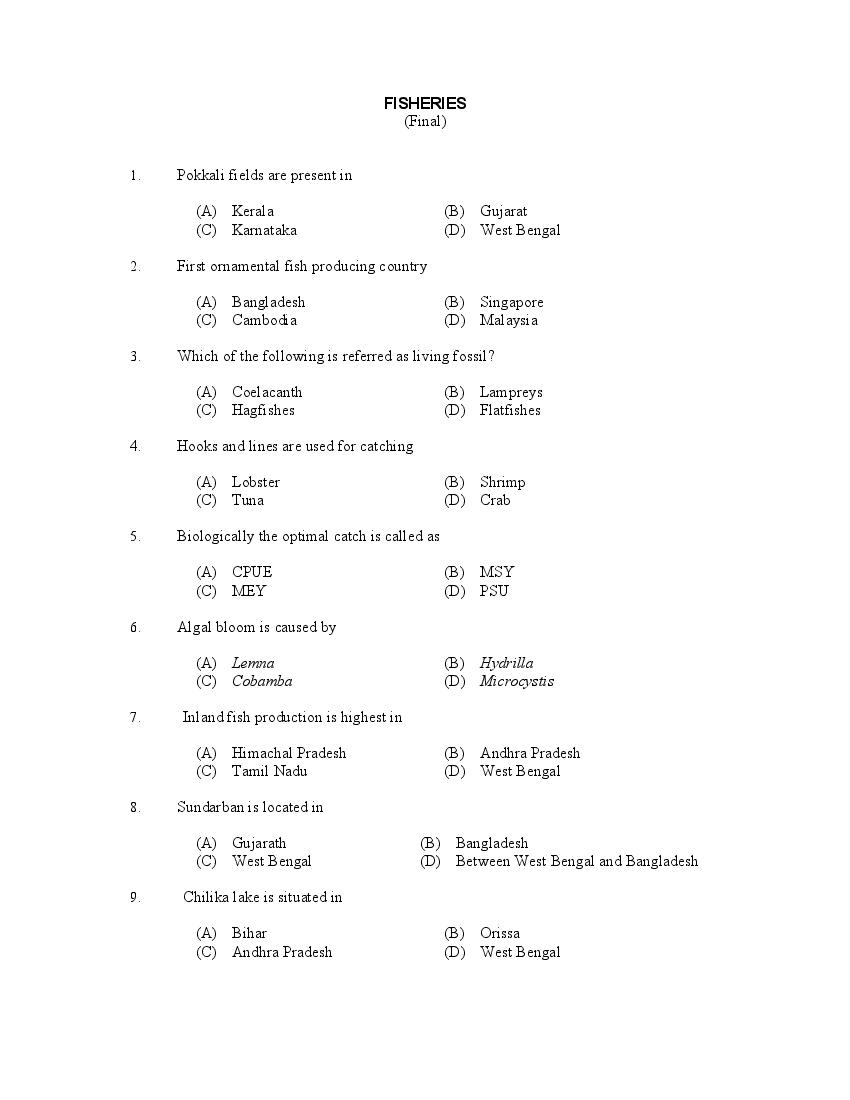
(Final)
1. Pokkali fields are present in
(A) Kerala (B) Gujarat
(C) Karnataka (D) West Bengal
2. First ornamental fish producing country
(A) Bangladesh (B) Singapore
(C) Cambodia (D) Malaysia
3. Which of the following is referred as living fossil?
(A) Coelacanth (B) Lampreys
(C) Hagfishes (D) Flatfishes
4. Hooks and lines are used for catching
(A) Lobster (B) Shrimp
(C) Tuna (D) Crab
5. Biologically the optimal catch is called as
(A) CPUE (B) MSY
(C) MEY (D) PSU
6. Algal bloom is caused by
(A) Lemna (B) Hydrilla
(C) Cobamba (D) Microcystis
7. Inland fish production is highest in
(A) Himachal Pradesh (B) Andhra Pradesh
(C) Tamil Nadu (D) West Bengal
8. Sundarban is located in
(A) Gujarath (B) Bangladesh
(C) West Bengal (D) Between West Bengal and Bangladesh
9. Chilika lake is situated in
(A) Bihar (B) Orissa
(C) Andhra Pradesh (D) West Bengal
Page 2
10. Which of the following is blue-green algae?
(A) Moina (B) Rotifer
(C) Daphnia (D) Spirulina
11. Fish oil is rich in
(A) Vitamin A (B) Vitamin D
(C) Vitamin C (D) Vitamin A and D
12. Aquaculture refers to
(A) culture of fish alone (B) culture of crustaceans
(C) culture of plants alone (D) culture of water-living form
13. Gizzard stomach is present in
(A) Mackerel (B) Murrels
(C) Mullet (D) Carps
14. Pitutary extract is preserved in
(A) Absolute alcohol (B) Formalin
(C) Acetone (D) Saline
15. Shark oil contains
(A) Caratin (B) Squalene
(C) Ambarine (D) None of the above
16. A step in canning of raw material in brine
(A) Frying (B) Cooling
(C) Roasting (D) Blanching
17. A male mate with several females is called
(A) Monogamy (B) Polygamy
(C) Polyandry (D) Monoyandry
18. Minamata disease is caused by
(A) Cadmium (B) Mercury
(C) Lead (D) Iron
19. Various steps in food chain are called
(A) Food web (B) Energy web
(C) Energy flow (D) Trophic level
Page 3
20. It is an association where no partner is harmed
(A) Communalism (B) Symbiosis
(C) Neutralism (D) Mutualism
21. Freshwater ecology is also called as
(A) Oncology (B) Hydrology
(C) Limnology (D) Meteorology
22. Sense organs found in fishes as unique features
(A) Olfactory sense organs (B) Auditory sense organs
(C) Semi circular canals (D) Lateral line organs
23. Air bladder is
(A) Excretory organ of fish (B) Respiratory organ of fish
(C) Excretory organ of mammals (D) Hydrostatic organ of bony fish
24. Blood circulation in fish is called as
(A) Double circulation (B) Arterial circulation
(C) Venous circulation (D) Arterial and venous circulation
25. In sucker fish ............... is modified as sucker
(A) mouth (B) dorsal fin
(C) ventral fin (D) ventral portion
26. Which of the following is a scale less fish?
(A) Scoliodon (B) Clarias
(C) Labeo (D) Channa
27. In which of the following fishes, the eyes are located in dorsal surface?
(A) Sharks (B) Skates
(C) Rat fish (D) Lion fish
28. Wheel-Animalclues belong to
(A) Insect (B) Porifera
(C) Rotifera (D) Trematodes
29. Pole culture is mainly for
(A) Crab (B) Prawn
(C) Mussel (D) Lobster
Page 4
30. Fast growing Indian major carp is
(A) Catla (B) Rohu
(C) Mrigal (D) Mahseer
31. White spot disease in shrimp is caused by
(A) Protozoa (B) Bacteria
(C) Fungus (D) Virus
32. Which of the following is a floating weed?
(A) Water lilly (B) Water milfoil
(C) Water hyacinth (D) None of the above
33. Pearl is a secretion of
(A) Kidney (B) Mantle
(C) Mouth (D) Water
34. Which culture technology is suitable for culture of sea bass?
(A) Pen (B) Cage
(C) Pond (D) Raceway
35. Mud bank is formed along the coast of
(A) Karnataka (B) Kerala
(C) Orissa (D) Goa
36. Head quarter of National Institute of Oceanography is located in
(A) Goa (B) Kerala
(C) Karnataka (D) Maharashtra
37 First Fisheries college established in India is in
(A) Kerala (B) Karnataka
(C) New Delhi (D) Maharashtra
38. First Fisheries university came into existence in India is
(A) Karnataka Fisheries University
(B) Tamil Nadu Fisheries University
(C) Andhra Pradesh Fishery Science University
(D) Kerala University of Fisheries and Ocean Studies
Page 5
39. On the basis of salinity, aquaculture system can be classified as
(A) Freshwater aquaculture (B) Brackishwater aquaculture
(C) Marinewater aquaculture (D) All of the above
40. In India, EEZ is extended up to ……….. nautical mile
(A) 12 (B) 200
(C) 212 (D) 400
41. Phytoplankton mesh size ………… microns
(A) 40 (B) 60
(C) 80 (D) 100
42. In tropical countries, the fish matures
(A) Late (B) Early
(C) Rarely (D) Seasonally
43. Dugong dugong is the scientific name of
(A) Sea otter (B) Dolphin
(C) Sea cow (D) Whale
44. Hippocampus trimaculatus is the scientific name of
(A) Sea urchin (B) Star fish
(C) Sea cucumber (D) Sea horse
45. Exotic game fish
(A) Brown trout (B) Snow trout
(C) Mahseer (D) Tilapia
46. Cyst of brine shrimp hatch out as
(A) Mysis (B) Nauplii
(C) Zoea (D) Protozoea
47. Which one of the following is known as Brine shrimp?
(A) Acetus indicus (B) Artemia salina
(C) Metapenaeus indicus (D) Penaeus indicus
48. The most widely used fish detection instrument is
(A) GPS (B) Sonar
(C) Radar (D) Echo Sounder
Page 6
49. An imaginary line on the earth’s surface which divides it into two poles
(A) Latitude (B) Equator
(C) Longitude (D) Greenwich meridian
50. Paddle wheel aerators are ................. type of aerators
(A) Gravity (B) Surface
(C) Turbine (D) Submersible
51. The fish which is mutual to sea anemone
(A) Scat (B) Clown fish
(C) Sea angle (D) Butterfly fish
52. An artificial fish habitat is
(A) a construction which provides a habitat for fishes
(B) a place where fishes are processed
(C) a place where fishes are sold
(D) a place where fishes are stocked
53. The country which initiated the use of live feed in aquaculture
(A) America (B) China
(C) India (D) Japan
54. What is Sagar Sampada?
(A) A research vessel (B) A commercial ship
(C) A Naval ship (D) A luxury vessel
55. What is the use of Echo Sounder?
(A) To find out the ship’s direction
(B) To find out the depth of the sea
(C) To find out the wind velocity
(D) To find out the sun’s position
56. Which is called as Guppy?
(A) Macropodus (B) Colisa
(C) Mollienisia (D) Poecilia
57. Which of the following is best used as Aquarium Cleaner?
(A) Noemacheilus (B) Poecilia
(C) Gambusia (D) Gyrinocheilus
Page 7
58. Asphyxiation is a term related with
(A) harvesting (B) preservation
(C) breathing (D) eating
59. Rigor Mortis is basically characterized by
(A) stiffening of body (B) softening of body
(C) asphyxiation (D) red cheeks
60. Self brine is the term associated with
(A) canning (B) pickling
(C) smoking (D) salting
61. Thiaminase has been found mainly in the flesh of
(A) freshwater fishes (B) marine fishes
(C) estuarine fishes (D) smoked fishes
62. A layer, in which there is rapid decrease of temperature with depth, is called
(A) Thermocline (B) Thermodecline
(C) Thermoline (D) Thermophile
63. Which of the following occurs along a seashore as a result of a rise in sea level?
(A) Marine terraces (B) Wave-cut beaches
(C) Beach ridges (D) Sand bars
64. The gas normally used to fill the Scuba dive cylinders is
(A) Oxygen (B) Carbon di oxide
(C) Liquefied ammonia (D) Atmospheric air
65. At which stage oysters or other shellfishes settling down and becoming attached to
a hard object?
(A) Spat (B) Fry
(C) Larva (D) Juvenile
66. The mud flat and saline swamps located in West Bengal are called
(A) Bheries (B) Lagoon
(C) Backwater (D) Embanked brackish water
67. Shrimp carrying fertilized eggs in the abdominal pouch is called
(A) matured female (B) berried female
(C) Endo pods (D) Post-larvae
Page 8
68. Sea urchins belong to the class
(A) Holothuroidea (B) Echinoidea
(C) Helicoplacoidea (D) Ophiocystioidea
69. Pinaeus japonicus is commonly called as
(A) Kuruma shrimp (B) Kuruma lobster
(C) Kuruma prawn (D) Kuruma fish
70. The Genus Homarus refers to
(A) a shrimp (B) a lobster
(C) a molluscan (D) a fish
71. Which of the following amino acids is found to be abundant in fish?
(A) Leucine (B) Lysine
(C) Tryptophan (D) Methionine
72. The Loaches belong to the family
(A) Cyprinidae (B) Cobitidae
(C) Amblycipitidae (D) Sisoridae
73. The zone where deep currents rise to the surface is called
(A) Zone of Eutrophication (B) Zone of Epiwelling
(C) Zone of Upwelling (D) Zone of Swelling
74. The blooming of which of the following diatom in the Arabian Sea is an indicator of the
abundance of Sardinella sp.?
(A) Noctiluca (B) Navicula
(C) Fragilaria (D) Miliolina
75. Phenomenon of Red Tide in the sea is due to the presence of
(A) Red Algae (B) Bioluminescent dinoflagellates
(C) Dinoflagellates (D) Red colour of water
76. The ratio between food consumed per unit weight gained by the body is expressed by
(A) Food Conversion Rate
(B) Food Absorption Rate
(C) Food Consumption Rate
(D) Food Assimilation Rate
Page 9
77. Ponderal Index is another term for
(A) Maturity of Gonads (B) Good Quotient
(C) Growth factor (D) Condition Factor
78. Pituitary Gland extracts are injected to induce
(A) Ovulation (B) Gonadal development
(C) Sex play (D) Secretion of Sex Hormones
79. Buccal Incubation is the characteristic of
(A) Cyprinus (B) Clarias
(C) Pangasius (D) Tilapia
80. Mono-Sex culture is adopted in case of
(A) Tilapia (B) Trouts
(C) Channel Catfish (D) Carps
81. Pure water is obtained from sea water by the process of
(A) Filtration (B) Distillation
(C) Evaporation (D) Fractional distillation
82. The fishes coming under the class Elasmobranchii will have
(A) two gill openings (B) three gill openings
(C) four gill openings (D) five gill openings
83. Anabas has which type of respiratory organ?
(A) Arborescent (B) Air bladder
(C) Labrinthine (D) Tubular sacs
84. Isthmus is a fleshy projection
(A) separating the gill openings (B) found in the intestine
(C) found in the head (D) found in the brain
85. Adipose tissue of fish is formed of
(A) Protein (B) Aminoacid
(C) Fat (D) Carbohydrate
86. Elasmobranchii includes
(A) Bony fishes (B) Cartilaginous fishes
(C) Jawless fish (D) Rays and skates
Page 10
87. Ammenoletic animals excrete
(A) Uric acid (B) Ammonia
(C) Urea (D) Nitrogen waste
88. What is the use of chloride cells in fishes?
(A) To eliminate blood cells (B) To eliminate chloride ions
(C) To eliminate wastes (D) To eliminate ions
89. In shark the claspers are located
(A) near the pelvic fins (B) near the pectoral fins
(C) near the caudal fins (D) near the dorsal fin
90. Hibernation is
(A) Summer sleep (B) Winter sleep
(C) Dormant stage (D) Diving
91. A fish is edentulous when it is
(A) without teeth (B) with teeth
(C) with one set of teeth (D) teeth in both jaws
92. The tides in the ocean are caused by
(A) wind over the sea (B) gravitational pull of the moon
(C) rotation of the earth (D) sun light
93. Oviparous fish produce
(A) Eggs (B) Babies
(C) Young ones (D) Adults
94. Which one of the following is a live feed organism?
(A) Tubifex (B) Sea weed
(C) Crab (D) Oyster
95. “Pasture of the sea” refers to
(A) Zooplankton (B) Phytoplankton
(C) Nannoplankton (D) Nekton
96. Which is called ‘round mouthed fish’?
(A) Elasmobranchii (B) Teleostomes
(C) Cyclostomata (D) None of the above
Page 11
97. The use of which of the following devices has given the modern biologist a better
insight into the internal structure of cells?
(A) Computer (B) Electron Microscope
(C) Micrometer (D) Ultracentrifuge
98. Vertical fins are
(A) unpaired fins found on the median line of the body
(B) paired fins found on the sides
(C) fins found in the anal region
(D) None of the above
99. The olfactory epithelium of Teleosts is highly secretory due to the presence of
(A) Phosphatase activity (B) Water
(C) Gland cells (D) Lipids
100. Oxygen deficiency in the water causes
(A) Suffocation (B) Allergy
(C) Death (D) Unconsciousness
101. Gular plate in a fish is
(A) a plate covering the upper part of the throat
(B) a plate covering the head
(C) a plate covering the eyes
(D) a plate covering the nose
102. What is “masmeen”?
(A) Dry tunas (B) Dry sadines
(C) Wet anchovies (D) Dry anchovies
103. The species which is most suitable for aquaculture is called
(A) Exotic species (B) Candidate species
(C) Subspecies (D) Native Species
104. Francis Day wrote the book
(A) The Marine and Fresh water Fishes of Ceylon
(B) The Sea Fishes of South Africa
(C) The Fishes of India
(D) The Fishes of the Indo-Australian Archipelago
Page 12
105. ‘Fishes of the Laccadive Archipelag’ was written by
(A) Smith, J.L.S (B) Munro, I.S.R
(C) Jones, S. and M. Kumaran (D) Jingran, V.G
106. Male sea-horse carries the eggs
(A) in its mouth (B) as a glutinous mass on the back
(C) in its pouch (D) in its stomach
107. Eyes are absent in
(A) Pelagic fishes (B) Benthic fishes
(C) Cave fishes (D) Brackish water fishes
108. Fishes in the culture ponds come to the surface in the morning for want of
(A) Oxygen (B) Food
(C) Sunlight (D) Shade
109. In many countries the use of explosives for fishing is prohibited by law because,
A) it has a devastating effect on all life in the area
(B) it pollutes the water
(C) it affects human beings
(D) it is poisonous to consume such fish
110. “Co-management” is a term used in
(A) Poulty Science (B) Animal Husbandry
(C) Fisheries Management (D) Agriculture
111. Sea ranching means
(A) sailing in the sea (B) diving in the sea
(C) snorkeling in the sea (D) releasing fish seed into the sea
112. Pen culture is a system meant for culturing
(A) Fish (B) Birds
(C) Turtles (D) Covals
113. Mono culture means
(A) culture of one species of fish
(B) culture of fish coming under one genus
(C) culture of fish from a family
(D) culture of fish from an order
Page 13
114. Trash fish means
(A) name of a fish (B) unwanted fish
(C) bottom dwelling fish (D) surface living fish
115. Bye catch means
(A) targeted fish catch in a trawl net
(B) non-targeted catch in a trawl net
(C) second-level catch in a trawl net
(D) purchase of a trawl catch
116. Which one is a flying fish?
(A) Eleuthronema (B) Exocoetus
(C) Carangid (D) Heteopneustus
117. Chromatophores are situated in the ........... of fishes
(A) Intestine (B) Heart
(C) Dermis (D) Eyes
118. ‘Anguiliform’ type of movement is seen in
(A) Eels (B) Sardine
(C) Perches (D) Anchovies
119. Polysiphonia is a
(A) Green Alga (B) Red Alga
(C) Yellow Alga (D) Brown Alga
120. The climping perch climb up the trees with the help of pectorals and
(A) Caudals (B) Operculum
(C) Anals (D) Ventrals
121. Which one of the following gems is produced by an animal?
(A) Diamond (B) Emerald
(C) Ruby (D) Pearl
122. The largest living animal is
(A) Whale (B) Elephant
(C) Tortoise (D) Tiger
Page 14
123. Hypophysation technique is followed in the case of
(A) Prawns (B) Finfish
(C) Clams (D) Mussels
124. Eyestalkablation is done to induce the spawning of
(A) Mullet (B) Shrimps
(C) Chanos (D) Channa
125. Fish is the richest source of
(A) Silica (B) Iodine
(C) Magnesium (D) Zinc
126. Carassius auratus is the scientific name of
(A) Molly (B) Guppy
(C) Gold fish (D) Mullet
127. Elver is the larva of
(A) Eel (B) Murrel
(C) Mullet (D) Channa
128. Heterocercal type of caudal fin is found in
(A) Scorpion (B) Scoliodon
(C) Eel (D) Tilapia
129. Larva of petromyzon is
(A) Ammocoetus (B) Tadpole
(C) Elver (D) Pupa
130. Which hormone is involved in the process of osmoregulation?
(A) Adrenalin (B) Insulin
(C) Thyroxin (D) Oestrogen
131. Which fish can produce electricity?
(A) Narcine (B) Sardine
(C) Mugil (D) Milkfish
132. Melanin is a ............... pigment
(A) black (B) yellow
(C) red (D) green
Page 15
133. The aquatic animal with the most developed intelligence is
(A) Whale (B) Seal
(C) Dolphin (D) Kangaroo
134. Which is the primary cause of spoilage of fish?
(A) Bacteria (B) Fungi
(C) Protozoa (D) Virus
135. Which is also called ‘Pearl Spot’?
(A) Tilapia (B) Clarias
(C) Etroplus (D) Macropolies
136. Mermaid purse is produced by
(A) Shark (B) Tilapia and Clarius
(C) Etroplus and cat fish (D) Chanos and Mullet
137. ‘Roe’ is called
(A) Sperm (B) Ovary of fish
(C) Lung of fish (D) Vasdeferens of fish
138. Epinephelus is commonly known as
(A) sea turtle (B) sea horse
(C) sea lily (D) sea bass
139. FAO stands for
(A) Foreign Associated Organization
(B) Foreign Agricultural Organization
(C) Food and Agricultural Organization
(D) Fossils and Animals organization
140. Which is called ‘Eagle ray’?
(A) Clarias (B) Narcine
(C) Myliobatus (D) Etroplus
141. ICAR is
(A) Indian Council of Agricultural Research
(B) Indian Coastal Aquacultural Research
(C) Indian Council of Aquatic Research
(D) Institute for Coastal Research
Page 16
142. 'Leaf like' stage of lobster is called
(A) Phyllosoma (B) Phyllicum
(C) Pnematophore (D) Physalia
143. Which is called as tiger prawn?
(A) Penaeus indicus (B) Metapenaeus dobsomi
(C) Penaeus monodon (D) Metapenaeus sp.
144. What is plankton?
(A) Floating plants
(B) Floating animals
(C) Floating micro plants and animals
(D) Free swimming organisms
145. Exoskeleton of crab is made up of
(A) Calcium (B) Chitin
(C) Phosphate (D) None of the above
146. The association between shark and sucker fish is referred to as
(A) Mutualism (B) Commensalism
(C) Symbiosis (D) Parasitism
147. Indicate the correct hierarchy
(A) family, species, genus (B) genus, family, species
(C) species, family, genus (D) family, genus, species
148. The larva of the prawn is
(A) Pilidium (B) Trochophore
(C) Zoea (D) Myotoxin
149. Excretory organs in the case of Echinoderms are
(A) Malphigian tubules (B) Kidneys
(C) Nephridia (D) Have no excretory organs
150. Furnuculosis appears to infect fishes living in
(A) Dirty water (B) Sea water
(C) Fresh water (D) Brackish water
***
Document Details
| Board / Org | Cochin University |
| Exam | CUSAT Common Admission Test |
| Type | Question Paper |
| Pages | 16 |
| Updated | 22 Jul 2026 |