CUSAT CAT 2017 Question Paper Geology
Finished viewing? Save it for later —
Download CUSAT CAT 2017 Question Paper Geology (PDF · 19 pages)About CUSAT CAT 2017 Question Paper Geology
CUSAT CAT 2017 Question Paper Geology is available here for free download. Published by Cochin University for CUSAT Common Admission Test, this question paper can be viewed online or downloaded as a PDF (19 pages). Candidates preparing for CUSAT Common Admission Test can use CUSAT CAT 2017 Question Paper Geology to understand the exam pattern, the type of questions asked, and the overall difficulty level.
Frequently Asked Questions
How can I download CUSAT CAT 2017 Question Paper Geology?
Open this page and click the Download button to save CUSAT CAT 2017 Question Paper Geology as a PDF. It is completely free on AglaSem Docs.
Is CUSAT CAT 2017 Question Paper Geology free to download?
Yes. CUSAT CAT 2017 Question Paper Geology can be viewed online and downloaded as a PDF free of cost on AglaSem Docs.
How many pages does CUSAT CAT 2017 Question Paper Geology have?
CUSAT CAT 2017 Question Paper Geology contains 19 pages, which you can read online or download together as a single PDF.
Where can I find more CUSAT Common Admission Test study material?
You can find more CUSAT Common Admission Test question papers, sample papers, syllabus, and answer keys on AglaSem Docs.
CUSAT CAT 2017 Question Paper Geology – Text
Read the full text of this question paper below — useful to quickly search, copy and reference the content online without downloading the PDF.
📄 View text version (19 pages)
Page 1
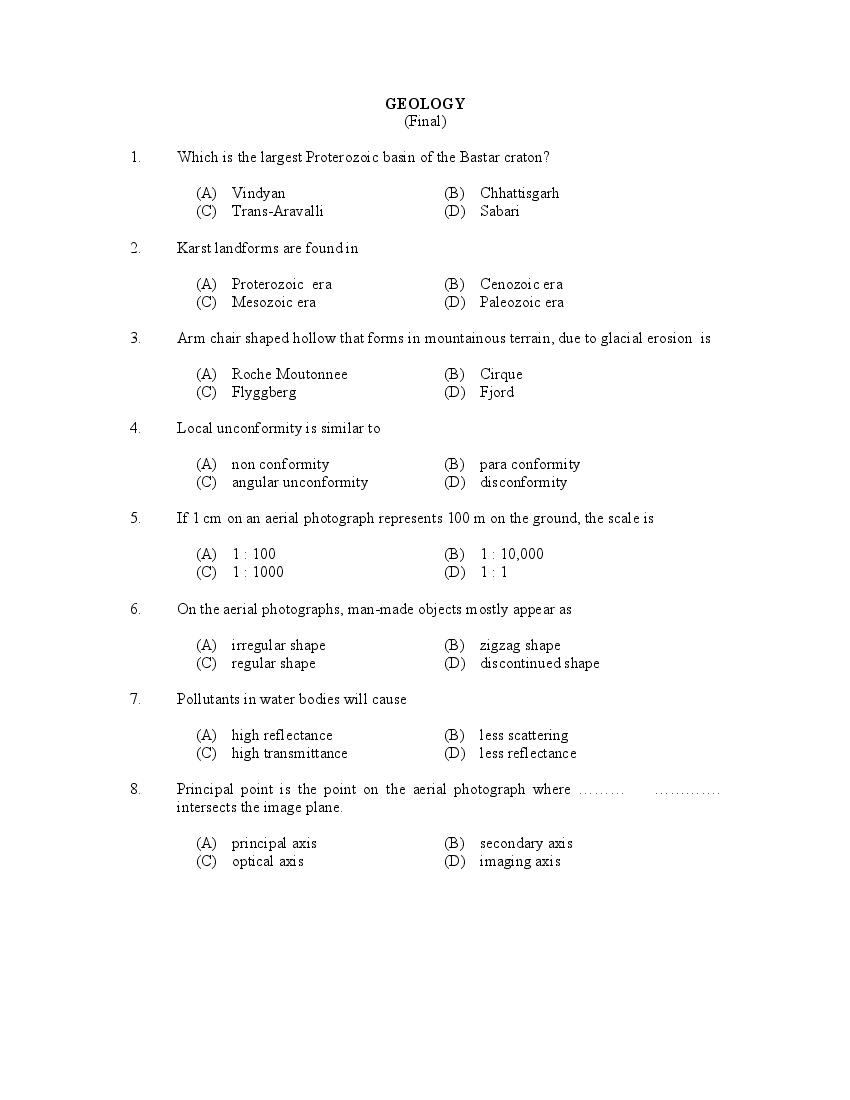
(Final)
1. Which is the largest Proterozoic basin of the Bastar craton?
(A) Vindyan (B) Chhattisgarh
(C) Trans-Aravalli (D) Sabari
2. Karst landforms are found in
(A) Proterozoic era (B) Cenozoic era
(C) Mesozoic era (D) Paleozoic era
3. Arm chair shaped hollow that forms in mountainous terrain, due to glacial erosion is
(A) Roche Moutonnee (B) Cirque
(C) Flyggberg (D) Fjord
4. Local unconformity is similar to
(A) non conformity (B) para conformity
(C) angular unconformity (D) disconformity
5. If 1 cm on an aerial photograph represents 100 m on the ground, the scale is
(A) 1 : 100 (B) 1 : 10,000
(C) 1 : 1000 (D) 1 : 1
6. On the aerial photographs, man-made objects mostly appear as
(A) irregular shape (B) zigzag shape
(C) regular shape (D) discontinued shape
7. Pollutants in water bodies will cause
(A) high reflectance (B) less scattering
(C) high transmittance (D) less reflectance
8. Principal point is the point on the aerial photograph where ……… ………….
intersects the image plane.
(A) principal axis (B) secondary axis
(C) optical axis (D) imaging axis
Page 2
9. The evolution of facial suture in Trilobites is noticed in the following order
(A) protoparian – proparian – hypoparian – gonatoparian
(B) proparian – hypoparian – gonatoparian – protoparian
(C) protoparian – hypoparian – gonatoparian – proparian
(D) hypoparian – gonatoparian – proparian – protoparian
10. The twin laws that govern polysynthetic twinning in microcline are
(A) Albite and Pericline (B) Pericline and Carlsbad
(C) Aarlsbad and Albite (D) Albite, Pericline and Carlsbad
11. Which of the following is not an alteration product of olivine?
(A) serpentine (B) iddingsite
(C) chloropharite (D) tephroite
12. In which schist belt the Kudremukh iron ore is situated?
(A) Dharwar (B) Shimoga
(C) Bababudan (D) Western-Ghats
13. What is uralitization?
(A) Replacement of pyroxene by amphibole
(B) Replacement of plagioclase by epidote
(C) Replacement of mineral by chlorite
(D) Replacement of feldspar by mica
14. The diameter of pyroclastic rock that ranges from 2 to 64 mm is called
(A) ash (B) tuff
(C) lapilli (D) bombs
15. In igneous rocks, mineral grains showing compact crystal forms with irregular
boundaries are called
(A) semihedral form (B) euhedral form
(C) subhedral form (D) anhedral form
Page 3
16. In terms of colour index, igneous rocks with less than 30 percent of dark minerals
are described as
(A) microcratic (B) melanocratic
(C) leucocratic (D) semicratic
17. The igneous rocks found in large deep-seated intrusions are described as
(A) plutonic (B) lopolith
(C) dyke (D) cone sheets
18. The product of volcanoclastic fabrics related to fragmentation of magmatic material is
(A) granitoid (B) granophyre
(C) oikocryst (D) pyroclast
19. Which one of the following is important in fixing the metamorphic grade?
(A) Grain size (B) Fabric
(C) Intensity of deformation (D) Mineral assemblage
20. Migmatite can be regarded as a mixed rock composed of
(A) magmatic and sedimentary rocks
(B) magmatic and meteorite rocks
(C) magmatic and metamorphic rocks
(D) magmatic and quartzitic rocks
21. Which one of the following is not a standard metamorphic facies?
(A) Zeolite (B) Granulite
(C) Sillimanite (D) Eclogite
22. The combination of raw materials used in cement industry are
(A) limestone, sandstone and shale
(B) limestone, clay, marl, oyster shells
(C) limestone, granite and basalt
(D) limestone, feldspar and magnesite
23. Which of the following plutons is anorthosite?
(A) Angadimogar (B) Peralimala
(C) Ezhimala (D) Perinthatta
Page 4
24. Bauxite deposits result due to
(A) biological activity of parent rock
(B) chemical weathering of parent rock
(C) mechanical weathering of parent rock
(D) wave action
25. In Assam, the oil bearing formation belong to
(A) Surma sandstone (B) Tipam sandstone
(C) Murree sandstone (D) Barail sandstone
26. Copper mineralization in the form of malachite encrustation is seen in
(A) Khetri copper belt of Rajasthan
(B) Singhbhum copper belt of Bihar
(C) Balaghat district of Madhya Pradesh
(D) Khammam district of Andhra Pradesh
27. In the Cuddapah Basin of Andhra Pradesh, asbestos has developed in Vempalle
limestone as
(A) intrusive deposits (B) contact metamorphic deposits
(C) volcanic deposits (D) segregation deposits
28. Hard water contains large amount of
(A) lead (B) sodium
(C) calcium (D) silicon
29. Which one of the following has least specific yield?
(A) Gravel (B) Sand
(C) Sandstone (D) Shale
30. For an aquifer with hydraulic gradient (I), cross-sectional area (A) and hydraulic
conductivity (K), the discharge as per Darcy’s law will be equal to
(A) K.I.A (B) K. I/A
(C) K. A/I (D) A/K. I
Page 5
31. Idukki dam constructed over Periyar river is an example of
(A) Buttress dam (B) Arch dam
(C) Embankment dam (D) Earth dam
32. Which of the following structures is seen in compressional tectonic regimes?
(A) Normal fault (B) Strike-slip fault
(C) Rift (D) Thrust
33. To which mobile belt, the charnockites of Kerala belong to?
(A) Eastern Ghats Mobile belt
(B) Western Ghats Mobile belt
(C) Pandyan Mobile belt
(D) Bababudan Mobile belt
34. Rare earth deposits of Manavalakurichi is
(A) Beach placers (B) Alluvial placers
(C) Eolian placers (D) Elluvial placers
35. Neyveli lignite deposits occur in
(A) Panaparai sandstone (B) Varkala sandstone
(C) Sriperampudur beds (D) Cuddalore sandstone
36. The specific gravity of monazite
(A) 5.2 (B) 3.1
(C) 2.5 (D) 2.8
37. At Chalk Hills of Salem, magnesite veins occur in
(A) granite (B) charnockite
(C) dunite (D) sandstone
38. According to which hypothesis, the planetary system is believed to the formed from
an originally hot, rarefied, gaseous atmosphere which surrounded the primeval sun?
(A) Nebular hypothesis (B) Planetesimal hypothesis
(C) Tidal hypothesis (D) Protoplanet hypothesis
Page 6
39. Mohorovicic discontinuity marks the base of
(A) inner core (B) core
(C) mantle (D) crust
40. Himalayas is an example of
(A) residual mountain (B) volcanic mountain
(C) collision mountain (D) rocky mountain
41. The theory of plate tectonics supposes that the lithosphere of the Earth is made up of
(A) seven major and several minor plates
(B) seven major and seven minor plates
(C) several major and seven minor plates
(D) several major and several minor plates
42. Landforms such as Eskers, Kettles Erratics and Varves are due to
(A) glaciers (B) streams
(C) rivers (D) wind
43. Shear folding is also known as
(A) recumbent folding (B) stress folding
(C) isoclinals folding (D) slip folding
44. What is the age of ‘Purana’ basins of Indian stratigraphy?
(A) Archean (B) Proterozoic
(C) Paleozoic (D) Phanerozoic
45. Which of the following is a common mineral in medium-grade regionally
metamorphosed argillaceous rock?
(A) Garnet (B) Staurolite
(C) Chlorite (D) Sillimantie
46. Which of the following is a penetrative planar structure?
(A) Boudinage (B) Schistocity
(C) Slicken side (D) Imbrication
Page 7
47. The unconformity with parallel beds on either side and cover a large extent and
represent considerable interval of time is referred as
(A) angular unconformity (B) disconformity
(C) local unconformity (D) non unconformity
48. Which of the following is not of the Epidote group?
(A) Zoisite (B) Piemontite
(C) Allanite (D) Wollastonite
49. Closely spaced intersecting joints in basic igneous rocks, in a small scale aerial
photograph, are seen as
(A) fine texture (B) rippled texture
(C) coarse texture (D) criss-cross texture
50. In India, Silurian graptolites are reported from
(A) Aravalli ranges (B) Western ghats
(C) Himalayan ranges (D) Vindhyan ranges
51. An unconformity in which the older crystalline rocks are overlain unconformably by
sedimentary rock or lava flow is referred as
(A) disconformity (B) non-conformity
(C) angular unconformity (D) local unconformity
52. The ammonoids became extinct in
(A) Jurassic (B) Triassic
(C) Cretaceous (D) Permian
53. Trace fossils are also known as
(A) organic fossils (B) ichno fossils
(C) ripple fossils (D) pseudo fossils
54. Which one of the following is correctly matched?
(A) Schloenbachia – Lower Lias
(B) Ceratites – Jurassic
(C) Perisphinctes – Triassic
(D) Baculites – Chalk
Page 8
55. The trilobite which does not belong to the Cambrian period is
(A) olenellus (B) paradoxides
(C) olenus (D) phacops
56. Graptolites occur most commonly in
(A) sandstones (B) argillaceous rocks
(C) limestones (D) arenaceous rocks
57. Which of the following is not an olivine?
(A) Siderite (B) Hyalosiderite
(C) Hortonolite (D) Tephroite
58. Which fault separates the North Khetri Belt from the South Khetri Belt?
(A) Alwar fault (B) Kantli fault
(C) Khetri fault (D) Ajabgarh fault
59. Bairenkonda quartzites belong to
(A) Kistna group (B) Nallamalai group
(C) Cheyyar group (D) Papaghni group
60. Which of the following is oldest?
(A) Srisailam quartzites (B) Nagari quartzite
(C) Paniam quartzites (D) Gulcheru quartzites
61. The famous Panna diamond field of India is found in
(A) Rewa group (B) Semri group
(C) Kaimur group (D) Bhander group
62. Which accessory mineral can be expected in Quartz-bearing syenite?
(A) Fayalite (B) Forsterite
(C) Nepheline (D) Chromite
63. Bireflectance is a property analogous to
(A) birefringence (B) biaxiality
(C) pleochrism (D) isotropism
Page 9
64. The least angle of incidence, for which there is total reflection when visible light
tends to pass from a denser into a less denser medium, is called
(A) extinction angle (B) critical angle
(C) angle of dispersion (D) incident angle
65. The exhibition of prismatic colours in the interior or on the surface of a mineral is
called
(A) fluorescence (B) iridescence
(C) opalescence (D) phosphorescence
66. Carlsbad, Baveno and Manebach twinning is commonly found in
(A) olivine (B) mica
(C) pyroxenes (D) plagioclase feldspars
67. The mineral crosstie is
(A) orthoamphibole (B) clinoamphibole
(C) triclinic amphibole (D) amphibole devoid of sodium
68. Which one of the following pairs is correctly matched?
(A) Olivine – Amphibole
(B) Cordierite – Mica
(C) Orthoclase – Pyroxene
(D) Nepheline – Feldspathoid
69. Carlsbad law of twinnings is characteristic of
(A) albite (B) oligoclase
(C) microcline (D) orthoclase
70. The chemical composition of leucite is
(A) NaAlSi2 O6 (B) KAlSi3 O8
(C) KAlSi2 O6 (D) NaAlSi3 O8
Page 10
71. Consider the following statements:
I. Aegirine is a pyroxene
II. Aegirine crystallizes in triclinic system
(A) Both I and II are correct (B) Both I and II are false
(C) I is correct, but II is false (D) II is correct, but I is false
72. Which one of the following is in the proper order of Moh’s scale of hardness?
(A) Calcite – Apatite – Fluorite – Orthoclase
(B) Calcite – Fluorite – Orthoclase – Gypsum
(C) Calcite – Fluorite – Apatite – Orthoclase
(D) Calcite – Orthoclase – Apatite – Quartz
73. Most of the gem quality of corundum is obtained from
(A) pegmatites (B) metamorphosed deposition
(C) placer deposits (D) nepheline syenites
74. Zircon is a common accessory mineral of igneous rocks particularly in
(A) volcanic rocks (B) hypa byssal rocks
(C) plutonic rocks (D) intermediate rocks
75. Which one of the following is an example of fibrous silicate with single direction of
cleavage?
(A) Wollastonite (B) Tremolite
(C) Sillimanite (D) Kyanite
76. Andalusite crystallizes in ………….. system.
(A) hexagonal (B) orthorhombic
(C) monoclinic (D) triclinic
77. Which of the following is not correctly matched?
(A) Zircon – Uniaxial positive
(B) Calcite – Uniaxial negative
(C) Spinel – Biaxial
(D) Pyrope – Isotropic
Page 11
78. Potash feldspar ovoids mantled by plagioclase feldspar is characteristic
of …………….. texture.
(A) spinifex (B) orbicular
(C) rapakivi (D) seriate
79. A granitic rock having equal amount of plagioclase and alkali feldspar is
(A) rockallite (B) enderbite
(C) adamellite (D) trondhjemite
80. The most distinctive feature of kimberlite compared with other mantle derived
magmas is the high contents of
(A) Na and volatiles (B) K and volatiles
(C) Ca and volatiles (D) Fe and volatiles
81. The constant proportion in which the two constituents crystallize simultaneously is
called
(A) eutectic (B) solidus
(C) liquidus (D) peritectic
82. The eutectic ratio for the pair diopside and anorthite is
(A) 35 : 65 (B) 58 : 42
(C) 88 : 12 (D) 65 : 35
83. The proper order of crystallization in the Bowen’s reaction series is
(A) Amphibole – Pyroxene – Mica – Quartz
(B) Pyroxene – Amphibole – Mica – Quartz
(C) Quartz – Pyroxene – Amphibole – Mica
(D) Pyroxene – Mica – Amphibole – Quartz
84. Consider the following statements:
I. Bowen’s reaction principle explains the process of magma mixing.
II. Plagioclase series form the continuous reaction series
III. The early formed plagioclase in a sub-alkalic magma is andesine.
IV. All Mg-pyroxenes are derived by reaction from olivine.
(A) I, II and III are correct (B) I and III are correct
(C) II and III are correct (D) II alone is correct
Page 12
85. Among the calcareous sedimentary deposits, a nodular iron-rich calc sinter formed by
capillary action is
(A) Tufa (B) Chalk
(C) Marl (D) Kankar
86. Which of the following minerals is otherwise known as ‘idocrase’?
(A) Halite (B) Fluorite
(C) Vesuvianite (D) Indicolite
87. The characteristic minerals formed with increasing grades of metamorphism are
(A) Chlorite – Biotite – Kyanite – sillimanite
(B) Chlorite – Kyanite – Sillimanite – Biotite
(C) Biotite – Chlorite – Kyanite – Sillimanite
(D) Biotite – Chlorite – Sillimanite – Kyanite
88. According to Grubenmann’s depth zones, amphibolite is in
(A) epi-zone (B) meso - zone
(C) kata - zone (D) para - zone
89. Spodumene is a
(A) clinopyroxene (B) orthopyroxene
(C) amphibole (D) feldspar
90. In lignite, the moisture content amounts to
(A) 43% (B) 21%
(C) 63% (D) 85%
91. Which one of the following minerals does not exhibit polymorphism?
(A) Andalusite (B) Rutile
(C) Orthoclase (D) Biotite
92. Which one of the following minerals has steel grey colour metallic lustre and two sets
of perfect octahedral cleavage?
(A) Magnetite (B) Molybdenite
(C) Barite (D) Galena
Page 13
93. A massive fine-grained, snow white or light coloured gypsum used in cement industry
is
(A) selenite (B) gypsite
(C) satin spar (D) alabaster
94. Cannel coals that show either of fresh water or of marine origin and usually related to
oil shales are
(A) peat (B) lignite
(C) bituminous coal (D) anthracite
95. The highest rank of coal variety is
(A) anthracite (B) bituminous
(C) sub-bituminous (D) lignite
96. Hematite is the ore mineral of
(A) aluminium (B) copper
(C) asbestos (D) iron
97. Which one of the following is the heaviest among all?
(A) Asbestos (B) Barite
(C) Coal (D) Mica
98. The mineral phlogopite is known as
(A) magnesium mica (B) sodium mica
(C) potassium mica (D) lithium mica
99. Which one of the following has maximum hydraulic conductivity?
(A) Loess (B) Fine gravel
(C) Coarse sand (D) Sandstone
100. Gahnite is an ore of which metal?
(A) Pb (B) Cu
(C) Zn (D) Ni
Page 14
101. Nickel is concentrated in
(A) dunite (B) pegmatite
(C) granite (D) nepheline syenite
102. The planatesimal hypothesis was postulated by
(A) Kant (B) Laplace
(C) Jean’s and Jeffrey’s (D) Chamberlain and Moulton
103. Which among the following planets has the least density?
(A) Jupiter (B) Saturn
(C) Venus (D) Earth
104. Galena crystallises in the form of
(A) cubes and octahedral (B) cubes and rhombohedra
(C) cubes and trapzohedra (D) cubes and dodecahedra
105. Olivine crystallises in ………… system.
(A) cubic (B) monoclinic
(C) triclinic (D) orthorhombic
106. Sittampundi complex is famous for
(A) anorthosite (B) magnesite
(C) granite (D) pegmatite
107. Which one of the following formations is devoid of fossils?
(A) Blaini (B) Infra krol
(C) Krol (D) Tal
108. Columnar joints are common in
(A) basalt (B) shale
(C) gabbro (D) granite
109. The vertical component of the dip slip in a fault is
(A) hade (B) slip
(C) throw (D) heave
Page 15
110. Which one of the following folds has sharp and angular hinges?
(A) Chevron fold (B) Drag fold
(C) Fan fold (D) Anticline
111. What is the use of ‘dip isogons’?
(A) For calculating true dip from apparent dip.
(B) For representing orientation of faults.
(C) For classifying faults and joints.
(D) For classifying folds.
112. Three sets of mutually perpendicular joints found in granites is
(A) mural joint (B) stress joint
(C) columnar joint (D) shear joint
113. When the lower beds of the older series extend further than the younger ones, it is
called
(A) over lap (B) off lap
(C) inlier (D) outlier
114. The thread like prolongations of graptolites are called
(A) sicula (B) stipes
(C) virgula (D) polypary
115. The most primitive suture line in trilobites is described as
(A) hypoparian (B) opisthoparian
(C) proparian (D) gonatoparian
116. Gastropod having spines and exhibiting dextral type of coiling is
(A) turritella (B) physa
(C) voluta (D) murex
117. The first land plant appeared in
(A) Silurian (B) Ordovician
(C) Devonian (D) Carboniferous
Page 16
118. Trilobites disappear at the end of
(A) Cretaceous (B) Pliocene
(C) Precambrian (D) Permian
119. Taxodonta dentition is found in
(A) arca (B) mytilus
(C) pecten (D) Unio
120. The first dinosaurs appeared in
(A) early Triassic (B) late Triassic
(C) early Jurassic (D) late Jurassic
121. The water entrapped in the sedimentary rock during their sedimentation process is
called
(A) Juvenile water (B) Connate water
(C) Meteoric water (D) Vadose water
122. A majority of aquifers consists of
(A) sand and gravel (B) shale
(C) limestone (D) conglomerate
123. Which one of the following has the highest porosity?
(A) Gravel (B) Clay
(C) Silt (D) Granite
124. The average porosity of sandstone is
(A) 5-10% (B) 10-20%
(C) 25-35% (D) 35-40%
125. Where is confined water found?
(A) Above the water table
(B) Between aquiclude and aquifer
(C) Below the water table
(D) Below an impermeable bed
Page 17
126. Gutenberg discontinuity layer occur at a depth of
(A) 60 kms (B) 970 kms
(C) 2730 kms (D) 2900 kms
127. Which one of the following minerals crystallises in the cubic system?
(A) Pyrite (B) Zircon
(C) Chalcopyrite (D) Quartz
128. In an orthorhombic crystal, the ‘a’ axis is known as
(A) macro axis (B) brachy axis
(C) clino axis (D) ortho axis
129. Pinacoid or Dome faces occur in the crystals belonging to
(A) monoclinic system (B) cubic system
(C) tetragonal system (D) hexagonal system
130. The fracture which involves the development of more or less smooth curved surfaces
is referred as
(A) uneven (B) even
(C) conchoidal (D) hackly
131. The refractive index of Canada balsam is
(A) 1.52 (B) 1.54
(C) 1.56 (D) 1.58
132. Minerals belonging to monoclinic and triclinic systems show
(A) parallel extinction (B) oblique extinction
(C) symmetrical extinction (D) irregular extinction
133. Which minerals cannot exhibit interference colours and birefringence?
(A) Isotropic minerals (B) Anisotropic minerals
(C) Metallic minerals (D) Non-metallic minerals
134. Plagioclase feldspar series crystallize in
(A) monoclinic system (B) triclinic system
(C) orthorhombic system (D) hexagonal system
Page 18
135. The chemical composition of forsterite is
(A) Mg 2 SiO4 (B) Fe2 SiO4
(C) 2Mg 2 SiO8 (D) 2Fe2 SiO8
136. Snighbhum and Bundlekhand granites are examples of
(A) Lopolith (B) Laccolith
(C) Batholith (D) Phacolith
137. Texture characteristic of lamprophyres is ………….. texture
(A) ophitic (B) panidiomorphic
(C) porphyritic (D) poikilitic
138. An example of monomineralic rock is
(A) peridotite (B) dunite
(C) dolerite (D) diorite
139. Intermediate rock with no free quartz is
(A) Dacite (B) Basalt
(C) Andesite (D) Dunite
140. Which one of the following is an arenaceous rock?
(A) Basalt (B) Siltstone
(C) Mudstone (D) Marl
141. What is the range of inter-limb angle of folds?
(A) 0 90o (B) 45 90o
(C) 0 180o (D) 0 360o
142. Which one of the following rock is unfoliated?
(A) Slate (B) Schist
(C) Phyllite (D) Hornfels
Page 19
143. Which mineral family is classed as dio-ctahedral and tri-octahedral types?
(A) Garnet (B) Pyroxene
(C) Amphibole (D) Clay
144. An example for the origin of iron ore deposits due to oxidation is
(A) limonite (B) hematite
(C) magnetite (D) pyrite
145. The chief class of manganese ore mineral is
(A) oxide minerals (B) carbonate minerals
(C) silicate minerals (D) sulphide minerals
146. An example of fertilizer mineral is
(A) malachite (B) molybdentie
(C) magnesite (D) apatite
147. Plastic clay with high alumina content is
(A) Kaolin clay (B) refractory clay
(C) ball clay (D) tile clay
148. Which one of the following minerals is known as peacock ore?
(A) Bornite (B) Chalcopyrite
(C) Pyrrhotite (D) Pentlandite
149. In sedimentary rocks, undulations produced on the surface of loose sediments due to
action of wind or waves in shallow water body are known as
(A) Mud cracks (B) Rain prints
(C) Ripple marks (D) Tracks and Trails
150. Barite powder is used as
(A) refractory brick (B) washing powder
(C) drilling mud (D) abrasive
***
Document Details
| Board / Org | Cochin University |
| Exam | CUSAT Common Admission Test |
| Type | Question Paper |
| Pages | 19 |
| Updated | 22 Jul 2026 |