CUSAT CAT 2017 Question Paper Food Science
Finished viewing? Save it for later —
Download CUSAT CAT 2017 Question Paper Food Science (PDF · 17 pages)About CUSAT CAT 2017 Question Paper Food Science
CUSAT CAT 2017 Question Paper Food Science is available here for free download. Published by Cochin University for CUSAT Common Admission Test, this question paper can be viewed online or downloaded as a PDF (17 pages). Candidates preparing for CUSAT Common Admission Test can use CUSAT CAT 2017 Question Paper Food Science to understand the exam pattern, the type of questions asked, and the overall difficulty level.
Frequently Asked Questions
How can I download CUSAT CAT 2017 Question Paper Food Science?
Open this page and click the Download button to save CUSAT CAT 2017 Question Paper Food Science as a PDF. It is completely free on AglaSem Docs.
Is CUSAT CAT 2017 Question Paper Food Science free to download?
Yes. CUSAT CAT 2017 Question Paper Food Science can be viewed online and downloaded as a PDF free of cost on AglaSem Docs.
How many pages does CUSAT CAT 2017 Question Paper Food Science have?
CUSAT CAT 2017 Question Paper Food Science contains 17 pages, which you can read online or download together as a single PDF.
Where can I find more CUSAT Common Admission Test study material?
You can find more CUSAT Common Admission Test question papers, sample papers, syllabus, and answer keys on AglaSem Docs.
CUSAT CAT 2017 Question Paper Food Science – Text
Read the full text of this question paper below — useful to quickly search, copy and reference the content online without downloading the PDF.
📄 View text version (17 pages)
Page 1
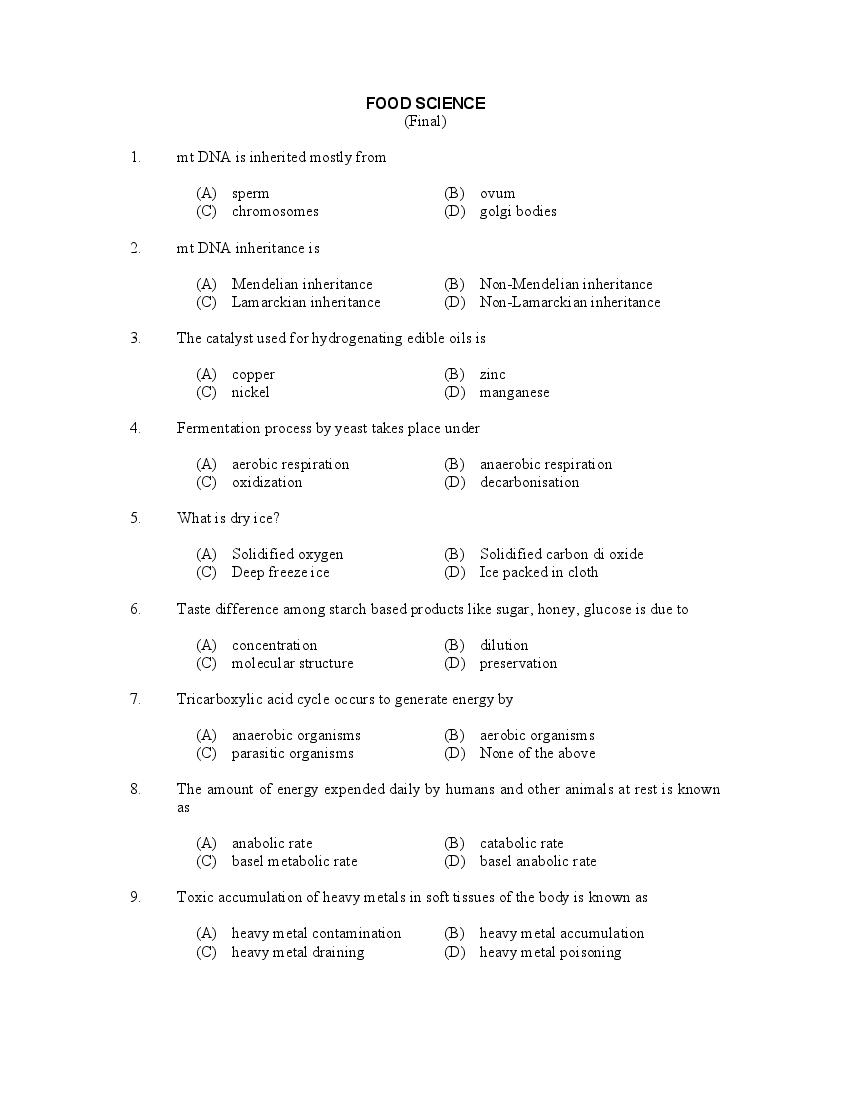
(Final)
1. mt DNA is inherited mostly from
(A) sperm (B) ovum
(C) chromosomes (D) golgi bodies
2. mt DNA inheritance is
(A) Mendelian inheritance (B) Non-Mendelian inheritance
(C) Lamarckian inheritance (D) Non-Lamarckian inheritance
3. The catalyst used for hydrogenating edible oils is
(A) copper (B) zinc
(C) nickel (D) manganese
4. Fermentation process by yeast takes place under
(A) aerobic respiration (B) anaerobic respiration
(C) oxidization (D) decarbonisation
5. What is dry ice?
(A) Solidified oxygen (B) Solidified carbon di oxide
(C) Deep freeze ice (D) Ice packed in cloth
6. Taste difference among starch based products like sugar, honey, glucose is due to
(A) concentration (B) dilution
(C) molecular structure (D) preservation
7. Tricarboxylic acid cycle occurs to generate energy by
(A) anaerobic organisms (B) aerobic organisms
(C) parasitic organisms (D) None of the above
8. The amount of energy expended daily by humans and other animals at rest is known
as
(A) anabolic rate (B) catabolic rate
(C) basel metabolic rate (D) basel anabolic rate
9. Toxic accumulation of heavy metals in soft tissues of the body is known as
(A) heavy metal contamination (B) heavy metal accumulation
(C) heavy metal draining (D) heavy metal poisoning
Page 2
10. Chemical elements having at five times the specific gravity of water are known as
(A) heavy waters (B) heavy metals
(C) heavy compounds (D) heavy mixtures
11. Scurvy is a disease caused by the deficiency of
(A) Vitamin A (B) Vitamin D
(C) Vitamin B (D) Vitamin C
12. Nutrition is the study of
(A) diseases (B) toxicity of food
(C) food and health (D) chemical changes in the body
13. Fat soluble vitamins are
(A) A, D, E and K (B) A, B, C and D
(C) C, D,E and K (D) B, C, E and K
14. The enzyme of saliva that breaks down carbohydrate is
(A) protease (B) amylase
(C) lipase (D) oxidase
15. Salmonella is a
(A) probiotic bacteria (B) food poisoning bacteria
(C) sporozoan parasite (D) blood parasite
16. Methionine is a
(A) basic amino acid (B) acidic amino acid
(C) aromatic amino acid (D) sulphur containing amino acid
17. Lactose contains
(A) a molecule of glucose and one molecule of fructose
(B) a molecule of glucose and one molecule of galactose
(C) two molecules of glucose
(D) a molecule of galactose and a molecule of fructose
18. Oxygenated derivatives of carotenes are
(A) vitamin (B) anthocyanin
(C) tannin (D) xanthophylls
Page 3
19. An apoenzyme contains
(A) both proteins and co-factors (B) only the protein factor
(C) only the co-factor (D) no protein and no factor
20. The other name of bacillary dysentery is
(A) amoebiosis (B) ketosis
(C) paralysis (D) shigellosis
21. Yeast secrete the enzyme complex called
(A) diastase (B) isomerase
(C) zymase (D) phenolase
22. Citric acid is produced by
(A) clostridium (B) penicillium
(C) aspergillus (D) mucor
23. Process of conversion of large fat globules in milk into smaller size is called
(A) saponification (B) curing
(C) homogenization (D) pasturisation
24. The unavailable sugars in pulses which are known for flatulence production is
(A) maltose (B) raffinose
(C) sucrose (D) galactose
25. The enzyme present in the raw papaya is
(A) papain (B) bromelin
(C) citric acid (D) tocopherol
26. Fish oil is rich in
(A) Vitamin D (B) Vitamin E
(C) Vitamin K (D) Vitamin B
27. F.P.O. stands for
(A) Fruit Products Order (B) Food Product Order
(C) Fruit Preservation Order (D) Food Preservation Order
28. Freeze drying involves
(A) evoperation (B) sublimation
(C) condensation (D) osmosis
Page 4
29. Canning procedure was invented by
(A) Jenner (B) Roentgen
(C) Louis Pasteur (D) Nicholas Apert
30. Which one of the following is a Class II preservative according to 52 of PFA Rule?
(A) Sodium chloride (B) Sucrose
(C) Edible vegetable oil (D) Sorbic acid
31. Browning reactions are caused by enzymatic oxidation of
(A) alcohol (B) acid
(C) polyphenol (D) indol
32. The processing technology of using carbon di oxide at high pressure to separate food
components is
(A) hydrostatic pressure (B) heat exchangers
(C) extrusion (D) supercritical fluid extraction
33. Fitness for use of food products refers to
(A) specification (B) quality
(C) standards (D) identification
34. Munsell systems measures
(A) colour (B) quantity
(C) texture (D) tenderness
35. A hidden quality attribute
(A) nutritive value (B) flavor
(C) viscosity (D) mouthfeel
36. Ripeness of fruits can be assessed by
(A) colour (B) flavor
(C) texture (D) All of the above
37. FPO was promulgated by Government of India in
(A) 1946 (B) 1955
(C) 1956 (D) 1954
Page 5
38. The organization that publishes approved laboratory methods, most applicable to ceral
products is
(A) AOAC (B) AACC
(C) AOCS (D) FCC
39. The only organic colouring matter which is permitted by PFA for use in certain
specified food item such as chewing gum is
(A) sudan red (B) erythrosine
(C) titanium dioxide (D) magnesium dioxide
40. The presence of metanin yellow in turmeric can be detected by the addition of
(A) nitric acid (B) hydrochloric acid
(C) sulphuric acid (D) phosphoric acid
41. Agar agar is extracted from
(A) sea grass (B) sea algae
(C) mangrove leaves (D) mangrove roots
42. Soxhelt method is used for
(A) sodium analysis (B) vitamin analysis
(C) fat analysis (D) starch analysis
43. Kjeldahl method is used to estimate
(A) protein (B) fat
(C) minerals (D) vitamins
44. Taste buds near the tip of the tongue are sensitive to
(A) sweet and salt (B) salt and bitter
(C) bitter and sour (D) sour and sweet
45. Father of white revolution in India is
(A) P.J. Kurien (B) Varghese Kurien
(C) A.K. Antony (D) None of the above
46. Method of separating one species of bacterium by dilution into nutrient agar plates is
(A) counting (B) dilution counting
(C) pouring (D) eliminating
Page 6
47. The temperature at which all organisms of a culture are killed by heat is
(A) heat mortality (B) thermal death point
(C) temperature mortality (D) sterilisation
48. Chemical breakdown caused by anaerobic bacteria is
(A) putrefaction (B) purification
(C) decomposition (D) synthesisation
49. Food products that provides health and medical benefits including prevention and
treatment of diseases are
(A) neutraceuticals (B) prophylactis
(C) chlorophytes (D) co-products
50. Food products produced by transferring, moving, deleting, multiplying of genes are
known as
(A) gene combined products (B) gene mutilated products
(C) genetically modified products (D) products of parthenogenesis
51. Partitioning of compounds in a feed into six categories based on chemical
composition is
(A) compound analysis (B) proximate analysis
(C) mixture separation (D) mixed compound
52. The process of forcing water through semipermiable membrane to remove solutes for
purification of water is known as
(A) osmosis (B) osmotic process
(C) osmoregulation (D) reverse osmosis
53. Microwave food processing is done by use of
(A) heat waves (B) water vapour
(C) magnetic waves (D) electromagnetic waves
54. Wilstaters method is used to estimate
(A) vitamins (B) glucose
(C) minerals (D) oil content
55. The spirit feni or fenny is made from the juice of
(A) Simla apple (B) ripe grapes
(C) cashew apple (D) pine apple
Page 7
56. The commonly known food product ‘Aamchur’ is made from
(A) mango kernel (B) mango peel
(C) ripe mango pulp (D) dried green mango
57. The Central Food Technological Research Institute was opened in the year
(A) 1950 (B) 1960
(C) 1970 (D) 1980
58. Straight chain fraction of starch is
(A) amylase (B) amylase
(C) glucose (D) fructose
59. Substance that retards oxidative rancidity in fats by becoming oxidized itself and
stopping chain reaction is
(A) deoxidant (B) anoxidant
(C) para oxidatant (D) antioxidant
60. Breakdown of starch molecules to polysaccharides is
(A) digestion (B) dextrinisation
(C) fermentation (D) acidification
61. Organic secretion by living cells that changes the rate of reaction without being used
up during reaction
(A) catalyst (B) hormone
(C) enzyme (D) mucus
62. Elastic, tenacious substance formed from the insoluble proteins of wheat flour during
dough development
(A) glutton (B) gluten
(C) foam (D) glycerol
63. The tendency to absorb water readily is
(A) hydrolysis (B) hydrophilic
(C) hygroscopic (D) hydrogenation
64. Ability to be molded or shaped
(A) elasticity (B) plasticity
(C) clayish (D) surf
Page 8
65. Separation or weeping of liquid from gel
(A) sol (B) sterelise
(C) solute (D) syneresis
66. The liquid portion remaining after the curdling of milk with citric acid or lemon juice
is
(A) jeera (B) butter milk
(C) whey (D) water
67. The process of sterilizing food and packing by flash lighting to high temperature to
last for months without refrigeration is known as
(A) additive process (B) oxidation process
(C) aseptic packaging (D) deep freeze packaging
68. Retension of nutrients during canning is done by
(A) adding chemicals
(B) preservatives
(C) high temperature heating before canning
(D) high temperature heating after canning
69. The process of forcing liquids at high pressure through small holes is known as
(A) super mixing (B) fortification
(C) homogenisation (D) extrusion
70. Listing of ingredients expressed in prints on the label of a food product is known as
(A) QUID (B) QUANTITY
(C) QUOTATION (D) QUANTIFICATION
71. The shelf life of dry food is increased by
(A) spin drying (B) spray drying
(C) evaporation (D) UV radiation
72. The process of row food material either in hot water or heating in steam at 95oC for
1 5 minutes is known as
(A) bleaching (B) baking
(C) blanching (D) None of the above
73. Food produced with the use of synthetic chemical nutrients is known as
(A) inorganic farming (B) organic farming
(C) short time farming (D) aseptic farming
Page 9
74. The process used to slow or stop the progress of food is known as
(A) processing (B) fermentation
(C) vacuum processing (D) preservation
75. Tax imposed on imported food is
(A) tariff (B) super taxing
(C) impounding (D) exercising
76. Palatability is
(A) sweet taste (B) pleasant taste
(C) eatable (D) easily digestive
77. Which one of the following is correct sequence of the given plastic material used in
packaging in decreasing order of their tensile properties?
(A) PVC, HDPE, LDPE and PET (B) PVC, LDPE, HDPE and PET
(C) PET, HDPE, LDPE and PVC (D) PET, LDPE, HEPE and PVC
78. Cellulose generally having a degree of polymerization of
(A) 1000 (B) 2000
(C) 10000 (D) 20000
79. Xanthan gum is a type of
(A) Microbial gum (B) Seed gum
(C) Sea weed gum (D) Exudate gum
80. Scientific name of tea is
(A) Thea chinensis (B) Camelia sinensis
(C) Theobrama sinensis (D) Theobrama cacao
81. Chemically caffeine is
(A) Fatty acid (B) Nucleotide
(C) Aminoacid (D) Carbohydrate
82. Highest protein is present in
(A) Peanut (B) Egg
(C) Lima beans (D) Garlic
83. Fruits are generally deficient in
(A) vitamins (B) water
(C) carbohydrates (D) proteins
Page 10
84. Deposition of fat within lean muscle is called
(A) Marbling (B) Homogenization
(C) Curing (D) None of the above
85. The cuts from the belly portion of hog carcass is called
(A) Mutton (B) Ham
(C) Veal (D) Bacon
86. Salami is a ………. type of sausage
(A) smoked (B) cooked
(C) fermented (D) All of the above
87. Vegetable oils are rich in
(A) ω-3 fatty acids (B) ω-4 fatty acids
(C) ω-5 fatty acids (D) ω-6 fatty acids
88. The important role of carotenoids in human diet is their ability to serve as precursors
of
(A) Vitamin C (B) Vitamin D
(C) Vitamin A (D) Vitamin K
89. Corn syrup is a mixture of
(A) Dextrose + Maltose (B) Dextrose + lactose
(C) Dextrose + galactose (D) Maltose + maltose
90. In the canned food industry, the 12 D concept means
(A) Sufficient thermal process to reduce initial population by 12 D cycles.
(B) A minimum process of inactivation for C.botulinum in canned foods
(C) Both (A) and (B)
(D) None of the above
91. The protein responsible for spongy structure in bread is
(A) Albumin (B) Zein
(C) Gluten (D) gliadin
92. Listed below are some of the functions of fats in human nutrition, identify the
incorrect function
(A) concentrated source of energy
(B) transport of oxygen to various organs
(C) absorption of fat soluble vitamins
(D) synthesis of cell membranes and hormones
Page 11
93. How the specific gravity of milk can be lowered?
(A) By adding water (B) By adding cream
(C) Both (A) and (B) (D) None of the above
94. Which rules of PFA deals with the obligatory conditions of packaging?
(A) 12 (B) 36
(C) 49 (D) 69
95. How many Central Food Laboratories are there in India?
(A) 4 (B) 8
(C) 16 (D) 20
96. Dunnett test is
(A) A test for monitoring the quality of imported grains in terms of its
pesticide content
(B) Applied to compare the treatment against a pre-determined control
(C) For the test of GM foods
(D) To decide whether a company has followed PFA standards.
97. Casein present in milk is found in the form of
(A) Magnisium caseinate –phosphate complex
(B) Calcium caseinate phosphate complex
(C) Potassium caseinate phosphate complex
(D) None of the above
98. ………..……. is the basis for checking pasteurization efficiency of milk
(A) Peroxidase and catalase test (B) Phosphatase test
(C) Analase test (D) None of the above
99. The effect of temperature and moisture gradients inside food may be related by
(A) Lewis number (B) Grashhoff number
(C) Reynolds number (D) Nusslet number
100. Which of the following is an intensive property of a system?
(A) Mass (B) Density
(C) Volume (D) None of the above
Page 12
101. Surface tension is due to
(A) Cohesion only
(B) Adhesion between liquid and solid molecules
(C) Difference in magnitude between the forces due to adhesion and cohesion
(D) Frictional forces
102. The storage temperature of milk to inhibit the growth of bacteria, should not exceed
(A) 1.4o C (B) 2.0o C
(C) 3.4o C (D) 4.4o C
103. The efficiency of a cyclone separator is increased by
(A) reducing air outlet diameter
(B) decreasing the size of the particle
(C) reducing the size of the separator
(D) increasing air inlet velocity
104. The quality of steam is equal to
(A) Dryness fraction of the steam (B) Vapor fraction of steam
(C) Liquid fraction of steam (D) None of the above
105. Which of the following containers should not be used in microwave oven?
(A) Glass (B) China ware
(C) Silver (D) Plastic
106. ISO standards are
(A) Mandatory orders (B) Mandatory regulations
(C) Non mandatory regulations (D) Non mandatory orders
107. Which of the following is a self carbonated beverage?
(A) Kumiss (B) Kefir
(C) Yoghurt (D) Bulgarian buttermilk
108. Operation flood-1 was launched in
(A) 1969 (B) 1970
(C) 1972 (D) 1971
109. Which of the following materials has the highest specific heat?
(A) Glass (B) Silver
(C) Gold (D) Water
Page 13
110. An object initially at a uniform temperature of 45o C is dipped in water bath at 25o C .
What will be the steady state temperature of the object?
(A) 20o C (B) 25oC
(C) 45o C (D) None of the above
111. D-value signifies
(A) Decimal reduction time (B) Generation time
(C) Doubling time (D) None of the above
112. Formula method for thermal process time determination was first developed by
(A) Stumbo (B) Hayakawa
(C) Bigelow (D) Ball
113. In case of canned mushrooms, which of the following sterilizer should be used?
(A) Crateless retorts (B) Steritot
(C) Flame sterilization system (D) None of the above
114. The phenomena of moisture uptake or loss in dehydrated foods is referred to as
(A) desorption (B) adsorption
(C) absorption (D) sorption
115. In spray drying the temperature of milk droplets is generally kept at
(A) 49-54o C (B) 54-60o C
(C) 60-65o C (D) 65-70o C
116. Freeze-drying time is directly proportional to
(A) thickness (B) square of thickness
(C) cube of thickness (D) None of the above
117. The packaging material for aseptic packaging is made up of
(A) Plastic (B) Steel
(C) Aluminum foil (D) Laminated roll stock
118. Safe storage temperature for apple is
(A) 2-3o C (B) 3-4o C
(C) ‒2 to ‒1o C (D) ‒6 to ‒20o C
119. The percentage of polyunsaturated fatty acids in soyabean oil is
(A) 62 (B) 10
(C) 93 (D) 72
Page 14
120. Methyl malonic aciduria is seen in the deficiency of
(A) Vitamin B6 (B) Folic acid
(C) Thiamine (D) Vitamin B12
121. Which amino acid causes twist and turn in protein structures?
(A) Valine (B) Isoleucine
(C) Proline (D) Glycine
122. Normal range of serum potassium is
(A) 2.1-3.4 mEq/L (B) 3.5-5.3 mEq/L
(C) 5.4-7.4 mEq/L (D) 7.5-9.5 mEq/L
123. During food preparation and processing the application of dry heat can cause the
change in the physical properties of starch. This is called
(A) Coagulation (B) Dextrinisation
(C) Emulsification (D) Caramelisation
124. Human heart muscle contains
(A) D-Arabinose (B) D-Ribose
(C) D-Xylose (D) L-Xylose
125. Renin converts casein to paracasein in presence of
(A) Ca++ (B) Mg++
(C) Na+ (D) K+
126. Enzyme that catalyze conversion of glucose to ethanol is
(A) Zymase (B) Invertase
(C) Maltase (D) Diastase
127. To make some ready to eat cereals, manufacturers use
(A) Pasting and cooking (B) Flaking and shredding
(C) Extending and fluffing (D) Gelling and squashing
128. The percentage of polyunsaturated fatty acids in butter is
(A) 60 (B) 37
(C) 25 (D) 3
Page 15
129. Asteringency in fruits are found due to the presence of
(A) Peptides (B) Xanthophyll
(C) Tannins (D) Chlorophyll
130. The maximum number of double bonds present in essential fatty acid is
(A) 2 (B) 3
(C) 4 (D) 5
131. ‘Burning foot syndrome’ has been ascribed to the deficiency of
(A) Pantothenic acid (B) Thiamin
(C) Cobalamin (D) Pyridoxine
132. Naturally occurring enzymes in raw milk which has a similar D value to heat resistant
pathogens
(A) Lacto peroxidase (B) Alkaline phosphatase
(C) Alkaline lactase (D) Alkaline protease
133. Two heat resistant enzymes which cause loss of heating and nutritional qualities in
vegetables and fruits
(A) Catalase and Peroxidase
(B) Polyphenoloxidase and Polygalacturonase
(C) Catalase and Polygalacturonase
(D) Peroxidase and Polyphenoloxidase
134. Which of the following processes is essential in the manufacture of freeze dried food
products?
(A) Dehydration (B) Evaporation
(C) Pasteurization (D) Sublimation
135. Daily requirement of vitamin A in an adult man can be expressed as
(A) 400 IU (B) 1000 IU
(C) 5000 IU (D) 10,000 IU
136. Which of the following is not a type of food processing?
(A) Cold processing (B) Rehydration
(C) Fermentation (D) Irradiation
137. The daily calcium requirement in pregnancy and lactation is about
(A) 600 mg (B) 800 mg
(C) 1,200 mg (D) 1,500 mg
Page 16
138. Which of the following crop has recently been genetically engineered to obtain edible
vaccine to develop immunity against hepatitis B?
(A) Banana (B) Maize
(C) Potato (D) Brinjal
139. ……………. is added to meat to produce a cured meat colour and flavor, and to serve
as an antibotulinal agent
(A) Sodium phosphate (B) Sodium carbonate
(C) Sodium choloride (D) Sodium nitrite
140. Isoelectric point of amino acids is used for
(A) Crystallisation (B) Precipitation
(C) Solubility (D) Reactivity
141. The Iodine number of essential fatty acids of vegetable oils is
(A) high (B) very high
(C) very low (D) low
142. Esterification of cholesterol occurs mainly in
(A) Adipose tissue (B) Liver
(C) Muscles (D) Kidneys
143. Water activity is the degree of availability of water in food. The water activity of pure
water is
(A) 0.100 (B) 1.000
(C) 10.00 (D) 100.0
144. Fumigation process falls under which treatment
(A) Physical (B) Physico-chemical
(C) chemical (D) All of the above
145. UHT milk can be stored unrefrigerated for at least ……….. months.
(A) 3 (B) 2
(C) 4 (D) 5-6
146. Antioxidants present in citrus peel is
(A) Limonoids (B) Flavonoids
(C) Indoles (D) Phenols
Page 17
147. Protein content of mushrooms, on dry wet basis is
(A) 60%-80% (B) 20%-40%
(C) 15%-20% (D) 80%-90%
148. Scoville value is used to express the pungency of………… extracts
(A) Ginger (B) Garlic
(C) Chilli (D) Pepper
149. Which of the following instrument is used to measure the plasticity of wheat dough for
preparing bread?
(A) Barbender Farinograph (B) Adams consistometer
(C) Succulometer (D) Shortometer
150. Sterilisation of standardised milk in bottles is done by heating continuously to a
temperature of
(A) 100°C for 10 min (B) 115°C for 10 min
(C) 100°C for 15 min (D) 115°C for 15 min
***
Document Details
| Board / Org | Cochin University |
| Exam | CUSAT Common Admission Test |
| Type | Question Paper |
| Pages | 17 |
| Updated | 22 Jul 2026 |