Page 1
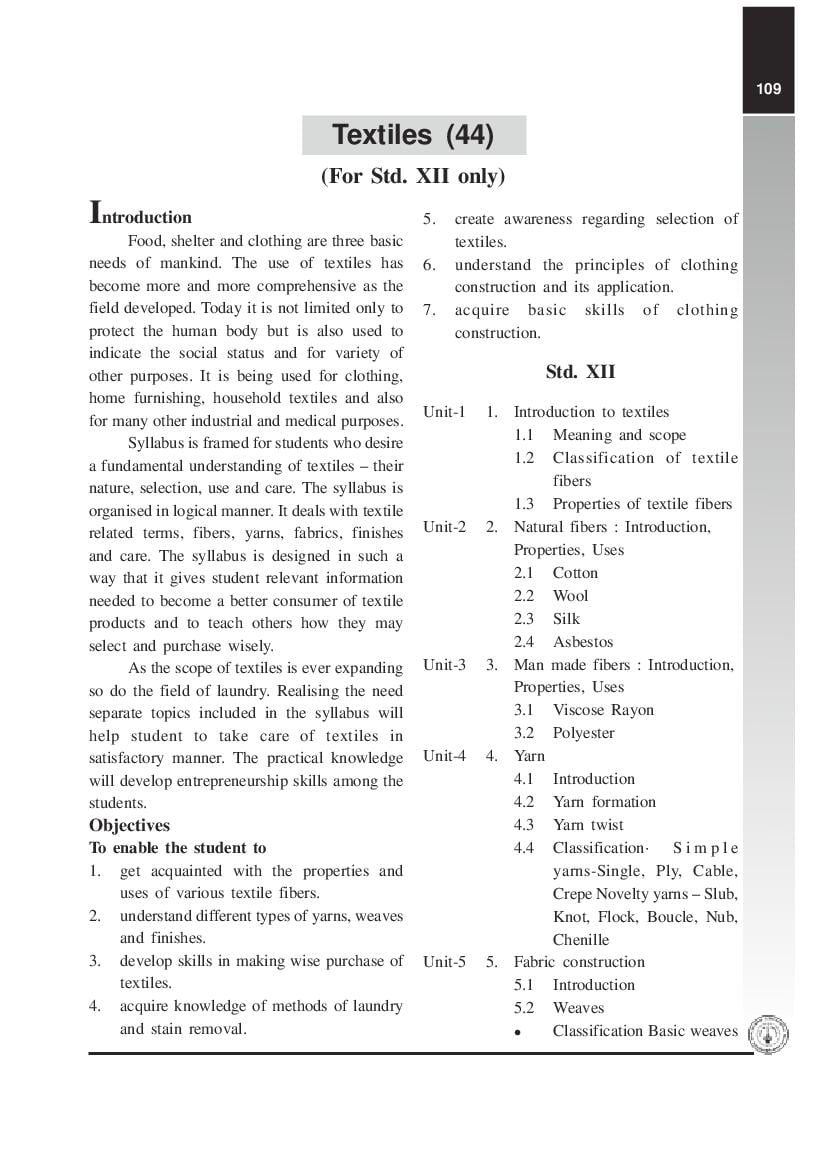
109 Textiles (44) (For Std. XII only) Introduction 5. create awareness regarding selection of Food, shelter and clothing are three basic textiles. needs of mankind. The use of textiles has 6. understand the principles of clothing become more and more comprehensive as the construction and its application. field developed. Today it is not limited only to 7. acquire basic skills of clothing protect the human body but is also used to construction. indicate the social status and for variety of other purposes. It is being used for clothing, Std. XII home furnishing, household textiles and also Unit-1 1. Introduction to textiles for many other industrial and medical purposes. Syllabus is framed for students who desire 1.1 Meaning and scope a fundamental understanding of textiles – their 1.2 Classification of textile nature, selection, use and care. The syllabus is fibers organised in logical manner. It deals with textile 1.3 Properties of textile fibers related terms, fibers, yarns, fabrics, finishes Unit-2 2. Natural fibers : Introduction, and care. The syllabus is designed in such a Properties, Uses way that it gives student relevant information 2.1 Cotton needed to become a better consumer of textile 2.2 Wool products and to teach others how they may 2.3 Silk select and purchase wisely. 2.4 Asbestos As the scope of textiles is ever expanding Unit-3 3. Man made fibers : Introduction, so do the field of laundry. Realising the need Properties, Uses separate topics included in the syllabus will 3.1 Viscose Rayon help student to take care of textiles in 3.2 Polyester satisfactory manner. The practical knowledge Unit-4 4. Yarn will develop entrepreneurship skills among the 4.1 Introduction students. 4.2 Yarn formation Objectives 4.3 Yarn twist To enable the student to 4.4 Classification· S i m p l e 1. get acquainted with the properties and yarns-Single, Ply, Cable, uses of various textile fibers. Crepe Novelty yarns – Slub, 2. understand different types of yarns, weaves Knot, Flock, Boucle, Nub, and finishes. Chenille 3. develop skills in making wise purchase of Unit-5 5. Fabric construction textiles. 5.1 Introduction 4. acquire knowledge of methods of laundry 5.2 Weaves and stain removal. � Classification Basic weaves
Page 2
110 – Plain, Twill, Satin· Unit-11 11. Introduction to Household Novelty weaves – Pile, Textiles Leno-Gauze, Honey Comb 11.1 Curtains and Draperies 5.3 Non-woven fabric 11.2 Bed sheets and Pillow construction covers Unit-6 6. Finishes 11.3 Towels and Napkins 6.1 Introduction 11.4 Carpets and Rugs 6.2 Objectives 6.3 Basic finishes -Singeing, Std. XII Scouring, Bleaching, Brushing, Sizing, Practicals and project Weighting, Degumming, 1. Sewing tools and accessories Mercerizing, Delustering, 2. Sewing machine – Parts, functions and Sanforizing and calendering care of sewing machine 6.4 Special finishes 3. Basic terms used in clothing construction Unit-7 7. Consumer Awareness 4. Body measurements 7.1 Problems of consumers and 5. Demonstration of various seams, necklines, remedies plackets, fastners 7.2 Labels 6. Stitching of Apron by incorporating 7.3 Purchase, storage and care following - of textiles i) Bias binding for bib Unit-8 8. Laundry ii) Patch pocket 8.1 Introduction : iii) Belt Aims and objectives 7. Stitching of A line frock by incorporating Scope of Laundry following - 8.2 Cleansing Agent : i) Bias binding for armhole and neckline Introduction, Types, Uses, ii) Plain placket Water, Soaps, Detergents iii) Fasteners Unit-9 9. Methods of laundering 8. Identification of Textile fibres by 9.1 Introduction performing burning test –Cotton, Wool, 9.2 Various methods of Silk, and Polyester fibre laundering 9. Identification of basic weaves - Plain, 9.3 Washing of different types Twill, Satin of clothes – Cotton, Silk, 10. Identification of novelty weaves - Honey Wool, Synthetic comb, Pile, Leno-gauze Unit-10 10. Stain Removal 11. Collection of textile labels – Informative, 10.1 Introduction Brand, Certification 10.2 Classification 12. Maintenance of journal 10.3 Techniques and methods 13. Any one project based on syllabus 10.4 General guidelines for stain ��� removal