Karnataka 1st PUC Model Question Paper 2027 for Geology (Paper 2)
Finished viewing? Save it for later —
Download Karnataka 1st PUC Model Question Paper 2027 for Geology (Paper 2) (PDF · 3 pages)About Karnataka 1st PUC Model Question Paper 2027 for Geology (Paper 2)
Karnataka 1st PUC Model Question Paper 2027 for Geology (Paper 2) is available here for free download. Published by Karnataka Board for Class 11, this sample paper can be viewed online or downloaded as a PDF (3 pages). Candidates preparing for Class 11 can use Karnataka 1st PUC Model Question Paper 2027 for Geology (Paper 2) to understand the exam pattern, the type of questions asked, and the overall difficulty level.
Frequently Asked Questions
How can I download Karnataka 1st PUC Model Question Paper 2027 for Geology (Paper 2)?
Open this page and click the Download button to save Karnataka 1st PUC Model Question Paper 2027 for Geology (Paper 2) as a PDF. It is completely free on AglaSem Docs.
Is Karnataka 1st PUC Model Question Paper 2027 for Geology (Paper 2) free to download?
Yes. Karnataka 1st PUC Model Question Paper 2027 for Geology (Paper 2) can be viewed online and downloaded as a PDF free of cost on AglaSem Docs.
How many pages does Karnataka 1st PUC Model Question Paper 2027 for Geology (Paper 2) have?
Karnataka 1st PUC Model Question Paper 2027 for Geology (Paper 2) contains 3 pages, which you can read online or download together as a single PDF.
Where can I find more Class 11 study material?
You can find more Class 11 question papers, sample papers, syllabus, and answer keys on AglaSem Docs.
Karnataka 1st PUC Model Question Paper 2027 for Geology (Paper 2) – Text
Read the full text of this sample paper below — useful to quickly search, copy and reference the content online without downloading the PDF.
📄 View text version (4 pages)
Page 1
Karnataka 1st PUC
Model Question Paper
2027 for Geology (Paper
2)
EXAM YEAR TYPE SUBJECT
Karnataka Class 11 2027 Sample Paper Geology
Notes · Sample Papers · Previous Year Papers · Mock Tests
Page 2
. s e
em l a
as ag
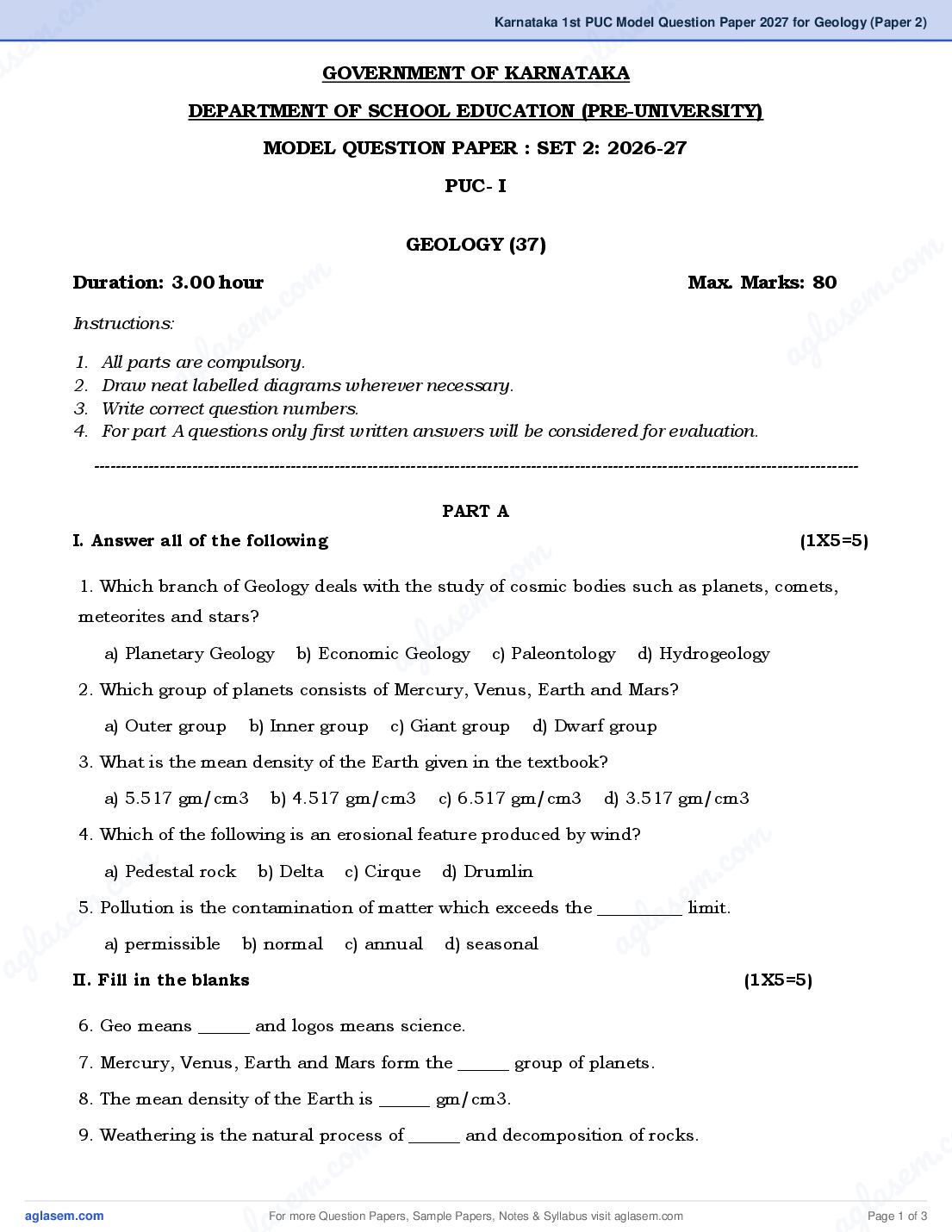
GOVERNMENT OF KARNATAKA
DEPARTMENT OF SCHOOL EDUCATION (PRE-UNIVERSITY)
MODEL QUESTION PAPER : SET 2: 2026-27
PUC- I
m
co
GEOLOGY (37)
Duration: 3.00 hour
.c om Max. Marks: 80
e m l a s
s g
Instructions:
gl a a
2. Draw neatalabelled diagrams wherever necessary.
1. All parts are compulsory.
3. Write correct question numbers.
4. For part A questions only first written answers will be considered for evaluation.
--------------------------------------------------------------------------------------------------------------------------------------------
PART A
m
I. Answer all of the following (1X5=5)
. co
em
1. Which branch of Geology deals with the study of cosmic bodies such as planets, comets,
meteorites and stars?
l a s
a) Planetary Geology b) Economic Geology
a g c) Paleontology d) Hydrogeology
2. Which group of planets consists of Mercury, Venus, Earth and Mars?
a) Outer group b) Inner group c) Giant group d) Dwarf group
3. What is the mean density of the Earth given in the textbook?
a) 5.517 gm/cm3 b) 4.517 gm/cm3 c) 6.517 gm/cm3 d) 3.517 gm/cm3
m
4. Which of the following is an erosional feature produced by wind?
o m m
. c e
a) Pedestal rock b) Delta c) Cirque d) Drumlin
ema) permissible b) normal c) annual d) seasonal l a s
s g
5. Pollution is the contamination of matter which exceeds the __________ limit.
gla a
a II. Fill in the blanks (1X5=5)
6. Geo means ______ and logos means science.
7. Mercury, Venus, Earth and Mars form the ______ group of planets.
8. The mean density of the Earth is ______ gm/cm3.
m . c
9. Weathering is the natural process of ______ and decomposition of rocks.
e m
m a s
se
g l Page 1 of 3
Page 3
and atomic structure.
III. Match the following (1X5=5)
11. A B
a. Milky Way i. A shape of the Earth
b. Geoidal ii. The name of our Galaxy
c. Troposphere iii. A type of glacier deposit
d. Drumlin iv. Established in 1851
e. GSI v. The lower part of the atmosphere
IV. Answer all of the following (1X5=5)
12. What is Geophysics?
13. What is Saltation?
14. What are Moraines?
15. What is a prism of a crystal?
16. What is air pollution?
PART B
V. Answer any seven of the (2X7=14)
17. What is Physical Geology?
18. What are Meteorites?
19. What are Comets?
20. What are the different views or opinions about the shape of the Earth?
21. What is Rotation?
22. What is Revolution?
23. Mention the causes for earthquakes.
24. What is Moho’s Scale of hardness?
25. Define interfacial angle.
26. What are crystallographic axes?
27. What is pollution?
VI. Answer any seven of the following (3X7=21)
28. What is weathering? Name its three types.
For more Question Papers, Sample Papers, Notes & Syllabus visit Page 2 of 3
Page 4
. s e
em l a
as ag as physical/mechanical
29. Explain frost action, action of gravity and temperature change
weathering processes.
30. Explain deflation, abrasion and attrition in wind erosion.
31. Explain the geological work of a river under erosion, transportation and deposition.
32. Describe the three types of glaciers given in the textbook.
m
co
33. What are moraines? Name their types.
.c om
34. What are P and S waves? State their nature as described in the textbook.
m
e l a s
s g
35. Explain the classification of earthquakes based on depth of focus.
g l a a
a law for crystals.
36. Give the scientific classification of minerals.
37. State Euler’s
38. Explain the three types of symmetry.
VII. Answer any Five of the following (5X5=25)
39. Explain the rotation and revolution of the Earth and their effects, namely day and night
m
and seasons.
40. Explain the properties of the atmosphere.
e m
a s with a neat sketch.
41. Explain the hydrological cycle with a neat diagram.
l
ag
42. Explain the internal structure of the Earth
43. What is weathering? Explain the types of weathering.
44. Describe the geological action of glaciers.
45. Explain seismograph and seismogram.
46. Explain the types of volcanoes.
m
47. Explain the physical properties of minerals.
m
c. o s e m
em la
---------------
las ag
ag
m . c
c. o s e m
m a
se
g l Page 3 of 3
Document Details
| Board / Org | Karnataka Board |
| Exam | Class 11 |
| Type | Sample Paper |
| Pages | 3 |
| Updated | 13 Nov 2026 |