Kerala Class 12 First Term Question Paper 2025 Accountancy AFS
Finished viewing? Save it for later —
Download Kerala Class 12 First Term Question Paper 2025 Accountancy AFS (PDF · 5 pages)About Kerala Class 12 First Term Question Paper 2025 Accountancy AFS
Kerala Class 12 First Term Question Paper 2025 Accountancy AFS is available here for free download. Published by Kerala Board for Class 12, this question paper can be viewed online or downloaded as a PDF (5 pages). Candidates preparing for Class 12 can use Kerala Class 12 First Term Question Paper 2025 Accountancy AFS to understand the exam pattern, the type of questions asked, and the overall difficulty level.
Frequently Asked Questions
How can I download Kerala Class 12 First Term Question Paper 2025 Accountancy AFS?
Open this page and click the Download button to save Kerala Class 12 First Term Question Paper 2025 Accountancy AFS as a PDF. It is completely free on AglaSem Docs.
Is Kerala Class 12 First Term Question Paper 2025 Accountancy AFS free to download?
Yes. Kerala Class 12 First Term Question Paper 2025 Accountancy AFS can be viewed online and downloaded as a PDF free of cost on AglaSem Docs.
How many pages does Kerala Class 12 First Term Question Paper 2025 Accountancy AFS have?
Kerala Class 12 First Term Question Paper 2025 Accountancy AFS contains 5 pages, which you can read online or download together as a single PDF.
Where can I find more Class 12 study material?
You can find more Class 12 question papers, sample papers, syllabus, and answer keys on AglaSem Docs.
Kerala Class 12 First Term Question Paper 2025 Accountancy AFS – Text
Read the full text of this question paper below — useful to quickly search, copy and reference the content online without downloading the PDF.
📄 View text version (5 pages)
Page 1
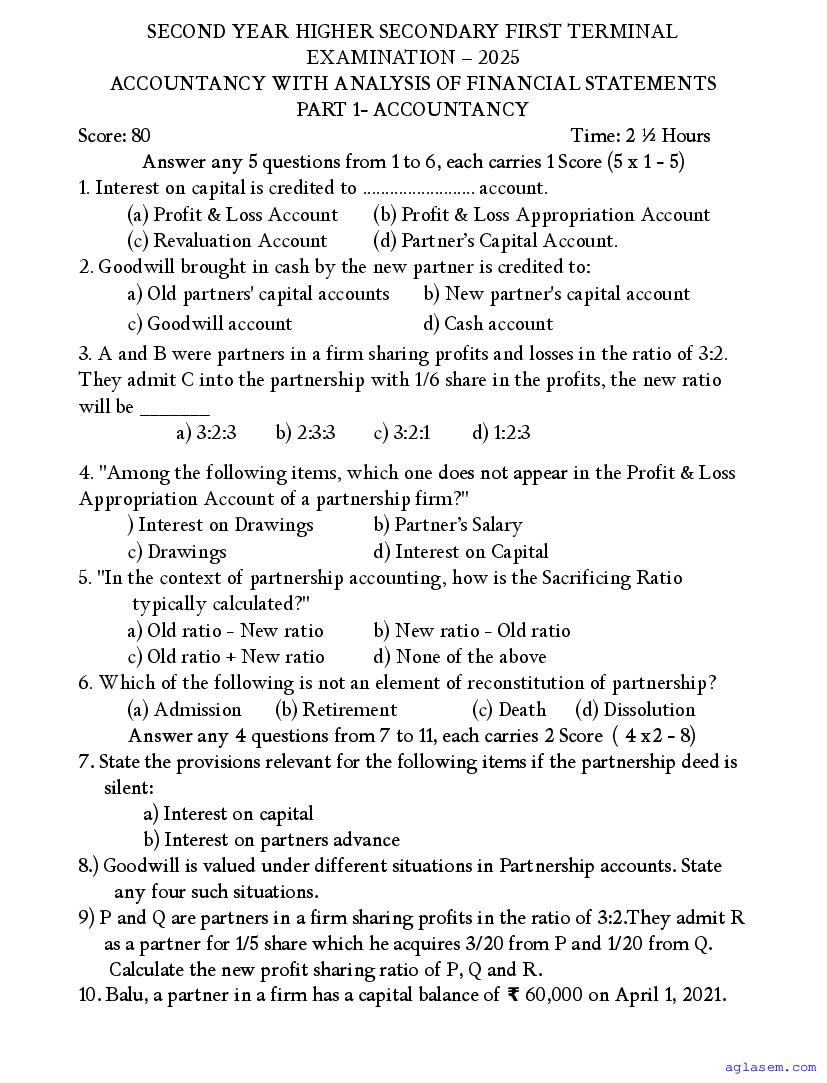
EXAMINATION – 2025
ACCOUNTANCY WITH ANALYSIS OF FINANCIAL STATEMENTS
PART 1- ACCOUNTANCY
Score: 80 Time: 2 ½ Hours
Answer any 5 questions from 1 to 6, each carries 1 Score (5 x 1 - 5)
1. Interest on capital is credited to ......................... account.
(a) Profit & Loss Account (b) Profit & Loss Appropriation Account
(c) Revaluation Account (d) Partner’s Capital Account.
2. Goodwill brought in cash by the new partner is credited to:
a) Old partners' capital accounts b) New partner's capital account
c) Goodwill account d) Cash account
3. A and B were partners in a firm sharing profits and losses in the ratio of 3:2.
They admit C into the partnership with 1/6 share in the profits, the new ratio
will be _______
a) 3:2:3 b) 2:3:3 c) 3:2:1 d) 1:2:3
4. "Among the following items, which one does not appear in the Profit & Loss
Appropriation Account of a partnership firm?"
) Interest on Drawings b) Partner’s Salary
c) Drawings d) Interest on Capital
5. "In the context of partnership accounting, how is the Sacrificing Ratio
typically calculated?"
a) Old ratio - New ratio b) New ratio - Old ratio
c) Old ratio + New ratio d) None of the above
6. Which of the following is not an element of reconstitution of partnership?
(a) Admission (b) Retirement (c) Death (d) Dissolution
Answer any 4 questions from 7 to 11, each carries 2 Score ( 4 x2 - 8)
7. State the provisions relevant for the following items if the partnership deed is
silent:
a) Interest on capital
b) Interest on partners advance
8.) Goodwill is valued under different situations in Partnership accounts. State
any four such situations.
9) P and Q are partners in a firm sharing profits in the ratio of 3:2.They admit R
as a partner for 1/5 share which he acquires 3/20 from P and 1/20 from Q.
Calculate the new profit sharing ratio of P, Q and R.
10. Balu, a partner in a firm has a capital balance of ₹ 60,000 on April 1, 2021.
Page 2
Balu's interest on capital @10% p.a. as on March 31, 2022
11. Resmi and Rekha are partners in a firm sharing profits and losses in the ratio
of 2:1.They admit Raji into partnership for 1/4 share in profits. Raji brings ₹
50,000 for capital and ₹ 12,000 as her share of goodwill. Give necessary journal
entries to record the above.
Answer any 5 questions from 12 to 17, each carries 3 Score ( 5 x 3 -15)
12. State any three differences between Fixed Capital method and Fluctuating
capital method.
13. Nandana and Greeshma are partners in a firm sharing profits in the ratio of
4:3. They admitted Gokul as a new partner. Their new profit sharing ratio will
be 2:3:1. Calculate the Sacrifice or gain of old partners.
14. Adithyan a partner in a firm withdrew the following amounts during the
year 2024 -25.
Date of withdrawal Amount
May 31, 2024 5,000
July 01 2024 4,000
Sep.30 2024 5,000
Jan 01 2025 3,000
Calculate the amount of interest on drawings to be charged from Adithyan @
8 % p a. Books closed on 31st March every year.
15. Angel Traders earn an average profit of ₹ 45,000 with a capital of ₹ 3,00,000.
The normal rate of return in the business is 10%. Using capitalisation of super
profits method, calculate the value of goodwill of the firm.
16. Biya, Amalya and Sebastian are in partnership sharing profits in the ratio of
3:2:1. Sebastian’s share in profit has been guaranteed by Biya and Amalya to be a
minimum sum of ₹ 10,000. Profits for the year ended March 31, 2025 was ₹
48,000. Divide the profit among the partners.
17. Briefly expalin any three factors affecting the value of goodwill of a firm.
Answer any 2 questions from 18 to 20, each carries 6 Score ( 2 x 6 - 12)
18. Baiju and Vinod are partners in a firm sharing profits and losses in the ratio
of 5:3. They admitted Ashok as a new partner for 1/6 share of profits. Ashok
brings ₹ 50,000 as capital and his requisite share of goodwill premium in cash,
Page 3
few years which were ₹ 20,000.The partners new profit sharing ratio is
3:2:1.Pass necessary journal entries for the following:
a) When the amount of goodwill is retained in the business.
b) When 50% of the amount of goodwill is withdrawn.
19. Saju and Sethu were partners in a firm sharing profits in the ratio of their
capitals which were ₹ 60,000 and ₹ 40,000 respectively as on April 1,2024.
According to the partnership agreement, interest on capital are allowed at 10%
p.a. Saju is to get a monthly salary of ₹ 3,000 and Sethu an annual commission
of ₹ 9,000. The profits for year ended March 31, 2025 before making above
appropriations was ₹1,00,000. The drawings of Saju and Sethu were ₹ 10,000
and ₹ 5,000, respectively. Interest on drawings amounted to ₹ 2,000 for Saju
and ₹ 1,000 for Sethu. Prepare Profit and Loss Appropriation Account and
partners’ capital accounts under Fixed capital method.
20.
a) A and B are equal partners. Their fixed capitals are ₹ 40,000 and ₹ 80,000,
respectively. After the accounts for the year have been prepared, it was
discovered that interest on partners capital @ 5 % p.a. has not been recorded in
the books of accounts. Give necessary adjusting journal entry. (3)
b) The capital of the firm is ₹ 2,00,000 and normal rate of return is 8 %, the
average profits for last 5 years are ₹ 25,000. Calculate the value of goodwill of
the firm at 3 years’ purchase of super profits, (3)
PART -II
ACCOUNTANCY WITH ANALYSIS OF FINANCIAL STATEMENTS
Answer any 5 questions from 21 to 26, each carries 1 Score (5 x 1 - 5)
21. The portion of Uncalled capital to be called only on the winding up of the
company is:
a) Paid up capital b) Reserve Capital
c) Calls in arrears d) Calls in advance
22 Which of the following is not a feature of Joint stock company?
a) Separate legal entity b) Common seal
c) Transferability of shares d) Unlimited liability
23. Equity shareholders are the ............... of the company.
a) Owners b) Customers
c) Creditors d) Suppliers
Page 4
as................ debentures.
a) Secured b) Zero coupon rate
c) Redeemable d) Bearer
25. Which among the following is true:
a) Debenture is a part of owned capital.
b) Debentures cannot be converted into shares
c) Return on debentures is interest
d) Debentures cannot be issued at a premium
26. Allotment of Shares' means:
1) Issuing shares to existing shareholders
2) Distribution of shares to applicants based on their applications
3) Selling shares in the open market
4) Redemption of shares
Answer any 4 questions from 27 to 31, each carries 2 Score ( 4 x 2 - 8)
27. Give Journal entries for the following:
Issue of Rs. 10,000, 10% debentures of Rs.100 each at par and redeemable at
a premium of 10%.
28.) Write a short note on Calls in arrears and Calls in advance.
29) What do you meant by Bearer debentures?
30) Calculate the amount of Issued capital & Subscribed up capital
from the following details:
Total number of shares : 10,000
Face value of shares : ₹50
Number of shares issued to Public : 8,000
Number of shares allotted :8000
31.) Briefly explain the different types of companies on the basis of liability of
its members.
Answer any 5 questions from 32 to 37, each carries 3 Score ( 5 x 3 -15)
32. Babu, a share holder, failed to pay the money for second and final call of Rs.
5 on 1,000 shares issued to him at a face value of Rs. 20 per share. His shares
were forfeited after the second and final call. Give the necessary journal entry for
forfeiture of the shares.
33. State the different purposes for which Securities Premium amount can be
utilised by a company. (Any three)
Page 5
35. TV Components Ltd., issued 10,000, 12% debentures of Rs 100 each at a
discount of 5% payable as follows:
On application Rs 40
On allotment Rs 55
Show the journal entries including those for cash, assuming that all the
instalments were duly collected.
36. A company issued 10,000 equity shares of ₹ 10 each with an application
money of Rs. 2 per share. The company received applications for 15,000 shares.
Excess application money were rejected. Give journal entry for the above
transaction.
37. Describe the different types of debentures on the basis of tenure.
Answer any 2 questions from 38 to 40, each carries 6 Score (2 x 6- 12)
38. RK Ltd. issued 80,000 equity shares of Rs.20 each, payable as follows:
On application Rs.5
On allotment Rs.6
On first Call Rs.5
On final call Rs.4
70,000 share were subscribed by the public and the company received all the
money due, with the exception of final call forfeited and reissued at Rs.12 per
share. Give journal entries in the books of the company.
39. KK Limited purchased assets of the book value of ₹ 99,000 from another
firm. It was agreed that purchase consideration be paid by issuing 11%
debentures of Rs. 100 each. Assume debentures have been issued.
1. At par
2. At discount of 10%, and
3. At a premium of 10%.
Record necessary journal entries.
40.
a) Write any three differences between Shares and Debentures. (3)
b) Briefly explain the share issue procedure. (3)
Document Details
| Board / Org | Kerala Board |
| Exam | Class 12 |
| Type | Question Paper |
| Pages | 5 |
| Updated | 24 Sep 2026 |