DUET 2021 Question Paper MA East Asian Studies
Finished viewing? Save it for later —
Download DUET 2021 Question Paper MA East Asian Studies (PDF · 14 pages)About DUET 2021 Question Paper MA East Asian Studies
DUET 2021 Question Paper MA East Asian Studies is available here for free download. Published by NTA for DUET, this question paper can be viewed online or downloaded as a PDF (14 pages). Candidates preparing for DUET can use DUET 2021 Question Paper MA East Asian Studies to understand the exam pattern, the type of questions asked, and the overall difficulty level.
Frequently Asked Questions
How can I download DUET 2021 Question Paper MA East Asian Studies?
Open this page and click the Download button to save DUET 2021 Question Paper MA East Asian Studies as a PDF. It is completely free on AglaSem Docs.
Is DUET 2021 Question Paper MA East Asian Studies free to download?
Yes. DUET 2021 Question Paper MA East Asian Studies can be viewed online and downloaded as a PDF free of cost on AglaSem Docs.
How many pages does DUET 2021 Question Paper MA East Asian Studies have?
DUET 2021 Question Paper MA East Asian Studies contains 14 pages, which you can read online or download together as a single PDF.
Where can I find more DUET study material?
You can find more DUET question papers, sample papers, syllabus, and answer keys on AglaSem Docs.
DUET 2021 Question Paper MA East Asian Studies – Text
Read the full text of this question paper below — useful to quickly search, copy and reference the content online without downloading the PDF.
📄 View text version (14 pages)
Page 1
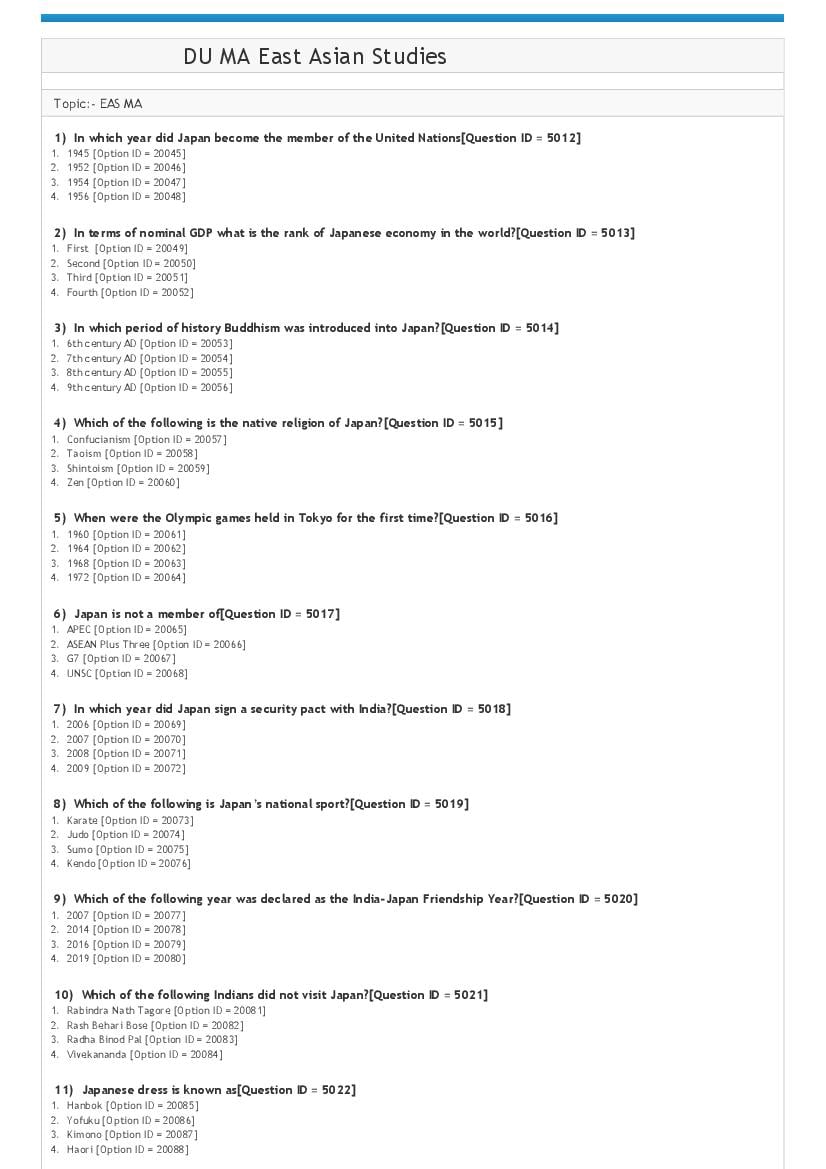
Topic:‐ EAS MA
1) In which year did Japan become the member of the United Nations[Question ID = 5012]
1. 1945 [Option ID = 20045]
2. 1952 [Option ID = 20046]
3. 1954 [Option ID = 20047]
4. 1956 [Option ID = 20048]
2) In terms of nominal GDP what is the rank of Japanese economy in the world?[Question ID = 5013]
1. First [Option ID = 20049]
2. Second [Option ID = 20050]
3. Third [Option ID = 20051]
4. Fourth [Option ID = 20052]
3) In which period of history Buddhism was introduced into Japan?[Question ID = 5014]
1. 6th century AD [Option ID = 20053]
2. 7th century AD [Option ID = 20054]
3. 8th century AD [Option ID = 20055]
4. 9th century AD [Option ID = 20056]
4) Which of the following is the native religion of Japan?[Question ID = 5015]
1. Confucianism [Option ID = 20057]
2. Taoism [Option ID = 20058]
3. Shintoism [Option ID = 20059]
4. Zen [Option ID = 20060]
5) When were the Olympic games held in Tokyo for the first time?[Question ID = 5016]
1. 1960 [Option ID = 20061]
2. 1964 [Option ID = 20062]
3. 1968 [Option ID = 20063]
4. 1972 [Option ID = 20064]
6) Japan is not a member of[Question ID = 5017]
1. APEC [Option ID = 20065]
2. ASEAN Plus Three [Option ID = 20066]
3. G7 [Option ID = 20067]
4. UNSC [Option ID = 20068]
7) In which year did Japan sign a security pact with India?[Question ID = 5018]
1. 2006 [Option ID = 20069]
2. 2007 [Option ID = 20070]
3. 2008 [Option ID = 20071]
4. 2009 [Option ID = 20072]
8) Which of the following is Japan’s national sport?[Question ID = 5019]
1. Karate [Option ID = 20073]
2. Judo [Option ID = 20074]
3. Sumo [Option ID = 20075]
4. Kendo [Option ID = 20076]
9) Which of the following year was declared as the India‐Japan Friendship Year?[Question ID = 5020]
1. 2007 [Option ID = 20077]
2. 2014 [Option ID = 20078]
3. 2016 [Option ID = 20079]
4. 2019 [Option ID = 20080]
10) Which of the following Indians did not visit Japan?[Question ID = 5021]
1. Rabindra Nath Tagore [Option ID = 20081]
2. Rash Behari Bose [Option ID = 20082]
3. Radha Binod Pal [Option ID = 20083]
4. Vivekananda [Option ID = 20084]
11) Japanese dress is known as[Question ID = 5022]
1. Hanbok [Option ID = 20085]
2. Yofuku [Option ID = 20086]
3. Kimono [Option ID = 20087]
4. Haori [Option ID = 20088]
Page 2
1. Art of Calligraphy [Option ID = 20089]
2. Art of Cooking [Option ID = 20090]
3. Art of growing trees in pots [Option ID = 20091]
4. Art of swardsmanship [Option ID = 20092]
13) What is the nature of Japan’s political system?[Question ID = 5024]
1. Monarchy [Option ID = 20093]
2. Democracy [Option ID = 20094]
3. Autocracy [Option ID = 20095]
4. Oligarchy [Option ID = 20096]
14) What is Japan’s staple food?[Question ID = 5025]
1. Noodles [Option ID = 20097]
2. Rice [Option ID = 20098]
3. Wheat [Option ID = 20099]
4. Soyabeans [Option ID = 20100]
15) Which of the following scripts is not used in writing Japanese language?[Question ID = 5026]
1. Hangeul [Option ID = 20101]
2. Kanji [Option ID = 20102]
3. Hiragana [Option ID = 20103]
4. Katakana [Option ID = 20104]
16) 15th August is an important date in the history of Japan because[Question ID = 5027]
1. The first nuclear bomb was dropped on Hiroshima [Option ID = 20105]
2. Japan surrendered before the Allied powers [Option ID = 20106]
3. Japan promulgated its new constitution [Option ID = 20107]
4. Japan started its first bullet train [Option ID = 20108]
17) Which of the following places was Japan’s capital for more than thousand years before Tokyo became the capital of
Japan in the middle of 19th century?[Question ID = 5028]
1. Nara [Option ID = 20109]
2. Asuka [Option ID = 20110]
3. Kamakura [Option ID = 20111]
4. Kyoto [Option ID = 20112]
18) What is the parliament of Japan known as[Question ID = 5029]
1. Tsogdu [Option ID = 20113]
2. Diet [Option ID = 20114]
3. Shora [Option ID = 20115]
4. Yuan [Option ID = 20116]
19) What is the level of literacy in Japan?[Question ID = 5030]
1. 100 per cent [Option ID = 20117]
2. 92 per cent [Option ID = 20118]
3. 86 per cent [Option ID = 20119]
4. 82 per cent [Option ID = 20120]
20) Who, according to the Japanese constitution, the chief executive authority?[Question ID = 5031]
1. Emperor [Option ID = 20121]
2. Parliament [Option ID = 20122]
3. Prime Minister [Option ID = 20123]
4. President [Option ID = 20124]
21) Japan’s high speed railways known as Bullet Train was inaugurated in[Question ID = 5032]
1. 1945 [Option ID = 20125]
2. 1959 [Option ID = 20126]
3. 1964 [Option ID = 20127]
4. 1973 [Option ID = 20128]
22) The present era name in Japan is[Question ID = 5033]
1. Meiji [Option ID = 20129]
2. Showa [Option ID = 20130]
3. Heisei [Option ID = 20131]
4. Reiwa [Option ID = 20132]
23) Okinawa is an island in Japan. It was earlier known as[Question ID = 5034]
1. Ryukyus [Option ID = 20133]
2. Takeshima [Option ID = 20134]
3. Hirado [Option ID = 20135]
4. Diaoyu [Option ID = 20136]
Page 3
modern period?[Question ID = 5035]
1. England [Option ID = 20137]
2. Portugal [Option ID = 20138]
3. Spain [Option ID = 20139]
4. Holland [Option ID = 20140]
25) Which of the following areas did Japan not occupy prior to the second world war?[Question ID = 5036]
1. Korea [Option ID = 20141]
2. Taiwan [Option ID = 20142]
3. Manchuria [Option ID = 20143]
4. Mongolia [Option ID = 20144]
26) A Japanese celebrity around the world, Miyazaki Hayao is known for his contributions in the field of[Question ID =
5037]
1. Robotics [Option ID = 20145]
2. Space Exploration [Option ID = 20146]
3. Literature [Option ID = 20147]
4. Films [Option ID = 20148]
27) Akira Kurosawa, a Japanese celebrity, is known for his contributions in the field of[Question ID = 5038]
1. Films [Option ID = 20149]
2. Physics [Option ID = 20150]
3. Evironmental activism [Option ID = 20151]
4. International Politics [Option ID = 20152]
28) Ainu, a tribal community in Japan lives on the island of[Question ID = 5039]
1. Hokkaido [Option ID = 20153]
2. Kyushu [Option ID = 20154]
3. Ogasawara [Option ID = 20155]
4. Tanegashima [Option ID = 20156]
29) Which of the following countries/regions was formerly known as Formosa?[Question ID = 5040]
1. Japan [Option ID = 20157]
2. China [Option ID = 20158]
3. Taiwan [Option ID = 20159]
4. Korea [Option ID = 20160]
30) Which of the following statements from 1 to 4 is true?
Assertion : Japan is called a Constitutional Monarchy.
Reason : Japan's Emperor, who is the Head of the State, is hereditary.
[Question ID = 5041]
1. Both the Assertion and the Reason are correct
[Option ID = 20161]
2. Neirther the Assertion nor the Reason is correct
[Option ID = 20162]
3. The Assertion is correct, but, the Reason is wrong
[Option ID = 20163]
4. The Assertion is wrong, but, the Reason is correct
[Option ID = 20164]
31) Which of the following is NOT a Japanese origin word found in English dictionaries?
[Question ID = 5042]
1. Tsunami
[Option ID = 20165]
2. Orinpikku
[Option ID = 20166]
3. Manga
[Option ID = 20167]
4. Karaoke
[Option ID = 20168]
32) Which of the following countries/regions was occupied by the Allied Powers at the end of WW II?[Question ID = 5043]
1. Taiwan [Option ID = 20169]
2. China [Option ID = 20170]
3. Japan [Option ID = 20171]
4. Korea [Option ID = 20172]
Page 4
1. In WW II, the combination of Germany, Italy, and, Japan was called the 'Allied Powers'. [Option ID = 20173]
2. In WW II, the combination of the US, the Soviet Union, and, the UK was called the 'Axis Powers'. [Option ID = 20174]
3. In WW II, the combination of the US, the Soviet Union, and, Japan was called the 'Allied Powers'. [Option ID = 20175]
4. In WW II, the combination of Germany, Italy, and, Japan was called the 'Axis Powers'. [Option ID = 20176]
34) Which of the following Asian countries has NEVER become a colony of western powers?[Question ID = 5045]
1. China [Option ID = 20177]
2. Japan [Option ID = 20178]
3. Vietnam [Option ID = 20179]
4. India [Option ID = 20180]
35) The members of Japanese Diet (Parliament) are elected by which of the following electoral system(s)?[Question ID =
5046]
1. Single seat Constituency System [Option ID = 20181]
2. Proportional Representation System [Option ID = 20182]
3. By the multi‐member winner system [Option ID = 20183]
4. By both the systems mentioned in 1 & 2 above [Option ID = 20184]
36) Which of the following best describes the Meiji Restoration in the history of Japan?
[Question ID = 5047]
1. Following the 'Black Ship' incident, the Tokugawa Shogunate voluntarily surrendered the power to Emperor Meiji
[Option ID = 20185]
2. Following the 'Black Ship' incident, both Emperor Meiji and Tokugawa Shogunate shared power through mutual understanding
[Option ID = 20186]
3. Following the 'Black Ship' incident, Emperor Meiji defeated the Tokugawa Shogunate and snatched the power from it
[Option ID = 20187]
4. Following the 'Black Ship' incident, power was taken away from the Tokugawa Shogunate in a bloodless coup and restored back to Emperor Meiji
[Option ID = 20188]
37) The territorial dispute between Korea and Japan pertains to which of the following island(s)?
[Question ID = 5048]
1. Dokodo or Takeshima
[Option ID = 20189]
2. Diaoyu or Senkaku
[Option ID = 20190]
3. Habomai, Shikotan, Kunashiri, and, Etorofu
[Option ID = 20191]
4. Tiaoyufai
[Option ID = 20192]
38) Which of the following constitutional reforms was/were implemented by the Allied Occupation Authority in Japan?
A. Sovereignty was vested on the people of Japan.
B. Universal franchise was adopted.
C. A massive land reform was implemented
D. Zaibatsu or financial conglomerations were disbanded
Choose the correct answer from the options given below
[Question ID = 5049]
1. Only A mentioned above
[Option ID = 20193]
2. Only A & B mentioned above
[Option ID = 20194]
3. Only A, B & C mentioned above
[Option ID = 20195]
4. All A, B, C & D mentioned above
[Option ID = 20196]
39) Which of the following parties has NEVER formed the Government in Japan so far?[Question ID = 5050]
1. Japanese Communist Party [Option ID = 20197]
2. Japan Socialist Party [Option ID = 20198]
3. Liberal Democratic Party [Option ID = 20199]
4. Democratic Party of Japan [Option ID = 20200]
Page 5
[Question ID = 5051]
1. Tokugawa period [Option ID = 20201]
2. Meiji period [Option ID = 20202]
3. Taisho period [Option ID = 20203]
4. Showa period [Option ID = 20204]
41) Which of the following is the official name of Taiwan?[Question ID = 5052]
1. Republic of China [Option ID = 20205]
2. Constitutional Republic of China [Option ID = 20206]
3. People's Republic of China [Option ID = 20207]
4. Democratic Republic of China [Option ID = 20208]
42) Who of the following was the Supreme Commander of Allied Powers (SCAP) during the occupation of Japan following
WW II?[Question ID = 5053]
1. President Franklin D. Roosevelt [Option ID = 20209]
2. General Douglas MacArthur [Option ID = 20210]
3. Commodore Matthew C. Perry [Option ID = 20211]
4. President Harry S. Truman [Option ID = 20212]
43) Which of the following novelists does NOT belong to the Meiji period of Japan?
[Question ID = 5054]
1. Oe Kenzaburo
[Option ID = 20213]
2. Natsume Soseki
[Option ID = 20214]
3. Mori Ogai
[Option ID = 20215]
4. Simazaki Toson
[Option ID = 20216]
44) Which of the following statements describes Kabuki the best?
[Question ID = 5055]
1. It is an art of growing small trees that mimic the shape and style of a full‐size tree
[Option ID = 20217]
2. It is a Japanese style of flower arrangement displayed with certain basic rules
[Option ID = 20218]
3. It is a classical form of Japanese dance‐drama staged with singing, dancing, and costume
[Option ID = 20219]
4. It is a traditional festival of Japan to celebrate the well‐being of young children
[Option ID = 20220]
45) The basic objective of Look East Policy of India denotes to which of the following?
[Question ID = 5056]
1. Forging new socio‐economic‐cultural ties with countries of East Asia, rahter than only following the western model
[Option ID = 20221]
2. Entering into strategic relations with countries of East Asia to combat the spread of communism
[Option ID = 20222]
3. Building a strategy with the US, Australia, and, Japan to free the Indo‐Pacific area from Chinese domination
[Option ID = 20223]
4. An economic planning to attract more and more Japanese manufacturing companies to India
[Option ID = 20224]
46) Which of the following is/are the pressing social problem(s) that Japan is facing at the present juncture?[Question ID =
5057]
1. Ageing population [Option ID = 20225]
2. Slow birth rate [Option ID = 20226]
3. Both 1 & 2 mentioned above [Option ID = 20227]
4. None of 1 or 2 mentioned above [Option ID = 20228]
47) Which of the following countries is the top‐most recipient of the Japanese Official Development Assistance at present?
[Question ID = 5058]
1. China [Option ID = 20229]
2. India [Option ID = 20230]
3. Vietnam [Option ID = 20231]
4. North Korea [Option ID = 20232]
Page 6
1. Renunciation of war and non‐possession of Defense Forces [Option ID = 20233]
2. Universal Franchise [Option ID = 20234]
3. Duties and Powers of the Japanese Imperial House [Option ID = 20235]
4. Enumerating the powers of the Japanese bi‐cameral legislature [Option ID = 20236]
49) Which of the following is said to be the major reason for a weak if not a strained relationship between India and Japan
between the end of WW II and 1980s‐90s?
[Question ID = 5060]
1. Detente or the release of tension between the US and the Soviet Union
[Option ID = 20237]
2. The onset of Cold War between the US and the Soviet Union
[Option ID = 20238]
3. The Chinese aggression against India of 1962
[Option ID = 20239]
4. The Indo‐Pak wars
[Option ID = 20240]
50) Which of the following is the correct arrangement of the Japanese Era system?
A. Heisei era ‐ Reiwa era ‐ Showa era ‐ Taisho era
B. Meiji era ‐ Taisho era ‐ Showa era ‐ Reiwa era
C. Meiji era ‐ Taiso era ‐ Showa era ‐ Heisei era
D. Heisei era ‐ Meiji era ‐ Reiwa era ‐ Showa era
Choose the correct answer from the options given below
[Question ID = 5061]
1. A
[Option ID = 20241]
2. B
[Option ID = 20242]
3. C
[Option ID = 20243]
4. D
[Option ID = 20244]
51) Which of the following statements underlines the goal of the Meiji era slogan of Enrich the Country, Strengthen the
Armed Forces
[Question ID = 5062]
1. Creating a nation‐state capable of restoring the lost political power to the monarch
[Option ID = 20245]
2. Creating a nation‐state capable of abolishing the Tokugawa led feudalism
[Option ID = 20246]
3. Creating a nation‐state capable of establishing a modern democracy
[Option ID = 20247]
4. Creating a nation‐state capable of standing equal among the western powers
[Option ID = 20248]
52) The Quadrilateral Security Dialogue (Quad) adopts which of the following ideas?[Question ID = 5063]
1. A free, open and prosperous Indo‐Pacific region [Option ID = 20249]
2. An informal strategic dialogue among Australia, India, Japan, and, the United States [Option ID = 20250]
3. An initiative to check the growing military and economic clout by China in the Indo‐Pacific region [Option ID = 20251]
4. All of the above [Option ID = 20252]
53) ' One Party Dominant System' refers to which of the following?[Question ID = 5064]
1. A system where only one political party is allowed to participate in the election [Option ID = 20253]
2. A system where a dictatorial regime prevails over the political parties [Option ID = 20254]
3. A multi‐party system where one party retains power for a long time [Option ID = 20255]
4. A system which does not recognise the role of political parties [Option ID = 20256]
54) Which of the following established practice(s) have been the guiding principles of the Japanese Industrial System?
[Question ID = 5065]
1. A promise by a company to its employees that they will have a job for thier whole working life [Option ID = 20257]
2. A practice by a company of promoting an employee in the order of proximity to one's retirement [Option ID = 20258]
3. Only the practice mentioned in 1 above [Option ID = 20259]
Page 7
55) The Meiji Constitution of Japan came into effect in which year?[Question ID = 5066]
1. 1889 [Option ID = 20261]
2. 1926 [Option ID = 20262]
3. 1945 [Option ID = 20263]
4. 1950 [Option ID = 20264]
56) Chooese the one (1) correct answer from the options given below:
The largest Christian population in East Asia is found in
A. Korea
B. Japan
C. Taiwan
D. China
[Question ID = 5067]
1. A only
[Option ID = 20265]
2. B only
[Option ID = 20266]
3. C only
[Option ID = 20267]
4. D only
[Option ID = 20268]
57) Choose the one (1) correct answer from the options given below
The language of East Asia that has three scripts is
A. Chinese
B. Korean
C. Cantonese
D. Japanese
[Question ID = 5068]
1. A only
[Option ID = 20269]
2. B only
[Option ID = 20270]
3. C only
[Option ID = 20271]
4. D only
[Option ID = 20272]
58) Choose the one (1) correct answer from the options given below
The "Tale of the Genji", is a novel describing imperial
A. Korea
B. China
C. Japan
D. Indonesia
[Question ID = 5069]
1. A only
[Option ID = 20273]
2. B only
[Option ID = 20274]
3. C only
[Option ID = 20275]
4. D only
[Option ID = 20276]
59) Choose the one (1) correct statement from the options given below
Page 8
A. Aggressive Diplomacy
B. Wolf Warrior Diplomacy
C. Real Politik Diplomacy
D. Hardened Diplomacy
[Question ID = 5070]
1. A only
[Option ID = 20277]
2. B only
[Option ID = 20278]
3. C only
[Option ID = 20279]
4. D only
[Option ID = 20280]
60) Choose the one correct (1) statement from the options given below
Chinese Think Tanks have been making several assessments of the emerging competition between China and the USA. One
book that has had a huge impact in China is Paul Kennedy's book
A. The Rise of China and the Decline of America
B, The Fall of the American Empire
C. The Rise and Fall of Great Empires: Economic Change and Military Conflict
D. The Inevitable Rise of China
[Question ID = 5071]
1. A only
[Option ID = 20281]
2. B only
[Option ID = 20282]
3. C only
[Option ID = 20283]
4. D only
[Option ID = 20284]
61) Choose the one correct answer from the options given below
Social Science theories are designed to create methodologies and concepts to understand social organizations, actions and
events. Amongst them
A. Structural Functionalism is a dominant school
B. Structural Functionalism has been a failure
C. Structural Functionalism has looked only at the physical sciences
D. Structural Functionalism has lacked followers
[Question ID = 5072]
1. A only
[Option ID = 20285]
2. B only
[Option ID = 20286]
3. C only
[Option ID = 20287]
4. D only
[Option ID = 20288]
62) Many different causes have been attributed to the start of the 2n d World War that also led to the final end of Western
colonial empires. However the immediate cause was
A. The assault on Hungary by Britain
B. The assination of the Archduke Ferdinand the II .
C. The rise of Russian imperialism
D. The war between France and Germany
Page 9
1. A only
[Option ID = 20289]
2. B only
[Option ID = 20290]
3. C only
[Option ID = 20291]
4. D only
[Option ID = 20292]
63) Choose the one (1) correct answer from the options given below
The Millenial Development Goals of the Untied Nations do not include the following
A. Health and Literacy
B. The life styles of the people
C. Maternal health and infant mortality
D. Water and sanitation
[Question ID = 5074]
1. A only
[Option ID = 20293]
2. B only
[Option ID = 20294]
3. C only
[Option ID = 20295]
4. D only
[Option ID = 20296]
64) Read the following passage and choose the one (1) correct statement:
"Mao Zedong, the leader of Communist China was famous for launching mass movements. He hoped through this strategy to
elimate class ideology and create a new Chnese society.: From the passage we learn that
A. Mao Zedong used mass movement to affect social change
B. Mao Zedong saw class ideology as irrelevant
C. Mao Zedong thought it was impossible to change Chinese society
D. Mao Zedong lost the class war that is why he encouraged mass movements
[Question ID = 5075]
1. A only
[Option ID = 20297]
2. B only
[Option ID = 20298]
3. C only
[Option ID = 20299]
4. D only
[Option ID = 20300]
65) Read the following passage and choose the one (1)ccorrect statement
"Family has been identified as one of the key common institution in all social cultures. Although the types and structure of
this institution may differe, nevertheless they serve both a productive and reproductive function". From this passage we
learn that:
A. Although family systems differ, they are common to all societies .
B. Families are an uncommon feature of social systems
C. The productive funciton of families is not important
D. The reproductive funciton of families does not appear common
[Question ID = 5076]
1. A only
[Option ID = 20301]
2. B only
[Option ID = 20302]
3. C only
Page 10
4. D only
[Option ID = 20304]
66) Read the following passage and choose the one (1) correct statement
"The strength of a Great Power can only be measured in relaion to other powers. Often Power is assesed as Comprehensive
National Power that accounts for militrary, economic and cultural power." From this passage we learn that
A. Power cannot be measured
B. Power included economic, political and cultural power
C. Power is only power when it is exercised
D. Cultural power is not important
[Question ID = 5077]
1. A only
[Option ID = 20305]
2. B only
[Option ID = 20306]
3. C only
[Option ID = 20307]
4. D only
[Option ID = 20308]
67) Read the following passage and choose the one (1) correct statement
"The youth of China are also called Little Emperors since they are single children and inherit the wealth and love of two sets
of grand parents. Howver, a change in China one child policy will also create more competition for this generation
economically," From this passage we learn that
A. Chinese youth are non competitive
B. The one child policy will not change the position of Chinese youth
C. Today's Chinese youth are lucky since they inherit from both sets of grandparents
D. Chinese youth are only interested in money
[Question ID = 5078]
1. A only
[Option ID = 20309]
2. B only
[Option ID = 20310]
3. C only
[Option ID = 20311]
4. D only
[Option ID = 20312]
68) Read the following passage and choose the one (1) correct answer
"The Indian Independence movement differed greatly from other struggles for liberation. Its chief difference was Gandhi's
strict rejection of violence as a means of struggle. However, one must not forget that even those who used violence, like
Bhagat Singh, also worked towards the same goal." The passage tells us that
A. Violence does not achieve independence
B. Gandhi did not approve of violence as a means to a goal
C. Bhagat Singh did not help in the cause of Independence
D. Independence is not a struggle
[Question ID = 5079]
1. A only
[Option ID = 20313]
2. B only
[Option ID = 20314]
3. C only
[Option ID = 20315]
4. D only
[Option ID = 20316]
Page 11
"The rivalry between India and China is far from over and as India's economy also begins to rise and attract attention, China's
postures to contain India will also acquire greater subtlety and strategy". From the passage we learn that"
A. India and China have good bilateral ties
B. India and China are rivals
C. China will continue to help and aid India in its development
D. China will try to contain India trhough diverse strategies.
[Question ID = 5080]
1. A only
[Option ID = 20317]
2. B only
[Option ID = 20318]
3. C only
[Option ID = 20319]
4. D only
[Option ID = 20320]
70) China ceded Taiwan to Japan in :[Question ID = 5081]
1. 1895 [Option ID = 20321]
2. 1890 [Option ID = 20322]
3. 1935 [Option ID = 20323]
4. 1893 [Option ID = 20324]
71) APEC stands for:[Question ID = 5082]
1. Asia – Pacific Economic Cooperation [Option ID = 20325]
2. Asia‐ Pacific Economic Co existence [Option ID = 20326]
3. Asia‐ Pacific Economic Community [Option ID = 20327]
4. Asia‐Pacific Economic Culture [Option ID = 20328]
72) Which Indian emperor sent his son and daughter to preach Buddhism in foreign lands?[Question ID = 5083]
1. Harshvardhan [Option ID = 20329]
2. Rajendra Chola [Option ID = 20330]
3. Vikramaditya [Option ID = 20331]
4. Ashoka [Option ID = 20332]
73) Decollectivisation is a new policy adopted in post – Mao China is pertaining to:[Question ID = 5084]
1. Agricurture [Option ID = 20333]
2. Science &Technology [Option ID = 20334]
3. Defence [Option ID = 20335]
4. Industry [Option ID = 20336]
74) Diplomatic relations between the PRC and the US was established in:[Question ID = 5085]
1. 1972 [Option ID = 20337]
2. 1979 [Option ID = 20338]
3. 1982 [Option ID = 20339]
4. 1970 [Option ID = 20340]
75) Match List I with List II
LIST I (Events) LIST II ( Year)
A.Great Leap Forward I. 1971
B.Hundred Flowers Campaign II. 1966
C.Cultural Revolution III. 1956
D.Death of Lin Biao IV. 1958
Choose the correct answer from the options given below:
[Question ID = 5086]
1. A ‐ I, B ‐ II, C ‐ III, D ‐ IV [Option ID = 20341]
2. A ‐ III, B ‐ IV, C ‐ II, D ‐ I [Option ID = 20342]
3. A ‐ IV, B ‐ III, C ‐ II, D ‐ I [Option ID = 20343]
4. A ‐ II, B ‐ IV, C ‐ I, D ‐ III [Option ID = 20344]
76) Arrange the following in the correct chronological order, from the earliest to the most recent.
A.Mao Zedong, Hua Guofeng, Deng Xiaoping, Jiang Zemin, Hu Jintao, Xi Jinping
B.Mao Zedong, Deng Xiaoping, Hua Guofeng, Jiang Zemin, Hu Jintao, Xi Jinping
C. Mao Zedong, Hu Yaobang, DengXiaoping, Jiang Zemin, Hu Jintao, Xi Jinping .
Page 12
Choose the correct answer from the options given below:
[Question ID = 5087]
1. A only
[Option ID = 20345]
2. B only
[Option ID = 20346]
3. C only
[Option ID = 20347]
4. D only
[Option ID = 20348]
77) Statement I: There are 56 ethnic groups in the People’s Republic of China.
Statement II: The People’s Republic of China is a multi –ethnic state.
[Question ID = 5088]
1. Both Statement I and Statement II are true
[Option ID = 20349]
2. Both Statement I and Statement II are false
[Option ID = 20350]
3. Statement I is true but Statement II is false
[Option ID = 20351]
4. Statement I is false but Statement II is true
[Option ID = 20352]
78) DPP is a Political Party in Taiwan Stands for:[Question ID = 5089]
1. Democratic Progressive Party [Option ID = 20353]
2. Democratic Popular Party [Option ID = 20354]
3. Democratic People’s Party [Option ID = 20355]
4. Democratic Protest Party [Option ID = 20356]
79) The South China Sea disputes involve:
A. Brunei, thePRC, the ROC on Taiwan, Malaysia, Indonesia, the Philippines and Vietnam
B. Vietnam, Cambodia, the ROC onTaiwan, the PRC, Brunei and the Philippines
C. Laos, Vietnam, Brunei, the PRC, Japan and the Philippines
D. Brunei, the PRC, Singapore, Indonesia, Malaysia, Vietnam and Thailand
Choose the correct answer from the options given below:
[Question ID = 5090]
1. A only
[Option ID = 20357]
2. B only
[Option ID = 20358]
3. C only
[Option ID = 20359]
4. D only
[Option ID = 20360]
80) Given below are two statements
Statement I: The People’s Republic of China (PRC) considers Taiwan a renegade Province.
Statement II:The PRC and Taiwan Dispute has not yet been resolved.
In light of the above statements, choose the most appropriate answer from the options given below
[Question ID = 5091]
1. Both Statement I and Statement II are correct
[Option ID = 20361]
2. Both Statement I and Statement II are incorrect
[Option ID = 20362]
3. Statement I is correct but Statement II is incorrect
[Option ID = 20363]
4. Statement I is incorrect but Statement II is correct
[Option ID = 20364]
Page 13
anarchy between 1966‐1976:[Question ID = 5092]
1. The Great Proletarian Cultural Revolution [Option ID = 20365]
2. Opening up and Reform Programme [Option ID = 20366]
3. Two whatever policy of Hua Guofeng [Option ID = 20367]
4. Democracy Wall Movement [Option ID = 20368]
82) The last Emperor of China was:[Question ID = 5093]
1. Cixi [Option ID = 20369]
2. Puyi [Option ID = 20370]
3. Kangxi [Option ID = 20371]
4. Yongle [Option ID = 20372]
83) Given below are two statements
Statement I:Mao started Great Leap Forward Programme in late 1950s in China.
Statement II:Mao Zedong‘s economic programmes were unsuccessful and miserably failed in China.
In light of the above statements, choose the most appropriate answer from the options given below
[Question ID = 5094]
1. Both Statement I and Statement II are correct
[Option ID = 20373]
2. Both Statement I and Statement II are incorrect
[Option ID = 20374]
3. Statement I is correct but Statement II is incorrect
[Option ID = 20375]
4. Statement I is incorrect but Statement II is correct
[Option ID = 20376]
84) Which of the following mountains located on the Korean Peninsula is wrongly matched?[Question ID = 5095]
1. North Korea ‐‐ Hamasan [Option ID = 20377]
2. South Korea ‐‐ Jirisan [Option ID = 20378]
3. North Korea ‐‐ Baektusan [Option ID = 20379]
4. North Korea ‐‐ Geumgangsan [Option ID = 20380]
85) In which year was Korean Peninsula divided along the 38th parallel?[Question ID = 5096]
1. 1942 [Option ID = 20381]
2. 1945 [Option ID = 20382]
3. 1949 [Option ID = 20383]
4. 1953 [Option ID = 20384]
86) Which of the following is not a typical Korean dish?[Question ID = 5097]
1. Kimchi [Option ID = 20385]
2. Kimbap [Option ID = 20386]
3. Kimhae [Option ID = 20387]
4. Bulgogi [Option ID = 20388]
87) The naming of “Sea of Japan” is a contested issue between which two countries?[Question ID = 5098]
1. North Korea and China [Option ID = 20389]
2. South Korea and Japan [Option ID = 20390]
3. China and Japan [Option ID = 20391]
4. North Korea and South Korea [Option ID = 20392]
88) On which day Korean Armistice agreement was signed?[Question ID = 5099]
1. 27 July 1952 [Option ID = 20393]
2. 25 June 1950 [Option ID = 20394]
3. 27 July 1953 [Option ID = 20395]
4. 26 June 1953 [Option ID = 20396]
89) Which of the following two countries militarily supported South Korea during the Korean War (1950‐53)?[Question ID =
5100]
1. India and China [Option ID = 20397]
2. Mongolia and Thailand [Option ID = 20398]
3. United States and Russia [Option ID = 20399]
4. United States and Britain [Option ID = 20400]
90) KOTRA is a South Korean agency associated with which of the following activities?[Question ID = 5101]
1. Tourism [Option ID = 20401]
2. Trade [Option ID = 20402]
3. Scientific Research [Option ID = 20403]
Page 14
91) What does Juche idea of North Korea mean?[Question ID = 5102]
1. Communism [Option ID = 20405]
2. Communalism [Option ID = 20406]
3. Self‐reliance [Option ID = 20407]
4. Globalisation [Option ID = 20408]
92) When South Korea became a full‐fledged member of the United Nations?[Question ID = 5103]
1. 1953 [Option ID = 20409]
2. 1991 [Option ID = 20410]
3. 1992 [Option ID = 20411]
4. 1993 [Option ID = 20412]
93) In which years South Korea hosted Summer and Winter Olympic Games, respectively?[Question ID = 5104]
1. 1960, 1992 [Option ID = 20413]
2. 1964, 2018 [Option ID = 20414]
3. 1988, 1972 [Option ID = 20415]
4. 1988, 2018 [Option ID = 20416]
94) Which of the following South Korean president/s was/were impeached?[Question ID = 5105]
1. Park Chung‐hee and Park Geun‐hye [Option ID = 20417]
2. Park Geun‐hye and Kim Young‐sam [Option ID = 20418]
3. Lee Myung‐bak and Park Geun‐hye [Option ID = 20419]
4. Park Geun‐hye [Option ID = 20420]
95) King Kim Suro who married the Indian Princess Suriratna belonged to which Korean kingdom?[Question ID = 5106]
1. Gayakam [Option ID = 20421]
2. Goguryeo [Option ID = 20422]
3. Goryeo [Option ID = 20423]
4. Gaya [Option ID = 20424]
96) Poet Rabindranath Tagore wrote “Lamp of the East” quatrain for Korea in which year?[Question ID = 5107]
1. 1919 [Option ID = 20425]
2. 1929 [Option ID = 20426]
3. 1939 [Option ID = 20427]
4. 1949 [Option ID = 20428]
97) Who was the first South Korean president to visit India?[Question ID = 5108]
1. Park Geun‐hye [Option ID = 20429]
2. Kim Young‐sam [Option ID = 20430]
3. Roh Moo‐hyun [Option ID = 20431]
4. Park Chung‐hee [Option ID = 20432]
98) Which South Korean province borders North Korea?[Question ID = 5109]
1. Jeolla [Option ID = 20433]
2. Gimhae [Option ID = 20434]
3. Jeju [Option ID = 20435]
4. Gangwon [Option ID = 20436]
99) Which of the following refers to South Korean rural development programme?[Question ID = 5110]
1. Samil Undong [Option ID = 20437]
2. Saemaul Undong [Option ID = 20438]
3. Hallyu [Option ID = 20439]
4. Sangu Undong [Option ID = 20440]
100) Which one of the following presidents of South Korea committed suicide?[Question ID = 5111]
1. Roh Moo‐hyun [Option ID = 20441]
2. Chun Doo‐hwan [Option ID = 20442]
3. Park Geun‐hye [Option ID = 20443]
4. Lee Myung‐bak [Option ID = 20444]
Document Details
| Board / Org | NTA |
| Exam | DUET |
| Type | Question Paper |
| Pages | 14 |
| Language | english |
| Updated | 30 Apr 2026 |