CUSAT CAT 2017 Question Paper Life Sciences
Finished viewing? Save it for later —
Download CUSAT CAT 2017 Question Paper Life Sciences (PDF · 18 pages)About CUSAT CAT 2017 Question Paper Life Sciences
CUSAT CAT 2017 Question Paper Life Sciences is available here for free download. Published by Cochin University for CUSAT Common Admission Test, this question paper can be viewed online or downloaded as a PDF (18 pages). Candidates preparing for CUSAT Common Admission Test can use CUSAT CAT 2017 Question Paper Life Sciences to understand the exam pattern, the type of questions asked, and the overall difficulty level.
Frequently Asked Questions
How can I download CUSAT CAT 2017 Question Paper Life Sciences?
Open this page and click the Download button to save CUSAT CAT 2017 Question Paper Life Sciences as a PDF. It is completely free on AglaSem Docs.
Is CUSAT CAT 2017 Question Paper Life Sciences free to download?
Yes. CUSAT CAT 2017 Question Paper Life Sciences can be viewed online and downloaded as a PDF free of cost on AglaSem Docs.
How many pages does CUSAT CAT 2017 Question Paper Life Sciences have?
CUSAT CAT 2017 Question Paper Life Sciences contains 18 pages, which you can read online or download together as a single PDF.
Where can I find more CUSAT Common Admission Test study material?
You can find more CUSAT Common Admission Test question papers, sample papers, syllabus, and answer keys on AglaSem Docs.
CUSAT CAT 2017 Question Paper Life Sciences – Text
Read the full text of this question paper below — useful to quickly search, copy and reference the content online without downloading the PDF.
📄 View text version (18 pages)
Page 1
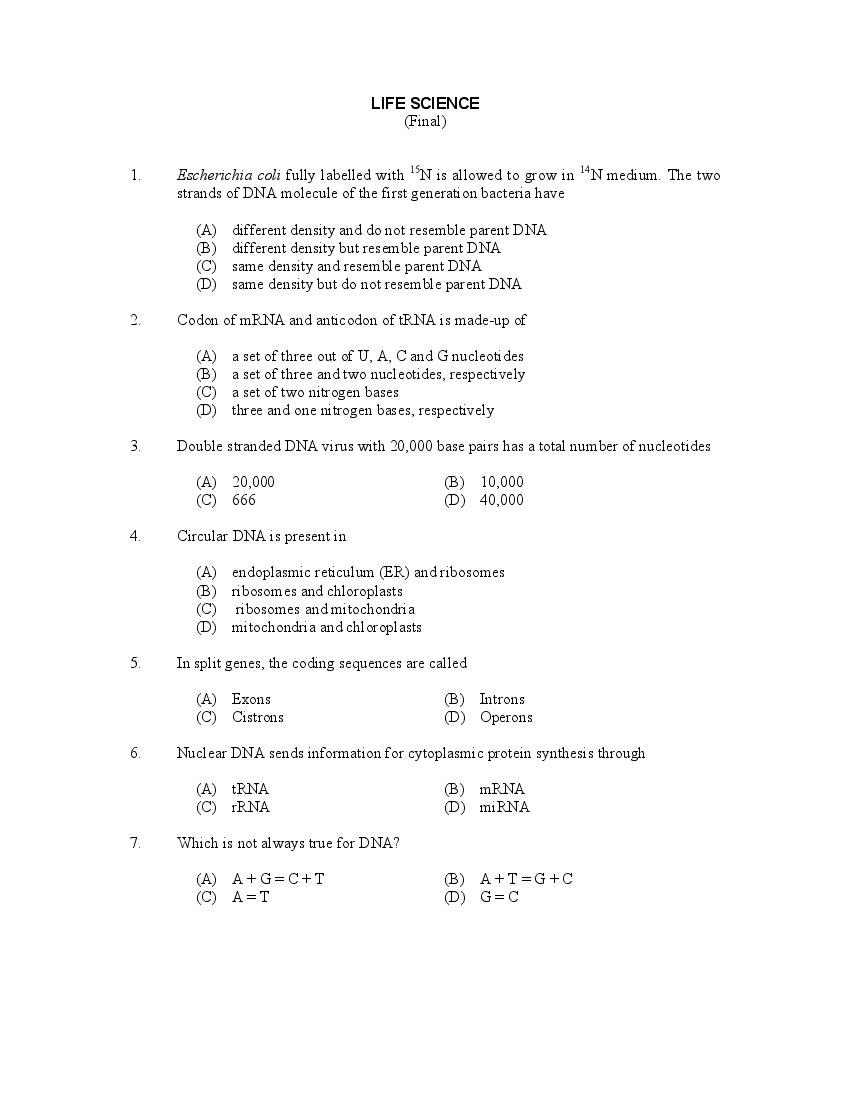
(Final)
1. Escherichia coli fully labelled with 15N is allowed to grow in 14N medium. The two
strands of DNA molecule of the first generation bacteria have
(A) different density and do not resemble parent DNA
(B) different density but resemble parent DNA
(C) same density and resemble parent DNA
(D) same density but do not resemble parent DNA
2. Codon of mRNA and anticodon of tRNA is made-up of
(A) a set of three out of U, A, C and G nucleotides
(B) a set of three and two nucleotides, respectively
(C) a set of two nitrogen bases
(D) three and one nitrogen bases, respectively
3. Double stranded DNA virus with 20,000 base pairs has a total number of nucleotides
(A) 20,000 (B) 10,000
(C) 666 (D) 40,000
4. Circular DNA is present in
(A) endoplasmic reticulum (ER) and ribosomes
(B) ribosomes and chloroplasts
(C) ribosomes and mitochondria
(D) mitochondria and chloroplasts
5. In split genes, the coding sequences are called
(A) Exons (B) Introns
(C) Cistrons (D) Operons
6. Nuclear DNA sends information for cytoplasmic protein synthesis through
(A) tRNA (B) mRNA
(C) rRNA (D) miRNA
7. Which is not always true for DNA?
(A) A + G = C + T (B) A + T = G + C
(C) A = T (D) G = C
Page 2
8. The number of different types of gametes produced from a plant with genotype
AaBbCc is
(A) one (B) two
(C) four (D) sixteen
9. Gregore Johannes Mendel could not find recombination and crossing over as
(A) traits he chose were either present on different chromosomes or were
far apart
(B) traits chosen by him were not influenced by gene
(C) he did not have a high power microscope
(D) he selected only pure types
10. The bacteria grown in the medium containing S35 as lone source of sulphur show its
incorporation in the
(A) DNA (B) Protein
(C) RNA (D) Glycerol
11. Haploids are preferred over diploids for mutation studies because in haploids
(A) recessive mutations express immediately
(B) dominant mutations express immediately
(C) mutations are readily induced
(D) tissue culture is easy
12. The phenomenon of exchange of segments between paternal and maternal
chromosomes is termed as
(A) linkage (B) recombination
(C) crossing over (D) segregation
13. Mutation in which one base is replaced by another base, is termed as
(A) addition (B) deletion
(C) translocation (D) substitution
14. Jumping genes are also known as
(A) Transposons (B) miRNA
(C) Exon (D) Intron
15. Isoelectric focussing method for separation of proteins works on the principle of
(A) electrophoretic separation based on relative content of acidic and basic
residues
(B) mass of the protein molecules
(C) number of amino acids
(D) coagulation capacity of protein molecules
Page 3
16. The use of colchicine is involved in the production of
(A) somaclonal variation (B) haploids
(C) hybrids (D) polyploids
17. Production of secondary metabolites (new term being: specialized metabolites)
requires the employment of
(A) protoplast cultures (B) apical meristem cultures
(C) auxillary bud cultures (D) cell suspension cultures
18. What role do opines play in crown gall disease?
(A) source of carbon, nitrogen and energy for the Agrobacterium tumefaciens
(B) transfer of T-DNA to plant cell
(C) attachment of Agrobacterium tumefaciens to the host plant
(D) induction of the expression of vir genes
19. In Plant tissue culture studies, one of the major problems is the production of
polyphenols in the growth media. This can be tackled to varying degrees by the
inclusion in the medium of
(A) Agar-agar (B) Vitamins
(C) Sucrose (D) Polyvinylpyrrolidine (PVP)
20. Datura metal anther cultures regenerate plants. What would be the ploidy of the
regenerants?
(A) Haploid (B) Both haploid and diploid
(C) Diploid (D) Polyploid
21. Hormone pair required for a callus to differentiate is
(A) Auxin and cytokinen (B) Auxin and gibberellin
(C) Ethylene and gibberellin (D) Cytokinin and gibberellin
22. Commonly used reporter gene in plant expression vector is
(A) Ti plasmid gene of Agrobacterium tumifaciens
(B) GUS gene
(C) β - Lactamase gene
(D) α - anylase gene
23. Cybrids are produced by
(A) fusion of two different nuclei from two different species
(B) fusion of two same type nuclei from same species
(C) nucleus of one species but cytoplasm from both the parent species
(D) fusion of two chloroplasts from the same species
Page 4
24. The phytohormone producing apical dominance is
(A) Auxin (B) Gibberellin
(C) Ethylene (D) Cytokinin
25. Which of the following phytohormone is connected with cell division?
(A) Kinetin (B) 2, 4 - D
(C) Gibberellic acid (GA3) (D) IAA
26. Why plant cells and tissue need external carbon source in the culture medium?
(A) because of lack of autotrophic ability
(B) because of lack of absorption ability
(C) because of lack of regeneration ability
(D) because of lack of endosmosis in cultures
27. Mitotic spindle is formed by bundles of
(A) microtubules (B) microfilaments
(C) microbodies (D) intermediate filaments
28. Which of the following are essential fally acids?
(A) Linoleic and linolenic acid (B) Stearic acid
(C) Oleic acid (D) Palmitic acid
29. The most important part of cell-cycle which is not observed under light microscope is
called
(A) Interphase (B) Anaphase
(C) Metaphase (D) Telophase
30. How many primary spermatocytes will form 400 spermatozoa?
(A) 400 (B) 200
(C) 100 (D) 50
31. Competitive inhibition is due to
(A) protein poison
(B) substrate analogue
(C) non-availability of activation energy
(D) short wave irradiation
32. End product inhibition is called
(A) substrate regulation (B) feed-back regulation
(C) irreversible inhibition (D) non-competitive inhibition
Page 5
33. Some antibiotics act as ionophores, which means that they
(A) interfere directly with bacterial cell-wall synthesis
(B) inhibit only translation
(C) increase cell membrane permeability to specific ions
(D) inhibit both translation and transcription
34. Which one among the following enzymes was first isolated and purified in the form of
crystals?
(A) Urease (B) Pepsin
(C) Amylase (D) Ribonuclease
35. The release of adenyl cyclase from the cell membrane converts
(A) ATP into ADP (B) ADP into ATP
(C) cAMP into ATP (D) ATP into cAMP
36. The enzyme used to dissolve blood clot in coronary artery is
(A) Thrombokinase (B) Renin
(C) Streptokinase (D) Tyrosinase
37. The plant enzyme that acts both as carboxylase at one time and oxygenase at another
time is
(A) carbonic anhydrase (B) PEP-carboxylase
(C) RUBP-carboxylase (D) Peptidase
38. The amount of heat required to raise the temperature of 1 kg of water through 1oC is
termed as
(A) Kilocalorie (B) Calorie
(C) Joule (D) Calorie / oC
39. A protein is known to form a tetramer at a specific pH. One of the following
techniques could be suitably used to authenticate the tetrameric nature:
(A) SDS-polyacrylamide gel electrophoresis (SDS-PAGE)
(B) Cation-exchange chromatography
(C) Anion-exchange chromatography
(D) Gel filtration chromatography
40. The neuron that releases acetylcholine is
(A) Cholinergic (B) Adrenergic
(C) Diuretic (D) Ionophoric
Page 6
41. Thiamine deficiency in human beings leads to a condition known as
(A) Pellagra (B) Scurvy
(C) Beri-beri (D) White muscle disease
42. The C value denotes the total amount of DNA in a
(A) aneuploid (B) diploid
(C) haploid (D) polyploid
43. In the conversion of glucose to fructose, which one of the following immobilized
enzymes is used in the industry?
(A) α-amylase (B) Lactase
(C) Glucoamylase (D) Glucose isomerase
44. Somatic embryogenesis is a procedure in plant tissue culture methodology described
best for the
(A) formation of both shoot and root meristem
(B) formation of zygotic embryos
(C) formation of axillary buds
(D) formation of tertiary roots
45. All the cells that participate in immune responses originate from a population of
(A) Neutrophils (B) Stem cells
(C) Macrophages (D) Lymphocytes
46. Parthenogenetic embryos in plants are those which are formed by
(A) unfertilized eggs (B) fertilized eggs
(C) sporophytic cells (D) male gametophytes
47. Which one of the following is the phytohormone used for growth of cells, tissues and
organs in plant tissue culture?
(A) Cysteine (B) Cytokinin
(C) Cytidylate (D) Cyclic AMP
48. To produce plants that are homozygous for all traits, the best choice is
(A) protoplast culture (B) cell suspension culture
(C) anther and pollen culture (D) apical meristem culture
49. DAHP synthetase catalyses the condensation of
(A) erythrose-4-phosphate (B) phosphoenol pyruvate
(C) Both (A) or (B) (D) phenylalanine
Page 7
50. Most of the energy in aerobic respiration of glucose is captured by
(A) substrate level phosphorylation
(B) electron transport of electrons from NADH
(C) long-chain fatty acid oxidation
(D) the enzyme forming-hydrogen lyase
51. Dolichole phosphate is
(A) complex lipid involved in docking vesicles with the plasma membrane
(B) the anchor, on which sugars assemble before transfer to proteins
(C) a chaperone used in protein folding
(D) a product of phospholipase C activation
52. If G of a chemical reaction is positive in value and Keq is less than 1, then the
chemical reaction will
(A) proceed in reverse direction
(B) proceed in forward direction
(C) not take place in any of the direction
(D) None of the above
53. When acetate is the sole source of carbon for some microorganisms, the cycle which
is used is called
(A) pentose phosphate pathway (B) glycolytic pathway
(C) glyoxylate pathway (D) oxaloacetate pathway
54. Mendal emasculated garden pea plant. Emasculation is the
(A) removal of flower buds
(B) removal of anthers before dehiscence
(C) removal of carpals before dehiscence
(D) removal of mature plants
55. Crossing over in diploid organism in responsible for
(A) dominance of games (B) segregation of alleles
(C) recombination of linked genes (D) linkage between genes
56. The introduction of remedial gene to bone marrow cells comes under
(A) germ line therapy (B) somatic cell therapy
(C) Both (A) or (B) (D) corrective gene therapy
57. Patau’s syndrome occurs due to
(A) trisomy of 13th chromosome (B) trisomy of 18th chromosome
(C) trisomy of 21st chromosome (D) trisomy of 22nd chromosome
Page 8
58. Identify a Mandelian disorder from the following
(A) Down’s syndrome (B) Klinefelter’s syndrome
(C) Turners syndrome (D) Polyketronuria
59. Xeroderma pigmentosum is a disease due to
(A) production of guanine –guanine dimmers in the DNA
(B) defective DNA repair
(C) auto immunity
(D) defective melanin metabolism
60. A gene showing co- dominance
(A) has one allele dominant to the other
(B) has both alleles independently expressed in the heterozygote
(C) has alleles tightly linked on the same chromosome
(D) has alleles expressed at the same time in development
61. Natural humoral immune response against a pathogen leads to the production of
(A) polyclonal antibodies (B) monoclonal antibodies
(C) macrophages (D) None of the above
62. HGPRT mutant cells are raised by inducing mutations using
(A) 5-bromouracil (B) 8-azaguanine
(C) Cochicine (D) 6-methyl isocyanate
63. Injection of anti-venom against snake bite is an example of
(A) active immunity
(B) passive immunity
(C) non-specific immunity
(D) phagocytic immunity
64. Alternate pathway of complement system is activated by
(A) antibody-antigen complexes
(B) antigen
(C) microorganisms or its toxins
(D) antigens bound to MHC
65. Which of the following is not coded by MHC genes?
(A) Glycoproteins
(B) Antigen presenting proteins
(C) Complements of complement pathway
(D) Immunoglobulins
Page 9
66. Which of the following is a combined vaccine?
(A) Hepatitis B vaccine (B) Hib vaccine
(C) Var vaccine (D) DPT vaccine
67. Activation of B cell receptor by the binding of an epitope result in the formation of
(A) plasma cells and T cytotoxic cells
(B) memory cells and T cytotoxic cells
(C) plasma cells for antibody production and memory cells for primary
response
(D) plasma cells for antibody production and memory cells for secondary
response
68. Cyclosporine is an immunosuppressive drug given to avoid transplant rejection which
acts by
(A) inhibition of T cells
(B) inhibition of B cells
(C) inhibition of immune system
(D) inhibition of complement system
69. Which of the following is the central molecule in complement pathway?
(A) C1 (B) C2
(C) C3b (D) C.5
70. Compared to the secondary antibody response, the primary response
(A) attains a higher IgG titer
(B) has a longer lag phase
(C) persists for a longer plateau period
(D) produces antibodies with a higher affinity for antigen
71. A 30 year old women has non bloody diarrhea for the past 14 hours. Which one of the
following organisms is least likely to cause this illness?
(A) Streptococcus pyogens (B) Clostridium difficile
(C) Shigella dysenteriae (D) Salmonella enteritidis
72. Which of the following disease is best diagnosed by serologic means?
(A) Pulmonary tuberculosis (B) Gonorrhea
(C) Actinomycosis (D) Q fever
73. Each of the following agent is a recognized cause of diarrhea EXCEPT
(A) Clostridium perfringens (B) Vibrio cholerae
(C) Enterococcus faecalis (D) Escheichia coli
Page 10
74. Which type of antibody is most effective in activating complement?
(A) IgG1 (B) IgG2
(C) IgG3 (D) IgM
75. Which of the following does not play a role in antigen presentation?
(A) MHC class I molecules (B) MHC class II molecules
(C) MHC class III molecules (D) None of the above
76. In a chronic carrier of hepatitis B virus (HBV), which positive test is most indicative
of high infectivity?
(A) Hepatitis B surface antigen (HbsAg)
(B) Hepatitis B core antigen (HbcAg)
(C) Hepatitis B e antigen (HbeAg)
(D) AntiHSBsAg
77. All of the following picornaviruses are resistant to the acidity of the stomach except
(A) Coxsackie virus A (B) Coxsackie virus B
(C) Echo virus (D) Rhinovirus
78. The number of double bonds in Arachidonic acid is
(A) 1 (B) 2
(C) 3 (D) 4
79. The retention signal of proteins of endoplasmic reticulum consists of amino acids
(A) Gly-Asp-Glu-Leu at the N – terminus
(B) Lys-Asp-Glu-Leu at the N terminus
(C) Gly-Asp-Glu-Leu at the C-terminus
(D) Lys-Asp-Glu-Leu at the C-terminus
80. Vitamin E prevents
(A) formation of vitamin D in skin
(B) secretion of superfluous enzymes
(C) keratinisation of epidermal cells
(D) absorption of harmful enzymes
81. Some of the enzymes, which are associated in converting fats into carbohydrates are
present in
(A) liposomes (B) golgi bodies
(C) glyoxysomes (D) microsomes
Page 11
82. Irreversible inhibitors often form covalent bonds with
(A) any amino acid residues at or near the active site
(B) tryptophane and phenylalanine residues at or near the active site
(C) positively charged residues at or near the active site
(D) ser or Cys residues at or near the active site
83. A 1.0 M solution of a compound with 2 ionizable groups(pka's = 6.2 and 9.5; 100 ml
total) has a pH of 6.8. If a biochemist adds 60 ml of 1.0 M HCl to this solution, the
solution will change to pH
(A) 5.60 (B) 8.90
(C) 9.13 (D) 9.32
84. During muscle contraction, hydrolysis of ATP results in a change in the
(A) conformation actin
(B) conformation of myosin
(C) structure of the myofibrils
(D) structure of the sarcoplasmic reticulum
85. Layer of atmosphere in which ozone layer lies is
(A) exosphere (B) mesosphere
(C) trophosphere (D) stratosphere
86. A high Biological Oxygen Demand (BOD) indicates that
(A) water is pure
(B) absence of microbial action
(C) low level of microbial pollution
(D) high level of microbial pollution
87. In which state of matter, the distance between the molecules is minimum?
(A) solid (B) liquid
(C) gas (D) plasma
88. Which of the following is a renewable source of energy?
(A) coal (B) petroleum
(C) plants (D) uranium
89. Acid rains are produced by
(A) excess NO2 and SO2 from burning fossil fuels
(B) excess production of NH3 by industry and coal gas
(C) excess release of carbon monoxide by incomplete combustion
(D) excess formation of CO2 by combustion and animal respiration
Page 12
90. The relation between algae and fungi in lichen is
(A) symbiosis (B) parasitism
(C) commensalism (D) protocooperation
91. Germinating pollen grain is a rich source of
(A) cytokinine (B) gibberellin
(C) auxin (D) rennin
92. Sessile flowers have
(A) no scent (B) irregular shape
(C) no pedicles (D) no petals
93. Tropical plants like sugarcane show high efficiency of CO2 fixation because of
(A) Calvin cycle (B) Hatch and Slack cycle
(C) EMP pathway (D) TCA cycle
94. Chlorophyll ‘e’ is generally present in
(A) thallophytes (B) rhodophytes
(C) mycophytes (D) xanthophytes
95. In cyclic photophosphorylation which one of the following is formed?
(A) NADP and ATP (B) ATP
(C) NADH2 and O2 (D) NADPH2 , ATP and O2
96. Which of the following is the most suitable for extraction in a system having very low
density difference?
(A) Centrifugal extractor (B) Pulsed extractor
(C) Mixed-settler extractor (D) Packed extraction tower
97. In a solution containing 0.30kg mole of solute and 600 kg of solvent, the molality is
(A) 1.0 (B) 0.50
(C) 0.60 (D) 2.0
98. Drying operation under vacuum is carried out to
(A) dry those materials which have very high unbound moisture content
(B) reduce drying temperature
(C) increase drying temperature
(D) dry materials having high bound moisture content
Page 13
99. To increase the absorption factor, (where, G=gas flow rate; S= solvent flow rate)
(A) increase both ‘G’ and ‘S’ (B) increase’S’and decrease’G’
(C) increase’G’ and decrease’S’ (D) decrease both’G’ and ‘S’
100. The mouth part of honey bee used to mould wax and adhere pollen is
(A) ligula (B) labium
(C) labellum (D) labrum
101. The larger poison claws of the centipede are
(A) mandibles (B) maxillepeds
(C) maxillae (D) Telson
102. Levels of which of the following hormones are increased in post-menopausal women?
(A) Estrogen (B) FSH
(C) Progesterone (D) Cortisone
103. The strongest ligament in the body is
(A) inguinal ligament (B) lacunar ligament
(C) ligamentum flavum (D) iliofemoral ligament
104. Receptors of pressure present in deep layers of skin are
(A) Corpulscles of ruffini (B) Meissner’s corpuscles
(C) Krause’s end bulb (D) Pacinian corpuscles
105. Clinical fever in malaria is due to
(A) erythrocyte gametogony (B) erythrocytic schigony
(C) pre-erythrocytic schizogony (D) exo-erythrocytic schizogony
106. Myxoedema in adults is caused due to
(A) hyperthyroidism (B) deficiency of PTH
(C) over production of PTH (D) deficiency of thyroid hormone
107. Oxytoxin stimulates the contraction of
(A) lung (B) ovary
(C) heart (D) uterus
108. Smooth endoplasmic reticulam is the site of
(A) protein synthesis (B) carbohydrate synthesis
(C) amino acid synthesis (D) lipid synthesis
Page 14
109. Experiments demonstrating the importance of the nucleus in controlling the growth of
the cell were performed in
(A) star fish (B) acetabularia
(C) neurospora (D) leucocytes
110. Pectin is stained using
(A) Sudan III (B) acetocarmine
(C) Ruthenium red (D) iodine
111. Which of the following organelle is involved in cell wall synthesis?
(A) Mitochondria (B) Chloroplast
(C) Golgi apparatus (D) Lysosome
112. Which aspect of mitosis is affected by colchicine in inducing polyploidy?
(A) DNA duplication (B) Spindle formation
(C) Cell plate formation (D) Chromosome doubling
113. During cell division, sometimes there will be failure of separation of sister
chromatids. This event is called
(A) interference (B) coincidence
(C) fusion (D) non-disjunction
114. In the cell cycle, DNA synthesis takes place during
(A) G1 phase (B) G2 phase
(C) S phase (D) prophase
115. During which stage of prophase I, the crossing over takes place?
(A) Pachytene (B) Leptotene
(C) Zygotene (D) Diplotene
116. What is the most common cause of aseptic meningitis of viral etiology?
(A) Enteroviruses (B) Herpesviruses
(C) Arboviruses (D) Retroviruses
117. Viruses that can remain latent (usually in neurons) for many years are most likely
(A) Togoviruses (B) Herpes viruses
(C) Enteroviruses (D) Retroviruses
Page 15
118. Enteroviruses differ from rhinoviruses mainly in their
(A) type of nucleic acid
(B) size
(C) capsid shape
(D) ability to survive acidic conditions
119. A complex mixture of brown amorphous and colloidal substaces synthesized by
various soil organisms is referred to as
(A) compost (B) humus
(C) FYM (D) peat super compost
120. A soil, which has pH more than 8.5, ESP more than 15 and EC less than 4 mmhos/cm
at 25 C, is called
(A) saline soil (B) alkaline soil
(C) saline alkaline soil (D) latterite soil
121. A surface horizon, which has very high organic matter is
(A) hisitic epipedon (B) ochric epipedon
(C) umbric epipedon (D) None of the above
122. Absorption of ions in plants occurring with the aid of metabolic energy is termed
(A) passive absorption (B) active absorption
(C) metabolic absorption (D) mass flow absorption
123. Acid soils can be reclaimed by
(A) CaCO3 (B) H2SO4
(C) CaSO4.2H2O (D) HNO3
124. Which of the following fungus is a nematophagous fungi?
(A) Beauveria bassiana (B) Fusarium sp.
(C) Arthrobotrys oligospora (D) Alternaria sp.
125. Treatment of municipal water supplies is based upon
(A) coagulation, filtration,chlorination
(B) chlorination, filtration, coadulation
(C) filtration, coagulation, chlorination
(D) coagulation, chlorination, filteration
Page 16
126. The death of a river by environmental pollutants ultimately results from
(A) the over production of algae
(B) the over abundance of toxic proteins
(C) the depletion of oxygen
(D) the build up of sediment on the river bottom
127. Which of the following acid will have higher bacteriostatic effect at a given pH?
(A) acetic acid (B) tartaric acid
(C) citric acid (D) maleic acid
128. Which of the following is least likely to have a rigid cell wall?
(A) Bacterium (B) Archaean
(C) Fungus (D) Protozoa
129. Which of the following test indicates the susceptibility to Streptococcal pyogenic
exotoxin?
(A) Schick test (B) Disk test
(C) ASO test (D) Precipitation test
130. All are genome sequencing strategies, except
(A) Edman degradation method
(B) short gun library
(C) whole genome short gun sequencing
(D) directed gene sequencing
131. Which of the following is not a gene expression data base?
(A) Gene Bank (B) Flyview
(C) Seed genes (D) Body map
132. The term genomics was coined by
(A) Thomas Cech (B) T.H. Morgan
(C) Thomas Roder (D) Craig Venter
133. DNA sequencing followed by genome annotation are steps of
(A) Comparative genomics (B) Structural genomics
(C) Functional genomics (D) Transcriptomics
Page 17
134. Milk is a colloidal system in which
(A) water is dispersed in fat
(B) fat is dispersed in water
(C) fat and water are dispersed in each other
(D) fat is dissolved
135. Which of the following alkali metals has highest specific heat?
(A) Caesium (B) Rubidium
(C) Potassium (D) Lithium
136. The genus Candida reproduce by
(A) arthrospore formation (B) blastospore formation
(C) sexual spores (D) ascospore formation
137. The primary pathogenic change in malaria is
(A) destruction of erythrocytes
(B) destruction of lymphocytes
(C) anoxemic impairment of tissues
(D) venous congestion
138. Food poisoning caused by S. aureus is due to the production of
(A) hemolysin (B) enterotoxin
(C) endotoxin (D) leukocidin
139. Pneumococcal capsules tend to be largest
(A) during lag phase (B) during exponential phase
(C) during stationary phase (D) after death phase
140. Campylobacter
(A) are sensitive to low pH
(B) can cause enteritis in humans
(C) exhibit a characteristic darting motion in wet mounts
(D) are very difficult to isolate from cases of enteritis
141. Which is the technique suited for the separation of large DNA fragments?
(A) AGE (B) PAGE
(C) PFGC (D) SDS-PAGE
142. Aminobenzyloxymethyl filter paper is commonly used for transfer in
(A) Western blotting (B) Southern blotting
(C) Northern blotting (D) Dot blotting
Page 18
143. Which of the following is best suited method for production of virus free plants?
(A) Embryo culture (B) Meristem culture
(C) Ovule culture (D) Anther culture
144. Expression vectors differ from a cloning vector in having
(A) an origin of replication (B) suitable marker genes
(C) unique restriction sites (D) control elements
145. For glycoproteins, most commonly used probe is
(A) antibody (B) lectin
(C) antogems (D) interferons
146. Which of the following detergent is commonly used to release integral proteins from
its membranes?
(A) Urea (B) Dimethyl sulphoxide
(C) Triton X 1000 (D) Cyanogens bromide
147. The blastocoele becomes the
(A) amniotic cavity (B) extra embryonic coelom
(C) primary yolk sac (D) chorionic cavity
148. Which of the following structures is believed to be a primary organizer or inducer
during organogenesis?
(A) somites (B) notochord
(C) metanephric blastema (D) lens placode
149. When the amount of amniotic fluid exceeds two liters, the condition is called
(A) oligohydramnios (B) polyhydramnies or hydramnies
(C) amniotitis (D) hydrogravida
150. The loading of phloem during translocation means
(A) elongation of phloem cells
(B) separation of phloem parenchyma
(C) strengthening of phloem fibres
(D) pouring of sugars in phloem
***
Document Details
| Board / Org | Cochin University |
| Exam | CUSAT Common Admission Test |
| Type | Question Paper |
| Pages | 18 |
| Updated | 22 Jul 2026 |