Goa Board Class 12 Question Paper Mar 2019 History
Finished viewing? Save it for later —
Download Goa Board Class 12 Question Paper Mar 2019 History (PDF · 6 pages)About Goa Board Class 12 Question Paper Mar 2019 History
Goa Board Class 12 Question Paper Mar 2019 History is available here for free download. Published by Goa Board for Class 12, this question paper can be viewed online or downloaded as a PDF (6 pages). Candidates preparing for Class 12 can use Goa Board Class 12 Question Paper Mar 2019 History to understand the exam pattern, the type of questions asked, and the overall difficulty level.
Frequently Asked Questions
How can I download Goa Board Class 12 Question Paper Mar 2019 History?
Open this page and click the Download button to save Goa Board Class 12 Question Paper Mar 2019 History as a PDF. It is completely free on AglaSem Docs.
Is Goa Board Class 12 Question Paper Mar 2019 History free to download?
Yes. Goa Board Class 12 Question Paper Mar 2019 History can be viewed online and downloaded as a PDF free of cost on AglaSem Docs.
How many pages does Goa Board Class 12 Question Paper Mar 2019 History have?
Goa Board Class 12 Question Paper Mar 2019 History contains 6 pages, which you can read online or download together as a single PDF.
Where can I find more Class 12 study material?
You can find more Class 12 question papers, sample papers, syllabus, and answer keys on AglaSem Docs.
Goa Board Class 12 Question Paper Mar 2019 History – Text
Read the full text of this question paper below — useful to quickly search, copy and reference the content online without downloading the PDF.
📄 View text version (6 pages)
Page 1
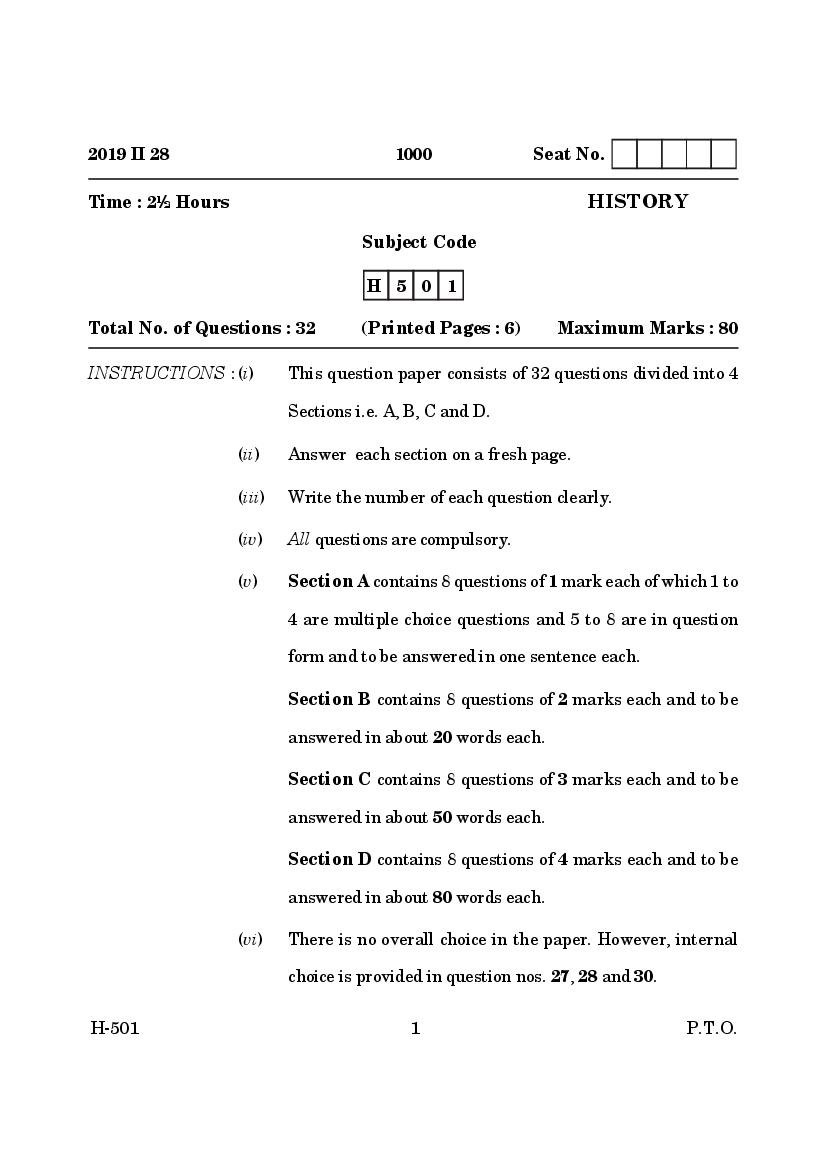
Time : 2½ Hours HISTORY
Subject Code
H 5 0 1
Total No. of Questions : 32 (Printed Pages : 6) Maximum Marks : 80
INSTRUCTIONS : (i) This question paper consists of 32 questions divided into 4
Sections i.e. A, B, C and D.
(ii) Answer each section on a fresh page.
(iii) Write the number of each question clearly.
(iv) All questions are compulsory.
(v) Section A contains 8 questions of 1 mark each of which 1 to
4 are multiple choice questions and 5 to 8 are in question
form and to be answered in one sentence each.
Section B contains 8 questions of 2 marks each and to be
answered in about 20 words each.
Section C contains 8 questions of 3 marks each and to be
answered in about 50 words each.
Section D contains 8 questions of 4 marks each and to be
answered in about 80 words each.
(vi) There is no overall choice in the paper. However, internal
choice is provided in question nos. 27, 28 and 30.
H-501 1 P.T.O.
Page 2
Section A contains 8 questions of 1 mark each.
1. The tiny settlement in the Harappan civilisation exclusively devoted to craft
production was ..................... .
(a) Lothal
(b) Dholavira
(c) Chanhudaro
2. The symbol of Buddhism that represented Buddha’s first sermon at Sarnath
is the ...................... .
(a) Stupa
(b) Empty Seat
(c) Wheel
3. The Nayanars of Tamil Nadu were devotees of ......................... .
(a) Shiva
(b) Vishnu
(c) Brahma
4. An ambassador sent by the ruler of Persia to Calicut in the 15th Century
was .................... .
(a) Domingo Paes
(b) Duarte Barbosa
(c) Abdur Razzak
H-501 2
Page 3
6. Name the nationalist weekly edited by Dr. Juliâo Menezes.
7. Name the kingdom where Birjis Qadr was the leader of the Revolt of 1857.
8. In which year was the Second Round Table Conference held in London ?
Section B
Section B contains 8 questions of 2 marks each and are to be answered in
about 20 words each.
9. How did the Harappan civilisation come to an end ?
10. State any two features of the Mahajanapadas.
11. What information does Ibn Batuta provide on the system of communication ?
12. What efforts were made by Vijayanagara rulers for regular water supply to
their kingdom ?
13. Why did Abul Fazl describe painting as a “Magical Art” ?
14. How did Francisco Luis Gomes arouse political consciousness amongst
Goans ?
15. What was the condition of Indian sepoys in the 19th Century ? (any two
points)
H-501 3 P.T.O.
Page 4
of the Mahatma” ? (any two points)
Section C
Section C contains 8 questions of 3 marks each and are to be answered in
about 50 words each.
17. Explain the nature of the Harappan script.
18. Explain any three principles of Buddhism.
19. Explain the growth of Sufism.
20. Why did Vijayanagara Kingdom decline after the death of Krishnadeva
Raya ?
21. How did the Land Revenue System function under the Mughals ?
22. How did the 19th century developments in communication benefit the
Goans ?
23. How was Hindu-Muslim unity achieved during the Revolt of 1857 ? (any three
points)
24. Why was the Salt March of 1930 notable ?
H-501 4
Page 5
Section D contains 8 questions of 4 marks each and are to be answered in
about 80 words each.
25. Explain the following with regard to the Harappan Civilisation :
(a) Seals and sealings
(b) Weights
26. Why did Magadha emerge as the most powerful mahajanapada ?
27. Write a brief note on Al-Biruni’s views regarding the caste system in India.
Or
What were Ibn Batuta’s views on Slavery in India ?
28. What were the sources for the study of the Vijayanagara Kingdom ?
Or
What were the features of temple architecture in Vijayanagara with regard to
the following :
(a) Gopurams
(b) Mandapas
29. Explain the provincial administration of the Mughals.
H-501 5 P.T.O.
Page 6
Or
What was the contribution of Azad Gomantak Dal to the freedom struggle of
Goa ?
31. How did the British rule suppress the following sections of Indian society :
(a) Zamindars
(b) Merchants.
32. What were the features of the Non-Cooperation Movement of 1920-22 ?
H-501 6
Document Details
| Board / Org | Goa Board |
| Exam | Class 12 |
| Type | Question Paper |
| Pages | 6 |
| Updated | 22 Jul 2026 |