DUET 2021 Question Paper MA English
Finished viewing? Save it for later —
Download DUET 2021 Question Paper MA English (PDF · 22 pages)About DUET 2021 Question Paper MA English
DUET 2021 Question Paper MA English is available here for free download. Published by NTA for DUET, this question paper can be viewed online or downloaded as a PDF (22 pages). Candidates preparing for DUET can use DUET 2021 Question Paper MA English to understand the exam pattern, the type of questions asked, and the overall difficulty level.
Frequently Asked Questions
How can I download DUET 2021 Question Paper MA English?
Open this page and click the Download button to save DUET 2021 Question Paper MA English as a PDF. It is completely free on AglaSem Docs.
Is DUET 2021 Question Paper MA English free to download?
Yes. DUET 2021 Question Paper MA English can be viewed online and downloaded as a PDF free of cost on AglaSem Docs.
How many pages does DUET 2021 Question Paper MA English have?
DUET 2021 Question Paper MA English contains 22 pages, which you can read online or download together as a single PDF.
Where can I find more DUET study material?
You can find more DUET question papers, sample papers, syllabus, and answer keys on AglaSem Docs.
DUET 2021 Question Paper MA English – Text
Read the full text of this question paper below — useful to quickly search, copy and reference the content online without downloading the PDF.
📄 View text version (22 pages)
Page 1
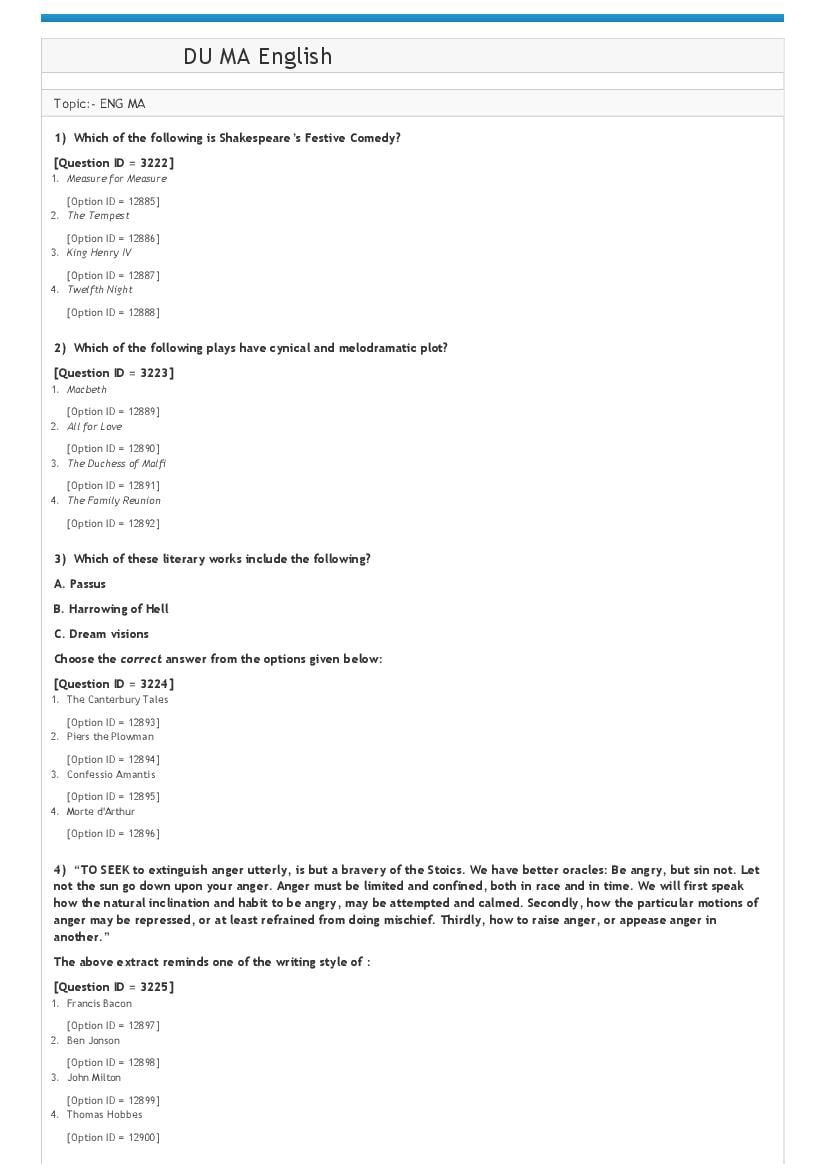
Topic:‐ ENG MA
1) Which of the following is Shakespeare’s Festive Comedy?
[Question ID = 3222]
1. Measure for Measure
[Option ID = 12885]
2. The Tempest
[Option ID = 12886]
3. King Henry IV
[Option ID = 12887]
4. Twelfth Night
[Option ID = 12888]
2) Which of the following plays have cynical and melodramatic plot?
[Question ID = 3223]
1. Macbeth
[Option ID = 12889]
2. All for Love
[Option ID = 12890]
3. The Duchess of Malfi
[Option ID = 12891]
4. The Family Reunion
[Option ID = 12892]
3) Which of these literary works include the following?
A. Passus
B. Harrowing of Hell
C. Dream visions
[Question ID = 3224]
1. The Canterbury Tales
[Option ID = 12893]
2. Piers the Plowman
[Option ID = 12894]
3. Confessio Amantis
[Option ID = 12895]
4. Morte d'Arthur
[Option ID = 12896]
4) “TO SEEK to extinguish anger utterly, is but a bravery of the Stoics. We have better oracles: Be angry, but sin not. Let
not the sun go down upon your anger. Anger must be limited and confined, both in race and in time. We will first speak
how the natural inclination and habit to be angry, may be attempted and calmed. Secondly, how the particular motions of
anger may be repressed, or at least refrained from doing mischief. Thirdly, how to raise anger, or appease anger in
another.”
The above extract reminds one of the writing style of :
[Question ID = 3225]
1. Francis Bacon
[Option ID = 12897]
2. Ben Jonson
[Option ID = 12898]
3. John Milton
[Option ID = 12899]
4. Thomas Hobbes
[Option ID = 12900]
Page 2
not the sun go down upon your anger. Anger must be limited and confined, both in race and in time. We will first speak
how the natural inclination and habit to be angry, may be attempted and calmed. Secondly, how the particular motions of
anger may be repressed, or at least refrained from doing mischief. Thirdly, how to raise anger, or appease anger in
another.”
Which one of the following options gives best expression to the central message of the passage?
[Question ID = 3226]
1. “To seek to extinguish anger utterly, is but a bravery of the Stoics.”
[Option ID = 12901]
2. “Let not the sun go down upon your anger.”
[Option ID = 12902]
3. “Anger must be limited and confined, both in race and in time.”
[Option ID = 12903]
4. One should not be angry at all.
[Option ID = 12904]
6) “TO SEEK to extinguish anger utterly, is but a bravery of the Stoics. We have better oracles: Be angry, but sin not. Let
not the sun go down upon your anger. Anger must be limited and confined, both in race and in time. We will first speak
how the natural inclination and habit to be angry, may be attempted and calmed. Secondly, how the particular motions of
anger may be repressed, or at least refrained from doing mischief. Thirdly, how to raise anger, or appease anger in
another.”
The author of the given passage appears to be in a __________.
[Question ID = 3227]
1. Reflexive mood
[Option ID = 12905]
2. Narrative mood
[Option ID = 12906]
3. Descriptive mood
[Option ID = 12907]
4. Spiritual Mood
[Option ID = 12908]
7) Who is the author of Moll Flanders?
[Question ID = 3228]
1. Jonathan Swift
[Option ID = 12909]
2. Daniel Defoe
[Option ID = 12910]
3. Henry Fielding
[Option ID = 12911]
4. Samuel Richardson
[Option ID = 12912]
8) Identify the correct statement/s from the ones given below:
A. Ben Jonson fought bravely to “restore the classic form of the drama.”
B. Volpone is Ben Jonson’s first comedy.
C. Ben Jonson killed an actor in a duel and only escaped hanging by pleading “benefit of clergy.
D. In his Every Man in His Humour “Shakespeare acted one of the parts.”
[Question ID = 3229]
1. A, B and C only
[Option ID = 12913]
2. B, C and D only
[Option ID = 12914]
3. A, C and D only
[Option ID = 12915]
4. A, B and D only
[Option ID = 12916]
9) Which of the following is not true about Anti‐foundationalism?[Question ID = 3230]
Page 3
2. It relies on continuing ethical enquiry without any universal system. [Option ID = 12918]
3. It is morally relativist and relies on a multitude of local and concrete practices. [Option ID = 12919]
4. It recognises self‐evident truths and reports of sense‐data as basic. [Option ID = 12920]
10) In Jonathan Swift’s Gulliver’s Travels, on which island does Gulliver discuss history with the ghosts of historical figures
like Julius Caesar, Brutus, Homer, Aristotle, etc.?
[Question ID = 3231]
1. Glubbdubdrib
[Option ID = 12921]
2. Balnibarbi
[Option ID = 12922]
3. Luggnagg
[Option ID = 12923]
4. Laputa
[Option ID = 12924]
11) Read the statement:
Statement: Modernism was a break with the past and the concurrent search for new forms of expression.
Which of the following is true in context of the above statement?
[Question ID = 3232]
1. Modernists were bored of following older traditions and thought of bringing a change by establishing new traditions.
[Option ID = 12925]
2. Modernists believed that after the World War, it was important to have a universality in art and culture.
[Option ID = 12926]
3. Modernists were of the view that all art forms need to be synchronized with the morality, optimism and conventions established in the Victorian
era.
[Option ID = 12927]
4. Modernists felt a growing alienation, incompatible with Victorian morality, optimism, and convention.
[Option ID = 12928]
12) William Jones is a/an:[Question ID = 3233]
1. Orientalist [Option ID = 12929]
2. Novelist [Option ID = 12930]
3. Essayist [Option ID = 12931]
4. Satirist [Option ID = 12932]
13) Match List I with List II
List I List II
Inspired Title of the Novel Shakespeare's Work
A. Infinite Jest I. Macbeth
B. Cakes and Ale II. Twelfth Night
C. The Winter of our Discontent III. Hamlet
D. By the Pricking of my Thumbs IV. Richard III
[Question ID = 3234]
1. A ‐ I, B ‐ II, C ‐ III, D ‐ IV [Option ID = 12933]
2. A ‐ III, B ‐ II, C ‐ IV, D ‐ I [Option ID = 12934]
3. A ‐ IV, B ‐ I, C ‐ II, D ‐ III [Option ID = 12935]
4. A ‐ II, B ‐ IV, C ‐ III, D ‐ I [Option ID = 12936]
14) Which one of the following is a novel by Smollett?
[Question ID = 3235]
1. Clarissa
[Option ID = 12937]
2. Jonathan Wild
[Option ID = 12938]
3. Humphrey Clinker
[Option ID = 12939]
4. A Sentimental Journey through France and Italy
Page 4
15) Arrange the following works in the chronological order:
A. Robert Browning’s “Andrea Del Sarto”
B. John Donne’s “The Canonization”
C. Alfred Tennyson’s “Ulysses”
D. T.S. Eliot’s “The Love Song of J. Alfred Prufrock”
Choose the correct answer from the options given below
[Question ID = 3236]
1. B, A, C, D
[Option ID = 12941]
2. C, B, D, A
[Option ID = 12942]
3. B, C, A, D
[Option ID = 12943]
4. A, B, D, C
[Option ID = 12944]
16) ______________ is a type of lyric poem perfected by Robert Browning.[Question ID = 3237]
1. Ode [Option ID = 12945]
2. Limerick [Option ID = 12946]
3. Dramatic Monologue [Option ID = 12947]
4. Elegy [Option ID = 12948]
17) Which of the following works of John Keats makes use of the dream vision, a mode of narrative widely used by the
medieval poets?[Question ID = 3238]
1. "La Belle Dame Sans Merci" [Option ID = 12949]
2. "The Fall of Hyperion" [Option ID = 12950]
3. "Ode on the Grecian Urn" [Option ID = 12951]
4. "On First Looking into Chapman’s Homer" [Option ID = 12952]
18) Which of the following is an/ are example(s) of a literary ballad?
A. "The Rime of the Ancient Mariner"
B. "La Belle Dame Sans Merci"
C. "Proud Maisie"
Choose the correct answer from the options given below
[Question ID = 3239]
1. A, B and C
[Option ID = 12953]
2. A Only
[Option ID = 12954]
3. A and B Only
[Option ID = 12955]
4. A and C Only
[Option ID = 12956]
19) Choose the correct order of PQRS set to complete the paragraph:
i. The phrase Celtic Revival describes past movements in literature, the arts, and social practices in which legends, poetry,
art, and spirituality of a distinctive kind were revived.
ii.________________________________________________________
iii._______________________________________________________
iv.________________________________________________________
v._________________________________________________________
vi. It was also evident in art, design, music, and sport.
P. The most significant Celtic Revival took place in Ireland toward the end of the 19th century and into the first two
decades of the 20th century.
Q. Writers and artists identified these with the Celtic people in parts of pre‐Christian and early Christian Europe.
R. The Irish Revival was felt most strongly in literature, drama, and the Irish language.
Page 5
associations with revival movements in Scotland, Wales, the English regions, and Brittany.
Choose the correct answer from the options given below
[Question ID = 3240]
1. PQRS
[Option ID = 12957]
2. QPSR
[Option ID = 12958]
3. PQSR
[Option ID = 12959]
4. QPRS
[Option ID = 12960]
20) The poem "Tiresias" was composed by:[Question ID = 3241]
1. Samuel Taylor Coleridge [Option ID = 12961]
2. Elizabeth Barrett Browning [Option ID = 12962]
3. Leigh Hunt [Option ID = 12963]
4. Alfred Lord Tennyson [Option ID = 12964]
21) Elizabeth Barret Browning was[Question ID = 3242]
1. A poet [Option ID = 12965]
2. A novelist [Option ID = 12966]
3. A fictional character [Option ID = 12967]
4. A dramatist [Option ID = 12968]
22) Which of the following popular French novels was not written by Gustave Flaubert?
[Question ID = 3243]
1. Madam Bovary
[Option ID = 12969]
2. The Flowers of Evil
[Option ID = 12970]
3. Memoirs of a Mad Man
[Option ID = 12971]
4. The Temptation of Saint Anthon
[Option ID = 12972]
23) Read the passage given below and answer the question that follow:
Justification for the exclusion is sought, instead, mainly upon questionable racial and ideological grounds not ordinarily
within the realm of expert military judgment, supplemented by certain semi‐military conclusions drawn from an
unwarranted use of circumstantial evidence. Individuals of Japanese ancestry are condemned because they are said to be
“a large, unassimilated, tightly knit racial group, bound to an enemy nation by strong ties of race, culture, custom and
religion.” They are claimed to be given to “emperor worshiping ceremonies” and to “dual citizenship.” Japanese language
schools and allegedly pro‐Japanese organizations are cited as evidence of possible group disloyalty, together with facts as to
certain persons being educated and residing at length in Japan.…
The military necessity which is essential to the validity of the evacuation order thus resolves itself into a few intimations
that certain individuals actively aided the enemy, from which it is inferred that the entire group of Japanese Americans
could not be trusted to remain loyal to the United States.
The author’s opinion of the military judgment used to justify the evacuation of Japanese Americans is
[Question ID = 3244]
1. That it is not based on evidence
[Option ID = 12973]
2. That it is not based on expert knowledge
[Option ID = 12974]
3. That it is based on racial prejudice
[Option ID = 12975]
4. All of the above
[Option ID = 12976]
24) Read the passage given below and answer the question that follow:
Justification for the exclusion is sought, instead, mainly upon questionable racial and ideological grounds not ordinarily
within the realm of expert military judgment, supplemented by certain semi‐military conclusions drawn from an
unwarranted use of circumstantial evidence. Individuals of Japanese ancestry are condemned because they are said to be
“a large, unassimilated, tightly knit racial group, bound to an enemy nation by strong ties of race, culture, custom and
Page 6
schools and allegedly pro‐Japanese organizations are cited as evidence of possible group disloyalty, together with facts as to
certain persons being educated and residing at length in Japan.…
The military necessity which is essential to the validity of the evacuation order thus resolves itself into a few intimations
that certain individuals actively aided the enemy, from which it is inferred that the entire group of Japanese Americans
could not be trusted to remain loyal to the United States.
“...a large, unassimilated, tightly knit racial group, bound to an enemy nation by strong ties of race, culture, custom and
religion” indicates
[Question ID = 3245]
1. A refusal to be citizens
[Option ID = 12977]
2. A refusal to think of Japanese as US citizens
[Option ID = 12978]
3. A refusal to accept the US as home
[Option ID = 12979]
4. Prejudice on the part of Japanese
[Option ID = 12980]
25) Read the passage given below and answer the question that follow:
Justification for the exclusion is sought, instead, mainly upon questionable racial and ideological grounds not ordinarily
within the realm of expert military judgment, supplemented by certain semi‐military conclusions drawn from an
unwarranted use of circumstantial evidence. Individuals of Japanese ancestry are condemned because they are said to be
“a large, unassimilated, tightly knit racial group, bound to an enemy nation by strong ties of race, culture, custom and
religion.” They are claimed to be given to “emperor worshiping ceremonies” and to “dual citizenship.” Japanese language
schools and allegedly pro‐Japanese organizations are cited as evidence of possible group disloyalty, together with facts as to
certain persons being educated and residing at length in Japan.…
The military necessity which is essential to the validity of the evacuation order thus resolves itself into a few intimations
that certain individuals actively aided the enemy, from which it is inferred that the entire group of Japanese Americans
could not be trusted to remain loyal to the United States.
The passage refers to the
[Question ID = 3246]
1. Internment of Japanese during World War II
[Option ID = 12981]
2. Internment of Japanese during World War I
[Option ID = 12982]
3. Internment of Japanese Americans during World War II
[Option ID = 12983]
4. Internment of Japanese Americans during World War I
[Option ID = 12984]
26) Read the passage given below and answer the question that follow:
Justification for the exclusion is sought, instead, mainly upon questionable racial and ideological grounds not ordinarily
within the realm of expert military judgment, supplemented by certain semi‐military conclusions drawn from an
unwarranted use of circumstantial evidence. Individuals of Japanese ancestry are condemned because they are said to be
“a large, unassimilated, tightly knit racial group, bound to an enemy nation by strong ties of race, culture, custom and
religion.” They are claimed to be given to “emperor worshiping ceremonies” and to “dual citizenship.” Japanese language
schools and allegedly pro‐Japanese organizations are cited as evidence of possible group disloyalty, together with facts as to
certain persons being educated and residing at length in Japan.…
The military necessity which is essential to the validity of the evacuation order thus resolves itself into a few intimations
that certain individuals actively aided the enemy, from which it is inferred that the entire group of Japanese Americans
could not be trusted to remain loyal to the United States.
An entire group being treated with suspicion for the actions of a few individuals is an example of
[Question ID = 3247]
1. Xenophobia
[Option ID = 12985]
2. Othering
[Option ID = 12986]
3. Race baiting
[Option ID = 12987]
4. All of the above
[Option ID = 12988]
Page 7
1. John Keats [Option ID = 12989]
2. W B Yeats [Option ID = 12990]
3. Percy B Shelley [Option ID = 12991]
4. W H Auden [Option ID = 12992]
28) Pick the odd one out[Question ID = 3249]
1. William Hazlitt [Option ID = 12993]
2. Richard Steele [Option ID = 12994]
3. Charles Lamb [Option ID = 12995]
4. Thomas De Quincey [Option ID = 12996]
29) Who wrote Agnes Grey?
[Question ID = 3250]
1. Charles Dickens
[Option ID = 12997]
2. Thomas Swinburne
[Option ID = 12998]
3. Henry Fielding
[Option ID = 12999]
4. Anne Bronte
[Option ID = 13000]
30) Arrange the following works in their chronological order.
A. Practical criticism
B. Coleridge on Imagination
C. Speculative Instruments
D. Science and Poetry
Choose the correct answer from the options given below
[Question ID = 3251]
1. A, B, C, D
[Option ID = 13001]
2. D, A, B, C
[Option ID = 13002]
3. B, C, A, D
[Option ID = 13003]
4. A, B, D, C
[Option ID = 13004]
31) Arrange these events chronologically:
A. Ulysses is serialized in 'The Little Review'.
B. Joyce and Nora went into self‐imposed exile, moving to Zürich.
C. Portrait of the Artist as a Young Man appears in 'The Egoist' magazine.
D. James Joyce manages the Volta Cinematograph, Ireland's first cinema.
Choose the correct answer from the options given below
[Question ID = 3252]
1. C, D, A, B
[Option ID = 13005]
2. A, B, D, C
[Option ID = 13006]
3. B, D, C, A
[Option ID = 13007]
4. B, D, A, C
[Option ID = 13008]
32) Choose the most appropriate reason for the following statement:
STATEMENT: Virginia Woolf wrote that there would be female Shakespeare in the future provided women found a room of
one's own.
Page 8
[Question ID = 3253]
1. Woolf believed that Shakespeare and other male dramatists use patriarchal language in their plays.
[Option ID = 13009]
2. Woolf was of the opinion that we need more and more female dramatists as the art form lacks strong female characters.
[Option ID = 13010]
3. Woolf argues that a woman writer has to struggle against societal oppression around gender.
[Option ID = 13011]
4. Woolf argues that a woman who wants to write must find a wealthy husband earning 500 pounds a year.
[Option ID = 13012]
33) “Whoever wishes to attain an English Style, familiar but not coarse, and elegant but not ostentatious, must give his
days and nights to the volumes of Addison.” Who among the following expressed the above quoted view?[Question ID =
3254]
1. Richard Steele [Option ID = 13013]
2. Oliver Goldsmith [Option ID = 13014]
3. Samuel Johnson [Option ID = 13015]
4. William Cowper [Option ID = 13016]
34) The speech “On Conciliation with America” was delivered by[Question ID = 3255]
1. Samuel Johnson [Option ID = 13017]
2. William Cowper [Option ID = 13018]
3. Edmund Burke [Option ID = 13019]
4. Martin Luther King Jr [Option ID = 13020]
35) Match List I with List II
List I List II
Work Author/Editor
A. The Boke named the Governor I. Sir Thomas Elyot
B. Art of Rhetorique II. Sir Thomas Wilson
C. The Schoolmaster III. Roger Ascham
D. The Hurt of Sedition IV. Sir John Check
Choose the correct answer from the options given below
[Question ID = 3256]
1. A ‐ I, B ‐ II, C ‐ III, D ‐ IV [Option ID = 13021]
2. A ‐ II, B ‐ III, C ‐ IV, D ‐ I [Option ID = 13022]
3. A ‐ III, B ‐ IV, C ‐ I, D ‐ II [Option ID = 13023]
4. A ‐ IV, B ‐ I, C ‐ II, D ‐ III [Option ID = 13024]
36) Which of the following poets is associated with ‘Movement Poetry’?[Question ID = 3257]
1. Anne Sexton [Option ID = 13025]
2. Philip Larkin [Option ID = 13026]
3. John Berryman [Option ID = 13027]
4. Ted Hughes [Option ID = 13028]
37) Premchand's novel, Rangbhumi is a major critique of caste vis‐a‐vis _______.[Question ID = 3258]
1. Nationalism [Option ID = 13029]
2. Industrialization [Option ID = 13030]
3. Communalism [Option ID = 13031]
4. Labour laws [Option ID = 13032]
38) Identify the critic who used the term ‘bourgeois epic’ for novels.[Question ID = 3259]
1. Matthew Arnold [Option ID = 13033]
2. Brian Wilkie [Option ID = 13034]
3. Georg Lukacs [Option ID = 13035]
4. None of the above [Option ID = 13036]
39) Which of these statements is/are true about the Bloomsbury group?
A. It was a group of associated English writers, intellectuals, philosophers and artists in the first half of the 21st century.
B. A historical feature of these friends and relations is that their close relationships all pre‐dated their fame as writers,
artists, and thinkers.
C. The lives and works of the group members reflect in large part, the influence of G. E. Moore.
D. This group contained a loose collective of friends and relatives who were closely associated with the University of
Cambridge for the women and King's College London for the men.
Page 9
1. A only
[Option ID = 13037]
2. A and D only
[Option ID = 13038]
3. C only
[Option ID = 13039]
4. B and C only
[Option ID = 13040]
40) Which among Shakespeare’s history plays are commonly believed to make up the Henriad?[Question ID = 3261]
1. Richard II, Henry V and Richard III [Option ID = 13041]
2. Henry V and Henry VIII [Option ID = 13042]
3. Richard II, Henry IV Part 1, Henry IV Part 2 and Henry V [Option ID = 13043]
4. Henry IV Part 1, Henry IV Part 2 and Henry V [Option ID = 13044]
41) Match List I with List II
List I List II
Philosopher Seminal Work
A. Philo I. Pinakes
B. Marcus Aurelius II. Academica
C. Callimachus III. Every Good Man Is Free
D. Cicero IV. Meditation
Choose the correct answer from the options given below
[Question ID = 3262]
1. A ‐ IV, B ‐ III, C ‐ I, D ‐ I [Option ID = 13045]
2. A‐I, B ‐IV , C ‐II , D ‐III [Option ID = 13046]
3. A ‐III , B ‐IV , C ‐I , D ‐II [Option ID = 13047]
4. A ‐I , B ‐ IV, C ‐III , D ‐II [Option ID = 13048]
42) Which of the following statements are not true about the Absurd Drama?
A. It has realistic settings.
B. It has a coherently evolving plot.
C. It has logical reasoning.
D. It parodies the traditional assumptions.
[Question ID = 3263]
1. A, B and C only
[Option ID = 13049]
2. B, C and D only
[Option ID = 13050]
3. A, C and D only
[Option ID = 13051]
4. All of the Above
[Option ID = 13052]
43) Match List I with List II.
List I List II
Quotation Author
A. “ No poet, no artist of any art, has his complete meaning alone. His significance, his appreciation is the I. Philip
appreciation of his relation to the dead poets and artists.” Sidney
B. “ The philosopher, therefore, and the historian are they, which would win the goal, the one by precept, the II. Dr
other by example; but both, not having both, do both halt.” Johnson
III.
C. “Nothing can please many, and please long, but just representations of general nature.”
Shelley
D. “ The future of poetry is immense, because in poetry, where it is worthy of its high destinies, our race, as IV. T S
time goes on, will find an ever surer and surer stay.” Eliot
[Question ID = 3264]
Page 10
2. A ‐ II, B ‐ III, C ‐ IV, D ‐ I [Option ID = 13054]
3. A ‐ III, B ‐ IV, C ‐ I, D ‐ II [Option ID = 13055]
4. A ‐ IV, B ‐ I, C ‐ II, D ‐ III [Option ID = 13056]
44) Matthew Arnold in his Culture and Anarchy suggests:
[Question ID = 3265]
1. Culture as the classical ideal of human perfection
[Option ID = 13057]
2. Culture as the smattering of Greek and Latin
[Option ID = 13058]
3. Culture as touch stone to test the value of other things
[Option ID = 13059]
4. Culture as modern human achievement
[Option ID = 13060]
45) “The President of the immortals had had his sport with Tess” marks the end of which of the following works?
[Question ID = 3266]
1. James Joyce’s The Portrait of the Artist as a Young Man
[Option ID = 13061]
2. Thomas Hardy’s Tess of the D’Urbervilles
[Option ID = 13062]
3. Leo Tolstoy’s War and Peace
[Option ID = 13063]
4. Jane Austen’s Persuasion
[Option ID = 13064]
46) “Spots of time” is a term that is associated with…[Question ID = 3267]
1. James Joyce [Option ID = 13065]
2. P.B. Shelley [Option ID = 13066]
3. William Blake [Option ID = 13067]
4. William Wordsworth [Option ID = 13068]
47) Pick the odd one out.[Question ID = 3268]
1. "Adonais" [Option ID = 13069]
2. "In Memoriam" [Option ID = 13070]
3. "In Memory of W B Yeats" [Option ID = 13071]
4. "On First Looking into Chapman’s Homer" [Option ID = 13072]
48) Which of the following statements is / are true about P. B. Shelley’s Defence of Poetry?
Statement I: It defends imaginative literature and associates poetry with social freedom and love.
Statement II: It holds that the literary imagination is essentially moral, and upholds the value of erotic writing.
In light of the above statements, choose the correct answer from the options given below
[Question ID = 3269]
1. I is true and II is false
[Option ID = 13073]
2. I is false but II is true
[Option ID = 13074]
3. Both I & II are true
[Option ID = 13075]
4. Both I & II are false
[Option ID = 13076]
49) "I mean ____________, that is when a man is capable of being in uncertainties, mysteries, doubts, without any
irritable reaching after fact and reason." Choose the correct option and fill in the blank:[Question ID = 3270]
1. Willing Suspension of Disbelief [Option ID = 13077]
2. Negative Capability [Option ID = 13078]
3. Heterotopia [Option ID = 13079]
4. Fantastical [Option ID = 13080]
50) Which of the following is not true about Shakespeare’s Major Tragic Characters?[Question ID = 3271]
1. They hail from higher class and are shown in their private affairs [Option ID = 13081]
2. They develop throughout the play [Option ID = 13082]
3. They come to a realisation by the end of the play [Option ID = 13083]
4. They make compromises and reconciliations by the end of the play [Option ID = 13084]
Page 11
A. Elaine Showalter’s A Literature of Their Own
B. Judith Butler’s Bodies that Matter
C. Luce Irigaray’s Speculum of the Other Woman
D. Eve Kosofsky Sedgwick’s Epistemology of the Closet
Choose the correct answer from the options given below
[Question ID = 3272]
1. A, B, C, D
[Option ID = 13085]
2. C, B, D, A
[Option ID = 13086]
3. A, C, D, B
[Option ID = 13087]
4. B, C, A, D
[Option ID = 13088]
52) Decide on the proper order of the sentences given below:
A. Therefore, it appears that she is not romantic in her love for Bertram, instead she possesses a practical approach towards
her love for Bertram.
B. On the contrary her love seems to get its roots from the practical approach to life.
C. She probably realizes that by marrying Bertram she can achieve the social status which her lower birth denied her.
D. To me it appears that Helena's love for Bertram is neither a religious one nor a romantic one.
Choose the correct answer from the options given below
[Question ID = 3273]
1. A, B, C, D
[Option ID = 13089]
2. D, B, C, A
[Option ID = 13090]
3. A, C, B, D
[Option ID = 13091]
4. D, B, A, C
[Option ID = 13092]
53) In psychoanalysis and literary analysis, the term “uncanny” suggests:[Question ID = 3274]
1. A familiar feeling [Option ID = 13093]
2. An unfamiliar feeling [Option ID = 13094]
3. An unfamiliar feeling within familiar [Option ID = 13095]
4. A familiar feeling within unfamiliar [Option ID = 13096]
54) Who is the precursor of Dialogic Criticism?[Question ID = 3275]
1. Karl Marx [Option ID = 13097]
2. Mikhail Bakhtin [Option ID = 13098]
3. Tzvetan Todorov [Option ID = 13099]
4. Wayne C. Booth [Option ID = 13100]
55) Which of these statement(s) is/are not associated with postmodernism?
A. Postmodern works reject the idea of absolute meaning and instead embrace randomness and disorder.
B. Postmodern literature emphasized meaninglessness and play.
C. Postmodernist writers employed pastiche and the combination of high and low culture.
D. Postmodernist writers used black humor, wordplay and irony to dizzy readers and muddle the story.
[Question ID = 3276]
1. B only
[Option ID = 13101]
2. A and D only
[Option ID = 13102]
3. C only
Page 12
4. None of the above
[Option ID = 13104]
56) _____________ is primarily engaged in identifying distinctly feminine subject matter in the literature written by
women, uncovering the history of female literary tradition, depicting that there is a feminine mode of experience and
subjectivity in thinking and perceiving the self and the world, and specifying traits of “woman’s language”, a distinctively
feminine style of speech and writing.[Question ID = 3277]
1. Cultural Theory [Option ID = 13105]
2. Feminism [Option ID = 13106]
3. Queer theory [Option ID = 13107]
4. Gynocriticism [Option ID = 13108]
57) Match List I with List II
List I List II
Theoretical Discourse Theorist
A. Russian Formalism I. Raymond Williams
B. Subaltern Studies II. Dipesh Chakrabarty
C. Structuralism III. Viktor Shklovsky
D. Marxism IV. Claude Levi‐Strauss
[Question ID = 3278]
1. A ‐ II, B ‐ IV, C ‐ III, D ‐ I [Option ID = 13109]
2. A ‐ I, B ‐ III, C ‐ IV, D ‐ II [Option ID = 13110]
3. A ‐ III, B ‐ II, C ‐ IV, D ‐ I [Option ID = 13111]
4. A ‐ III, B ‐ IV, C ‐ I, D ‐ II [Option ID = 13112]
58) Find out which part of the sentence has an error, if there is no error, mark option 4.[Question ID = 3279]
1. The flexibility of language arise because [Option ID = 13113]
2. language is not constrained by the need [Option ID = 13114]
3. to match the form of a word and its meaning [Option ID = 13115]
4. No Error [Option ID = 13116]
59) Choose the option which has the correct spelling:[Question ID = 3280]
1. Meiternium [Option ID = 13117]
2. Mietnerium [Option ID = 13118]
3. Meitnerium [Option ID = 13119]
4. Meiterium [Option ID = 13120]
60) "I'll love you, dear, I'll love you
Till China and Africa meet,
And the river jumps over the mountain
And the salmon sing in the street."
The above lines are an example of:
[Question ID = 3281]
1. Hyperbole
[Option ID = 13121]
2. Alliteration
[Option ID = 13122]
3. Irony
[Option ID = 13123]
4. Personification
[Option ID = 13124]
61) Arrange these events in chronological order:
A. Publication of Bankim Chandra Chatterjee’s Rajmohan’s Wife.
B. "Macaulay’s Minutes Upon Indian Education"
C. Publication of Rabindranath Tagore's Gitanjali
D. Publication of India's first newspaper "Hicky's Bengal Gazette" by James Augustus Hicky
Choose the correct answer from the options given below
[Question ID = 3282]
1. D, B, A, C
[Option ID = 13125]
Page 13
[Option ID = 13126]
3. C, D, B, A
[Option ID = 13127]
4. B, C, A, D
[Option ID = 13128]
62) Identify the poem written by Nissim Ezekiel:[Question ID = 3283]
1. "My Grandmother's House" [Option ID = 13129]
2. "Freedom" [Option ID = 13130]
3. "Night of the Scorpion" [Option ID = 13131]
4. "A River" [Option ID = 13132]
63) Who among the following Indian authors propagated the idea of ‘world literature’?[Question ID = 3284]
1. Munshi Premchand [Option ID = 13133]
2. Rabindranath Tagore [Option ID = 13134]
3. Mirza Ghalib [Option ID = 13135]
4. Fakir Mohan Senapati [Option ID = 13136]
64) Which of the following is a verse adaptation of an episode from the legend of Bon Bibi, a tale popular in the villages of
the Sundarban?
[Question ID = 3285]
1. Amitav Ghosh’s Junglenama
[Option ID = 13137]
2. Manik Bandhopadhay’s The Boatman of Padma
[Option ID = 13138]
3. Bibhutibhushan Bandopadhyay’s Restless water of Ichamati
[Option ID = 13139]
4. Bankim Chandra Chatterjee’s Mrinalni
[Option ID = 13140]
65) Given below are two statements, one is labelled as Assertion A and the other is labelled as Reason R
Assertion A: Romanticism of the Indian poets was different from English romanticism since the former was fraught with
nationalism, spirituality and mysticism.
Reason R: While Aurobindo searched for the divine in man, quest of Tagore’s poetry was the beautiful in man and nature.
In light of the above statements, choose the most appropriate answer from the options given below
[Question ID = 3286]
1. Both A and R are correct and R is the correct explanation of A
[Option ID = 13141]
2. Both A and R are correct but R is NOT the correct explanation of A
[Option ID = 13142]
3. A is correct but R is not correct
[Option ID = 13143]
4. A is not correct but R is correct
[Option ID = 13144]
66) Choose the appropriate response with reference to the following statements:
Statement I: Rabindranath Tagore won the Nobel Prize for Literature in 1913 for his collection Gitanjali published in 1912.
Statement II: The central theme of Gitanjali is devotion, and its motto is colonialism.
In light of the above statements, choose the correct answer from the options given below
[Question ID = 3287]
1. Both I and II are true
[Option ID = 13145]
2. Only Statement I is true
[Option ID = 13146]
3. Only Statement II is true
[Option ID = 13147]
4. Both Statement I and Statement II are false
[Option ID = 13148]
67) Amrita Pritam is best remembered for her poignant poem, "Ajj aakhaan Waris Shah nu" (Today I invoke Waris Shah).
Page 14
[Question ID = 3288]
1. Elegy
[Option ID = 13149]
2. Lyric
[Option ID = 13150]
3. Narrative
[Option ID = 13151]
4. Dramatic
[Option ID = 13152]
68) Which of these is/are not a theme/s of Raag Darbari?
A. Rural dystopia
B. Misuse of technology
C. Power politics
D. Satire on government
[Question ID = 3289]
1. A and C only
[Option ID = 13153]
2. B only
[Option ID = 13154]
3. C only
[Option ID = 13155]
4. B and D only
[Option ID = 13156]
69) Read the passage given below and answer the questions which follow by choosing the most appropriate response, with
reference to the passage, from the given options:
She had gone back to Tara once in fear and defeat and she had emerged from its sheltering walls strong and armed for
victory. What she had done once, somehow–please God, she could do again! How, she did not know. She did not want to
think of that now. All she wanted was a breathing space in which to hurt, a quiet place to lick her wounds, a haven in
which to plan her campaign. She thought of Tara and it was as if a gentle cool hand were stealing over her heart. She could
see the white house gleaming welcome to her through the reddening autumn leaves, feel the quiet hush of the country
twilight coming down over her like a benediction, feel the dews falling on the acres of green bushes starred with fleecy
white, see the raw color of the red earth and the dismal dark beauty of the pines on the rolling hills.
She felt vaguely comforted, strengthened by the picture, and some of her hurt and frantic regret was pushed from the top
of her mind. She stood for a moment remembering small things, the avenue of dark cedars leading to Tara, the banks of
cape jessamine bushes, vivid green against the white walls, the fluttering white curtains. And Mammy would be there.
Suddenly she wanted Mammy desperately, as she had wanted her when she was a little girl, wanted the broad bosom on
which to lay her head, the gnarled black hand on her hair. Mammy, the last link with the old days. With the spirit of her
people who would not know defeat, even when it stared them in the face, she raised her chin. She could get Rhett back.
She knew she could. There had never been a man she couldn’t get, once she set her mind upon him.
“I’ll think of it all tomorrow, at Tara. I can stand it then. Tomorrow, I’ll think of some way to get him back. After all,
tomorrow is another day.”
Why is the person in reference, the “she”, feels comforted on reaching her native place?
[Question ID = 3290]
1. Because Mammy might still inhabit her native place.
[Option ID = 13157]
2. Because she hopes to find comfort by establishing a nostalgic link to the spirit of her people.
[Option ID = 13158]
3. Because the reddening autumn leaves and dews falling on the acres of green bushes remind her of Rhett.
[Option ID = 13159]
4. Because that is where her lost lover, Rhett, has gone to.
[Option ID = 13160]
70) Read the passage given below and answer the questions which follow by choosing the most appropriate response, with
reference to the passage, from the given options:
She had gone back to Tara once in fear and defeat and she had emerged from its sheltering walls strong and armed for
victory. What she had done once, somehow–please God, she could do again! How, she did not know. She did not want to
think of that now. All she wanted was a breathing space in which to hurt, a quiet place to lick her wounds, a haven in
Page 15
see the white house gleaming welcome to her through the reddening autumn leaves, feel the quiet hush of the country
twilight coming down over her like a benediction, feel the dews falling on the acres of green bushes starred with fleecy
white, see the raw color of the red earth and the dismal dark beauty of the pines on the rolling hills.
She felt vaguely comforted, strengthened by the picture, and some of her hurt and frantic regret was pushed from the top
of her mind. She stood for a moment remembering small things, the avenue of dark cedars leading to Tara, the banks of
cape jessamine bushes, vivid green against the white walls, the fluttering white curtains. And Mammy would be there.
Suddenly she wanted Mammy desperately, as she had wanted her when she was a little girl, wanted the broad bosom on
which to lay her head, the gnarled black hand on her hair. Mammy, the last link with the old days. With the spirit of her
people who would not know defeat, even when it stared them in the face, she raised her chin. She could get Rhett back.
She knew she could. There had never been a man she couldn’t get, once she set her mind upon him.
“I’ll think of it all tomorrow, at Tara. I can stand it then. Tomorrow, I’ll think of some way to get him back. After all,
tomorrow is another day.”
Who is the author referring to as “Mammy” in the extract?
[Question ID = 3291]
1. The childhood black maid of the person in reference.
[Option ID = 13161]
2. The lost lover of the person in reference.
[Option ID = 13162]
3. The beloved pet of the person in reference.
[Option ID = 13163]
4. The native place of the person in reference.
[Option ID = 13164]
71) Read the passage given below and answer the questions which follow by choosing the most appropriate response, with
reference to the passage, from the given options:
She had gone back to Tara once in fear and defeat and she had emerged from its sheltering walls strong and armed for
victory. What she had done once, somehow–please God, she could do again! How, she did not know. She did not want to
think of that now. All she wanted was a breathing space in which to hurt, a quiet place to lick her wounds, a haven in
which to plan her campaign. She thought of Tara and it was as if a gentle cool hand were stealing over her heart. She could
see the white house gleaming welcome to her through the reddening autumn leaves, feel the quiet hush of the country
twilight coming down over her like a benediction, feel the dews falling on the acres of green bushes starred with fleecy
white, see the raw color of the red earth and the dismal dark beauty of the pines on the rolling hills.
She felt vaguely comforted, strengthened by the picture, and some of her hurt and frantic regret was pushed from the top
of her mind. She stood for a moment remembering small things, the avenue of dark cedars leading to Tara, the banks of
cape jessamine bushes, vivid green against the white walls, the fluttering white curtains. And Mammy would be there.
Suddenly she wanted Mammy desperately, as she had wanted her when she was a little girl, wanted the broad bosom on
which to lay her head, the gnarled black hand on her hair. Mammy, the last link with the old days. With the spirit of her
people who would not know defeat, even when it stared them in the face, she raised her chin. She could get Rhett back.
She knew she could. There had never been a man she couldn’t get, once she set her mind upon him.
“I’ll think of it all tomorrow, at Tara. I can stand it then. Tomorrow, I’ll think of some way to get him back. After all,
tomorrow is another day.”
What is the mood of the person “she”, according to the passage?
[Question ID = 3292]
1. She is fundamentally despondent to the future.
[Option ID = 13165]
2. She is inherently desolate towards the future.
[Option ID = 13166]
3. She is fundamentally optimistic towards the future.
[Option ID = 13167]
4. She is in denial towards a traumatizing bleak future.
[Option ID = 13168]
72) Read the passage given below and answer the questions which follow by choosing the most appropriate response, with
reference to the passage, from the given options:
She had gone back to Tara once in fear and defeat and she had emerged from its sheltering walls strong and armed for
victory. What she had done once, somehow–please God, she could do again! How, she did not know. She did not want to
think of that now. All she wanted was a breathing space in which to hurt, a quiet place to lick her wounds, a haven in
which to plan her campaign. She thought of Tara and it was as if a gentle cool hand were stealing over her heart. She could
see the white house gleaming welcome to her through the reddening autumn leaves, feel the quiet hush of the country
twilight coming down over her like a benediction, feel the dews falling on the acres of green bushes starred with fleecy
white, see the raw color of the red earth and the dismal dark beauty of the pines on the rolling hills.
She felt vaguely comforted, strengthened by the picture, and some of her hurt and frantic regret was pushed from the top
of her mind. She stood for a moment remembering small things, the avenue of dark cedars leading to Tara, the banks of
Page 16
Suddenly she wanted Mammy desperately, as she had wanted her when she was a little girl, wanted the broad bosom on
which to lay her head, the gnarled black hand on her hair. Mammy, the last link with the old days. With the spirit of her
people who would not know defeat, even when it stared them in the face, she raised her chin. She could get Rhett back.
She knew she could. There had never been a man she couldn’t get, once she set her mind upon him.
“I’ll think of it all tomorrow, at Tara. I can stand it then. Tomorrow, I’ll think of some way to get him back. After all,
tomorrow is another day.”
Based on your understanding of the above passage, which genre would you identify the extract from?
[Question ID = 3293]
1. Pastoral fiction
[Option ID = 13169]
2. Victorian Romance
[Option ID = 13170]
3. Tragicomedy
[Option ID = 13171]
4. Modernist literature
[Option ID = 13172]
73) Who won the Nobel Prize for Literature in 2020?[Question ID = 3294]
1. Doris Lessing [Option ID = 13173]
2. Amitav Ghosh [Option ID = 13174]
3. Louise Gluck [Option ID = 13175]
4. Isabelle Allende [Option ID = 13176]
74) Which of these statement/s is/ are correct about Aristotle's Poetics?
A. The Poetics is a short treatise of twenty‐six chapters and forty‐five pages.
B. It does not say much about comedy, touches rather briefly on the epic.
C. The concept of Catharsis has been fully developed in the Poetics.
[Question ID = 3295]
1. A, B and C
[Option ID = 13177]
2. A only
[Option ID = 13178]
3. B and C only
[Option ID = 13179]
4. A and B only
[Option ID = 13180]
75) Given below are two statements about Deconstruction
Statement I: It doubts a definitive meaning and thrusts on an impasse
Statement II: It is a form of relativist scepticism that focuses on puns and wordplay
In light of the above statements, choose the correct answer from the options given below.
[Question ID = 3296]
1. Both Statement I and Statement II are false.
[Option ID = 13181]
2. Statement I is true but Statement II is false.
[Option ID = 13182]
3. Both Statement I and Statement II are true.
[Option ID = 13183]
4. Statement I is false but Statement II is true.
[Option ID = 13184]
76) Which of the following is not true about Naturalism?[Question ID = 3297]
1. It was a literary movement in 19th C. [Option ID = 13185]
2. It depicts the subject with scientific objectivity. [Option ID = 13186]
3. It idealises day to day human experiences. [Option ID = 13187]
4. It holds that human life is strictly subject to natural laws. [Option ID = 13188]
77) Match List I with List II
List I List II
Page 17
A. "As shades more sweetly recommend the light,
I. "An Essay on Man"
So modest plainness sets off sprightly wit."
B. "Plac'd on this isthmus of a middle state,
II."An Essay on Criticism"
A being darkly wise, and rudely great:"
C. "While you, great patron of mankind, sustain
III. "The Rape of the Lock"
The balanc'd world, and open all the main;"
D. "Oft, when the world imagine women stray,
IV. "Imitations of Horace"
The Sylphs through mystic mazes guide their way,"
[Question ID = 3298]
1. A ‐ I, B ‐ II, C ‐ III, D ‐ IV [Option ID = 13189]
2. A ‐II, B ‐I, C ‐IV, D ‐ III [Option ID = 13190]
3. A ‐III, B ‐IV, C ‐I, D ‐ II [Option ID = 13191]
4. A ‐IV, B ‐I, C ‐II, D ‐ III [Option ID = 13192]
78) Which of the following dramatic conventions is a performance convention in which invisible, imagined barrier separates
actors from the audience?[Question ID = 3299]
1. Suspension of disbelief [Option ID = 13193]
2. Fourth wall [Option ID = 13194]
3. Split focus [Option ID = 13195]
4. Flashback/flashforward [Option ID = 13196]
79) Arrange the following works in the chronological order:
1. The Second Sex
2. Gender Trouble
3. A Vindication of the Rights of Woman
4. The Subjugation of Women
Choose the correct answer from the options given below
[Question ID = 3300]
1. C, D, A, B
[Option ID = 13197]
2. C, B, D, A
[Option ID = 13198]
3. B, C, A, D
[Option ID = 13199]
4. A, B, D, C
[Option ID = 13200]
80) Which of the following literary modes subverts and liberates the assumptions of the dominant style or atmosphere
through humour and chaos?[Question ID = 3301]
1. Fantastique [Option ID = 13201]
2. Grotesque [Option ID = 13202]
3. Carnivalesque [Option ID = 13203]
4. Burlesque [Option ID = 13204]
81) Which of the following are the markers of Jacobean stage?
A. Cruelty and violence
B. Selfishness
C. Overt sex
D. Mutual harmony between two sexes
[Question ID = 3302]
1. A, B and C only
[Option ID = 13205]
2. B, C and D only
[Option ID = 13206]
3. A, C and D only
[Option ID = 13207]
4. All of the above
[Option ID = 13208]
82) Which of the following theatres attempts to “prevent the emotional identification or involvement of the audience with
the characters and their actions in a play?”[Question ID = 3303]
Page 18
2. The Shakespearean Theatre [Option ID = 13210]
3. The Theatre of Problem Plays [Option ID = 13211]
4. The Epic Theatre [Option ID = 13212]
83) _______________ was a late‐twentieth century development in American poetry that sought to draw fresh attention
to traditional forms of verse in terms of meter, rhyme, and stanzaic symmetry.[Question ID = 3304]
1. Postcolonialism [Option ID = 13213]
2. Transcendentalism [Option ID = 13214]
3. Magic Realism [Option ID = 13215]
4. New Formalism [Option ID = 13216]
84) A confidant in a drama is:
A. A minor character in a drama
B. A major character in a drama
C. A trusted friend of the protagonist
D. A plausible device for communicating to connect with the audience
[Question ID = 3305]
1. A, B and C only
[Option ID = 13217]
2. B, C and D only
[Option ID = 13218]
3. A, C and D only
[Option ID = 13219]
4. All of the above
[Option ID = 13220]
85) Choose the correct order of the paragraph to create a meaning out of ABCD set:
A: This includes the changes which it may have suffered in physical condition over the years as well as the various changes
in its ownership.
B: Even the most perfect reproduction of a work of art is lacking in one element: its presence in time and space, its unique
existence at the place where it happens to be.
C: The traces of the first can be revealed only by chemical or physical analyzes which it is impossible to perform on a
reproduction; changes of ownership are subject to a tradition which must be traced from the situation of the original.
D: This unique existence of the work of art determined the history to which it was subject throughout the time of its
existence.
Choose the correct answer from the options given below
[Question ID = 3306]
1. A,B,D,C
[Option ID = 13221]
2. B,D,A,C
[Option ID = 13222]
3. D,C,A,B
[Option ID = 13223]
4. C,D,A,B
[Option ID = 13224]
86) Choose the option which is opposite in meaning to the word 'obfuscate'.[Question ID = 3307]
1. Illuminate [Option ID = 13225]
2. Suffocate [Option ID = 13226]
3. Habitual [Option ID = 13227]
4. Discontented [Option ID = 13228]
87) Which of these is not a characteristic of Chivalric Romance?[Question ID = 3308]
1. It is a type of literature that was popular in the aristocratic circles of High Medieval and Early Modern Europe. [Option ID = 13229]
2. It typically describes the adventures of quest‐seeking, legendary knights. [Option ID = 13230]
3. It celebrates an idealized code of civilized behaviour that combines loyalty, honour, and courtly love. [Option ID = 13231]
4. It is a type of early literature produced solely by medieval women writers. [Option ID = 13232]
88) In Other Words is a translated work by/ of which of the following authors?
[Question ID = 3309]
1. Salman Rushdie
[Option ID = 13233]
Page 19
[Option ID = 13234]
3. Italo Calvino
[Option ID = 13235]
4. Jhumpa Lahiri
[Option ID = 13236]
89) Eighteenth Century literature is generally called the literature of:
A. Augustan Age
B.The Puritan Age
C. Classical Age
D.The Restoration Age
[Question ID = 3310]
1. B Only
[Option ID = 13237]
2. D Only
[Option ID = 13238]
3. Both A & C
[Option ID = 13239]
4. Both B & D
[Option ID = 13240]
90) Match List I with List II
List I List II
Character Play
A. Sir Anthony Absolute I. The Rival
B. Dangle II. The Critic
C. Charles Surface III. The School for Scandal
D. Lord Foppington IV. A Trip to Scarborough
[Question ID = 3311]
1. A ‐I , B ‐II , C ‐III , D ‐IV
[Option ID = 13241]
2. A ‐ II, B ‐III , C ‐IV , D ‐I
[Option ID = 13242]
3. A ‐III , B ‐IV , C ‐I , D ‐II
[Option ID = 13243]
4. A ‐ IV, B ‐I , C ‐II , D ‐ III
[Option ID = 13244]
91) Identify the meter employed in the following extract.
“The plowman homeward plods his weary way,
And leaves the world to darkness and to me.”
[Question ID = 3312]
1. Iambic pentameter
[Option ID = 13245]
2. Trochaic hexameter
[Option ID = 13246]
3. Anapestic octameter
[Option ID = 13247]
4. Dactylic tetrameter
[Option ID = 13248]
92) From which profession did William Tyndale begin his career?[Question ID = 3313]
1. Preacher [Option ID = 13249]
2. Tutor [Option ID = 13250]
3. Aristocrat [Option ID = 13251]
4. Monk [Option ID = 13252]
Page 20
Assertion A : Epic theatre was created by Bertolt Brecht who rejected realistic theatre.
Reason R : Brecht felt that realistic theatre was too picture‐perfect.
In light of the above statements, choose the correct answer from the options given below
[Question ID = 3314]
1. Both A and R are true and R is the correct explanation of A
[Option ID = 13253]
2. Both A and R are true but R is NOT the correct explanation of A
[Option ID = 13254]
3. A is true but R is false
[Option ID = 13255]
4. A is false but R is true
[Option ID = 13256]
94) Match List I with List II
List I List II
Poet Poem
A. T. E. Hulme I. The Cantos
B. D. H. Lawrence II. Oread
C. Ezra Pound III. Amores
D. Hilda Doolittle IV. A City Sunset
[Question ID = 3315]
1. A ‐IV, B ‐III , C ‐I , D ‐II [Option ID = 13257]
2. A ‐ I, B ‐III , C ‐II , D ‐IV [Option ID = 13258]
3. A ‐ II , B ‐ III , C ‐ IV , D ‐ I [Option ID = 13259]
4. A ‐ I, B ‐ IV , C ‐ II , D ‐ III [Option ID = 13260]
95) Which among the following statement(s) is/are true about The Faerie Queene?
A. The Faerie Queene contains 6 books while originally it was planned to have 12 books.
B. Each book of The Faerie Queene was intended by the poet to convey some virtue.
C. Sir Philip Sidney composed canto V, Book V of The Faerie Queene.
D. The “Prefatory Letter” to The Faerie Queene was addressed to Stephen Gosson.
[Question ID = 3316]
1. A and B
[Option ID = 13261]
2. B and D
[Option ID = 13262]
3. A and C
[Option ID = 13263]
4. B and C
[Option ID = 13264]
96) Match List I with List II
List I List II
Extract Poem
A. “When love with one another so
Interinanimates two souls,
That abler soul, which thence doth I. “The Canonization”
flow,
Defects of loneliness controls.
B. “For God's sake hold your tongue,
and let me love,
Or chide my palsy, or my gout, II. “The Ecstasy”
My five gray hairs, or ruined fortune
flout,….”
C. “Moving of th' earth brings harms
and fears,
Men reckon what it did, and meant; III. “The Relic”
But trepidation of the spheres,
Page 21
D. “When my grave is broke up again
Some second guest to entertain,
(For graves have learn'd that woman
head,
IV. “A Valediction:
To be to more than one a bed)
Forbidding Mourning”
And he that digs it, spies
A bracelet of bright hair about the
bone,
Will he not let'us alone,….”
[Question ID = 3317]
1. A ‐I , B ‐II , C ‐III , D ‐IV [Option ID = 13265]
2. A ‐II , B ‐I , C ‐IV , D ‐III [Option ID = 13266]
3. A ‐III , B ‐IV , C ‐I , D ‐II [Option ID = 13267]
4. A ‐IV , B ‐I , C ‐II , D ‐III [Option ID = 13268]
97) Which of the following are features of Sanskrit Plays?
A. These are written in classic Sanskrit
B. Most of them begin with invocation and end with blessings
C. Clown plays a vital role
D. Show very integral relationship with the nature
[Question ID = 3318]
1. A, B & C
[Option ID = 13269]
2. B, C & D
[Option ID = 13270]
3. A, C & D
[Option ID = 13271]
4. All of the Above
[Option ID = 13272]
98) Which one of the following is a masque written and performed for Queen Elizabeth by Sir Philip Sidney?
[Question ID = 3319]
1. The Lady of May
[Option ID = 13273]
2. The Masque of Queens
[Option ID = 13274]
3. The Masque of Beauty
[Option ID = 13275]
4. A Private Entertainment of the King and Queen on May‐Day
[Option ID = 13276]
99) Which one of the following is not true about The Faerie Queene?
[Question ID = 3320]
1. Chrysogonee is the mother of Amoretta
[Option ID = 13277]
2. Belphoebe is the sister of Florimell
[Option ID = 13278]
3. Timias falls in love with Belphoebe
[Option ID = 13279]
4. The third book of The Faerie Queene contains the legend of Britomartis
[Option ID = 13280]
100) Arrange the following dialogues (A to F) between two characters into the order they should occur:
A. It may be so, for it is not mine own….
B. That is no slander, sir, which is a truth,
And what I spake, I spake it to my face.
C. Thy face is mine, and thou hast slandered it.
D. Poor soul, thy face is much abused with tears.
Page 22
F. The tears have got small victory by that,
For it was bad enough before their spite.
[Question ID = 3321]
1. A, B, C, D, E, F
[Option ID = 13281]
2. D, F, E, B, C, A
[Option ID = 13282]
3. A, C, B, D, F, E
[Option ID = 13283]
4. F, D, B, A, C, E
[Option ID = 13284]
Document Details
| Board / Org | NTA |
| Exam | DUET |
| Type | Question Paper |
| Pages | 22 |
| Language | english |
| Updated | 30 Apr 2026 |