DUET 2021 Question Paper MA Environmental Studies
Finished viewing? Save it for later —
Download DUET 2021 Question Paper MA Environmental Studies (PDF · 17 pages)About DUET 2021 Question Paper MA Environmental Studies
DUET 2021 Question Paper MA Environmental Studies is available here for free download. Published by NTA for DUET, this question paper can be viewed online or downloaded as a PDF (17 pages). Candidates preparing for DUET can use DUET 2021 Question Paper MA Environmental Studies to understand the exam pattern, the type of questions asked, and the overall difficulty level.
Frequently Asked Questions
How can I download DUET 2021 Question Paper MA Environmental Studies?
Open this page and click the Download button to save DUET 2021 Question Paper MA Environmental Studies as a PDF. It is completely free on AglaSem Docs.
Is DUET 2021 Question Paper MA Environmental Studies free to download?
Yes. DUET 2021 Question Paper MA Environmental Studies can be viewed online and downloaded as a PDF free of cost on AglaSem Docs.
How many pages does DUET 2021 Question Paper MA Environmental Studies have?
DUET 2021 Question Paper MA Environmental Studies contains 17 pages, which you can read online or download together as a single PDF.
Where can I find more DUET study material?
You can find more DUET question papers, sample papers, syllabus, and answer keys on AglaSem Docs.
DUET 2021 Question Paper MA Environmental Studies – Text
Read the full text of this question paper below — useful to quickly search, copy and reference the content online without downloading the PDF.
📄 View text version (17 pages)
Page 1
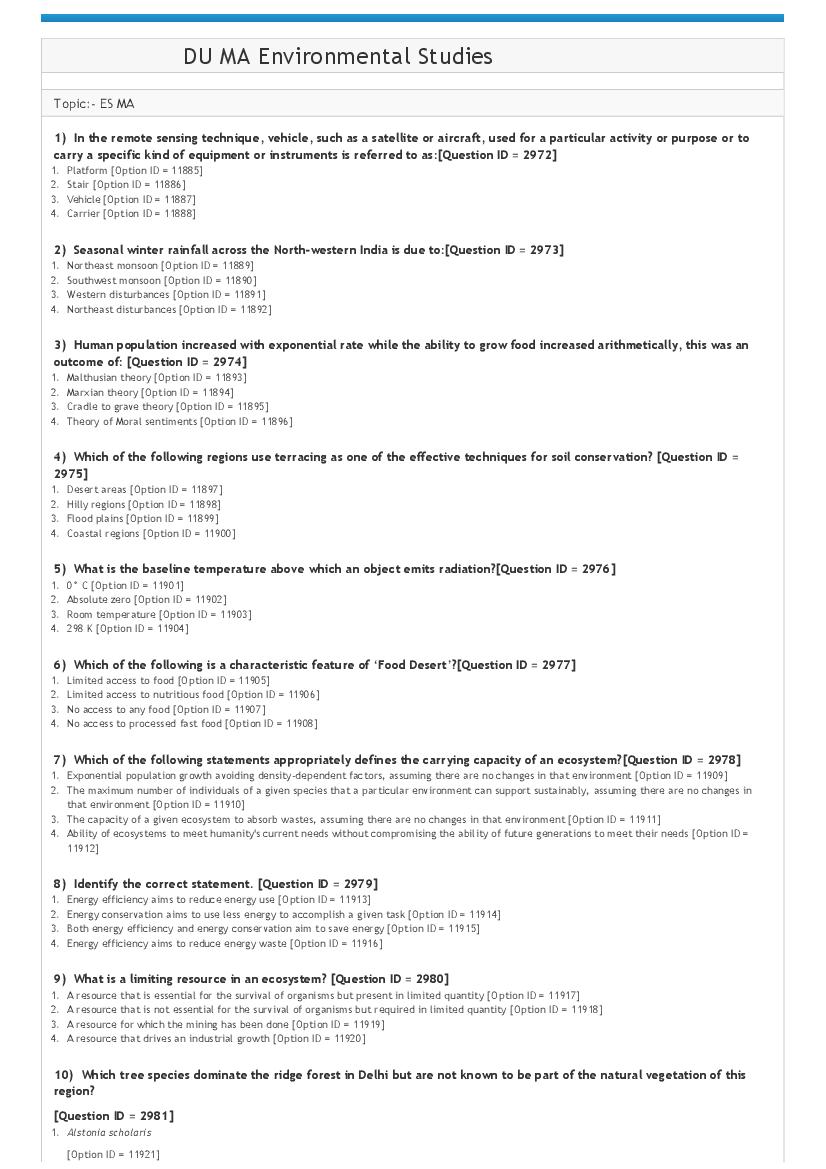
Topic:‐ ES MA
1) In the remote sensing technique, vehicle, such as a satellite or aircraft, used for a particular activity or purpose or to
carry a specific kind of equipment or instruments is referred to as:[Question ID = 2972]
1. Platform [Option ID = 11885]
2. Stair [Option ID = 11886]
3. Vehicle [Option ID = 11887]
4. Carrier [Option ID = 11888]
2) Seasonal winter rainfall across the North‐western India is due to:[Question ID = 2973]
1. Northeast monsoon [Option ID = 11889]
2. Southwest monsoon [Option ID = 11890]
3. Western disturbances [Option ID = 11891]
4. Northeast disturbances [Option ID = 11892]
3) Human population increased with exponential rate while the ability to grow food increased arithmetically, this was an
outcome of: [Question ID = 2974]
1. Malthusian theory [Option ID = 11893]
2. Marxian theory [Option ID = 11894]
3. Cradle to grave theory [Option ID = 11895]
4. Theory of Moral sentiments [Option ID = 11896]
4) Which of the following regions use terracing as one of the effective techniques for soil conservation? [Question ID =
2975]
1. Desert areas [Option ID = 11897]
2. Hilly regions [Option ID = 11898]
3. Flood plains [Option ID = 11899]
4. Coastal regions [Option ID = 11900]
5) What is the baseline temperature above which an object emits radiation?[Question ID = 2976]
1. 0° C [Option ID = 11901]
2. Absolute zero [Option ID = 11902]
3. Room temperature [Option ID = 11903]
4. 298 K [Option ID = 11904]
6) Which of the following is a characteristic feature of ‘Food Desert’?[Question ID = 2977]
1. Limited access to food [Option ID = 11905]
2. Limited access to nutritious food [Option ID = 11906]
3. No access to any food [Option ID = 11907]
4. No access to processed fast food [Option ID = 11908]
7) Which of the following statements appropriately defines the carrying capacity of an ecosystem?[Question ID = 2978]
1. Exponential population growth avoiding density‐dependent factors, assuming there are no changes in that environment [Option ID = 11909]
2. The maximum number of individuals of a given species that a particular environment can support sustainably, assuming there are no changes in
that environment [Option ID = 11910]
3. The capacity of a given ecosystem to absorb wastes, assuming there are no changes in that environment [Option ID = 11911]
4. Ability of ecosystems to meet humanity's current needs without compromising the ability of future generations to meet their needs [Option ID =
11912]
8) Identify the correct statement. [Question ID = 2979]
1. Energy efficiency aims to reduce energy use [Option ID = 11913]
2. Energy conservation aims to use less energy to accomplish a given task [Option ID = 11914]
3. Both energy efficiency and energy conservation aim to save energy [Option ID = 11915]
4. Energy efficiency aims to reduce energy waste [Option ID = 11916]
9) What is a limiting resource in an ecosystem? [Question ID = 2980]
1. A resource that is essential for the survival of organisms but present in limited quantity [Option ID = 11917]
2. A resource that is not essential for the survival of organisms but required in limited quantity [Option ID = 11918]
3. A resource for which the mining has been done [Option ID = 11919]
4. A resource that drives an industrial growth [Option ID = 11920]
10) Which tree species dominate the ridge forest in Delhi but are not known to be part of the natural vegetation of this
region?
[Question ID = 2981]
1. Alstonia scholaris
[Option ID = 11921]
Page 2
[Option ID = 11922]
3. Prosopis juliflora
[Option ID = 11923]
4. Cassia fistula
[Option ID = 11924]
11) Which of the following is incorrect related to the interactions between plants and inorganic contaminants?
[Question ID = 2982]
1. Plants may volatilize the inorganic contaminants
[Option ID = 11925]
2. Plants may transform the inorganic contaminants
[Option ID = 11926]
3. Plants may accumulate the inorganic contaminants
[Option ID = 11927]
4. Plants may degrade the inorganic contaminants
[Option ID = 11928]
12) Which of the following is the major goal of creating a wildlife corridor? [Question ID = 2983]
1. To connect the wildlife populations separated by human activities [Option ID = 11929]
2. To separate the wildlife populations, present in a large geographical area [Option ID = 11930]
3. To connect the aquatic animals, present in river and ocean [Option ID = 11931]
4. To separate the aquatic animals, present in a large water body [Option ID = 11932]
13) Which of these awards was instituted by the Government of India for individuals or communities from rural areas that
have shown extraordinary courage and dedication in protecting wildlife?[Question ID = 2984]
1. Dr. Salim Ali National Wildlife Fellowship Award [Option ID = 11933]
2. Shri Kailash Sankhla National Wildlife Fellowship Award [Option ID = 11934]
3. Amrita Devi Bishnoi Wildlife Protection Award [Option ID = 11935]
4. Indira Gandhi Paryavaran Puraskar [Option ID = 11936]
14) Which of the following is referred to as the manufacturing of new organic materials from inorganic molecules such as
H2O and CO2?[Question ID = 2985]
1. Primary productivity [Option ID = 11937]
2. Secondary productivity [Option ID = 11938]
3. Net Secondary productivity [Option ID = 11939]
4. National productivity [Option ID = 11940]
15) Which of the following sampling types involves selecting sites with no particular pattern or reason?[Question ID = 2986]
1. Systematic [Option ID = 11941]
2. Composite [Option ID = 11942]
3. Random [Option ID = 11943]
4. Grab [Option ID = 11944]
16) Which of the following is an example of non‐point source pollution?[Question ID = 2987]
1. A sewage treatment plant [Option ID = 11945]
2. E‐wastes [Option ID = 11946]
3. Dumping at a food‐processing plant [Option ID = 11947]
4. Runoff from agricultural fields [Option ID = 11948]
17) Which of the following methods is generally not recommended for the safe disposal of biomedical waste?
[Question ID = 2988]
1. Incineration
[Option ID = 11949]
2. Freeze Drying
[Option ID = 11950]
3. Landfilling
[Option ID = 11951]
4. Shredding after disinfection
[Option ID = 11952]
18) In biomedical waste management, colour coding for disposing biomedical waste is described in:[Question ID = 2989]
1. Schedule I [Option ID = 11953]
2. Schedule II [Option ID = 11954]
3. Schedule III [Option ID = 11955]
4. Schedule IV [Option ID = 11956]
Page 3
1. Biogas [Option ID = 11957]
2. Biomass [Option ID = 11958]
3. Bituminous [Option ID = 11959]
4. Lignite [Option ID = 11960]
20) Which of the following is referred to the moral obligation of the present generation to manage the earth in a
responsible manner without jeopardizing the aesthetic and economic welfare of future generations?[Question ID = 2991]
1. Intergenerational equity [Option ID = 11961]
2. Poetic justice [Option ID = 11962]
3. Investment management [Option ID = 11963]
4. Public Trust Doctrine [Option ID = 11964]
21) Arrange the following in the correct sequence of ecosystems, from high temperature to low temperature.
A. Tropical rain forest
B. Boreal forest
C. Tundra
D. Temperate deciduous forest
Choose the correct answer from the options given below
[Question ID = 2992]
1. A > B > D > C
[Option ID = 11965]
2. A > D > B > C
[Option ID = 11966]
3. B > D > A > C
[Option ID = 11967]
4. B > A > D > C
[Option ID = 11968]
22) Arrange the following in the correct sequence of steps in the process of a standard ‘life cycle assessment’ study.
A. Impact assessment
B. Goal and scope definition
C. Improvement analysis
D. Inventory analysis
Choose the correct answer from the options given below
[Question ID = 2993]
1. B → A → C→ D
[Option ID = 11969]
2. D → B → A → C
[Option ID = 11970]
3. D → A → B → C
[Option ID = 11971]
4. B → D → A → C
[Option ID = 11972]
23) Arrange the following in the correct sequence of ecosystems, from lowest estimated annual net primary productivity to
the highest.
A. Desert
B. Agricultural land
C. Savanna
D. Estuaries
E. Tropical rain forest
Choose the correct answer from the options given below
[Question ID = 2994]
1. A < C < B < E < D
[Option ID = 11973]
2. B < C < A < D < E
[Option ID = 11974]
Page 4
[Option ID = 11975]
4. A < B < C < D < E
[Option ID = 11976]
24) Arrange the following in correct sequence of bulbs/lights, from high energy efficiency to low energy efficiency.
A. Incandescent light bulb
B. Compact fluorescent light
C. Light emitting diode
Choose the correct answer from the options given below
[Question ID = 2995]
1. C > B > A
[Option ID = 11977]
2. B > C > A
[Option ID = 11978]
3. A > C > B
[Option ID = 11979]
4. A > B > C
[Option ID = 11980]
25) Arrange the following in the correct sequence of a detritus food chain, from bottom to top.
A. Bacteria
B. Protozoa
C. Leaf litter
D. Small fish
E. Big fish
Choose the correct answer from the options given below
[Question ID = 2996]
1. A, B, D, C, E
[Option ID = 11981]
2. B, A, C, D, E
[Option ID = 11982]
3. D, E, A, C, B
[Option ID = 11983]
4. C, A, B, D, E
[Option ID = 11984]
26) Arrange the following in the correct sequence of waste management hierarchy, from least favored to most favored
option.
A. Disposal
B. Recycling
C. Energy recovery
D. Reuse
E. Minimization
Choose the correct answer from the options given below
[Question ID = 2997]
1. A, C, B, D, E
[Option ID = 11985]
2. A, C, D, B, E
[Option ID = 11986]
3. A, E, D, B, C
[Option ID = 11987]
4. D, C, A, B, E
[Option ID = 11988]
27) Arrange the following in the correct sequence of gases in the Earth’s atmosphere, from most abundant to least
Page 5
A. Nitrogen
B. Oxygen
C. Carbon dioxide
D. Argon
E. Neon
Choose the correct answer from the options given below
[Question ID = 2998]
1. A > B > C > D > E
[Option ID = 11989]
2. D > B > A > E > C
[Option ID = 11990]
3. A > B > D > C > E
[Option ID = 11991]
4. B > A > D > C > E
[Option ID = 11992]
28) Which of the following statements are true for atmospheric water vapor?
A. Source of all clouds
B. Transport latent heat from one place to other
C. Heating the atmosphere
D. Cooling the atmosphere
Choose the correct answer from the options given below:
[Question ID = 2999]
1. A, B and C only
[Option ID = 11993]
2. B, C and D only
[Option ID = 11994]
3. A, C and D only
[Option ID = 11995]
4. A, B and D only
[Option ID = 11996]
29) Which of the following represents the types of carbon credits?
A. Ex‐Post Carbon Credits
B. Carbon Bitcoins
C. Ex‐Ante Carbon Credits
D. Carbon Load
Choose the correct answer from the options given below:
[Question ID = 3000]
1. A and B only
[Option ID = 11997]
2. A and D only
[Option ID = 11998]
3. A and C only
[Option ID = 11999]
4. B and D only
[Option ID = 12000]
30) In which of the following environmental movements, people of the native community embrace the trees to protect the
forest?
A. Silent valley movement
B. Appiko movement
C. Bishnoi movement
D. Chipko movement
Page 6
[Question ID = 3001]
1. A, B and D only
[Option ID = 12001]
2. B, C and D only
[Option ID = 12002]
3. A, C and D only
[Option ID = 12003]
4. A, B and C only
[Option ID = 12004]
31) Arrange the following in the correct chronological order, from the most recent to the earliest.
A. Project Tiger
B. Crocodile Breeding and Conservation Program
C. Project Elephant
D. Sea Turtle Project
Choose the correct answer from the options given below:
[Question ID = 3002]
1. A, B, C, D
[Option ID = 12005]
2. D, C, B, A
[Option ID = 12006]
3. C, B, D, A
[Option ID = 12007]
4. B, C, A, D
[Option ID = 12008]
32) Which of the following contribute to the greenhouse effect? A. Water vapour B. Sulfate C. Methane D. Carbon dioxide
Choose the correct answer from the options given below:[Question ID = 3003]
1. A, B and C only [Option ID = 12009]
2. A, B and D only [Option ID = 12010]
3. A, C and D only [Option ID = 12011]
4. B, C and D only [Option ID = 12012]
33) What are the roles of a National Park?
A. Recreation
B. Introduction of invasive species
C. Harvesting wildlife for economic development
D. Ecosystem preservation
Choose the correct answer from the options given below:
[Question ID = 3004]
1. A and C only
[Option ID = 12013]
2. A and B only
[Option ID = 12014]
3. A and D only
[Option ID = 12015]
4. B and D only
[Option ID = 12016]
34) Which of the following impacts are due to discharging of super‐heated water into water bodies?
A. Death of flora and fauna at the point of discharge
B. Alters the metabolic activities of several organisms
C. It hampers the breeding of fishes
D. Increases the dissolved oxygen content of water
Choose the correct answer from the options given below:
[Question ID = 3005]
Page 7
[Option ID = 12017]
2. B, C and D only
[Option ID = 12018]
3. A, C and D only
[Option ID = 12019]
4. A, B and D only
[Option ID = 12020]
35) Which of the following are secondary pollutants? A. Sulfuric acid B. Sulfur dioxide C. Carbon monoxide D. Ground‐level
ozone Choose the correct answer from the options given below:[Question ID = 3006]
1. A and B only [Option ID = 12021]
2. B and C only [Option ID = 12022]
3. A and D only [Option ID = 12023]
4. B and D only [Option ID = 12024]
36) What are the essential features of a sustainable city?
A. Ensuring the well‐being of current and future generation
B. Reducing energy consumption by its efficient use
C. Focus on only technology rather than policy interventions to reduce and manage pollution
D. Increasing use of renewable sources as the primary source of energy
Choose the correct answer from the options given below:
[Question ID = 3007]
1. B, C and D only
[Option ID = 12025]
2. A, C and D only
[Option ID = 12026]
3. A, B and C only
[Option ID = 12027]
4. A, B and D only
[Option ID = 12028]
37) Which of the following characteristics make electricity a flexible form of energy?
A. It can be produced from any energy source
B. It is easy to transport to short distances only
C. It can be used for heating and lighting
D. It can be used for transportation
Choose the correct answer from the options given below:
[Question ID = 3008]
1. A, B and D only
[Option ID = 12029]
2. A, B and C only
[Option ID = 12030]
3. A, C and D only
[Option ID = 12031]
4. B, C and D only
[Option ID = 12032]
38) Which of the following constitutes small or microscopic aquatic organisms that are relatively feeble swimmers and thus,
for the most part, are carried about by currents and waves?[Question ID = 3009]
1. Benthos [Option ID = 12033]
2. Plankton [Option ID = 12034]
3. Periphyton [Option ID = 12035]
4. Nekton [Option ID = 12036]
39) Which of the following is a micronutrient?[Question ID = 3010]
1. Carbon [Option ID = 12037]
2. Molybdenum [Option ID = 12038]
3. Oxygen [Option ID = 12039]
4. Phosphorous [Option ID = 12040]
Page 8
of the citizen?[Question ID = 3011]
1. Article 19(1)a [Option ID = 12041]
2. Article 51A(g) [Option ID = 12042]
3. Article 21 [Option ID = 12043]
4. Article 48A [Option ID = 12044]
41) In which year, Supreme Court had issued directive to central government to include environmental education at
undergraduate level?[Question ID = 3012]
1. 1991 [Option ID = 12045]
2. 2001 [Option ID = 12046]
3. 2005 [Option ID = 12047]
4. 2010 [Option ID = 12048]
42) Which of the following diameter size particulate matter in the air causes the greatest harm to human health?[Question
ID = 3013]
1. 15 micrometers or more [Option ID = 12049]
2. 2.5 micrometers or less [Option ID = 12050]
3. 125 micrometers or more [Option ID = 12051]
4. 25 micrometers or more [Option ID = 12052]
43) A noble prize winner who is known for initiating a well‐known Green Belt Movement.[Question ID = 3014]
1. Wangari Mathai [Option ID = 12053]
2. Greta Thunberg [Option ID = 12054]
3. Jadav Payeng [Option ID = 12055]
4. Vandana Shiva [Option ID = 12056]
44) Which of the following processes is associated with Montreal Protocol?[Question ID = 3015]
1. Control of emission of ozone depleting substances [Option ID = 12057]
2. Control of radioactive wastes [Option ID = 12058]
3. Control of desertification [Option ID = 12059]
4. Protection and management of forests [Option ID = 12060]
45) Shared resources such as the atmosphere, fresh water, forests, wildlife, and ocean fisheries that are available to
everyone but for which no single individual has responsibility are considered as[Question ID = 3016]
1. Common pool resources [Option ID = 12061]
2. Natural resources [Option ID = 12062]
3. Non‐renewable resources [Option ID = 12063]
4. Renewable‐resources [Option ID = 12064]
46) An economy which focuses on industrial growth along with reducing, reusing and recycling of wastes is referred to
as[Question ID = 3017]
1. Subsistence economy [Option ID = 12065]
2. Circular economy [Option ID = 12066]
3. Linear economy [Option ID = 12067]
4. Productive economy [Option ID = 12068]
47) Which of the following relies on the balance of social justice, economic growth, and environmental conservation?
[Question ID = 3018]
1. Social development [Option ID = 12069]
2. Economic development [Option ID = 12070]
3. Sustainable development [Option ID = 12071]
4. Agricultural development [Option ID = 12072]
48) Which of the following are non‐marketable outputs of a forest?[Question ID = 3019]
1. Timber and honey [Option ID = 12073]
2. Flood control and soil protection [Option ID = 12074]
3. Cane and fruits [Option ID = 12075]
4. Gums and resins [Option ID = 12076]
49) Which of following geological epoch is known for the significant impact of humans on Earth and natural ecosystems?
[Question ID = 3020]
1. Eocene [Option ID = 12077]
2. Miocene [Option ID = 12078]
3. Anthropocene [Option ID = 12079]
4. Paleocene [Option ID = 12080]
50) Which of following group of vertebrates is the most threatened according to IUCN?[Question ID = 3021]
1. Reptiles [Option ID = 12081]
2. Mammals [Option ID = 12082]
3. Aves [Option ID = 12083]
4. Amphibians [Option ID = 12084]
Page 9
1. Sunderban National Park [Option ID = 12085]
2. Panna National Park [Option ID = 12086]
3. Khangchendzonga National Park [Option ID = 12087]
4. Agasthyamalai National Park [Option ID = 12088]
52) What is the primary reason of designating 3rd of March as World Wildlife Day?[Question ID = 3023]
1. It was the day of signature of the CITES treaty [Option ID = 12089]
2. It was the day when the convention on biological diversity was enforced [Option ID = 12090]
3. It was the day of the signature of the convention on biological diversity [Option ID = 12091]
4. It was the day of signature of Ramsar Convention [Option ID = 12092]
53) Which of the following represents the largest population in the pyramid of numbers of grassland ecosystem?[Question ID
= 3024]
1. Producers [Option ID = 12093]
2. Primary Consumers [Option ID = 12094]
3. Secondary Consumers [Option ID = 12095]
4. Herbivores [Option ID = 12096]
54) Which of the following organizations is jointly established by The World Meteorological Organization and the United
Nations Environment Program to study the changes in the environment?[Question ID = 3025]
1. IPCC [Option ID = 12097]
2. WCED [Option ID = 12098]
3. IPCE [Option ID = 12099]
4. WWF [Option ID = 12100]
55) What does water table refer to?[Question ID = 3026]
1. The upper surface of the unsaturated zone of ground water [Option ID = 12101]
2. The upper surface of the saturated zone of ground water [Option ID = 12102]
3. The supply of fresh water under Earth’s surface [Option ID = 12103]
4. The contact between an aquifer and an underlying, impermeable layer of rock [Option ID = 12104]
56) Which amongst these is 'not' a geological hazard?[Question ID = 3027]
1. Earthquake [Option ID = 12105]
2. Tsunami [Option ID = 12106]
3. Slope failure [Option ID = 12107]
4. Thunderstorm [Option ID = 12108]
57) Which of the following is an 'incorrect' statement?[Question ID = 3028]
1. Clay has dominance of secondary mineral [Option ID = 12109]
2. Clay shows a high ability to hold chemicals and nutrients in plant‐available form [Option ID = 12110]
3. Sand particles show a high affinity for water [Option ID = 12111]
4. Silt has particles with a diameter ranging from nearly 0.05 to 0.002 mm [Option ID = 12112]
58) Given below are two statements
Statement I: Basel convention originally allowed countries to export hazardous waste only with the prior informed consent of
the importing country as well as of any countries that the waste passed through in transit.
Statement II: In 1995, the Basel Convention was amended to ban the export of any hazardous waste from industrialized to
developing countries.
In light of the above statements, choose the most appropriate answer from the options given below
[Question ID = 3029]
1. Both Statement I and Statement II are correct
[Option ID = 12113]
2. Both Statement I and Statement II are incorrect
[Option ID = 12114]
3. Statement I is correct but Statement II is incorrect
[Option ID = 12115]
4. Statement I is incorrect but Statement II is correct
[Option ID = 12116]
59) Given below are two statements
Statement I: Each element has a characteristic atomic mass.
Statement II: Forms of a single element that differ in atomic number are known as isotopes.
In light of the above statements, choose the most appropriate answer from the options given below
[Question ID = 3030]
1. Both Statement I and Statement II are correct
Page 10
2. Both Statement I and Statement II are incorrect
[Option ID = 12118]
3. Statement I is correct but Statement II is incorrect
[Option ID = 12119]
4. Statement I is incorrect but Statement II is correct
[Option ID = 12120]
60) Given below are two statements
Statement I: Microcredit consists of small loans extended to very poor people to help them establish self‐employment
projects that generate income.
Statement II: Microcredit was first tried in Pakistan in the 1970s, where it has helped thousands of urban and rural poor
start successful businesses. Muhammad Yunus founded the Grameen Bank and pioneered microcredit.
In light of the above statements, choose the most appropriate answer from the options given below
[Question ID = 3031]
1. Statement I is correct but Statement II is incorrect
[Option ID = 12121]
2. Statement I is incorrect but Statement II is correct
[Option ID = 12122]
3. Both Statement I and Statement II are correct
[Option ID = 12123]
4. Both Statement I and Statement II are incorrect
[Option ID = 12124]
61) Given below are two statements
Statement I: Total amount of energy in the universe is decreasing over time.
Statement II: According Second law of thermodynamics the amount of usable energy available to do work in the universe
decreases over time.
In light of the above statements, choose the most appropriate answer from the options given below
[Question ID = 3032]
1. Statement I is correct but Statement II is incorrect
[Option ID = 12125]
2. Statement I is incorrect but Statement II is correct
[Option ID = 12126]
3. Both Statement I and Statement II are correct
[Option ID = 12127]
4. Both Statement I and Statement II are incorrect
[Option ID = 12128]
62) Given below are two statements
Statement I: Bacillus thuringiensis was first isolated in 1911.
Statement II: Bacillus thuringiensis kills leaf‐eating caterpillars by producing a protein that turns into a lethal poison when
the insect ingests it.
In light of the above statements, choose the correct answer from the options given below
[Question ID = 3033]
1. Both Statement I and Statement II are true
[Option ID = 12129]
2. Both Statement I and Statement II are false
[Option ID = 12130]
3. Statement I is true but Statement II is false
[Option ID = 12131]
4. Statement I is false but Statement II is true
[Option ID = 12132]
63) Given below are two statements
Statement I: International agreements such as the World Heritage Convention attempt to protect and support biologically
rich natural areas.
Statement II: India is not a signatory to the convention and has still included several protected areas as World Heritage sites.
Page 11
[Question ID = 3034]
1. Both Statement I and Statement II are true
[Option ID = 12133]
2. Both Statement I and Statement II are false
[Option ID = 12134]
3. Statement I is true but Statement II is false
[Option ID = 12135]
4. Statement I is false but Statement II is true
[Option ID = 12136]
64) Given below are two statements
Statement I: Tropospheric ozone prevents much of the solar UV radiation from penetrating to Earth’s surface.
Statement II: Ozone in the Stratosphere is a secondary air pollutant.
In light of the above statements, choose the correct answer from the options given below
[Question ID = 3035]
1. Both Statement I and Statement II are true
[Option ID = 12137]
2. Both Statement I and Statement II are false
[Option ID = 12138]
3. Statement I is true but Statement II is false
[Option ID = 12139]
4. Statement I is false but Statement II is true
[Option ID = 12140]
65) Given below are two statements
Statement I: A community with low species richness has high resistance and resilience than a community with high species
richness.
Statement II: Community stability is a consequence of community complexity.
In light of the above statements, choose the most appropriate answer from the options given below
[Question ID = 3036]
1. Both Statement I and Statement II are correct
[Option ID = 12141]
2. Both Statement I and Statement II are incorrect
[Option ID = 12142]
3. Statement I is correct but Statement II is incorrect
[Option ID = 12143]
4. Statement I is incorrect but Statement II is correct
[Option ID = 12144]
66) Given below are two statements
Statement I: As per the biogeographic classification of India, there exits 10 major regions.
Statement II: The biodiversity of an area influences every aspect of the lives of people who inhabit it.
In light of the above statements, choose the most appropriate answer from the options given below
[Question ID = 3037]
1. Both Statement I and Statement II are correct
[Option ID = 12145]
2. Both Statement I and Statement II are incorrect
[Option ID = 12146]
3. Statement I is correct but Statement II is incorrect
[Option ID = 12147]
4. Statement I is incorrect but Statement II is correct
[Option ID = 12148]
67) Match List I with List II
List I List II
Type of contaminant Example
A. Organic contaminant I. Pollen
Page 12
C. Physical contaminant III. Pesticide
D. Biological contaminant IV. Heavy metals
Choose the correct answer from the options given below:
[Question ID = 3038]
1. A ‐ III, B ‐ IV, C ‐II , D ‐ I [Option ID = 12149]
2. A ‐I , B ‐IV , C ‐III , D ‐II [Option ID = 12150]
3. A ‐IV , B ‐ III, C ‐I , D ‐II [Option ID = 12151]
4. A ‐IV , B ‐II , C ‐III , D ‐ I [Option ID = 12152]
68) Match List I with List II
List I List II
Elevation Zone Latitude Zone
A. Snow I. Arctic Tundra
B. Deciduous Forest II. Polar Region
C. Alpine Tundra III. Temperate Forest
D. Sub‐alpine Coniferous ForestIV. Boreal Forest
Choose the correct answer from the options given below:
[Question ID = 3039]
1. A ‐III , B ‐I , C ‐II , D ‐ IV [Option ID = 12153]
2. A ‐IV , B ‐III , C ‐I , D ‐II [Option ID = 12154]
3. A ‐ I, B ‐ II, C ‐ III, D ‐ IV [Option ID = 12155]
4. A ‐ II, B ‐III , C ‐I , D ‐IV [Option ID = 12156]
69) Match List I with List II
List I List II
Disease Poisoning Agent
A. Minamata I. Mercury
B. Itai Itai II. Cadmium
C. Blue Baby SyndromeIII. Nitrate
D. Black foot disease IV. Arsenic
Choose the correct answer from the options given below:
[Question ID = 3040]
1. A ‐ I, B ‐II , C ‐IV , D ‐ III [Option ID = 12157]
2. A ‐ III, B ‐IV , C ‐II , D ‐I [Option ID = 12158]
3. A ‐IV , B ‐II , C ‐I , D ‐III [Option ID = 12159]
4. A ‐ I, B ‐II , C ‐ III, D ‐ IV [Option ID = 12160]
70) Match List I with List II
List I List II
Types of Waste Treatment and Disposal
A. Vegetable residueI. Incineration
B. Incineration ash II. Disinfection
C. Syringes III. Disposal in municipal landfill
D. Cytotoxic drugs IV. Composting
Choose the correct answer from the options given below:
[Question ID = 3041]
1. A ‐IV , B ‐III , C ‐I , D ‐II
[Option ID = 12161]
2. A ‐IV , B ‐ I , C ‐II , D ‐III
[Option ID = 12162]
3. A ‐ IV, B ‐ II, C ‐ I, D ‐ III
[Option ID = 12163]
4. A ‐IV , B ‐ III, C ‐ II, D ‐ I
[Option ID = 12164]
71) Match List I with List II
List I List II
Types of Succession Related to succession
A. Primary I. Starts in an inorganic setting
B. Secondary II. Starts in an organic environment
C. Autotrophic III. Landslides is an example
D. Heterotrophic IV. Forest fires is an example
Choose the correct answer from the options given below:
Page 13
1. A ‐IV , B ‐I , C ‐III , D ‐II [Option ID = 12165]
2. A ‐IV , B ‐II , C ‐III , D ‐I [Option ID = 12166]
3. A ‐III , B ‐IV , C ‐I , D ‐II [Option ID = 12167]
4. A ‐IV , B ‐III , C ‐II , D ‐I [Option ID = 12168]
72) Match List I with List II
List I List II
Organism Conservation Status
A. Caspian Tiger I. Vulnerable
B. Red Panda II. Critically Endangered
C. King Cobra III. Extinct
D. Black Rhinoceros IV. Endangered
Choose the correct answer from the options given below:
[Question ID = 3043]
1. A ‐III , B ‐IV , C ‐I, D ‐ II [Option ID = 12169]
2. A ‐IV , B ‐III , C ‐I , D ‐II [Option ID = 12170]
3. A ‐IV , B ‐II , C ‐III , D ‐I [Option ID = 12171]
4. A ‐ III, B ‐II , C ‐IV , D ‐I [Option ID = 12172]
73) Match List I with List II
List I List II
Concept Definition
A. Natural capital I. Provision to emit a specified amount of a given pollutant
B. National income accountsII. An emission charge on polluter
C. Tradable permits III. Earth's resources and processes that sustain living organisms
D. Environmental tax IV. Total income of a nation for a given year
Choose the correct answer from the options given below:
[Question ID = 3044]
1. A ‐III, B ‐IV, C ‐I , D ‐II [Option ID = 12173]
2. A ‐IV , B ‐III , C ‐II , D ‐I [Option ID = 12174]
3. A ‐IV , B ‐II , C ‐III , D ‐I [Option ID = 12175]
4. A ‐I , B ‐IV , C ‐III , D ‐II [Option ID = 12176]
74) Match List I with List II
List I List II
Types of organism Example
A. Primary producer I. Tigers
B. Primary consumer II. Lizards
C. Secondary consumer III. Trees
D. Tertiary consumer IV. Grasshoppers
Choose the correct answer from the options given below:
[Question ID = 3045]
1. A ‐I , B ‐II , C ‐IV , D ‐III [Option ID = 12177]
2. A ‐III , B ‐II , C ‐IV , D ‐I [Option ID = 12178]
3. A ‐III, B ‐I , C ‐IV , D ‐II [Option ID = 12179]
4. A ‐III , B ‐IV , C ‐II , D ‐I [Option ID = 12180]
75) Which of these is the primary factor in the creation of magnetic field of the Earth?[Question ID = 3046]
1. The permanent magnetism of the Earth’s solid inner core [Option ID = 12181]
2. The flow of molten iron in the inner core [Option ID = 12182]
3. The geodynamo, created by convection in the outer liquid core, and electrical currents [Option ID = 12183]
4. Solar radiation bombarding the Earth [Option ID = 12184]
76) Which of the following characterizes a retreating glacier?[Question ID = 3047]
1. Accumulation of snow is less than the ablation off the glacier [Option ID = 12185]
2. Accumulation of snow exceeds the ablation off the glacier [Option ID = 12186]
3. Accumulation of snow is equal to the ablation [Option ID = 12187]
4. Boundary between the zone of accumulation and ablation moves to lower elevations [Option ID = 12188]
77) Which of the following phenomena refers to the periodic, large‐scale warming of surface water in the central and
eastern tropical Pacific Ocean?[Question ID = 3048]
1. El‐Nino [Option ID = 12189]
2. La‐Nina [Option ID = 12190]
3. Pacific Decadal Oscillation [Option ID = 12191]
4. North Atlantic Oscillation [Option ID = 12192]
Page 14
1. Climate change [Option ID = 12193]
2. Habitat loss [Option ID = 12194]
3. Pollution [Option ID = 12195]
4. Pollination [Option ID = 12196]
79) Which of the following gases has been associated with the accident at the Union Carbide plant in Bhopal in 1984?
[Question ID = 3050]
1. Leakage of Hydrogen Cyanide [Option ID = 12197]
2. Methyl Isocyanate [Option ID = 12198]
3. Methyl Isocyanide [Option ID = 12199]
4. Methyl Mercaptan [Option ID = 12200]
80) According to the World Bank Report 2013, which of the following countries has the lowest per capita CO2 emission?
[Question ID = 3051]
1. Canada [Option ID = 12201]
2. India [Option ID = 12202]
3. China [Option ID = 12203]
4. Japan [Option ID = 12204]
81) Which of the following countries were once known to be a part of Gondwana?[Question ID = 3052]
1. Europe and North America [Option ID = 12205]
2. Antarctica, South America, Africa, Australia, and Indian Subcontinent [Option ID = 12206]
3. Arctic, Africa, and Europe [Option ID = 12207]
4. North America, Arctic, and South America [Option ID = 12208]
82) Which of the following is the largest terrestrial biome on the earth?[Question ID = 3053]
1. Tundra [Option ID = 12209]
2. Taiga [Option ID = 12210]
3. Tropical rain forest [Option ID = 12211]
4. Tropical deciduous forest [Option ID = 12212]
83) In which year, the Government of India enacted Disaster Management Act.[Question ID = 3054]
1. 2001 [Option ID = 12213]
2. 2002 [Option ID = 12214]
3. 2004 [Option ID = 12215]
4. 2005 [Option ID = 12216]
84) Below the earth’s surface, the point along the fault where an earthquake begins is referred to as[Question ID = 3055]
1. Epicenter [Option ID = 12217]
2. Focus [Option ID = 12218]
3. Richter point [Option ID = 12219]
4. Rift [Option ID = 12220]
85) Which of the following conditions is witnessed during the highest tides?[Question ID = 3056]
1. The Sun, Moon, and Earth are linearly aligned [Option ID = 12221]
2. The Sun and Moon are at right angles to the Earth [Option ID = 12222]
3. The Earth is closest to the Sun [Option ID = 12223]
4. The Moon is in either its first or its last quarter [Option ID = 12224]
86) Which of the following is the primary causal factor for desertification?[Question ID = 3057]
1. Overgrazing [Option ID = 12225]
2. Tourism [Option ID = 12226]
3. Industrialization [Option ID = 12227]
4. Organic farming [Option ID = 12228]
87) Which of the following types of power stations are generally located in mountainous regions?[Question ID = 3058]
1. Hydro‐electric power stations [Option ID = 12229]
2. Nuclear power stations [Option ID = 12230]
3. Solar power stations [Option ID = 12231]
4. Biomass power stations [Option ID = 12232]
88) Which of the following diseases is associated with the award of Nobel Prize 2020 in Physiology or Medicine?[Question ID
= 3059]
1. Blood‐borne Hepatitis [Option ID = 12233]
2. Cancer [Option ID = 12234]
3. AIDS [Option ID = 12235]
4. SARS‐CoV‐2 [Option ID = 12236]
89) Which of the following national parks is famous for conserving critically endangered Hangul deer?[Question ID = 3060]
1. Keibul Lamjao National Park [Option ID = 12237]
2. Dachigam National Park [Option ID = 12238]
3. Khangchendzonga National Park [Option ID = 12239]
Page 15
90) Which of this circulation is observed in the zones between the equator and 30° north and south latitude?[Question ID =
3061]
1. Polar cell [Option ID = 12241]
2. Ferrel cell [Option ID = 12242]
3. Hadley cell [Option ID = 12243]
4. Polar Front [Option ID = 12244]
91) If the infant mortality rate in Zambia is 70, it means that[Question ID = 3062]
1. 70% of Zambian infants die before reaching the age of one [Option ID = 12245]
2. 7% of Zambian infants die before reaching the age of one [Option ID = 12246]
3. 0.7% of Zambian infants die before reaching the age of one [Option ID = 12247]
4. 0.007% of Zambian infants die before reaching the age of one [Option ID = 12248]
92) Given below are two statements, one is labelled as Assertion A and the other is labelled as Reason R
Assertion A: During the 1960s, public concern about pollution and resource quality began to increase, in large part because
of marine biologist Rachel Carson
Reason R: Rachel Carson, in her most famous book, Silent Spring, wrote against the use of genetically modified organisms.
In light of the above statements, choose the most appropriate answer from the options given below
[Question ID = 3063]
1. Both A and R are correct and R is the correct explanation of A
[Option ID = 12249]
2. Both A and R are correct but R is NOT the correct explanation of A
[Option ID = 12250]
3. A is correct but R is not correct
[Option ID = 12251]
4. A is not correct but R is correct
[Option ID = 12252]
93) Given below are two statements, one is labelled as Assertion A and the other is labelled as Reason R
Assertion A: M.C. Mehta is known for his significant contributions in environmental protection in India.
Reason R: His most famous and long drawn battles supported by the Supreme Court include protecting the Taj Mahal,
cleaning up the Ganges River, initiating Government to implement compulsory environmental education in schools and
colleges in India.
In light of the above statements, choose the most appropriate answer from the options given below
[Question ID = 3064]
1. Both A and R are correct and R is the correct explanation of A
[Option ID = 12253]
2. Both A and R are correct but R is NOT the correct explanation of A
[Option ID = 12254]
3. A is correct but R is not correct
[Option ID = 12255]
4. A is not correct but R is correct
[Option ID = 12256]
94) Given below are two statements, one is labelled as Assertion A and the other is labelled as Reason R
Assertion A: National Income Accounts are incomplete estimates of national economic performance.
Reason R: An externality is a harmful environmental or social cost that is borne by people not directly involved in buying or
selling a product.
In light of the above statements, choose the most appropriate answer from the options given below
[Question ID = 3065]
1. Both A and R are correct and R is the correct explanation of A
[Option ID = 12257]
2. Both A and R are correct but R is NOT the correct explanation of A
[Option ID = 12258]
3. A is correct but R is not correct
[Option ID = 12259]
4. A is not correct but R is correct
[Option ID = 12260]
Page 16
Assertion A: Natural selection is the process in which better‐adapted individuals are more likely to survive and reproduce,
increasing their proportion in the population.
Reason R: The better‐adapted individuals have a combination of genetic traits better suited to environmental conditions and
are most likely to survive and reproduce, passing their genetic characters on to the next generation.
In light of the above statements, choose the most appropriate answer from the options given below
[Question ID = 3066]
1. Both A and R are correct and R is the correct explanation of A
[Option ID = 12261]
2. Both A and R are correct but R is NOT the correct explanation of A
[Option ID = 12262]
3. A is correct but R is not correct
[Option ID = 12263]
4. A is not correct but R is correct
[Option ID = 12264]
96) Given below are two statements, one is labelled as Assertion A and the other is labelled as Reason R
Assertion A: Eutrophication is the enrichment of a lake, estuary, or slow‐flowing stream by inorganic plant and algal
nutrients such as phosphorus.
Reason R: Natural eutrophication results from the enrichment of aquatic ecosystems by nutrients found predominantly in
fertilizer runoff and sewage.
In light of the above statements, choose the most appropriate answer from the options given below
[Question ID = 3067]
1. Both A and R are correct and R is the correct explanation of A
[Option ID = 12265]
2. Both A and R are correct but R is NOT the correct explanation of A
[Option ID = 12266]
3. A is correct but R is not correct
[Option ID = 12267]
4. A is not correct but R is correct
[Option ID = 12268]
97) Given below are two statements, one is labelled as Assertion A and the other is labelled as Reason R
Assertion A: Population growth rates are generally highest where poverty is most intense.
Reason R: Increasing literacy rates among women and increasing access to family planning services can both help reduce
unwanted births.
In light of the above statements, choose the most appropriate answer from the options given below
[Question ID = 3068]
1. Both A and R are correct and R is the correct explanation of A
[Option ID = 12269]
2. Both A and R are correct but R is NOT the correct explanation of A
[Option ID = 12270]
3. A is correct but R is not correct
[Option ID = 12271]
4. A is not correct but R is correct
[Option ID = 12272]
98) Given below are two statements, one is labelled as Assertion A and the other is labelled as Reason R
Assertion A: The density of inland waters is less than the oceanic water.
Reason R: Dissolved salts increase the density of water.
In light of the above statements, choose the most appropriate answer from the options given below
[Question ID = 3069]
1. Both A and R are correct and R is the correct explanation of A
[Option ID = 12273]
2. Both A and R are correct but R is NOT the correct explanation of A
[Option ID = 12274]
3. A is correct but R is not correct
Page 17
4. A is not correct but R is correct
[Option ID = 12276]
99) Given below are two statements, one is labelled as Assertion A and the other is labelled as Reason R
Assertion A: Ozone absorbs ultraviolet radiation very strongly in the region 220 to 330 nm.
Reason R: Ozone is effective in filtering out dangerous UV‐B radiation.
In light of the above statements, choose the most appropriate answer from the options given below
[Question ID = 3070]
1. Both A and R are correct and R is the correct explanation of A
[Option ID = 12277]
2. Both A and R are correct but R is NOT the correct explanation of A
[Option ID = 12278]
3. A is correct but R is not correct
[Option ID = 12279]
4. A is not correct but R is correct
[Option ID = 12280]
100) Given below are two statements, one is labelled as Assertion A and the other is labelled as Reason R
Assertion A: Aerobic treatment processes are the secondary wastewater treatment methods by chemical processes.
Reason R: Activated sludge process is an important aerobic treatment process.
In light of the above statements, choose the most appropriate answer from the options given below
[Question ID = 3071]
1. Both A and R are correct and R is the correct explanation of A
[Option ID = 12281]
2. Both A and R are correct but R is NOT the correct explanation of A
[Option ID = 12282]
3. A is correct but R is not correct
[Option ID = 12283]
4. A is not correct but R is correct
[Option ID = 12284]
Document Details
| Board / Org | NTA |
| Exam | DUET |
| Type | Question Paper |
| Pages | 17 |
| Language | english |
| Updated | 30 Apr 2026 |