Tamil Nadu 11th Std Model Question Paper 2026 Botany
Finished viewing? Save it for later —
Download Tamil Nadu 11th Std Model Question Paper 2026 Botany (PDF · 11 pages)About Tamil Nadu 11th Std Model Question Paper 2026 Botany
Tamil Nadu 11th Std Model Question Paper 2026 Botany is available here for free download. Published by Tamil Nadu Board for Class 11, this sample paper can be viewed online or downloaded as a PDF (11 pages). Candidates preparing for Class 11 can use Tamil Nadu 11th Std Model Question Paper 2026 Botany to understand the exam pattern, the type of questions asked, and the overall difficulty level.
Frequently Asked Questions
How can I download Tamil Nadu 11th Std Model Question Paper 2026 Botany?
Open this page and click the Download button to save Tamil Nadu 11th Std Model Question Paper 2026 Botany as a PDF. It is completely free on AglaSem Docs.
Is Tamil Nadu 11th Std Model Question Paper 2026 Botany free to download?
Yes. Tamil Nadu 11th Std Model Question Paper 2026 Botany can be viewed online and downloaded as a PDF free of cost on AglaSem Docs.
How many pages does Tamil Nadu 11th Std Model Question Paper 2026 Botany have?
Tamil Nadu 11th Std Model Question Paper 2026 Botany contains 11 pages, which you can read online or download together as a single PDF.
Where can I find more Class 11 study material?
You can find more Class 11 question papers, sample papers, syllabus, and answer keys on AglaSem Docs.
Tamil Nadu 11th Std Model Question Paper 2026 Botany – Text
Read the full text of this sample paper below — useful to quickly search, copy and reference the content online without downloading the PDF.
📄 View text version (11 pages)
Page 1
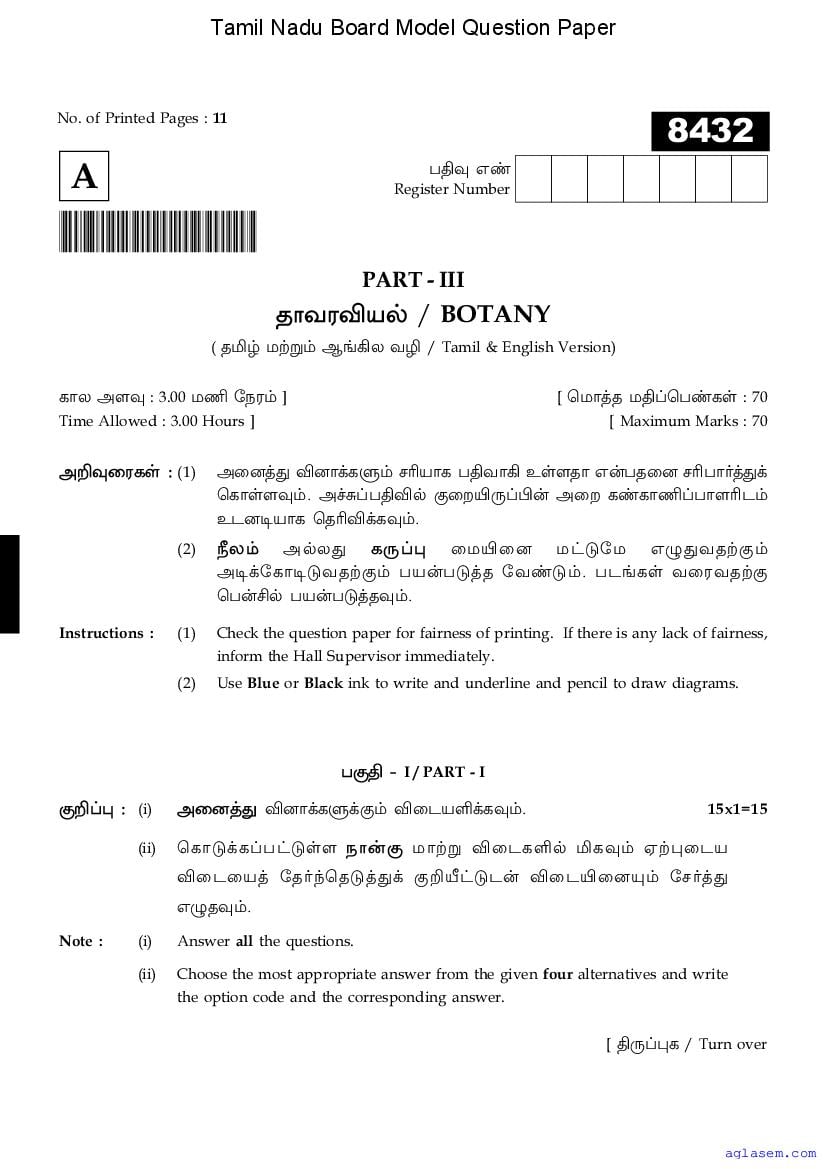
No. of Printed Pages : 11
8432
£vÄ Gs
A Register Number
!8432IstYearBotany!
PART - III
uõÁµÂ¯À / BOTANY
( uªÌ ©ØÖ® B[Q» ÁÈ / Tamil & English Version)
Põ» AÍÄ : 3.00 ©o ÷|µ® ] [ ö©õzu ©v¨ö£sPÒ : 70
Time Allowed : 3.00 Hours ] [ Maximum Marks : 70
AÔÄøµPÒ : (1) AøÚzx ÂÚõUPЮ \›¯õP £vÁõQ EÒÍuõ GߣuøÚ \›£õºzxU
öPõÒÍÄ®. Aa_¨£vÂÀ SøÓ°¸¨¤ß AøÓ PsPõo¨£õÍ›h®
EhÚi¯õP öu›ÂUPÄ®.
(2) }»® AÀ»x P¸¨¦ ø©°øÚ ©mk÷© GÊxÁuØS®
AiU÷PõikÁuØS® £¯ß£kzu ÷Ásk®. £h[PÒ ÁøµÁuØS
ö£ß]À £¯ß£kzuÄ®.
Instructions : (1) Check the question paper for fairness of printing. If there is any lack of fairness,
inform the Hall Supervisor immediately.
(2) Use Blue or Black ink to write and underline and pencil to draw diagrams.
£Sv & I / PART - I
SÔ¨¦ : (i) AøÚzx ÂÚõUPÐUS® Âøh¯ÎUPÄ®. 15x1=15
(ii) öPõkUP¨£mkÒÍ |õßS ©õØÖ ÂøhPÎÀ ªPÄ® Hئøh¯
Âøhø¯z ÷uº¢öukzxU SÔ±mkhß Âøh°øÚ²® ÷\ºzx
GÊuÄ®.
Note : (i) Answer all the questions.
(ii) Choose the most appropriate answer from the given four alternatives and write
the option code and the corresponding answer.
[ v¸¨¦P / Turn over
Page 2
1. RÌPsh ÁõUQ¯[PøÍU P¸zvÀ öPõÒP.
Á\¢u Põ»zvÀ ÁõìS»º ÷P®¤¯®.
(i) SøÓÁõÚ ö\¯À£õk öPõshx.
(ii) AvP¨£i¯õÚ ø\»UTÖPøÍ ÷uõØÖÂUQßÓÚ.
(iii) APßÓ EÒöÁÎ öPõsh ø\»USÇõ´PøÍ E¸ÁõUSQßÓx.
(A) (i) ©ØÖ® (ii) \›¯õÚøÁ BÚõÀ (iii) \›¯õÚuÀ».
(B) (i) \›¯õÚx BÚõÀ (ii) ©ØÖ® (iii) \›¯õÚøÁ AÀ».
(C) (i) ©ØÖ® (ii) \›¯õÚøÁ¯À» BÚõÀ (iii) \›¯õÚx.
(D) (i) \›¯õÚuÀ» BÚõÀ (ii) ©ØÖ® (iii) \›¯õÚøÁ.
Consider the following statements.
In spring season vascular cambium :
(i) is less active.
(ii) produces a large number of xylary elements.
(iii) forms xylem vessels with wide cavities of these.
(a) (i) and (ii) are correct but (iii) is not correct.
(b) (i) is correct but (ii) and (iii) are not correct.
(c) (i) and (ii) are not correct but (iii) is correct.
(d) (i) is not correct but (ii) and (iii) are correct.
2. £õv uØ\õº¦øh¯ ö\À ~sqÖ¨£õP £_[PoP® P¸u¨£kÁuØS Põµn® :
(A) JÎa÷\ºUøP ÂøÚ |øhö£ÖÁuõÀ
(B) \ÆÂÚõÀ `Ǩ£mkÒÍx
(C) DNA EÒÍuõÀ
(D) RNA EÒÍx
Identify the reason for “Chloroplast is a semi-autonomous organelle”.
(a) carry out photosynthetic reactions
(b) membrane bounded
(c) presence of DNA
(d) presence of RNA
A
Page 3
3. â®÷Úõìö£º®PÎß P¸Ås v_ E¸ÁõÁx :
(A) P¸ÄÖu¾US¨ ¤ß
(B) P¸ÄÖu¼ß ÷£õx
(C) P¸ Á͸® ÷£õx
(D) P¸ÄÖu¾US •ß
In Gymnosperm, endosperm is formed :
(a) after fertilization
(b) at the time of fertilization
(c) along with the development of embryo
(d) before fertilization
4. P÷µõ»ì ¼ß÷Ú¯ì & ÁøP¨£õmk •øÓ Gߣx :
(A) CÚ¨£›nõ© ÁÈ ÁøP¨£õmk •øÓ
(B) ö\¯ØøP ÁøP¨£õmk •øÓ
(C) ÷Áv •øÓ ÁøP¨£õmk •øÓ
(D) C¯ØøP ÁøP¨£õmk •øÓ
The Classification system of Carolus Linnaeus is __________.
(a) Phylogenetic system of classification
(b) Artificial system of classification
(c) Chemotaxonomy
(d) Natural system of classification
5. ¤ßÁ¸ÁÚÁØÖÒ G¢u •øÓ Âøu EÓUPzøu }UP £¯ß£kzu¨£kQßÓÚ ?
(A) ÷©õuÀ {PÌzxuÀ (B) AkUPø©zuÀ
(C) Âøu²øÓ ö\xURk (D) ÷©ØTÔ¯ AøÚzx®
Which one of the following methods are used to break the seed dormancy ?
(a) Impaction (b) Stratification
(c) Scarification (d) All the above
A [ v¸¨¦P / Turn over
Page 4
6. ö£õ¸zxP.
usiß E¸©õØÓ® uõÁµzvß ö£¯º
(1) SªÇ® (i) öPõ»÷P]¯õ
(2) P¢u® (ii) ÷PÚõ
(3) ©mh{»z usk (iii) AÀ¼¯® ^£õ
(4) QÇ[S (iv) ö\õ»õÚ® i³£÷µõ\®
(A) (1)-(iii), (2)-(i), (3)-(ii), (4)-(iv) (B) (1)-(iii), (2)-(ii), (3)-(i), (4)-(iv)
(C) (1)-(iv), (2)-(ii), (3)-(i), (4)-(iii) (D) (1)-(i), (2)-(ii), (3)-(iii), (4)-(iv)
Match :
Stem modification Plant name
(1) Bulb (i) Colocasia
(2) Corm (ii) Canna
(3) Rhizome (iii) Allium cepa
(4) Tuber (iv) Solanum tuberosum
(a) (1)-(iii), (2)-(i), (3)-(ii), (4)-(iv) (b) (1)-(iii), (2)-(ii), (3)-(i), (4)-(iv)
(c) (1)-(iv), (2)-(ii), (3)-(i), (4)-(iii) (d) (1)-(i), (2)-(ii), (3)-(iii), (4)-(iv)
7. ÂøÓ¨£Êzu® Eøh¯ ö\À¼À :
(A) DPD=0 ÁÎ; OP=5 ÁÎ; TP=10 ÁÎ.
(B) DPD=10 ÁÎ; OP=5 ÁÎ; TP=10 ÁÎ.
(C) DPD=20 ÁÎ; OP=20 ÁÎ; TP=10 ÁÎ.
(D) DPD=0 ÁÎ; OP=10 ÁÎ; TP=10 ÁÎ.
In a fully turgid cell :
(a) DPD=0 atm; OP=5 atm; TP=10 atm;
(b) DPD=10 atm; OP=5 atm; TP=10 atm;
(c) DPD=20 atm; OP=20 atm; TP=10 atm;
(d) DPD=0 atm; OP=10 atm; TP=10 atm;
A
Page 5
8. GuØS Cøh÷¯ ÷áõi ÷\ºuÀ (]Úõ¨]ì) |øhö£ÖQÓx ?
(A) Cµsk Jzu S÷µõ÷©õ÷\õ®PÒ
(B) mRNA ©ØÖ® øµ÷£õ÷\õ®PÒ
(C) J¸ Bs ©ØÖ® J¸ ö£s ÷P«mk
(D) Pvº÷PõÀ CøÇPÒ ©ØÖ® ö\ßm÷µõª¯ºPÒ
Synapsis occur between :
(a) two homologous Chromosomes.
(b) mRNA and Ribosomes.
(c) a male and a female gamete.
(d) Spindle fibres and Centromeres.
9. ö\À¿÷»õ]À EÒÍ β-D SÐU÷Põì A»SPÒ JßÖhß JßÖ __________
¤øn¨£õÀ CønUP¨£mkÒÍx.
(A) 1→3 ¤øn¨¦
(B) N&A]møhÀ £UP\[Q¼PÒ
(C) β-(1, 4) QøÍUPõø\miU ¤øn¨¦
(D) N&A]møhÀ D - SÐU÷Põ\ø©ß
The β-D Glucose units in cellulose are linked together by :
(a) 1→3 Linkage.
(b) N-acetyl side chains.
(c) β-(1, 4) glycosidic Linkage.
(d) N-acetyl D - Glucosamine.
10. Cµsk ‰»UTÖ ø\m÷hõ÷\õ¼U NADH + H+ BUêá÷ÚØÓ©øh²® ÷£õx
uõÁµ[PÎÀ E¸ÁõS® ATP ‰»UTÖPÎß GsoUøP :
(A) 6 (B) 3 (C) 8 (D) 4
During oxidation of two molecules of cytosolic NADH + H+, number of ATP molecules
produced in plants are :
(a) 6 (b) 3 (c) 8 (d) 4
A [ v¸¨¦P / Turn over
Page 6
11. \›¯õÚÁØøÓ¨ ö£õ¸zxP.
uÛ©[PÒ £oPÒ
(1) ©õ¼¨iÚ® (i) £aø\¯®
(2) xzu|õP® (ii) ö©zv÷¯õÛß
(3) ö©UÜ]¯® (iii) BU]ß
(4) \À£º (iv) ø|m÷µõâ÷Úì
(A) (1)-(iv), (2)-(iii), (3)-(i), (4)-(ii)
(B) (1)-(i), (2)-(iii), (3)-(iv), (4)-(ii)
(C) (1)-(iv), (2)-(ii), (3)-(i), (4)-(iii)
(D) (1)-(ii), (2)-(i), (3)-(iii), (4)-(iv)
Match the correct combination.
Minerals Role
(1) Molybdenum (i) Chlorophyll
(2) Zinc (ii) Methionine
(3) Magnesium (iii) Auxin
(4) Sulphur (iv) Nitrogenase
(a) (1)-(iv), (2)-(iii), (3)-(i), (4)-(ii)
(b) (1)-(i), (2)-(iii), (3)-(iv), (4)-(ii)
(c) (1)-(iv), (2)-(ii), (3)-(i), (4)-(iii)
(d) (1)-(ii), (2)-(i), (3)-(iii), (4)-(iv)
12. }»¨£_® £õ]P÷Íõk öuõhº¦øh¯ \›¯õÚ TØÖ Gx ?
(A) Eh»zøua _ØÔ ª³]÷»ä Põn¨£kÁvÀø»
(B) |PºÁuØPõÚ EÖ¨¦PÒ CÀø»
(C) L¦÷Íõ›i¯ß uµ\® Põn¨£kQÓx
(D) ö\À _Á›À ö\À¾÷»õì Põn¨£kQÓx
The correct statement regarding Blue green algae is ___________.
(a) absence of mucilage around the thallus
(b) lack of motile structure
(c) presence of floridean starch
(d) presence of cellulose in cell wall
A
Page 7
13. C¸ Âzvø»z uõÁµz usiß ¦Óz÷uõ»iz ÷uõÀ £Sv°À Põn¨£k® v_.
(A) ìQÎöµßøP©õ (B) £õµßøP©õ
(C) S÷ÍõµßøP©õ (D) ÷Põ»ßøP©õ
The tissue found in hypodermis of dicot stem :
(a) Sclerenchyma (b) Parenchyma
(c) Chlorenchyma (d) Collenchyma
14. GÆÁøP £aø\¯zvÀ ø£mhõÀ ÁõÀ£Sv Põn¨£kÁvÀø» ?
(A) £aø\¯® c (B) £aø\¯® a
(C) £aø\¯® d (D) £aø\¯® b
Which chlorophyll molecule does not have a phytol tail ?
(a) Chl-c (b) Chl-a
(c) Chl-d (d) Chl-b
15. Esø©U PÛ Gߣx :
(A) ©»›ß `»P¨ø£, ¦À¼Ámh® ©ØÖ® §zuÍ® PÛ¯õP E¸ÁõÁx.
(B) ©»›ß `»P¨ø£ ©mk÷© PÛ¯õP E¸ÁõÁx.
(C) ©»›ß AøÚzx Ámh[PЮ PÛ¯õP E¸ÁõÁx.
(D) ©»›ß `»P¨ø£ ©ØÖ® ¦À¼Ámh® PÛ¯õP E¸ÁõÁx.
A true fruit is the one where :
(a) Ovary, calyx and thalamus of the flower develop into fruit.
(b) Only ovary of the flower develops into fruit.
(c) All floral whorls of the flower develop into fruit.
(d) Ovary and calyx of the flower develop into fruit.
£Sv & II / PART - II
SÔ¨¦ : GøÁ÷¯Ý® BÖ ÂÚõUPÐUS ©mk® Âøh¯ÎUPÄ®. ÂÚõ Gs 24 &US
Pmhõ¯©õP Âøh¯ÎUPÄ®. 6x2=12
Note : Answer any six questions. Question No. 24 is Compulsory.
16. APõ›PêÀ Põn¨£k® ø©^¼¯[PÎß ÁøPPøÍU SÔ¨¤kP.
Name the types of mycelium found in Agaricus.
17. ""¤U÷Úõø\¼U'' £ØÔ }º AÔÁx ¯õx ?
What do you infer from the term “Pycnoxylic” ?
A [ v¸¨¦P / Turn over
Page 8
18. Cø»zöuõÈÀ usk GßÓõÀ GßÚ ? Euõµn® u¸P.
What is Phylloclade ? Give an example.
19. uõÁµa ö\À¾US®, »[S ö\À¾US® Cøh÷¯ EÒÍ H÷uÝ® Cµsk
÷ÁÖ£õkPøÍ GÊxP.
Write any two differences between plant cell and animal cell.
20. ø©mhõ]ì]ß H÷uÝ® Cµsk ]Ó¨¤¯À¦PøÍ GÊxP.
Write any two significance of mitosis.
21. ø£Úì, ÷©õµì Pmøhø¯ ÷ÁÖ£kzxP.
Differentiate the wood formed in Pinus from that of Morus.
22. §Áia ö\v¾øh¯, §UPõ®¦a ö\v»ØÓ C¸£õÀ ©»º, •Êø©¯õÚ I¢u[P
©»º, uÛzu ¦À¼Ámh®, uÛzu AÀ¼Ámh®, ÷©À©mha `»P¨ø£ öPõsh
©»›ß ©»º `zvµzvøÚ GÊxP.
Find out the floral formula for a bisexual flower with bract, regular pentamerous, distinct
calyx and corolla, superior ovary without bracteole.
23. RNA &Âß ÁøPPøÍ GÊxP.
Write the types of RNA.
24. uõÁµ }µõ¨÷£õUS uk¨£õßPÎß £¯ßPøÍU SÔ¨¤kP.
Point out the uses of plant anti-transpirants.
£Sv & III / PART - III
SÔ¨¦ : GøÁ÷¯Ý® BÖ ÂÚõUPÐUS ©mk® Âøh¯ÎUPÄ®. ÂÚõ Gs 33 &US
Pmhõ¯©õP Âøh¯ÎUPÄ®. 6x3=18
Note : Answer any six questions. Question No. 33 is Compulsory.
25. ø\Pì Tmiø»U Põ®¤ß SÖUS öÁmkz ÷uõØÓzvøÚ £h® Áøµ¢x
£õP[PøÍU SÔUPÄ®.
Draw and label the parts of Cycas Rachis T.S.
A
Page 9
26. J¸ |k |µ®£ø©ÄUS®, £» |k |µ®£ø©ÄUS® Cøh÷¯ EÒÍ ÷ÁÖ£õmøhU
TÖP.
Differentiate pinnate unicostate with palmate multicostate venation.
27. ª³éõ £õµiê¯õPõ uõÁµzvß ©»º `zvµ® GÊv Auß ©»º Áøµ£h® ÁøµP.
Write the floral formula of Musa Paradisiaca and draw their floral diagram.
28. uõÁµa ö\ÀPξ® »[S ö\ÀPξ® ø\m÷hõøPÛ]ì – ÷ÁÖ£kzxP.
Differentiate cytokinesis in plant cells and animal cells.
29. øh÷»õìPÒ – ]Ö SÔ¨¦ ÁøµP.
Write short notes on Tyloses.
30. uõÁµzvÀ _U÷µõêøÚ ö£Ö® JÎa÷\ºUøP ö\´¯Â¯»õ £SvPøͨ £mi¯¼kP.
List out the non-photosynthetic parts of a plant that need a supply of sucrose.
31. JÎa _Áõ\zvØS® C¸Ò _Áõ\zvØS® Cøh÷¯ EÒÍ H÷uÝ® ‰ßÖ
÷ÁÖ£õkPøÍ GÊxP.
Write any three differences between Photorespiration and Dark respiration.
32. EMP ÁÈzuhzvÀ £õ죛Pµn® ©ØÖ® £õì÷£m }UP® BQ¯ ÂøÚPÎÀ
Dk£k® ö|õvPÒ ¯õøÁ ?
What are the enzymes involved in phosphorylation and dephosphorylation reactions in EMP
pathway ?
33. PõØÔÀ»õa _Áõ]zu¼ß _Áõ\ DÄ ©v¨¦ •i¼. Hß ?
Respiratory Quotient value of Anaerobic respiration is infinity. Why ?
A [ v¸¨¦P / Turn over
Page 10
£Sv & IV / PART - IV
SÔ¨¦ : AøÚzx ÂÚõUPÐUS® Âøh¯ÎUPÄ®. 5x5=25
Note : Answer all the questions.
34. (A) I®ö£¸® ¤›Ä ÁøP¨£õmiøÚ ÂÁ›zx, Auß {øÓ, SøÓPøͨ £ØÔ
GÊxP.
AÀ»x
(B) CuÇø©Ä GßÓõÀ GßÚ ? Auß ÁøPPøÍ £hzxhß ÂÁ›.
(a) Describe Five Kingdom classification. Add a note on its merits and demerits.
OR
(b) What is Aestivation ? Explain their types with diagram.
35. (A) ³L÷£õº¤÷¯] Sk®£zvß H÷uÝ® I¢x ö£õ¸Íõuõµ •UQ¯zxÁzøu
GÊxP.
AÀ»x
(B) ¦÷µõ÷P›÷¯õmkPÐUS®, ³÷P›÷¯õmkPÐUS® Cøh÷¯¯õÚ
÷ÁÖ£õkPøÍ GÊxP.
(a) Write any five economic importance of family Euphorbiaceae.
OR
(b) Write the differences between Prokaryotes and Eukaryotes.
36. (A) ö|õvPÎß £s¦PøÍ £mi¯¼kP.
AÀ»x
(B) C¸Âøu°ø» usiØS®, J¸ Âøu°ø»z usiØS® Cøh÷¯ EÒÍ
EÒÍø©¨¤¯À ÷ÁÖ£õkPøÍ GÊxP.
(a) List the properties of Enzymes.
OR
(b) Distinguish the anatomy of Dicot stem from Monocot stem.
A
Page 11
37. (A) Bg]÷¯õìö£º®PÎß §a]²sq® EnÅmh •øÓ°øÚ ÂÁ›.
AÀ»x
(B) SÐU÷Põì Eøh²® ©õØÖÁȨ £õøu°ß ö£¯º GßÚ ? AvÀ
|øhö£Ö® ÂøÚPøÍ ÂÁ›UPÄ®.
(a) Explain the insectivorous mode of nutrition in Angiosperms.
OR
(b) What is the name of alternate way of glucose break down ? Explain the processes
involved in it.
38. (A) Qµ¨ì _ÇØ]°ß ÂÍUP¨£h® ©mk® u¸P.
AÀ»x
(B) Áõ² {ø»°À EÒÍ uõÁµ íõº÷©õß Gx ? Auß Áõ̯À ö\¯ÀPøÍ
GÊxP.
(a) Give the flow chart of Krebs cycle.
OR
(b) Which is the gaseous phytohormone ? Write their physiological effects.
-oOo-
A [ v¸¨¦P / Turn over
Document Details
| Board / Org | Tamil Nadu Board |
| Exam | Class 11 |
| Type | Sample Paper |
| Pages | 11 |
| Updated | 24 Sep 2026 |