Goa Board Class 12 Question Paper Mar 2019 Mathematics and Statistics
Finished viewing? Save it for later —
Download Goa Board Class 12 Question Paper Mar 2019 Mathematics and Statistics (PDF · 8 pages)About Goa Board Class 12 Question Paper Mar 2019 Mathematics and Statistics
Goa Board Class 12 Question Paper Mar 2019 Mathematics and Statistics is available here for free download. Published by Goa Board for Class 12, this question paper can be viewed online or downloaded as a PDF (8 pages). Candidates preparing for Class 12 can use Goa Board Class 12 Question Paper Mar 2019 Mathematics and Statistics to understand the exam pattern, the type of questions asked, and the overall difficulty level.
Frequently Asked Questions
How can I download Goa Board Class 12 Question Paper Mar 2019 Mathematics and Statistics?
Open this page and click the Download button to save Goa Board Class 12 Question Paper Mar 2019 Mathematics and Statistics as a PDF. It is completely free on AglaSem Docs.
Is Goa Board Class 12 Question Paper Mar 2019 Mathematics and Statistics free to download?
Yes. Goa Board Class 12 Question Paper Mar 2019 Mathematics and Statistics can be viewed online and downloaded as a PDF free of cost on AglaSem Docs.
How many pages does Goa Board Class 12 Question Paper Mar 2019 Mathematics and Statistics have?
Goa Board Class 12 Question Paper Mar 2019 Mathematics and Statistics contains 8 pages, which you can read online or download together as a single PDF.
Where can I find more Class 12 study material?
You can find more Class 12 question papers, sample papers, syllabus, and answer keys on AglaSem Docs.
Goa Board Class 12 Question Paper Mar 2019 Mathematics and Statistics – Text
Read the full text of this question paper below — useful to quickly search, copy and reference the content online without downloading the PDF.
📄 View text version (8 pages)
Page 1
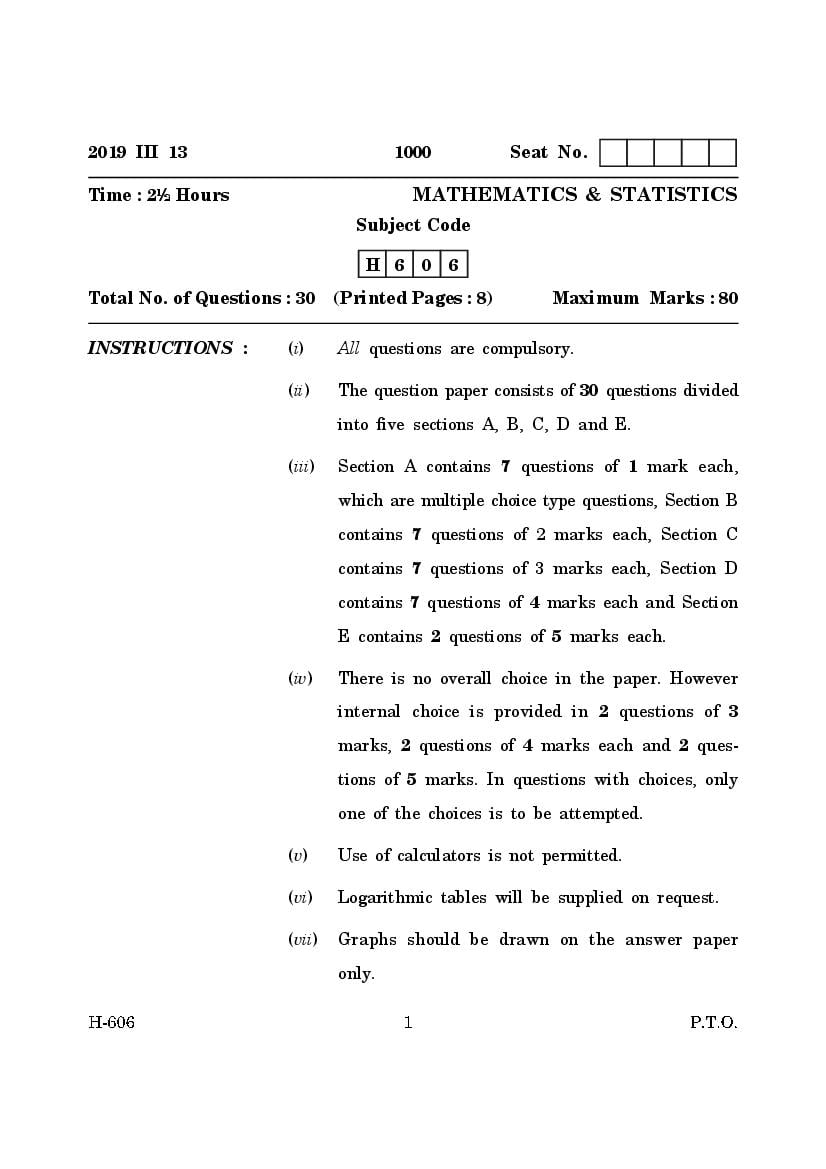
Time : 2½ Hours MATHEMATICS & STATISTICS
Subject Code
H 6 0 6
Total No. of Questions : 30 (Printed Pages : 8) Maximum Marks : 80
INSTRUCTIONS : (i) All questions are compulsory.
(ii) The question paper consists of 30 questions divided
into five sections A, B, C, D and E.
(iii) Section A contains 7 questions of 1 mark each,
which are multiple choice type questions, Section B
contains 7 questions of 2 marks each, Section C
contains 7 questions of 3 marks each, Section D
contains 7 questions of 4 marks each and Section
E contains 2 questions of 5 marks each.
(iv) There is no overall choice in the paper. However
internal choice is provided in 2 questions of 3
marks, 2 questions of 4 marks each and 2 ques-
tions of 5 marks. In questions with choices, only
one of the choices is to be attempted.
(v) Use of calculators is not permitted.
(vi) Logarithmic tables will be supplied on request.
(vii) Graphs should be drawn on the answer paper
only.
Page 2
Question Nos. 1 to 7 carry 1 mark each. In each question, four options are
provided, out of which one is correct. Write the correct option.
3 2 1 4
1. If 2X = , then matrix X = ............
1 1 1 1
2 2
2 0
1 1
1 0
1 1
2 2
1
0
2
1 1
1 0
dy
2. If y = log (sec x), then = ............
dx
sec x tan x
sec x
tan x
sec x + tan x
3. Which statement among the following statements is false ?
Banker’s gain is interest on true discount
Banker’s discount is interest on face value
True discount is interest on present value
Banker’s gain is interest on Banker’s discount
Page 3
the last payment period of an annuity is called :
Payment interval
Interval of deferment
Term
Time period
5. In a partnership deed on admission of a new partner, the premium brought
by the new partner is shared among the old partners in ...............
Sacrificing ratio
Gaining ratio
New profit sharing ratio
Old profit sharing ratio
1
6. dx ............. C
x2 a2
1 x a
log
2a x a
1 x a
log
2a x a
log ( x x2 a2 )
log ( x x2 a2 )
/4
7. sec2 x dx ..............
0
0
1
2
–1
1
Page 4
Question Nos. 8 to 14 carry 2 marks each.
8. If f : R+ (1, ) such that f (x) = x2 + 1, then show that the function ‘f ’
is bijective.
ab
9. If a * b = and (x * 5) × 3 = 15, then find x.
2
2 3
10. If A = , then show that A3 = A.
1 2
11. If the point (1, 1), (0, 2) and (3, y) are collinear points, then find y using
determinant.
12. Total cost function of a commodity is given by C(x) = 3x2 + 7x + 12. Find
x so that marginal cost is equal to average cost.
13. Write the linear constraints of a linear programming problem if the feasible
region of the problem is given by the shaded region in the following
figure :
Page 5
14. If A and B are two independent events such that P(A) = and P(B) = ,
3 4
then find P(A B ).
Section C
Question Nos. 15 to 21 carry 3 marks each.
15. Find x, y and z if :
3 1 2 2 x
2
3 2 1 4 1 0 y .
1
0 1 1 1 z
16. If ex + ey = ex+y, then show that :
dy ey
.
dx ex
17. A monopolist’s demand function for one of its products is p(x) = ax + b,
where x is the number of units produced and p is the price per unit. If on
selling 10 units, the price is Rs. 1,200 per unit and on selling 7 units, the
price per unit is Rs. 1,500, then find total revenue function and marginal
revenue function of the product.
Or
Profit function of a commodity is given by P(x) = 600x – 2000 – 3x2, where
x is number of items. Then find x so that profit is maximum.
Page 6
x 1
2
dx.
x 2x 3
19. Evaluate :
x sin x dx.
0
20. Solve the differential equation :
y( x 1) dx x( y 1) dy 0.
Also find the particular solution given that y = 1 when x = 1.
Or
Solve the differential equation :
dy
x2 x2 y2 xy.
dx
21. Form the differential equation by eliminating the arbitrary constants A and
B from the equation :
y Ax 2 Bx.
Section D
Question Nos. 22 to 28 carry 4 marks each.
22. By using properties of determinants prove that :
2a b a a
a 2a b a (4 a b) (a b)2 .
a a 2a b
Page 7
f (x) = 4x4 – 3x3, 0 < x < 1
= Ax + B, 1 < x < 2
= 5x2 – 8x, 2 < x < 3
and f is continuous on its domain, then find A and B.
log t dy
24. If x = t2 log t and y , then find when t = 1.
t dx
25. There are three boxes containing bulbs. In Box I out of 10 bulbs 4 are
defective. In Box II out of 9 bulbs 3 are defective. In Box III out of 8 bulbs
4 are defective. One of the boxes is selected at random and a bulb is selected
from the box at random. If the selected bulb is defective, then find the
probability that it is from box II.
Or
A die is tossed 3 times. If getting a number greater than 2 is a success
then find the probability distribution of number of successes. Also find mean
of the probability distribution.
26. Solve the following linear programming problem graphically.
Minimize :
Z = 8x + 9y
Subject to the constraints :
x + y < 8, 4x + 3y > 7,
x + 6y > 7, x > 0, and y > 0.
27. A bill of Rs. 60,000 drawn on 2nd January, 2017 for 9 months and discounted
on 12th May 2017 for Rs. 58,680. Find the rate of interest per annum.
28. Find :
sin x dx
.
cos2 x 5 cos x 7
Or
Find :
1
2
dx.
2 sin x 3 cos2 x 1
Page 8
Question Nos. 29 and 30 carry 5 marks each.
29. A loan of Rs. 5,05,700 to purchase a car is re-paid in 18 half yearly equal
instalments, at 8% per annum compounded half yearly. The first
instalment being paid at the end of first half year. Find the amount of each
instalment.
Or
Find the amount of deferred annuity of Rs. 9,000 payable at the end of
every quarter year, the first instalment being made at the end of 2 years
and last instalment at the end of 10 years, if money is worth 12% per annum
compounded quarterly.
2
30. X and Y started a business in partnership. X invested of the capital and
3
rest by Y. After 9 months, X withdrew half of his investment. After n months,
they divided their profit in the ratio 3 : 2. Then find n.
Or
A, B and C are partners of a firm contributing Rs. 5,00,000, Rs. 3,00,000
and Rs. 2,00,000 respectively. The partnership deed provided an interest of
5% on the capital investment. B and C gets Rs. 30,000 and Rs. 20,000 per
month respectively, as salary for their services to the firm. At the end of
the year the firm gets a profit of Rs. 12,00,000. What will each receive if
the remaining profit is shared in ratio of capitals.
Document Details
| Board / Org | Goa Board |
| Exam | Class 12 |
| Type | Question Paper |
| Pages | 8 |
| Updated | 30 Apr 2026 |