CUSAT CAT 2017 Question Paper Physics
Finished viewing? Save it for later —
Download CUSAT CAT 2017 Question Paper Physics (PDF · 23 pages)About CUSAT CAT 2017 Question Paper Physics
CUSAT CAT 2017 Question Paper Physics is available here for free download. Published by Cochin University for CUSAT CAT, this question paper can be viewed online or downloaded as a PDF (23 pages). Candidates preparing for CUSAT CAT can use CUSAT CAT 2017 Question Paper Physics to understand the exam pattern, the type of questions asked, and the overall difficulty level.
Frequently Asked Questions
How can I download CUSAT CAT 2017 Question Paper Physics?
Open this page and click the Download button to save CUSAT CAT 2017 Question Paper Physics as a PDF. It is completely free on AglaSem Docs.
Is CUSAT CAT 2017 Question Paper Physics free to download?
Yes. CUSAT CAT 2017 Question Paper Physics can be viewed online and downloaded as a PDF free of cost on AglaSem Docs.
How many pages does CUSAT CAT 2017 Question Paper Physics have?
CUSAT CAT 2017 Question Paper Physics contains 23 pages, which you can read online or download together as a single PDF.
Where can I find more CUSAT CAT study material?
You can find more CUSAT CAT question papers, sample papers, syllabus, and answer keys on AglaSem Docs.
CUSAT CAT 2017 Question Paper Physics – Text
Read the full text of this question paper below — useful to quickly search, copy and reference the content online without downloading the PDF.
📄 View text version (23 pages)
Page 1
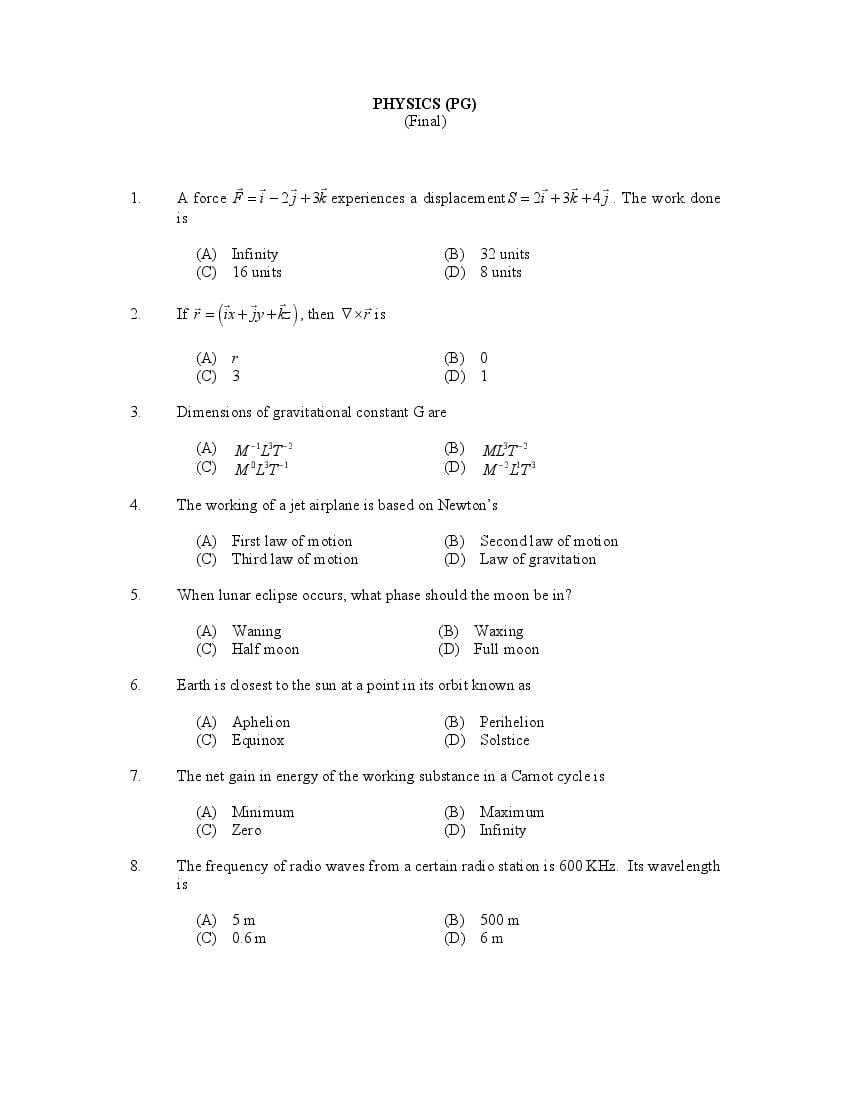
(Final)
1. A force F i 2 j 3k experiences a displacement S 2i 3k 4 j . The work done
is
(A) Infinity (B) 32 units
(C) 16 units (D) 8 units
2.
If r ix jy kz , then r is
(A) r (B) 0
(C) 3 (D) 1
3. Dimensions of gravitational constant G are
(A) M 1 L3T 2 (B) ML3T 2
(C) M 0 L3T 1 (D) M 2 LT
1 3
4. The working of a jet airplane is based on Newton’s
(A) First law of motion (B) Second law of motion
(C) Third law of motion (D) Law of gravitation
5. When lunar eclipse occurs, what phase should the moon be in?
(A) Waning (B) Waxing
(C) Half moon (D) Full moon
6. Earth is closest to the sun at a point in its orbit known as
(A) Aphelion (B) Perihelion
(C) Equinox (D) Solstice
7. The net gain in energy of the working substance in a Carnot cycle is
(A) Minimum (B) Maximum
(C) Zero (D) Infinity
8. The frequency of radio waves from a certain radio station is 600 KHz. Its wavelength
is
(A) 5 m (B) 500 m
(C) 0.6 m (D) 6 m
Page 2
9. Which one of the following statements about black body radiation is false?
(A) Good absorbers are good emitters
(B) Black body radiation from an enclosure is dependent of the temperature of
the enclosure
(C) Black body radiation can be fully explained by Plank’s law
(D) Black body radiation from an enclosure is dependent on the material of
which it is made
10. Corpuscular nature of light can be illustrated through
(A) Polarization of light (B) Compton scattering
(C) Diffraction of light (D) Interference of light
11. Which one of the following experiments confirms the existence of space
quantization?
(A) Young’s double slit experiment (B) Frank-Hertz experiment
(C) Stern-Gerlach experiment (D) Michelson-Morley experiment
12. The de Broglie wavelength of an electron of mass m and speed v is
(A) mvh (B) h / mv
(C) mv 2 / h (D) m / hv
13. If an experiment has N equally probable outcomes as events, the apriori probability of
each event is
(A) 1/N (B) N
(C) 1/N2 (D) N‒1
14. Which one of the following is a Fermion?
(A) Photon (B) Mesons
(C) Electron (D) Alpha particle
15. Colour in thin soap film seen during day time is due to
(A) reflection of light (B) refraction of light
(C) diffraction of light (D) interference of light
16. Which one of the following is not electromagnetic in nature?
(A) Cathode rays (B) X-rays
(C) Gamma rays (D) Infrared rays
Page 3
17. Among seven crystal systems, the most and least symmetric ones are
(A) Cubic and Monoclinic (B) Tetragonal Triclinic
(C) Cubic and Triclinic (D) Orthorhombic and Triclinic
18. The biding energy in ionic crystals is due to
(A) sharing of valence electrons
(B) sharing of ions
(C) transfer of valence electrons
(D) transfer of protons
19. Fermi level in intrinsic semiconductor lies
(A) in the forbidden gap (B) in conduction band
(C) in valence band (D) above conduction band
20. If the beta (β) of the transistor is 99, its alpha (α) is
(A) 0.66 (B) 0.99
(C) 0.98 (D) 0.93
21. Glass is a
(A) Crystalline solid (B) Amorphous solid
(C) Liquid crystalline material (D) Polymeric material
22. The superconducting transition temperature in mercury is
(A) 100 K (B) 68 K
(C) 4.2 K (D) 1.0 K
23. The maximum number of electrons that a shell of quantum number 3 can
accommodate is
(A) 2 (B) 18
(C) 6 (D) 32
24. According to Bohr principle, the relation between principal quantum number n and
the radius of the orbit is
(A) r 1/ n (B) rn
2
(C) rn (D) r 1/ n2
25. Nuclei having same number of protons but different number of neutrons are called
(A) mirror nuclei (B) isotopes
(C) isotones (D) isomers
Page 4
26. Zeeman effect is due to
(A) electric field (B) magnetic field
(C) gravitational field (D) Coulomb field
27. The wavelength of the green line of mercury is
(A) 4070 A0 (B) 5461 A0
(C) 4358 A0 (D) 6078 A0
28. The law that relates the half life and range of α-particles for a large number of α-
emitters is the
(A) Mosley’s law (B) Fermi-Golden rule
(C) Curie-Weiss law (D) Geiger –Nuttal law
29. A quantum particle is placed inside a one-dimensional box with rigid walls. The first
excited state energy of the particle is 4 eV. The ground state energy is
(A) 2 eV (B) 3 eV
(C) 1 eV (D) 0 eV
30. Light emission from ordinary optical sources is incoherent because
(A) emission is predominantly spontaneous
(B) emission is predominantly stimulated
(C) emission occurs at several wavelengths
(D) emission occurs with low intensity
31. Which of the following molecules contains a double bond?
(A) N2 (B) H2
(C) O2 (D) Cl2
32. The acronym ‘modem’ stands for
(A) modulation of electromagnetic waves
(B) modern method of transmission
(C) modulation and demodulation
(D) modes of transmission
33. Optical fibers transmit light signals from one place to another place by
(A) internal conical refraction (B) double refraction
(C) interference of light signals (D) total internal reflection
Page 5
34. The major constituent gas in the earth’s atmosphere is
(A) Carbon dioxide (B) Nitrogen
(C) Oxygen (D) Water vapor
35. Which one of the following is not a green house gas?
(A) Nitrogen (B) Carbon dioxide
(C) Water vapor (D) Methane
36. The major constituent of the biogas
(A) Carbon dioxide (B) Oxygen
(C) Methane (D) Butane
37. In the case of uniform circular motion, which of the following quantities remain
constant?
(A) Speed (B) Momentum
(C) Angular displacement (D) Velocity
38. Force of friction on a body kept on the surface of a table does not depend on
(A) nature of the surface (B) weight of the body
(C) area of contact (D) material of the body
39. If the velocity of an object is doubled, its kinetic energy will be increased by
(A) three times (B) eight times
(C) four times (D) six times
40. Two wires carrying the same current in the same direction and placed 1 cm apart will
experience
(A) no force at all (B) a mutually repulsive force
(C) a strong repulsive force (D) a mutually attractive force
41. Ground wave or surface wave propagation is useful only for transmission of
(A) Lower radio frequencies (B) Very high frequency (VHF)
(C) Ultra high frequency(UHF) (D) Microwave frequencies
42. Which physical phenomenon is responsible for spherical shape of the rain drop?
(A) Viscosity (B) Friction
(C) Surface tension (D) Buoyancy
Page 6
43. For a particle undergoing SHM, the velocity is plotted against the displacement. The
curve will be
(A) a straight line (B) a parabola
(C) a circle (D) an ellipse
44. Bernoulli’s principle (or equation) is a consequence of
(A) conservation of energy only
(B) conservation of momentum only
(C) conservation of linear momentum
(D) conservation of angular momentum
45. The penetrating powers of α, β and γ radiations, in decreasing order are
(A) γ, α, β (B) γ, β, α
(C) α , β, γ (D) β, γ, α
46. A ball is thrown from a point with a speed ‘u’ at an elevation angle of . From the
same point and at the same instant a person starts running with a constant speed u/2 to
catch the ball, will he be able to catch the ball? If yes, what should be the value of ?
(A) Yes, 60o (B) Yes, 30o
(C) No (D) Yes, 45o
47. When a force of magnitude ‘F’ acts on a body of mass ‘m’, the magnitude of
acceleration of the body is ‘a’. If three co-planar forces F1 = F2 = F3 = F acts on the
same body as shown in the figure below, the acceleration produced is
(A) 2 1 a (B) 2 1 a
(C) 2a (D) a
Page 7
48. A pendulum has a length L, its bob is pulled aside from its equilibrium position
through an angle and then released. The speed of the bob when it passes through
the equilibrium position is given by
(A) 2gL (B) 2 g / cos
(C) 2 gL 1 cos (D) 2 gL 1 sin
49. Two particles of masses m and 4 m have kinetic energies in the ratio of 2 : 1, what is
the ratio of their linear momenta?
(A) 1/ 2 (B) 1/2
(C) 1/4 (D) 1/6
50. A bullet, incident normally on a wooden plank, loses one-tenth of its speed in passing
through the plank. The least number of such planks required to stop the bullet is
(A) 5 (B) 6
(C) 7 (D) 8
51. A bullet of mass 50 g is fired by a gun of mass 5 kg. If the muzzle speed is 200 m/s
what is the recoil speed of the gun?
(A) 1 m/s (B) 2 m/s
(C) 3 m/s (D) 4 m/s
52. Two identical balls marked 2 and 3, in contact with each other and at rest on a
horizontal frictionless table, are hit head on by another identical ball marked 1 moving
initially with a speed ‘v’ as shown in figure below. What is observed, if the collision
is elastic?
(A) Ball 1 comes to rest and balls 2 and 3 roll out with speed V/2 each.
(B) Balls 1 and 2 comes to rest and ball 3 rolls out with speed V.
(C) Balls 1, 2 and 3 roll out with speed V/3 each
(D) Balls 1, 2 and 3 comes to rest
53. A rubber ball is dropped from a height of 5 m on a planet where the acceleration due
to gravity is not known. On bouncing it rises to 1.8 m. The ball loses its velocity on
bouncing by a factor of
(A) 16/25 (B) 2/5
(C) 3/5 (D) 9/2
Page 8
54. A molecule consists of 2 atoms, each of mass m, separated by a distance a. The
moment of inertia of the molecule about an axis through the centre of mass and
perpendicular to the bond length is
(A) 2ma2 (B) ma 2
(C) 1/ 2 ma 2 (D) 1/ 4 ma 2
55. Two dices of moments of inertia I1 and I2 about their respective axes, rotating with
angular frequencies W1 and W2 respectively, are brought into contact face to face with
their axes of rotation coinciding each other. The angular frequency of the composite
disc will be
(A) I1W1 I 2W2 / I1 I 2 (B) I1W1 I 2W2 / I1 I 2
(C) I 2W1 I1W2 / I1 I 2 (D) I 2W1 I 2W1 / I1 I 2
56. A body of mass ‘m’ is tied to one end of a spring and whirled round in a horizontal
plane with a constant angular velocity, the elongation in the spring is one centimeter.
If the angular velocity is doubled the elongation in the spring is 5 cm. The original
length of the spring is
(A) 16 cm (B) 15 cm
(C) 14 cm (D) 13 cm
57. A solid sphere is rotating in free space. If the radius of the sphere is increased,
keeping its mass the same, which one of the following will not be affected?
(A) Moment of inertia (B) Angular momentum
(C) Angular velocity (D) Rotational kinetic energy
58. If the radius of earth suddenly decreases to 80% of its present value, the mass of the
earth remaining the same, the value of the acceleration due to gravity will
(A) remain unchanged (B) decrease by 36%
(C) increases by about 36% (D) increase by about 56%
59. Two satellites of the same mass are orbiting round the earth at heights of R and 4R
above the earth’s surface. R being the radius of the earth, their kinetic energies are in
the ratio of
(A) 4 : 1 (B) 3 : 2
(C) 4 : 3 (D) 5 : 2
Page 9
60. An instrument package is released from an orbiting earth satellite by simply detaching
it from the outer wall of the satellite, the package will
(A) go away from the earth and get lost in outer surface
(B) fall to the surface of the earth
(C) continue moving along with the satellite in the same orbit and with the same
velocity
(D) fall through a certain distance and then move in an orbit around the earth
61. A object weight W newton on earth, it is suspended from the lower end of a spring
balance whose upper end is fixed to the ceiling of a space capsule in a stable orbit
around the Earth, the reading of the spring balance will be
(A) W (B) less than W
(C) more than W (D) zero
62. The acceleration due to gravity on the surface of the moon is one-sixth that on the
earth. Radius of the moon is about one-fourth that of the earth. If Vc is the escape
velocity on the surface of the earth, then the escape velocity on the surface of the
moon will be
Vc
(A) Vc 4 / 6 (B)
6 4
Vc
(C) Vc 4 / 6 (D)
6 4
63. When a stone of mass m is falling in the earth of mass M, the acceleration of the earth
will be
(A) Zero (B) mg/M
(C) Mg/m (D) g
64. Two small and heavy spheres, each of mass ‘M’ are placed a distance ‘r’ apart on a
horizontal surface. The gravitational potential at the mid-point of the line joining the
centre of the sphere is
(A) zero (B) – GM / r
(C) – 2 GM / r (D) – 4 GM / r
65. A satellite of mass m is orbiting the earth at a height ‘h’ from its surface. If M is the
mass of the Earth and R is its radius, the potential energy of the satellite is given by
(A) – G m M / (R + h)2 (B) – G m M / 2(R + h)2
(C) – G m M / (R + h) (D) – G m M / 2(R + h)
Page 10
66. The height of the point vertically above the earth’s surface at which the acceleration
due to gravity becomes 1% of its value at the surface is (R is the radius of the earth).
(A) 8 R (B) 9 R
(C) 10 R (D) 20 R
67. Which of the following substances possess the highest elasticity?
(A) Rubber (B) Glass
(C) Steel (D) Copper
68. When a force is applied at one end of an elastic wire, it produces a strain in the
wire. If ‘y’ is the Young’s modules of the material of the wire, the amount of energy
stored / unit volume of the wire is given by
(A) y (B) 1/ 2 y
(C) y2 (D) 1/ 2 y 2
69. A wire suspended vertically stretches by 1 mm when mass of 20 kg is attached to the
lower end. What is the energy gained by the wire? Take g = 10 m/s2
(A) 0.05 J (B) 0.1 J
(C) 0.2 J (D) 0.4 J
70. A uniform wire of cross-sectional area A and Yong’s modules Y is stretched within
the elastic limit. If S in the stress in the wire, the elastic energy density stored in the
wire in terms of the given parameters is
(A) S / 2Y (B) 2Y / S2
(C) S2 / 2Y (D) S2 / Y
71. A block of wood floats in a liquid in a beaker with 3/4th of its volume under the liquid.
If the beaker is placed in an enclosure that is falling freely under gravity, the block
will
(A) float with 3/4th of its volume submerged
(B) float completely submerged
(C) float with any fraction of its volume submerged
(D) sink to the bottom
72. A body floats in water with 40% of its volume outside water. When the same body
floats in oil, 60% of its volume remains outside. The relative density of oil is
(A) 0.9 (B) 1.2
(C) 1.5 (D) 1.8
Page 11
73. A man is sitting in a boat which is floating on a pond, the man drinks some water
from the pond, what happens to the water level in the pond? The water level
(A) remains unchanged
(B) falls
(C) rises
(D) may rise (or) fall depending on how much water the man drink
74. An ice cube is floating in water contained in a vessel. When ice melts the level of
water in the vessel
(A) rises (B) falls
(C) remains unchanged (D) falls at first and then rises
75. A piece of copper having an internal cavity weights 264 g in air and 221 g in water.
The density of copper is 8.8 g/cm3. What is the volume of the cavity?
(A) 12 cm3 (B) 13 cm3
(C) 14 cm3 (D) 15 cm3
76. Equal volume of 2 substance of densities, 1 and 2 are mixed together. The density
of the mixture would be
1 2
(A) (B) 1 2
2
(C) 1 2 (D) 1 2 / 1 2
77. Figure below shows the P‒V curves of certain mass of an ideal gas at 2 constant
temperatures T1 and T2 . Which one of the following inferences is correct?
(A) T1 = T 2
(B) T1 > T 2
(C) T1 < T 2
(D) No inference can be drawn due to insufficient information
Page 12
78. In a surface tension experiment with a capillary tube, water rises upto 0.1 m. If the
same experiment is repeated in an artificial satellite, which is revolving around the
earth, water will rise in the capillary tube upto a height of
(A) 0.1 m (B) 0.2 m
(C) 0.98 m (D) full length of the capillary tube
79. A body floats in a liquid contained in a beaker. The whole system falls freely under
gravity. The up thrust of the body due to the liquid is
(A) zero
(B) equal to the weight of the liquid displaced
(C) equal to the weight of the body in air
(D) equal to the weight of the immersed portion of the body
80. A rain drop of radius ‘r’ falls in air with a terminal speed Vt. What is the terminal
speed of a rain drop of radius 2r?
(A) Vt/2 (B) Vt
(C) 2Vt (D) 4Vt
81. Water is flowing through a tube of radius ‘r’ with a speed V. If this tube is joined to
another tube of radius r/2, what is the speed of water in the second tube?
(A) V/4 (B) V/2
(C) 2V (D) 4V
82. A uniform spring has a certain mass suspended from it and its period for vertical
oscillations is T1. The spring is now cut into 2 equal halves and the same mass is
suspended from one of the halves. The period of vertical oscillations now is T2. The
ratio T2/T1 is
(A) 1/2 (B) 1/ 2
(C) 2 (D) 2
83. A simple harmonic motion is given by the equation x 3 sin 3 t 4 cos3 t , where
‘x’ is in metres. The amplitude of the motion is
(A) 3 m (B) 4 m
(C) 5 m (D) 7 m
84. Two springs of equal lengths and equal cross sectional areas are made of materials
whose Young’s modulii are in the ratio of 3 : 2. They are suspended and loaded with
the same mass. When stretched and released, they will oscillate with time periods in
the ratio of
(A) 3: 2 (B) 3 : 2
(C) 3 3:2 2 (D) 9 : 4
Page 13
85. A body executing linear simple harmonic motion has a velocity of 3 cm/s when its
displacement is 4 cm and a velocity of 4 cm/s when its displacement is 3 cm. What is
the amplitude of oscillation?
(A) 5 cm (B) 7.5 cm
(C) 10 cm (D) 12.5 cm
86. If a spring extends by x on loading, then the energy stored in the spring is (T is the
tension in the spring and K is force constant)
T2 T2
(A) (B)
2x 2K
2K 2T 2
(C) (D)
T2 K
87. Two particles P and Q start from the origin and execute simple harmonic motion
along x-axis with the same amplitude and time periods 3s and 6s respectively. The
ratio of the velocities of P and Q when they meet is
(A) 1 : 2 (B) 2 : 1
(C) 2 : 3 (D) 3 : 2
88. Two parts of a sonometer wire, divided by a moving knife, differ in length by 1 cm
and produce 1 beat per second when sounded together. If the total length of the wire
is 100 cm, the frequencies of the two parts of the wire are
(A) 51 Hz, 50 Hz (B) 50.5 Hz, 49.5 Hz
(C) 49 Hz, 48 Hz (D) 49.5 Hz, 48.5 Hz
89. An organ pipe, open at both ends and another organ pipe, closed at one end, will
resonate with each other, if their lengths are in the ratio of
(A) 1 : 1 (B) 1 : 4
(C) 1 : 2 (D) 2 : 1
90. A uniform metal wire of density , cross-sectional area A and length L is stretched
with a tension T. The speed of transverse wave in the wire is given by
(A) TL / A (B) T / AL
(C) T / A (D) T / A
91. A pipe of length 20 cm is open at both ends. Which harmonic mode of the pipe is
resonantly excited by a 1700 Hz source? The speed of sound = 340 m/s
(A) First harmonic (B) Second harmonic
(C) Third harmonic (D) Fourth harmonic
Page 14
92. A machine gun is mounted on a tank moving at a speed of 20 m/s towards a target
with the gun pointing in the direction of motion of the tank. The muzzle speed of the
bullet equals the speed of sound i.e., 340 m/s. If at the time of firing, the target is
500m away from the tank, then
(A) the sound arrives at the target later than the bullet
(B) the sound arrives at the target earlier than the bullet
(C) both sound and bullet arrive at the target at same time
(D) the bullet will never arrive at the target
93. The speed of sound in hydrogen at STP is V. The speed of sound in mixture
containing 3 parts of hydrogen and 2 parts of oxygen at STP will be
(A) V / 2 (B) V/ 5
(C) 7V (D) V / 7
94. An observer moves towards a stationary source of sound with a velocity one tenth the
velocity of sound. The apparent increase in frequency is
(A) zero (B) 5%
(C) 10% (D) 0.1%
95. A tube closed at one end containing air, produces, when excited, the fundamental note
of frequency 512 Hz. If the tube is open at both ends, the fundamental frequency that
can be excited in Hz is
(A) 1024 (B) 512
(C) 256 (D) 128
96. A wave travelling in a stretched string is described by the equation.
Y A sin Kx wt . The maximum particle velocity is
(A) Aw (B) w/ K
(C) dw / dK (D) w/t
97. A radar sends a radio signal of frequency 9 109 Hz towards an aircraft approaching
the radar. If the reflected wave shows a frequency shift of 3 103 Hz , the speed with
which the aircraft is approaching the radar is? (The velocity of radio wave is
3 108 m/s )
(A) 150 m/s (B) 100 m/s
(C) 50 m/s (D) 25 m/s
Page 15
98. A Linear accelerator consists of a hundred brass discs tightly fitted into a steel tube.
At 40oC the diameter of each disc is 10.02 cm. The system is assembled by cooling
the discs in dry ice at – 60oC to enable them to slide into the close fitting tube. If the
coefficient of expansion of brass is 2 × 10⁻⁵ /oC, the diameter of each disc in dry ice
will be
(A) 9.94 cm (B) 9.96 cm
(C) 9.98 cm (D) 10.00 cm
99. A metallic container is completely filled with a liquid. The coefficient of linear
expansion of the metal is 2.0 × 10⁻⁶ /oC and the coefficient of cubical expansion of the
liquid is 6.0 × 10⁻⁶/oC. On heating the vessel
(A) the liquid will over flow
(B) the level of the liquid will fall
(C) the level of the liquid will remain unchanged
(D) the level of liquid will rise (or) fall depending on the nature of the metal and
the liquid
100. When a metallic bar is heated from 0oC to 100oC, its length increases by 0.05%.
What is the coefficient of linear expansion of the metal?
(A) 5 × 10⁻³ oC–1 (B) 5×10⁻⁴ oC–1
(C) 5 × 10⁻⁵ oC–1 (D) 5 × 10⁻⁶ oC–1
101. A metallic sphere of diameter O has a cavity of diameter ‘’ at its centre. If the
sphere is heated, the diameter of the cavity will
(A) decrease
(B) increase
(C) remain unchanged
(D) decrease if d < D/2 and increase if d > D/2
102. The density of a liquid of coefficient of cubical expansion is at 10oC. When the
liquid is heated to temperature T, the change in density will be
(A) + T / (1 + T) (B) + T / ( T)
(C) + (1 + T) / ( T) (D) (1 + T) / ( T)
103. The coefficient of expansion of a crystal in one dimensional (x-axis) is 2.0 × 10⁻⁶ /K
and that in the other 2 perpendicular (y and z-axes) directions is 1.6 × 10⁻⁶ K–1. What
is the coefficient of cubical expansion of the crystal?
(A) 1. 6 × 10⁻⁶ / K (B) 1.8 × 10⁻⁶ / K
(C) 2.6 × 10⁻⁶ / K (D) 5.2 × 10⁻⁶ / K
Page 16
104. A steel metre scale is to be ruled so that the millimeter intervals are accurate to about
5 × 10⁻⁵ m at a certain temperature. The maximum temperature variation allowed
during ruling is (the coefficient of linear expansion of steel = 10 × 10–6 / K)
(A) 2 oC (B) 5 oC
(C) 7 oC (D) 10 oC
105. 100 g of ice at 0oC is mixed with 100g of water which is at 80oC. The final
temperature of the mixture will be
(A) 0 oC (B) 20 oC
(C) 40 oC (D) 60 oC
106. Cooking vegetable and other food in a pressure cooker saves time and fuel because
(A) under increased pressure, water can be made to boil at a temperature much
higher than 100 oC.
(B) under increased pressure, water can be made to boil at a temperature much
lower than 100 oC.
(C) heat losses are reduced to a minimum.
(D) condensation of steam is prevented.
107. Which of the following statements is not true about heat?
(A) 4.18 J mechanical work produce one calorie of heat
(B) Heat is a form of energy
(C) Heat can be completely converted into useful work under ideal conditions
(D) Heat can be reflected from a mirror
108. A certain mass of an ideal gas at pressure P1 is adiabatically expanded from an initial
volume ‘V1’ to final volume ‘V2’. The resulting pressure P2 of the gas is given by
(A) P2 = P1 [V1 / V2] (B) P2 = P1 [V1 / V2]1/
(C) P2 = P1 [V1 / V2] ‒1/v (D) P2 = P1 [V1 / V2]/v‒1
109. An ideal mono atomic gas is taken around the cycle ABCDA as shown in the P-V
diagram. The work done during the cycle is given by
(A) 1/2 PV (B) PV
(C) 2 PV (D) 4 PV
Page 17
110. When two moles of oxygen is heated from 0oC to 10oC at constant volume, its internal
energy changes by 420 J. What is the molar specific heat of oxygen at constant
volume?
(A) 5.75 J/kmol (B) 10.5 J/kmol
(C) 21 J/kmol (D) 42 J/kmol
111. A Carnot’s engine working between 27oC and 127oC takes up 800 J of heat from the
reservoir in one cycle. What is the work done by the engine?
(A) 100 J (B) 200 J
(C) 300 J (D) 400 J
112. A Carno’t engine working between 300 K and 600 K has work output of 800 J/cycle.
How much heat energy is supplied to the engine from the source in each cycle?
(A) 1400 J (B) 1500 J
(C) 1600 J (D) 1700 J
113. The equation of state corresponding to 8g of O2 is (assume O2 to be an ideal gas)
(A) PV = 8 RT (B) PV = RT/4
(C) PV = RT (D) PV = RT / 2
114. If dV represents the increase in internal energy of a thermodynamic system and dw
the work done by the system, which of the following statements is true?
(A) dV = – dw in an adiabatic process
(B) dV = dw in an isothermal process
(C) dV = – dw in an isothermal process
(D) dV = dw in an adiabatic process
115. A gas does 4.5 J of external work during adiabatic expansion if its temperature falls
by 2 K, its internal energy will
(A) increase by 4.5 J (B) decrease by 4.5 J
(C) decrease by 2.25 J (D) increase by 9.0 J
116. The relation between volume V, pressure P, and absolute temperature T of an ideal
gas is PV = xT where ‘x’ is a constant. The value of x depends upon
(A) the mass of the gas molecule
(B) the average K.E. of the gas molecules
(C) P, V and T
(D) the number of gas molecules in volume V
Page 18
117. The following four gases are at the same temperature. In which gas do the molecules
have the maximum root mean square speed?
(A) Hydrogen (B) Oxygen
(C) Nitrogen (D) Carbon dioxide
118. The root mean square speed of the molecules of an enclosed gas is V. What will be
the root mean square speed if the pressure is doubled, the temperature remaining the
same?
(A) V/2 (B) V
(C) 2 V (D) 4 V
119. Choose the correct statement from the following
(A) the pressure of a gas is equal to the total kinetic energy of the molecules in a
unit volume of the gas.
(B) the product of pressure and volume of a gas is always constant.
(C) the average kinetic energy of molecules of a gas is proportional to its
absolute temperature.
(D) the average kinetic energy of molecules of a gas is proportional to the square
root of its absolute temperature.
120. Three closed vessels A, B and C are at the same temperature. Vessel A contains only
O2. B only N2 and C a mixture of equal quantities of O2 and N2. If the average speed
of O2 molecules in vessel A is V1, that of N2 molecules in vessel B in V2, the average
speed of O2 molecules in vessel ‘C’ is
(A) 1/ 2 V1 V2 (B) V1
(C) V1V2 (D) 3KT / M
121. Two different metal rods of the same length have their ends kept at the same
temperature 1 and 2 with 2 > 1 if A1 and A2 are their cross sectional areas and K1
and K2 their thermal conductivities. The rate of flow of heat in the two rods will be
the same if
(A) A1/A2 = K1/K2 (B) A1/A2 = K2/K1
(C) A1/A2 = K1 1 / (K2 2) (D) A1/A2 = K2 2 / (K1 1)
122. Which of the following phenomena gives evidence of the molecular structure of
matter?
(A) Brownian movement (B) Diffusion
(C) Evaporation (D) All of the above
Page 19
123. Which one of the following statements is not true about the thermal radiations?
(A) all bodies emit thermal at all temperatures.
(B) thermal radiations are electromagnetic waves
(C) thermal radiations are not reflected from a mirror
(D) thermal radiations travel in free space with a velocity of 3 × 10⁸ m/s
124. The wavelength of the radiation emitted by a body depends upon
(A) the nature of its surface (B) the area of its surface
(C) the temperature of its surface (D) all the above factors
125. If the temperature of a black body increases from 7oC to 287oC, then the rate of
energy radiation increases by
(A) (287 / 7)4 (B) 16
(C) 4 (D) 2
126. A spherical black body of radius 12 cm radiates 450 W power at 500 K. If the radius
were halved and the temperature doubled, the power radiated in watt would be
(A) 225 (B) 450
(C) 900 (D) 1800
127. A ray of light in a medium of refractive index 1 is partly reflected and refracted at
the boundary of medium of refractive index 2, as shown in figure. If BOC = 90o the
value of angle r is given by
(A) tan–1 (1 /2) (B) tan–1 (2 /1)
(C) sin–1 (2 /1) (D) cos–1 (1 /2)
Page 20
128. The equi-convex lens, as shown in figure, ha s a focal length f. What will be the focal
length of each half if the lens is cut along AB?
(A) f/2 (B) f
(C) 3f/2 (D) 2 f
129. A small plane mirror is rotating at a constant frequency of n rotations / second. With
what linear velocity (m/s) will a light spot move along a spherical screen of radium of
curvature of R metres if the mirror is the centre of curvature of the screen?
(A) n R (B) 2 n R
(C) 4 n R (D) 2 n R
130. A ray of light incident normally on face AB of an isoceles prism travels as shown in
the figure. The least value of the refractive index, the prism must have, should be
(A) 2 (B) 1.5
(C) 3 (D) 2.0
131. A plano-convex lens is made of glass of refractive index 1.5. The focal length f of the
lens and radius of curvature R of its curved face are related as
(A) f = R/2 (B) f = R
(C) f = 2 R (D) f = 3/2 R
132. A lens of power + 2.0 D is placed in contact with another lens of power –1.0 D. The
combination will behave like
(A) a converging lens of focal length 100 cm
(B) a diverging lens of focal length 100 cm
(C) a converging lens of focal length 50 cm
(D) a diverging lens of focal length 50 cm
Page 21
133. A parallel beam of light falls on a convex lens. The path of the rays is shown in
figure below, it follows that
(A) 1 > > 2 (B) 1 < < 2
(C) 1 = < 2 (D) 1 = > 2
134. A lamp is at a height of 4 m from a table. If the height of the lamp is increased to
5 m, the illumination on the table will decrease by
(A) 25% (B) 36%
(C) 64% (D) 72%
135. A ray is incident at an angle of incidence ‘i’ on one face of a prism of a small angle A
and emerges normally from the opposite face. If the refractive index of the prism is ,
the angle of incidence ‘i’ is nearly equal to
A A
(A) (B)
2
A
(C) A (D)
2
136. A converging lens is used to form an image on a screen. When the upper half of the
lens is covered by an opaque screen
(A) half the image will disappear
(B) complete image will be formed
(C) intensity of the image will increase
(D) complete image disappears
137. A ray of light travelling in air is incident on a medium at an angle of 45o and refracted
at an angle of 30o in the medium. What is the velocity of light in the medium?
(A) 1.96 × 10⁸ m/s (B) 2.12 × 10⁸ m/s
(C) 3.18 × 10⁸ m/s (D) 3.33 × 10⁸ m/s
Page 22
138. A spherical surface of radius of curvature R separates air (refractive index 1.0) from
glass (refractive index 1.5). The centre of curvature is in the glass. A point object P
placed in air is found to have a real image Q in the glass. The line PQ cuts the surface
at point O and PO = OQ. The distance PO is equal to
(A) 5 R (B) 3 R
(C) 2 R (D) 1.5 R
139. An equi-convex crown glass lens has a focal length 20 cm for violet rays. Its focal
length for red ray is (v = 1.5 and r = 1.47)
(A) 20.82 cm (B) 21.28 cm
(C) 22.85 cm (D) 24.85 cm
140. A plano convex lens of refractive index 1.5 and radius of curvature 30 cm is silvered
at the curved surface. Now this lens has been used to form the image of an object. At
what distance from this lens an object be placed in order to have a real image of the
size of the object?
(A) 20 cm (B) 30 cm
(C) 60 cm (D) 80 cm
141. What is the effect on the interference fringes in Young’s double slit experiment if the
widths of the two slits are increased?
(A) The fringe width increases
(B) The fringe width decreases
(C) The bright fringe are equally bright and equally spaced
(D) The bright fringes are no longer equally bright and equally spaced
142. A single slit diffraction pattern is obtained using a beam of red light. What happens if
the red light is replaced by blue light?
(A) There is no change in the diffraction pattern
(B) Diffraction fringes become narrower and crowded together
(C) Diffraction fringes become broader and farther apart
(D) The diffraction pattern disappears
143. What will be the colour of the sky as seen from the earth if there is no atmosphere?
(A) Black (B) Blue
(C) Orange (D) Red
144. When a ray of light goes from a denser into a rarer medium
(A) the wavelength of light is decreased
(B) the frequency of light is increased
(C) the speed of light is increased
(D) the light undergoes a phase change of
Page 23
145. The speed of a wave in a medium is 760 m/s. If 3600 waves pass through a point in a
medium in 2 minutes, its wavelength is
(A) 13.8 m (B) 25.3 m
(C) 41.5 m (D) 57.2 m
146. The photo electrons emitted from a metal surface
(A) are all at rest
(B) have the same K.E
(C) have the same momentum
(D) have speeds varying from zero up to a certain maximum value
147. Energy of monochromatic X-rays of wave length 1Å is roughly equal to
(A) 2 × 10–15 J (B) 2 × 10–16 J
(C) 2 × 10–17 J (D) 2 × 10–18 J
148. The maximum wavelength of X-rays produced in an X-ray tube is when the
operating voltage is V. What is the minimum wavelength of the X-rays when the
operating voltage is V/2?
(A) /2 (B)
(C) 2 (D) 4
149. Moving with the same velocity, which of the following has the longest de Broglie
wave length?
(A) –particle (B) –particle
(C) proton (D) neutron
150. The ionization potential of the hydrogen atom is 13.6 eV. Its energy in n = 2 energy
state is
(A) – 3.4 eV (B) – 6.8 eV
(C) – 13.6 eV (D) – 27.2 eV
***
Document Details
| Board / Org | Cochin University |
| Exam | CUSAT CAT |
| Type | Question Paper |
| Pages | 23 |
| Updated | 24 Sep 2026 |