UGC NET Anthropology Question Paper 2018
Finished viewing? Save it for later —
Download UGC NET Anthropology Question Paper 2018 (PDF · 56 pages)About UGC NET Anthropology Question Paper 2018
UGC NET Anthropology Question Paper 2018 is available here for free download. Published by NTA for UGC NET, this question paper can be viewed online or downloaded as a PDF (56 pages). Candidates preparing for UGC NET can use UGC NET Anthropology Question Paper 2018 to understand the exam pattern, the type of questions asked, and the overall difficulty level.
Frequently Asked Questions
How can I download UGC NET Anthropology Question Paper 2018?
Open this page and click the Download button to save UGC NET Anthropology Question Paper 2018 as a PDF. It is completely free on AglaSem Docs.
Is UGC NET Anthropology Question Paper 2018 free to download?
Yes. UGC NET Anthropology Question Paper 2018 can be viewed online and downloaded as a PDF free of cost on AglaSem Docs.
How many pages does UGC NET Anthropology Question Paper 2018 have?
UGC NET Anthropology Question Paper 2018 contains 56 pages, which you can read online or download together as a single PDF.
Where can I find more UGC NET study material?
You can find more UGC NET question papers, sample papers, syllabus, and answer keys on AglaSem Docs.
UGC NET Anthropology Question Paper 2018 – Text
Read the full text of this question paper below — useful to quickly search, copy and reference the content online without downloading the PDF.
📄 View text version (56 pages)
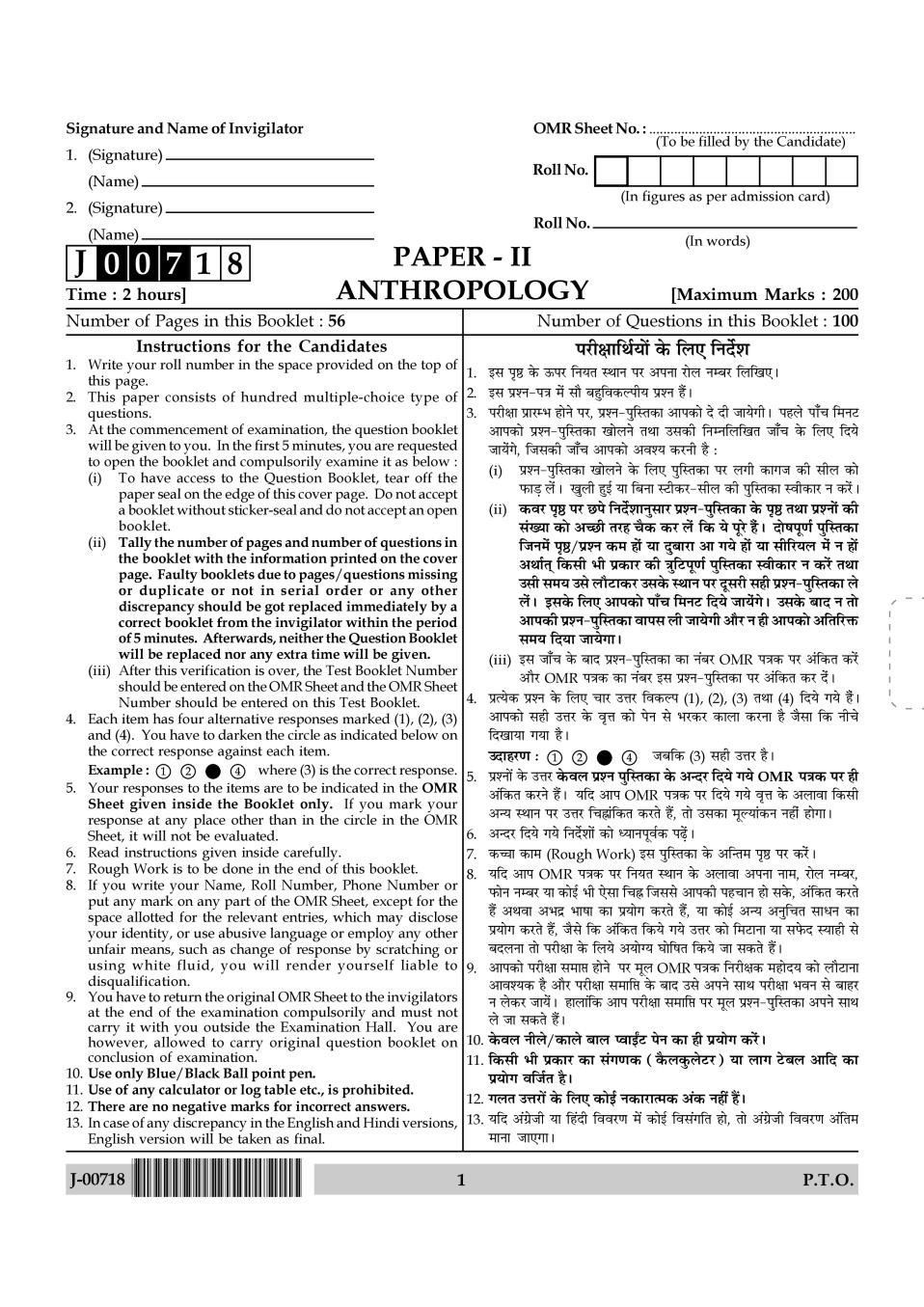
Page 1
(To be filled by the Candidate)
1. (Signature)
Roll No.
(Name)
(In figures as per admission card)
2. (Signature)
Roll No.
(Name) (In words)
J 0 0 7 1 8 PAPER - II
Time : 2 hours] ANTHROPOLOGY [Maximum Marks : 200
Number of Pages in this Booklet : 56 Number of Questions in this Booklet : 100
Instructions for the Candidates ¬⁄UˡÊÊÁÕ¸ÿÙ¢ ∑§ Á‹∞ ÁŸŒ¸‡Ê
1. Write your roll number in the space provided on the top of
1. ß‚ ¬ÎDU ∑§ ™§¬⁄U ÁŸÿà SÕÊŸ ¬⁄U •¬ŸÊ ⁄UÙ‹U Ÿê’⁄U Á‹Áπ∞–
this page.
2. This paper consists of hundred multiple-choice type of 2. ß‚ ¬˝‡Ÿ-¬òÊ ◊¢ ‚ÊÒ ’„ÈÁfl∑§À¬Ëÿ ¬˝‡Ÿ „Ò¥–
questions. 3. ¬⁄UˡÊÊ ¬˝Ê⁄êU÷ „ÙŸ ¬⁄U, ¬˝‡Ÿ-¬ÈÁSÃ∑§Ê •Ê¬∑§Ù Œ ŒË ¡ÊÿªË– ¬„‹U ¬UÊ°ø Á◊Ÿ≈U
3. At the commencement of examination, the question booklet •Ê¬∑§Ù ¬˝‡Ÿ-¬ÈÁSÃ∑§Ê πÙ‹Ÿ ÃÕÊ ©‚∑§Ë ÁŸêŸÁ‹Áπà ¡Ê°ø ∑§ Á‹∞ ÁŒÿ
will be given to you. In the first 5 minutes, you are requested ¡Êÿ¢ª, Á¡‚∑§Ë ¡Ê°ø •Ê¬∑§Ù •fl‡ÿ ∑§⁄UŸË „Ò —
to open the booklet and compulsorily examine it as below :
(i) ¬˝‡Ÿ-¬ÈÁSÃ∑§Ê πÙ‹Ÿ ∑§ Á‹∞ ¬ÈÁSÃ∑§Ê ¬⁄U ‹ªË ∑§Êª¡ ∑§Ë ‚Ë‹ ∑§Ê
(i) To have access to the Question Booklet, tear off the
paper seal on the edge of this cover page. Do not accept »§Ê«∏ ‹¢U– πÈ‹Ë „È߸ ÿÊ Á’ŸÊ S≈UË∑§⁄U-‚Ë‹U ∑§Ë ¬ÈÁSÃ∑§Ê SflË∑§Ê⁄U Ÿ ∑§⁄¢U–
a booklet without sticker-seal and do not accept an open (ii) ∑§fl⁄U ¬ÎDU ¬⁄U ¿U¬ ÁŸŒ¸‡ÊÊŸÈ‚Ê⁄U ¬˝‡Ÿ-¬ÈÁSÃ∑§Ê ∑§ ¬ÎDU ÃÕÊ ¬˝‡ŸÙ¢ ∑§Ë
booklet. ‚¢ÅÿÊ ∑§Ù •ë¿UË Ã⁄U„ øÒ∑§ ∑§⁄U ‹¢U Á∑§ ÿ ¬Í⁄U „Ò¢U– ŒÙ·¬Íáʸ ¬ÈÁSÃ∑§Ê
(ii) Tally the number of pages and number of questions in Á¡Ÿ◊¢ ¬ÎDU/¬˝‡Ÿ ∑§◊ „Ù¢ ÿÊ ŒÈ’Ê⁄UÊ •Ê ªÿ „Ù¢ ÿÊ ‚ËÁ⁄Uÿ‹U ◊¢ Ÿ „Ù¢
the booklet with the information printed on the cover •ÕʸØ Á∑§‚Ë ÷Ë ¬˝∑§Ê⁄U ∑§Ë òÊÈÁ≈U¬Íáʸ ¬ÈÁSÃ∑§Ê SflË∑§Ê⁄U Ÿ ∑§⁄¢U ÃÕÊ
page. Faulty booklets due to pages/questions missing
or duplicate or not in serial order or any other ©‚Ë ‚◊ÿ ©‚ ‹Uı≈UÊ∑§⁄U ©‚∑§ SÕÊŸ ¬⁄U ŒÍ‚⁄UË ‚„Ë ¬˝‡Ÿ-¬ÈÁSÃ∑§Ê ‹
discrepancy should be got replaced immediately by a ‹¢– U ß‚∑§ Á‹∞ •Ê¬∑§Ù ¬Ê°ø Á◊Ÿ≈U ÁŒÿ ¡Êÿ¢ª– ©‚∑§ ’ÊŒ Ÿ ÃÙ
correct booklet from the invigilator within the period •Ê¬∑§Ë ¬˝‡Ÿ-¬ÈÁSÃ∑§Ê flʬ‚ ‹Ë ¡ÊÿªË •ı⁄U Ÿ „Ë •Ê¬∑§Ù •ÁÃÁ⁄UQ§
of 5 minutes. Afterwards, neither the Question Booklet ‚◊ÿ ÁŒÿÊ ¡ÊÿªÊ–
will be replaced nor any extra time will be given. (iii) ß‚ ¡Ê°ø ∑§ ’ÊŒ ¬˝‡Ÿ-¬ÈÁSÃ∑§Ê ∑§Ê Ÿ¥’⁄U OMR ¬òÊ∑§ ¬⁄U •¢Á∑§Ã ∑§⁄¢U
(iii) After this verification is over, the Test Booklet Number
should be entered on the OMR Sheet and the OMR Sheet
•Uı⁄U OMR ¬òÊ∑§ ∑§Ê Ÿ¥’⁄U ß‚ ¬˝‡Ÿ-¬ÈÁSÃ∑§Ê ¬⁄U •¢Á∑§Ã ∑§⁄U Œ¢–
Number should be entered on this Test Booklet. 4. ¬˝àÿ∑§ ¬˝‡Ÿ ∑§ Á‹∞ øÊ⁄U ©ûÊ⁄U Áfl∑§À¬ (1), (2), (3) ÃÕÊ (4) ÁŒÿ ªÿ „Ò¢–
4. Each item has four alternative responses marked (1), (2), (3) •Ê¬∑§Ù ‚„Ë ©ûÊ⁄U ∑§ flÎûÊ ∑§Ù ¬Ÿ ‚ ÷⁄U∑§⁄U ∑§Ê‹Ê ∑§⁄UŸÊ „Ò ¡Ò‚Ê Á∑§ ŸËø
and (4). You have to darken the circle as indicated below on ÁŒπÊÿÊ ªÿÊ „Ò–
the correct response against each item. ©ŒÊ„⁄UáÊ — ¡’Á∑§ (3) ‚„Ë ©ûÊ⁄U „Ò–
Example : where (3) is the correct response. 5. ¬˝‡ŸÊ¥ ∑§ ©ûÊ⁄U ∑§fl‹ ¬˝‡Ÿ ¬ÈÁSÃ∑§Ê ∑§ •ãŒ⁄U ÁŒÿ ªÿ OMRU ¬òÊ∑§ ¬⁄U „Ë
5. Your responses to the items are to be indicated in the OMR
•¥Á∑§Ã ∑§⁄UŸ „Ò¥– ÿÁŒ •Ê¬ OMRU ¬òÊ∑§ ¬⁄U ÁŒÿ ªÿ flÎûÊ ∑§ •‹ÊflÊ Á∑§‚Ë
Sheet given inside the Booklet only. If you mark your
response at any place other than in the circle in the OMR •ãÿ SÕÊŸ ¬⁄U ©ûÊ⁄U ÁøqÊ¢Á∑§Ã ∑§⁄Uà „Ò¥, ÃÙ ©‚∑§Ê ◊ÍÀUÿÊ¢∑§Ÿ Ÿ„Ë¢ „٪ʖ
Sheet, it will not be evaluated. 6. •ãŒ⁄U ÁŒÿ ªÿ ÁŸŒ¸‡ÊÙ¢ ∑§Ù äÿÊŸ¬Ífl¸∑§ ¬…∏¢U–
6. Read instructions given inside carefully. 7. ∑§ìÊÊ ∑§Ê◊ (Rough Work) ß‚ ¬ÈÁSÃ∑§Ê ∑§ •ÁãÃ◊ ¬ÎDU ¬⁄U ∑§⁄¢U–
7. Rough Work is to be done in the end of this booklet. 8. ÿÁŒ •Ê¬ OMR ¬òÊ∑§ ¬⁄U ÁŸÿà SÕÊŸ ∑§ •‹ÊflÊ •¬ŸÊ ŸÊ◊, ⁄UÊ‹ Ÿê’⁄U,
8. If you write your Name, Roll Number, Phone Number or
put any mark on any part of the OMR Sheet, except for the
»§ÊŸ Ÿê’⁄U ÿÊ ∑§Ê߸ ÷Ë ∞‚Ê Áøq Á¡‚‚ •Ê¬∑§Ë ¬„øÊŸ „Ê ‚∑§, •¥Á∑§Ã ∑§⁄UÃ
space allotted for the relevant entries, which may disclose „Ò¥ •ÕflÊ •÷Œ˝ ÷Ê·Ê ∑§Ê ¬˝ÿʪ ∑§⁄Uà „Ò¥, ÿÊ ∑§Ê߸ •ãÿ •ŸÈÁøà ‚ÊœŸ ∑§Ê
your identity, or use abusive language or employ any other ¬˝ÿʪ ∑§⁄Uà „Ò¥, ¡Ò‚ Á∑§ •¥Á∑§Ã Á∑§ÿ ªÿ ©ûÊ⁄U ∑§Ê Á◊≈UÊŸÊ ÿÊ ‚»§Œ SÿÊ„Ë ‚
unfair means, such as change of response by scratching or ’Œ‹ŸÊ ÃÊ ¬⁄UˡÊÊ ∑§ Á‹ÿ •ÿÊÇÿ ÉÊÊÁ·Ã Á∑§ÿ ¡Ê ‚∑§Ã „Ò¥–
using white fluid, you will render yourself liable to 9. •Ê¬∑§Ù ¬⁄UˡÊÊ ‚◊Ê# „ÙŸ §¬⁄U ◊Í‹ OMR ¬òÊ∑§ ÁŸ⁄UˡÊ∑§ ◊„ÙŒÿ ∑§Ù ‹Uı≈UÊŸÊ
disqualification. •Êfl‡ÿ∑§ „Ò •ı⁄U ¬⁄UˡÊÊ ‚◊ÊÁ# ∑§ ’ÊŒ ©‚ •¬Ÿ ‚ÊÕ ¬⁄UˡÊÊ ÷flŸ ‚ ’Ê„⁄U
9. You have to return the original OMR Sheet to the invigilators Ÿ ‹∑§⁄U ¡Êÿ¢– „Ê‹Ê¥Á∑§ •Ê¬ ¬⁄UˡÊÊ ‚◊ÊÁ# ¬⁄U ◊Í‹ ¬˝‡Ÿ-¬ÈÁSÃ∑§Ê •¬Ÿ ‚ÊÕ
at the end of the examination compulsorily and must not
carry it with you outside the Examination Hall. You are ‹ ¡Ê ‚∑§Ã „Ò¥–
however, allowed to carry original question booklet on 10. ∑§fl‹ ŸË‹/∑§Ê‹ ’Ê‹U åflÊßZ≈U ¬Ÿ ∑§Ê „Ë ¬˝ÿʪ ∑§⁄¢U–
conclusion of examination. 11. Á∑§‚Ë ÷Ë ¬˝∑§Ê⁄U ∑§Ê ‚¢ªáÊ∑§ (∑Ò§‹∑ȧ‹≈U⁄U) UÿÊ ‹Êª ≈U’‹ •ÊÁŒ ∑§Ê
10. Use only Blue/Black Ball point pen. ¬˝ÿÙª flÁ¡¸Ã „Ò–
11. Use of any calculator or log table etc., is prohibited.
12. ª‹Ã ©ûÊ⁄UÊ¥ ∑§ Á‹∞ ∑§Ê߸ Ÿ∑§Ê⁄UÊà◊∑§ •¥∑§ Ÿ„Ë¥ „Ò¥–
12. There are no negative marks for incorrect answers.
13. In case of any discrepancy in the English and Hindi versions, 13. ÿÁŒ •¥ª˝¡Ë ÿÊ Á„¥ŒË Áflfl⁄UáÊ ◊¥ ∑§Ê߸ Áfl‚¥ªÁà „Ê, ÃÊ •¥ª˝¡Ë Áflfl⁄UáÊ •¥ÁÃ◊
English version will be taken as final. ◊ÊŸÊ ¡Ê∞ªÊ–
J-00718 !J-00718-PAPER-II! 1 P.T.O.
Page 2
PAPER - II
Note : This paper contains hundred (100) objective type questions of two (2) marks each. All
questions are compulsory.
1. Who among the following gave the concept of geographical, local and micro-races ?
(1) R.D. Lewontin (2) S.M. Garn (3) E.A. Hooton (4) W.C. Boyd
2. Which one of the following Epochs is called the “Age of Apes” ?
(1) Oligocene (2) Eocene (3) Pleistocene (4) Miocene
3. Which bone is known as ‘shin bone’ ?
(1) Femur (2) Tibia (3) Humerus (4) Ulna
4. One of the first to study brachydactyly was :
(1) Francis Galton (2) William Bateson (3) W.C. Farabee (4) A.E. Garrod
5. “Goodness of fit” test is also known as :
(1) t - test (2) ANOVA (3) Chi square test (4) Regression
6. The maintenance of two or more alleles in a gene pool as a result of heterozygote advantage
is :
(1) Transient polymorphism (2) Genetic Equilibrium
(3) Multiple allelism (4) Balanced polymorphism
7. A deficiency disease relating to protein energy malnutrition characterized by growth failure,
edema, irritability and pigment changes in the skin is known as :
(1) Marasmus (2) Kwashiorkor (3) Rickets (4) Dermatitis
8. The totality of deleterious alleles in a population is known as :
(1) Genetic load (2) Genetic loss
(3) Genetic equilibrium (4) Genetic mortality
J-00718 !J-00718-PAPER-II! 2 Paper-II
Page 3
¬˝‡Ÿ-¬òÊ - II
ÁŸŒ¸‡Ê — ß‚ ¬˝‡Ÿ-¬òÊ ◊¥ ‚ÊÒ (100) ’„È - Áfl∑§À¬UËÿ ¬˝‡Ÿ „Ò¥– ¬˝àÿ∑§ ¬˝‡Ÿ ∑§ ŒÙ (2) •¢∑§ „Ò¥– ‚÷Ë ¬˝‡Ÿ •ÁŸflÊÿ¸ „Ò¥–
1. ÷ÊÒªÊÁ‹∑§, SÕÊŸËÿ ÃÕÊ ‚͡◊-ŸÎ¡ÊÁÃÿÊ¥ ∑§Ë •flœÊ⁄UáÊÊ ÁŸêŸÁ‹Áπà ◊¥ ‚ Á∑§‚Ÿ ŒË „Ò?
(1) •Ê⁄U.«UË. ‹flÊ¥Á≈UŸ (2) ∞‚.∞◊. ªÊŸ¸ (3) ß.∞. „Í≈UÊŸ (4) «UéÀÿÍ.‚Ë. ’ÊÚÿ«U
2. ÁŸêŸÁ‹Áπà ◊¥ ‚ ∑§ÊÒŸ-‚Ê ∞∑§ ÿȪ ““flÊŸ⁄U ÿȪ”” ∑§„‹ÊÃÊ „Ò?
(1) •À¬ŸÍß (2) •ÊÁŒ ŸÍß (3) •àÿ¥Ã ŸÍß (4) ◊äÿ ŸÍß
3. ∑§ÊÒŸ-‚Ë •ÁSÕ “Á‡ÊŸ ’ÊŸ” „Ò?
(1) »§Ë◊⁄U (©Áfl¸∑§Ê) (2) Á≈UÁ’ÿÊ (•¥Ã¡ZÁÉÊ∑§Ê)
(3) „˜ÿÍ◊⁄U‚ (¬˝ª¥Á«U∑§Ê) (4) •‹ŸÊ (•¥Ã—¬˝∑§ÊÁc∆U∑§Ê)
4. ‹ÉÊÈ•¥ªÈÁ‹ÃÊ ∑§Ê •äÿÿŸ ‚fl¸¬˝Õ◊ Á∑§‚Ÿ Á∑§ÿÊ ÕÊ?
(1) »˝§Ê¥Á‚‚ ªÊÀ≈UŸU (2) ÁflÁ‹ÿ◊ ’≈U‚Ÿ (3) «UéÀÿÍ.‚Ë. »§Ê⁄UÊ’Ë (4) ∞.ß. ªÒ⁄UÊ«U
5. ““ªÈ«UŸÒ‚ •ÊÚ»§ Á»§≈U”” ¬⁄UˡÊáÊ ∑§Ê •ãÿ Á∑§‚ ŸÊ◊ ‚ ¡ÊŸÃ „Ò¥?
(1) ≈UË-¬⁄UˡÊáÊ (2) ∞ŸÊflÊ (3) ∑§Ê߸-SÄflÒÿ⁄U ¬⁄UˡÊáÊ (4) ‚◊ÊüÊÿáÊ
6. Áfl·◊ÿÈÇ◊¡ ‹Ê÷ ∑§ »§‹SflM§¬ ¡ËŸ ∑§Ê· ◊¥ ŒÊ ÿÊ íÿÊŒÊ ∞‹Ë‹Ê¥ ∑§Ê ⁄Uπ⁄UπÊfl ÄÿÊ „ÊÃÊ „Ò?
(1) ˇÊáÊ÷¥ªÈ⁄U ’„È‹∑§ÃÊ (2) •ÊŸÈfl¥Á‡Ê∑§ ‚¥ÃÈ‹Ÿ
(3) ’„È ∞‹Ë‹ÃÊ (4) ‚¥ÃÈÁ‹Ã ’„È‹∑§ÃÊ
7. ¬˝Ê≈UËŸ-™§¡Ê¸ ∑ȧ¬Ê·áÊ ‚ ‚ê’ÁãœÃ •À¬ÃÊ ∑§Ê ⁄Uʪ, Á¡‚◊¥ Áfl∑§Ê‚ ⁄UÊœ, ∞«UË◊Ê, Áø«∏Áø«∏ʬŸ •ÊÒ⁄U àfløÊ ◊¥ fláʸ∑§
’Œ‹Êfl „Êà „Ò¥ ÄÿÊ ∑§„‹ÊÃÊ „Ò?
(1) ◊⁄UÊS◊‚ (2) ÄflÊÁ‡Ê•Ê⁄U∑§⁄U (3) Á⁄U∑§≈˜‚ (4) «U◊ʸ≈UÊßÁ≈U‚
8. ¡Ÿ‚¥ÅÿÊ ◊¥ ©ã◊ûÊ ∞‹Ë‹Ê¥ ∑§Ë ‚◊ª˝ÃÊ ∑§Ê ÄÿÊ ∑§„à „Ò¥?
(1) •ÊŸÈfl¥Á‡Ê∑§ ÷Ê⁄U (2) •ÊŸÈfl¥Á‡Ê∑§ „ÊÁŸ
(3) •ÊŸÈfl¥Á‡Ê∑§ ‚¥ÃÈ‹Ÿ (4) •ÊŸÈfl¥Á‡Ê∑§ ◊ÎàÿÈ
J-00718 !J-00718-PAPER-II! 3 Paper-II
Page 4
(1) Your mother’s cousin’s children
(2) The children of your mother’s sister or / and your father’s brother
(3) Your father’s cousin’s children
(4) The children of your father’s sister or / and mother’s brother
10. Who among the following is regarded as an ‘armchair anthropologist’ ?
(1) Edmund Leach (2) James Frazer
(3) Evans - Pritchard (4) B. Malinowski
11. Which of the following Constitutional Safeguard (Article) is related with the economic
development of the Scheduled Tribes ?
(1) Article 339(1) (2) Article 275(1) (3) Article 29 (4) Article 338
12. Who has edited the book ‘Anthropology Today An Encyclopedic Inventory’ ?
(1) Franz Boas (2) A.L. Kroeber (3) Edmund Leach (4) B. Malinowski
13. Who first formulated the doctrine of ‘the psychic unity of mankind’ ?
(1) L.H. Morgan (2) E.B. Tylor (3) Kenneth Pike (4) Adolf Bastian
14. Who proposed the evolutionary scheme of religion as follows ?
Animism → Ancestor worship → Polytheism → Monotheism
(1) Franz Boas (2) E.B. Tylor (3) L.H. Morgan (4) R.R. Marrett
15. The concept that behaviour in a society should be evaluated in terms of the society’s own
cultural values is known as :
(1) Revivalism (2) Configurationism
(3) Cultural relativism (4) Ethnocentrism
16. In a society divided into several clans, if clan ‘A’ gives women in marriage to clan ‘B’, and
clan ‘A’ does not take women from clan ‘B’ is known as :
(1) Bilateral descent (2) Ambilineal descent
(3) Symmetrical alliance (4) Asymmetrical alliance
J-00718 !J-00718-PAPER-II! 4 Paper-II
Page 5
(1) •Ê¬∑§Ë ◊ÊÃÊ ∑§ øø⁄U, ◊◊⁄U, ◊ÊÒ‚⁄U, »È§»§⁄U ÷Ê߸-’„Ÿ ∑§ ’ëø
(2) •Ê¬∑§Ë ◊ÊÃÊ ∑§Ë ’„Ÿ ÿÊ / •ÊÒ⁄U •Ê¬∑§ Á¬ÃÊ ∑§ ÷Ê߸ ∑§ ’ëø
(3) •Ê¬∑§ Á¬ÃÊ ∑§ øø⁄U, ◊◊⁄U, ◊ÊÒ‚⁄U, »È§»§⁄U ÷Ê߸-’„Ÿ ∑§ ’ëø
(4) •Ê¬∑§ Á¬ÃÊ ∑§Ë ’„Ÿ ÿÊ / •ÊÒ⁄U ◊ÊÃÊ ∑§ ÷Ê߸ ∑§ ’ëø
10. ÁŸêŸÁ‹Áπà ◊¥ ‚ Á∑§‚∑§Ê “•Ê◊¸øÿ⁄U ∞ãÕ˝Ê¬Ê‹ÊÚÁ¡S≈U” (•Ê⁄UÊ◊Ë’ ŸÎÁflôÊÊŸË) ◊ÊŸÊ ¡ÊÃÊ „Ò?
(1) ∞«U◊¥«U ‹Ëø (2) ¡ê‚ »˝§$¡⁄U
(3) ßflÊã‚-Á¬˝øÊ«¸U (4) ’Ë. ◊ÒÁ‹ŸÊflS∑§Ë
11. ÁŸêŸÁ‹Áπà ◊¥ ‚ ∑§ÊÒŸ-‚Ê ‚¥flÒœÊÁŸ∑§ ‚È⁄UˇÊÊ ©¬Êÿ (•ŸÈë¿UŒ) •ŸÈ‚ÍÁøà ¡Ÿ¡ÊÁà ∑§ •ÊÁÕ¸∑§ Áfl∑§Ê‚ ‚ ‚¥’¥ÁœÃ
„Ò?
(1) •ŸÈë¿UŒ 339(1) (2) •ŸÈë¿UŒ 275(1) (3) •ŸÈë¿UŒ 29 (4) •ŸÈë¿UŒ 338
12. ÁŸêŸÁ‹Áπà ◊¥ ‚ Á∑§‚Ÿ “∞ãÕ˝Ê¬Ê‹ÊÚ¡Ë ≈ÈU«U ∞Ÿ ߟ‚ÊßċʬÁ«U∑§ ߟflã≈U⁄UË” ¬ÈSÃ∑§ ∑§Ê ‚¥¬ÊŒŸ Á∑§ÿÊ „Ò?
(1) »˝Ò§ã¡ ’Ê•Ê‚ (2) ∞.∞‹. ∑˝§Ê’⁄U (3) ∞«U◊¥«U ‹Ëø (4) ’Ë. ◊ÒÁ‹ŸÊflS∑§Ë
13. ÁŸêŸÁ‹Áπà ◊¥ ‚ Á∑§‚Ÿ “◊ÊŸfl ◊ÁSÃc∑§ ∑§Ë ‚◊M§¬ÃÊ” ∑§Ê Á‚hʥà ‚ÍÁòÊà Á∑§ÿÊ ÕÊ?
(1) ∞‹.∞ø. ◊ʪ¸Ÿ (2) ߸.’Ë. ≈UÊÿ‹⁄U (3) ∑Ò§ŸÕ ¬Êß∑§ (4) ∞«UÊÀ»§ ’ÊS≈UËÿŸ
14. ÁŸêŸÁ‹Áπà ◊¥ ‚ Á∑§‚Ÿ œ◊¸ ∑§Ë Áfl∑§Ê‚flÊŒË ÿÊ¡ŸÊ ∑§Ê ß‚ ¬˝∑§Ê⁄U ¬˝SÃÈà Á∑§ÿÊ ÕÊ?
•Êà◊ÊflÊŒ → ¬Ífl¸$¡ ¬Í¡Ê → ’„ÈŒflÃÊflÊŒ → ∞∑§‡fl⁄UflÊŒ
(1) »˝Ò§ã¡ ’Ê•Ê‚ (2) ߸.’Ë. ≈UÊÿ‹⁄U (3) ∞‹.∞ø. ◊ʪ¸Ÿ (4) •Ê⁄U.•Ê⁄U. ◊Ò⁄U≈U
15. fl„ •flœÊ⁄UáÊÊ, Á¡‚◊¥ Á∑§‚Ë ‚◊Ê¡ ◊¥ √ÿfl„Ê⁄U ∑§Ê •Ê∑§‹Ÿ ©Äà ‚◊Ê¡ ∑§ ‚Ê¥S∑ΧÁÃ∑§ ◊ÍÀÿÊ¥ ∑§ ‚¥Œ÷¸ ◊¥ Á∑§ÿÊ ¡ÊÃÊ
„Ò, ©‚ Á∑§‚ M§¬ ◊¥ ¡ÊŸÊ ¡ÊÃÊ „Ò?
(1) ¬ÈŸ— ¬˝fløŸflÊŒ (2) ‚¥ÁflãÿÊ‚flÊŒ
(3) ‚Ê¥S∑ΧÁÃ∑§ ‚ʬˇÊflÊŒ (4) ‚¡ÊÃËÿ ∑§ãŒ˝flÊŒ
16. •Ÿ∑§ ªÊòÊ ◊¥ Áfl÷ÊÁ¡Ã Á∑§‚Ë ‚◊Ê¡ ◊¥ ÿÁŒ ªÊòÊ “∞” ∑§ ‹Êª ◊Á„‹Ê•Ê¥ ∑§Ê ÁflflÊ„ ªÊòÊ “’Ë” ◊¥ ∑§⁄Uà „Ò¥ •ÊÒ⁄U ªÊòÊ
“∞” ∑§ ‹Êª ªÊòÊ “’Ë” ∑§Ë ◊Á„‹Ê•Ê¥ ∑§Ê ÁflflÊ„ ∑§ Á‹∞ SflË∑§Ê⁄U Ÿ„Ë¥ ∑§⁄Uà „Ò¥ ÃÊ ß‚∑§Ê Á∑§‚ M§¬ ◊¥ ¡ÊŸÊ ¡ÊÃÊ „Ò?
(1) Ám¬ˇÊËÿ fl¥‡Ê ÁŸÿ◊ (2) ©÷ÿ¬ˇÊËÿ fl¥‡Ê ÁŸÿ◊
(3) ‚◊Á◊à ª∆U’¥œŸ (4) •‚◊Á◊à ª∆U’¥œŸ
J-00718 !J-00718-PAPER-II! 5 Paper-II
Page 6
(1) Ropar (2) Kalibangan (3) Dholavira (4) Lothal
18. Which of the following is characteristic feature of domesticated cereals ?
(1) Shattering grain (2) Non-shattering grain
(3) Split grain (4) Wind blown grain
19. Which of the following is not an iron age site ?
(1) Noh (2) Attranjikhera
(3) Ahichchatra (4) Utnur
20. Which of the following is not an attribute of Neolithic culture ?
(1) Grinding-polishing technique (2) Pottery
(3) Food production (4) Smelting
21. Which of the following features best describe the Homo habilis fossil ? Use the given code.
(a) It was discovered by Louis and Mary Leakey
(b) The first fossil of this type came from South Africa
(c) The fossil was also called as ‘Handy Man’
(d) The rock deposits bearing the fossil belong to Late Miocence Epoch.
Code :
(1) (a) and (d) are correct (2) (b), (c) and (d) are correct
(3) (a) and (c) are correct (4) (a), (b) and (c) are correct
22. Which of the following features correctly describe the Down Syndrome ? Use the given
code.
(a) It is also known as 21 - Trisomy
(b) Curt Stern was the first one describe it
(c) It is accompanied by mental retardation, dermatoglyphic changes and congenital heart
disease.
(d) Only males are affected; females die even before birth.
Code :
(1) (a), (c) and (d) are correct (2) (b), (c) and (d) are correct
(3) (a) and (c) are correct (4) (a) and (b) are correct
J-00718 !J-00718-PAPER-II! 6 Paper-II
Page 7
(1) ⁄Uʬ«∏ (2) ∑§Ê‹Ë’¥ªŸ (3) œÊ‹ÊflË⁄UÊ (4) ‹ÊÕ‹
18. ÉÊ⁄U‹Í œÊãÿ ∑§Ë ÁŸêŸÁ‹Áπà ◊¥ ‚ ∑§ÊÒŸ-‚Ë Áfl‡Ê·ÃÊ „Ò?
(1) ≈UÍ≈U œÊãÿ (2) ªÒ⁄U-≈ÍU≈U œÊãÿ
(3) Áfl÷ÊÁ¡Ã œÊãÿ (4) „flÊ ‚ Á’π⁄UÊ „È•Ê œÊãÿ
19. ÁŸêŸÁ‹Áπà ◊¥ ‚ ∑§ÊÒŸ-‚Ê ‹ÊÒ„ ÿȪ˟ SÕ‹ Ÿ„Ë¥ „Ò?
(1) ŸÊ„ (2) •Ã⁄¥U¡Ëπ«∏Ê
(3) •Á„¿UòÊ (4) ©≈UŸÍ⁄U
20. Ÿfl-¬Ê·ÊáÊ ‚¥S∑ΧÁà ∑§Ê ÁŸêŸÁ‹Áπà ◊¥ ‚ ∑§ÊÒŸ-‚Ê ∞∑§ ªÈáÊ Ÿ„Ë¥ „Ò?
(1) Á¬‚Ê߸ (Áª˝Áã«¥Uª) - ¬ÊÚÁ‹Á‡Ê¥ª Ã∑§ŸË∑§ (2) Á◊^Ë ∑§ ’øŸ
(3) πÊlÊ㟠©à¬ÊŒŸ (4) ª‹ÊŸÊ
21. ÁŸêŸÁ‹Áπà ◊¥ ‚ ∑§ÊÒŸ-‚Ë Áfl‡Ê·ÃÊ „Ê◊Ê „ÒÁ’Á‹‚ ¡Ëflʇ◊ ∑§Ë üÊc∆U √ÿÊÅÿÊ ∑§⁄UÃË „Ò? ŸËø ÁŒ∞ ∑ͧ≈U ∑§Ê ©¬ÿʪ
∑§ËÁ¡∞ —
(a) ß‚ ‹È߸‚ ∞fl¥ ◊⁄UË ‹Ë∑§ Ÿ πÊ¡Ê ÕÊ–
(b) ß‚ ¬˝∑§Ê⁄U ∑§Ê ¬˝Õ◊ ¡Ëflʇ◊ ŒÁˇÊáÊ •»˝§Ë∑§Ê ‚ •ÊÿÊ ÕÊ–
(c) ¡Ëflʇ◊ ∑§Ê “„Ò¥«UË ◊ÒŸ” ÷Ë ∑§„Ê ¡ÊÃÊ „Ò–
(d) ¡Ëflʇ◊ ¬Ê∞ ¡ÊŸ flÊ‹ ø^ÊŸ ÁŸˇÊ¬ ©ûÊ⁄U •À¬ŸÍß (◊ÊÿÊ‚ËŸ) ∑§Ê‹ ∑§ „Ò¥–
∑ͧ≈U —
(1) (a) •ÊÒ⁄U (d) ‚„Ë „Ò¥ (2) (b), (c) •ÊÒ⁄U (d) ‚„Ë „Ò¥
(3) (a) •ÊÒ⁄U (c) ‚„Ë „Ò¥ (4) (a), (b) •ÊÒ⁄U (c) ‚„Ë „Ò¥
22. «UÊ™§Ÿ Á‚Ÿ«˛UÊ◊ ∑§Ê ÁŸêŸÁ‹Áπà ◊¥ ‚ ∑§ÊÒŸ-‚Ë Áfl‡Ê·ÃÊ ‚„Ë ¬Á⁄U÷ÊÁ·Ã ∑§⁄UÃË „Ò? ŸËø ÁŒ∞ ∑ͧ≈U ∑§Ê ©¬ÿʪ
∑§ËÁ¡∞ —
(a) ß‚ 21 - Á≈˛U‚Ê◊Ë ÷Ë ∑§„à „Ò¥–
(b) ∑§≈¸U S≈UŸ¸ Ÿ ‚fl¸¬˝Õ◊ ß‚∑§Ë √ÿÊÅÿÊ ∑§Ë ÕË–
(c) ß‚◊¥ ◊ÊŸÁ‚∑§ ◊¥ŒŸ, «U◊¸≈UÊÇ‹ÊßÁ»§∑§ ’Œ‹Êfl •ÊÒ⁄U ¬ÒŒÊ߇ÊË NŒÿ ⁄Uʪ ÷Ë „Êà „Ò¥–
(d) ∑§fl‹ ¬ÈL§· ¬˝÷ÊÁflà „Êà „Ò¥; ÁSòÊÿÊ¥ ¡ã◊ ‚ ¬„‹ „Ë ◊⁄U ¡ÊÃË „Ò¥–
∑ͧ≈U —
(1) (a), (c) •ÊÒ⁄U (d) ‚„Ë „Ò¥ (2) (b), (c) •ÊÒ⁄U (d) ‚„Ë „Ò¥
(3) (a) •ÊÒ⁄U (c) ‚„Ë „Ò¥ (4) (a) •ÊÒ⁄U (b) ‚„Ë „Ò¥
J-00718 !J-00718-PAPER-II! 7 Paper-II
Page 8
code.
(a) Affected individuals in equal proportions.
(b) Affected individuals in multiple generations.
(c) Unequal transmission by individuals; i.e, male to male transmission is more.
(d) Sometimes there may be a skipping of a generation.
Code :
(1) (a), (b) and (d) are correct (2) (c) and (d) are correct
(3) (a) and (b) are correct (4) (a), (b) and (c) are correct
24. Which of the following features best describe the H.H. Risley’s classification of the people of
India ? Use the given code.
(a) He gave his classification in 1930.
(b) It was on the basis of anthropometric measurements.
(c) He classified the people of Indian-subcontinent into seven major groups.
(d) Identification of the Western Brachycephals in India was one of his classification’s
highlights.
Code :
(1) (a), (b) and (c) are correct (2) (b), (c), and (d) are correct
(3) (a), (c) and (d) are correct (4) (b) and (c) are correct
25. Which of the following best describe the characteristic features of Meiosis ? Use the given
code.
(a) Daughter cells are genetically similar.
(b) Parts of chromosomes are exchanged in crossing over.
(c) Occurs only in ovaries and testes.
(d) Involves two cell divisions.
Code :
(1) (a), (b) and (c) are correct (2) (b), (c) and (d) are correct
(3) (a), (c) and (d) are correct (4) (a), (b) and (d) are correct
J-00718 !J-00718-PAPER-II! 8 Paper-II
Page 9
∑ͧ≈U ∑§Ê ©¬ÿʪ ∑§ËÁ¡∞ —
(a) ‚◊ÊŸ •ŸÈ¬Êà ◊¥ ¬˝÷ÊÁflà √ÿÁÄÖ
(b) ’„È ¬ËÁ…∏ÿÊ¥ ◊¥ ¬˝÷ÊÁflà √ÿÁÄÖ
(c) √ÿÁÄÃÿÊ¥ ∑§Ê •‚◊ÊŸ ‚¥ø⁄UáÊ; ÿÊÁŸ ¬ÈL§· ‚ ¬ÈL§· ‚¥ø⁄UáÊ íÿÊŒÊ „Ò–
(d) ∑§÷Ë-∑§÷Ë ∑§Ê߸ ∞∑§ ¬Ë…∏Ë ¿ÍU≈ ¡ÊÃË „Ò–
∑ͧ≈U —
(1) (a), (b) •ÊÒ⁄U (d) ‚„Ë „Ò¥ (2) (c) •ÊÒ⁄U (d) ‚„Ë „Ò¥
(3) (a) •ÊÒ⁄U (b) ‚„Ë „Ò¥ (4) (a), (b) •ÊÒ⁄U (c) ‚„Ë „Ò¥
24. ÁŸêŸÁ‹Áπà ◊¥ ‚ ∑§ÊÒŸ-‚Ë ∞∑§ Áfl‡Ê·ÃÊ ÷Ê⁄Uà ∑§ ‹ÊªÊ¥ ∑§Ê ∞ø.∞ø. Á⁄U‚‹ mÊ⁄UÊ Á∑§∞ flªË¸∑§⁄UáÊ ∑§Ë üÊc∆U √ÿÊÅÿÊ
∑§⁄UÃË „Ò? ŸËø ÁŒ∞ ∑ͧ≈U ∑§Ê ©¬ÿʪ ∑§ËÁ¡∞ —
(a) ©‚Ÿ •¬ŸÊ flªË¸∑§⁄UáÊ 1930 ◊¥ ¬˝SÃÈà Á∑§ÿÊ–
(b) ÿ„ ◊ÊŸflÁ◊Áà ◊ʬ ∑§ •ÊœÊ⁄U ¬⁄U ÕÊ–
(c) ©‚Ÿ ÷Ê⁄UÃËÿ ©¬-◊„Êmˬ ∑§ ‹ÊªÊ¥ ∑§Ê ‚Êà ◊ÈÅÿ ‚◊Í„Ê¥ ◊¥ flªË¸∑Χà Á∑§ÿÊ–
(d) ÷Ê⁄Uà ◊¥ ¬Á‡ø◊-’Ò∑§Ë‚»§‹˜‚ ∑§Ë ¬„øÊŸ ©‚∑§Ë ∞∑§ Áfl‡Ê·ÃÊ „Ò–
∑ͧ≈U —
(1) (a), (b) •ÊÒ⁄U (c) ‚„Ë „Ò¥ (2) (b), (c) •ÊÒ⁄U (d) ‚„Ë „Ò¥
(3) (a), (c) •ÊÒ⁄U (d) ‚„Ë „Ò¥ (4) (b) •ÊÒ⁄U (c) ‚„Ë „Ò¥
25. •œ¸‚ÍòÊáÊ ∑§Ë ◊ÈÅÿ Áfl‡Ê·ÃÊ ∑§Ê ÁŸêŸÁ‹Áπà ◊¥ ‚ ∑§ÊÒŸ ∞∑§ ‚fl¸üÊc∆U ¬Á⁄U÷ÊÁ·Ã ∑§⁄UÃË „Ò? ŸËø ÁŒ∞ ∑ͧ≈U ∑§Ê ©¬ÿʪ
∑§ËÁ¡∞ —
(a) «UÊÚ≈U⁄U (ÿÊ ©¬) ∑§ÊÁ‡Ê∑§Ê∞¥ ¡ÒÁfl∑§ M§¬ ‚ ‚◊ÊŸ „ÊÃË „Ò¥–
(b) ªÈáÊ‚ÍòÊÊ¥ ∑§ ∑ȧ¿U ÷ʪʥ ∑§Ê ß‚ ¬˝Á∑˝§ÿÊ ∑§ ŒÊÒ⁄UÊŸ ‹Ÿ-ŒŸ „Ê ¡ÊÃÊ „Ò–
(c) ÿ„ ∑§fl‹ Á«Uê’ª˝¥ÁÕ •ÊÒ⁄U •¥«ª˝¥ÁÕ ◊¥ „Ë „ÊÃÊ „Ò–
(d) ß‚∑§ ‚ÊÕ ŒÊ ∑§ÊÁ‡Ê∑§Ê Áfl÷Ê¡Ÿ ¡È«∏ „Ò¥–
∑ͧ≈U —
(1) (a), (b) •ÊÒ⁄U (c) ‚„Ë „Ò¥ (2) (b), (c) •ÊÒ⁄U (d) ‚„Ë „Ò¥
(3) (a), (c) •ÊÒ⁄U (d) ‚„Ë „Ò¥ (4) (a), (b) •ÊÒ⁄U (d) ‚„Ë „Ò¥
J-00718 !J-00718-PAPER-II! 9 Paper-II
Page 10
(a) They are also called lesser ape.
(b) They have prehensile tails.
(c) Locomotion is in the form of brachiation.
(d) They are natives of Asia only.
Code :
(1) (a), (c) and (d) are correct (2) (b), (c) and (d) are correct
(3) (a), (b) and (c) are correct (4) (b) and (d) are correct
27. Which of the following theories are associated with the origin of caste system in India ? Use
code.
(a) Varna theory (b) Occupational theory
(c) Ecological theory (d) Theory of culture and personality
Code :
(1) (a), (b) and (c) are correct (2) (a), (b) and (d) are correct
(3) (b), (c) and (d) are correct (4) (a) and (b) are correct
28. Which of the following anthropologists are considered belonging to New Evolutionary
School ? Use code.
(a) V.G. Childe (b) J.J. Bachofen
(c) Julian H. Steward (d) L.A. White
Code :
(1) (a), (b) and (c) are correct (2) (b), (c) and (d) are correct
(3) (a) and (b) are correct (4) (a), (c) and (d) are correct
29. Which of the following books have been written / edited by Ruth Benedict ? Use code.
(a) Primitive Art
(b) Patterns of culture
(c) The chrysanthemum and the sword
(d) Race, science and politics
Code :
(1) (a), (b) and (c) are correct (2) (b), (c) and (d) are correct
(3) Only (b) and (c) are correct (4) Only (a) and (b) are correct
J-00718 !J-00718-PAPER-II! 10 Paper-II
Page 11
©¬ÿʪ ∑§ËÁ¡∞–
(a) ©ã„¥ ‹ÉÊÈ flÊŸ⁄U ÷Ë ∑§„Ê ¡ÊÃÊ „Ò–
(b) ©Ÿ∑§Ë ¬Á⁄Uª˝Ê„Ë ¬Í¥¿U „ÊÃË „Ò–
(c) ªÁà ’˝∑§Ë∞‡ÊŸ ∑§ M§¬ ◊¥ „ÊÃË „Ò–
(d) fl ∑§fl‹ ∞Á‡ÊÿÊ ∑§ ◊Í‹flÊ‚Ë „Ò–
∑ͧ≈U —
(1) (a), (c) •ÊÒ⁄U (d) ‚„Ë „Ò¥ (2) (b), (c) •ÊÒ⁄U (d) ‚„Ë „Ò¥
(3) (a), (b) •ÊÒ⁄U (c) ‚„Ë „Ò¥ (4) (b) •ÊÒ⁄U (d) ‚„Ë „Ò¥
27. ÁŸêŸÁ‹Áπà ◊¥ ‚ ∑§ÊÒŸ-‚ Á‚hʥà ÷Ê⁄Uà ◊¥ ¡ÊÁà ¬˝áÊÊ‹Ë ∑§ ©Œ˜÷fl ‚ ‚¥’¥ÁœÃ „Ò¥? ∑ͧ≈U ∑§Ê ¬˝ÿʪ ∑§ËÁ¡∞ —
(a) fláʸ Á‚hʥà (b) √ÿÊfl‚ÊÁÿ∑§ Á‚hÊ¥Ã
(c) ¬ÊÁ⁄UÁSÕÁÃ∑§Ë Á‚hʥà (d) ‚¥S∑ΧÁà •ÊÒ⁄U √ÿÁÄÃàfl ∑§Ê Á‚hÊ¥Ã
∑ͧ≈U —
(1) (a), (b) •ÊÒ⁄U (c) ‚„Ë „Ò¥ (2) (a), (b) •ÊÒ⁄U (d) ‚„Ë „Ò¥
(3) (b), (c) •ÊÒ⁄U (d) ‚„Ë „Ò¥ (4) (a) •ÊÒ⁄U (b) ‚„Ë „Ò¥
28. ÁŸêŸÁ‹Áπà ◊¥ ‚ Á∑§Ÿ ŸÎÁflôÊÊÁŸÿÊ¥ ∑§Ê Ÿfl-Áfl∑§Ê‚flÊŒË ÁfløÊ⁄UœÊ⁄UÊ ‚ ‚¥’¥ÁœÃ ◊ÊŸÊ ¡ÊÃÊ „Ò? ∑ͧ≈U ∑§Ê ¬˝ÿʪ
∑§ËÁ¡∞ —
(a) flË.¡Ë. øÊßÀ«U (b) ¡.¡. ’ÒøÊ»§Ÿ
(c) ¡ÈÁ‹ÿŸ ∞ø. S≈UËfl«¸U (d) ∞‹.∞. √„Êß≈U
∑ͧ≈U —
(1) (a), (b) •ÊÒ⁄U (c) ‚„Ë „Ò¥ (2) (b), (c) •ÊÒ⁄U (d) ‚„Ë „Ò¥
(3) (a) •ÊÒ⁄U (b) ‚„Ë „Ò¥ (4) (a), (c) •ÊÒ⁄U (d) ‚„Ë „Ò¥
29. M§Õ ’ŸÁ«UÄ≈U Ÿ ÁŸêŸÁ‹Áπà ◊¥ ‚ Á∑§Ÿ ¬ÈSÃ∑§Ê¥ ∑§Ê Á‹πÊ / ‚¥¬ÊÁŒÃ Á∑§ÿÊ „Ò? ∑ͧ≈U ∑§Ê ¬˝ÿʪ ∑§ËÁ¡∞ —
(a) Á¬˝Á◊≈UËfl •Ê≈¸U
(b) ¬Ò≈Uジ •ÊÚ»§ ∑§Àø⁄U
(c) Œ Á∑˝§‚ãÕ◊◊ ∞¥«U Œ SflÊ«¸U
(d) ⁄U‚, ‚Êߥ‚ ∞¥«U ¬ÊÚ‹ËÁ≈UÄ‚
∑ͧ≈U —
(1) (a), (b) •ÊÒ⁄U (c) ‚„Ë „Ò¥ (2) (b), (c) •ÊÒ⁄U (d) ‚„Ë „Ò¥
(3) ∑§fl‹ (b) •ÊÒ⁄U (c) ‚„Ë „Ò¥ (4) ∑§fl‹ (a) •ÊÒ⁄U (b) ‚„Ë „Ò¥
J-00718 !J-00718-PAPER-II! 11 Paper-II
Page 12
(a) Nature - Man - Spirit complex (b) Sacred complex
(c) Westernization (d) Modernization
Code :
(1) (a), (b) and (c) are correct (2) (a) and (b) are correct
(3) (a) and (c) are correct (4) (c) and (d) are correct
31. Which of the following principles of Rapid Rural Appraisals are agreed upon by its
practitioners ? Use code.
(a) Optimising trade - offs (b) Offsetting baises
(c) Triangulating (d) Formal Questionnaire survey
Code :
(1) (b), (c) and (d) are correct (2) (a), (b) and (c) are correct
(3) (a), (c) and (d) are correct (4) Only (c) and (d) are correct
32. Which of the following authors are related with village studies ? Use code.
(a) Oscar Lewis (b) Mckim Marriott
(c) S.C. Tiwari (d) William Weiser
Code :
(1) (a), (b) and (c) are correct (2) (b), (c) and (d) are correct
(3) (c) and (d) are correct (4) (a), (b) and (d) are correct
33. Find the correct answer for the cause of Ice Age. Use code :
(a) Change in solar radiation
(b) Change in earth’s orbit
(c) Change in magnetic polarity of Earth
(d) Change in sea level
Code :
(1) Only (a) and (d) are correct (2) Only (b) and (c) are correct
(3) Only (a), (c) and (d) are correct (4) Only (a), (b) and (c) are correct
J-00718 !J-00718-PAPER-II! 12 Paper-II
Page 13
(a) ¬˝∑ΧÁÃ-◊ÊŸfl-•Êà◊Ê ‚¥∑ȧ‹ (b) ¬ÁflòÊ ‚¥∑ȧ‹
(c) ¬Á‡ø◊Ë∑§⁄UáÊ (d) •ÊœÈÁŸ∑§Ë∑§⁄UáÊ
∑ͧ≈U —
(1) (a), (b) •ÊÒ⁄U (c) ‚„Ë „Ò¥ (2) (a) •ÊÒ⁄U (b) ‚„Ë „Ò¥
(3) (a) •ÊÒ⁄U (c) ‚„Ë „Ò¥ (4) (c) •ÊÒ⁄U (d) ‚„Ë „Ò¥
31. Œ˝Èà ª˝Ê◊ËáÊ ◊ÍÀÿÊ¥∑§Ÿ ∑§ ÁŸêŸÁ‹Áπà Á‚hÊ¥ÃÊ¥ ◊¥ ‚ Á∑§Ÿ ¬⁄U ©‚∑§ •ŸÈÿÊÿË ‚„◊à „Ò¥? ∑ͧ≈U ∑§Ê ¬˝ÿʪ ∑§ËÁ¡∞–
(a) •ë¿U ‚ •ë¿UÊ ‚◊¥¡Ÿ (b) ¬˝ÁÃ∑§Ê⁄U∑§ •Á÷ŸÁÃ
(c) ÁòÊ÷È¡ŸË∑§⁄UáÊ (d) •ÊÒ¬øÊÁ⁄U∑§ ¬˝‡ŸÊfl‹Ë ‚fl¸ˇÊáÊ
∑ͧ≈U —
(1) (b), (c) •ÊÒ⁄U (d) ‚„Ë „Ò¥ (2) (a), (b) •ÊÒ⁄U (c) ‚„Ë „Ò¥
(3) (a), (c) •ÊÒ⁄U (d) ‚„Ë „Ò¥ (4) ∑§fl‹ (c) •ÊÒ⁄U (d) ‚„Ë „Ò¥
32. ÁŸêŸÁ‹Áπà ◊¥ ‚ ∑§ÊÒŸ-‚ ‹π∑§ ªÊ¥fl ∑§ •äÿÿŸÊ¥ ‚ ‚¥’¥ÁœÃ „Ò– ∑ͧ≈U ∑§Ê ¬˝ÿʪ ∑§ËÁ¡∞–
(a) •ÊÚS∑§⁄U ‹flË‚ (b) ◊Á∑§◊ ◊ÒÁ⁄U•ÊÚ≈U
(c) ∞‚.‚Ë. ÁÃflÊ⁄UË (d) ÁflÁ‹ÿ◊ flÊß¡⁄U
∑ͧ≈U —
(1) (a), (b) •ÊÒ⁄U (c) ‚„Ë „Ò¥ (2) (b), (c) •ÊÒ⁄U (d) ‚„Ë „Ò¥
(3) (c) •ÊÒ⁄U (d) ‚„Ë „Ò¥ (4) (a), (b) •ÊÒ⁄U (d) ‚„Ë „Ò¥
33. Á„◊ ÿȪ ∑§ ∑§Ê⁄UáÊ ∑§Ê ‚„Ë ©ûÊ⁄U ŒËÁ¡∞– ∑ͧ≈U ∑§Ê ¬˝ÿʪ ∑§ËÁ¡∞–
(a) ‚ÊÒ⁄U ÁflÁ∑§⁄UáÊ ◊¥ ¬Á⁄UfløŸ
(b) ¬ÎâflË ∑§Ë ∑§ˇÊÊ ◊¥ ¬Á⁄UfløŸ
(c) ¬ÎâflË ∑§Ë øÈê’∑§Ëÿ œ˝ÈflËÿÃÊ ◊¥ ¬Á⁄UfløŸ
(d) ‚◊ÈŒ˝Ë SÃ⁄U ◊¥ ¬Á⁄UfløŸ
∑ͧ≈U —
(1) ∑§fl‹ (a) •ÊÒ⁄U (d) ‚„Ë „Ò¥ (2) ∑§fl‹ (b) •ÊÒ⁄U (c) ‚„Ë „Ò¥
(3) ∑§fl‹ (a), (c) •ÊÒ⁄U (d) ‚„Ë „Ò¥ (4) ∑§fl‹ (a), (b) •ÊÒ⁄U (c) ‚„Ë „Ò¥
J-00718 !J-00718-PAPER-II! 13 Paper-II
Page 14
(a) Walking (b) Observation (c) Digging (d) Remote sensing
Code :
(1) (a), (b) and (c) are correct (2) (a), (c) and (d) are correct
(3) (b), (c) and (d) are correct (4) (a), (b) and (d) are correct
35. Which of the following traits continued from Indus Valley civilization into later cultures in
India ? Use code :
(a) Weights and measures (b) Religious ideas
(c) Pottery making techniques (d) Iron technology
Code :
(1) (a), (b) and (c) are correct (2) (b), (c) and (d) are correct
(3) (b), (d) and (a) are correct (4) (a), (d) and (c) are correct
36. Given below are two statements, one is labelled as Assertion (A) and the other is labelled as
Reason (R).
Assertion (A) : For fetal development to occur normally, the process of meiosis needs to be
normal. If chromosome strands do not separate during divisions, serious
problems can arise.
Reason (R) : Trisomies are caused due to non-disjunction.
In the context of the above two statements which one of the following is correct ?
(1) (A) is correct, but (R) is wrong (2) Both (A) and (R) are correct
(3) (A) is wrong, but (R) is correct (4) Both (A) and (R) are wrong
37. Given below are two statements, one is labelled as Assertion (A) and the other is labelled as
Reason (R).
Assertion (A) : In general, Homo is characterized by a smaller facial skeleton, including
smaller teeth and jaws.
Reason (R) : The early fossils belonging to the genus Homo were originally placed into a
single species, Homo habilis, discovered by Raymond Dart.
In the context of the above two statements which one of the following is correct ?
(1) (A) is correct, but (R) is wrong (2) Both (A) and (R) are correct
(3) (A) is wrong, but (R) is correct (4) Both (A) and (R) are wrong
J-00718 !J-00718-PAPER-II! 14 Paper-II
Page 15
(a) ø‹ŸÊ (b) •fl‹Ê∑§Ÿ (c) ©àπŸŸ (d) ŒÍ⁄UflÃ˸ ‚¥flŒŸ
∑ͧ≈U —
(1) (a), (b) •ÊÒ⁄U (c) ‚„Ë „Ò¥ (2) (a), (c) •ÊÒ⁄U (d) ‚„Ë „Ò¥
(3) (b), (c) •ÊÒ⁄U (d) ‚„Ë „Ò¥ (4) (a), (b) •ÊÒ⁄U (d) ‚„Ë „Ò¥
35. ÁŸêŸÁ‹Áπà ◊¥ ‚ ∑§ÊÒŸ-‚ ªÈáÊ Á‚¥œÈ ÉÊÊ≈UË ‚èÿÃÊ ‚ ‹∑§⁄U ÷Ê⁄Uà ◊¥ ’ÊŒ ∑§Ë ‚¥S∑ΧÁÃÿÊ¥ ◊¥ ¡Ê⁄UË ⁄U„? ∑ͧ≈U ∑§Ê ¬˝ÿʪ
∑§ËÁ¡∞–
(a) ÃÊÒ‹ •ÊÒ⁄U ◊ʬ (b) œÊÁ◊¸∑§ ÁfløÊ⁄U
(c) Á◊^Ë ∑§Ê ¬ÊòÊ ’ŸÊŸ ∑§Ë Ã∑§ŸË∑¥§ (d) ‹ÊÒ„ ¬˝ÊÒlÊÁª∑§Ë
∑ͧ≈U —
(1) (a), (b) •ÊÒ⁄U (c) ‚„Ë „Ò¥ (2) (b), (c) •ÊÒ⁄U (d) ‚„Ë „Ò¥
(3) (b), (d) •ÊÒ⁄U (a) ‚„Ë „Ò¥ (4) (a), (d) •ÊÒ⁄U (c) ‚„Ë „Ò¥
36. ŸËø ŒÊ ∑§ÕŸ ÁŒ∞ ª∞ „Ò¥, Á¡Ÿ◊¥ ‚ ∞∑§ ∑§Ê •Á÷∑§ÕŸ (A) •ÊÒ⁄U ŒÍ‚⁄U ∑§Ê Ã∑¸§ (R) ∑§„Ê ªÿÊ „Ò–
•Á÷∑§ÕŸ (A) : ÷˝ÍáÊ ∑§Ê ‚Ê◊Êãÿ Áfl∑§Ê‚ „ÊŸ ∑§ Á‹∞ ◊Êß•ÊÁ‚‚ (•œ¸‚ÍòÊáÊ) ∑§Ë ¬˝Á∑˝§ÿÊ ∑§Ê ‚Ê◊Êãÿ „ÊŸÊ
øÊÁ„∞– ÿÁŒ ªÈáÊ‚ÍòÊ ‹«∏Ë, Áfl÷Ê¡Ÿ ∑§ ŒÊÒ⁄UÊŸ ¬ÎÕ∑§ Ÿ„Ë¥ „Êà „Ò¥, ÃÊ ª¥÷Ë⁄U ‚◊SÿÊ ©à¬ãŸ „Ê
‚∑§ÃË „Ò–
Ã∑¸§ (R) : ≈˛UÊ߸‚ÊÚ◊Ë‚ •ÁflÿÊ¡Ÿ ∑§ ∑§Ê⁄UáÊ „ÊÃË „Ò–
©¬⁄UÊÄà ŒÊŸÊ¥ ∑§ÕŸÊ¥ ∑§ ‚¥Œ÷¸ ◊¥ ‚ ∑§ÊÒŸ-‚Ê ‚„Ë „Ò?
(1) (A) ‚„Ë „Ò, ‹Á∑§Ÿ (R) ª‹Ã „Ò (2) (A) •ÊÒ⁄U (R) ŒÊŸÊ¥ ‚„Ë „Ò¥
(3) (A) ª‹Ã „Ò, ‹Á∑§Ÿ (R) ‚„Ë „Ò (4) (A) •ÊÒ⁄U (R) ŒÊŸÊ¥ ª‹Ã „Ò¥
37. ŸËø ŒÊ ∑§ÕŸ ÁŒ∞ ª∞ „Ò¥, Á¡Ÿ◊¥ ‚ ∞∑§ ∑§Ê •Á÷∑§ÕŸ (A) •ÊÒ⁄U ŒÍ‚⁄U ∑§Ê Ã∑¸§ (R) ∑§„Ê ªÿÊ „Ò–
•Á÷∑§ÕŸ (A) : ‚Ê◊ÊãÿÃÿÊ, „Ê◊Ê ∑§Ë Áfl‡Ê·ÃÊ íÿÊŒÊ ¿UÊ≈U ŒÊ¥Ã •ÊÒ⁄U ¡’«∏ ‚◊à íÿÊŒÊ ¿UÊ≈UÊ ◊ÈπËÿ ∑¥§∑§Ê‹ „Ò–
Ã∑¸§ (R) : ¡ËŸ˜‚ „Ê◊Ê ∑§ ¬˝Ê⁄UÁê÷∑§ ¡Ëflʇ◊ ◊Í‹ÃÿÊ ∞∑§‹ Á∑§S◊ ◊¥ ⁄Uπ ª∞ Õ, ÿÊÁŸ „Ê◊Ê „ÒÁ’Á‹‚ ◊¥
Á¡‚∑§Ë ⁄ÒU◊á«U «UÊ≈¸U mÊ⁄UÊ πÊ¡ ∑§Ë ªß¸ ÕË–
©¬⁄UÊÄà ŒÊŸÊ¥ ∑§ÕŸÊ¥ ∑§ ‚¥Œ÷¸ ◊¥ ‚ ∑§ÊÒŸ-‚Ê ‚„Ë „Ò?
(1) (A) ‚„Ë „Ò, ‹Á∑§Ÿ (R) ª‹Ã „Ò (2) (A) •ÊÒ⁄U (R) ŒÊŸÊ¥ ‚„Ë „Ò¥
(3) (A) ª‹Ã „Ò, ‹Á∑§Ÿ (R) ‚„Ë „Ò (4) (A) •ÊÒ⁄U (R) ŒÊŸÊ¥ ª‹Ã „Ò¥
J-00718 !J-00718-PAPER-II! 15 Paper-II
Page 16
Reason (R).
Assertion (A) : Changing - allele frequencies in a population represent evolutionary change.
Reason (R) : Though Hardy - Weinberg Law can be used to estimate the frequency of
autosomal recessive alleles in a population, it can not be used for X - linked
recessive alleles.
In the context of the above two statements which one of the following is correct ?
(1) (A) is correct, but (R) is wrong (2) Both (A) and (R) are correct
(3) (A) is wrong, but (R) is correct (4) Both (A) and (R) are wrong
39. Given below are two statements, one is labelled as Assertion (A) and the other is labelled as
Reason (R).
Assertion (A) : Genomic methods are being used to compare the similarities and differences
in the genomes of Humans, Chimpanzees and Neanderthals.
Reason (R) : There is no need of conducting genomic studies on non-human primates as
the fossil record provides us a complete catalogue of the major phenotypic
changes that have occurred over time.
In the context of the above two statements which one of the following is correct ?
(1) (A) is correct, but (R) is wrong (2) Both (A) and (R) are correct
(3) (A) is wrong, but (R) is correct (4) Both (A) and (R) are wrong
40. Given below are two statements, one is labelled as Assertion (A) and the other is labelled as
Reason (R).
Assertion (A) : Variability is inherent in all populations.
Reason (R) : The human species is polymorphic, and natural selection can be seen.
In the context of the above two statements which one of the following is correct ?
(1) (A) is correct, but (R) is wrong (2) Both (A) and (R) are correct
(3) (A) is wrong, but (R) is correct (4) Both (A) and (R) are wrong
41. Given below are two statements, one is labelled as Assertion (A) and the other is labelled as
Reason (R).
Assertion (A) : Genetic drift, or Founder effect is the random factor in evolution, and it is
not a function of population size.
Reason (R) : If an allele is rare in a small population it may completely disappear because,
just by chance, it is not passed on to the offspring.
In the context of the above two statements which one of the following is correct ?
(1) (A) is correct, but (R) is wrong (2) Both (A) and (R) are correct
(3) (A) is wrong, but (R) is correct (4) Both (A) and (R) are wrong
J-00718 !J-00718-PAPER-II! 16 Paper-II
Page 17
•Á÷∑§ÕŸ (A) : ¡Ÿ‚¥ÅÿÊ ◊¥ ¬Á⁄UflÁøà „Ê ⁄U„Ë ∞‹Ë‹ •ÊflÎÁÃÿÊ¥ ©Ám∑§Ê‚Ëÿ ¬Á⁄UfløŸ ¬˝ŒÁ‡Ê¸Ã ∑§⁄UÃË „Ò–
Ã∑¸§ (R) : ÿlÁ¬ ¡Ÿ‚¥ÅÿÊ ◊¥ •ÊÚ≈UÊ‚Ê◊‹ ¬‡øªÊ◊Ë ∞‹Ë‹Ê¥ ∑§Ë •ÊflÎÁûÊ ∑§ ◊ʬ ∑§ Á‹∞ „Ê«U˸-flËŸ’ª¸
ÁŸÿ◊ ∑§Ê ©¬ÿʪ Á∑§ÿÊ ¡Ê ‚∑§ÃÊ „Ò, ¬⁄UãÃÈ X - ‚ê’ÁãœÃ ¬‡øªÊ◊Ë ∞‹Ë‹Ê¥ ∑§ Á‹∞ Ÿ„Ë¥
©¬ÿʪ Á∑§ÿÊ ¡Ê ‚∑§ÃÊ „Ò–
©¬⁄UÊÄà ŒÊŸÊ¥ ∑§ÕŸÊ¥ ∑§ ‚¥Œ÷¸ ◊¥ ‚ ∑§ÊÒŸ-‚Ê ‚„Ë „Ò?
(1) (A) ‚„Ë „Ò, ‹Á∑§Ÿ (R) ª‹Ã „Ò (2) (A) •ÊÒ⁄U (R) ŒÊŸÊ¥ ‚„Ë „Ò¥
(3) (A) ª‹Ã „Ò, ‹Á∑§Ÿ (R) ‚„Ë „Ò (4) (A) •ÊÒ⁄U (R) ŒÊŸÊ¥ ª‹Ã „Ò¥
39. ŸËø ŒÊ ∑§ÕŸ ÁŒ∞ ª∞ „Ò¥, Á¡Ÿ◊¥ ‚ ∞∑§ ∑§Ê •Á÷∑§ÕŸ (A) •ÊÒ⁄U ŒÍ‚⁄U ∑§Ê Ã∑¸§ (R) ∑§„Ê ªÿÊ „Ò–
•Á÷∑§ÕŸ (A) : ◊ÊŸfl, Áø¥¬Ò¡Ë •ÊÒ⁄U Ÿ•Ê¥«⁄UÕ‹ ◊ÊŸflÊ¥ ∑§ ¡ËŸÊ◊Ê¥ ∑§Ë ‚◊ÊŸÃÊ•Ê¥ •ÊÒ⁄U Á÷ãŸÃÊ•Ê¥ ∑§Ë ÃÈ‹ŸÊ
∑§⁄UŸ ∑§ Á‹∞ ¡ËŸÊÁ◊∑§ Ã⁄UË∑§Ê¥ ∑§Ê ©¬ÿʪ Á∑§ÿÊ ¡Ê ⁄U„Ê „Ò–
Ã∑¸§ (R) : •◊ÊŸfl ¬˝Êß◊≈UÊ¥ ¬⁄U ¡ËŸÊÁ◊∑§ •äÿÿŸ ∑§⁄UŸ ∑§Ë ∑§Ê߸ •Êfl‡ÿ∑§ÃÊ Ÿ„Ë¥ „Ò ÄÿÊ¥Á∑§ ¡Ëflʇ◊
Á⁄U∑§ÊÚ«¸U ◊ÈÅÿ Á»§ŸÊÁ≈UÁ¬∑§ ¬Á⁄UfløŸÊ¥ ∑§Ë ¬Í⁄UË ‚ÍøË ¬˝ŒÊŸ ∑§⁄UÃÊ „Ò ¡Ê Á∑§ Á¬¿U‹ ‚◊ÿ ◊¥ „È∞ „Ò¥–
©¬⁄UÊÄà ŒÊŸÊ¥ ∑§ÕŸÊ¥ ∑§ ‚¥Œ÷¸ ◊¥ ‚ ∑§ÊÒŸ-‚Ê ‚„Ë „Ò?
(1) (A) ‚„Ë „Ò, ‹Á∑§Ÿ (R) ª‹Ã „Ò (2) (A) •ÊÒ⁄U (R) ŒÊŸÊ¥ ‚„Ë „Ò¥
(3) (A) ª‹Ã „Ò, ‹Á∑§Ÿ (R) ‚„Ë „Ò (4) (A) •ÊÒ⁄U (R) ŒÊŸÊ¥ ª‹Ã „Ò¥
40. ŸËø ŒÊ ∑§ÕŸ ÁŒ∞ ª∞ „Ò¥, Á¡Ÿ◊¥ ‚ ∞∑§ ∑§Ê •Á÷∑§ÕŸ (A) •ÊÒ⁄U ŒÍ‚⁄U ∑§Ê Ã∑¸§ (R) ∑§„Ê ªÿÊ „Ò–
•Á÷∑§ÕŸ (A) : ÁflÁ÷ãŸÃÊ ‚÷Ë ¡Ÿ‚¥ÅÿÊ•Ê¥ ◊¥ •¥ÃÁŸ¸Á„à „Ò–
Ã∑¸§ (R) : ◊ÊŸfl ¡Ëfl Á∑§S◊ ’„ÈL§¬Ë „ÊÃË „Ò •ÊÒ⁄U ¬˝Ê∑ΧÁÃ∑§ øÈŸÊfl ŒπÊ ¡Ê ‚∑§ÃÊ „Ò–
©¬⁄UÊÄà ŒÊŸÊ¥ ∑§ÕŸÊ¥ ∑§ ‚¥Œ÷¸ ◊¥ ‚ ∑§ÊÒŸ-‚Ê ‚„Ë „Ò?
(1) (A) ‚„Ë „Ò, ‹Á∑§Ÿ (R) ª‹Ã „Ò (2) (A) •ÊÒ⁄U (R) ŒÊŸÊ¥ ‚„Ë „Ò¥
(3) (A) ª‹Ã „Ò, ‹Á∑§Ÿ (R) ‚„Ë „Ò (4) (A) •ÊÒ⁄U (R) ŒÊŸÊ¥ ª‹Ã „Ò¥
41. ŸËø ŒÊ ∑§ÕŸ ÁŒ∞ ª∞ „Ò¥, Á¡Ÿ◊¥ ‚ ∞∑§ ∑§Ê •Á÷∑§ÕŸ (A) •ÊÒ⁄U ŒÍ‚⁄U ∑§Ê Ã∑¸§ (R) ∑§„Ê ªÿÊ „Ò–
•Á÷∑§ÕŸ (A) : •ÊŸÈfl¥Á‡Ê∑§ •¬‚⁄UáÊ, ÿÊ ¡Ÿ∑§ ¬˝÷Êfl ©Ám∑§Ê‚ ◊¥ ÿÊŒÎÁë¿U∑§ ∑§Ê⁄U∑§ „Ò, •ÊÒ⁄U ÿ„ ¡Ÿ‚¥ÅÿÊ ∑§
•Ê∑§Ê⁄U ∑§Ê »§‹Ÿ Ÿ„Ë¥ „Ò–
Ã∑¸§ (R) : ÿÁŒ ¿UÊ≈U •Ê∑§Ê⁄U ∑§Ë ¡Ÿ‚¥ÅÿÊ ◊¥ ∞‹Ë‹ ŒÈ‹¸÷ „Ò ÃÊ ÿ„ ¬ÍáʸÃÿÊ ªÊÿ’ „Ê ‚∑§ÃÊ „Ò, ÄÿÊ¥Á∑§,
◊ÊòÊ ‚¥ÿʪfl‡Ê, ÿ„ ’ëøÊ¥ ◊¥ ‚¥øÊÁ⁄Uà Ÿ„Ë¥ „ÊÃÊ–
©¬⁄UÊÄà ŒÊŸÊ¥ ∑§ÕŸÊ¥ ∑§ ‚¥Œ÷¸ ◊¥ ‚ ∑§ÊÒŸ-‚Ê ‚„Ë „Ò?
(1) (A) ‚„Ë „Ò, ‹Á∑§Ÿ (R) ª‹Ã „Ò (2) (A) •ÊÒ⁄U (R) ŒÊŸÊ¥ ‚„Ë „Ò¥
(3) (A) ª‹Ã „Ò, ‹Á∑§Ÿ (R) ‚„Ë „Ò (4) (A) •ÊÒ⁄U (R) ŒÊŸÊ¥ ª‹Ã „Ò¥
J-00718 !J-00718-PAPER-II! 17 Paper-II
Page 18
Reason (R).
Assertion (A) : “Out of Africa” model believes that modern human populations are all
derived from a single speciation event that took place in a restricted region
within Africa.
Reason (R) : The human populations which remained in Africa have the highest degree
of genetic diversity, and all populations outside Africa show a high degree
of genetic relatedness.
In the context of the above statements which one of the following is correct ?
(1) (A) is correct, but (R) is wrong (2) Both (A) and (R) are correct
(3) (A) is wrong, but (R) is correct (4) Both (A) and (R) are wrong
43. Given below are two statements, one is labelled as Assertion (A) and the other is labelled as
Reason (R).
Assertion (A) : The forward position of the foramen magnum in the base of the skull can
not be used to infer upright posture.
Reason (R) : The anatomical evidence for erect posture and bipedalism is mainly found
in the post cranial skeleton.
In the context of the above two statements which one of the following is correct ?
(1) (A) is correct, but (R) is wrong (2) Both (A) and (R) are correct
(3) (A) is wrong, but (R) is correct (4) Both (A) and (R) are wrong
44. Given below are two statements, one is labelled as Assertion (A) and the other is labelled as
Reason (R).
Assertion (A) : In double descent, the members of the group observe some rights, duties,
and privileges from father side and some from mother side.
Reason (R) : The case of double descent emerges in a society that is in transition from
matriarchy to patriarchy.
In the context of the above two statements which one of the following is correct ?
(1) (A) is correct, but (R) is wrong (2) Both (A) and (R) are correct
(3) (A) is wrong, but (R) is correct (4) Both (A) and (R) are wrong
J-00718 !J-00718-PAPER-II! 18 Paper-II
Page 19
•Á÷∑§ÕŸ (A) : ““•Ê™§≈U •ÊÚ»§ •»˝§Ë∑§Ê”” ◊ÊÚ«U‹ ∑§Ê ◊ÊŸŸÊ „Ò Á∑§ •ÊœÈÁŸ∑§ ◊ÊŸflËÿ ¡Ÿ‚¥ÅÿÊ∞¥ ‚÷Ë ∞∑§‹
¡ÊÁà ©Œ˜÷flŸ ÉÊ≈UŸÊ ‚ ÁŸ∑§‹Ë „Ò¥ ¡Ê •»˝§Ë∑§Ê ◊¥ ¬˝ÁÃ’¥ÁœÃ ˇÊòÊ ◊¥ ÉÊÁ≈Uà „È߸–
Ã∑¸§ (R) : ¡Ê ◊ÊŸfl ¡Ÿ‚¥ÅÿÊ∞¥ •»˝§Ë∑§Ê ◊¥ ⁄U„ ªß¸ ©Ÿ◊¥ ©ëø Á«Uª˝Ë ∑§Ë •ÊŸÈfl¥Á‡Ê∑§ ÁflÁ÷ãŸÃÊ „Ò, •ÊÒ⁄U
•»˝§Ë∑§Ê ‚ ’Ê„⁄U ‚÷Ë ¡Ÿ‚¥ÅÿÊ∞¥ ©ëø üÊáÊË ∑§Ë •ÊŸÈfl¥Á‡Ê∑§ ‚ê’ãœÃÊ Œ‡ÊʸÃË „Ò–
©¬⁄UÊÄà ŒÊŸÊ¥ ∑§ÕŸÊ¥ ∑§ ‚¥Œ÷¸ ◊¥ ‚ ∑§ÊÒŸ-‚Ê ‚„Ë „Ò?
(1) (A) ‚„Ë „Ò, ‹Á∑§Ÿ (R) ª‹Ã „Ò (2) (A) •ÊÒ⁄U (R) ŒÊŸÊ¥ ‚„Ë „Ò¥
(3) (A) ª‹Ã „Ò, ‹Á∑§Ÿ (R) ‚„Ë „Ò (4) (A) •ÊÒ⁄U (R) ŒÊŸÊ¥ ª‹Ã „Ò¥
43. ŸËø ŒÊ ∑§ÕŸ ÁŒ∞ ª∞ „Ò¥, Á¡Ÿ◊¥ ‚ ∞∑§ ∑§Ê •Á÷∑§ÕŸ (A) •ÊÒ⁄U ŒÍ‚⁄U ∑§Ê Ã∑¸§ (R) ∑§„Ê ªÿÊ „Ò–
•Á÷∑§ÕŸ (A) : πʬ«∏Ë ∑§ ◊Í‹ ◊¥ »§Ê⁄UÊ◊Ÿ ◊ÒªŸ◊ (◊„Ê⁄¥Uœ) ∑§Ë ÁSÕÁà ∑§Ê ‚Ëœ •¥ªÁflãÿÊ‚ ∑§Ê •ŸÈ◊ÊŸ ‹ªÊŸ
∑§ Á‹∞ ©¬ÿʪ Ÿ„Ë¥ Á∑§ÿÊ ¡Ê ‚∑§ÃÊ „Ò–
Ã∑¸§ (R) : ‚Ëœ π«∏ •¥ªÁflãÿÊ‚ •ÊÒ⁄U Ám¬ŒÃÊ ∑§ Á‹∞ ‡Ê⁄UË⁄U ⁄UøŸÊ ‚ê’ãœË ‚Êˇÿ ◊ÈÅÿÃÊ ©ûÊ⁄U-∑§¬Ê‹Ëÿ
∑¥§∑§Ê‹ ◊¥ ¬ÊÿÊ ¡ÊÃÊ „Ò–
©¬⁄UÊÄà ŒÊŸÊ¥ ∑§ÕŸÊ¥ ∑§ ‚¥Œ÷¸ ◊¥ ‚ ∑§ÊÒŸ-‚Ê ‚„Ë „Ò?
(1) (A) ‚„Ë „Ò, ‹Á∑§Ÿ (R) ª‹Ã „Ò (2) (A) •ÊÒ⁄U (R) ŒÊŸÊ¥ ‚„Ë „Ò¥
(3) (A) ª‹Ã „Ò, ‹Á∑§Ÿ (R) ‚„Ë „Ò (4) (A) •ÊÒ⁄U (R) ŒÊŸÊ¥ ª‹Ã „Ò¥
44. ŸËø ŒÊ ∑§ÕŸ ÁŒ∞ ª∞ „Ò¥, Á¡Ÿ◊¥ ‚ ∞∑§ ∑§Ê •Á÷∑§ÕŸ (A) •ÊÒ⁄U ŒÍ‚⁄U ∑§Ê Ã∑¸§ (R) ∑§„Ê ªÿÊ „Ò–
•Á÷∑§ÕŸ (A) : ŒÊ„⁄U fl¥‡Ê ÁŸÿ◊ ◊¥ ‚◊Í„ ∑§ ‚ŒSÿÊ¥ ∑§ ¬Ê‚ ∑ȧ¿U Á¬ÃÊ ¬ˇÊ •ÊÒ⁄U ∑ȧ¿U ◊ÊÃÊ ¬ˇÊ ‚ ¬˝ÊåÃ
•Áœ∑§Ê⁄U, ∑§ûʸ√ÿ •ÊÒ⁄U Áfl‡Ê·ÊÁœ∑§Ê⁄U „Êà „Ò¥–
Ã∑¸§ (R) : ŒÊ„⁄U fl¥‡Ê ÁŸÿ◊ ∑§Ê ©Œÿ Ã’ „ÊÃÊ „Ò, ¡’ ∑§Ê߸ ‚◊Ê¡ ◊ÊÃÎ ‚ûÊÊ ‚ Á¬ÃÎ ‚ûÊÊ ∑§ ‚¥∑˝§Ê◊∑§ ŒÊÒ⁄U
‚ ªÈ¡⁄UÃÊ „Ò–
©¬⁄UÊÄà ŒÊŸÊ¥ ∑§ÕŸÊ¥ ∑§ ‚¥Œ÷¸ ◊¥ ‚ ∑§ÊÒŸ-‚Ê ‚„Ë „Ò?
(1) (A) ‚„Ë „Ò, ‹Á∑§Ÿ (R) ª‹Ã „Ò (2) (A) •ÊÒ⁄U (R) ŒÊŸÊ¥ ‚„Ë „Ò¥
(3) (A) ª‹Ã „Ò, ‹Á∑§Ÿ (R) ‚„Ë „Ò (4) (A) •ÊÒ⁄U (R) ŒÊŸÊ¥ ª‹Ã „Ò¥
J-00718 !J-00718-PAPER-II! 19 Paper-II
Page 20
Reason (R).
Assertion (A) : Durkheim’s analyses of Arunta totemism reflects his functional viewpoint.
Reason (R) : Through totemistic beliefs and practices, Aruntas maintain an equillibrium
between the availability of food stuff and survival of the group.
In the context of the above two statements which one of the following is correct ?
(1) Both (A) and (R) are true and (R) is the correct explanation of (A).
(2) Both (A) and (R) are true and (R) is not the correct explanation of (A).
(3) (A) is true, but (R) is false.
(4) (A) is false, but (R) is true.
46. Given below are two statements, one is labelled as Assertion (A) and the other is labelled as
Reason (R).
Assertion (A) : According to Claude-Levi Strauss since the making process of all languages
is one and the same, therefore, there is structural uniformity in all the
languages of the world.
Reason (R) : Claude - Levi Strauss’ concept of structural anthropology is absolutely based
upon structural linguistics of the Prague school of linguistics.
In the context of the above two statements which one of the following is correct ?
(1) Both (A) and (R) are true and (R) is the correct explanation of (A).
(2) Both (A) and (R) are true and (R) is not the correct explanation of (A).
(3) (A) is true, but (R) is false.
(4) (A) is false, but (R) is true.
47. Given below are two statements, one is labelled as Assertion (A) and the other is labelled as
Reason (R).
Assertion (A) : Malinowski’s fieldwork in Trobriand Islands is considered to be the longest
fieldwork done by any anthropologists till date.
Reason (R) : It was a forced stay in the field by Malinowski due to the outbreak of First
World War, not any voluntary stay by him.
In the context of the above two statements which one of the following is correct ?
(1) (A) is correct, but (R) is wrong (2) Both (A) and (R) are correct
(3) (A) is wrong, but (R) is correct (4) Both (A) and (R) are wrong
J-00718 !J-00718-PAPER-II! 20 Paper-II
Page 21
•Á÷∑§ÕŸ (A) : ŒÈπ˸◊ mÊ⁄UÊ •M¥§≈UÊ ≈UÊ≈U◊flÊŒ ∑§ ’Ê⁄U ◊¥ ÁŒÿÊ ªÿÊ Áfl‡‹·áÊ ©Ÿ∑§ ¬˝∑§Êÿʸà◊∑§ ŒÎÁc≈U∑§ÊáÊ ∑§Ê
¬˝ÁÃÁ’Áê’à ∑§⁄UÃÊ „Ò–
Ã∑¸§ (R) : •M¥§≈UÊ, ≈UÊ≈U◊flÊŒ ‚ ‚¥’¥ÁœÃ Áfl‡flÊ‚Ê¥ •ÊÒ⁄U Á∑˝§ÿÊ∑§‹Ê¬Ê¥ ∑§ ◊Êäÿ◊ ‚, πÊl ‚Ê◊ª˝Ë ∑§Ë
©¬‹éœÃÊ ÃÕÊ ‚◊Í„ ∑§Ë ©ûÊ⁄U¡ËÁflÃÊ ∑§ ’Ëø ∞∑§ ‚¥ÃÈ‹Ÿ ’ŸÊ∞ ⁄UπÃÊ „Ò–
©¬⁄UÊÄà ŒÊŸÊ¥ ∑§ÕŸÊ¥ ∑§ ‚¥Œ÷¸ ◊¥ ‚ ∑§ÊÒŸ-‚Ê ‚„Ë „Ò?
(1) (A) ∞fl¥ (R) ŒÊŸÊ¥ ‚„Ë „Ò¥ •ÊÒ⁄U (R), (A) ∑§Ë ‚„Ë √ÿÊÅÿÊ „Ò–
(2) (A) ∞fl¥ (R) ŒÊŸÊ¥ ‚„Ë „Ò¥ •ÊÒ⁄U (R), (A) ∑§Ë ‚„Ë √ÿÊÅÿÊ Ÿ„Ë¥ „Ò–
(3) (A) ‚„Ë „Ò, ‹Á∑§Ÿ (R) ª‹Ã „Ò–
(4) (A) ª‹Ã „Ò, ‹Á∑§Ÿ (R) ‚„Ë „Ò–
46. ŸËø ŒÊ ∑§ÕŸ ÁŒ∞ ª∞ „Ò¥, Á¡Ÿ◊¥ ‚ ∞∑§ ∑§Ê •Á÷∑§ÕŸ (A) •ÊÒ⁄U ŒÍ‚⁄U ∑§Ê Ã∑¸§ (R) ∑§„Ê ªÿÊ „Ò–
•Á÷∑§ÕŸ (A) : Ä‹ÊÚ«U-‹flËS≈˛UÊÚ‚ ∑§ •ŸÈ‚Ê⁄ øÍ°Á∑§ ‚÷Ë ÷Ê·Ê•Ê¥ ∑§ ÁŸ◊ʸáÊ ∑§Ë ¬˝Á∑˝§ÿÊ ∞∑§ ‚◊ÊŸ „ÊÃË „Ò,
ß‚Á‹∞ Áfl‡fl ∑§Ë ‚÷Ë ÷Ê·Ê•Ê¥ ◊¥ ‚¥⁄UøŸÊà◊∑§ ‚◊M§¬ÃÊ „Ò–
Ã∑¸§ (R) : ‚¥⁄UøŸÊà◊∑§ ŸÎÁflôÊÊŸ ∑§ ’Ê⁄U ◊¥ Ä‹ÊÚ«U-‹flËS≈˛UÊÚ‚ ∑§Ë •flœÊ⁄UáÊÊ ÷Ê·Ê ÁflôÊÊŸ ∑§Ë ¬˝Êª ÁfløÊ⁄UœÊ⁄UÊ
∑§ ‚¥⁄UøŸÊà◊∑§ ÷Ê·Ê ÁflôÊÊŸ ¬⁄U ¬ÍáʸM§¬áÊ •ÊœÊÁ⁄Uà „Ò–
©¬⁄UÊÄà ŒÊŸÊ¥ ∑§ÕŸÊ¥ ∑§ ‚¥Œ÷¸ ◊¥ ‚ ∑§ÊÒŸ-‚Ê ‚„Ë „Ò?
(1) (A) ∞fl¥ (R) ŒÊŸÊ¥ ‚„Ë „Ò¥ •ÊÒ⁄U (R), (A) ∑§Ë ‚„Ë √ÿÊÅÿÊ „Ò–
(2) (A) ∞fl¥ (R) ŒÊŸÊ¥ ‚„Ë „Ò¥ •ÊÒ⁄U (R), (A) ∑§Ë ‚„Ë √ÿÊÅÿÊ Ÿ„Ë¥ „Ò–
(3) (A) ‚„Ë „Ò, ‹Á∑§Ÿ (R) ª‹Ã „Ò–
(4) (A) ª‹Ã „Ò, ‹Á∑§Ÿ (R) ‚„Ë „Ò–
47. ŸËø ŒÊ ∑§ÕŸ ÁŒ∞ ª∞ „Ò¥, Á¡Ÿ◊¥ ‚ ∞∑§ ∑§Ê •Á÷∑§ÕŸ (A) •ÊÒ⁄U ŒÍ‚⁄U ∑§Ê Ã∑¸§ (R) ∑§„Ê ªÿÊ „Ò–
•Á÷∑§ÕŸ (A) : ◊ÒÁ‹ŸÊflS∑§Ë ∑§ ≈˛UÊÁ’∞¥«U mˬʥ ◊¥ »§ËÀ«Ufl∑¸§ ∑§Ê ŸÎÁflôÊÊÁŸÿÊ¥ mÊ⁄UÊ •’ Ã∑§ Á∑§∞ ª∞ »§ËÀ«Ufl∑¸§
◊¥ ‚’‚ ŒËÉʸ∑§Ê‹ËŸ »§ËÀ«Ufl∑¸§ ◊ÊŸÊ ¡ÊÃÊ „Ò–
Ã∑¸§ (R) : ¬˝Õ◊ Áfl‡fl ÿÈh ∑§ ¬˝Ê⁄¥U÷ „ÊŸ ∑§ ∑§Ê⁄UáÊ ◊ÒÁ‹ŸÊflS∑§Ë ∑§Ê »§ËÀ«U ◊¥ ∞∑§ ◊¡’Í⁄UŸ ¬˝flÊ‚ ÕÊ, Ÿ
Á∑§ ©Ÿ∑§Ê SflÒÁë¿U∑§ ¬˝flÊ‚–
©¬⁄UÊÄà ŒÊŸÊ¥ ∑§ÕŸÊ¥ ∑§ ‚¥Œ÷¸ ◊¥ ‚ ∑§ÊÒŸ-‚Ê ‚„Ë „Ò?
(1) (A) ‚„Ë „Ò, ‹Á∑§Ÿ (R) ª‹Ã „Ò (2) (A) •ÊÒ⁄U (R) ŒÊŸÊ¥ ‚„Ë „Ò¥
(3) (A) ª‹Ã „Ò, ‹Á∑§Ÿ (R) ‚„Ë „Ò (4) (A) •ÊÒ⁄U (R) ŒÊŸÊ¥ ª‹Ã „Ò¥
J-00718 !J-00718-PAPER-II! 21 Paper-II
Page 22
Reason (R).
Assertion (A) : ‘Universalization’ and ‘Parochialization’ are the concepts related with great
and little tradition.
Reason (R) : When an element of great tradition assumes the form of a little tradition, it
is a case of universalization, and when an element of little tradition assumes
the form of great tradition, it is called Parochialization.
In the context of the above two statements which one of the following is correct ?
(1) (A) is correct, but (R) is wrong (2) Both (A) are (R) are correct
(3) (A) is wrong, but (R) is correct (4) Both (A) are (R) are wrong
49. Given below are two statements, one is labelled as Assertion (A) and the other is labelled as
Reason (R).
Assertion (A) : 19th century evolutionism in anthropology is also referred to as ‘Parallel
evolution’.
Reason (R) : According to parallel evolutionism, the culture emerges once and once only
in favourable circumstances, and then it spreads through diffusion and
migration.
In the context of the above two statements which one of the following is correct ?
(1) Both (A) and (R) are true and (R) is the correct explanation of (A).
(2) Both (A) and (R) are true and (R) is not the correct explanation of (A).
(3) (A) is true, but (R) is false.
(4) (A) is false, but (R) is true.
50. Given below are two statements, one is labelled as Assertion (A) and the other is labelled as
Reason (R).
Assertion (A) : A kingdom and a chiefdom both are considered as ‘Stateless societies’.
Reason (R) : Characteristics of a state consist of defined territory, defined population,
sovereignty, and a government.
In the context of the above two statements which one of the following is correct ?
(1) (A) is correct, but (R) is wrong (2) Both (A) and (R) are correct
(3) (A) is wrong, but (R) is correct (4) Both (A) and (R) are wrong
J-00718 !J-00718-PAPER-II! 22 Paper-II
Page 23
•Á÷∑§ÕŸ (A) : “‚Êfl¸÷ÊÒÁ◊∑§Ë∑§⁄UáÊ” •ÊÒ⁄U “SÕÊŸËÿ∑§⁄UáÊ” ∑§Ë •flœÊ⁄UáÊÊ∞¥ ’΄à •ÊÒ⁄U ‹ÉÊÈ ¬⁄Uê¬⁄UÊ•Ê¥ ‚ ‚¥’¥ÁœÃ
„Ò–¥
Ã∑¸§ (R) : ¡’ ’΄à ¬⁄Uê¬⁄UÊ ∑§Ê ∑§Ê߸ Ãàfl ‹ÉÊÈ ¬⁄Uê¬⁄UÊ ∑§Ê M§¬ œÊ⁄UáÊ ∑§⁄U ‹ÃÊ „Ò ÃÊ ÿ„ ‚Êfl¸÷ÊÒÁ◊∑§Ë∑§⁄UáÊ
„Ò •ÊÒ⁄U ¡’ ‹ÉÊÈ ¬⁄Uê¬⁄UÊ ∑§Ê ∑§Ê߸ Ãàfl ’΄à ¬⁄Uê¬⁄UÊ ∑§Ê M§¬ œÊ⁄UáÊ ∑§⁄U ‹ÃÊ „Ò ÃÊ ß‚
SÕÊŸËÿ∑§⁄UáÊ ∑§„Ê ¡ÊÃÊ „Ò–
©¬⁄UÊÄà ŒÊŸÊ¥ ∑§ÕŸÊ¥ ∑§ ‚¥Œ÷¸ ◊¥ ‚ ∑§ÊÒŸ-‚Ê ‚„Ë „Ò?
(1) (A) ‚„Ë „Ò, ‹Á∑§Ÿ (R) ª‹Ã „Ò (2) (A) •ÊÒ⁄U (R) ŒÊŸÊ¥ ‚„Ë „Ò¥
(3) (A) ª‹Ã „Ò, ‹Á∑§Ÿ (R) ‚„Ë „Ò (4) (A) •ÊÒ⁄U (R) ŒÊŸÊ¥ ª‹Ã „Ò¥
49. ŸËø ŒÊ ∑§ÕŸ ÁŒ∞ ª∞ „Ò¥, Á¡Ÿ◊¥ ‚ ∞∑§ ∑§Ê •Á÷∑§ÕŸ (A) •ÊÒ⁄U ŒÍ‚⁄U ∑§Ê Ã∑¸§ (R) ∑§„Ê ªÿÊ „Ò–
•Á÷∑§ÕŸ (A) : ŸÎÁflôÊÊŸ ◊¥ 19flË¥ ‡ÊÃÊéŒË ∑§ Áfl∑§Ê‚flÊŒ ∑§Ê ‚◊ÊŸÊãÃ⁄U Áfl∑§Ê‚flÊŒ ∑§ M§¬ ◊¥ ÷Ë ‚¥ŒÁ÷¸Ã Á∑§ÿÊ
¡ÊÃÊ „Ò–
Ã∑¸§ (R) : ‚◊ÊŸÊãÃ⁄U Áfl∑§Ê‚flÊŒ ∑§ •ŸÈ‚Ê⁄U ‚¥S∑ΧÁà ∑§Ê •ŸÈ∑ͧ‹ ¬Á⁄UÁSÕÁÃÿÊ¥ ◊¥ ∞∑§ ’Ê⁄U •ÊÒ⁄U Á‚»¸§ ∞∑§
’Ê⁄U ©Œÿ „ÊÃÊ „Ò •ÊÒ⁄U ß‚∑§ ’ÊŒ ß‚∑§Ê Áfl‚⁄UáÊ ∞fl¥ ¬˝fl‚Ÿ ∑§ ◊Êäÿ◊ ‚ ¬˝‚Ê⁄U „ÊÃÊ „Ò–
©¬⁄UÊÄà ŒÊŸÊ¥ ∑§ÕŸÊ¥ ∑§ ‚¥Œ÷¸ ◊¥ ‚ ∑§ÊÒŸ-‚Ê ‚„Ë „Ò?
(1) (A) ∞fl¥ (R) ŒÊŸÊ¥ ‚„Ë „Ò¥ •ÊÒ⁄U (R), (A) ∑§Ë ‚„Ë √ÿÊÅÿÊ „Ò–
(2) (A) ∞fl¥ (R) ŒÊŸÊ¥ ‚„Ë „Ò¥ •ÊÒ⁄U (R), (A) ∑§Ë ‚„Ë √ÿÊÅÿÊ Ÿ„Ë¥ „Ò–
(3) (A) ‚„Ë „Ò, ‹Á∑§Ÿ (R) ª‹Ã „Ò–
(4) (A) ª‹Ã „Ò, ‹Á∑§Ÿ (R) ‚„Ë „Ò–
50. ŸËø ŒÊ ∑§ÕŸ ÁŒ∞ ª∞ „Ò¥, Á¡Ÿ◊¥ ‚ ∞∑§ ∑§Ê •Á÷∑§ÕŸ (A) •ÊÒ⁄U ŒÍ‚⁄U ∑§Ê Ã∑¸§ (R) ∑§„Ê ªÿÊ „Ò–
•Á÷∑§ÕŸ (A) : ⁄UÊ¡‡ÊÊ„Ë •ÊÒ⁄U ‚⁄UŒÊ⁄UË √ÿflSÕÊ ŒÊŸÊ¥ ∑§Ê ⁄UÊíÿÁfl„ËŸ ‚◊Ê¡Ê¥ ∑§ M§¬ ◊¥ ◊ÊŸÊ ¡ÊÃÊ „Ò–
Ã∑¸§ (R) : Á∑§‚Ë ⁄UÊíÿ ∑§Ë Áfl‡Ê·ÃÊ•Ê¥ ◊¥ ¬Á⁄U÷ÊÁ·Ã ÷Í÷ʪ, ¬Á⁄U÷ÊÁ·Ã ¡Ÿ‚¥ÅÿÊ, ‚¥¬˝÷ÈÃÊ •ÊÒ⁄U ‚⁄U∑§Ê⁄U
‚Áê◊Á‹Ã „Ò¥–
©¬⁄UÊÄà ŒÊŸÊ¥ ∑§ÕŸÊ¥ ∑§ ‚¥Œ÷¸ ◊¥ ‚ ∑§ÊÒŸ-‚Ê ‚„Ë „Ò?
(1) (A) ‚„Ë „Ò, ‹Á∑§Ÿ (R) ª‹Ã „Ò (2) (A) •ÊÒ⁄U (R) ŒÊŸÊ¥ ‚„Ë „Ò¥
(3) (A) ª‹Ã „Ò, ‹Á∑§Ÿ (R) ‚„Ë „Ò (4) (A) •ÊÒ⁄U (R) ŒÊŸÊ¥ ª‹Ã „Ò¥
J-00718 !J-00718-PAPER-II! 23 Paper-II
Page 24
Reason (R).
Assertion (A) : Franz Boas is regarded as a ‘historical particularist’.
Reason (R) : Historical particularism refers to development of human culture from
savagery through barbarism to civilisation.
In the context of the above two statements which one of the following is correct ?
(1) (A) is correct, but (R) is wrong (2) Both (A) and (R) are correct
(3) (A) is wrong, but (R) is correct (4) Both (A) and (R) are wrong
52. Given below are two statements, one is labelled as Assertion (A) and the other is labelled as
Reason (R).
Assertion (A) : Classification in archaeology depends on the problem being studied.
Reason (R) : Tool types represent patterns of separated association of attributes.
In the context of the above two statements which one of the following is correct ?
(1) (A) is correct, but (R) is wrong (2) Both (A) and (R) are correct
(3) (A) is wrong, but (R) is correct (4) Both (A) and (R) are wrong
53. Given below are two statements, one is labelled as Assertion (A) and the other is labelled as
Reason (R).
Assertion (A) : Taphonomy was important for the study of culture at Olduvai Gorge.
Reason (R) : There were both Oldowan tools and remains of broken bones and teeth
from many different animals at Olduvai Gorge.
In the context of the above two statements which one of the following is correct ?
(1) Both (A) and (R) are true and (R) is the correct explanation of (A)
(2) Both (A) and (R) are true and (R) is not the correct explanation of (A)
(3) (A) is true but (R) is false
(4) (A) is false but (R) is true
54. Given below are two statements, one is labelled as Assertion (A) and the other is labelled as
Reason (R).
Assertion (A) : Age structure of animal population is important for analysis of farming
practices.
Reason (R) : Bones do not offer possibilities for comparison between food supply and
animal husbandry.
In the context of the above two statements which one of the following is correct ?
(1) (A) is correct, but (R) is wrong (2) Both (A) and (R) are correct
(3) (A) is wrong, but (R) is correct (4) Both (A) and (R) are wrong
J-00718 !J-00718-PAPER-II! 24 Paper-II
Page 25
•Á÷∑§ÕŸ (A) : »˝Ò§ã¡ ’Ê•Ê‚ ∑§Ê ∞∑§ “∞ÁÄÊÁ‚∑§ ÁflÁ‡Êc≈Uflʌ˔ ◊ÊŸÊ ¡ÊÃÊ „Ò–
Ã∑¸§ (R) : ∞ÁÄÊÁ‚∑§ ÁflÁ‡Êc≈UflÊŒ ∑§Ê ÃÊà¬ÿ¸ ¡¥ª‹Ë¬Ÿ ‚ ’’¸⁄UÃÊflÊŒ ∑§Ê ¬Ê⁄U ∑§⁄Uà „È∞ ‚èÿÃÊ ∑§Ë •Ê⁄U
◊ÊŸfl ‚¥S∑ΧÁà ∑§Ê Áfl∑§Ê‚ „Ò–
©¬⁄UÊÄà ŒÊŸÊ¥ ∑§ÕŸÊ¥ ∑§ ‚¥Œ÷¸ ◊¥ ‚ ∑§ÊÒŸ-‚Ê ‚„Ë „Ò?
(1) (A) ‚„Ë „Ò, ‹Á∑§Ÿ (R) ª‹Ã „Ò (2) (A) •ÊÒ⁄U (R) ŒÊŸÊ¥ ‚„Ë „Ò¥
(3) (A) ª‹Ã „Ò, ‹Á∑§Ÿ (R) ‚„Ë „Ò (4) (A) •ÊÒ⁄U (R) ŒÊŸÊ¥ ª‹Ã „Ò¥
52. ŸËø ŒÊ ∑§ÕŸ ÁŒ∞ ª∞ „Ò¥, Á¡Ÿ◊¥ ‚ ∞∑§ ∑§Ê •Á÷∑§ÕŸ (A) •ÊÒ⁄U ŒÍ‚⁄U ∑§Ê Ã∑¸§ (R) ∑§„Ê ªÿÊ „Ò–
•Á÷∑§ÕŸ (A) : ¬È⁄UÊÃàfl ◊¥ flªË¸∑§⁄UáÊ •äÿÿŸ ∑§Ë ‚◊SÿÊ ¬⁄U ÁŸ÷¸⁄U ∑§⁄UÃÊ „Ò–
Ã∑¸§ (R) : •ÊÒ$¡Ê⁄U ∑§ ¬˝∑§Ê⁄U ªÈáÊÊ¥ ∑§ ¬ÎÕ∑§ ‚¥’¥œ ∑§ ‚¥M§¬ ∑§Ê ¬˝ÁÃÁŸÁœàfl ∑§⁄Uà „Ò¥–
©¬⁄UÊÄà ŒÊŸÊ¥ ∑§ÕŸÊ¥ ∑§ ‚¥Œ÷¸ ◊¥ ‚ ∑§ÊÒŸ-‚Ê ‚„Ë „Ò?
(1) (A) ‚„Ë „Ò, ‹Á∑§Ÿ (R) ª‹Ã „Ò (2) (A) •ÊÒ⁄U (R) ŒÊŸÊ¥ ‚„Ë „Ò¥
(3) (A) ª‹Ã „Ò, ‹Á∑§Ÿ (R) ‚„Ë „Ò (4) (A) •ÊÒ⁄U (R) ŒÊŸÊ¥ ª‹Ã „Ò¥
53. ŸËø ŒÊ ∑§ÕŸ ÁŒ∞ ª∞ „Ò¥, Á¡Ÿ◊¥ ‚ ∞∑§ ∑§Ê •Á÷∑§ÕŸ (A) •ÊÒ⁄U ŒÍ‚⁄U ∑§Ê Ã∑¸§ (R) ∑§„Ê ªÿÊ „Ò–
•Á÷∑§ÕŸ (A) : ≈ÒU»§ÊŸÊÚ◊Ë, •ÊÀ«ÈUflÊ߸ ªÊ¡¸ ◊¥ ‚¥S∑ΧÁà ∑§ •äÿÿŸ ∑§ Á‹∞ ◊„àfl¬Íáʸ ÕË–
Ã∑¸§ (R) : •ÊÀ«ÈUflÊ߸ ªÊ¡¸ ◊¥ •ÊÀ«UÊflÊŸ •ÊÒ$¡Ê⁄U •ÊÒ⁄U •Ÿ∑§ Á÷㟠¬‡ÊÈ•Ê¥ ∑§Ë ≈ÍU≈UË •ÁSÕÿÊ¥ ∞fl¥ ŒÊ¥ÃÊ¥ ∑§
‡Ê·-•fl‡Ê· ŒÊŸÊ¥ ¬Ê∞ ª∞–
©¬⁄UÊÄà ŒÊŸÊ¥ ∑§ÕŸÊ¥ ∑§ ‚¥Œ÷¸ ◊¥ ‚ ∑§ÊÒŸ-‚Ê ‚„Ë „Ò?
(1) (A) ∞fl¥ (R) ŒÊŸÊ¥ ‚„Ë „Ò¥ •ÊÒ⁄U (R), (A) ∑§Ë ‚„Ë √ÿÊÅÿÊ „Ò–
(2) (A) ∞fl¥ (R) ŒÊŸÊ¥ ‚„Ë „Ò¥ •ÊÒ⁄U (R), (A) ∑§Ë ‚„Ë √ÿÊÅÿÊ Ÿ„Ë¥ „Ò–
(3) (A) ‚„Ë „Ò, ‹Á∑§Ÿ (R) ª‹Ã „Ò–
(4) (A) ª‹Ã „Ò, ‹Á∑§Ÿ (R) ‚„Ë „Ò–
54. ŸËø ŒÊ ∑§ÕŸ ÁŒ∞ ª∞ „Ò¥, Á¡Ÿ◊¥ ‚ ∞∑§ ∑§Ê •Á÷∑§ÕŸ (A) •ÊÒ⁄U ŒÍ‚⁄U ∑§Ê Ã∑¸§ (R) ∑§„Ê ªÿÊ „Ò–
•Á÷∑§ÕŸ (A) : ¬‡ÊÈ ¡Ÿ‚¥ÅÿÊ ∑§Ë •ÊÿÈ ‚¥⁄UøŸÊ πÃË ∑§ ÃÊÒ⁄U-Ã⁄UË∑§Ê¥ ∑§ Áfl‡‹·áÊ ∑§ Á‹∞ ◊„àfl¬Íáʸ „Ò–
Ã∑¸§ (R) : •ÁSÕÿÊ¥, πÊl •Ê¬ÍÁø •ÊÒ⁄U ¬‡ÊȬʋŸ ∑§ ’Ëø ÃÈ‹ŸÊ ∑§ Á‹∞ ‚¥÷ÊflŸÊ∞¥ ¬˝ŒÊŸ Ÿ„Ë¥ ∑§⁄UÃË „Ò¥–
©¬⁄UÊÄà ŒÊŸÊ¥ ∑§ÕŸÊ¥ ∑§ ‚¥Œ÷¸ ◊¥ ‚ ∑§ÊÒŸ-‚Ê ‚„Ë „Ò?
(1) (A) ‚„Ë „Ò, ‹Á∑§Ÿ (R) ª‹Ã „Ò (2) (A) •ÊÒ⁄U (R) ŒÊŸÊ¥ ‚„Ë „Ò¥
(3) (A) ª‹Ã „Ò, ‹Á∑§Ÿ (R) ‚„Ë „Ò (4) (A) •ÊÒ⁄U (R) ŒÊŸÊ¥ ª‹Ã „Ò¥
J-00718 !J-00718-PAPER-II! 25 Paper-II
Page 26
Reason (R).
Assertion (A) : The speed of decay of unstable radioactive isotope is expressed as half life.
Reason (R) : The time taken for half of the total radioactivity to decay takes seconds to
millions of years.
In the context of the above two statements which one of the following is correct ?
(1) Both (A) and (R) are true and (R) is the correct explanation of (A)
(2) Both (A) and (R) are true and (R) is not the correct explanation of (A)
(3) (A) is true but (R) is false
(4) (A) is false but (R) is true
56. Identify the correct sequence of the following fossils of our own Genus in the ascending
order of their discovery. Use the given code :
(a) Homo naledi (b) Homo ergaster
(c) Homo habilis (d) Homo floresiensis
Code :
(1) (b), (c), (a), (d) (2) (c), (b), (d), (a)
(3) (a), (c), (b), (d) (4) (b), (a), (c), (d)
57. Identify the correct sequence of the following blood group systems in the ascending order of
their discovery. Use the given code :
(a) Bombay blood group (b) M N Blood group
(c) Rh Blood group (d) Duffy Blood group
Code :
(1) (a), (c), (d), (b) (2) (b), (a), (c), (d)
(3) (d), (b), (a),(c) (4) (b), (c), (d), (a)
58. Identify the correct sequence of the following major landmark advances in the field of genetics.
Use the given code :
(a) One - gene - one - enzyme hypothesis
(b) The concept of linkage
(c) Mutations, and mutation theory
(d) Chromosomal abnormalities first observed
Code :
(1) (c), (b), (d), (a) (2) (b), (a), (c), (d)
(3) (d), (b), (a), (c) (4) (a), (d), (b),(c)
J-00718 !J-00718-PAPER-II! 26 Paper-II
Page 27
•Á÷∑§ÕŸ (A) : •ÁSÕ⁄U ⁄UÁ«UÿÊ‚∑˝§Ëÿ ‚◊SÕÊÁŸ∑§ ∑§ ˇÊÿ ∑§Ë ªÁà ∑§Ê •Êœ ¡ËflŸ ∑§ M§¬ ◊¥ •Á÷√ÿÄà „ÊÃË
„Ò–
Ã∑¸§ (R) : ∑ȧ‹ ⁄UÁ«UÿÊ‚Á∑˝§ÿÃÊ ∑§ •Êœ ¡ËflŸ ∑§ ˇÊÿ ◊¥ ‚∑§ã«˜U‚ ‚ ∑§ß¸ Á◊Á‹ÿŸ fl·¸ ‹ª ¡Êà „Ò¥–
©¬⁄UÊÄà ŒÊŸÊ¥ ∑§ÕŸÊ¥ ∑§ ‚¥Œ÷¸ ◊¥ ∑§ÊÒŸ-‚Ê ‚„Ë „Ò?
(1) (A) ∞fl¥ (R) ŒÊŸÊ¥ ‚„Ë „Ò¥ •ÊÒ⁄U (R), (A) ∑§Ë ‚„Ë √ÿÊÅÿÊ „Ò–
(2) (A) ∞fl¥ (R) ŒÊŸÊ¥ ‚„Ë „Ò¥ •ÊÒ⁄U (R), (A) ∑§Ë ‚„Ë √ÿÊÅÿÊ Ÿ„Ë¥ „Ò–
(3) (A) ‚„Ë „Ò, ‹Á∑§Ÿ (R) ª‹Ã „Ò–
(4) (A) ª‹Ã „Ò, ‹Á∑§Ÿ (R) ‚„Ë „Ò–
56. „◊Ê⁄U •¬Ÿ fl¥‡Ê ∑§ ÁŸêŸÁ‹Áπà ¡Ëflʇ◊Ê¥ ∑§Ê ©Ÿ∑§Ë πÊ¡ ∑§ •Ê⁄UÊ„Ë ∑˝§◊ ∑§ ‚„Ë •ŸÈ∑˝§◊ ∑§Ë ¬„øÊŸ ∑§ËÁ¡∞ —
(a) „Ê◊Ê ŸÊ‹«UË (b) „Ê◊Ê •ªÊ¸S≈U⁄U
(c) „Ê◊Ê „ÒÁ’Á‹‚ (d) „Ê◊Ê ç‹Ê⁄UÁ‚∞Áã‚‚
∑ͧ≈U —
(1) (b), (c), (a), (d) (2) (c), (b), (d), (a)
(3) (a), (c), (b), (d) (4) (b), (a), (c), (d)
57. ÁŸêŸÁ‹Áπà ⁄UÄà ‚◊Í„ ¬˝áÊÊÁ‹ÿÊ¥ ∑§Ë ©Ÿ∑§Ë πÊ¡ ∑§ •Ê⁄UÊ„Ë ∑˝§◊ ◊¥ ‚„Ë •ŸÈ∑˝§◊ ∑§Ë ¬„øÊŸ ∑§ËÁ¡∞– ŸËø ÁŒ∞
∑ͧ≈U ∑§Ê ©¬ÿʪ ∑§ËÁ¡∞ —
(a) ’ÊÚê’ ⁄UÄà ‚◊Í„ (b) ∞◊.∞Ÿ. ⁄UÄà ‚◊Í„
(c) Rh ⁄UÄà ‚◊Í„ (d) «Uç»§Ë ⁄UÄà ‚◊Í„
∑ͧ≈U —
(1) (a), (c), (d), (b) (2) (b), (a), (c), (d)
(3) (d), (b), (a),(c) (4) (b), (c), (d), (a)
58. •ÊŸÈfl¥Á‡Ê∑§Ë ∑§ ˇÊòÊ ◊¥, ÁŸêŸÁ‹Áπà ◊ÈÅÿ ßÁÄÊÁ‚∑§ ¬˝ªÁÃÿÊ¥ ∑§ ‚„Ë •ŸÈ∑˝§◊ ∑§Ë ¬„øÊŸ ∑§ËÁ¡∞– ŸËø ÁŒ∞ ∑ͧ≈U
∑§Ê ©¬ÿʪ ∑§ËÁ¡∞ —
(a) ∞∑§-¡ËŸ-∞∑§ ∞Ÿ¡Êß◊ ¬Á⁄U∑§À¬ŸÊ
(b) Á‹¥∑§¡ (ÿÊ ‚¥ÿÊ¡Ÿ) ∑§Ë •flœÊ⁄UáÊÊ
(c) ©à¬Á⁄UfløŸ, •ÊÒ⁄U ©à¬Á⁄UfløŸ Á‚hÊãÃ
(d) ¬˝Õ◊ •fl‹ÊÁ∑§Ã ªÈáÊ‚ÍòÊËÿ •¬‚Ê◊ÊãÿÃÊ∞°
∑ͧ≈U —
(1) (c), (b), (d), (a) (2) (b), (a), (c), (d)
(3) (d), (b), (a), (c) (4) (a), (d), (b),(c)
J-00718 !J-00718-PAPER-II! 27 Paper-II
Page 28
the correct sequence of steps involved from beginning to the end. Use the given code :
(a) Appreciate the way heredity contributes to the disorder and the risk of recurrence;
(b) Understand the medical facts, including the diagnosis, prognosis and the available
management;
(c) Choose the course of action, in view of the risk, family goals and their ethical and
religious standards;
(d) Understand the alternatives for dealing with the risk of recurrence;
Code :
(1) (d), (c), (a), (b) (2) (a), (b), (c), (d)
(3) (b), (a), (d), (c) (4) (c), (a), (b), (d)
60. Identify the correct sequence of the following facial landmarks in the cephalo-caudal order.
Use the given code :
(a) Stomion (b) Nasion (c) Gnathion (d) Trichion
Code :
(1) (b), (d), (a), (c) (2) (d), (b), (a), (c)
(3) (a), (d), (c), (b) (4) (a), (c), (b), (d)
61. Epidemiological transition moves forward through the four stages. Identify the correct
sequence of these stages. Use the code given :
(a) During this stage, morbidity and mortality are affected by man-made diseases.
(b) The age of pestilence and famine when mortality is high. Poor use of ecological sources.
(c) The age of degenerative diseases, mortality declines and eventually approaches stability.
(d) Population growth is sustained and begins to describe an exponential curve. The average
life expectancy at birth increases.
Code :
(1) (a), (c), (d), (b) (2) (b), (d) ,(a), (c)
(3) (b), (d), (c), (a) (4) (c), (a), (b), (d)
J-00718 !J-00718-PAPER-II! 28 Paper-II
Page 29
¬„øÊŸ ∑§ËÁ¡∞– ŸËø ÁŒ∞ ∑ͧ≈U ∑§Ê ©¬ÿʪ ∑§ËÁ¡∞ —
(a) •ÊŸÈfl¥Á‡Ê∑§ÃÊ Á¡‚ ¬˝∑§Ê⁄U ‚ ⁄Uʪ/Áfl∑§Ê⁄U ©à¬ãŸ ∑§⁄UÃÊ „Ò •ÊÒ⁄U ¬ÈŸ— ⁄Uʪ/Áfl∑§Ê⁄U ©à¬ÁûÊ ∑§Ê ¡ÊÁπ◊ ’ŸÊ ⁄U„ÃÊ
„Ò ©‚∑§Ê ◊ÍÀÿÊ¥∑§Ÿ ∑§ËÁ¡∞–
(b) ⁄UʪÁŸŒÊŸ, ¬ÍflʸŸÈ◊ÊŸ •ÊÒ⁄U ©¬‹éœ ¬˝’㜟 ‚◊à ◊Á«U∑§‹ ÃâÿÊ¥ ∑§Ê ‚◊Á¤Ê∞–
(c) ¡ÊÁπ◊, ¬ÊÁ⁄UflÊÁ⁄U∑§ ‹ˇÿÊ¥ •ÊÒ⁄U ©Ÿ∑§ ŸËÁì⁄U∑§ ∞fl¥ œÊÁ◊¸∑§ ◊ÊŸ∑§Ê¥ ∑§Ë ŒÎÁc≈U ‚ ©¬Êÿ ∑§ Ã⁄UË∑§ ∑§Ê øÿŸ
∑§ËÁ¡∞–
(d) ⁄Uʪ ∑§ ¬ÈŸ— ¬˝ª≈U „Ê ¡ÊŸ ∑§ ¡ÊÁπ◊ ∑§Ê ◊È∑§Ê’‹Ê ∑§⁄UŸ ∑§ Áfl∑§À¬ ∑§Ê ‚◊Á¤Ê∞–
∑ͧ≈U —
(1) (d), (c), (a), (b) (2) (a), (b), (c), (d)
(3) (b), (a), (d), (c) (4) (c), (a), (b), (d)
60. Á‡Ê⁄UʬÈë¿UËÿ ∑˝§◊ ◊¥ ◊ÈπËÿ ÁflÁ‡Êc≈U Áfl‡Ê·ÃÊ•Ê¥ ∑§ ‚„Ë •ŸÈ∑˝§◊ ∑§Ë ¬„øÊŸ ∑§ËÁ¡∞– ŸËø ÁŒ∞ ∑ͧ≈U ∑§Ê ©¬ÿʪ
∑§ËÁ¡∞ —
(a) S≈UÊÁ◊•ÊŸ (b) ŸÁ‚•ÊŸ (c) ŸÁÕ•ÊŸ (d) Á≈˛UÁø•ÊŸ
∑ͧ≈U —
(1) (b), (d), (a), (c) (2) (d), (b), (a), (c)
(3) (a), (d), (c), (b) (4) (a), (c), (b), (d)
61. ◊„Ê◊Ê⁄UË ÁflôÊÊŸËÿ ¬Á⁄UfløŸ øÊ⁄U •flSÕÊ•Ê¥ ∑§ ¡Á⁄Uÿ •Êª ’…∏ÃÊ „Ò– ߟ∑§Ë •flSÕÊ•Ê¥ ∑§ ‚„Ë •ŸÈ∑˝§◊ ∑§Ë ¬„øÊŸ
∑§ËÁ¡∞– ŸËø ÁŒ∞ ∑ͧ≈U ∑§Ê ©¬ÿʪ ∑§ËÁ¡∞ —
(a) ß‚ •flSÕÊ ∑§ ŒÊÒ⁄UÊŸ, L§ÇáÊÃÊ •ÊÒ⁄U ◊ÎàÿÈ ◊ŸÈcÿ ÁŸÁ◊¸Ã ⁄Uʪʥ mÊ⁄UÊ ¬˝÷ÊÁflà „ÊÃË „Ò–
(b) ¡’ ◊ÎàÿÈ Œ⁄U ©ëø „Ò ÃÊ ◊„Ê◊Ê⁄UË •ÊÒ⁄U ÷Èπ◊⁄UË ∑§Ê ÿȪ „ÊÃÊ „Ò– ¬ÊÁ⁄UÁSÕÁÃ∑§ dÊÃÊ¥ ∑§Ê ©¬ÿʪ ’„Èà ∑§◊ „ÊÃÊ
„Ò–
(c) •¬∑§·¸∑§ ⁄Uʪʥ ∑§Ê ∑§Ê‹, ◊ÎàÿÈ Œ⁄U ÉÊ≈UÃË „Ò •ÊÒ⁄U •ãÃ× ÁSÕ⁄UÃÊ •Ê ¡ÊÃË „Ò–
(d) ¡Ÿ‚¥ÅÿÊ flÎÁh ’ŸË ⁄U„ÃË „Ò •ÊÒ⁄U ø⁄UÉÊÊÃÊ¥∑§Ë fl∑˝§ ∑§Ë √ÿÊÅÿÊ ¬˝Ê⁄Uê÷ ∑§⁄U ŒÃË „Ò– ¡ã◊ ¬⁄U •ÊÒ‚Ã ¡ËflŸ
¬˝àÿʇÊÊ ’…∏ ¡ÊÃË „Ò–
∑ͧ≈U —
(1) (a), (c), (d), (b) (2) (b), (d), (a), (c)
(3) (b), (d), (c), (a) (4) (c), (a), (b), (d)
J-00718 !J-00718-PAPER-II! 29 Paper-II
Page 30
anthropologists :
(1) Village Ghaghra → Village Senapur → Village Bisipara → Village Rampur
(2) Village Senapur → Village Bisipara → Village Rampur → Village Ghaghra
(3) Village Bisipara → Village Rampur → Village Senapur → Village Ghaghra
(4) Village Rampur → Village Bisipara → Village Ghaghra → Village Senapur
63. Arrange the sequence of the books of L.P. Vidyarthi in ascending order, as per the year of
publication :
(1) Sacred complex in Hindu Gaya → Maler : A study in Nature - Man - Spirit complex →
Cultural Configuration of Ranchi District → Rise of Anthropology in India
(2) Rise of Anthropology in India → Cultural Configuration of Ranchi District →
Maler : A study in Nature - Man - Spirit complex → Sacred complex in Hindu Gaya
(3) Sacred complex in Hindu Gaya → Cultural Configuration of Ranchi District → Rise of
Anthropology in India → Maler : A study in Nature - Man - Spirit complex
(4) Maler : A study in Nature - Man - Spirit complex → Rise of Anthropology in India →
Cultural Configuration of Ranchi District → Sacred complex in Hindu Gaya
64. Arrange the sequence in ascending order the advent of the following religions in India :
(1) Sikhism → Islam → Buddhism → Christianity
(2) Islam → Sikhism→ Christianity → Buddhism
(3) Buddhism → Christianity → Islam → Sikhism
(4) Christianity → Islam → Buddhism → Sikhism
65. Arrange the sequence of the following concepts /theories in descending order as per their
emergence in anthropology :
(1) Cultural relativism → Cultural ecology → Culture pattern → Cultural materialism
(2) Cultural materialism → Cultural ecology → Culture pattern → Cultural relativism
(3) Cultural ecology → Cultural materialism → Culture pattern → Cultural relativism
(4) Cultural materialism → Culture pattern → Cultural ecology → Cultural relativism
66. Arrange in ascending order the sequence of the following social groups :
(1) Tribe → Clan → Family → Lineage
(2) Clan → Tribe → Lineage → Family
(3) Lineage → Family → Clan → Tribe
(4) Family → Lineage → Clan → Tribe
J-00718 !J-00718-PAPER-II! 30 Paper-II
Page 31
∑§ËÁ¡∞ —
(1) ÉÊÊÉÊ⁄UÊ ªÊ¥fl → ‚ŸÊ¬È⁄U ªÊ¥fl → Á’‚ˬʫ∏Ê ªÊ¥fl → ⁄UÊ◊¬È⁄U ªÊ¥fl
(2) ‚ŸÊ¬È⁄U ªÊ¥fl → Á’‚ˬʫ∏Ê ªÊ¥fl → ⁄UÊ◊¬È⁄U ªÊ¥fl → ÉÊÊÉÊ⁄UÊ ªÊ¥fl
(3) Á’‚ˬʫ∏Ê ªÊ¥fl → ⁄UÊ◊¬È⁄U ªÊ¥fl → ‚ŸÊ¬È⁄U ªÊ¥fl → ÉÊÊÉÊ⁄UÊ ªÊ¥fl
(4) ⁄UÊ◊¬È⁄U ªÊ¥fl → Á’‚ˬʫ∏Ê ªÊ¥fl → ÉÊÊÉÊ⁄UÊ ªÊ¥fl → ‚ŸÊ¬È⁄U ªÊ¥fl
63. ∞‹.¬Ë. ÁfllÊÕ˸ ∑§Ë ÁŸêŸÁ‹Áπà ¬ÈSÃ∑§Ê¥ ∑§Ê ©Ÿ∑§ ¬˝∑§Ê‡ÊŸ ∑§ fl·¸ ∑§ •ŸÈ‚Ê⁄U •Ê⁄UÊ„Ë ∑˝§◊ ◊¥ √ÿflÁSÕà ∑§ËÁ¡∞ —
(1) ‚∑˝§«U ∑§ÊÚêå‹Ä‚ ߟ Á„ãŒÍ ªÿÊ → ◊Ê‹⁄U — ∞ S≈U«UË ßŸ ŸÒø⁄U-◊ÒŸ-S¬ËÁ⁄U≈U ∑§ÊÚêå‹Ä‚ → ∑§Àø⁄U‹ ∑§ã»§ËÇÿÍ⁄U‡ÊŸ
•ÊÚ»§ ⁄UÊ¥øË Á«UÁS≈˛UÄ≈U → ⁄UÊß¡ •ÊÚ»§ ∞ãÕ˝Ê¬Ê‹ÊÚ¡Ë ßŸ ߥÁ«UÿÊ
(2) ⁄UÊß¡ •ÊÚ»§ ∞ãÕ˝Ê¬Ê‹ÊÚ¡Ë ßŸ ߥÁ«UÿÊ → ∑§Àø⁄U‹ ∑§ã»§ËÇÿÍ⁄U‡ÊŸ •ÊÚ»§ ⁄UÊ¥øË Á«UÁS≈˛UÄ≈U → ◊Ê‹⁄U — ∞ S≈U«UË ßŸ
ŸÒø⁄U-◊ÒŸ-S¬ËÁ⁄U≈U ∑§ÊÚêå‹Ä‚ → ‚∑˝§«U ∑§ÊÚêå‹Ä‚ ߟ Á„ãŒÍ ªÿÊ
(3) ‚∑˝§«U ∑§ÊÚêå‹Ä‚ ߟ Á„ãŒÍ ªÿÊ → ∑§Àø⁄U‹ ∑§ã»§ËÇÿÍ⁄U‡ÊŸ •ÊÚ»§ ⁄UÊ¥øË Á«UÁS≈˛UÄ≈U → ⁄UÊß¡ •ÊÚ»§ ∞ãÕ˝Ê¬Ê‹ÊÚ¡Ë
ߟ ߥÁ«UÿÊ → ◊Ê‹⁄U — ∞ S≈U«UË ßŸ ŸÒø⁄U-◊ÒŸ-S¬ËÁ⁄U≈U ∑§ÊÚêå‹Ä‚
(4) ◊Ê‹⁄U — ∞ S≈U«UË ßŸ ŸÒø⁄U-◊ÒŸ-S¬ËÁ⁄U≈U ∑§ÊÚêå‹Ä‚ → ⁄UÊß¡ •ÊÚ»§ ∞ãÕ˝Ê¬Ê‹ÊÚ¡Ë ßŸ ߥÁ«UÿÊ → ∑§Àø⁄U‹
∑§ã»§ËÇÿÍ⁄U‡ÊŸ •ÊÚ»§ ⁄UÊ¥øË Á«UÁS≈˛UÄ≈U → ‚∑˝§«U ∑§ÊÚêå‹Ä‚ ߟ Á„ãŒÍ ªÿÊ
64. ÷Ê⁄Uà ◊¥ ÁŸêŸÁ‹Áπà œ◊ÊZ ∑§ •Êª◊Ÿ ∑§Ê •Ê⁄UÊ„Ë ∑˝§◊ ◊¥ √ÿflÁSÕà ∑§ËÁ¡∞ —
(1) Á‚π œ◊¸ → ßS‹Ê◊ œ◊¸ → ’ÊÒh œ◊¸ → ߸‚Ê߸ œ◊¸
(2) ßS‹Ê◊ œ◊¸ → Á‚π œ◊¸ → ߸‚Ê߸ œ◊¸ → ’ÊÒh œ◊¸
(3) ’ÊÒh œ◊¸ → ߸‚Ê߸ œ◊¸ → ßS‹Ê◊ œ◊¸ → Á‚π œ◊¸
(4) ߸‚Ê߸ œ◊¸ → ßS‹Ê◊ œ◊¸ → ’ÊÒh œ◊¸ → Á‚π œ◊¸
65. ÁŸêŸÁ‹Áπà •flœÊ⁄UáÊÊ•Ê¥/Á‚hÊ¥ÃÊ¥ ∑§Ê ŸÎÁflôÊÊŸ ◊¥ ©Œ˜÷fl ∑§ •ŸÈ‚Ê⁄U •fl⁄UÊ„Ë ∑˝§◊ ◊¥ √ÿflÁSÕà ∑§ËÁ¡∞ —
(1) ‚Ê¥S∑ΧÁÃ∑§ ‚ʬˇÊflÊŒ → ‚Ê¥S∑ΧÁÃ∑§ ¬ÊÁ⁄UÁSÕÁÃ∑§Ë → ‚¥S∑ΧÁà ‚¥M§¬ → ‚Ê¥S∑ΧÁÃ∑§ ÷ÊÒÁÃ∑§flÊŒ
(2) ‚Ê¥S∑ΧÁÃ∑§ ÷ÊÒÁÃ∑§flÊŒ → ‚Ê¥S∑ΧÁÃ∑§ ¬ÊÁ⁄UÁSÕÁÃ∑§Ë → ‚¥S∑ΧÁà ‚¥M§¬ → ‚Ê¥S∑ΧÁÃ∑§ ‚ʬˇÊflÊŒ
(3) ‚Ê¥S∑ΧÁÃ∑§ ¬ÊÁ⁄UÁSÕÁÃ∑§Ë → ‚Ê¥S∑ΧÁÃ∑§ ÷ÊÒÁÃ∑§flÊŒ → ‚¥S∑ΧÁà ‚¥M§¬ → ‚Ê¥S∑ΧÁÃ∑§ ‚ʬˇÊflÊŒ
(4) ‚Ê¥S∑ΧÁÃ∑§ ÷ÊÒÁÃ∑§flÊŒ → ‚¥S∑ΧÁà ‚¥M§¬ → ‚Ê¥S∑ΧÁÃ∑§ ¬ÊÁ⁄UÁSÕÁÃ∑§Ë → ‚Ê¥S∑ΧÁÃ∑§ ‚ʬˇÊflÊŒ
66. ÁŸêŸÁ‹Áπà ‚Ê◊ÊÁ¡∑§ ‚◊Í„Ê¥ ∑§Ê •Ê⁄UÊ„Ë ∑˝§◊ ◊¥ √ÿflÁSÕà ∑§ËÁ¡∞ —
(1) ¡Ÿ¡ÊÁà → ªÊòÊ → ¬Á⁄UflÊ⁄U → fl¥‡Ê
(2) ªÊòÊ → ¡Ÿ¡ÊÁà → fl¥‡Ê → ¬Á⁄UflÊ⁄U
(3) fl¥‡Ê → ¬Á⁄UflÊ⁄U → ªÊòÊ → ¡Ÿ¡ÊÁÃ
(4) ¬Á⁄UflÊ⁄U → fl¥‡Ê → ªÊòÊ → ¡Ÿ¡ÊÁÃ
J-00718 !J-00718-PAPER-II! 31 Paper-II
Page 32
concepts/theories in ascending order :
(1) Culture area approach → Modal personality → Neo-evolutionism → Cultural
materialism
(2) Culture area approach → Neo-evolutionism → Modal personality → Cultural
materialism
(3) Cultural materialism → Modal personality → Neo-evolutionism → Culture area
approach
(4) Modal personality → Cultural materialism → Neo-evolutionism → Culture area
approach
68. Identify the correct sequence of the stone Age cultures of Africa in ascending order according
to the chronology of their appearance. Use code :
(a) Sangoan (b) Fauresmith (c) Stillbay (d) Wilton
Code :
(1) (a), (b), (c), (d) (2) (b), (d), (a), (c) (3) (a), (c), (b), (d) (4) (d), (a), (c), (b)
69. Identify the correct sequence of the following geological stages in ascending order. Use
code :
(a) Neogene (b) Pleistocene (c) Holocene (d) Palaeogene
Code :
(1) (a), (b), (c), (d) (2) (b), (c), (d), (a) (3) (d), (a), (b), (c) (4) (c), (d), (a), (b)
70. Identify correct sequence of the following cultural features in ascending order as they appeared
at Olduvai Gorge. Use code :
(a) Chopper tools (b) Earliest evidence of fire
(c) Home bases (d) Earliest acheulian tools
Code :
(1) (d), (b), (c), (a) (2) (b), (c), (a), (d)
(3) (a), (c), (d), (b) (4) (c), (d), (b), (a)
71. Match the items in List - I with the items in List - II. Use the code given below :
List - I List - II
(a) Genetic Drift (i) J.B.S. Haldane
(b) Genetic Distance (ii) M. Nei
(c) Twin Method (iii) Sewall Wright
(d) Genetic Load (iv) Francis Galton
Code :
(a) (b) (c) (d)
(1) (iii) (i) (ii) (iv)
(2) (iii) (ii) (iv) (i)
(3) (i) (iv) (iii) (ii)
(4) (ii) (iii) (i) (iv)
J-00718 !J-00718-PAPER-II! 32 Paper-II
Page 33
(1) ‚¥S∑ΧÁà ˇÊòÊ ©¬Êª◊ → ’„È‹∑§ √ÿÁÄÃàfl → Ÿfl-Áfl∑§Ê‚flÊŒ → ‚Ê¥S∑ΧÁÃ∑§ ÷ÊÒÁÃ∑§flÊŒ
(2) ‚¥S∑ΧÁà ˇÊòÊ ©¬Êª◊ → Ÿfl-Áfl∑§Ê‚flÊŒ → ’„È‹∑§ √ÿÁÄÃàfl → ‚Ê¥S∑ΧÁÃ∑§ ÷ÊÒÁÃ∑§flÊŒ
(3) ‚Ê¥S∑ΧÁÃ∑§ ÷ÊÒÁÃ∑§flÊŒ → ’„È‹∑§ √ÿÁÄÃàfl → Ÿfl-Áfl∑§Ê‚flÊŒ → ‚¥S∑ΧÁà ˇÊòÊ ©¬Êª◊
(4) ’„È‹∑§ √ÿÁÄÃàfl → ‚Ê¥S∑ΧÁÃ∑§ ÷ÊÒÁÃ∑§flÊŒ → Ÿfl-Áfl∑§Ê‚flÊŒ → ‚¥S∑ΧÁà ˇÊòÊ ©¬Êª◊
68. •»˝§Ë∑§Ê ∑§Ë ÁŸêŸÁ‹Áπà ¬Ê·ÊáÊÿȪ˟ ‚¥S∑ΧÁÃÿÊ¥ ∑§Ë ∑§Ê‹∑˝§◊ ◊¥ ©Ÿ∑§ ©Œ˜÷fl ∑§ •ŸÈ‚Ê⁄U ‚„Ë •Ê⁄UÊ„Ë ∑˝§◊ ◊¥
¬„øÊŸ ∑§ËÁ¡∞– ∑ͧ≈U ∑§Ê ¬˝ÿʪ ∑§ËÁ¡∞ —
(a) ‚Ê¥ªflÊŸ (b) »§ÊÚ ⁄UÁS◊Õ (c) S≈UË‹’ (d) ÁflÀ≈UŸ
∑ͧ≈U —
(1) (a), (b), (c), (d) (2) (b), (d), (a), (c) (3) (a), (c), (b), (d) (4) (d), (a), (c), (b)
69. ÁŸêŸÁ‹Áπà ÷ÍflÒôÊÊÁŸ∑§ ø⁄UáÊÊ¥ ∑§Ë ©Ÿ∑§ •Ê⁄UÊ„Ë ∑˝§◊ ◊¥ ¬„øÊŸ ∑§ËÁ¡∞– ∑ͧ≈U ∑§Ê ¬˝ÿʪ ∑§ËÁ¡∞ —
(a) ÁŸÿÊ¡ËŸ (b) å‹Ê߸S≈UÊ‚ËŸ (c) „Ê‹Ê‚ËŸ (d) ¬ÒÁ‹ÿÊ¡ËŸ
∑ͧ≈U —
(1) (a), (b), (c), (d) (2) (b), (c), (d), (a) (3) (d), (a), (b), (c) (4) (c), (d), (a), (b)
70. ÁŸêŸÁ‹Áπà ‚Ê¥S∑ΧÁÃ∑§ Áfl‡Ê·ÃÊ•Ê¥ ∑§Ë •ÊÀ«UflË ªÊ¡¸ ◊¥ ©Ÿ∑§ ©Œ˜÷fl ∑§ •ŸÈ‚Ê⁄U ‚„Ë ∑˝§◊ ◊¥ ¬„øÊŸ ∑§ËÁ¡∞– ∑ͧ≈U
∑§Ê ¬˝ÿʪ ∑§ËÁ¡∞ —
(a) øÊÚ¬⁄U •ÊÒ$¡Ê⁄U (b) •ÁÇŸ ∑§Ê ¬˝ÊøËŸÃ◊ ‚Êˇÿ
(c) „Ê◊ ’‚¡ (d) ¬˝ÊøËŸÃ◊ ∞‡ÿÍ‹Ë •ÊÒ$¡Ê⁄U
∑ͧ≈U —
(1) (d), (b), (c), (a) (2) (b), (c), (a), (d)
(3) (a), (c), (d), (b) (4) (c), (d), (b), (a)
71. ‚ÍøË - I ∑§Ë ◊ŒÊ¥ ∑§Ê ‚ÍøË - II ∑§Ë ◊ŒÊ¥ ∑§ ‚ÊÕ ‚È◊Á‹Ã ∑§⁄¥U– ŸËø ÁŒ∞ ª∞ ∑ͧ≈U ∑§Ê ¬˝ÿʪ ∑§ËÁ¡∞ —
‚ÍøË - I ‚ÍøË - II
(a) •ÊŸÈfl¥Á‡Ê∑§ •¬fl„Ÿ (i) ¡.’Ë.∞‚. „Ê‹«UŸ
(b) •ÊŸÈfl¥Á‡Ê∑§ ŒÍ⁄UË (ii) ∞◊.ŸË
(c) ¡È«∏flÊ¥ ÁflÁœ (iii) Á‚flÊ‹ ⁄UÊ߸≈U
(d) •ÊŸÈfl¥Á‡Ê∑§ ÷Ê⁄U (iv) »˝§Ê¥Á‚‚ ªÊÀ≈UŸ
∑ͧ≈U —
(a) (b) (c) (d)
(1) (iii) (i) (ii) (iv)
(2) (iii) (ii) (iv) (i)
(3) (i) (iv) (iii) (ii)
(4) (ii) (iii) (i) (iv)
J-00718 !J-00718-PAPER-II! 33 Paper-II
Page 34
List - I List - II
(a) Excessive mucus production, (i) Tay - Sachs disease
digestive and respiratory failure
(b) Build up of fatty deposits in brain, (ii) Albinism
blindness, mental impairment
(c) Anemia due to abnormal red blood (iii) Cystic fibrosis
cells, bone and spleen enlargement
(d) Little or no melanin pigment in (iv) Beta thalassemia
skin, hair and eyes
Code :
(a) (b) (c) (d)
(1) (iii) (i) (iv) (ii)
(2) (i) (ii) (iii) (iv)
(3) (ii) (iii) (i) (iv)
(4) (iv) (i) (iii) (ii)
73. Match the items in List - I with the items in List - II. Use the code given below :
List - I List - II
(a) ‘Partitioned’model of population (i) J.B.S. Haldane and P.Moslinsky
subdivision
(b) Inbreeding coefficient ‘F’ (ii) James Crow and A.P. Mange
(c) Genealogical method (iii) Sten Wahlund
(d) Estimating inbreeding from (iv) Sewall Wright
isonomy
Code :
(a) (b) (c) (d)
(1) (i) (iii) (ii) (iv)
(2) (ii) (iv) (i) (iii)
(3) (iv) (i) (iii) (ii)
(4) (iii) (iv) (i) (ii)
74. Match the items in List - I with the items in List - II. Use the code given below :
List - I List - II
(a) Weight (kg)/ height2 (cm) (i) Cormic index
(b) Ratio of arm length to leg length (ii) Ponderal index
(c) Standing height divided by sitting height (iii) Quetelet index
(d) Mass (kg)/ height3 (meters) (iv) Intermembral index
Code :
(a) (b) (c) (d)
(1) (ii) (i) (iii) (iv)
(2) (iii) (iv) (i) (ii)
(3) (i) (iii) (iv) (ii)
(4) (iv) (ii) (iii) (i)
J-00718 !J-00718-PAPER-II! 34 Paper-II
Page 35
‚ÍøË - I ‚ÍøË - II
(a) •àÿÊÁœ∑§ ’‹ª◊ ’ŸŸÊ, ¬Êø∑§ ∞fl¥ ‡fl‚Ÿ ∑§Ê ˇÊÿ (i) ≈U-‚Êø˜‚ ⁄Uʪ
(b) ◊ÁSÃc∑§ ◊¥ fl‚Ê ÁŸˇÊ¬Ê¥ ∑§Ê ÁŸ◊ʸáÊ, •¥œÃÊ, ◊ÊŸÁ‚∑§ ˇÊÁà (ii) ∞‹Á’ÁŸí◊
(c) •‚Ê◊Êãÿ ‹Ê‹ ∑§ÊÁ‡Ê∑§Ê•Ê¥ ∑§ ∑§Ê⁄UáÊ, •ÁSÕ ∞fl¥ å‹Ë„Ê (iii) Á‚ÁS≈U∑§ »§Êß’˝ÊÁ‚‚
ÁflSÃÊ⁄U ∑§ ∑§Ê⁄UáÊ ⁄UÄà •À¬ÃÊ
(d) àfløÊ, ∑§‡Ê ∞fl¥ ŸòÊÊ¥ ◊¥ ∑§◊ ◊‹ÊÁŸŸ fláʸ∑§ ÿÊ Á’À∑ȧ‹ Ÿ„Ë¥ (iv) ’Ë≈UÊ ÕÒ‹ÊS‚Á◊ÿÊ
∑ͧ≈U —
(a) (b) (c) (d)
(1) (iii) (i) (iv) (ii)
(2) (i) (ii) (iii) (iv)
(3) (ii) (iii) (i) (iv)
(4) (iv) (i) (iii) (ii)
73. ‚ÍøË - I ∑§Ë ◊ŒÊ¥ ∑§Ê ‚ÍøË - II ∑§Ë ◊ŒÊ¥ ∑§ ‚ÊÕ ‚È◊Á‹Ã ∑§⁄¥U– ŸËø ÁŒ∞ ª∞ ∑ͧ≈U ∑§Ê ¬˝ÿʪ ∑§ËÁ¡∞ —
‚ÍøË - I ‚ÍøË - II
(a) ¬ÊÁ≈¸U‡ÊŸ˜«U ◊ÊÚ«U‹ •ÊÚ»§ ¬Ê¬È‹‡ÊŸ ‚’Á«UÁfl$¡Ÿ (i) ¡.’Ë.∞‚. „‹«UŸ ∞fl¥ ¬Ë. ◊ÊÚ‚Á‹¥S∑§Ë
(b) •¥Ã— ¬˝¡ŸŸ ªÈáÊÊ¥∑§-“∞»§” (ii) ¡ê‚ ∑˝§Ê ∞fl¥ ∞.¬Ë. ◊Ê¥ª
(c) fl¥‡ÊÊfl‹Ë ÁflÁœ (iii) S≈UŸ flÊ„‹á«U
(d) ‚◊’Ê⁄¥U’Ê⁄UÃÊ (•Êß‚ÊŸÊ◊Ë) ‚ •¥Ã— ¬˝¡ŸŸ ∑§Ê ◊ʬ (iv) Á‚flÊ‹ ⁄UÊ߸≈U
∑ͧ≈U —
(a) (b) (c) (d)
(1) (i) (iii) (ii) (iv)
(2) (ii) (iv) (i) (iii)
(3) (iv) (i) (iii) (ii)
(4) (iii) (iv) (i) (ii)
74. ‚ÍøË - I ∑§Ë ◊ŒÊ¥ ∑§Ê ‚ÍøË - II ∑§Ë ◊ŒÊ¥ ∑§ ‚ÊÕ ‚È◊Á‹Ã ∑§⁄¥U– ŸËø ÁŒ∞ ª∞ ∑ͧ≈U ∑§Ê ¬˝ÿʪ ∑§ËÁ¡∞ —
‚ÍøË - I ‚ÍøË - II
(a) fl¡Ÿ (∑§.¡Ë.)/‹ê’Ê߸ (cm) 2 (i) ∑§ÊÚ⁄UÁ◊∑§ ‚Íø∑§Ê¥∑§
(b) ’Ê°„ ∑§Ë ‹ê’Ê߸ ∑§Ê ≈UÊ¥ª ∑§Ë ‹ê’Ê߸ ‚ •ŸÈ¬Êà (ii) ¬ÊÚá«U⁄U‹ ‚Íø∑§Ê¥∑§
(c) π«∏ „ÊŸ ¬⁄U ‹ê’Ê߸ ∑§Ê ’Ò∆U „ÊŸ ¬⁄U ‹ê’Ê߸ ‚ •ŸÈ¬Êà (iii) $ÄflË≈U‹≈U ‚Íø∑§Ê¥∑§
(d) ◊Ê‚ (÷Ê⁄U)(∑§.¡Ë.) / ‹ê’Ê߸3 (◊Ë≈U⁄U) (iv) ߥ≈U⁄U◊ê’⁄U‹ ‚Íø∑§Ê¥∑§
∑ͧ≈U —
(a) (b) (c) (d)
(1) (ii) (i) (iii) (iv)
(2) (iii) (iv) (i) (ii)
(3) (i) (iii) (iv) (ii)
(4) (iv) (ii) (iii) (i)
J-00718 !J-00718-PAPER-II! 35 Paper-II
Page 36
List - I List - II
(a) Proved that fossils are organisms’ remains (i) Carolus Linnaeus
(b) Presented the binomial nomenclature (ii) Robert Hooke
of plants and animals
(c) Created the first scientific classification (iii) Thomas Malthus
of plants and animals
(d) Founded demography (iv) John Ray
Code :
(a) (b) (c) (d)
(1) (ii) (i) (iv) (iii)
(2) (i) (ii) (iii) (iv)
(3) (iii) (i) (iv) (ii)
(4) (iv) (ii) (iii) (i)
76. Match the items in List - I with the items in List - II. Use the code given below :
List - I List - II
(a) Homo heidelbergensis (i) Woodward
(b) Homo erectus (ii) L.S.B. Leakey
(c) Homo rhodesiensis (iii) Schoetensack
(d) Homo habilis (iv) Dubois
Code :
(a) (b) (c) (d)
(1) (iii) (ii) (iv) (i)
(2) (i) (ii) (iii) (iv)
(3) (iii) (iv) (i) (ii)
(4) (ii) (iii) (iv) (i)
77. Match the items in List - I with the items in List - II. Use the code given below :
List - I List - II
(a) Sequencing of entire genome (i) Human Genome Diversity Project
(b) To develop a haplotype map (ii) Genographic Project
of the human genome
(c) To record the genetic profile of (iii) Human Genome Project
indigenous populations
(d) To analyse historical patterns (iv) Hapmap Project
in DNA from participants around
the world
Code :
(a) (b) (c) (d)
(1) (i) (ii) (iii) (iv)
(2) (iii) (iv) (i) (ii)
(3) (ii) (i) (iv) (iii)
(4) (iv) (iii) (ii) (i)
J-00718 !J-00718-PAPER-II! 36 Paper-II
Page 37
‚ÍøË - I ‚ÍøË - II
(a) Á‚h Á∑§ÿÊ Á∑§ ¡Ëflʇ◊ ¡ËflÊ¥ ∑§ •fl‡Ê· „Ò¥ (i) ∑Ò§⁄UÊ‹‚ Á‹Ÿ˜ŸÊß‚
(b) ¬ÊҜʥ •ÊÒ⁄U ¬‡ÊÈ•Ê¥ ∑§Ë Ám¬ŒËÿ ŸÊ◊Êfl‹Ë ŒË (ii) ⁄UÊÚ’≈¸U „È∑§
(c) ¬ÊҜʥ •ÊÒ⁄U ¬‡ÊÈ•Ê¥ ∑§ ¬˝Õ◊ flÒôÊÊÁŸ∑§ flªË¸∑§⁄UáÊ ∑§Ë ⁄UøŸÊ ∑§Ë (iii) ÕÊÚ◊‚ ◊ÊÀÕ‚
(d) ¡ŸÊ¥Á∑§∑§Ë ∑§Ë ŸËfl ⁄UπË (iv) ¡ÊÚŸ ⁄U
∑ͧ≈U —
(a) (b) (c) (d)
(1) (ii) (i) (iv) (iii)
(2) (i) (ii) (iii) (iv)
(3) (iii) (i) (iv) (ii)
(4) (iv) (ii) (iii) (i)
76. ‚ÍøË - I ∑§Ë ◊ŒÊ¥ ∑§Ê ‚ÍøË - II ∑§Ë ◊ŒÊ¥ ∑§ ‚ÊÕ ‚È◊Á‹Ã ∑§⁄¥U– ŸËø ÁŒ∞ ª∞ ∑ͧ≈U ∑§Ê ¬˝ÿʪ ∑§ËÁ¡∞ —
‚ÍøË - I ‚ÍøË - II
(a) „Ê◊Ê „ÊßÁ«U‹’¡ZÁ‚‚ (i) flÈ«UflÊ«¸U
(b) „Ê◊Ê •⁄UÄ≈U‚ (ii) ∞‹.∞‚.’Ë. ‹Ë∑§
(c) „Ê◊Ê ⁄UÊ„˜«UÁ‚∞¥Á‚‚ (iii) ‡ÊÍ≈¥U‚Ê∑§
(d) „Ê◊Ê „Á’Á‹‚ (iv) «UÈ’Ê•Ê‚
∑ͧ≈U —
(a) (b) (c) (d)
(1) (iii) (ii) (iv) (i)
(2) (i) (ii) (iii) (iv)
(3) (iii) (iv) (i) (ii)
(4) (ii) (iii) (iv) (i)
77. ‚ÍøË - I ∑§Ë ◊ŒÊ¥ ∑§Ê ‚ÍøË - II ∑§Ë ◊ŒÊ¥ ∑§ ‚ÊÕ ‚È◊Á‹Ã ∑§⁄¥U– ŸËø ÁŒ∞ ª∞ ∑ͧ≈U ∑§Ê ¬˝ÿʪ ∑§ËÁ¡∞ —
‚ÍøË - I ‚ÍøË - II
(a) ‚◊Sà ¡ËŸÊ◊ ∑§Ê •ŸÈ∑˝§◊Ë∑§⁄UáÊ (i) ◊ÊŸflËÿ ¡ËŸÊ◊ ÁflÁflœÃÊ ¬˝Ê¡Ä≈U
(b) ◊ÊŸflËÿ ¡ËŸÊ◊ ∑§ „Òå‹Ê≈UÊ߬ ∑§Ê ◊ÊŸÁøòÊ ÃÒÿÊ⁄U ∑§⁄UŸÊ (ii) ¡ËŸÊª˝ÊÁ»§∑§ ¬˝Ê¡∑§≈U
(c) Œ‡ÊËÿ ¡Ÿ‚¥ÅÿÊ•Ê¥ ∑§Ë •ÊŸÈfl¥Á‡Ê∑§ L§¬⁄UπÊ Œ¡¸ ∑§⁄UŸÊ (iii) ◊ÊŸfl ¡ËŸÊ◊ ¬˝Ê¡Ä≈U
(d) Áfl‡fl ÷⁄U ‚ ‚„÷ÊÁªÿÊ¥ ∑§ «UË.∞Ÿ.∞. ∑§ ßÁÄÊÁ‚∑§ (iv) „Ò¬◊Ò¬ ¬˝Ê¡Ä≈U
¬Ò≈UŸÊZ ∑§Ê Áfl‡‹·áÊ
∑ͧ≈U —
(a) (b) (c) (d)
(1) (i) (ii) (iii) (iv)
(2) (iii) (iv) (i) (ii)
(3) (ii) (i) (iv) (iii)
(4) (iv) (iii) (ii) (i)
J-00718 !J-00718-PAPER-II! 37 Paper-II
Page 38
List - I List - II
(Book) (Authors)
(a) Human Body Measurements (i) S.P. Singh & Rajan Gaur
(b) Sports Anthropometry (ii) H.S. Sodhi
(c) Human Body Composition (iii) S.P. Singh and Pramila Mehta
(d) Manual of Biological Anthropology (iv) I.P. Singh and M.K. Bhasin
Code :
(a) (b) (c) (d)
(1) (iii) (ii) (i) (iv)
(2) (i) (ii) (iv) (iii)
(3) (ii) (iii) (i) (iv)
(4) (iv) (ii) (i) (iii)
79. Match the items in List - I with the items in List - II. Use the code given below :
List - I List - II
(a) Folk - urban continuum (i) Mckim Marriott
(b) Universalisation and parochialisation (ii) F.G. Bailey
(c) Tribe - caste continuum (iii) Robert Redfield
(d) Dominant caste (iv) M.N. Srinivas
Code :
(a) (b) (c) (d)
(1) (i) (ii) (iii) (iv)
(2) (iii) (i) (ii) (iv)
(3) (iii) (i) (iv) (ii)
(4) (ii) (i) (iii) (iv)
J-00718 !J-00718-PAPER-II! 38 Paper-II
Page 39
‚ÍøË - I ‚ÍøË - II
(¬ÈSÃ∑§) (‹π∑§)
(a) „˜ÿÍ◊Ÿ ’ÊÚ«UË ◊Ò$¡⁄U◊¥≈˜U‚ (i) ∞‚.¬Ë. Á‚¥„ ∞fl¥ ⁄UÊ¡Ÿ ªÊÒ⁄U
(b) S¬Ê≈¸U‚ ∞¥Õ⁄UʬÊ◊Ë≈U⁄UË (ii) ∞ø.∞‚. ‚Ê…∏Ë
(c) „˜ÿÈ◊Ÿ ’ÊÚ«UË ∑¥§¬Ê$¡Ë‡ÊŸ (iii) ∞‚.¬Ë. Á‚¥„ ∞fl¥ ¬˝Á◊‹Ê ◊„ÃÊ
(d) ◊ÒŸÈ•‹ •ÊÚ»§ ’Êÿ‹ÊÚ¡Ë∑§‹ ∞¥Õ⁄UʬÊÚ‹Ê¡Ë (iv) •Ê߸.¬Ë. Á‚¥„ ∞fl¥ ∞◊.∑§. ÷‚ËŸ
∑ͧ≈U —
(a) (b) (c) (d)
(1) (iii) (ii) (i) (iv)
(2) (i) (ii) (iv) (iii)
(3) (ii) (iii) (i) (iv)
(4) (iv) (ii) (i) (iii)
79. ‚ÍøË - I ∑§Ë ◊ŒÊ¥ ∑§Ê ‚ÍøË - II ∑§Ë ◊ŒÊ¥ ∑§ ‚ÊÕ ‚È◊Á‹Ã ∑§⁄¥U– ŸËø ÁŒ∞ ª∞ ∑ͧ≈U ∑§Ê ¬˝ÿʪ ∑§ËÁ¡∞ —
‚ÍøË - I ‚ÍøË - II
(a) ‹Ê∑§-Ÿª⁄UËÿ ‚Ê¥Ãàÿ (i) ◊Á∑§◊ ◊ÒÁ⁄U•ÊÚ≈U
(b) ‚Êfl¸÷ÊÒÁ◊∑§Ë∑§⁄UáÊ •ÊÒ⁄U SÕÊŸËÿ∑§⁄UáÊ (ii) ∞»§.¡Ë. ’‹Ë
(c) ¡Ÿ¡ÊÁÃ-¡ÊÁà ‚Ê¥Ãàÿ (iii) ⁄UÊÚ’≈¸U ⁄U«U»§ËÀ«U
(d) ¬˝÷ÊflË ¡ÊÁà (iv) ∞◊.∞Ÿ. üÊËÁŸflÊ‚
∑ͧ≈U —
(a) (b) (c) (d)
(1) (i) (ii) (iii) (iv)
(2) (iii) (i) (ii) (iv)
(3) (iii) (i) (iv) (ii)
(4) (ii) (i) (iii) (iv)
J-00718 !J-00718-PAPER-II! 39 Paper-II
Page 40
List - I List - II
(Sex ratio of Scheduled Tribes (States)
as per Census - 2011)
(a) 1035 (i) Jammu and Kashmir
(b) 924 (ii) Madhya Pradesh
(c) 984 (iii) Kerala
(d) 1020 (iv) Chhattisgarh
Code :
(a) (b) (c) (d)
(1) (i) (ii) (iii) (iv)
(2) (ii) (iii) (i) (iv)
(3) (i) (iii) (iv) (ii)
(4) (iii) (i) (ii) (iv)
81. Match the items in List - I with the items in List - II. Use the code given below :
List - I List - II
(a) Social Safeguard (i) Article 330
(b) Economic Safeguard (ii) Article 23
(c) Education and Cultural Safeguard (iii) Article 15 (4)
(d) Political Safeguard (iv) Article 275
Code :
(a) (b) (c) (d)
(1) (ii) (iv) (iii) (i)
(2) (i) (ii) (iii) (iv)
(3) (iv) (iii) (ii) (i)
(4) (ii) (iv) (i) (iii)
J-00718 !J-00718-PAPER-II! 40 Paper-II
Page 41
‚ÍøË - I ‚ÍøË - II
(2011 ∑§Ë ¡ŸªáÊŸÊ ∑§ •ŸÈ‚Ê⁄U •ŸÈ‚ÍÁøà (⁄UÊíÿ)
¡Ÿ¡ÊÁÃÿÊ¥ ∑§Ê Á‹¥ªÊŸÈ¬ÊÃ)
(a) 1035 (i) ¡ê◊Í ∞fl¥ ∑§‡◊Ë⁄U
(b) 924 (ii) ◊äÿ ¬˝Œ‡Ê
(c) 984 (iii) ∑§⁄U‹
(d) 1020 (iv) ¿UûÊË‚ª…∏
∑ͧ≈U —
(a) (b) (c) (d)
(1) (i) (ii) (iii) (iv)
(2) (ii) (iii) (i) (iv)
(3) (i) (iii) (iv) (ii)
(4) (iii) (i) (ii) (iv)
81. ‚ÍøË - I ∑§Ë ◊ŒÊ¥ ∑§Ê ‚ÍøË - II ∑§Ë ◊ŒÊ¥ ∑§ ‚ÊÕ ‚È◊Á‹Ã ∑§⁄¥U– ŸËø ÁŒ∞ ª∞ ∑ͧ≈U ∑§Ê ¬˝ÿʪ ∑§ËÁ¡∞ —
‚ÍøË - I ‚ÍøË - II
(a) ‚Ê◊ÊÁ¡∑§ ‚È⁄UˇÊÊ ©¬Êÿ (i) •ŸÈë¿UŒ - 330
(b) •ÊÁÕ¸∑§ ‚È⁄UˇÊÊ ©¬Êÿ (ii) •ŸÈë¿UŒ - 23
(c) ‡ÊÒÁˇÊ∑§ •ÊÒ⁄U ‚Ê¥S∑ΧÁÃ∑§ ‚È⁄UˇÊÊ ©¬Êÿ (iii) •ŸÈë¿UŒ - 15 (4)
(d) ⁄UÊ¡ŸËÁÃ∑§ ‚È⁄UˇÊÊ ©¬Êÿ (iv) •ŸÈë¿UŒ - 275
∑ͧ≈U —
(a) (b) (c) (d)
(1) (ii) (iv) (iii) (i)
(2) (i) (ii) (iii) (iv)
(3) (iv) (iii) (ii) (i)
(4) (ii) (iv) (i) (iii)
J-00718 !J-00718-PAPER-II! 41 Paper-II
Page 42
List - I List - II
(a) Kol Rebellion (i) 1895
(b) Birsa Movement (ii) 1831
(c) Zeliangrong Movement (iii) 1789
(d) Revolt of the Tamar of Chhotanagpur (iv) 1925 - 47
Code :
(a) (b) (c) (d)
(1) (i) (ii) (iii) (iv)
(2) (ii) (i) (iii) (iv)
(3) (ii) (i) (iv) (iii)
(4) (iv) (iii) (ii) (i)
83. Match the items in List - I with the items in List - II. Use the code given below :
List - I List - II
(a) Community Development Programme (i) Vth Five - Year Plan
(b) Tribal sub - plan (ii) IIIrd Five - Year Plan
(c) Tribal Cooperative Marketing (iii) Ist Five - Year Plan
Development Federation of India
(d) Tribal Development Block (iv) VIIth Five - Year Plan
Code :
(a) (b) (c) (d)
(1) (i) (ii) (iii) (iv)
(2) (iv) (iii) (ii) (i)
(3) (iii) (i) (iv) (ii)
(4) (iii) (i) (ii) (iv)
J-00718 !J-00718-PAPER-II! 42 Paper-II
Page 43
‚ÍøË - I ‚ÍøË - II
(a) ∑§Ê‹ ÁflŒ˝Ê„ (i) 1895
(b) Á’⁄U‚Ê •Ê¥ŒÊ‹Ÿ (ii) 1831
(c) ¡Á‹ÿŸª˝Ê㪠•Ê¥ŒÊ‹Ÿ (iii) 1789
(d) ¿UÊ≈UÊ ŸÊª¬È⁄U ∑§ Ã◊Ê«∏ ∑§Ê ÁflŒ˝Ê„ (iv) 1925 - 47
∑ͧ≈U —
(a) (b) (c) (d)
(1) (i) (ii) (iii) (iv)
(2) (ii) (i) (iii) (iv)
(3) (ii) (i) (iv) (iii)
(4) (iv) (iii) (ii) (i)
83. ‚ÍøË - I ∑§Ë ◊ŒÊ¥ ∑§Ê ‚ÍøË - II ∑§Ë ◊ŒÊ¥ ∑§ ‚ÊÕ ‚È◊Á‹Ã ∑§⁄¥U– ŸËø ÁŒ∞ ª∞ ∑ͧ≈U ∑§Ê ¬˝ÿʪ ∑§ËÁ¡∞ —
‚ÍøË - I ‚ÍøË - II
(a) ‚Ê◊ÈŒÊÁÿ∑§ Áfl∑§Ê‚ ∑§Êÿ¸∑˝§◊ (i) ¬Ê°øflË¥ ¬¥øfl·Ë¸ÿ ÿÊ¡ŸÊ
(b) •ÊÁŒflÊ‚Ë ©¬-ÿÊ¡ŸÊ (ii) ÃË‚⁄UË ¬¥øfl·Ë¸ÿ ÿÊ¡ŸÊ
(c) ÷Ê⁄UÃËÿ •ÊÁŒflÊ‚Ë ‚„∑§Ê⁄UË Áfl¬áÊŸ Áfl∑§Ê‚ ‚¥ÉÊ (iii) ¬˝Õ◊ ¬¥øfl·Ë¸ÿ ÿÊ¡ŸÊ
(d) •ÊÁŒflÊ‚Ë Áfl∑§Ê‚ ¬˝π¥«U (iv) ‚ÊÃflË¥ ¬¥øfl·Ë¸ÿ ÿÊ¡ŸÊ
∑ͧ≈U —
(a) (b) (c) (d)
(1) (i) (ii) (iii) (iv)
(2) (iv) (iii) (ii) (i)
(3) (iii) (i) (iv) (ii)
(4) (iii) (i) (ii) (iv)
J-00718 !J-00718-PAPER-II! 43 Paper-II
Page 44
List - I List - II
(a) Claude Levi - Strauss (i) Social Structure
(b) George Peter Murdock (ii) Man and His work
(c) E.E. Evans - Pritchard (iii) The Nuer
(d) Melville J. Herskovits (iv) The Elementary Structures of Kinship
Code :
(a) (b) (c) (d)
(1) (iv) (i) (iii) (ii)
(2) (iv) (i) (ii) (iii)
(3) (i) (ii) (iii) (iv)
(4) (iv) (iii) (i) (ii)
85. Match the items in List - I with the items in List - II. Use the code given below :
List - I List - II
th
N+1
(a) Size of item (i) Mean
2
ΣX
(b) (ii) Median
N
f1 − f0
(c) l1 + × ( l2 − l1 ) (iii) Mode
2f 1 − f 0 − f 2
Σd 2
(d) (iv) Standard deviation
N
Code :
(a) (b) (c) (d)
(1) (ii) (i) (iii) (iv)
(2) (ii) (i) (iv) (iii)
(3) (i) (ii) (iii) (iv)
(4) (iv) (iii) (ii) (i)
J-00718 !J-00718-PAPER-II! 44 Paper-II
Page 45
‚ÍøË - I ‚ÍøË - II
(a) Ä‹ÊÚ«U ‹flË-S≈˛UÊÚ‚ (i) ‚ʇʋ S≈˛UÄø⁄U
(b) ¡ÊÚ¡¸ ¬Ë≈U⁄U ◊«Uʸ∑§ (ii) ◊ÒŸ ∞¥«U Á„¡ fl∑¸§
(c) ߸.߸. ßflÊã‚ Á¬˝øÊ«¸U (iii) Œ ŸÈ•⁄U
(d) ◊‹Áfl‹ ¡. „‚¸∑§ÊÁfl≈˜‚ (iv) Œ ∞Á‹◊ã≈U⁄UË S≈˛UÄø‚¸ •ÊÚ»§ Á∑§ŸÁ‡Ê¬
∑ͧ≈U —
(a) (b) (c) (d)
(1) (iv) (i) (iii) (ii)
(2) (iv) (i) (ii) (iii)
(3) (i) (ii) (iii) (iv)
(4) (iv) (iii) (i) (ii)
85. ‚ÍøË - I ∑§Ë ◊ŒÊ¥ ∑§Ê ‚ÍøË - II ∑§Ë ◊ŒÊ¥ ∑§ ‚ÊÕ ‚È◊Á‹Ã ∑§⁄¥U– ŸËø ÁŒ∞ ª∞ ∑ͧ≈U ∑§Ê ¬˝ÿʪ ∑§ËÁ¡∞ —
‚ÍøË - I ‚ÍøË - II
N+1
(a) flË¥ ◊Œ ∑§Ê •Ê∑§Ê⁄U (i) ◊Êäÿ (◊ËŸ)
2
ΣX
(b) (ii) ◊äÿ (◊Á«UÿŸ)
N
f1 − f0
(c) l1 + × ( l2 − l1 ) (iii) ◊Ê«U
2f 1 − f 0 − f 2
Σd 2
(d) (iv) ◊ÊŸ∑§ Áflø‹Ÿ
N
∑ͧ≈U —
(a) (b) (c) (d)
(1) (ii) (i) (iii) (iv)
(2) (ii) (i) (iv) (iii)
(3) (i) (ii) (iii) (iv)
(4) (iv) (iii) (ii) (i)
J-00718 !J-00718-PAPER-II! 45 Paper-II
Page 46
List - I List - II
(a) Village Kishangarhi in U.P (i) F.G. Bailey
(b) Village Bisipara in Orissa (ii) Mckim Marriott
(c) Village Shamirpet in Andhra Pradesh (iii) M.N. Srinivas
(d) Village Rampura in Karnataka (iv) S.C. Dube
Code :
(a) (b) (c) (d)
(1) (ii) (i) (iv) (iii)
(2) (ii) (i) (iii) (iv)
(3) (i) (ii) (iii) (iv)
(4) (iv) (iii) (ii) (i)
87. Match the items in List - I with the items in List - II. Use the code given below :
List - I List - II
(Books) (Authors)
(a) Archaeology : An Introduction (i) L.R. Binford
(b) An Archaeological Perspective (ii) V.G. Childe
(c) What Happened in History (iii) Brian M. Fagan
(d) Archaeology : A Brief Introduction (iv) Kevin Greene
Code :
(a) (b) (c) (d)
(1) (iii) (ii) (i) (iv)
(2) (ii) (iii) (iv) (i)
(3) (i) (iv) (iii) (ii)
(4) (iv) (i) (ii) (iii)
88. Match the items in List - I with the items in List - II. Use the code given below :
List - I List - II
(Theories in Archaeological Anthropology ) (First author to contribute)
(a) Ethnoarchaeology (i) Nicole Branton
(b) Settlement archaeology (ii) Jeremy A. Sabloff
(c) Landscape archaeology (iii) Gordon Willey
(d) Action archaeology (iv) W. Longacre
Code :
(a) (b) (c) (d)
(1) (i) (ii) (iii) (iv)
(2) (ii) (iv) (i) (iii)
(3) (iv) (iii) (i) (ii)
(4) (iii) (i) (iv) (ii)
J-00718 !J-00718-PAPER-II! 46 Paper-II
Page 47
‚ÍøË - I ‚ÍøË - II
(a) ©ûÊ⁄U ¬˝Œ‡Ê ◊¥ Á∑§‡ÊŸª…∏ ªÊ¥fl (i) ∞»§.¡Ë. ’‹Ë
(b) •ÊÁ«∏‡ÊÊ ◊¥ Á’‚ˬʫ∏Ê ªÊ¥fl (ii) ◊Á∑§◊ ◊ÒÁ⁄U•ÊÚ≈U
(c) •Ê¥œ˝ ¬˝Œ‡Ê ◊¥ ‡Ê◊Ë⁄U¬≈U ªÊ¥fl (iii) ∞◊.∞Ÿ. üÊËÁŸflÊ‚
(d) ∑§ŸÊ¸≈U∑§ ◊¥ ⁄UÊ◊¬È⁄UÊ ªÊ¥fl (iv) ∞‚.‚Ë. ŒÈ’
∑ͧ≈U —
(a) (b) (c) (d)
(1) (ii) (i) (iv) (iii)
(2) (ii) (i) (iii) (iv)
(3) (i) (ii) (iii) (iv)
(4) (iv) (iii) (ii) (i)
87. ‚ÍøË - I ∑§Ë ◊ŒÊ¥ ∑§Ê ‚ÍøË - II ∑§Ë ◊ŒÊ¥ ∑§ ‚ÊÕ ‚È◊Á‹Ã ∑§⁄¥U– ŸËø ÁŒ∞ ª∞ ∑ͧ≈U ∑§Ê ¬˝ÿʪ ∑§ËÁ¡∞ —
‚ÍøË - I ‚ÍøË - II
(¬ÈSÃ∑§) (‹π∑§)
(a) •ÊÁ∑¸§ÿÊ‹ÊÚ¡Ë — ∞Ÿ ߥ¥≈˛UÊ«Ućʟ (i) ∞‹.•Ê⁄U. Á’Ÿ»§Ê«¸U
(b) ∞Ÿ •ÊÁ∑¸§ÿÊ‹ÊÚÁ¡∑§‹ ¬‚¸¬ÁÄ≈Ufl (ii) flË.¡Ë. øÊßÀ«U
(c) flÊ≈U „Ò¬ã«U ߟ Á„S≈˛UË (iii) Á’˝ÿÊŸ ∞◊. »Ò§ªŸ
(d) •ÊÁ∑¸§ÿÊ‹ÊÚ¡Ë — ∞ ’˝Ë»§ ߥ≈˛UÊ«Ućʟ (iv) ∑§ÁflŸ ª˝ËŸ
∑ͧ≈U —
(a) (b) (c) (d)
(1) (iii) (ii) (i) (iv)
(2) (ii) (iii) (iv) (i)
(3) (i) (iv) (iii) (ii)
(4) (iv) (i) (ii) (iii)
88. ‚ÍøË - I ∑§Ë ◊ŒÊ¥ ∑§Ê ‚ÍøË - II ∑§Ë ◊ŒÊ¥ ∑§ ‚ÊÕ ‚È◊Á‹Ã ∑§⁄¥U– ŸËø ÁŒ∞ ª∞ ∑ͧ≈U ∑§Ê ¬˝ÿʪ ∑§ËÁ¡∞ —
‚ÍøË - I ‚ÍøË - II
(¬È⁄UÊÃÊÁàfl∑§ ŸÎÁflôÊÊŸ ◊¥ Á‚hÊ¥Ã) (¬˝Õ◊ ‹π∑§, Á¡‚Ÿ ÿʪŒÊŸ Á∑§ÿÊ)
(a) ŸÎ¡ÊÁÃ-¬È⁄UÊÃàfl ÁflôÊÊŸ (i) ÁŸ∑§Ê‹ ’˝Êã≈UŸ
(b) ‚≈U‹◊ã≈U •ÊÁ∑¸§ÿÊ‹ÊÚ¡Ë (ii) ¡⁄U◊Ë ∞. ‚’‹ÊÚ»§
(c) ‹Ò¥«US∑§¬ •ÊÁ∑¸§ÿÊ‹ÊÚ¡Ë (iii) ªÊ«¸UŸ Áfl‹Ë
(d) ∞ćʟ •ÊÁ∑¸§ÿÊ‹ÊÚ¡Ë (iv) «UéÀÿÍ. ‹Êãª∑§⁄U
∑ͧ≈U —
(a) (b) (c) (d)
(1) (i) (ii) (iii) (iv)
(2) (ii) (iv) (i) (iii)
(3) (iv) (iii) (i) (ii)
(4) (iii) (i) (iv) (ii)
J-00718 !J-00718-PAPER-II! 47 Paper-II
Page 48
List - I List - II
(Archaeologists) (Sites excavated)
(a) H.D. Sankalia (i) Mahadaha
(b) R.S. Bisht (ii) Utnur
(c) F.R. Allchin (iii) Dholavira
(d) G.R. Sharma (iv) Nevasa
Code :
(a) (b) (c) (d)
(1) (i) (ii) (iii) (iv)
(2) (ii) (i) (iv) (iii)
(3) (iii) (iv) (i) (ii)
(4) (iv) (iii) (ii) (i)
90. Match the items in List - I with the items in List - II. Use the code given below :
List - I List - II
(Authors) (Books written)
(a) Mortimer Wheeler (i) The Indus Civilization : A Contemporary
Perspective
(b) Gregory Possehl (ii) Indus Civilization : An Interdisciplinary
Perspective
(c) Jonathan Mark Kenoyer (iii) The Indus Civilization : Supplementary
Volume to The Cambridge History of India
(d) D.P. Agrawal (iv) Ancient Cities of Indus Valley Civilization
Code :
(a) (b) (c) (d)
(1) (iii) (i) (iv) (ii)
(2) (i) (ii) (iii) (iv)
(3) (ii) (iv) (i) (iii)
(4) (iv) (iii) (ii) (i)
J-00718 !J-00718-PAPER-II! 48 Paper-II
Page 49
‚ÍøË - I ‚ÍøË - II
(¬È⁄UÊÃàflÁflŒ˜) (©àπÁŸÃ SÕ‹)
(a) ∞ø.«UË. ‚¥∑§ÊÁ‹ÿÊ (i) ◊„ʌʄÊ
(b) •Ê⁄U.∞‚. Á’c≈U (ii) ©≈UŸÍ⁄U
(c) ∞»§.•Ê⁄U. •‹ÁøŸ (iii) œÊ‹ÊflË⁄UÊ
(d) ¡Ë.•Ê⁄U. ‡Ê◊ʸ (iv) ŸflÊ‚Ê
∑ͧ≈U —
(a) (b) (c) (d)
(1) (i) (ii) (iii) (iv)
(2) (ii) (i) (iv) (iii)
(3) (iii) (iv) (i) (ii)
(4) (iv) (iii) (ii) (i)
90. ‚ÍøË - I ∑§Ë ◊ŒÊ¥ ∑§Ê ‚ÍøË - II ∑§Ë ◊ŒÊ¥ ∑§ ‚ÊÕ ‚È◊Á‹Ã ∑§⁄¥U– ŸËø ÁŒ∞ ª∞ ∑ͧ≈U ∑§Ê ¬˝ÿʪ ∑§ËÁ¡∞ —
‚ÍøË - I ‚ÍøË - II
(‹π∑§) (Á‹Áπà ¬ÈSÃ∑§)
(a) ◊ÊÚÁ≈U¸◊⁄U flË‹⁄U (i) Œ ߥ«U‚ Á‚Áfl‹Êß¡‡ÊŸ — ∞ ∑§ã≈Uê¬⁄U⁄UË ¬‚¸¬ÁÄ≈Ufl
(b) ª˝ª⁄UË ¬Ê‡Ê‹ (ii) ߥ«U‚ Á‚Áfl‹Êß¡‡ÊŸ — ∞Ÿ ߥ≈U⁄UÁ«UÁ‚å‹ËŸ⁄UË ¬‚¸¬ÁÄ≈Ufl
(c) ¡ÊŸÊÕŸ ◊Ê∑¸§ ∑§ŸÊ•⁄U (iii) Œ ߥ«U‚ Á‚Áfl‹Êß¡‡ÊŸ — ‚å‹Ë◊ã≈U⁄UË flÊÚÀÿÍ◊ ≈ÍU Œ ∑Ò§Áê’˝¡
Á„S≈˛UË •ÊÚ»§ ߥÁ«UÿÊ
(d) «UË.¬Ë. •ª˝flÊ‹ (iv) ∞Áã‚∞¥≈U Á‚≈UË¡ •ÊÚ»§ ߥ«U‚ fl‹Ë Á‚Áfl‹Êß¡‡ÊŸ
∑ͧ≈U —
(a) (b) (c) (d)
(1) (iii) (i) (iv) (ii)
(2) (i) (ii) (iii) (iv)
(3) (ii) (iv) (i) (iii)
(4) (iv) (iii) (ii) (i)
J-00718 !J-00718-PAPER-II! 49 Paper-II
Page 50
questions : (Q. No. 91 - 95)
Ever since the Europeans entered into Melanesia, recurrent messianic movements took place
in this region of the Pacific ocean. Such movements have been referred to as ‘Cargo Cults’.
Peter Worsley has exquisitely described it in his book” The Trumpet shall sound : a study of
Cargo Cults in Melanesia.
The specific features of the Cargo Cult were that at any point of time, a shaman would
suddenly announce like a messiah, that the doomsday have arrived. Every thing would be
inundated underwater and thus destroyed. Therefore, there was no need to accumulate any
wealth. The gardens were uprooted and destroyed. All domestic pigs and fawls were killed.
He further declared that after the doomsday there would be a new beginning. In the new
set-up, the whitemen would become black, and blacks would become whites. In addition, he
also announced that their gods and ancestors would arrive in their land by aeroplane. They
would bring enormous ‘Cargo’ i.e., the European goods produced in factories for them. He
blamed the whitemen that the Cargo that they gave to them were, in fact, sent by their
ancestors from heaven.
The Europeans first thought that it was a rebellion against them, and they tried to suppress
them forcefully.
Peter Worsley suggests that Cargo Cults were, in fact, revitalization movements carried on
by the Melanesians during their early contact with the Europeans. The Europeans were then
technologically most advanced, and the Melanesians were the least in this respect. Cargo
Cults is also a manifestation of culture conflict.
As a result, despite being aware of their grass exploitation by the whitemen, the
Melanesians could not clash with them. They were aware of the might of the European
guns. On the other hand, they had become so used to Europeans goods that they were
indispensable for them. Finding no way out, they looked up to their Shaman for panacea.
91. What is Cargo Cult ?
(1) a rebellion movement (2) a revitalization movement
(3) a violent movement (4) a non-violent movement
92. What did Melanesians mean by Cargo ?
(1) a cargo ship (2) the European goods produced in factories
(3) a cargo plane (4) the guns and gun-powder of the Europeans
93. Where did Cargo Cult take place ?
(1) in Melanesia (2) in Malaysia (3) in Indonesia (4) in Indo-china
J-00718 !J-00718-PAPER-II! 50 Paper-II
Page 51
ÿÍ⁄UʬËÿ ‹ÊªÊ¥ Ÿ ¡’ ‚ ◊‹ÊŸÁ‡ÊÿÊ ◊¥ ¬˝fl‡Ê Á∑§ÿÊ, Ã’ ‚ ¬˝‡Êʥà ◊„ʂʪ⁄U ∑§ ß‚ ˇÊòÊ ◊¥ ’Ê⁄Uê’Ê⁄U ◊‚Ë„ÊflÊŒË •Ê¥ŒÊ‹Ÿ
„È∞– ߟ •Ê¥ŒÊ‹ŸÊ¥ ∑§Ê “∑§ÊªÊ¸ ∑§À≈˜‚” ∑§ M§¬ ◊¥ ‚¥ŒÁ÷¸Ã Á∑§ÿÊ ªÿÊ „Ò– ¬Ë≈U⁄U fl‚¸‹ Ÿ •¬ŸË ¬ÈSÃ∑§
““Œ ≈˛Uê¬≈U ‡ÊÒ‹ ‚Ê©¥«U — ∞ S≈U«UË •ÊÚ»§ ∑§ÊªÊ¸ ∑§À≈˜‚ ߟ ◊‹ÊŸÁ‡ÊÿÊ”” ◊¥ ß‚∑§ ’Ê⁄U ◊¥ ‚È¥Œ⁄U …¥Uª ‚ fláʸŸ Á∑§ÿÊ „Ò–
∑§ÊªÊ¸ ∑§À≈U ∑§Ë ÁflÁ‡Êc≈U Áfl‡Ê·ÃÊ∞¥ ÿ„ ÕË¥ Á∑§ ∞∑§ •Ê¤ÊÊ ◊‚Ë„Ê ∑§Ë ÷Ê¥Áà Á∑§‚Ë ÷Ë ‚◊ÿ •øÊŸ∑§ ÉÊÊ·áÊÊ ∑§⁄UÃÊ Á∑§
∑§ÿÊ◊à ∑§Ê ÁŒŸ •Ê ªÿÊ „Ò– ¬˝àÿ∑§ øË¡ ¡‹◊ÇŸ „Ê∑§⁄U Ÿc≈U „Ê ¡Ê∞ªË– ß‚Á‹∞, Á∑§‚Ë ÷Ë ‚ê¬ÁûÊ ∑§ ‚¥ª˝„áÊ ∑§Ë
∑§Ê߸ •Êfl‡ÿ∑§ÃÊ Ÿ„Ë¥ „Ò– ’ʪ ©πÊ«∏ ∑§⁄U Ÿc≈U ∑§⁄U ÁŒ∞ ¡Êà Ֆ ‚÷Ë ¬Ê‹ÃÍ ‚È•⁄U •ÊÒ⁄U ¬ˇÊË ◊Ê⁄U ÁŒ∞ ¡Êà Ֆ
fl„ •Êª ÉÊÊ·áÊÊ ∑§⁄UÃÊ Á∑§ ∑§ÿÊ◊à ∑§ ÁŒŸ ∑§ ¬‡øÊØ ∞∑§ Ÿß¸ ‡ÊÈM§•Êà „ʪ˖ Ÿß¸ √ÿflSÕÊ ◊¥ ‡flà √ÿÁÄà •‡flà „Ê
¡Ê∞¥ª •ÊÒ⁄U •‡flà √ÿÁÄà ‡flà „Ê ¡Ê∞¥ª– ß‚∑§ •ÁÃÁ⁄UÄÃ, fl„ ÿ„ ÷Ë ÉÊÊ·áÊÊ ∑§⁄UÃÊ Á∑§ ©Ÿ∑§ ŒflË-ŒflÃÊ •ÊÒ⁄U ¬Ífl¸¡
Áfl◊ÊŸ ◊¥ ‚flÊ⁄U „Ê∑§⁄U ©Ÿ∑§Ë ÷ÍÁ◊ ¬⁄U ¬„È°ø¥ª– fl •ÕÊ„ “∑§ÊªÊ¸”, ÿÊŸË ©Ÿ∑§ Á‹∞ »Ò§ÁÄ≈˛UÿÊ¥ ◊¥ ÁŸÁ◊¸Ã ÿÍ⁄UʬËÿ flSÃÈ∞¥,
‹Ê∞¥ª– ©‚Ÿ ‡flà √ÿÁÄÃÿÊ¥ ¬⁄U ŒÊ· ◊…∏Ê Á∑§ ©ã„¥ ¡Ê ∑§ÊªÊ¸ ÁŒÿÊ ¡ÊÃÊ „Ò, fl„ Œ⁄U•‚‹ ©Ÿ∑§ ¬Ífl¸¡ÊZ mÊ⁄UÊ Sflª¸ ‚ ÷¡Ê
¡ÊÃÊ „Ò–
ÿÍ⁄UʬËÿ √ÿÁÄÃÿÊ¥ Ÿ ¬„‹ ‚ÊøÊ Á∑§ ÿ„ ©Ÿ∑§ ÁflM§h ∞∑§ ÁflŒ˝Ê„ „Ò •ÊÒ⁄U ©ã„Ê¥Ÿ ß‚ ’‹¬Ífl¸∑§ Œ◊Ÿ ∑§Ê ¬˝ÿÊ‚ Á∑§ÿÊ–
¬Ë≈U⁄U fl‚¸‹ ∑§Ê ◊ÊŸŸÊ „Ò Á∑§ ∑§ÊªÊZ ∑§À≈˜‚ flÊSÃfl ◊¥ Á⁄UflÊß≈U‹Êß¡‡ÊŸ •Ê¥ŒÊ‹Ÿ Õ, ¡Ê ÿÍ⁄UʬËÿ √ÿÁÄÃÿÊ¥ ∑§ ‚ÊÕ
©Ÿ∑§ ¬˝Ê⁄UÁê÷∑§ ‚ê¬∑¸§ ∑§ ŒÊÒ⁄UÊŸ ◊‹ÊŸÁ‡ÊÿŸ ‹ÊªÊ¥ mÊ⁄UÊ ø‹Ê∞ ª∞ Õ– Ã’ ÿÍ⁄UʬËÿ ‹Êª ¬˝ÊÒlÊÁª∑§Ëÿ M§¬ ‚
‚flʸÁœ∑§ •ª˝flÃË Õ •ÊÒ⁄U ◊‹ÊŸÁ‡ÊÿŸ ‹Êª ß‚ ◊Ê◊‹ ◊¥ ‚flʸÁœ∑§ Á¬¿U«∏ Õ– ∑§ÊªÊ¸ ∑§À≈U ‚¥S∑ΧÁà ◊¥ ‚¥ÉÊ·¸ ∑§Ë ÷Ë
∞∑§ •Á÷√ÿÁÄà „Ò–
‡flà √ÿÁÄÃÿÊ¥ mÊ⁄UÊ ÉÊÊ⁄U ‡ÊÊ·áÊ ∑§ ’Êfl¡ÍŒ ◊‹ÊŸÁ‡ÊŸ ‹Êª ©Ÿ∑§ ‚ÊÕ ‹«∏Ê߸ Ÿ„Ë¥ ∑§⁄U ‚∑§Ã Õ– fl ÿÍ⁄UʬËÿ ’¥ŒÍ∑§Ê¥ ∑§Ë
‡ÊÁÄà ‚ ¬Á⁄UÁøà Ֆ ŒÍ‚⁄UË •ÊÒ⁄U fl ÿÍ⁄UʬËÿ flSÃÈ•Ê¥ ∑§ ßß •ÊŒË „Ê ª∞ Õ Á∑§ fl ©Ÿ∑§ Á‹∞ •¬Á⁄U„Êÿ¸ ’Ÿ ªß¸ ÕË¥–
•Ã∞fl, ∑§Ê߸ ¿ÈU≈U∑§Ê⁄UÊ Ÿ ¬Ê∑§⁄U •¬ŸË ‚◊SÿÊ•Ê¥ ∑§ ÁŸŒÊŸ ∑§ Á‹∞ ©Ÿ∑§Ë ÁŸªÊ„¥ ©Ÿ∑§ •Ê¤ÊÊ ¬⁄U Á≈U∑§Ë ⁄U„Ë¥–
91. ∑§ÊªÊ¸ ∑§À≈U ÄÿÊ „Ò?
(1) ∞∑§ ÁflŒ˝Ê„Ë •Ê¥ŒÊ‹Ÿ (2) ∞∑§ Á⁄UflÊß≈U‹Êß¡‡ÊŸ •Ê¥ŒÊ‹Ÿ
(3) ∞∑§ Á„¥‚∑§ •Ê¥ŒÊ‹Ÿ (4) ∞∑§ •Á„¥‚∑§ •Ê¥ŒÊ‹Ÿ
92. ◊‹ÊŸÁ‡ÊÿŸ √ÿÁÄÃÿÊ¥ ∑§Ê ∑§ÊªÊ¸ ‚ ÄÿÊ ÃÊà¬ÿ¸ ÕÊ?
(1) ∑§ÊªÊ¸ ¡„Ê¡ (2) »Ò§ÁÄ≈˛UÿÊ¥ ◊¥ ÁŸÁ◊¸Ã ÿÍ⁄UʬËÿ flSÃÈ∞°
(3) ∑§ÊªÊ¸ Áfl◊ÊŸ (4) ÿÍ⁄UʬËÿ √ÿÁÄÃÿÊ¥ ∑§Ë ’¥ŒÍ∑¥§ •ÊÒ⁄U ’ÊM§Œ
93. ∑§ÊªÊ¸ ∑§À≈U ∑§„Ê° „ÊÃÊ ⁄U„Ê?
(1) ◊‹ÊŸÁ‡ÊÿÊ ◊¥ (2) ◊‹Á‡ÊÿÊ ◊¥ (3) ߥ«UÊŸÁ‡ÊÿÊ ◊¥ (4) Á„ãŒ-øËŸ ◊¥
J-00718 !J-00718-PAPER-II! 51 Paper-II
Page 52
(1) a war of independence by Melanesians against the Europeans
(2) a result of culture contact and manifestation of culture conflict
(3) a freedom movement by the Europeans
(4) a treaty between the Melanesians and Europeans
95. Who is supposed to bring panacea in Cargo Cult ?
(1) The Whitemen
(2) Melanesians
(3) Peter Worsley the author of the book
(4) Melanesian Shamans
Table below depicts the sex ratio among the rural populations of some North Eastern states
of India (Census 1991). After carefully going through the table answer Q. Nos. 96 - 100.
State 0 - 14 years 15 - 49 years 49+ years
Arunachal Pradesh 1045.85 975.76 1472.22
Assam 725.19 816.70 967.21
Meghalaya 1045.66 1002.17 1032.97
Mizoram 1064.87 890.95 976.19
Sikkim 1094.87 973.95 792.79
Tripura 1020.30 991.68 1008.00
96. In 0 - 14 years age group which state of the following had the highest sex ratio ?
(1) Assam (2) Sikkim (3) Meghalaya (4) Tripura
J-00718 !J-00718-PAPER-II! 52 Paper-II
Page 53
(1) ÿÍ⁄UʬËÿ √ÿÁÄÃÿÊ¥ ∑§ ÁflM§h ◊‹ÊŸÁ‡ÊÿŸ ‹ÊªÊ¥ ∑§Ê SflÃ¥òÊÃÊ ‚¥ª˝Ê◊
(2) ‚¥S∑ΧÁÃ-‚ê¬∑¸§ ∑§Ê ¬Á⁄UáÊÊ◊ •ÊÒ⁄U ‚S∑ΧÁÃ-‚¥ÉÊ·¸ ∑§Ë •Á÷√ÿÁÄÃ
(3) ÿÍ⁄UʬËÿ √ÿÁÄÃÿÊ¥ ∑§Ê SflÃ¥òÊÃÊ •Ê¥ŒÊ‹Ÿ
(4) ◊‹ÊŸÁ‡ÊÿŸ √ÿÁÄÃÿÊ¥ •ÊÒ⁄U ÿÍ⁄UʬËÿ √ÿÁÄÃÿÊ¥ ∑§ ’Ëø ‚¥Áœ
95. ∑§ÊªÊ¸ ∑§À≈U ◊¥ ⁄UÊ◊’ÊáÊ ∑§ Á‹∞ Á∑§‚‚ •¬ˇÊÊ ∑§Ë ªß¸?
(1) ‡flà √ÿÁÄÃÿÊ¥ ‚
(2) ◊‹ÊŸÁ‡ÊÿŸ √ÿÁÄÃÿÊ¥ ‚
(3) ¬ÈSÃ∑§ ∑§ ‹π∑§ ¬Ë≈U⁄U fl‚¸‹ ‚
(4) ◊‹ÊŸÁ‡ÊÿŸ •Ê¤ÊÊ ‚
ÁŸêŸÁ‹Áπà ÃÊÁ‹∑§Ê ÷Ê⁄Uà ∑§ ∑ȧ¿U ©ûÊ⁄U ¬Ífl˸ ⁄UÊíÿÊ¥ ∑§Ë ª˝Ê◊ËáÊ ¡Ÿ‚¥ÅÿÊ ◊¥ Á‹¥ªÊŸÈ¬Êà (¡ŸªáÊŸÊ, 1991) ∑§Ê
Œ‡ÊʸÃË „Ò– ß‚ ÃÊÁ‹∑§Ê ∑§Ê ‚ÊflœÊŸË¬Ífl¸∑§ ¬…∏Ÿ ∑§ ’ÊŒ ¬˝‡Ÿ ‚¥ÅÿÊ 96 - 100 ∑§ ©ûÊ⁄U ŒËÁ¡∞ —
⁄UÊíÿ 0 - 14 fl·¸ 15 - 49 fl·¸ 49+ fl·¸
•L§áÊÊø‹ ¬˝Œ‡Ê 1045.85 975.76 1472.22
•‚◊ 725.19 816.70 967.21
◊ÉÊÊ‹ÿ 1045.66 1002.17 1032.97
Á◊$¡Ê⁄U◊ 1064.87 890.95 976.19
Á‚ÁÄ∑§◊ 1094.87 973.95 792.79
ÁòʬÈ⁄UÊ 1020.30 991.68 1008.00
96. 0 - 14 fl·¸ ∑§ •ÊÿÈ ‚◊Í„ ◊¥ ÁŸêŸÁ‹Áπà ◊¥ ‚ Á∑§‚ ⁄UÊíÿ ◊¥ ‚flʸÁœ∑§ Á‹¥ªÊŸÈ¬Êà ÕÊ?
(1) •‚◊ (2) Á‚ÁÄ∑§◊ (3) ◊ÉÊÊ‹ÿ (4) ÁòʬÈ⁄UÊ
J-00718 !J-00718-PAPER-II! 53 Paper-II
Page 54
(1) Arunachal Pradesh (2) Mizoram
(3) Sikkim (4) Assam
98. Which of the following states showed the highest increase in sex ratio from one age - cohort
to another ?
(1) Tripura (2) Mizoram
(3) Arunachal Pradesh (4) Assam
99. Which state showed the consistent increase in sex ratio from 0 to 49+ age cohorts taken
together ?
(1) Mizoram (2) Assam (3) Tripura (4) Sikkim
100. Which state showed the consistent decline in sex ratio across the three major age cohorts ?
(1) Tripura (2) Mizoram (3) Sikkim (4) Meghalaya
-oOo-
J-00718 !J-00718-PAPER-II! 54 Paper-II
Page 55
(1) •M§áÊÊø‹ ¬˝Œ‡Ê (2) Á◊$¡Ê⁄U◊
(3) Á‚ÁÄ∑§◊ (4) •‚◊
98. ÁŸêŸÁ‹Áπà ◊¥ ‚ Á∑§‚ ⁄UÊíÿ Ÿ ∞∑§ •ÊÿÈ-∑§Ê„Ê≈¸U ‚ ŒÍ‚⁄U •ÊÿÈ-∑§Ê„Ê≈¸U Ã∑§ Á‹¥ªÊŸÈ¬Êà ◊¥ ‚flʸÁœ∑§ flÎÁh Œ‡Êʸ߸ ÕË?
(1) ÁòʬÈ⁄UÊ (2) Á◊$¡Ê⁄U◊
(3) •M§áÊÊø‹ ¬˝Œ‡Ê (4) •‚◊
99. ÁŸêŸÁ‹Áπà ◊¥ ‚ Á∑§‚ ⁄UÊíÿ Ÿ 0 ‚ 49+ •ÊÿÈ ∑§Ê„Ê≈˜¸‚ ∑§Ê Á◊‹Ê∑§⁄U Á‹¥ªÊŸÈ¬Êà ◊¥ ÁŸ⁄¥UÃ⁄U flÎÁh Œ‡Êʸ߸ ÕË?
(1) Á◊$¡Ê⁄U◊ (2) •‚◊ (3) ÁòʬÈ⁄UÊ (4) Á‚ÁÄ∑§◊
100. Á∑§‚ ⁄UÊíÿ Ÿ ÃËŸ ¬˝◊Èπ •ÊÿÈ ∑§Ê„Ê≈˜¸‚ ◊¥ Á‹¥ªÊŸÈ¬Êà ◊¥ ÁŸ⁄¥UÃ⁄U Áª⁄UÊfl≈U Œ‡ÊʸÿË ÕË?
(1) ÁòʬÈ⁄UÊ (2) Á◊$¡Ê⁄U◊ (3) Á‚ÁÄ∑§◊ (4) ◊ÉÊÊ‹ÿ
-oOo-
J-00718 !J-00718-PAPER-II! 55 Paper-II
Page 56
J-00718 !J-00718-PAPER-II! 56 Paper-II
Document Details
| Board / Org | NTA |
| Exam | UGC NET |
| Type | Question Paper |
| Pages | 56 |
| Updated | 30 Apr 2026 |