DUET 2021 Question Paper M.Tech Microwave Electronics
Finished viewing? Save it for later —
Download DUET 2021 Question Paper M.Tech Microwave Electronics (PDF · 10 pages)About DUET 2021 Question Paper M.Tech Microwave Electronics
DUET 2021 Question Paper M.Tech Microwave Electronics is available here for free download. Published by NTA for DUET, this question paper can be viewed online or downloaded as a PDF (10 pages). Candidates preparing for DUET can use DUET 2021 Question Paper M.Tech Microwave Electronics to understand the exam pattern, the type of questions asked, and the overall difficulty level.
Frequently Asked Questions
How can I download DUET 2021 Question Paper M.Tech Microwave Electronics?
Open this page and click the Download button to save DUET 2021 Question Paper M.Tech Microwave Electronics as a PDF. It is completely free on AglaSem Docs.
Is DUET 2021 Question Paper M.Tech Microwave Electronics free to download?
Yes. DUET 2021 Question Paper M.Tech Microwave Electronics can be viewed online and downloaded as a PDF free of cost on AglaSem Docs.
How many pages does DUET 2021 Question Paper M.Tech Microwave Electronics have?
DUET 2021 Question Paper M.Tech Microwave Electronics contains 10 pages, which you can read online or download together as a single PDF.
Where can I find more DUET study material?
You can find more DUET question papers, sample papers, syllabus, and answer keys on AglaSem Docs.
DUET 2021 Question Paper M.Tech Microwave Electronics – Text
Read the full text of this question paper below — useful to quickly search, copy and reference the content online without downloading the PDF.
📄 View text version (10 pages)
Page 1
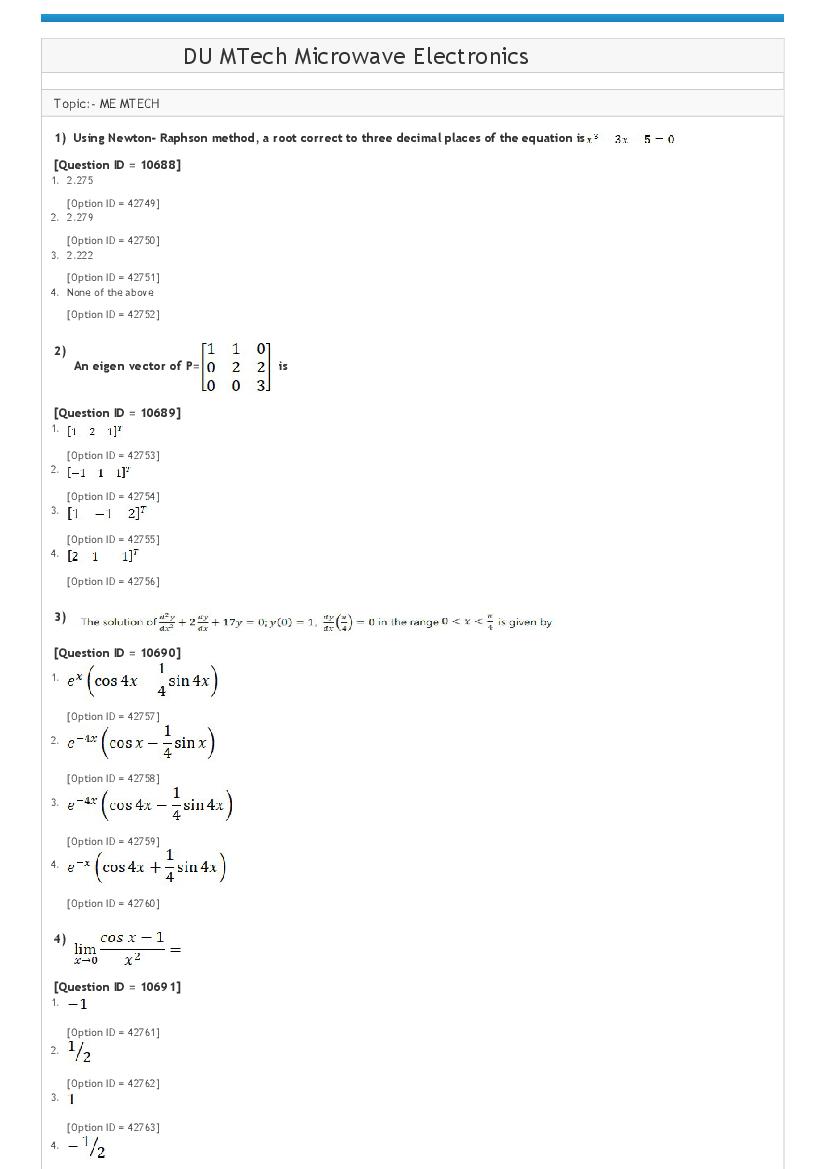
Topic:‐ ME MTECH
1) Using Newton‐ Raphson method, a root correct to three decimal places of the equation is
[Question ID = 10688]
1. 2.275
[Option ID = 42749]
2. 2.279
[Option ID = 42750]
3. 2.222
[Option ID = 42751]
4. None of the above
[Option ID = 42752]
2)
An eigen vector of P= is
[Question ID = 10689]
1.
[Option ID = 42753]
2.
[Option ID = 42754]
3.
[Option ID = 42755]
4.
[Option ID = 42756]
3)
[Question ID = 10690]
1.
[Option ID = 42757]
2.
[Option ID = 42758]
3.
[Option ID = 42759]
4.
[Option ID = 42760]
4)
[Question ID = 10691]
1.
[Option ID = 42761]
2.
[Option ID = 42762]
3.
[Option ID = 42763]
4.
Page 2
5) The value of given definite integral
is
[Question ID = 10692]
1. 1
[Option ID = 42765]
2. 0
[Option ID = 42766]
3. infinity
[Option ID = 42767]
4. ‐1
[Option ID = 42768]
6)
[Question ID = 10693]
1.
[Option ID = 42769]
2.
[Option ID = 42770]
3.
[Option ID = 42771]
4.
[Option ID = 42772]
7) The partial differentiation equation can be classified as
[Question ID = 10694]
1. Elliptic
[Option ID = 42773]
2. Parabolic
[Option ID = 42774]
3. Hyperbolic
[Option ID = 42775]
4. None of the above
[Option ID = 42776]
8)
[Question ID = 10695]
1.
[Option ID = 42777]
2.
[Option ID = 42778]
3.
[Option ID = 42779]
4.
[Option ID = 42780]
9)
[Question ID = 10696]
1.
Page 3
2.
[Option ID = 42782]
3.
[Option ID = 42783]
4.
[Option ID = 42784]
10) Match List I with List II
List I List II
Quantities Units
A. R/L I. Second
B. 1/LC II. Ohm
C. RC III. (Radian/Second)2
D. IV. (Second)‐1
Choose the correct answer from the options given below:
[Question ID = 10697]
1. A ‐ IV, B ‐ III, C ‐ I, D ‐ II
[Option ID = 42785]
2. A ‐ III, B ‐ IV, C ‐ II, D ‐ I
[Option ID = 42786]
3. A ‐ IV, B ‐ III, C ‐ II, D ‐ I
[Option ID = 42787]
4. A ‐ III, B ‐ IV, C ‐ I, D ‐ II
[Option ID = 42788]
11) For the circuit given below, what is the expression for the voltage V?
[Question ID = 10698]
1.
[Option ID = 42789]
2.
[Option ID = 42790]
3.
[Option ID = 42791]
4.
[Option ID = 42792]
12) It is required to find the current through a particular branch of a linear bilateral network without mutual coupling when
the branch impedance takes four different values. Which one of the following methods will be preferred?[Question ID =
10699]
1. Superposition theorem [Option ID = 42793]
2. Thevenin’s equivalent circuit [Option ID = 42794]
3. Mesh Analysis [Option ID = 42795]
4. Nodal analysis [Option ID = 42796]
13) A two port network is characterized by
I1 = 3 V1 + 4 V2
6 I2 = 2 V1 – 4 V2
Page 4
[Question ID = 10700]
1. 2, ‐3, 10, ‐9
[Option ID = 42797]
2. 2, 3, 6, 9
[Option ID = 42798]
3. 3, 2, ‐9, 6
[Option ID = 42799]
4. 3, ‐2, 9, ‐6
[Option ID = 42800]
14) In the delta equivalent of the below star connected circuit, ZQR is equal to
[Question ID = 10701]
1. 5 Ω
[Option ID = 42801]
2. (10 + j30) Ω
[Option ID = 42802]
3. 40 Ω
[Option ID = 42803]
4. (20 + j10) Ω
[Option ID = 42804]
15) Which one of the following impedance values of load will cause maximum power to be transferred to the load for the
network shown in the figure?
[Question ID = 10702]
1. 2 Ω
[Option ID = 42805]
2. – j2 Ω
[Option ID = 42806]
3. (2 + 2j) Ω
[Option ID = 42807]
4. (2 – 2j) Ω
[Option ID = 42808]
16) Integrated Circuit based computers are started from which generation?[Question ID = 10703]
1. 3r d generation [Option ID = 42809]
2. 2nd generation [Option ID = 42810]
3. 1st generation [Option ID = 42811]
4. 4th generation [Option ID = 42812]
17) Which operating system doesn’t support networking between computers?[Question ID = 10704]
1. Windows NT [Option ID = 42813]
2. Windows 2000 [Option ID = 42814]
3. Windows 95 [Option ID = 42815]
4. Windows 3.1 [Option ID = 42816]
18) In C language, what is the output of the following code
<#include<studio.h>
void f()
Page 5
static int i;
++i;
printf("%d", i);
}
int main()
{
f();
f();
f();
f();
}
[Question ID = 10705]
1. 1111
[Option ID = 42817]
2. 0000
[Option ID = 42818]
3. Error
[Option ID = 42819]
4. 1234
[Option ID = 42820]
19) What will be the output of the following C code?
#include<studio.h>
int main()
{
int c = 2 ^ 4;
printf("%d\n", c);
}
[Question ID = 10706]
1. error
[Option ID = 42821]
2. 4
[Option ID = 42822]
3. 6
[Option ID = 42823]
4. 0
[Option ID = 42824]
20) The number of digits required to represent a decimal number 31 in equivalent binary form are[Question ID = 10707]
1. 5 [Option ID = 42825]
2. 6 [Option ID = 42826]
3. 4 [Option ID = 42827]
4. 7 [Option ID = 42828]
21) The value of by the using one‐segment trapezoidal rule is most nearly
[Question ID = 10708]
1. 1.707
[Option ID = 42829]
2. 2.707
[Option ID = 42830]
3. 7.807
[Option ID = 42831]
4. 4.672
[Option ID = 42832]
Page 6
then what is the ratio of their drift velocities?[Question ID = 10709]
1. 4/7 [Option ID = 42833]
2. 5/4 [Option ID = 42834]
3. 5/8 [Option ID = 42835]
4. 4/5 [Option ID = 42836]
23) The circuit has two oppositely connected ideal diodes in parallel. What is the current flowing in the circuit?
[Question ID = 10710]
1. 1.33 A [Option ID = 42837]
2. 2 A [Option ID = 42838]
3. 2.31 A [Option ID = 42839]
4. 1.71 A [Option ID = 42840]
24) The carrier mobility in a semiconductor is 0.4 m2/V s. Its diffusion constant at 300 K will be (in m2 / s)[Question ID =
10711]
1. 0.01 [Option ID = 42841]
2. 0.43 [Option ID = 42842]
3. 0.04 [Option ID = 42843]
4. 0.16 [Option ID = 42844]
25) A one‐sided abrupt junction has 1021 /m3 of dopants on the lightly doped side, zero bias voltage and a built in potential
of 0.2 V. The depletion width of the abrupt junction is approximately
(q = 1.6 x 10 ‐19 C, Ɛ r = 16 and Ɛ o = 8.875 x 10‐12 F/m)
[Question ID = 10712]
1. 0.6 μm
[Option ID = 42845]
2. 3 μm
[Option ID = 42846]
3. 0.036 μm
[Option ID = 42847]
4. 1.5 μm
[Option ID = 42848]
26) The Hall‐ coefficient of a specimen of doped semiconductor is 3.06 x 10‐4 m3 C‐1 and the resistivity of the specimen is
6.93 x 10‐3 Ωm. the majority carrier mobility will be:
[Question ID = 10713]
1. 0.0442 m2 / V‐sec
[Option ID = 42849]
2. 0.024 m2 / V‐sec
[Option ID = 42850]
3. 0.034 m2 / V‐sec
[Option ID = 42851]
4. 0.0625 m2 / V‐sec
[Option ID = 42852]
27) A schottky diode clamp is used along with switching BJT for[Question ID = 10714]
1. Reducing power dissipation [Option ID = 42853]
2. Increasing the value of current gain [Option ID = 42854]
3. Reducing switching time [Option ID = 42855]
4. Reducing the base current [Option ID = 42856]
28) If a p‐n junction has doping densities Na = 3.5 × 1018 cm–3 and Nd = 2.5 × 1015 cm–3 in the two regions then its built‐in
potential at 300 K is _____________. (Take ni = 2.5 × 1010 cm–3)[Question ID = 10715]
1. 0.393 V [Option ID = 42857]
2. 1.574 V [Option ID = 42858]
3. 0.787 V [Option ID = 42859]
4. 0 V [Option ID = 42860]
Page 7
carrier and the operating frequency for this IMPATT diode are ___________ and _____ respectively.[Question ID = 10716]
1. 4 × 10‐9 s and 50 GHz [Option ID = 42861]
2. 2 × 10‐6 s and 100 GHz [Option ID = 42862]
3. 2 × 10‐11 s and 25 GHz [Option ID = 42863]
4. 1 × 10‐10 s and 100 GHz [Option ID = 42864]
30) A 4 GHz carrier is DSB‐SC modulated by a lowpass message signal with maximum frequency of 2MHz. The resultant
signal is to be ideally sampled. The minimum frequency of the sampling impulse train should be[Question ID = 10717]
1. 8.004 GHz [Option ID = 42865]
2. 8 MHz [Option ID = 42866]
3. 4 MHz [Option ID = 42867]
4. 8 GHz [Option ID = 42868]
31) A 10MHz carrier is frequency modulated by a sinusoidal signal of 500 Hz, the maximum frequency deviation being 50
kHz. The bandwidth required, as given by Carson’s rule is[Question ID = 10718]
1. 100kHz [Option ID = 42869]
2. 99kHz [Option ID = 42870]
3. 101kHz [Option ID = 42871]
4. 98kHz [Option ID = 42872]
32) The bit stream 01001 is differentially encoded using ‘Delay and Ex‐OR’ scheme for DPSK transmission. Assuming the
reference bit as a ‘1’and assigning phases of ‘0’and ‘π’for 1’s and 0’s respectively, in the encoded sequence, the
transmitted phase sequence becomes
[Question ID = 10719]
1. π π 0 π π
[Option ID = 42873]
2. 0 π π π 0
[Option ID = 42874]
3. 0 0 π π 0
[Option ID = 42875]
4. π 0 π π 0
[Option ID = 42876]
33) A source generates three symbols with probabilities 0.25, 0.25 and 0.50 at a rate of 3000 symbols per second.
Assuming independent generation of symbols, the most efficient source encoder would have average bit rate is[Question ID
= 10720]
1. 6000 bits/sec [Option ID = 42877]
2. 1500 bits/sec [Option ID = 42878]
3. 4500 bits/sec [Option ID = 42879]
4. 3000 bits/sec [Option ID = 42880]
34) A superheterodyne receiver operates in the frequency range of 58 MHz – 68 MHz. The intermediate frequency fIF and
local oscillator frequency fLO are chosen such that fIF ≤ fLO. It is required that the image frequencies fall outside the 58
MHz – 68 MHz band. The minimum required fIF (in MHz) is[Question ID = 10721]
1. 5 MHz [Option ID = 42881]
2. 10 MHz [Option ID = 42882]
3. 15 MHz [Option ID = 42883]
4. 1 MHz [Option ID = 42884]
35) Coherent demodulation of FSK signal can be detected using[Question ID = 10722]
1. Bandpass filters and envelope detectors [Option ID = 42885]
2. Matched filter [Option ID = 42886]
3. Correlation receiver [Option ID = 42887]
4. Discriminator detection [Option ID = 42888]
36) Consider sinusoidal modulation in an AM systems. Assuming no over modulation , the modulation index (µ) when the
maximum and minimum values of the envelope, respectively, are 4V and 2V is[Question ID = 10723]
1. 0.33 [Option ID = 42889]
2. 0.22 [Option ID = 42890]
3. 0.11 [Option ID = 42891]
4. 0.7 [Option ID = 42892]
37) The Nyquist sampling rate for the signal is given by
[Question ID = 10724]
1. 140 Hz
[Option ID = 42893]
2. 100 Hz
Page 8
3. 120 Hz
[Option ID = 42895]
4. 50 Hz
[Option ID = 42896]
38) The divergence of the vector A = is
[Question ID = 10725]
1.
[Option ID = 42897]
2.
[Option ID = 42898]
3.
[Option ID = 42899]
4.
[Option ID = 42900]
39) If Electric flux density , the volume charge density at (‐1, 0, 2) is
[Question ID = 10726]
1.
[Option ID = 42901]
2.
[Option ID = 42902]
3.
[Option ID = 42903]
4.
[Option ID = 42904]
40) Two point charges ‐4 µC and 4 µC are located at (2, ‐2, 3) and (1, 4, 1), respectively. Assuming zero potential at
infinity, the potential at (1, 0, 1) is[Question ID = 10727]
1. ‐3 kV [Option ID = 42905]
2. ‐1 kV [Option ID = 42906]
3. ‐2 kV [Option ID = 42907]
4. ‐4 kV [Option ID = 42908]
41) Voltage applied across a dielectric produces an electrostatic 50 times greater than air. The dielectric constant of the
dielectric will be[Question ID = 10728]
1. 5 [Option ID = 42909]
2. 10 [Option ID = 42910]
3. 20 [Option ID = 42911]
4. 50 [Option ID = 42912]
42) The electric field intensity in Styrofoam ( = 1.03) filing the space between the plates of parallel‐plate capacitor is 20
KV/m. The distance between the plates is 1.7 mm. Electric flux density D and the potential difference between the plates
are respectively:
[Question ID = 10729]
1. 177 nC/m2 and 30 V
[Option ID = 42913]
2. 177 nC/m2 and 17 V
[Option ID = 42914]
3. 182.31 nC/m2 and 17 V
[Option ID = 42915]
4. 182.31 nC/m2 and 34 V
[Option ID = 42916]
43) A lossless transmission line of length 15 cm with L = 20μH/m, C = 45pF/m is opearated at 250 MHz. Its electrical length
is
[Question ID = 10730]
1. π
Page 9
2. 2.25π
[Option ID = 42918]
3. 2.57λ
[Option ID = 42919]
4. 0.25λ
[Option ID = 42920]
44) The input impedance of a transmission line of length l < λ/4 and open circuited at the far end is
[Question ID = 10731]
1. resonative
[Option ID = 42921]
2. capacitive
[Option ID = 42922]
3. inductive
[Option ID = 42923]
4. resistive
[Option ID = 42924]
45) A lossless line of 50 Ω is terminated in a load of 100 Ω resistive. The VSWR of this line is
[Question ID = 10732]
1. 1:4
[Option ID = 42925]
2. 2:1
[Option ID = 42926]
3. 1:2
[Option ID = 42927]
4. 4:1
[Option ID = 42928]
46) The propagation constant of a transmission line with impedance and admittance of 9 and 16 respectively is[Question ID
= 10733]
1. 225 [Option ID = 42929]
2. 12 [Option ID = 42930]
3. 25 [Option ID = 42931]
4. 144 [Option ID = 42932]
47) Normalized impedance of 0.3 + j0.4 lies in the[Question ID = 10734]
1. Lower half of the impedance smith chart. [Option ID = 42933]
2. Horizontal line of the chart. [Option ID = 42934]
3. Upper half of the impedance smith chart. [Option ID = 42935]
4. Vertical line of the chart. [Option ID = 42936]
48) A commonly used antenna for TV reception is[Question ID = 10735]
1. Log periodic antenna [Option ID = 42937]
2. Simple dipole antenna [Option ID = 42938]
3. Yagi antenna [Option ID = 42939]
4. Horn antenna [Option ID = 42940]
49) A reflex Klystron function as:[Question ID = 10736]
1. Microwave amplifier. [Option ID = 42941]
2. A high gain cavity. [Option ID = 42942]
3. Both as Microwave amplifier and oscillator. [Option ID = 42943]
4. Microwave oscillator. [Option ID = 42944]
50) Radiation resistance of a current element of length dl is
[Question ID = 10737]
1. ohms
[Option ID = 42945]
2. ohms
[Option ID = 42946]
3. ohms
Page 10
4. ohms
[Option ID = 42948]
Document Details
| Board / Org | NTA |
| Exam | DUET |
| Type | Question Paper |
| Pages | 10 |
| Language | english |
| Updated | 30 Apr 2026 |