UGC NET 2021 Question Paper Yoga
Finished viewing? Save it for later —
Download UGC NET 2021 Question Paper Yoga (PDF · 88 pages)About UGC NET 2021 Question Paper Yoga
UGC NET 2021 Question Paper Yoga is available here for free download. Published by NTA for UGC NET, this question paper can be viewed online or downloaded as a PDF (88 pages). Candidates preparing for UGC NET can use UGC NET 2021 Question Paper Yoga to understand the exam pattern, the type of questions asked, and the overall difficulty level.
Frequently Asked Questions
How can I download UGC NET 2021 Question Paper Yoga?
Open this page and click the Download button to save UGC NET 2021 Question Paper Yoga as a PDF. It is completely free on AglaSem Docs.
Is UGC NET 2021 Question Paper Yoga free to download?
Yes. UGC NET 2021 Question Paper Yoga can be viewed online and downloaded as a PDF free of cost on AglaSem Docs.
How many pages does UGC NET 2021 Question Paper Yoga have?
UGC NET 2021 Question Paper Yoga contains 88 pages, which you can read online or download together as a single PDF.
Where can I find more UGC NET study material?
You can find more UGC NET question papers, sample papers, syllabus, and answer keys on AglaSem Docs.
UGC NET 2021 Question Paper Yoga – Text
Read the full text of this question paper below — useful to quickly search, copy and reference the content online without downloading the PDF.
📄 View text version (88 pages)
Page 1
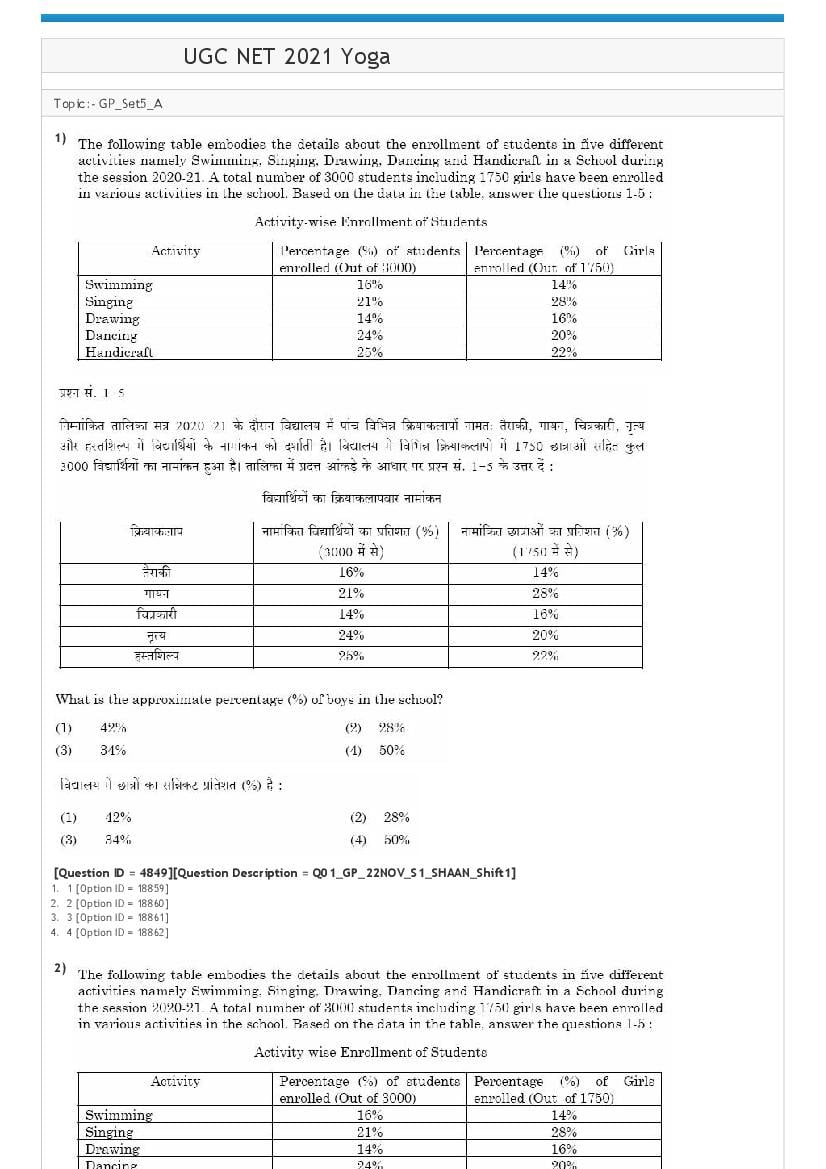
Topic:‐ GP_Set5_A
1)
[Question ID = 4849][Question Description = Q01_GP_22NOV_S1_SHAAN_Shift1]
1. 1 [Option ID = 18859]
2. 2 [Option ID = 18860]
3. 3 [Option ID = 18861]
4. 4 [Option ID = 18862]
2)
Page 2
1. 1 [Option ID = 18863]
2. 2 [Option ID = 18864]
3. 3 [Option ID = 18865]
4. 4 [Option ID = 18866]
3)
Page 3
[Option ID = 18867]
[Option ID = 18868]
[Option ID = 18869]
[Option ID = 18870]
4)
Page 4
1. 1 [Option ID = 18871]
2. 2 [Option ID = 18872]
3. 3 [Option ID = 18873]
4. 4 [Option ID = 18874]
5)
[Question ID = 4853][Question Description = Q05_GP_22NOV_S1_SHAAN_Shift1]
1. 1 [Option ID = 18875]
2. 2 [Option ID = 18876]
3. 3 [Option ID = 18877]
4. 4 [Option ID = 18878]
Topic:‐ GP_Set5_B
1) Which of the following is designated as key behaviour of effectiveness of teaching as evident from researches?
(1) Using student ideas and contribution (2) Structuring
(3) Teacher task‐orientation (4) Teacher affect
Page 5
[Option ID = 18879]
[Option ID = 18880]
[Option ID = 18881]
[Option ID = 18882]
2) Identify the indirect teaching strategies from the following list :
(A) Gaining attention, informing the learner of the objective and presenting the stimulus material
(B) Concept building through examples and non‐examples
(C) Explaining, exemplification and practice
(D) Problem based presentation with pair‐share technique
(E) Encouraging students to use references from their own experiences
Choose the correct answer from the options given below :
(1) (B), (D) and (E) (2) (A), (B) and (C)
(3) (B), (C) and (D) (4) (C), (D) and (E)
[Question ID = 4855][Question Description = Q07_GP_22NOV_S1_SHAAN_Shift1]
[Option ID = 18883]
[Option ID = 18884]
[Option ID = 18885]
[Option ID = 18886]
3) Match List I with List II :
Page 6
Modalities of Teaching Implementation
(A) Instruction (I) One way imposition of ideas from the teacher to the students
(B) Training (II) Associative presentation of ideas from teacher to students
(C) Conditioning (III) Disciplined drill conducted by teacher
(D) Indoctrination (IV) Active interchange of ideas between teacher and students
Choose the correct answer from the options given below :
(1) (A)‐(II), (B)‐(I), (C)‐(IV), (D)‐(III) (2) (A)‐(I), (B)‐(II), (C)‐(III), (D)‐(IV)
(3) (A)‐(IV), (B)‐(III), (C)‐(II), (D)‐(I) (4) (A)‐(III), (B)‐(IV), (C)‐(I), (D)‐(II)
[Question ID = 4856][Question Description = Q08_GP_22NOV_S1_SHAAN_Shift1]
1. 1 [Option ID = 18887]
2. 2 [Option ID = 18888]
3. 3 [Option ID = 18889]
4. 4 [Option ID = 18890]
4) Given below are two statements :
Statement I : Computer based testing promotes objectivity in assessment processes.
Statement II : Choice‐based credit system in Indian Higher Education is a new entry.
In the light of the above statements, Choose the most appropriate answer from the options given below :
(1) Both Statement I and Statement II are correct. (2) Both Statement I and Statement II are incorrect.
(3) Statement I is correct but Statement II is incorrect. (4) Statement I is incorrect but Statement II is correct.
[Question ID = 4857][Question Description = Q09_GP_22NOV_S1_SHAAN_Shift1]
1. 1 [Option ID = 18891]
Page 7
3. 3 [Option ID = 18893]
4. 4 [Option ID = 18894]
5) Given below are two statements : One is labeled as Assertion A and the other is labeled as Reason R.
Assertion (A) : Teaching support system whether traditional or modern is purportedly put in place for effecting economy and
ensuring quality in teaching‐learning transactions.
Reason (R) : Learning outcomes in order to be congruent with stipulated instructional goals need scaffolds to begin with.
In the light of the above statements, Choose the most appropriate answer from the options given below :
(1) Both (A) and (R) are correct and (R) is the correct explanation of (A). (2) Both (A) and (R) are correct but (R) is
NOT the correct explanation of (A).
(3) (A) is correct but (R) is not correct. (4) (A) is not correct but (R) is correct.
[Question ID = 4858][Question Description = Q10_GP_22NOV_S1_SHAAN_Shift1]
1. 1 [Option ID = 18895]
2. 2 [Option ID = 18896]
3. 3 [Option ID = 18897]
4. 4 [Option ID = 18898]
6) In which method of research an independent variable is manipulated with an intent to observe concomitant changes in
dependent variable?
(1) ExPost Facto method (2) Case study method
(3) Descriptive survey method (4) Experimental method
[Question ID = 4859][Question Description = Q11_GP_22NOV_S1_SHAAN_Shift1]
1. 1 [Option ID = 18899]
2. 2 [Option ID = 18900]
3. 3 [Option ID = 18901]
4. 4 [Option ID = 18902]
7) Identify the features of empirico‐inductive paradigm of research
(A) Research is concerned with the process rather than simply with outcomes or products
(B) Based on logical positivist philosophy which assumes a single objective reality
(C) Researchers are concerned with what are called ‘participant perspectives’
(D) Attempts to establish universal context free generalizations
Choose the most appropriate answer from the options given below :
(1) (A) and (B) only (2) (B) and (C) only
(3) (C) and (D) only (4) (A) and (C) only
Page 8
1. 1 [Option ID = 18903]
2. 2 [Option ID = 18904]
3. 3 [Option ID = 18905]
4. 4 [Option ID = 18906]
8) Match List I and List II
List I List II
Sampling Methods Procedure involved
(A) Simple Random Sampling (I) The first member is used as an informant to identify other. The process goes on like
this
(B) Stratified Random Sampling (II) The units are chosen intact on the basis of their settings
(C) Cluster Sampling (III) The units are chosen from defined groups/levels randomly
(D) Snowball sampling (IV) The units are chosen by giving equal and independent chance to each
Choose the correct answer from the options given below :
(1) (A)‐(I), (B)‐(II), (C)‐(III), (D)‐(IV) (2) (A)‐(IV), (B)‐(III), (C)‐(II), (D)‐(I)
(3) (A)‐(III), (B)‐(IV), (C)‐(I), (D)‐(II) (4) (A)‐(II), (B)‐(I), (C)‐(IV), (D)‐(III)
[Question ID = 4861][Question Description = Q13_GP_22NOV_S1_SHAAN_Shift1]
[Option ID = 18907]
[Option ID = 18908]
[Option ID = 18909]
[Option ID = 18910]
Page 9
Statement I : Action Research is used primarily to improve a given situation by a practitioner.
Statement II : Applied research is directed at exploring applicability of principles already established.
In the light of the above statements, Choose the most appropriate answer from the options given below :
(1) Both Statement I and Statement II are correct. (2) Both Statement I and Statement II are incorrect.
(3) Statement I is correct but Statement II is incorrect. (4) Statement I is incorrect but Statement II is correct.
[Question ID = 4862][Question Description = Q14_GP_22NOV_S1_SHAAN_Shift1]
1. 1 [Option ID = 18911]
2. 2 [Option ID = 18912]
3. 3 [Option ID = 18913]
4. 4 [Option ID = 18914]
10) Given below are two statements : One is labeled as Assertion A and the other is labeled as Reason R.
Assertion (A) : A research thesis has to follow a prescribed format and style of referencing.
Reasons (R) : This ensures the observance of research ethics.
In the light of the above statements, Choose the most appropriate answer from the options given below :
(1) Both (A) and (R) are correct and (R) is the correct explanation of (A).
(2) Both (A) and (R) are correct but (R) is NOT the correct explanation of (A).
(3) (A) is correct but (R) is not correct.
(4) (A) is not correct but (R) is correct.
Page 10
[Option ID = 18915]
[Option ID = 18916]
[Option ID = 18917]
[Option ID = 18918]
11) Which of the following is an example of physical barrier to communication?
(1) Cultural disparity (2) Inattention
(3) Verbalism (4) Ill health
[Question ID = 4864][Question Description = Q16_GP_22NOV_S1_SHAAN_Shift1]
1. 1 [Option ID = 18919]
2. 2 [Option ID = 18920]
3. 3 [Option ID = 18921]
4. 4 [Option ID = 18922]
12) When in a classroom communication, a teacher shows ability of creativity, correlation and analysis, it belongs to which
category of skills?
(1) Thinking skills (2) Expression skills
(3) Media utilization skills (4) Human skills
[Question ID = 4865][Question Description = Q17_GP_22NOV_S1_SHAAN_Shift1]
1. 1 [Option ID = 18923]
2. 2 [Option ID = 18924]
3. 3 [Option ID = 18925]
4. 4 [Option ID = 18926]
13) Why do we communicate?
(A) For social interaction.
(B) For happiness sake.
(C) For messages to be understood.
(D) For sharing of experience.
(E) For protection of traditions.
Choose the correct answer from the options given below :
(1) (A), (C), (E) only (2) (B), (C), (D) only
(3) (A), (C), (D) only (4) (A), (B), (E) only
Page 11
1. 1 [Option ID = 18927]
2. 2 [Option ID = 18928]
3. 3 [Option ID = 18929]
4. 4 [Option ID = 18930]
14) Match List I with List II
List I List II
Types of communication Function served
(A) Mass communication (I) Corridor discussion
(B) Intrapersonal communication (II) Classroom Teaching
(C) Group communication (III) For communicates with oneself
(D) Interpersonal communication (IV) For mechanical message transmission
Choose the correct answer from the options given below :
(1) (A)‐(IV), (B)‐(III), (C)‐(II), (D)‐(I) (2) (A)‐(I), (B)‐(II), (C)‐(III), (D)‐(IV)
(3) (A)‐(II), (B)‐(III), (C)‐(IV), (D)‐(I) (4) (A)‐(III), (B)‐(II), (C)‐(I), (D)‐(IV)
[Question ID = 4867][Question Description = Q19_GP_22NOV_S1_SHAAN_Shift1]
[Option ID = 18931]
[Option ID = 18932]
[Option ID = 18933]
[Option ID = 18934]
15) Given below are two statements : One is labeled as Assertion A and the other is labeled as Reason R.
Assertion (A) : A man pulls a loaded truck by his hair which becomes news.
Page 12
In the light of the above statements, Choose the most appropriate answer from the options given below :
(1) Both (A) and (R) are correct and (R) is the correct explanation of (A). (2) Both (A) and (R) are correct but (R) is
NOT the correct explanation of (A).
(3) (A) is correct but (R) is not correct. (4) (A) is not correct but (R) is correct.
[Question ID = 4868][Question Description = Q20_GP_22NOV_S1_SHAAN_Shift1]
1. 1 [Option ID = 18935]
2. 2 [Option ID = 18936]
3. 3 [Option ID = 18937]
4. 4 [Option ID = 18938]
16) Smita rode her scooty Northwards, then turned left and then again rode to her left 4 km. She found herself exactly 2
km West of her starting point. How far did she ride Northward initially?
(1) 2 km (2) 4 km
(3) 5 km (4) 6 km
[Question ID = 4869][Question Description = Q21_GP_22NOV_S1_SHAAN_Shift1]
1. 1 [Option ID = 18939]
2. 2 [Option ID = 18940]
3. 3 [Option ID = 18941]
4. 4 [Option ID = 18942]
17) A 108 meter long train moving at a speed of 50 km/hr crosses a 112 meters long train coming from the opposite
direction in 6 seconds. The speed of the second train is :
(1) 48 km/hr (2) 54 km/hr
(3) 66 km/hr (4) 82 km/hr
[Question ID = 4870][Question Description = Q22_GP_22NOV_S1_SHAAN_Shift1]
1. 1 [Option ID = 18943]
2. 2 [Option ID = 18944]
3. 3 [Option ID = 18945]
4. 4 [Option ID = 18946]
Page 13
elevation of the wall is :
(1) 45° (2) 30°
(3) 60° (4) 50°
[Question ID = 4871][Question Description = Q23_GP_22NOV_S1_SHAAN_Shift1]
1. 1 [Option ID = 18947]
2. 2 [Option ID = 18948]
3. 3 [Option ID = 18949]
4. 4 [Option ID = 18950]
19) The profit earned by selling a chair for Rs. 752 is 1.2 times the loss incurred when the same chair was sold for Rs. 400.
What is the cost price of the chair?
(1) Rs. 540 (2) Rs. 592
(3) Rs. 560 (4) Rs. 640
[Question ID = 4872][Question Description = Q24_GP_22NOV_S1_SHAAN_Shift1]
1. 1 [Option ID = 18951]
2. 2 [Option ID = 18952]
3. 3 [Option ID = 18953]
4. 4 [Option ID = 18954]
20) Three men, four women and six children can complete a work in seven days. A woman does double the work a man
does and a child does half the work a man does. How many women alone can complete this work in 7 days?
(1) 7 (2) 8
(3) 9 (4) 12
[Question ID = 4873][Question Description = Q25_GP_22NOV_S1_SHAAN_Shift1]
1. 1 [Option ID = 18955]
2. 2 [Option ID = 18956]
3. 3 [Option ID = 18957]
4. 4 [Option ID = 18958]
21)
Page 14
1. 1 [Option ID = 18959]
2. 2 [Option ID = 18960]
3. 3 [Option ID = 18961]
4. 4 [Option ID = 18962]
22)
[Question ID = 4875][Question Description = Q27_GP_22NOV_S1_SHAAN_Shift1]
1. 1 [Option ID = 18963]
2. 2 [Option ID = 18964]
3. 3 [Option ID = 18965]
4. 4 [Option ID = 18966]
23)
Page 15
1. 1 [Option ID = 18967]
2. 2 [Option ID = 18968]
3. 3 [Option ID = 18969]
4. 4 [Option ID = 18970]
24) Given below are two statements :
Statement I : A formal fallacy is one that may be identified through mere inspection of the form or structure of an
argument.
Statement II : Formal fallacies are found only in deductive arguments that have identifiable forms.
In the light of the above statements, Choose the correct answer from the options given below :
(1) Both Statement I and Statement II are true. (2) Both Statement I and Statement II are false.
(3) Statement I is true but Statement II is false. (4) Statement I is false but Statement II is true.
[Question ID = 4877][Question Description = Q29_GP_22NOV_S1_SHAAN_Shift1]
1. 1 [Option ID = 18971]
2. 2 [Option ID = 18972]
3. 3 [Option ID = 18973]
4. 4 [Option ID = 18974]
25) ‘‘Whoever thrusts a knife into another person should be arrested. Surgeons thrust a knife into another person when
operating. Therefore surgeons should be arrested’’.
Which fallacy is committed in the following argument?
Page 16
(3) Red Herring (4) Appeal to unqualified authority
[Question ID = 4878][Question Description = Q30_GP_22NOV_S1_SHAAN_Shift1]
1. 1 [Option ID = 18975]
2. 2 [Option ID = 18976]
3. 3 [Option ID = 18977]
4. 4 [Option ID = 18978]
26) The next number P in the sequence of binary numbers 0, 10, 100, 110, P ….., is :
(1) 111 (2) 1000
(3) 1010 (4) 1001
[Question ID = 4879][Question Description = Q31_GP_22NOV_S1_SHAAN_Shift1]
1. 1 [Option ID = 18979]
2. 2 [Option ID = 18980]
3. 3 [Option ID = 18981]
4. 4 [Option ID = 18982]
27) Identify the correct order of following computer memory types ranked from slowest to fastest in terms of access time.
(A) Cache
(B) CDROM
(C) Hard Disk
(D) RAM
(E) Register
Choose the correct answer from the options given below :
(1) (C), (B), (A), (D), (E) (2) (E), (A), (D), (C), (B)
(3) (B), (C), (D), (A), (E) (4) (D), (A), (E), (B), (C)
Page 17
1. 1 [Option ID = 18983]
2. 2 [Option ID = 18984]
3. 3 [Option ID = 18985]
4. 4 [Option ID = 18986]
28) Given below are two statements :
Statement I : CPU executes software directly from secondary memory.
Statement II : A software is termed as Open Source Software if it can be downloaded from the Internet.
In the light of the above statements, Choose the correct answer from the options given below :
(1) Both Statement I and Statement II are true. (2) Both Statement I and Statement II are false.
(3) Statement I is true but Statement II is false. (4) Statement I is false but Statement II is true.
[Question ID = 4881][Question Description = Q33_GP_22NOV_S1_SHAAN_Shift1]
1. 1 [Option ID = 18987]
2. 2 [Option ID = 18988]
3. 3 [Option ID = 18989]
4. 4 [Option ID = 18990]
29) Which of the following statements about wikis are True?
(A) Wiki pages can be locked by moderators to prevent vandlism.
(B) Every change that is made to a wiki page is logged and can be viewed in a history list.
(C) A wiki is designed to allow people to collaborate easily.
Choose the correct answer from the options given below :
(1) (A) and (B) only (2) (B) and (C) only
(3) (A) and (C) only (4) (A), (B) and (C)
Page 18
1. 1 [Option ID = 18991]
2. 2 [Option ID = 18992]
3. 3 [Option ID = 18993]
4. 4 [Option ID = 18994]
30) Match List I with List II
List I List II
(Digital Initiatives in Higher Education) (Purpose)
(A) SWAYAM (I) Online store and access of academic awards namely degrees, mark‐sheets etc.
(B) SWAYAM PRABHA (II) Store and access personal e‐documents irrespective of physical location.
(C) Digilocker (III) MOOCs for high‐quality education anywhere and anytime.
(D) NAD (IV) Free DTH channel for high‐quality education.
Choose the correct answer from the options given below :
(1) (A)‐(III), (B)‐(IV), (C)‐(II), (D)‐(I) (2) (A)‐(IV), (B)‐(III), (C)‐(I), (D)‐(II)
(3) (A)‐(IV), (B)‐(III), (C)‐(II), (D)‐(I) (4) (A)‐(II), (B)‐(I), (C)‐(III), (D)‐(IV)
[Question ID = 4883][Question Description = Q35_GP_22NOV_S1_SHAAN_Shift1]
1. 1 [Option ID = 18995]
2. 2 [Option ID = 18996]
3. 3 [Option ID = 18997]
4. 4 [Option ID = 18998]
31) The waste component of waste categorized as ‘Trash’ consists of
(A) Paper, Cardboard cartons
(B) Animal wastes
(C) Industrial process wastes
(D) Vegetable wastes
(E) Wood
Choose the correct answer from the options given below :
(1) (A) and (E) only (2) (A), (C) and (E) only
(3) (A), (C), (D) and (E) only (4) (A), (B), (D) and (E) only
Page 19
1. 1 [Option ID = 18999]
2. 2 [Option ID = 19000]
3. 3 [Option ID = 19001]
4. 4 [Option ID = 19002]
32)
[Question ID = 4885][Question Description = Q37_GP_22NOV_S1_SHAAN_Shift1]
1. 1 [Option ID = 19003]
2. 2 [Option ID = 19004]
3. 3 [Option ID = 19005]
4. 4 [Option ID = 19006]
33) Small hydro power potential in India is estimated approximately as
(1) ~ 60 MW (2) ~ 100 MW
(3) ~ 10 GW (4) ~ 20 GW
[Question ID = 4886][Question Description = Q38_GP_22NOV_S1_SHAAN_Shift1]
1. 1 [Option ID = 19007]
2. 2 [Option ID = 19008]
3. 3 [Option ID = 19009]
4. 4 [Option ID = 19010]
34) The global environmental issue of Ozone depletion is due to emission of :
(A) Sulphur dioxide
(B) Chlorinated hydrocarbons
(C) Methane
(D) Carbone dixoide
Choose the most appropriate answer from the options given below :
(1) (A) and (B) only (2) (B) only
(3) (B) and (D) only (4) (A), (B) and (C) only
Page 20
1. 1 [Option ID = 19011]
2. 2 [Option ID = 19012]
3. 3 [Option ID = 19013]
4. 4 [Option ID = 19014]
35) Match List I with List II
List I List II
(Digital Initiatives in Higher Education) (Purpose)
(A) SWAYAM (I) Online store and access of academic awards namely degrees, mark‐sheets etc.
(B) SWAYAM PRABHA (II) Store and access personal e‐documents irrespective of physical location.
(C) Digilocker (III) MOOCs for high‐quality education anywhere and anytime.
(D) NAD (IV) Free DTH channel for high‐quality education.
Choose the correct answer from the options given below :
(1) (A)‐(III), (B)‐(IV), (C)‐(II), (D)‐(I) (2) (A)‐(IV), (B)‐(III), (C)‐(I), (D)‐(II)
(3) (A)‐(IV), (B)‐(III), (C)‐(II), (D)‐(I) (4) (A)‐(II), (B)‐(I), (C)‐(III), (D)‐(IV)
[Question ID = 4888][Question Description = Q40_GP_22NOV_S1_SHAAN_Shift1]
1. 1 [Option ID = 19015]
2. 2 [Option ID = 19016]
3. 3 [Option ID = 19017]
4. 4 [Option ID = 19018]
36) The NEP‐2020 proposes to prepare which of the curriculum frameworks?
(A) National Curriculum Framework for School Education
(B) National Curriculum Framework for Adult Education
(C) National Curriculum Framework for Teacher Education
(D) National Curriculum Framework for Technical Education
(E) National Curriculum Framework for Vocational Education
Choose the correct answer from the options given below :
(1) (A), (C), (E) only (2) (B), (C), (D) only
(3) (A), (B), (C) only (4) (C), (D), (E) only
[Question ID = 4889][Question Description = Q41_GP_22NOV_S1_SHAAN_Shift1]
1. 1 [Option ID = 19019]
2. 2 [Option ID = 19020]
3. 3 [Option ID = 19021]
Page 21
37) Which of the following values is related to self‐transcendance?
(1) Security value (2) Value of Universalism
(3) Value of freedom (4) Value of conformity
[Question ID = 4890][Question Description = Q42_GP_22NOV_S1_SHAAN_Shift1]
1. 1 [Option ID = 19023]
2. 2 [Option ID = 19024]
3. 3 [Option ID = 19025]
4. 4 [Option ID = 19026]
38) NEP‐2020 proposes to establish which of the following new bodies?
(A) SSSA
(B) PARAKH
(C) IITI
(D) NITI
(E) NTA
Choose the correct answer from the options given below :
(1) (A), (C), (D) only (2) (B), (C), (E) only
(3) (A), (B), (C) only (4) (B), (C), (D) only
[Question ID = 4891][Question Description = Q43_GP_22NOV_S1_SHAAN_Shift1]
1. 1 [Option ID = 19027]
2. 2 [Option ID = 19028]
3. 3 [Option ID = 19029]
4. 4 [Option ID = 19030]
39) Which of the following is an apex advisory and non statutory body?
(1) NITI Aayog (2) NCTE
(3) AICTE (4) MCI
[Question ID = 4892][Question Description = Q44_GP_22NOV_S1_SHAAN_Shift1]
1. 1 [Option ID = 19031]
2. 2 [Option ID = 19032]
3. 3 [Option ID = 19033]
4. 4 [Option ID = 19034]
40) Who among the following was the first Chairman of UGC?
Page 22
(3) Sh M. Moolgaokar (4) Moolchand Sharma
[Question ID = 4893][Question Description = Q45_GP_22NOV_S1_SHAAN_Shift1]
1. 1 [Option ID = 19035]
2. 2 [Option ID = 19036]
3. 3 [Option ID = 19037]
4. 4 [Option ID = 19038]
Topic:‐ GP_Set5_C
1) Read the passage carefully and answer the question that follow:
As the world is becoming increasingly interconnected, Global Citizenship Education (GCED), a response to contemporary
global challenges, will be provided to empower learners to become aware of and understand global issues and to become
active promoters of more peaceful, tolerant, inclusive, secure and sustainable societies. As a part of holistic education,
students at all HEIs will be provided with opportunities for internships with local industry, businesses, artists, crafts person
etc. as well as research internship with faculty and researchers at their own or other HEIs/research institutions, so that
students may actively engage with the practical side of their learning and, as a by‐product, further improve their
employability. India will be promoted as a global study destination providing premium education at affordable costs thereby
helping to restore its role as a Vishwa Guru. An international students office at each HEI hosting foreign students will be set
up to coordinate all matters relating to welcoming and supporting students arriving from abroad. Research training
colloboration and faculty/student exchanges with high quality foreign institution will be facilitated, and relevant mutually
beneficial MOU with foreign countries will be signed. High Performing Indian Universities will be encouraged to set up
campuses in other countries, and similarly, selected universities e.g. those from top 100 universities in the world will be
facilitated to operate in India. A legislative framework facilitating such entry will be put in place and such universities will
be given special dispensation regarding regulatory, governance and content norms on par wth other autonomous institutions
of India. Furthermore, research collaboration and student exhanges between Indian institutions and global institutions will
be promoted through special efforts. Credits acquired in foreign universities will be permitted, where appropriate as per
the requirements of each HEI, to be counted for the award of a degree.
New National Education Policy is grounded in the assumptions that :
(A) There is increasing interconnectedness among nations at the global level.
(B) Technical knowledge should replace traditional models of learning.
(C) HEIs must focus on promotion of desirable ethical values.
(D) There is need for changes in legislative framework to facilitiate free exchange of academic ideas and achievements.
Choose the correct answer from the options given below :
(1) (A), (B) and (D) only (2) (A) and (C) only
(3) (A), (C) and (D) only (4) (C) and (D) only
Page 23
[Option ID = 19039]
[Option ID = 19040]
[Option ID = 19041]
[Option ID = 19042]
2) Read the passage carefully and answer the question that follow:
As the world is becoming increasingly interconnected, Global Citizenship Education (GCED), a response to contemporary
global challenges, will be provided to empower learners to become aware of and understand global issues and to become
active promoters of more peaceful, tolerant, inclusive, secure and sustainable societies. As a part of holistic education,
students at all HEIs will be provided with opportunities for internships with local industry, businesses, artists, crafts person
etc. as well as research internship with faculty and researchers at their own or other HEIs/research institutions, so that
students may actively engage with the practical side of their learning and, as a by‐product, further improve their
employability. India will be promoted as a global study destination providing premium education at affordable costs thereby
helping to restore its role as a Vishwa Guru. An international students office at each HEI hosting foreign students will be set
up to coordinate all matters relating to welcoming and supporting students arriving from abroad. Research training
Page 24
beneficial MOU with foreign countries will be signed. High Performing Indian Universities will be encouraged to set up
campuses in other countries, and similarly, selected universities e.g. those from top 100 universities in the world will be
facilitated to operate in India. A legislative framework facilitating such entry will be put in place and such universities will
be given special dispensation regarding regulatory, governance and content norms on par wth other autonomous institutions
of India. Furthermore, research collaboration and student exhanges between Indian institutions and global institutions will
be promoted through special efforts. Credits acquired in foreign universities will be permitted, where appropriate as per
the requirements of each HEI, to be counted for the award of a degree.
Given below are two statements :
Statement I : National Education Policy is framed with an objective of saving national HEIs from competition at the global
level.
Statement II : National Education Policy is framed with an objective of encouraging exchange of knowledge and expertise
both at local and global level.
In the light of the above statements, Choose the most appropriate answer from the options given below :
(1) Both Statement I and Statement II are correct. (2) Both Statement I and Statement II are incorrect.
(3) Statement I is correct but Statement II is incorrect (4) Statement I is incorrect but Statement II is correct.
Page 25
[Option ID = 19043]
[Option ID = 19044]
[Option ID = 19045]
[Option ID = 19046]
3) Read the passage carefully and answer the question that follow:
As the world is becoming increasingly interconnected, Global Citizenship Education (GCED), a response to contemporary
global challenges, will be provided to empower learners to become aware of and understand global issues and to become
active promoters of more peaceful, tolerant, inclusive, secure and sustainable societies. As a part of holistic education,
students at all HEIs will be provided with opportunities for internships with local industry, businesses, artists, crafts person
etc. as well as research internship with faculty and researchers at their own or other HEIs/research institutions, so that
students may actively engage with the practical side of their learning and, as a by‐product, further improve their
employability. India will be promoted as a global study destination providing premium education at affordable costs thereby
helping to restore its role as a Vishwa Guru. An international students office at each HEI hosting foreign students will be set
up to coordinate all matters relating to welcoming and supporting students arriving from abroad. Research training
colloboration and faculty/student exchanges with high quality foreign institution will be facilitated, and relevant mutually
beneficial MOU with foreign countries will be signed. High Performing Indian Universities will be encouraged to set up
campuses in other countries, and similarly, selected universities e.g. those from top 100 universities in the world will be
facilitated to operate in India. A legislative framework facilitating such entry will be put in place and such universities will
be given special dispensation regarding regulatory, governance and content norms on par wth other autonomous institutions
of India. Furthermore, research collaboration and student exhanges between Indian institutions and global institutions will
be promoted through special efforts. Credits acquired in foreign universities will be permitted, where appropriate as per
the requirements of each HEI, to be counted for the award of a degree.
Which of the following statements most appropriately represent one of the chief concerns regarding higher education?
(1) It argues for only local production and of knowledge and its implementation.
(2) It emphasizes only upon implementation of foreign higher education models in India.
(3) It argues for mutual exchange of knowledge and learning among national and international institutions of higher
education.
(4) It argues for practical learning alone for employability putting social issues aside.
Page 26
[Option ID = 19047]
[Option ID = 19048]
[Option ID = 19049]
[Option ID = 19050]
4) Read the passage carefully and answer the question that follow:
As the world is becoming increasingly interconnected, Global Citizenship Education (GCED), a response to contemporary
global challenges, will be provided to empower learners to become aware of and understand global issues and to become
active promoters of more peaceful, tolerant, inclusive, secure and sustainable societies. As a part of holistic education,
students at all HEIs will be provided with opportunities for internships with local industry, businesses, artists, crafts person
etc. as well as research internship with faculty and researchers at their own or other HEIs/research institutions, so that
students may actively engage with the practical side of their learning and, as a by‐product, further improve their
employability. India will be promoted as a global study destination providing premium education at affordable costs thereby
helping to restore its role as a Vishwa Guru. An international students office at each HEI hosting foreign students will be set
up to coordinate all matters relating to welcoming and supporting students arriving from abroad. Research training
colloboration and faculty/student exchanges with high quality foreign institution will be facilitated, and relevant mutually
beneficial MOU with foreign countries will be signed. High Performing Indian Universities will be encouraged to set up
campuses in other countries, and similarly, selected universities e.g. those from top 100 universities in the world will be
Page 27
be given special dispensation regarding regulatory, governance and content norms on par wth other autonomous institutions
of India. Furthermore, research collaboration and student exhanges between Indian institutions and global institutions will
be promoted through special efforts. Credits acquired in foreign universities will be permitted, where appropriate as per
the requirements of each HEI, to be counted for the award of a degree.
Holistic education at HEIs is aimed at :
(A) Research internship with researchers and faculty at different HEIs.
(B) Recyling of traditional knowledge systems.
(C) Providing opportunities for internships at local level.
(D) Keeping social sciences and natural sciences within distinct spheres of teaching and learning.
Choose the correct answer from the options given below :
(1) (B) and (D) only (2) (A) and (C) only
(3) (A) and (D) only (4) (C) and (D) only
Page 28
[Option ID = 19051]
[Option ID = 19052]
[Option ID = 19053]
[Option ID = 19054]
5) Read the passage carefully and answer the question that follow:
As the world is becoming increasingly interconnected, Global Citizenship Education (GCED), a response to contemporary
global challenges, will be provided to empower learners to become aware of and understand global issues and to become
active promoters of more peaceful, tolerant, inclusive, secure and sustainable societies. As a part of holistic education,
students at all HEIs will be provided with opportunities for internships with local industry, businesses, artists, crafts person
etc. as well as research internship with faculty and researchers at their own or other HEIs/research institutions, so that
students may actively engage with the practical side of their learning and, as a by‐product, further improve their
employability. India will be promoted as a global study destination providing premium education at affordable costs thereby
helping to restore its role as a Vishwa Guru. An international students office at each HEI hosting foreign students will be set
up to coordinate all matters relating to welcoming and supporting students arriving from abroad. Research training
colloboration and faculty/student exchanges with high quality foreign institution will be facilitated, and relevant mutually
beneficial MOU with foreign countries will be signed. High Performing Indian Universities will be encouraged to set up
campuses in other countries, and similarly, selected universities e.g. those from top 100 universities in the world will be
facilitated to operate in India. A legislative framework facilitating such entry will be put in place and such universities will
be given special dispensation regarding regulatory, governance and content norms on par wth other autonomous institutions
of India. Furthermore, research collaboration and student exhanges between Indian institutions and global institutions will
be promoted through special efforts. Credits acquired in foreign universities will be permitted, where appropriate as per
the requirements of each HEI, to be counted for the award of a degree.
Given below are two statements :
Statement I : National Education Policy envisages learning as a process of inculcating values of tolerance, inclusion and
sustainability.
Statement II : National Education Policy lays stress on employability of learners in businesses and industries.
In the light of the above statements, Choose the most appropriate answer from the options given below :
(1) Both Statement I and Statement II are correct. (2) Both Statement I and Statement II are incorrect.
(3) Statement I is correct but Statement II is incorrect (4) Statement I is incorrect but Statement II is correct.
Page 29
[Option ID = 19055]
[Option ID = 19056]
[Option ID = 19057]
[Option ID = 19058]
Topic:‐ Yoga_A
1) In Muktikopnishad, the number of Upnishadas are
(1) 11 (2) 10
(3) 108 (4) 223
Page 30
[Option ID = 21576]
[Option ID = 21577]
[Option ID = 21578]
[Option ID = 21579]
2) The famous theory of Samkhya Darshana is
(1) Satkaryavad (2) Asatkaryavad
(3) Vivartvaad (4) Sadsatkhyativaad
[Question ID = 5533][Question Description = Q02_Yoga_SHAAN_22NOV_SI_Shift1]
[Option ID = 21580]
[Option ID = 21581]
[Option ID = 21582]
[Option ID = 21583]
3) Term Shruti is used for
(1) Yaagyavalkya smriti (2) Bhagvad Gita
(3) Veda (4) Purana
[Question ID = 5534][Question Description = Q03_Yoga_SHAAN_22NOV_SI_Shift1]
[Option ID = 21584]
[Option ID = 21585]
[Option ID = 21586]
[Option ID = 21587]
4) The propounder of Nyaya Darshana, Gautama is also known as
(1) Pragya Chakshu (2) Aksha Paad
(3) Prabhu Paad (4) Vaatsyaayan
Page 31
[Option ID = 21588]
[Option ID = 21589]
[Option ID = 21590]
[Option ID = 21591]
5) In Taittariya upnishad, which of the following has been described by ‘Yato vacho Nivarttante. Aprapya Manasa Sah’?
(1) The world (Jagat) (2) Education
(3) Brahma (4) Cause and effect
[Question ID = 5536][Question Description = Q05_Yoga_SHAAN_22NOV_SI_Shift1]
[Option ID = 21592]
[Option ID = 21593]
[Option ID = 21594]
[Option ID = 21595]
6) In Bhagawadgita following example of Indriya‐Nigraha has been given in context of ‘Sthitpragya’
(1) Boat (Naav) (2)Soil (Mitti)
(3) Turtle (Koorma) (4)Elephant (Hasti)
[Question ID = 5537][Question Description = Q06_Yoga_SHAAN_22NOV_SI_Shift1]
[Option ID = 21596]
[Option ID = 21597]
[Option ID = 21598]
[Option ID = 21599]
7)
Page 32
[Option ID = 21600]
[Option ID = 21601]
[Option ID = 21602]
[Option ID = 21603]
8) Choose correct option to fill the blank in the following Pada according to Yogavasishtha : ‘Manasah Spandanam Pranah,
Pranasya Spandanam – ’
(1) Buddhih (2Hridayam
(3) Indriyah (4)Manah
[Question ID = 5539][Question Description = Q08_Yoga_SHAAN_22NOV_SI_Shift1]
1. 1 [Option ID = 21604]
2. 2 [Option ID = 21605]
3. 3 [Option ID = 21606]
4. 4 [Option ID = 21607]
9) According to the Dhyanbindu Upanishad the Guna associated with ‘Ukar’ is
(1) Rajoguna (2) Tamoguna
(3) Sāttvik Guna (4) Mishrit Guna
[Question ID = 5540][Question Description = Q09_Yoga_SHAAN_22NOV_SI_Shift1]
1. 1 [Option ID = 21608]
2. 2 [Option ID = 21609]
3. 3 [Option ID = 21610]
4. 4 [Option ID = 21611]
10) In Nadabindoopnishad 12th Matra has been referred as
(1) Dhriti (2) Ghoshini
(3) Vayuvegini (4) Brhami
[Question ID = 5541][Question Description = Q10_Yoga_SHAAN_22NOV_SI_Shift1]
[Option ID = 21612]
Page 33
[Option ID = 21614]
[Option ID = 21615]
11) ‘‘Mayamtu Prakritim Vidyanmayinam Tam Maheshwaram’’ in which Upanishad the form of God has been explained by
the above Statement?
(1) Yograjopnishad (2) Yogtattvopnishad
(3) Swetaswataropnishad (4) Trishikhibrahmnopnishad
[Question ID = 5542][Question Description = Q11_Yoga_SHAAN_22NOV_SI_Shift1]
[Option ID = 21616]
[Option ID = 21617]
[Option ID = 21618]
[Option ID = 21619]
12) ‘Chittasya Nischalibhavo Dharana’ in which Upanishad ‘Dharana’ has been interpreted as above?
(1) Swetaswatar Upanishad (2) Yogkundalyopnishad
(3) Yogchudamanyupanishad (4) Trishikhibrahmnopanishad
[Question ID = 5543][Question Description = Q12_Yoga_SHAAN_22NOV_SI_Shift1]
[Option ID = 21620]
[Option ID = 21621]
[Option ID = 21622]
[Option ID = 21623]
13) According to Yog sutra term ‘Prakash’ is related with
(1) Aatma (2) Satoguna
(3) Rajoguna (4) Surya
[Question ID = 5544][Question Description = Q13_Yoga_SHAAN_22NOV_SI_Shift1]
[Option ID = 21624]
Page 34
[Option ID = 21626]
[Option ID = 21627]
14) According to Yogasutra ‘Sabdarth Gyan Vikalpaih’ is related to which samapatti?
(1) Svitarka (2) Nivitarka
(3) Nirvichar (4) Asmita
[Question ID = 5545][Question Description = Q14_Yoga_SHAAN_22NOV_SI_Shift1]
[Option ID = 21628]
[Option ID = 21629]
[Option ID = 21630]
[Option ID = 21631]
15) According to Patanjal yoga sutra Purushkhyati is related to
(1) Asampragyat samadhi (2) Nirbij samadhi
(3) Par vairagya (4) Apar Vairagya
[Question ID = 5546][Question Description = Q15_Yoga_SHAAN_22NOV_SI_Shift1]
[Option ID = 21632]
[Option ID = 21633]
[Option ID = 21634]
[Option ID = 21635]
16) Which are ‘Klishta’ among the following?
(1) Chittabhumi (2) Chittavritti
(3) Klesha (4) Karma
[Question ID = 5547][Question Description = Q16_Yoga_SHAAN_22NOV_SI_Shift1]
Page 35
[Option ID = 21637]
[Option ID = 21638]
[Option ID = 21639]
17) In which stage of Nadanusandhan Abhyas various types of Gambhir Nad are heard?
(1) In Pratham Abhyas (2) In Madhya Abhyas
(3) At the completion of Abhyas (4) At the relaxation stage of Abhyas
[Question ID = 5548][Question Description = Q17_Yoga_SHAAN_22NOV_SI_Shift1]
[Option ID = 21640]
[Option ID = 21641]
[Option ID = 21642]
[Option ID = 21643]
18) According to Hatha Pradipika, after Siddhi of which asana all the three bandhas are automatically performed?
(1) Siddhasana (2) Paschimottanasana
(3) Kukkutasana (4) Uttankurmasana
[Question ID = 5549][Question Description = Q18_Yoga_SHAAN_22NOV_SI_Shift1]
[Option ID = 21644]
[Option ID = 21645]
[Option ID = 21646]
[Option ID = 21647]
19) ‘‘Abhayasina Cha Bhoktavyam Stokam Stokmanekdhai Poorvoktkale Kuryattu Kumbhkan Prativasaram’’.
This Shloka belongs to which patala of Shiva Sanhita?
(1) Pratham Patala (2) Tritiya Patala
(3) Chaturtha Patala (4) Pancham Patala
Page 36
[Option ID = 21648]
[Option ID = 21649]
[Option ID = 21650]
[Option ID = 21651]
20) The number of Yamas in Vasishtha Samhita are
(1) Five (2) Seven
(3) Ten (4) Twelve
[Question ID = 5551][Question Description = Q20_Yoga_SHAAN_22NOV_SI_Shift1]
[Option ID = 21652]
[Option ID = 21653]
[Option ID = 21654]
[Option ID = 21655]
21) How many types of amino acids are found in proteins?
(1) 22 (2) 25
(3) 27 (4) 29
[Question ID = 5552][Question Description = Q21_Yoga_SHAAN_22NOV_SI_Shift1]
[Option ID = 21656]
[Option ID = 21657]
[Option ID = 21658]
[Option ID = 21659]
22) The cell was first discovered by
(1) Watson and Crick in 1685
(2) Robert Hooke in 1665
(3) Anton Van Leeuwenhock in 1674
(4) Theodor Schwann and Matthias Schleiden in 1838
Page 37
[Option ID = 21660]
[Option ID = 21661]
[Option ID = 21662]
[Option ID = 21663]
23) The volume of air breathed in and out of lungs in a healthy individual is known as
(1) Residual volume (2) Tidal volume
(3) Vital capacity (4) Lung capacity
[Question ID = 5554][Question Description = Q23_Yoga_SHAAN_22NOV_SI_Shift1]
[Option ID = 21664]
[Option ID = 21665]
[Option ID = 21666]
[Option ID = 21667]
24) ‘‘Stress refers to nonspecific response of the body to any demand made upon it’’ stated by
(1) Baron (2) Hens Selye
(3) Morgan and King (4) Holmes and Masuda
[Question ID = 5555][Question Description = Q24_Yoga_SHAAN_22NOV_SI_Shift1]
[Option ID = 21668]
[Option ID = 21669]
[Option ID = 21670]
[Option ID = 21671]
25)
Page 38
[Option ID = 21672]
[Option ID = 21673]
[Option ID = 21674]
[Option ID = 21675]
26) How many rasas are identified according to Ayurveda?
(1) Six (2) Seven
(3) Eight (4) Nine
[Question ID = 5557][Question Description = Q26_Yoga_SHAAN_22NOV_SI_Shift1]
[Option ID = 21676]
[Option ID = 21677]
[Option ID = 21678]
[Option ID = 21679]
27) Which Vayu helps in word utterance/speech?
(1) Udana Vayu (2) Samana Vayu
(3) Apana Vayu (4) Prana Vayu
[Question ID = 5558][Question Description = Q27_Yoga_SHAAN_22NOV_SI_Shift1]
[Option ID = 21680]
[Option ID = 21681]
[Option ID = 21682]
[Option ID = 21683]
28) Untreated or under treated streptococcal infection can lead towards
(1) Sinusitis (2) Rheumatic Valvular lesions
(3) Glomerulonephritis (4) Migraine
Page 39
[Option ID = 21684]
[Option ID = 21685]
[Option ID = 21686]
[Option ID = 21687]
29) Which is the correct scale for assessment of Body Mass Index (BMI)?
(1) Weight in kg/height in meter square
(2) Weight in grams/height in meter square
(3) Height in meter square/weight in kg
(4) Height in meter square/weight in grams
[Question ID = 5560][Question Description = Q29_Yoga_SHAAN_22NOV_SI_Shift1]
[Option ID = 21688]
[Option ID = 21689]
[Option ID = 21690]
[Option ID = 21691]
30) Hot flashes, disturbed sleep and emotional changes are the characteristic features of
(1) Pre‐menstrual syndrome (2) Metabolic syndrome
(3) Nephrotic syndrome (4) Menopausal syndrome
[Question ID = 5561][Question Description = Q30_Yoga_SHAAN_22NOV_SI_Shift1]
[Option ID = 21692]
[Option ID = 21693]
[Option ID = 21694]
[Option ID = 21695]
31) Acromegaly is a disorder due to excessive secretion of
(1) Adrenaline (2) Growth hormone
Page 40
[Question ID = 5562][Question Description = Q31_Yoga_SHAAN_22NOV_SI_Shift1]
[Option ID = 21696]
[Option ID = 21697]
[Option ID = 21698]
[Option ID = 21699]
32) Which is the most suitable teaching method for teaching yoga practices in a small group of learners?
(1) Demonstration method
(2) Direct practice method
(3) Group discussion method
(4) Response‐to‐instruction method
[Question ID = 5563][Question Description = Q32_Yoga_SHAAN_22NOV_SI_Shift1]
[Option ID = 21700]
[Option ID = 21701]
[Option ID = 21702]
[Option ID = 21703]
33) According to ‘Teaching methods for Yogic Practices’ ‐ the learning pattern ‘‘Simple to complex’’ and ‘‘from known to
unknown’’ belongs to
(1) Psychological Principles (2) Educational Principles
(3) Sociological Principles (4) Yogic Principles
[Question ID = 5564][Question Description = Q33_Yoga_SHAAN_22NOV_SI_Shift1]
[Option ID = 21704]
[Option ID = 21705]
[Option ID = 21706]
[Option ID = 21707]
Page 41
(1) Shiva Samhita (2) Hathapradeepika
(3) Gheranda Samhita (4) Vashistha Samhita
[Question ID = 5565][Question Description = Q34_Yoga_SHAAN_22NOV_SI_Shift1]
[Option ID = 21708]
[Option ID = 21709]
[Option ID = 21710]
[Option ID = 21711]
35) Pranayama is advised to be practiced
(1) Before shat karma (2) Before perfection in asana
(3) After perfection in asana (4) After perfection in pratyahara
[Question ID = 5566][Question Description = Q35_Yoga_SHAAN_22NOV_SI_Shift1]
[Option ID = 21712]
[Option ID = 21713]
[Option ID = 21714]
[Option ID = 21715]
36) Which yoga practice is not recommended for patients of Depression?
(1) Shatkarma (2) Asanas
(3) Pranayama (4) Meditation
[Question ID = 5567][Question Description = Q36_Yoga_SHAAN_22NOV_SI_Shift1]
[Option ID = 21716]
[Option ID = 21717]
[Option ID = 21718]
[Option ID = 21719]
37) In Gheranda Samhita Ashta Kumbhaka is mentioned at
(1) Chapter 5 shloke No. 41 (2) Chapter 5 shloke No. 44
Page 42
P>
[Question ID = 5568][Question Description = Q37_Yoga_SHAAN_22NOV_SI_Shift1]
[Option ID = 21720]
[Option ID = 21721]
[Option ID = 21722]
[Option ID = 21723]
38) The ability of a nerve fibre to transmit the impulse from the area of stimulation to other areas is ————–.
(1) Excitability (2) Contractibility
(3) Elasticity (4) Conductivity
[Question ID = 5569][Question Description = Q38_Yoga_SHAAN_22NOV_SI_Shift1]
[Option ID = 21724]
[Option ID = 21725]
[Option ID = 21726]
[Option ID = 21727]
39) According to yog Kundalyupanishad, sahit Kumbhakas are
(1) Plawani, Moorchha, Sitkari
(2) Suryabhedan, Ujjayee, Shitali and Bhastrika
(3) Bahya, Abhyantar, Stambh
(4) Mitahar and Asan
[Question ID = 5570][Question Description = Q39_Yoga_SHAAN_22NOV_SI_Shift1]
[Option ID = 21728]
[Option ID = 21729]
[Option ID = 21730]
Page 43
40) Difficulty in swallowing food is termed as
(1) Achalasia (2) Dysphagia
(3) Dysplasia (4) Dyspnoea
[Question ID = 5571][Question Description = Q40_Yoga_SHAAN_22NOV_SI_Shift1]
[Option ID = 21732]
[Option ID = 21733]
[Option ID = 21734]
[Option ID = 21735]
41) Maharshi Dayanand took the deeksha of samnyasa where and by whom?
(A) Mathura
(B) Kankhal
(C) Swami Virjananda
(D) Swami Poormanand Saraswati
(E) Swami Shivananda
Choose the correct answer from the options given below :
(1) (A), (D) only
(2) (B), (D) only
(3) (E), (C) only
(4) (B), (C) only
[Question ID = 5572][Question Description = Q41_Yoga_SHAAN_22NOV_SI_Shift1]
[Option ID = 21736]
Page 44
[Option ID = 21738]
[Option ID = 21739]
42) Granthas written by Tulsi are
(A) Ramayana
(B) Ramcharit Manas
(C) Vinay Patrika
(D) Vairagya Shatak
(E) Neeti Shatak
Choose the correct answer from the options given below :
(1) (A), (B) only
(2) (B), (D) only
(3) (E), (C) only
(4) (B), (C) only
[Question ID = 5573][Question Description = Q42_Yoga_SHAAN_22NOV_SI_Shift1]
[Option ID = 21740]
[Option ID = 21741]
[Option ID = 21742]
[Option ID = 21743]
43) Among the following granthas which are written by Gorakshnath
(A) Hath Ratnavali
(B) Siddh Siddhant Padthati
(C) Gherand Samhita
(D) Yoga Beeja
Page 45
Choose the correct answer from the options given below :
(1) (A), (B) only
(2) (B), (C) only
(3) (E), (D) only
(4) (B), (D) only
[Question ID = 5574][Question Description = Q43_Yoga_SHAAN_22NOV_SI_Shift1]
[Option ID = 21744]
[Option ID = 21745]
[Option ID = 21746]
[Option ID = 21747]
44) According to Yogavasishtha ‘Aadhi’ and ‘Vyadhi’
(A) Are two causes of Jnana
(B) Are two causes of Sorrow
(C) Freedom from them is a pleasant feeling
(D) Their decay has been termed as Moksha
(E) Freedom from them is a sorrowful feeling
Choose the correct answer from the options given below :
(1) (A), (B), (C) only
(2) (B), (D), (E) only
(3) (A), (D), (E) only
(4) (B), (C), (D) only
Page 46
[Option ID = 21748]
[Option ID = 21749]
[Option ID = 21750]
[Option ID = 21751]
45) Terms which are mentioned in Aitreyopnishad are
(A) ‘Sanjnana’
(B) ‘Aajnana’ (power to given order)
(C) ‘Vijnana’
(D) ‘Prajnana’
(E) ‘Mahajnana’
Choose the correct answer from the options given below :
(1) (A), (B), (C), (E) only
(2) (A), (C), (D), (E) only
(3) (B), (C), (D), (E) only
(4) (A), (B), (C), (D) only
Page 47
[Option ID = 21752]
[Option ID = 21753]
[Option ID = 21754]
[Option ID = 21755]
46) According to Yogakundalyupanishad
(A) there are three reasons for flickering of mind‐stuff (Chitta) ‐ Vasana, Vayu, heavy diet
(B) there are two reasons for flickering of mind‐stuff (Chitta) – Vaasana and Vaya (Prana)
(C) there are only two tools for getting victory over Pran ‐ Asan, Shaktichalinee Mudra
(D) there are three tools for getting victory over Pran ‐ Mitahar, Asan, Shaktichalini Mudra
Choose the correct answer from the options given below :
(1) (A), (C) only
(2) (B), (C) only
(3) (B), (D) only
(4) (A), (D) only
[Question ID = 5577][Question Description = Q46_Yoga_SHAAN_22NOV_SI_Shift1]
[Option ID = 21756]
[Option ID = 21757]
[Option ID = 21758]
[Option ID = 21759]
47) According to Yogatattvopnishad primary characteristics of Yogasiddhi are
(A) Sharirlaghuta
(B) Akrishatava
(C) Sthoolta
Page 48
(E) Jatharagnimandan
Choose the correct answer from the options given below :
(1) (B), (C) only
(2) (B), (E) only
(3) (A), (D) only
(4) (C), (E) only
[Question ID = 5578][Question Description = Q47_Yoga_SHAAN_22NOV_SI_Shift1]
[Option ID = 21760]
[Option ID = 21761]
[Option ID = 21762]
[Option ID = 21763]
48) According to Nadabindoopnishad
(A) The name of Dwitiya Matra is ‘Vidhunmatra’
(B) The name of Dwitiya Matra is ‘Patangi’
(C) Tenth Matra has been called ‘Dhriti’
(D) Tenth Matra has been called ‘Aindri’
(E) Twelth Matra has been called ‘Brahmi’
Choose the correct answer from the options given below :
(1) (B), (A), (D) only
(2) (D), (C), (E) only
(3) (A), (C), (E) only
(4) (B), (C), (D) only
Page 49
[Option ID = 21764]
[Option ID = 21765]
[Option ID = 21766]
[Option ID = 21767]
49) According to Patanjala Yogasutra, Mahavrata is beyond the limits of
(A) Samkhya
(B) Jaati
(C) Desh
(D) Kaal
(E) Samay
Choose the most appropriate answer from the options given below :
(1) (A), (B), (C), (D) only
(2) (B), (C), (D), (E) only
(3) (C), (B), (E), (A) only
(4) (A), (C), (D), (E) only
Page 50
[Option ID = 21768]
[Option ID = 21769]
[Option ID = 21770]
[Option ID = 21771]
50) According to Patanjal yoga sutra the characteristics of ‘Parvairagya’ are
(A) Virakti from drishta subjects
(B) Virakti from aanushravik subjects
(C) Vivek khyati
(D) Purushkhyati
(E) Lack of trishna in Gunas
Choose the correct answer from the options given below :
(1) (A), (B) only
(2) (B), (C) only
(3) (C), (D) only
(4) (D), (E) only
[Question ID = 5581][Question Description = Q50_Yoga_SHAAN_22NOV_SI_Shift1]
[Option ID = 21772]
[Option ID = 21773]
[Option ID = 21774]
[Option ID = 21775]
51) According to patanjal yogsutra despite disturbance by which smriti and samskara remain uniform?
Page 51
(B) Roga
(C) Jati
(D) Desh
(E) Kaal
Choose the correct answer from the options given below :
(1) (A), (B), (C) only
(2) (B), (C), (D) only
(3) (C), (D), (E) only
(4) (B), (D), (E) only
[Question ID = 5582][Question Description = Q51_Yoga_SHAAN_22NOV_SI_Shift1]
[Option ID = 21776]
[Option ID = 21777]
[Option ID = 21778]
[Option ID = 21779]
52) According to Hatha Pradipika the benefits of suryabhedi pranayama are :
(A) Forehead purification (Kapal shodhan)
(B) Cough mitigation
(C) Stimulates Jatharagni
(D) Removes worms related problems (Krimi doshas)
(E) Enhances capacity of creation and annihilation (Srishti and Sanhar)
Choose the most appropriates answer from the options given below
(1) (B), (C) only
(2) (C), (D) only
(3) (E), (D) only
(4) (A), (D) only
Page 52
[Option ID = 21780]
[Option ID = 21781]
[Option ID = 21782]
[Option ID = 21783]
53) According to Vasishatha Sanhita which of the following are yamas?
(A) Aparigraha
(B) Dhritih
(C) Daya
(D) Santosh
(E) Tapa
Choose the most appropriates answer from the options given below
(1) (B), (C) only
(2) (A), (B) only
(3) (C), (D) only
(4) (E), (C) only
Page 53
[Option ID = 21784]
[Option ID = 21785]
[Option ID = 21786]
[Option ID = 21787]
54) Which Asanas among the following have been mentioned in Shiva Samhita?
(A) Swastikasana
(B) Kukkutasana
(C) Paschimottanasana
(D) Gomukhasana
(E) Veerasana
Choose the most appropriate answer from the options given below
(1) (B), (C) only
(2) (C), (D) only
(3) (A), (C) only
(4) (C), (E) only
[Question ID = 5585][Question Description = Q54_Yoga_SHAAN_22NOV_SI_Shift1]
[Option ID = 21788]
[Option ID = 21789]
[Option ID = 21790]
[Option ID = 21791]
Page 54
(A) Over Nutrition
(B) Good Nutrition
(C) Under Nutrition
(D) Balanced nutrition
(E) Imbalanced nutrition
Choose the correct answer from the options given below
(1) (A), (B), (D) only
(2) (B), (C), (E) only
(3) (A), (C), (E) only
(4) (A), (B), (C) only
[Question ID = 5586][Question Description = Q55_Yoga_SHAAN_22NOV_SI_Shift1]
[Option ID = 21792]
[Option ID = 21793]
[Option ID = 21794]
[Option ID = 21795]
56) Bones of Axial Skeleton are
(A) Clavicle
(B) Vertebrae
(C) Scapula
(D) Skull
(E) Hyoid
Choose the correct answer from the options given below
(1) (A), (B), (C) only
(2) (C), (D), (E) only
(3) (A), (C), (E) only
Page 55
[Question ID = 5587][Question Description = Q56_Yoga_SHAAN_22NOV_SI_Shift1]
[Option ID = 21796]
[Option ID = 21797]
[Option ID = 21798]
[Option ID = 21799]
57) According to yoga sutra types of sorrow (Dukha) are :
(A) ‘Aadhi Daivik’
(B) ‘Aadhi Bhautik’
(C) ‘Parinam dukha’
(D) ‘Aadhyatmik’
(E) ‘Sanskara Dukha’
Choose the correct answer from the options given below
(1) (A), (B) only
(2) (B), (C) only
(3) (C), (D) only
(4) (C), (E) only
Page 56
[Option ID = 21800]
[Option ID = 21801]
[Option ID = 21802]
[Option ID = 21803]
58) According to ‘Hathapradeepika’ the components of pathya Ahara are not
(A) Sathi chawal
(B) Curd
(C) Madhu (Honey)
(D) Mishri
(E) Til
Choose the correct answer from the options given below
(1) (A), (D) only
(2) (B), (E) only
(3) (C), (D) only
(4) (D), (E) only
[Question ID = 5589][Question Description = Q58_Yoga_SHAAN_22NOV_SI_Shift1]
[Option ID = 21804]
[Option ID = 21805]
Page 57
[Option ID = 21807]
59) According to Bhagavadgita, the properties of satvik Aahar are :
(A) The one which gives intellect
(B) Fire Inducing
(C) Pleasure enhancing
(D) Causing worry
(E) Love enhancing
Choose the correct answer from the options given below
(1) (B), (D), (E) only
(2) (A), (B), (D) only
(3) (A), (C), (E) only
(4) (C), (B), (E) only
[Question ID = 5590][Question Description = Q59_Yoga_SHAAN_22NOV_SI_Shift1]
[Option ID = 21808]
[Option ID = 21809]
[Option ID = 21810]
[Option ID = 21811]
60) In Bhagwadgita, for the eradication of sorrow (Dukhā) what are described as parts of
life‐style?
(A) Aasana
(B) Yukta Aahar
(C) Shat Karma
(D) Mudra
(E) Yukta Vihar
Choose the correct answer from the options given below :
Page 58
(2) (C), (D) only
(3) (D), (E) only
(4) (B), (E) only
[Question ID = 5591][Question Description = Q60_Yoga_SHAAN_22NOV_SI_Shift1]
[Option ID = 21812]
[Option ID = 21813]
[Option ID = 21814]
[Option ID = 21815]
61) Which of the following are the purpose of lesson plan?
(A) To reduce the last minute pressure in the class room
(B) Dealing with difficult students in the class room
(C) To show the importance of modern education system
(D) To show the more interest in teaching Aids
(E) To keep the class towards the goal
Choose the correct answer from the options given below :
(1) (A), (B), (C) only
(2) (A), (B), (D) only
(3) (A), (B), (E) only
(4) (A), (D), (E) only
Page 59
[Option ID = 21816]
[Option ID = 21817]
[Option ID = 21818]
[Option ID = 21819]
62) Which of the following are not the followers of Natha sampradaye :
(A) Caurangi (Sarangi)
(B) Chand
(C) Siddhi‐buddhi
(D) Kantha
(E) Kapali
Choose the correct answer from the options given below :
(1) (A), (C) only
(2) (B), (D) only
(3) (C), (E) only
(4) (D), (E) only
[Question ID = 5593][Question Description = Q62_Yoga_SHAAN_22NOV_SI_Shift1]
Page 60
[Option ID = 21821]
[Option ID = 21822]
[Option ID = 21823]
63) Which of the following are successful teaching‐learning approach?
(A) Teacher ‐ Centered Approach
(B) Student ‐ Centered Approach
(C) Curriculum ‐ Centered Approach
(D) Tradition ‐ centered Approach
Choose the correct answer from the options given below
(1) (A), (B) only
(2) (C), (D) only
(3) (A), (C) only
(4) (B), (D) only
[Question ID = 5594][Question Description = Q63_Yoga_SHAAN_22NOV_SI_Shift1]
[Option ID = 21824]
[Option ID = 21825]
[Option ID = 21826]
[Option ID = 21827]
64) The word “Education” is derived from the Latin roots :
(A) Educere
(B) Educol
(C) Educare
(D) Edulom
Choose the correct answer from the options given below
(1) (A), (B) only
Page 61
(3) (A), (C) only
(4) (B), (D) only
[Question ID = 5595][Question Description = Q64_Yoga_SHAAN_22NOV_SI_Shift1]
[Option ID = 21828]
[Option ID = 21829]
[Option ID = 21830]
[Option ID = 21831]
65) According to Swami Dheerendra Brahmachari which of the following are not known as Yogic Sukshma Vyayama
(A) Hridgati
(B) Skandha shakti vikasaka
(C) Sarvanga pushti
(D) Uccharansthala tatha vishuddhi chakra ki shuddhi
Choose the most appropriate answer from the options given below :
(1) (A), (B) only
(2) (C), (D) only
(3) (A), (C) only
(4) (B), (D) only
Page 62
[Option ID = 21832]
[Option ID = 21833]
[Option ID = 21834]
[Option ID = 21835]
66) According to Gheranda Samhita, one should not begin the practice of Yoga in these seasons :
(A) Hemant
(B) Shishir
(C) Versha
(D) Vasant
(E) Sharad
Choose the correct answer from the options given below :
(1) (A), (B), (C) only
(2) (B), (C), (D) only
(3) (C), (D), (E) only
(4) (A), (C), (E) only
[Question ID = 5597][Question Description = Q66_Yoga_SHAAN_22NOV_SI_Shift1]
[Option ID = 21836]
[Option ID = 21837]
[Option ID = 21838]
Page 63
67) Match List I with List II
List I List II
(A) Shri Arvind (I) Gyan Yoga
(B) Maharshi Dayanand (II) Poorna Yoga
(C) Shyamacharan Lahiri (III) Upasana Yoga
(D) Maharshi Raman (IV) Kriya yoga
Choose the correct answer from the options given below :
(1) (A)‐(I), (B)‐(III), (C)‐(II), (D)‐(IV)
(2) (A)‐(II), (B)‐(IV), (C)‐(I), (D)‐(III)
(3) (A)‐(II), (B)‐(III), (C)‐(IV), (D)‐(I)
(4) (A)‐(III), (B)‐(IV), (C)‐(II), (D)‐(I)
[Question ID = 5598][Question Description = Q67_Yoga_SHAAN_22NOV_SI_Shift1]
[Option ID = 21840]
[Option ID = 21841]
[Option ID = 21842]
[Option ID = 21843]
68) According to Kathopnishad
List I List II
(A) Aatma (Soul) (I) Sarathi (Charioter)
(B) Sharir (Body) (II) Lagaam (Reigns)
(C) Buddhi (Wisdom) (III) Rathi (passanger)
(D) Mana (Mind) (IV) Rath (Chariot)
Choose the correct answer from the options given below :
(1) (A)‐(II), (B)‐(III), (C)‐(IV), (D)‐(I)
(2) (A)‐(I), (B)‐(II), (C)‐(III), (D)‐(IV)
(3) (A)‐(IV), (B)‐(I), (C)‐(II), (D)‐(III)
Page 64
[Question ID = 5599][Question Description = Q68_Yoga_SHAAN_22NOV_SI_Shift1]
[Option ID = 21844]
[Option ID = 21845]
[Option ID = 21846]
[Option ID = 21847]
69) Match List I with List II According to Yoga Kundali Upanishad
List I List II
(A) Khechari (I) Upapran
(B) Vyan (II) Mudra
(C) Krikal (III) Bandha
(D) Jalandhar (IV) Pran
Choose the correct answer from the options given below :
(1) (A)‐(III), (B)‐(II), (C)‐(IV), (D)‐(I)
(2) (A)‐(I), (B)‐(III), (C)‐(II), (D)‐(IV)
(3) (A)‐(IV), (B)‐(I), (C)‐(III), (D)‐(II)
(4) (A)‐(II), (B)‐(IV), (C)‐(I), (D)‐(III)
Page 65
[Option ID = 21848]
[Option ID = 21849]
[Option ID = 21850]
[Option ID = 21851]
70) Match List I with List II
List I List II
(I) Tasya saptdha prant bhumih
(A) Samadhipaad
pragya
(B) Sadhan paad (II) Tasya prashantvadhita samskarat
(C) Vibhuti paad (III) Tivra samveganam Aasannah
(D) Kaivalya paad (IV) Tatra Dhyanajam Anashyam
Choose the correct answer from the options given below :
(1) (A)‐(II), (B)‐(III), (C)‐(I), (D)‐(IV)
(2) (A)‐(III), (B)‐(I), (C)‐(II), (D)‐(IV)
(3) (A)‐(IV), (B)‐(III), (C)‐(II), (D)‐(I)
(4) (A)‐(I), (B)‐(III), (C)‐(II), (D)‐(IV)
[Question ID = 5601][Question Description = Q70_Yoga_SHAAN_22NOV_SI_Shift1]
[Option ID = 21852]
[Option ID = 21853]
Page 66
[Option ID = 21855]
71) Match List I with List II
List I List II
(A) Pratham Patal (I) Yoga types and practioners
(B) Dwitiya Patal (II) Mudras
(C) Chaturtha Patal (III) Philosophical Assumptions
(IV) Body is a replica of the huge
(D) Pancham Patal
universe
Choose the correct answer from the options given below :
(1) (A)‐(II), (B)‐(I), (C)‐(III), (D)‐(IV)
(2) (A)‐(III), (B)‐(IV), (C)‐(II), (D)‐(I)
(3) (A)‐(I), (B)‐(II), (C)‐(III), (D)‐(IV)
(4) (A)‐(IV), (B)‐(III), (C)‐(II), (D)‐(I)
[Question ID = 5602][Question Description = Q71_Yoga_SHAAN_22NOV_SI_Shift1]
[Option ID = 21856]
[Option ID = 21857]
[Option ID = 21858]
[Option ID = 21859]
72) Match List I with List II
List I List II
(Vitamins) (Deficiency Disorders)
(A) Vitamin B (I) Malnutrition
(B) Vitamin C (II) Rickets
(C) Vitamin D (III) Scurvy
(D) Vitamin E (IV) Pellagra
Page 67
(1) (A)‐(IV), (B)‐(III), (C)‐(II), (D)‐(I)
(2) (A)‐(I), (B)‐(II), (C)‐(III), (D)‐(IV)
(3) (A)‐(I), (B)‐(IV), (C)‐(III), (D)‐(II)
(4) (A)‐(IV), (B)‐(II), (C)‐(III), (D)‐(I)
[Question ID = 5603][Question Description = Q72_Yoga_SHAAN_22NOV_SI_Shift1]
[Option ID = 21860]
[Option ID = 21861]
[Option ID = 21862]
[Option ID = 21863]
73) Match List I with List II according to yoga sutra
List I List II
(A) Maitri (I) Towards virtuous persons
(B) Karuna (II) Towards happy persons
(C) Mudita (III) Towards sad persons
(D) Upeksha (IV) Towards sinners
Choose the correct answer from the options given below :
(1) (A)‐(II), (B)‐(III), (C)‐(I), (D)‐(IV)
(2) (A)‐(III), (B)‐(II), (C)‐(IV), (D)‐(I)
(3) (A)‐(IV), (B)‐(I), (C)‐(III), (D)‐(II)
(4) (A)‐(II), (B)‐(I), (C)‐(IV), (D)‐(III)
Page 68
[Option ID = 21864]
[Option ID = 21865]
[Option ID = 21866]
[Option ID = 21867]
74) Match List I with List II
List I List II
(Practices) (Benefits)
(A) Matsyendrasana (I) Lack of Tandra
(B) Mayurasana (II) Jataranalasya udayam
(C) Paschimottanasana (III) Jatarapradeeptim
(D) Trataka (IV) Jarayet Kalakutam
Choose the correct answer from the options given below
(1) (A)‐(III), (B)‐(II), (C)‐(IV), (D)‐(I)
(2) (A)‐(II), (B)‐(I), (C)‐(III), (D)‐(IV)
(3) (A)‐(IV), (B)‐(II), (C)‐(III), (D)‐(I)
(4) (A)‐(III), (B)‐(IV), (C)‐(II), (D)‐(I)
Page 69
[Option ID = 21868]
[Option ID = 21869]
[Option ID = 21870]
[Option ID = 21871]
75) Match List I with List II
List I List II
(Practices) (Body parts)
(A) Jalandhara bandha (I) Abdomen
(B) Uddiyana bandha (II) Tongue and palate
(C) Mula Bandha (III) Throat
(D) Jihva bandha (IV) Perinum and anus
Choose the correct answer from the options given below
(1) (A)‐(III), (B)‐(IV), (C)‐(I), (D)‐(II)
(2) (A)‐(III), (B)‐(I), (C)‐(IV), (D)‐(II)
(3) (A)‐(IV), (B)‐(I), (C)‐(III), (D)‐(II)
(4) (A)‐(III), (B)‐(II), (C)‐(IV), (D)‐(I)
[Question ID = 5606][Question Description = Q75_Yoga_SHAAN_22NOV_SI_Shift1]
[Option ID = 21872]
[Option ID = 21873]
[Option ID = 21874]
[Option ID = 21875]
76) Identify correct sequence of superiority (Param) according to kathopnished :
(A) Sensory subjects (Arthah)
(B) Senses (Indriyah)
Page 70
(D) Mind (Mana)
(E) Intellect (Buddhi)
Choose the correct answer from the options given below :
(1) (A), (B), (C), (D), (E)
(2) (D), (E), (A), (B), (C)
(3) (A), (B), (D), (E), (C)
(4) (B), (A), (D), (E), (C)
[Question ID = 5607][Question Description = Q76_Yoga_SHAAN_22NOV_SI_Shift1]
[Option ID = 21876]
[Option ID = 21877]
[Option ID = 21878]
[Option ID = 21879]
77) According to Dhyanbindoopnishad
(A) Aasana, pranasanrodha, pratyahar, Dharana, Dhyan, Samadhi are shat ‐ yogang
(B) Siddha, Bhadra, Sinha, Padma ‐ are Aasana chatushtaya
(C) Pranayama, Dharana, Dhyan, Samadhi ‐ are yogangs
(D) Swastika, Kurma, Sarvanga, Shirsha ‐ are Aasana chatushtaya
(E) Yama, Niyama, Aasana, Pratyanar, Dhyan, Samadhi ‐ are shat yogang
Choose the correct answer from the options given below
(1) (A), (E)
(2) (C), (D)
(3) (A), (B)
(4) (B), (E)
Page 71
[Option ID = 21880]
[Option ID = 21881]
[Option ID = 21882]
[Option ID = 21883]
78) Arrange the following according to patanjal yoga sutra :
(A) Lingmatra
(B) Alinga
(C) Vishesh
(D) Avishesh
Choose the correct answer from the options given below :
(1) (A), (B), (C), (D)
(2) (B), (C), (A), (D),
(3) (C), (D), (A), (B)
(4) (D), (C), (A), (B)
[Question ID = 5609][Question Description = Q78_Yoga_SHAAN_22NOV_SI_Shift1]
Page 72
[Option ID = 21885]
[Option ID = 21886]
[Option ID = 21887]
79) Arrange these units of glucose in the sequence of mono‐saccharides, di‐saccharides and poly saccharides :
(A) Fructose
(B) Sucrose
(C) Galactose
(D) Lactose
(E) Starch
Choose the correct answer from the options given below
(1) (A), (B), (C), (D), (E)
(2) (A), (C), (B), (D), (E)
(3) (E), (A), (C), (B), (D)
(4) (E), (B), (C), (A), (D)
[Question ID = 5610][Question Description = Q79_Yoga_SHAAN_22NOV_SI_Shift1]
[Option ID = 21888]
[Option ID = 21889]
[Option ID = 21890]
[Option ID = 21891]
80) According to yogsutra arrange the following in words
(A) Styaan
(B) Pramad
(C) Sanshaya
(D) Bhranti Darshan
(E) Aalasya
Page 73
(1) (B), (C), (D), (A), (E)
(2) (A), (C), (B), (E), (D)
(3) (C), (A), (E), (B), (D)
(4) (E), (B), (C), (A), (D)
[Question ID = 5611][Question Description = Q80_Yoga_SHAAN_22NOV_SI_Shift1]
[Option ID = 21892]
[Option ID = 21893]
[Option ID = 21894]
[Option ID = 21895]
81) According to “Teaching methods for yogic practices” arrange the following steps of Yoga practical class in a sequence
of start to end
(A) Question and answer
(B) Group practice
(C) Individual practice
(D) Relaxation
(E) Sitting arrangement
Choose the correct answer from the options given below
(1) (E), (C), (B), (D), (A)
(2) (A), (E), (C), (B), (D)
(3) (E), (C), (B), (A), (D)
(4) (A), (E), (B), (C), (D)
Page 74
[Option ID = 21896]
[Option ID = 21897]
[Option ID = 21898]
[Option ID = 21899]
82) Arrange the follwoing practices according to Sapta Sadhana of Gheranda Samhita
(A) Mudra
(B) Asana
(C) Shatkarma
(D) Dhyana
(E) Pranayama
Choose the correct answer from the options given below
(1) (C), (B), (E), (A), (D)
(2) (C), (D), (B), (A), (E)
(3) (C), (B), (A), (E), (D)
(4) (C), (A), (B), (E), (D)
[Question ID = 5613][Question Description = Q82_Yoga_SHAAN_22NOV_SI_Shift1]
Page 75
[Option ID = 21901]
[Option ID = 21902]
[Option ID = 21903]
83) Statement I : Shri Arvind was a frreedom fighter and a Yogi
Statement II : His disciple Shri Maa has not established an Arvinda Ashram in Pondichery
In the light of the above staments, Choose the correct answer from the options given below
(1) Both Statement I and Statement II are true
(2) Both Statement I and Statement II are false
(3) Statement I is true but Statement II is false
(4) Statement I is false but Statement II is true
[Question ID = 5614][Question Description = Q83_Yoga_SHAAN_22NOV_SI_Shift1]
[Option ID = 21904]
[Option ID = 21905]
[Option ID = 21906]
[Option ID = 21907]
84) According to Mandookys Upanishad
Statement I : ‘Tejas’ of swapna state is the third step of onkara
Statement II : ‘Pragy’ of Sushupti state is the second step of onkara
In the light of the above statements, choose the most appropriate answer from the options geiven below
(1) Both Statement I and Statement II are correct
(2) Both Statement I and Statement II are incorrect
(3) Statement I is correct Statement II is incorrect
(4) Statement I is incorrect Statement II is correct
Page 76
[Option ID = 21908]
[Option ID = 21909]
[Option ID = 21910]
[Option ID = 21911]
85) Statement I: Cessation of mental modifications of mind stuff (Chittavritti Nirodh) is called Yoga.
Stattement II : The state of absolute cessation of all mental modifications of mind stuff is Nirbij Samadhi
In the light of the above statements, choose the correct answer from the options given below
(1) Both Statement I and Statement II are true
(2) Both Statement I and Statement II are false
(3) Statement I is true but Statement II is false
(4) Statement I is false Statement II is true
[Question ID = 5616][Question Description = Q85_Yoga_SHAAN_22NOV_SI_Shift1]
Page 77
[Option ID = 21913]
[Option ID = 21914]
[Option ID = 21915]
86) Given below are two statements: one is liabelled as Assertion A and the other is liabelled as Reasen R
Assertion (A) : Practice of Pranayama cures all ailments
Reason (R) : The way animals like elephant, tiger are gradually tamed, Pranavayu should similarly be
controlled
In the light of the above statements, choose the most appropriate answer from the options given below:
(1) Both (A) and (R) are correct and (R) is the correct explanation of (A)
(2) Both (A) and (R) are correct but (R) is NOT the correct explanation of (A)
(3) (A) is correct but (R) is not correct
(4) (A) is not correct but (R) is correct
[Question ID = 5617][Question Description = Q86_Yoga_SHAAN_22NOV_SI_Shift1]
[Option ID = 21916]
[Option ID = 21917]
[Option ID = 21918]
[Option ID = 21919]
87) Given below are two statements: one is labelled as Assertion A and the other is labelled as Reason R
Assertion (A) : Vitamin B12 is essential for synthesis of DNA in RBCs
Reason (R) : Its deficiency leads to failure in maturation of the cell and reduction in the cell division
In the light of the above statements, choose the most approproiate answer from the options given beow
(1) Both (A) and (R) are correct and (R) is the correct explanation of (A)
(2) Both (A) and (R) are correct but (R) is NOT the correct explanation of (A)
(3) (A) is correct but (R) is not correct
(4) (A) is not correct but (R) is correct
Page 78
[Option ID = 21920]
[Option ID = 21921]
[Option ID = 21922]
[Option ID = 21923]
88) Given below are two statements
Statement I: Increased secretion of thyroid hormone is called hyper thyroidism
Statement II: Grave’s disease is an autoimmune disease and it is the most common cause of
hyperthyroidism
In the light of the above statement, choose the correct answer from the options given below
(1) Both Statement I and Statement II are true
(2) Both Statement I and Statement II are false
(3) Statement I is true but Statement II is false
(4) Statement I is false but Statement II is true
[Question ID = 5619][Question Description = Q88_Yoga_SHAAN_22NOV_SI_Shift1]
Page 79
[Option ID = 21925]
[Option ID = 21926]
[Option ID = 21927]
89) Given below are two statements:
Statemnent I: Value based education seems absent in modern times
Statement II: Maximizing self gratification is the moral value
In the light of the above statement, choose the most appropriate answer from the options given below
(1) Both Statement I and Statement II are correct
(2) Both Statement I and Statement II are incorrect
(3) Statement I is correct but Statement II is incorrect
(4) Statement I is incorrect Statement II is correct
[Question ID = 5620][Question Description = Q89_Yoga_SHAAN_22NOV_SI_Shift1]
[Option ID = 21928]
[Option ID = 21929]
[Option ID = 21930]
[Option ID = 21931]
90) Given below are two statements: One is labelled as Assertion A and the other is labelled as Reason R
Assertion (A) : Practice of Asanas and Shatkarma before Kumbhaka is essential
Reason (R) : Kumbhaka is fully beneficial only when the body becomes firm by practising Asanas and
purified by practising Shatkarma
In the light of the above statement, choose the most appropriate answer from the options given below
(1) Both (A) and (R) are correct and (R) is the correct explanation of (A)
(2) Both (A) and (R) are correct and (R) is NOT the correct explanation of (A)
(3) (A) is correct but (R) is not correct
(4) (A) is Not correct but (R) is correct
Page 80
[Option ID = 21932]
[Option ID = 21933]
[Option ID = 21934]
[Option ID = 21935]
Topic:‐ Yoga_B
1) Read the following paragraph carefully and answer the five questions that follow :
Diabetes mellitus is commonly known as diabetes. It is a metabolic disease, which causes high blood glucose level. The
insulin hormone, which secrets from pancreas gland, can regulate the metabolism of glucose. In this process glucose
molecules get stored inside the mitochondria of cells in the form of glycogen.
This process is known as glycogenesis. If pancreas does’nt secretes an adequate amount of insulin hormone that condition is
known as diabetes mellitus type 1 and if pancreas secretes some amount of insulin hormone but due to some resistance
body does not use that synthesised hormone that condition is known as diabetes mellitus type 2. If a pregnent women gets
affected by diabetes mellitus that is known as gestational diabetes. The new bron baby under gestational diabetes get more
prone for diabetes mellitus type ‐ 2.
The common symptoms for diabetes are polyurea, polyphasea, polydipsea, weight loss, blurry vision and cardiovascular
diseases etc. It seems that yoga practices can exert very positive effects on diabetes mellitus patients. Neti, Dhauti,
Mandukasana, Utrasana, Ardhamatsyendrasana, Katichakrasana, suryabhedana pranayama and bhramri pranayama are most
effective practices for the management of diabetes mellitus.
The storage of glucose molecules in the mitochondria is known as
(1) Glycolysis (2) Glycogenesis
(3) Kreb’s cycle (4) Cellular absorption
Page 81
[Option ID = 21956]
[Option ID = 21957]
[Option ID = 21958]
[Option ID = 21959]
2) Read the following paragraph carefully and answer the five questions that follow :
Diabetes mellitus is commonly known as diabetes. It is a metabolic disease, which causes high blood glucose level. The
insulin hormone, which secrets from pancreas gland, can regulate the metabolism of glucose. In this process glucose
molecules get stored inside the mitochondria of cells in the form of glycogen.
This process is known as glycogenesis. If pancreas does’nt secretes an adequate amount of insulin hormone that condition is
known as diabetes mellitus type 1 and if pancreas secretes some amount of insulin hormone but due to some resistance
body does not use that synthesised hormone that condition is known as diabetes mellitus type 2. If a pregnent women gets
affected by diabetes mellitus that is known as gestational diabetes. The new bron baby under gestational diabetes get more
prone for diabetes mellitus type ‐ 2.
The common symptoms for diabetes are polyurea, polyphasea, polydipsea, weight loss, blurry vision and cardiovascular
diseases etc. It seems that yoga practices can exert very positive effects on diabetes mellitus patients. Neti, Dhauti,
Mandukasana, Utrasana, Ardhamatsyendrasana, Katichakrasana, suryabhedana pranayama and bhramri pranayama are most
effective practices for the management of diabetes mellitus.
In which form the glucose is stored in the mitochondria?
(1) Glucose (2) Glycogen
(3) Sucrose (4) Galactose
[Question ID = 5628][Question Description = Q92_Yoga_SHAAN_22NOV_SI_Shift1]
[Option ID = 21960]
[Option ID = 21961]
[Option ID = 21962]
[Option ID = 21963]
3) Read the following paragraph carefully and answer the five questions that follow :
Page 82
insulin hormone, which secrets from pancreas gland, can regulate the metabolism of glucose. In this process glucose
molecules get stored inside the mitochondria of cells in the form of glycogen.
This process is known as glycogenesis. If pancreas does’nt secretes an adequate amount of insulin hormone that condition is
known as diabetes mellitus type 1 and if pancreas secretes some amount of insulin hormone but due to some resistance
body does not use that synthesised hormone that condition is known as diabetes mellitus type 2. If a pregnent women gets
affected by diabetes mellitus that is known as gestational diabetes. The new bron baby under gestational diabetes get more
prone for diabetes mellitus type ‐ 2.
The common symptoms for diabetes are polyurea, polyphasea, polydipsea, weight loss, blurry vision and cardiovascular
diseases etc. It seems that yoga practices can exert very positive effects on diabetes mellitus patients. Neti, Dhauti,
Mandukasana, Utrasana, Ardhamatsyendrasana, Katichakrasana, suryabhedana pranayama and bhramri pranayama are most
effective practices for the management of diabetes mellitus.
If pancreas does not synthesise an adequate amount of insulin hormone that condition is known as
(1) Diabetes mellitus type 1 (2) Diabetes mellitus type 2
(3) Diabetes insipidus (4) Hypoglycemia
[Question ID = 5629][Question Description = Q93_Yoga_SHAAN_22NOV_SI_Shift1]
[Option ID = 21964]
[Option ID = 21965]
[Option ID = 21966]
[Option ID = 21967]
4) Read the following paragraph carefully and answer the five questions that follow :
Diabetes mellitus is commonly known as diabetes. It is a metabolic disease, which causes high blood glucose level. The
insulin hormone, which secrets from pancreas gland, can regulate the metabolism of glucose. In this process glucose
molecules get stored inside the mitochondria of cells in the form of glycogen.
This process is known as glycogenesis. If pancreas does’nt secretes an adequate amount of insulin hormone that condition is
known as diabetes mellitus type 1 and if pancreas secretes some amount of insulin hormone but due to some resistance
body does not use that synthesised hormone that condition is known as diabetes mellitus type 2. If a pregnent women gets
affected by diabetes mellitus that is known as gestational diabetes. The new bron baby under gestational diabetes get more
prone for diabetes mellitus type ‐ 2.
The common symptoms for diabetes are polyurea, polyphasea, polydipsea, weight loss, blurry vision and cardiovascular
diseases etc. It seems that yoga practices can exert very positive effects on diabetes mellitus patients. Neti, Dhauti,
Mandukasana, Utrasana, Ardhamatsyendrasana, Katichakrasana, suryabhedana pranayama and bhramri pranayama are most
effective practices for the management of diabetes mellitus.
Page 83
(1) Diabetes mellitus type 1 (2) Diabetes mellitus type 2
(3) Gestational diabetes (4) Diabetes insipidus
[Question ID = 5630][Question Description = Q94_Yoga_SHAAN_22NOV_SI_Shift1]
[Option ID = 21968]
[Option ID = 21969]
[Option ID = 21970]
[Option ID = 21971]
5) Read the following paragraph carefully and answer the question that follow :
Diabetes mellitus is commonly known as diabetes. It is a metabolic disease, which causes high blood glucose level. The
insulin hormone, which secrets from pancreas gland, can regulate the metabolism of glucose. In this process glucose
molecules get stored inside the mitochondria of cells in the form of glycogen. This process is known as glycogenesis. If
pancreas does’nt secretes an adequate amount of insulin hormone that condition is known as diabetes mellitus type 1 and if
pancreas secretes some amount of insulin hormone but due to some resistance body does not use that synthesised hormone
that condition is known as diabetes mellitus type 2. If a pregnent women gets affected by diabetes mellitus that is known as
gestational diabetes. The new bron baby under gestational diabetes get more prone for diabetes mellitus type ‐ 2. The
common symptoms for diabetes are polyurea, polyphasea, polydipsea, weight loss, blurry vision and cardiovascular diseases
etc. It seems that yoga practices can exert very positive effects on diabetes mellitus patients. Neti, Dhauti, Mandukasana,
Utrasana, Ardhamatsyendrasana, Katichakrasana, suryabhedana pranayama and bhramri pranayama are most effective
practices for the management of diabetes mellitus.
Which pranayama is most suitable for the management of diabetes mellitus?
(1) Bhastrika pranayama (2) Nadishodhana pranayama
(3) Surya bhedan pranayama (4) Ujjayee pranayama
Page 84
[Option ID = 21972]
[Option ID = 21973]
[Option ID = 21974]
[Option ID = 21975]
Topic:‐ Yoga_C
1) Read the following paragraph carefully and answer the five questions :
Cessation of modifications of mind‐stuff is yoga. Here the question arises that what are modifications of mind‐stuff? While
explaining the meaning of modification, Vyas Ji has said that the praticular outcome of mind‐stuff is modification. As the
mind stuff gets objectified after coming into contact with the object, it is called outcome of mind‐stuff. When the mind‐
stuff gets objectified ideas concerning that particular object germinate in the mind‐stuff. In general terms ideas themselves
are called modifications.
There are innumerable objects in the world and many ideas are associated with one particular object. Thus, it appears
difficult to have knowledge about all the ideas Maharshi Patanjali has categorized all the ideas in five parts in form of
modifications. These are Pramana, Viparyaya, Vikalp, Nidra and Smriti. Ideas related to all objects of the world fall within
these five modifications.
Modifications are five type of Jnanai Pramana is Yathartha Jnana. Viparyaya is Mithya Jnana. Vikalp is only Shabdik Jnana.
Nidra is Abhavjanya Jnana and Smriti is Anubhavjanya Jnana. These modifications are of two types: Klishta and Aklishta. By
cessation of these two types of modifications the yogi attains his own true self.
According to Vyasji, modification is:
(1) Feeling of pleasure in the mind‐Stuff
(2) Feeling of sorrow in the mind‐stuff
(3) The particular outcome of the mind‐stuff
(4) Auspicious‐enauspicious acts
[Question ID = 5632][Question Description = Q96_Yoga_SHAAN_22NOV_SI_Shift1]
[Option ID = 21976]
[Option ID = 21977]
[Option ID = 21978]
Page 85
2) Read the following paragraph carefully and answer the five questions :
Cessation of modifications of mind‐stuff is yoga. Here the question arises that what are modifications of mind‐stuff? While
explaining the meaning of modification, Vyas Ji has said that the praticular outcome of mind‐stuff is modification. As the
mind stuff gets objectified after coming into contact with the object, it is called outcome of mind‐stuff. When the mind‐
stuff gets objectified ideas concerning that particular object germinate in the mind‐stuff. In general terms ideas themselves
are called modifications.
There are innumerable objects in the world and many ideas are associated with one particular object. Thus, it appears
difficult to have knowledge about all the ideas Maharshi Patanjali has categorized all the ideas in five parts in form of
modifications. These are Pramana, Viparyaya, Vikalp, Nidra and Smriti. Ideas related to all objects of the world fall within
these five modifications.
Modifications are five type of Jnanai Pramana is Yathartha Jnana. Viparyaya is Mithya Jnana. Vikalp is only Shabdik Jnana.
Nidra is Abhavjanya Jnana and Smriti is Anubhavjanya Jnana. These modifications are of two types: Klishta and Aklishta. By
cessation of these two types of modifications the yogi attains his own true self.
Patanjali has categorized all the ideas in how many parts?
(1) Three parts (2) Five parts
(3) Four parts (4) Six parts
[Question ID = 5633][Question Description = Q97_Yoga_SHAAN_22NOV_SI_Shift1]
[Option ID = 21980]
[Option ID = 21981]
[Option ID = 21982]
[Option ID = 21983]
3) Read the following paragraph carefully and answer the five questions :
Cessation of modifications of mind‐stuff is yoga. Here the question arises that what are modifications of mind‐stuff? While
explaining the meaning of modification, Vyas Ji has said that the praticular outcome of mind‐stuff is modification. As the
mind stuff gets objectified after coming into contact with the object, it is called outcome of mind‐stuff. When the mind‐
stuff gets objectified ideas concerning that particular object germinate in the mind‐stuff. In general terms ideas themselves
are called modifications.
There are innumerable objects in the world and many ideas are associated with one particular object. Thus, it appears
difficult to have knowledge about all the ideas Maharshi Patanjali has categorized all the ideas in five parts in form of
modifications. These are Pramana, Viparyaya, Vikalp, Nidra and Smriti. Ideas related to all objects of the world fall within
these five modifications.
Modifications are five type of Jnanai Pramana is Yathartha Jnana. Viparyaya is Mithya Jnana. Vikalp is only Shabdik Jnana.
Nidra is Abhavjanya Jnana and Smriti is Anubhavjanya Jnana. These modifications are of two types: Klishta and Aklishta. By
Page 86
Anubhavjanya Jnana is:
(1) Pramana (2) Vikalp
(3) Smriti (4) Nidra
[Question ID = 5634][Question Description = Q99_Yoga_SHAAN_22NOV_SI_Shift1]
[Option ID = 21984]
[Option ID = 21985]
[Option ID = 21986]
[Option ID = 21987]
4) Read the following paragraph carefully and answer the five questions :
Cessation of modifications of mind‐stuff is yoga. Here the question arises that what are modifications of mind‐stuff? While
explaining the meaning of modification, Vyas Ji has said that the praticular outcome of mind‐stuff is modification. As the
mind stuff gets objectified after coming into contact with the object, it is called outcome of mind‐stuff. When the mind‐
stuff gets objectified ideas concerning that particular object germinate in the mind‐stuff. In general terms ideas themselves
are called modifications.
There are innumerable objects in the world and many ideas are associated with one particular object. Thus, it appears
difficult to have knowledge about all the ideas Maharshi Patanjali has categorized all the ideas in five parts in form of
modifications. These are Pramana, Viparyaya, Vikalp, Nidra and Smriti. Ideas related to all objects of the world fall within
these five modifications.
Modifications are five type of Jnanai Pramana is Yathartha Jnana. Viparyaya is Mithya Jnana. Vikalp is only Shabdik Jnana.
Nidra is Abhavjanya Jnana and Smriti is Anubhavjanya Jnana. These modifications are of two types: Klishta and Aklishta. By
cessation of these two types of modifications the yogi attains his own true self.
Page 87
(1) Pramana (2) Vikalp
(3) Smriti (4) Nidra
[Question ID = 5635][Question Description = Q100_Yoga_SHAAN_22NOV_SI_Shift1]
[Option ID = 21988]
[Option ID = 21989]
[Option ID = 21990]
[Option ID = 21991]
5) Read the following paragraph carefully and answer the five questions :
Cessation of modifications of mind‐stuff is yoga. Here the question arises that what are modifications of mind‐stuff? While
explaining the meaning of modification, Vyas Ji has said that the praticular outcome of mind‐stuff is modification. As the
mind stuff gets objectified after coming into contact with the object, it is called outcome of mind‐stuff. When the mind‐
stuff gets objectified ideas concerning that particular object germinate in the mind‐stuff. In general terms ideas themselves
are called modifications.
There are innumerable objects in the world and many ideas are associated with one particular object. Thus, it appears
difficult to have knowledge about all the ideas Maharshi Patanjali has categorized all the ideas in five parts in form of
modifications. These are Pramana, Viparyaya, Vikalp, Nidra and Smriti. Ideas related to all objects of the world fall within
these five modifications.
Modifications are five type of Jnanai Pramana is Yathartha Jnana. Viparyaya is Mithya Jnana. Vikalp is only Shabdik Jnana.
Nidra is Abhavjanya Jnana and Smriti is Anubhavjanya Jnana. These modifications are of two types: Klishta and Aklishta. By
cessation of these two types of modifications the yogi attains his own true self.
Mithya Jnana is:
(1) Viparyaya (2) Pramana
(3) Vikalp (4) Nidra
[Question ID = 5636][Question Description = Q98_Yoga_SHAAN_22NOV_SI_Shift1]
[Option ID = 21992]
Page 88
[Option ID = 21994]
[Option ID = 21995]
Document Details
| Board / Org | NTA |
| Exam | UGC NET |
| Type | Question Paper |
| Pages | 88 |
| Updated | 09 Jun 2026 |