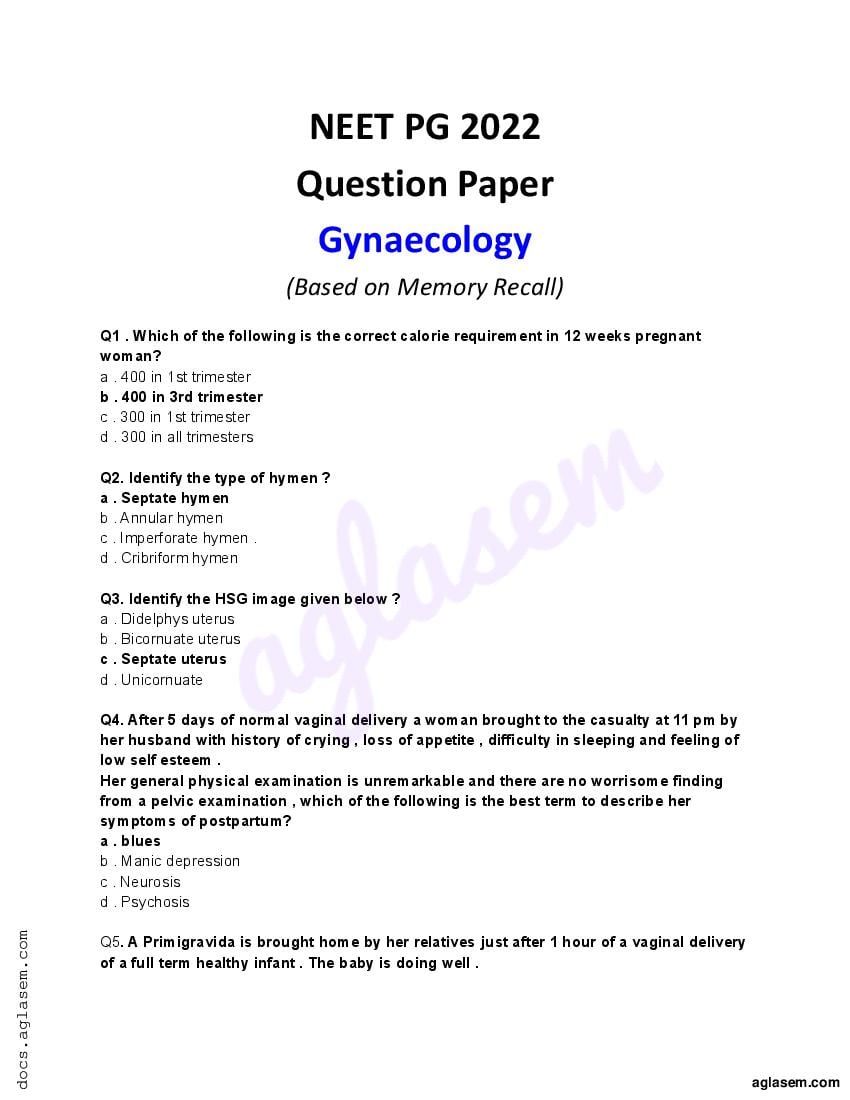
NEET PG 2022 Question Paper Obstetrics and Gynaecology
Finished viewing? Save it for later —
Download NEET PG 2022 Question Paper Obstetrics and Gynaecology (PDF · 3 pages)About NEET PG 2022 Question Paper Obstetrics and Gynaecology
NEET PG 2022 Question Paper Obstetrics and Gynaecology is available here for free download. Published by NBEMS for NEET PG, this question paper can be viewed online or downloaded as a PDF (3 pages). Candidates preparing for NEET PG can use NEET PG 2022 Question Paper Obstetrics and Gynaecology to understand the exam pattern, the type of questions asked, and the overall difficulty level.
Frequently Asked Questions
How can I download NEET PG 2022 Question Paper Obstetrics and Gynaecology?
Open this page and click the Download button to save NEET PG 2022 Question Paper Obstetrics and Gynaecology as a PDF. It is completely free on AglaSem Docs.
Is NEET PG 2022 Question Paper Obstetrics and Gynaecology free to download?
Yes. NEET PG 2022 Question Paper Obstetrics and Gynaecology can be viewed online and downloaded as a PDF free of cost on AglaSem Docs.
How many pages does NEET PG 2022 Question Paper Obstetrics and Gynaecology have?
NEET PG 2022 Question Paper Obstetrics and Gynaecology contains 3 pages, which you can read online or download together as a single PDF.
Where can I find more NEET PG study material?
You can find more NEET PG question papers, sample papers, syllabus, and answer keys on AglaSem Docs.
NEET PG 2022 Question Paper Obstetrics and Gynaecology – Text
Read the full text of this question paper below — useful to quickly search, copy and reference the content online without downloading the PDF.
📄 View text version (3 pages)
Page 1
Question Paper
Gynaecology
(Based on Memory Recall)
Q1 . Which of the following is the correct calorie requirement in 12 weeks pregnant
woman?
a . 400 in 1st trimester
b . 400 in 3rd trimester
c . 300 in 1st trimester
d . 300 in all trimesters
Q2. Identify the type of hymen ?
a . Septate hymen
b . Annular hymen
c . Imperforate hymen .
d . Cribriform hymen
Q3. Identify the HSG image given below ?
a . Didelphys uterus
b . Bicornuate uterus
c . Septate uterus
d . Unicornuate
Q4. After 5 days of normal vaginal delivery a woman brought to the casualty at 11 pm by
her husband with history of crying , loss of appetite , difficulty in sleeping and feeling of
low self esteem .
Her general physical examination is unremarkable and there are no worrisome finding
from a pelvic examination , which of the following is the best term to describe her
symptoms of postpartum?
a . blues
b . Manic depression
c . Neurosis
d . Psychosis
Q5. A Primigravida is brought home by her relatives just after 1 hour of a vaginal delivery
of a full term healthy infant . The baby is doing well .
Page 2
coagulation . Which of the following is the most likely cause?
a . Vaginal bleeding
b . Albuminuria
c . Abdominal distension due to rupture uterus
d . Amniotic fluid embolism
Q6. Identify the area marked in Green ?
a . Pelvic outlet
b . Anatomical outlet
c . Midpelvis
d . Obstetric outlet
Q7. A 34 year old female , previous classical C section is now having breech presentation
confirmed on USG at 34 weeks, insists of normal delivery , what will you do ?
a . Wait for 36 weeks
b . Plan Cesarean section at 37 weeks
c . Repeat USG after a week and decide
d . Do vaginal delivery
Q8. A primi gravida patient presented with soft tender abdomen, on examination fetus is
on ROP position, How will you deliver ?
a . Vacuum assisted delivery
b . C section .
c . Normal Vaginal Delivery
d . Forceps delivery
Q9. The following procedure is being done on a 25 yr old lady in labor . The cord gets
torn . What should be the best thing to do ?
a . Uterine massage
b . Inj oxytocin
c . Manual removal
d . Arrange blood and remove placenta via Crede's method
Q10. Uterine artery doppler done at 14 weeks detects which of the following ?
a . Late onset preeclampsia
b . Early onset preeclampsia
C. IUGR
Q11. A 25 year old female with history of 2 weeks amenorrhea came in emergency
department with c/o scanty vaginal bleeding .on examination no adnexal mass noted.
In lab investigation HCG was 1400mIU/ml, on USG, uterus was bulky, trilaminar
endometrium was seen. Patient vitals stable, what is the next step to do ?
a. Repeat HCG after 48 hrs
b. Give progesterone
Page 3
Q12. what is the position of uterus on postpartum day 2?
a. Two fingers below umblicus
b. Four fingers below umbilicus
c. just above symphysis pubis
d. At the level of umblicus
Q13. Which site of implantation will cause severe vaginal bleeding; no sign of rupture
ectopic despite 22 weeks of gestation?
A. Internal os.
B.Ovary
C.Tube
D.Abdominal
Q14. The fetus is at the level of ischial spine, ROT. Molding ++, caput ++. What's the
appropriate management?
a. Vacumm
b. Forceps
c. Lscs
Q15. Apre eclampsia patient presented with absent Bilateral plantar reflex. Lungs clear ,
RBS - 200+ , Patellar reflex absent. What is the possible diagnosis?
a. diabetes insipidus
b. postpartum eclampsia
c. Mgso4 toxicity
Q16. What is the absolute contra indication of cervical cerclage:
a. Rupture of membrane
b. Bag of water in vagina
c. History of ectopic pregnancy
d. Previous miscarriage
Q17. A pregnant lady at 32 weeks gestation develop proteinuria and hypertension, doctor
suspect a case of placental insufficiency. Due to
a. extra villous cytotrophoblast invasion in spiral artery
b. Villous cytotrophoblast invasion in spiral artery
c. Extravillous cytotrophoblast invasion in luminal artery.
Document Details
| Board / Org | NBEMS |
| Exam | NEET PG |
| Type | Question Paper |
| Pages | 3 |
| Updated | 23 Oct 2026 |