Kerala Class 12 First Term Question Paper 2025 Chemistry – Text
Read the full text of this question paper below — useful to quickly search, copy and reference the content online without downloading the PDF.
📄 View text version (2 pages)
Page 1
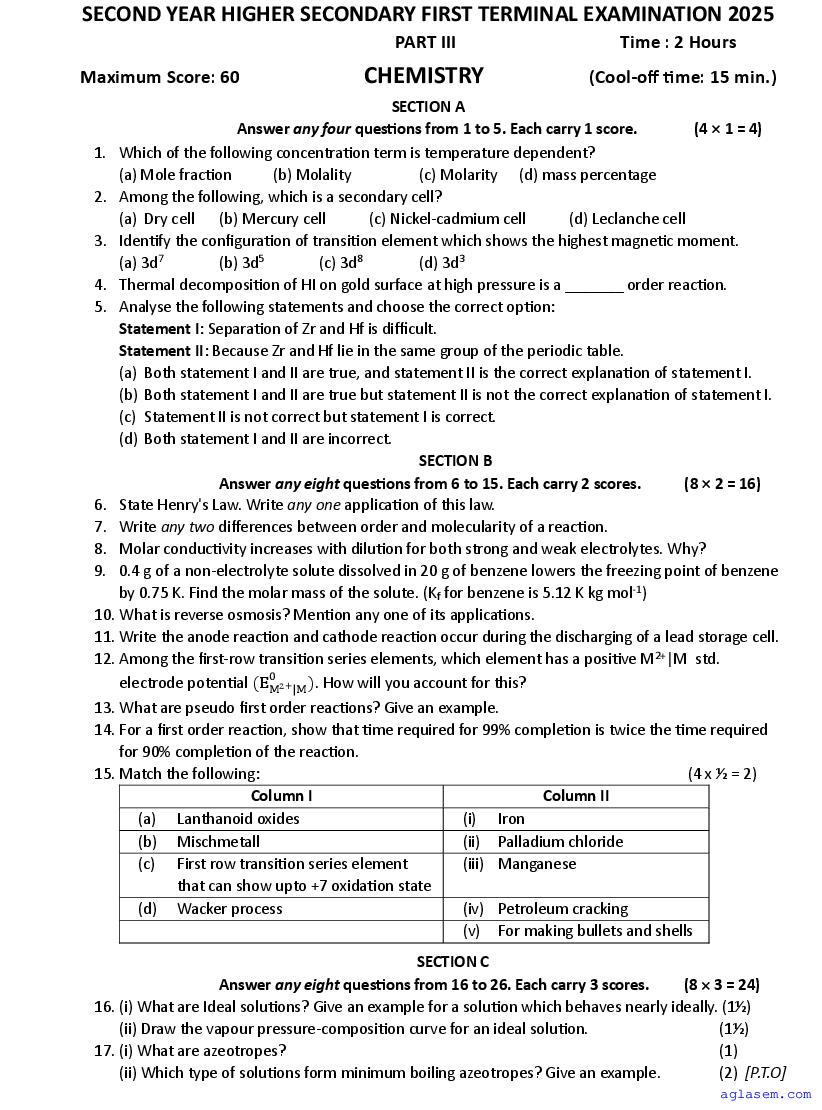
SECOND YEAR HIGHER SECONDARY FIRST TERMINAL EXAMINATION 2025 PART III Time : 2 Hours Maximum Score: 60 CHEMISTRY (Cool-off time: 15 min.) SECTION A Answer any four questions from 1 to 5. Each carry 1 score. (4 1 = 4) 1. Which of the following concentration term is temperature dependent? (a) Mole fraction (b) Molality (c) Molarity (d) mass percentage 2. Among the following, which is a secondary cell? (a) Dry cell (b) Mercury cell (c) Nickel-cadmium cell (d) Leclanche cell 3. Identify the configuration of transition element which shows the highest magnetic moment. (a) 3d7 (b) 3d5 (c) 3d8 (d) 3d3 4. Thermal decomposition of HI on gold surface at high pressure is a _______ order reaction. 5. Analyse the following statements and choose the correct option: Statement I: Separation of Zr and Hf is difficult. Statement II: Because Zr and Hf lie in the same group of the periodic table. (a) Both statement I and II are true, and statement II is the correct explanation of statement I. (b) Both statement I and II are true but statement II is not the correct explanation of statement I. (c) Statement II is not correct but statement I is correct. (d) Both statement I and II are incorrect. SECTION B Answer any eight questions from 6 to 15. Each carry 2 scores. (8 2 = 16) 6. State Henry's Law. Write any one application of this law. 7. Write any two differences between order and molecularity of a reaction. 8. Molar conductivity increases with dilution for both strong and weak electrolytes. Why? 9. 0.4 g of a non-electrolyte solute dissolved in 20 g of benzene lowers the freezing point of benzene by 0.75 K. Find the molar mass of the solute. (Kf for benzene is 5.12 K kg mol-1) 10. What is reverse osmosis? Mention any one of its applications. 11. Write the anode reaction and cathode reaction occur during the discharging of a lead storage cell. 12. Among the first-row transition series elements, which element has a positive M2+|M std. 0 electrode potential (EM 2+ |M ). How will you account for this? 13. What are pseudo first order reactions? Give an example. 14. For a first order reaction, show that time required for 99% completion is twice the time required for 90% completion of the reaction. 15. Match the following: (4 x ½ = 2) Column I Column II (a) Lanthanoid oxides (i) Iron (b) Mischmetall (ii) Palladium chloride (c) First row transition series element (iii) Manganese that can show upto +7 oxidation state (d) Wacker process (iv) Petroleum cracking (v) For making bullets and shells SECTION C Answer any eight questions from 16 to 26. Each carry 3 scores. (8 3 = 24) 16. (i) What are Ideal solutions? Give an example for a solution which behaves nearly ideally. (1½) (ii) Draw the vapour pressure-composition curve for an ideal solution. (1½) 17. (i) What are azeotropes? (1) (ii) Which type of solutions form minimum boiling azeotropes? Give an example. (2) [P.T.O]
Page 2
18. The standard electrode potentials for nickel electrode (Ni|Ni2+) and copper electrode (Cu|Cu2+) are –0.25 V and 0.34 V respectively. (a) Identify the anode and cathode of the cell formed by the above electrodes. (1) 0 (b) Calculate the standard emf (Ecell ) of the above cell. (1) (c) Write the Nernst equation for this cell. (1) 19. (i) State Kohlrausch’s law of independent migration of ions. (1) –1 2 –1 (ii) The molar conductivity of 0.025 mol L Methanoic acid is 46.1 S cm mol . Calculate its degree of dissociation. Given Λ0(H+) = 349.6 S cm2 mol–1 and Λ0(HCOO–) = 54.6 S cm2 mol–1. (2) 20. (i) What are the products obtained at the anode and cathode, when an aqueous solution of NaCl is electrolysed. (1) (ii) If a current of 0.5 ampere flows through a metallic wire for 2 hours, then how many electrons would flow through the wire? (2) 21. Half-life period of a first order reaction is 20 seconds. How much time will it take to reduce the initial concentration of the reactant to its 1⁄16 th value? 22. Define the following terms: (i) Activation energy (ii) Collision frequency (iii) Effective collision 23. For the reaction, 2NO(g) + O2(g) → 2NO2(g), the rate law is given as, rate = k[NO]2[O2]. (i) Write the order of the reaction with respect to NO. (1) (ii) What is the overall order of the reaction? (1) (iii) What happens to the rate of the reaction when the concentration of NO is doubled. (1) 24. Explain the preparation of potassium dichromate from chromite ore? Write the necessary chemical equations. 25. What is meant by lanthanoid contraction? Write any two consequences of it. 26. (i) Write the electronic configuration of the following transition metal ions and identify the ions which are coloured in aqueous solution: Sc3+, Ti3+, Cr3+, Cu+ (Atomic number of Sc, Ti, Cr and Cu are 21, 22, 24 and 29 respectively). (2½) (ii) Most of the transition metal ions are coloured in aqueous solution. Why? (½) SECTION D Answer any four questions from 27 to 31. Each carry 4 scores. (4 4 = 16) 27. (i) What are colligative properties? Write the names of any two colligative properties. (2) (ii) Which colligative property is preferred for the determination of the molar mass of proteins? Why? (1) (iii) What happens if we place our blood cells in a solution containing more than 0.9% (mass/ volume) sodium chloride solution? (1) 28. (i) Write the equation relating rate constant and temperature for a chemical reaction. (1) I − / Alkaline medium (ii) For the reaction, 2H2O2 → 2H2O + O2, the rate law is r = k[H2O2][I-]. Write the chemical equation for the rate determining step in the mechanism of this reaction. (1) (iii) The rate constant of a reaction doubles when the temperature is increased from 27 C to 370C. 0 Calculate the activation energy for the reaction (R = 8.314 J K-1 mol-1). (2) 29. (i) What are fuel cells? (1) (ii) Write any two advantages of fuel cells. (1) (iii) Write the anode reaction, cathode reaction and net reaction occurring in a H2–O2 fuel cell. (2) 30. (i) Draw the structures of chromate and dichromate ions. (2) (ii) Write one reaction that shows the oxidising property of potassium permanganate in acidic medium. Write down the balanced chemical equation. (2) 31. (i) Define van’t Hoff factor. (1) (ii) Determine the osmotic pressure of a solution prepared by dissolving 3.33 g of MgCl2 in 3 litre water at 270C. (Atomic mass of Mg = 24u and Cl = 35.5u, R = 0.0821 L atm K-1 mol-1 and i = 3) (3) ===============================================================================