Tamil Nadu 11th Std Model Question Paper 2026 Computer Science
Finished viewing? Save it for later —
Download Tamil Nadu 11th Std Model Question Paper 2026 Computer Science (PDF · 11 pages)About Tamil Nadu 11th Std Model Question Paper 2026 Computer Science
Tamil Nadu 11th Std Model Question Paper 2026 Computer Science is available here for free download. Published by Tamil Nadu Board for Class 11, this sample paper can be viewed online or downloaded as a PDF (11 pages). Candidates preparing for Class 11 can use Tamil Nadu 11th Std Model Question Paper 2026 Computer Science to understand the exam pattern, the type of questions asked, and the overall difficulty level.
Frequently Asked Questions
How can I download Tamil Nadu 11th Std Model Question Paper 2026 Computer Science?
Open this page and click the Download button to save Tamil Nadu 11th Std Model Question Paper 2026 Computer Science as a PDF. It is completely free on AglaSem Docs.
Is Tamil Nadu 11th Std Model Question Paper 2026 Computer Science free to download?
Yes. Tamil Nadu 11th Std Model Question Paper 2026 Computer Science can be viewed online and downloaded as a PDF free of cost on AglaSem Docs.
How many pages does Tamil Nadu 11th Std Model Question Paper 2026 Computer Science have?
Tamil Nadu 11th Std Model Question Paper 2026 Computer Science contains 11 pages, which you can read online or download together as a single PDF.
Where can I find more Class 11 study material?
You can find more Class 11 question papers, sample papers, syllabus, and answer keys on AglaSem Docs.
Tamil Nadu 11th Std Model Question Paper 2026 Computer Science – Text
Read the full text of this sample paper below — useful to quickly search, copy and reference the content online without downloading the PDF.
📄 View text version (11 pages)
Page 1
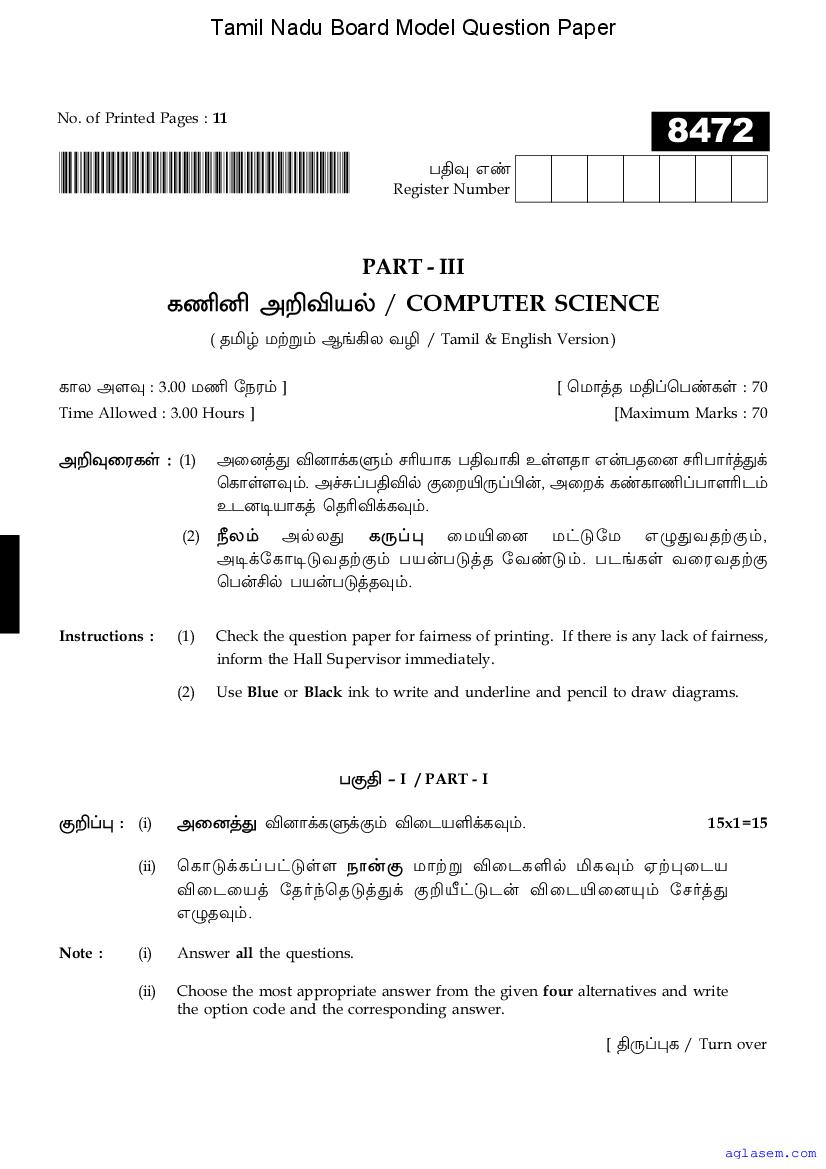
No. of Printed Pages : 11
8472
!8472IstYearComputerScience! £vÄ Gs
Register Number
PART - III
PoÛ AÔ¯À / COMPUTER SCIENCE
( uªÌ ©ØÖ® B[Q» ÁÈ / Tamil & English Version )
Põ» AÍÄ : 3.00 ©o ÷|µ® ] [ ö©õzu ©v¨ö£sPÒ : 70
Time Allowed : 3.00 Hours ] [Maximum Marks : 70
AÔÄøµPÒ : (1) AøÚzx ÂÚõUPЮ \›¯õP £vÁõQ EÒÍuõ GߣuøÚ \›£õºzxU
öPõÒÍÄ®. Aa_¨£vÂÀ SøÓ°¸¨¤ß, AøÓU PsPõo¨£õÍ›h®
EhÚi¯õPz öu›ÂUPÄ®.
(2) }»® AÀ»x P¸¨¦ ø©°øÚ ©mk÷© GÊxÁuØS®,
AiU÷PõikÁuØS® £¯ß£kzu ÷Ásk®. £h[PÒ ÁøµÁuØS
ö£ß]À £¯ß£kzuÄ®.
Instructions : (1) Check the question paper for fairness of printing. If there is any lack of fairness,
inform the Hall Supervisor immediately.
(2) Use Blue or Black ink to write and underline and pencil to draw diagrams.
£Sv – I / PART - I
SÔ¨¦ : (i) AøÚzx ÂÚõUPÐUS® Âøh¯ÎUPÄ®. 15x1=15
(ii) öPõkUP¨£mkÒÍ |õßS ©õØÖ ÂøhPÎÀ ªPÄ® Hئøh¯
Âøhø¯z ÷uº¢öukzxU SÔ±mkhß Âøh°øÚ²® ÷\ºzx
GÊuÄ®.
Note : (i) Answer all the questions.
(ii) Choose the most appropriate answer from the given four alternatives and write
the option code and the corresponding answer.
Page 2
1. uØPõ¼P {øÚÁP® Gx ?
(A) RAM (B) ROM (C) EPROM (D) PROM
Name the volatile memory.
(a) RAM (b) ROM (c) EPROM (d) PROM
2. §¼¯ß C¯ØPouzvÀ A+A= ?
(A) 1 (B) A (C) A (D) 0
In Boolean Algebra A+A= ?
(a) 1 (b) A (c) A (d) 0
3. JØøÓ £¯Úº C¯UP Aø©¨¤ØS GkzxUPõmk :
(A) MS-DOS (B) ¼ÚUì (C) ²ÛUì (D) Âs÷hõì
An example for single task operating system is :
(a) MS-DOS (b) Linux (c) Unix (d) Windows
4. a=5; C¯[SÁuØS •ß a :=a−1 C¯[Q¯uØS ¤ß a &ß ©v¨¦ :
(A) 3 (B) 5 (C) 2 (D) 4
If a=5 before the assignment a :=a−1 after the assignment, the value of a is :
(a) 3 (b) 5 (c) 2 (d) 4
5. ©hUQØS •ßÚº C ö£õ´ GÛÀ Pmk¨£õmk £õ´Ä Guß ÁÈ÷¯ C¯[S® ?
(1) S1
(2) while C
(3) S2
(4) S3
(A) S1; S2; S2; S3 (B) S1; S3
(C) S1; S2; S2; S2; S3 (D) S1; S2; S3
If C is false just before the loop, the control flows through :
(1) S1
(2) while C
(3) S2
(4) S3
(a) S1; S2; S2; S3 (b) S1; S3
(c) S1; S2; S2; S2; S3 (d) S1; S2; S3
Page 3
6. ¤ßÁ¸ÁÚÁØÖÒ Gx uµÂÚ[PÎß £s¦nºzv AÀ» ?
(A) long (B) signed (C) short (D) int
Which of the following is not a data type modifier ?
(a) long (b) signed (c) short (d) int
7. ¤ßÁ¸® ©hUS GzuøÚ •øÓ C¯[S® ?
for (int a=0; a<10; a++)
(A) 9 (B) 0 (C) 11 (D) 10
How many times the following loop will execute ?
for (int a=0; a<10; a++)
(a) 9 (b) 0 (c) 11 (d) 10
8. {µ¼ß ö\¯»õUP® G¢u ö\¯ØTÔ¼¸¢x öuõh[S® ?
(A) main( ) (B) isalpha( ) (C) islower( ) (D) isdigit( )
Which function begins the program execution ?
(a) main( ) (b) isalpha( ) (c) islower( ) (d) isdigit( )
9. J¸ Pmk¸ AÔ¨¦ RÌPshÁõÖ öPõkUP¨£mkÒÍx.
struct Time
{
int hours;
int minutes;
int seconds;
}t;
÷©÷» EÒÍ AÔ¨¤À seconds GßÓ Pmk¸ ©õÔø¯ ¤ßÁ¸ÁÚÁØÖÒ Gx
SÔUQÓx ?
(A) seconds (B) Time.seconds (C) t.seconds (D) Time::seconds
A structure declaration is given below.
struct Time
{
int hours;
int minutes;
int seconds;
}t;
Using above declaration which of the following refers to seconds ?
(a) seconds (b) Time.seconds (c) t.seconds (d) Time::seconds
Page 4
10. ¤ßÁ¸ÁÚÁØÖÒ Gx £¯Úº Áøµ¯ÖUS® uµÄ ÁøP ?
(A) •Ê Gs (B) CÚUSÊ (C) ö£õ¸Ò (D) ªuøÁ
Which of the following is a user defined data type ?
(a) int (b) class (c) object (d) float
11. CÚUSÊÂß EÖ¨¦PøÍ AqSÁuØS G¢u ö\¯ØSÔ £¯ß£kQÓx ?
(A) . (¦ÒÎ) (B) : (•UPõئÒÎ)
(C) :: (Áøµö¯Àø») (D) ; (Aøµ¦ÒÎ)
Which operator is used to access the class members ?
(a) . (dot) (b) : (colon)
(c) :: (scope resolution) (d) ; (semicolon)
12. ¤ßÁ¸ÁÚÁØÖÒ Gx ö\¯ØTÖPÐUS ÷ÁÖ£mh ö£õ¸Ò EÒÍøu
SÔUQÓx ?
(A) ö\¯ØSÔ £oªS¨¦ (B) ö\¯ØTÖ £oªS¨¦
(C) ö\¯Ø£õk £oªS¨¦ (D) EÖ¨¦ £oªS¨¦
Which of the following refers to a function having more than one distinct meaning ?
(a) Operator overloading (b) Function overloading
(c) Operations overloading (d) Member overloading
13. ©µ¦›©® ö\¯À•øÓ°À, ¦v¯ CÚUSÊ Gv¼¸¢x E¸ÁõUP¨£kQÓx ?
(A) u¸ÂUP¨£mh CÚUSÊ (B) Ai¨£øh CÚUSÊ
(C) ö\¯ØTÖ (D) A¸Á©õUP®
Inheritance is a process of creating new class from :
(a) derived class (b) Base class
(c) Function (d) abstract
14. \mh Â÷µõu©õP ö£õx©UPÐUS QøhUP Ti¯ ÁoP {µÀPÒ __________.
(A) C»Á\ ö©ßö£õ¸Ò (B) C»Á\ ö£õ¸Ò
(C) ö©ßö£õ¸Ò (D) ÁõºìPÒ
Commercial Programs made available to the public illegally are known as __________.
(a) free software (b) freeware
(c) software (d) warez
Page 5
15. TSCII &ß Â›ÁõUP® ?
(A) Tamil Scope Code for Information Interchange
(B) Tamil Script Code for Information Interchange
(C) Tamil Scope Code for International Interchange
(D) Tamil Script Code for International Interchange
Expansion for TSCII.
(a) Tamil Scope Code for Information Interchange
(b) Tamil Script Code for Information Interchange
(c) Tamil Scope Code for International Interchange
(d) Tamil Script Code for International Interchange
£Sv – II / PART - II
SÔ¨¦ : GøÁ÷¯Ý® BÖ ÂÚõUPÐUS Âøh¯ÎUPÄ®. ÂÚõ Gs 24 &US
Pmhõ¯©õP Âøh¯ÎUPÄ®. 6x2=12
Note : Answer any six questions. Question No. 24 is compulsory.
16. ø©¯a ö\¯»Pzvß (CPU) £SvPÒ ¯õøÁ ?
What are the components of a CPU ?
17. {µÀ PÄsmhº GßÓõÀ GßÚ ?
What is a program counter ?
18. ö\¢uµ £oUSÔ GßÓõÀ GßÚ ?
What are called standard icons ?
19. Pmk¨£õmk £õ´Ä TØÖPÒ ¯õøÁ ?
What are the control flow statements ?
20. setw( ) ÁiÁø©¨¦ øP¯õЮ ö\¯ØTÔß £¯ß GßÚ ?
What is the use of setw( ) format manipulator ?
Page 6
21. £À¾¸ÁõUP® GßÓõÀ GßÚ ?
What is Polymorphism ?
22. £oªSUP •i¯õu ö\¯ØSÔPøͨ £mi¯¼kP.
List the operators that cannot be overloaded.
23. L¤æ[ GßÓõÀ GßÚ ?
What is phishing ?
24. ¤ßÁ¸® {µ¼ß öÁαmøh GÊxP.
#include<iostream>
#include<string.h>
int main()
{
char str1[50];
str1=“COMPUTER SCIENCE”;
cout<<strlwr(str1);
cout<<strlen(str1);
}
Write the output of the following program.
#include<iostream>
#include<string.h>
int main()
{
char str1[50];
str1=“COMPUTER SCIENCE”;
cout<<strlwr(str1);
cout<<strlen(str1);
}
Page 7
£Sv – III / PART - III
SÔ¨¦ : HuõÁx BÖ ÂÚõUPÐUS Âøh¯ÎUPÄ®. ÂÚõ Gs 33 &US
Pmhõ¯©õP Âøh¯ÎUPÄ®. 6x3=18
Note : Answer any six questions. Question No. 33 is compulsory.
25. öPõkUP¨£mkÒÍ C¸{ø» Gsøn Gsoø» ©ØÖ® £vÚõÖ{ø» GsnõP
©õØÖP
101110101 2
Convert the given Binary number into its equivalent octal and hexadecimal number.
101110101 2
26. C¯UP Aø©¨¤ß •UQ¯ ]Ó¨¤¯À¦PøÍ £mi¯¼kP.
List out the key features of operating system.
27. A¸Á©õUP® GßÓõÀ GßÚ ?
What is Abstraction ?
28. uØ_ÇØ] GßÓõÀ GßÚ ?
What is Recursion ?
29. \µ[PÎß Aoø¯¨ £ØÔ ]Ö SÔ¨¦ GÊxP.
Write a short note on Array of strings.
30. BUQPÎß ÁøPPÒ ¯õøÁ ?
What are the types of constructors ?
31. private, public, protected Põs¦{ø» £õ[SPøÍ ÷ÁÖ£kzxP.
Differentiate between private, public, protected visibility modes.
32. uªÌ Cøn¯U PÀÂPÇP® ]Ö SÔ¨¦ ÁøµP.
Write a short note on Tamil Virtual Academy.
33. for ©hUøP £¯ß£kzv 1 •uÀ 10 Áøµ EÒÍ GsPÎß öuõhº Tmhø»
öÁΰk® C++ {µÀ GÊxP.
Write a C++ program to sum the numbers from 1 to 10 using for loop.
Page 8
£Sv – IV / PART - IV
SÔ¨¦ : AøÚzx ÂÚõUPÐUS® Âøh¯ÎUPÄ®. 5x5=25
Note : Answer all the questions.
34. (A) ¤ßÁ¸ÁÚÁØøÓ ÂÍUSP.
(i) ø©¨¥a_ Aa_¨ö£õÔ
(ii) £À¿hP¨ £hÃÌzv
(iii) £møhU SÔ±k / QR SÔ±k £i¨£õß
AÀ»x
(B) R÷Ç öPõkUP¨£mkÒÍ A, B ©ØÖ® C ©õÔPÎß ©v¨¦PøÍ JßÔ¼¸¢x,
©ØöÓõßÖUS _ÇØ]¯õP ©õØÖ® ÂÁµUSÔ¨¦ ©ØÖ® ö|Ô•øÓø¯
Pmhø©UPÄ®. A®¦USÔ°h¨£mkÒÍ£i, B ©õÔUPõÚ ©v¨¦
A ©õÔ°¼¸¢x®, C ©õÔUPõÚ ©v¨¦ B ©õÔ°¼¸¢x®, A ©õÔUPõÚ
©v¨¦ C ©õÔ°¼¸¢x® ö£Ó¨£k®.
(a) Explain the following :
(i) Inkjet Printer
(ii) Multimedia Projector
(iii) Barcode / QR code Reader
OR
(b) Circulate the contents : Write the specification and construct an algorithm to circulate
the contents of the variables A, B and C as shown below : The arrows indicate that B
gets the value of A, C gets the value of B and A gets the value of C.
Page 9
35. (A) ~sö\¯¼°ß £s¦ TÖPøÍ ÂÍUSP.
AÀ»x
(B) ~øÇÄ ÷\õv¨¦ ©hUS GßÓõÀ GßÚ ? H÷uÝ® J¸ ~øÇÄ ÷\õv¨¦
©hUøP ö£õ¸zu©õÚ GkzxUPõmkhß ÂÍUSP.
(a) Explain the characteristics of a microprocessor.
OR
(b) What is an entry control loop ? Explain any one of the entry controlled loop with
suitable example.
36. (A) (i) TmkP : 1101010 2 +101101 2
(ii) PÈUP : 1101011 2 −111010 2
AÀ»x
(B) ©v¨¦ ‰»® AøÇzuÀ •øÓø¯ uS¢u GkzxUPõmkhß ÂÍUSP.
(a) (i) Add : 1101010 2 +101101 2
(ii) Subtract : 1101011 2 −111010 2
OR
(b) Explain call by value method with suitable example.
37. (A) C++ {µø» E¸ÁõUSÁuØS®, C¯USÁuØS® ¤ß£ØÓ ÷Ási¯
£i{ø»PøÍ GÊxP.
AÀ»x
(B) ö£õ¸Ò ÷|õUS {µ»õUPzvß |ßø©PÒ ¯õøÁ ?
(a) Write the important steps one must follow for creating and executing a C++ program.
OR
(b) What are the advantages of OOPs ?
Page 10
38. (A) ¤ßÁ¸® C++ {µ¼À EÒÍ ¤øÇPøÍ v¸zxP.
(a) Debug the following C++ program.
Output :
Enter First String : COMPUTER
Enter Second String : SCIENCE
Concatenated String is : COMPUTERSCIENCE
Program :
~INCLUDE(iostream)
~include<string.h>
using namespace std;
class strings
{
PUBLIC;
char s[20];
VOID getstring(char str[ ]):
{
strcpy(s, str):
}
void operator+(strings);
}:
void strings :: operator+(strings ob)
{
strcat(s:ob:s);
cout>> “\n concatenated string is:”<<s;
}
int main[]
{
string ob1, ob2;
char string1[10], string2[10];
cout>>“\n Enter First String:”;
cin<<string1;
ob1.getstring(string1);
cout<<“\n Enter Second String:”;
cin<<string2:
ob2.getstring(string2);
ob1+ob2;
return 0;
};
AÀ»x / OR
Page 11
(B) ¤ßÁ¸® C++ {µ¼ß öÁαmøh GÊxP.
(b) Write the output of the following C++ program.
#include<iostream>
using namespace std;
Struct Student
{
int age;
float height, weight;
} m;
void main( )
{
cout<<“Enter the age:”<<endl;
cin>>m.age;
cout<<“Enter the height:”<<endl;
cin>>m.height;
cout<<“Enter the weight:”<<endl;
cin>>m.weight;
cout<<“The values entered”<<endl;
cout<<m.age<<“\t”<<m.height<<“\t”<<m.weight;
}
-oOo-
Document Details
| Board / Org | Tamil Nadu Board |
| Exam | Class 11 |
| Type | Sample Paper |
| Pages | 11 |
| Updated | 24 Sep 2026 |