PU LLB Migration Test 2027 Sample Paper
Finished viewing? Save it for later —
Download PU LLB Migration Test 2027 Sample Paper (PDF · 10 pages)About PU LLB Migration Test 2027 Sample Paper
PU LLB Migration Test 2027 Sample Paper is available here for free download. Published by Panjab University for PU LLB Migration Test, this sample paper can be viewed online or downloaded as a PDF (10 pages). Candidates preparing for PU LLB Migration Test can use PU LLB Migration Test 2027 Sample Paper to understand the exam pattern, the type of questions asked, and the overall difficulty level.
Frequently Asked Questions
How can I download PU LLB Migration Test 2027 Sample Paper?
Open this page and click the Download button to save PU LLB Migration Test 2027 Sample Paper as a PDF. It is completely free on AglaSem Docs.
Is PU LLB Migration Test 2027 Sample Paper free to download?
Yes. PU LLB Migration Test 2027 Sample Paper can be viewed online and downloaded as a PDF free of cost on AglaSem Docs.
How many pages does PU LLB Migration Test 2027 Sample Paper have?
PU LLB Migration Test 2027 Sample Paper contains 10 pages, which you can read online or download together as a single PDF.
Where can I find more PU LLB Migration Test study material?
You can find more PU LLB Migration Test question papers, sample papers, syllabus, and answer keys on AglaSem Docs.
PU LLB Migration Test 2027 Sample Paper – Text
Read the full text of this sample paper below — useful to quickly search, copy and reference the content online without downloading the PDF.
📄 View text version (10 pages)
Page 1
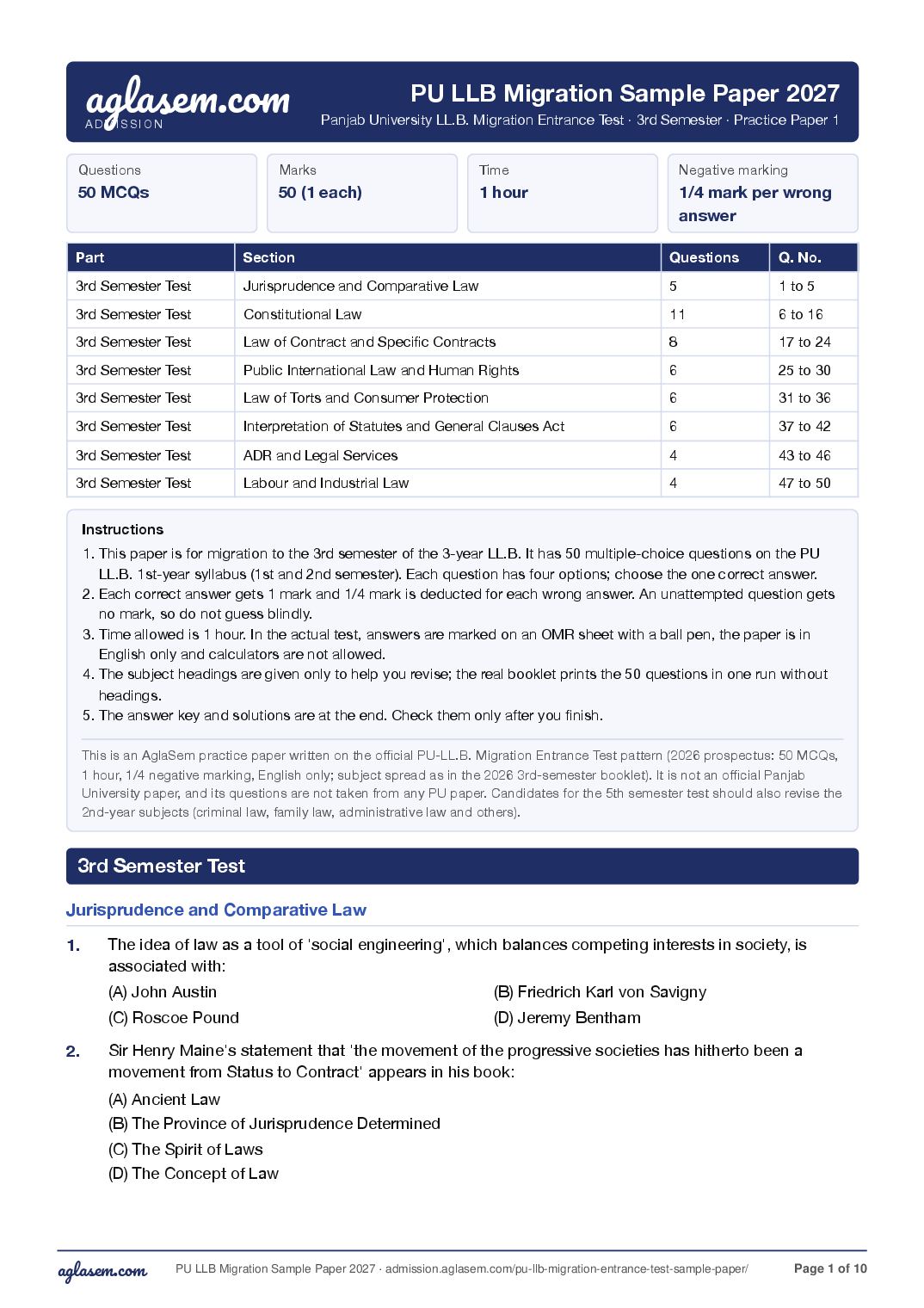
PU LLB Migration Sample Paper 2027
Panjab University LL.B. Migration Entrance Test · 3rd Semester · Practice Paper 1
Questions Marks Time Negative marking
50 MCQs 50 (1 each) 1 hour 1/4 mark per wrong
answer
Part Section Questions Q. No.
3rd Semester Test Jurisprudence and Comparative Law 5 1 to 5
3rd Semester Test Constitutional Law 11 6 to 16
3rd Semester Test Law of Contract and Specific Contracts 8 17 to 24
3rd Semester Test Public International Law and Human Rights 6 25 to 30
3rd Semester Test Law of Torts and Consumer Protection 6 31 to 36
3rd Semester Test Interpretation of Statutes and General Clauses Act 6 37 to 42
3rd Semester Test ADR and Legal Services 4 43 to 46
3rd Semester Test Labour and Industrial Law 4 47 to 50
Instructions
1. This paper is for migration to the 3rd semester of the 3-year LL.B. It has 50 multiple-choice questions on the PU
LL.B. 1st-year syllabus (1st and 2nd semester). Each question has four options; choose the one correct answer.
2. Each correct answer gets 1 mark and 1/4 mark is deducted for each wrong answer. An unattempted question gets
no mark, so do not guess blindly.
3. Time allowed is 1 hour. In the actual test, answers are marked on an OMR sheet with a ball pen, the paper is in
English only and calculators are not allowed.
4. The subject headings are given only to help you revise; the real booklet prints the 50 questions in one run without
headings.
5. The answer key and solutions are at the end. Check them only after you finish.
This is an AglaSem practice paper written on the official PU-LL.B. Migration Entrance Test pattern (2026 prospectus: 50 MCQs,
1 hour, 1/4 negative marking, English only; subject spread as in the 2026 3rd-semester booklet). It is not an official Panjab
University paper, and its questions are not taken from any PU paper. Candidates for the 5th semester test should also revise the
2nd-year subjects (criminal law, family law, administrative law and others).
3rd Semester Test
Jurisprudence and Comparative Law
1. The idea of law as a tool of 'social engineering', which balances competing interests in society, is
associated with:
(A) John Austin (B) Friedrich Karl von Savigny
(C) Roscoe Pound (D) Jeremy Bentham
2. Sir Henry Maine's statement that 'the movement of the progressive societies has hitherto been a
movement from Status to Contract' appears in his book:
(A) Ancient Law
(B) The Province of Jurisprudence Determined
(C) The Spirit of Laws
(D) The Concept of Law
PU LLB Migration Sample Paper 2027 · admission./pu-llb-migration-entrance-test-sample-paper/ Page 1 of 10
Page 2
and the rule of adjudication are called:
(A) Secondary rules (B) Basic norms
(C) Rules of natural law (D) Primary rules
4. The view that law is nothing more than 'the prophecies of what the courts will do in fact' belongs to:
(A) Henry Maine, of the historical school
(B) Oliver Wendell Holmes, of the realist school
(C) Thomas Aquinas, of the natural law school
(D) John Austin, of the analytical school
5. The grouping of the legal systems of the world into 'families', such as the Romano-Germanic, Common
Law and Socialist families, is chiefly associated with:
(A) Alan Watson (B) Max Weber
(C) Hans Kelsen (D) René David
Constitutional Law
6. The doctrine of colourable legislation is best expressed by the principle that:
(A) what cannot be done directly cannot be done indirectly
(B) every law is presumed to be constitutional
(C) a law in force before 1950 remains valid
(D) a later law repeals an earlier law on the subject
7. A classification made by law is valid under Article 14 if it is founded on an intelligible differentia and:
(A) it was made before the Constitution came into force
(B) the differentia has a rational nexus with the object of the law
(C) it is approved by a resolution of both Houses of Parliament
(D) it applies equally to every citizen of India
8. The guarantee that 'no person accused of any offence shall be compelled to be a witness against
himself' is contained in:
(A) Article 22(1) (B) Article 21
(C) Article 20(2) (D) Article 20(3)
9. Under Article 22(4), a law for preventive detention cannot authorise detention for longer than three
months unless:
(A) the detenu gives consent to it in writing
(B) an Advisory Board reports sufficient cause for it
(C) the State Legislature approves it by a resolution
(D) the President signs a separate detention order
10. The collegium system, under which the Chief Justice of India and senior judges decide on appointment
of judges, was laid down in:
(A) the Keshav Singh case (1965) (B) the First Judges case (1981)
(C) the Minerva Mills case (1980) (D) the Second Judges case (1993)
11. Under Article 61, the President of India can be removed by impeachment only on the ground of:
(A) proved misbehaviour or incapacity
(B) conviction for any criminal offence
(C) loss of the confidence of the Lok Sabha
(D) violation of the Constitution
PU LLB Migration Sample Paper 2027 · admission./pu-llb-migration-entrance-test-sample-paper/ Page 2 of 10
Page 3
then, as a rule under Article 254:
(A) the law made by Parliament prevails
(B) the State law prevails within that State
(C) the later of the two laws prevails
(D) both laws become void to that extent
13. A new All India Service can be created by Parliament under Article 312 only after:
(A) a majority of State Legislatures ratify the proposal
(B) the Rajya Sabha passes a resolution by a two-thirds majority
(C) the Supreme Court gives its advisory opinion on it
(D) the Union Public Service Commission recommends it
14. Under Article 85, the President must summon the Houses of Parliament so that the gap between the
last sitting of one session and the first sitting of the next is not more than:
(A) six months (B) four months
(C) one year (D) three months
15. Under the Constitution, a pardon for a sentence passed by a court martial can be granted by:
(A) the Supreme Court, under Article 142
(B) the President, under Article 72
(C) the Prime Minister, under Article 78
(D) the Governor, under Article 161
16. The right of all minorities, whether based on religion or language, to establish and administer
educational institutions of their choice is given by:
(A) Article 29(2) (B) Article 26(a)
(C) Article 28(1) (D) Article 30(1)
Law of Contract and Specific Contracts
17. In Carlill v. Carbolic Smoke Ball Co. (1893), the court held that in the case of a general offer:
(A) acceptance must be posted to the offeror before any performance
(B) only the first person to perform can ever accept the offer
(C) performing its conditions is acceptance, without notice of it
(D) no contract arises, as the offer is not made to anyone in particular
18. In Lalman Shukla v. Gauri Dutt (1913), a servant who traced a missing boy before he knew of the reward
could not claim it, because:
(A) there can be no acceptance without knowledge of the offer
(B) a reward is a gift that the law does not enforce
(C) the reward was offered for an unlawful object
(D) a servant cannot contract with his own master
19. A, a tradesman, leaves goods at B's house by mistake. B treats the goods as his own. B is bound to
pay A for them under:
(A) Section 70 of the Indian Contract Act
(B) Section 71 of the Indian Contract Act
(C) Section 68 of the Indian Contract Act
(D) Section 72 of the Indian Contract Act
PU LLB Migration Sample Paper 2027 · admission./pu-llb-migration-entrance-test-sample-paper/ Page 3 of 10
Page 4
guarantee is called the:
(A) principal debtor (B) creditor
(C) surety (D) indemnity-holder
21. Under Section 151 of the Indian Contract Act, a bailee must take as much care of the goods bailed as:
(A) an insurer would take of goods he has insured
(B) is written down in the contract of bailment only
(C) a man of ordinary prudence would take of his own goods
(D) the bailor himself would take of goods of that kind at home
22. Under the Sale of Goods Act, 1930, the breach of a warranty (as opposed to a condition) gives the
buyer the right to:
(A) rescind the contract and recover the price
(B) treat the contract as void from the start
(C) reject the goods and end the contract
(D) claim damages, but not to reject the goods
23. Under Section 43 of the Indian Partnership Act, 1932, a partnership at will may be dissolved by:
(A) the partners only by a unanimous vote at a meeting
(B) any partner, by written notice to all the other partners
(C) an order of the court only, on the suit of a partner
(D) the Registrar of Firms, after due notice is published
24. Under Section 14 of the Specific Relief Act, 1963, which of these contracts cannot be specifically
enforced?
(A) A contract to sell a particular plot of land
(B) A contract to sell a rare antique vase
(C) A contract with a famous artist to paint a portrait
(D) A contract to sell shares that are not in the market
Public International Law and Human Rights
25. Under Article 9 of the Vienna Convention on Diplomatic Relations, 1961, the receiving State may, at any
time and without giving reasons, declare a member of a diplomatic mission:
(A) persona non grata (B) a prisoner of war
(C) an enemy alien (D) a stateless person
26. How many judges make up the International Court of Justice?
(A) 11 (B) 9
(C) 15 (D) 21
27. The theory under which a new State becomes an international person only when it is recognised by
other States is the:
(A) declaratory theory (B) constitutive theory
(C) Estrada doctrine (D) Stimson doctrine
28. The Montevideo Convention of 1933 lists four qualifications of a State. Which of these is NOT one of
them?
(A) A defined territory
(B) Capacity to enter into relations with other States
(C) Membership of the United Nations
(D) A permanent population
PU LLB Migration Sample Paper 2027 · admission./pu-llb-migration-entrance-test-sample-paper/ Page 4 of 10
Page 5
passage through the:
(A) inland rivers (B) territorial sea
(C) internal waters (D) national airspace
30. The International Covenant on Civil and Political Rights was adopted by the UN General Assembly in:
(A) 1948 (B) 1950
(C) 1966 (D) 1976
Law of Torts and Consumer Protection
31. The maxim 'qui facit per alium facit per se' (he who acts through another does the act himself) is the
basis of:
(A) the defence of necessity (B) contributory negligence
(C) vicarious liability (D) the rule of strict liability
32. In Nichols v. Marsland (1876), the defendant was not liable when artificial lakes on his land burst after an
extraordinary rainfall, because of the defence of:
(A) statutory authority (B) act of a stranger
(C) consent of the plaintiff (D) act of God (vis major)
33. Unlawful interference with a person's use or enjoyment of land, or of some right over it, is the tort of:
(A) public nuisance (B) trespass to land
(C) private nuisance (D) conversion
34. The 'rule of last opportunity' in negligence, under which the party who had the last chance to avoid the
accident is liable, comes from:
(A) Donoghue v. Stevenson (1932) (B) Davies v. Mann (1842)
(C) Ashby v. White (1703) (D) Rylands v. Fletcher (1868)
35. Under the Consumer Protection Act, 2019, a person who buys goods for which of these purposes is
NOT a 'consumer'?
(A) Personal use
(B) Resale for profit
(C) Use by a family member
(D) Earning a livelihood by self-employment
36. Under Section 34 of the Consumer Protection Act, 2019, a complaint can be filed before a District
Commission within whose limits, among other places:
(A) the State Commission for the State is located
(B) the goods were first manufactured by the trader
(C) the complainant resides or personally works for gain
(D) the advertisement for the goods was first shown
Interpretation of Statutes and General Clauses Act
37. The rule that the meaning of a doubtful word can be gathered from the words that go with it ('a word is
known by the company it keeps') is called:
(A) reddendo singula singulis
(B) noscitur a sociis
(C) ejusdem generis
(D) generalia specialibus non derogant
PU LLB Migration Sample Paper 2027 · admission./pu-llb-migration-entrance-test-sample-paper/ Page 5 of 10
Page 6
(A) prefer a reading that makes the law work over one that makes it void
(B) read penal laws strictly in favour of the person accused of the offence
(C) give technical words their trade and technical meaning
(D) follow the decision of a higher court on the same point
39. In Sri Venkataramana Devaru v. State of Mysore (1958), the Supreme Court reconciled Article 25(2)(b)
and Article 26(b) by applying the rule of:
(A) strict construction (B) beneficial construction
(C) literal construction (D) harmonious construction
40. The principle of 'casus omissus' means that:
(A) a proviso must be read as a separate section
(B) the title of an Act cannot be used to read it
(C) a repealed law can come back into force by itself
(D) a court cannot supply what the legislature has left out
41. In Pepper v. Hart, the House of Lords held that, where a statute is ambiguous, a court may refer to:
(A) the private notes of the judge who heard it
(B) the opinions of the law officers of the Crown
(C) Hansard, the record of debates in Parliament
(D) newspaper reports on the passing of the Bill
42. Under Section 21 of the General Clauses Act, 1897, a power to issue notifications, orders, rules or bye-
laws includes a power, exercisable in the like manner, to:
(A) give them effect from any earlier date
(B) add to, amend, vary or rescind them
(C) punish the breach of them by imprisonment
(D) suspend the parent Act for a short period
ADR and Legal Services
43. Under Section 10 of the Arbitration and Conciliation Act, 1996, the parties are free to fix the number of
arbitrators, provided that the number:
(A) includes a retired judge (B) is approved by the court
(C) is not more than three (D) is not an even number
44. Under Section 2(2) of the Arbitration and Conciliation Act, 1996, Part I of the Act (domestic arbitration)
applies, as a rule, where:
(A) the award is to be paid in rupees
(B) both the parties are citizens of India
(C) the contract was signed in India
(D) the place of arbitration is in India
45. Under Section 74 of the Arbitration and Conciliation Act, 1996, a settlement agreement signed by the
parties in a conciliation has:
(A) the same status and effect as an arbitral award on agreed terms
(B) no legal effect until it is registered with the Sub-Registrar
(C) the status of a contract that can be revoked by either party
(D) the force of a decree only after a court approves it on appeal
PU LLB Migration Sample Paper 2027 · admission./pu-llb-migration-entrance-test-sample-paper/ Page 6 of 10
Page 7
legal services, whatever his or her income?
(A) Any woman or any child (B) A practising advocate
(C) A registered partnership firm (D) A retired government officer
Labour and Industrial Law
47. The doctrine of 'notional extension' of the employer's premises is used to decide whether an accident
to a workman on his way to or from work:
(A) was caused by an act of God or by a stranger
(B) arose out of and in the course of his employment
(C) was caused by the workman's own negligence
(D) took place inside the factory gates or not
48. In Jay Engineering Works Ltd. v. State of West Bengal (1968), the Calcutta High Court held that a
'gherao' of managers by workmen:
(A) is not a legitimate trade union activity
(B) is a legal form of a strike in an industry
(C) is protected as a peaceful assembly
(D) is allowed if notice is given in advance
49. In Steel Authority of India Ltd. v. National Union Waterfront Workers (2001), the Supreme Court held that
when contract labour is prohibited in an establishment:
(A) the contract labour is not automatically absorbed by the principal employer
(B) the principal employer must close down the establishment that used them
(C) the contractor must pay double wages to the workers till they are re-employed
(D) the contract labour becomes the regular staff of the principal employer at once
50. Article 43A, which directs the State to secure the participation of workers in the management of
undertakings, was added to the Constitution by the:
(A) 44th Amendment, 1978 (B) 73rd Amendment, 1992
(C) 24th Amendment, 1971 (D) 42nd Amendment, 1976
PU LLB Migration Sample Paper 2027 · admission./pu-llb-migration-entrance-test-sample-paper/ Page 7 of 10
Page 8
1 C 2 A 3 A 4 B 5 D 6 A 7 B 8 D 9 B 10 D
11 D 12 A 13 B 14 A 15 B 16 D 17 C 18 A 19 A 20 C
21 C 22 D 23 B 24 C 25 A 26 C 27 B 28 C 29 B 30 C
31 C 32 D 33 C 34 B 35 B 36 C 37 B 38 A 39 D 40 D
41 C 42 B 43 D 44 D 45 A 46 A 47 B 48 A 49 A 50 D
Solutions
Jurisprudence and Comparative Law
1. (C) Roscoe Pound, the leading American sociological jurist, described law as social engineering: the task of
balancing individual, public and social interests.
2. (A) Maine wrote this in Ancient Law (1861), a work of the historical school. The Concept of Law is Hart's, The
Province of Jurisprudence Determined is Austin's and The Spirit of Laws is Montesquieu's.
3. (A) Hart divides rules into primary rules (which impose duties) and secondary rules (rules about rules: recognition,
change and adjudication). The 'basic norm' (Grundnorm) is Kelsen's idea.
4. (B) Holmes gave this definition in 'The Path of the Law' (1897). It is the starting point of American legal realism,
which studies law as it is applied by the courts.
5. (D) René David classified legal systems into major families in 'Major Legal Systems in the World Today'. Alan Watson
is known for the theory of legal transplants.
Constitutional Law
6. (A) The doctrine asks whether a legislature, while seeming to act within its powers, has in substance gone beyond
them. If it has, the law is void (K.C. Gajapati Narayan Deo v. State of Orissa, 1953).
7. (B) Article 14 forbids class legislation but allows reasonable classification. The twin test (intelligible differentia and
rational nexus with the object) was laid down in State of West Bengal v. Anwar Ali Sarkar (1952).
8. (D) Article 20(3) gives the right against self-incrimination. Article 20(2) bars double jeopardy and Article 22(1) gives
the right to consult a lawyer of one's choice on arrest.
9. (B) Article 22(4)(a) requires an Advisory Board of persons qualified to be High Court judges to report, before the
three months end, that there is sufficient cause for longer detention.
10. (D) In Supreme Court Advocates-on-Record Association v. Union of India (1993), the Second Judges case, the
Court gave primacy to the opinion of the CJI and a collegium of senior judges. The First Judges case (S.P. Gupta,
1981) had held the opposite.
11. (D) Article 61 names 'violation of the Constitution' as the only ground. 'Proved misbehaviour or incapacity' is the
ground for removing a Supreme Court or High Court judge.
12. (A) Under Article 254(1) the Union law prevails and the State law is void to the extent of repugnancy. Under Article
254(2), a State law reserved for and given the President's assent can prevail in that State.
13. (B) Article 312 needs a Rajya Sabha resolution supported by at least two-thirds of the members present and
voting, declaring it necessary in the national interest.
14. (A) Article 85(1) says that six months shall not intervene between the last sitting in one session and the date of the
first sitting in the next session.
15. (B) Article 72(1)(a) gives the President power to pardon in all cases where the punishment or sentence is by a court
martial. The Governor's power under Article 161 does not extend to court-martial sentences.
16. (D) Article 30(1) gives this right to religious and linguistic minorities. Article 29(2) bars denial of admission to State-
aided institutions on grounds of religion, race, caste or language.
PU LLB Migration Sample Paper 2027 · admission./pu-llb-migration-entrance-test-sample-paper/ Page 8 of 10
Page 9
17. (C) An offer to the world at large can be accepted by anyone who performs its conditions, and the offeror is taken
to have waived notice of acceptance (also Section 8 of the Indian Contract Act).
18. (A) The Allahabad High Court held that an offer can be accepted only by a person who knows of it. Acting in
ignorance of the offer is not acceptance.
19. (A) This is an illustration to Section 70: a person who enjoys the benefit of a non-gratuitous act done lawfully for
him must compensate the doer. Section 68 covers necessaries for incapable persons, 71 the finder of goods and 72
money paid by mistake.
20. (C) Section 126 names three parties: the surety (who gives the guarantee), the principal debtor (for whose default it
is given) and the creditor (to whom it is given).
21. (C) Section 151 sets the standard of a man of ordinary prudence, in similar circumstances, of his own goods of the
same bulk, quality and value.
22. (D) Section 12 defines a warranty as a stipulation collateral to the main purpose; its breach gives a claim for
damages only. Breach of a condition gives a right to treat the contract as repudiated.
23. (B) Where the partnership is at will, any partner can dissolve the firm by giving notice in writing to all the other
partners of his intention to dissolve it.
24. (C) Section 14 bars specific performance of a contract so dependent on personal qualifications that the court
cannot enforce its material terms. Land, rare goods and shares not available in the market are classic cases where
specific performance is granted.
Public International Law and Human Rights
25. (A) Article 9 lets the receiving State declare a diplomat persona non grata without explanation; the sending State
must then recall the person or end his functions with the mission.
26. (C) Article 3 of the ICJ Statute provides for fifteen members, no two of whom may be nationals of the same State.
The Court sits at The Hague.
27. (B) The constitutive theory makes recognition the act that creates statehood. The declaratory theory says
recognition only accepts a fact that already exists. The Stimson doctrine is non-recognition of territory gained by force.
28. (C) Article 1 of the Montevideo Convention on the Rights and Duties of States lists a permanent population, a
defined territory, a government and the capacity to enter into relations with other States. The UN was formed only in
1945.
29. (B) Article 17 of UNCLOS gives the right of innocent passage through the territorial sea. Internal waters are fully
under the coastal State's sovereignty, and there is no right of innocent passage through airspace.
30. (C) Both Covenants (ICCPR and ICESCR) were adopted on 16 December 1966. They came into force in 1976, and
the Universal Declaration of Human Rights dates from 1948.
Law of Torts and Consumer Protection
31. (C) Under vicarious liability, a master or principal is liable for torts committed by a servant or agent in the course of
employment, as if he had done them himself.
32. (D) The court held the unprecedented rainfall to be an act of God, an exception to the rule in Rylands v. Fletcher.
33. (C) Private nuisance protects the use and enjoyment of land. Trespass is a direct entry on land, public nuisance
affects the public at large, and conversion relates to goods.
34. (B) In Davies v. Mann, the plaintiff's donkey was left fettered on a highway; the defendant, who could have avoided
it by ordinary care, was held liable.
35. (B) Section 2(7) excludes a person who obtains goods for resale or for any commercial purpose. Goods bought
and used only to earn a livelihood by self-employment are not treated as a commercial purpose.
36. (C) Section 34(2)(d) lets the complainant file where he resides or personally works for gain, besides the places
where the opposite party resides or works, or the cause of action arises.
PU LLB Migration Sample Paper 2027 · admission./pu-llb-migration-entrance-test-sample-paper/ Page 9 of 10
Page 10
37. (B) Noscitur a sociis reads a word in the light of its neighbours. Ejusdem generis is narrower: general words that
follow specific words of one class are limited to that class.
38. (A) The maxim means 'it is better for a thing to have effect than to be made void'. Where two readings are possible,
the court chooses the one that gives the provision effect.
39. (D) The Court read the two Articles together so that both could operate: temple entry for all classes under Article
25(2)(b), subject to the denomination's right to manage its religious affairs under Article 26(b).
40. (D) A casus omissus is a case omitted from a statute. As a rule, courts do not fill such a gap by reading words into
the law; that is for the legislature.
41. (C) Pepper v. Hart relaxed the old exclusionary rule: clear statements of a minister or promoter of the Bill in
Hansard may be used as an external aid where the statute is ambiguous or obscure, or leads to absurdity.
42. (B) Section 21 gives the authority that issued a notification, order, rule or bye-law the power to add to, amend, vary
or rescind it, in the same manner and subject to the same conditions.
ADR and Legal Services
43. (D) Section 10(1) lets the parties choose the number, but it shall not be an even number. If they do not fix it, Section
10(2) provides for a sole arbitrator.
44. (D) Section 2(2) makes Part I apply where the place (seat) of arbitration is in India; a few sections also apply to
international commercial arbitrations seated abroad.
45. (A) Section 74 gives a conciliation settlement the same status and effect as an arbitral award on agreed terms
under Section 30, so it can be enforced like an award.
46. (A) Section 12 lists persons entitled to legal services, including members of SCs and STs, women and children,
persons with disability, industrial workmen and persons in custody; for others an income ceiling applies.
Labour and Industrial Law
47. (B) Under employees' compensation law, the place of work is notionally extended to cover the access route the
workman must use; the Supreme Court explained the doctrine and its limits in Saurashtra Salt Mfg. Co. v. Bai Valu Raja
(1958).
48. (A) A Special Bench held that gherao, the confinement of managers to force demands, is not a lawful form of trade
union action and the police must act against it as an offence.
49. (A) A Constitution Bench overruled Air India Statutory Corporation (1997) and held that a notification abolishing
contract labour does not lead to automatic absorption of the contract labour by the principal employer.
50. (D) The Constitution (Forty-second Amendment) Act, 1976 inserted Article 43A in the Directive Principles, along
with Articles 39A and 48A.
PU LLB Migration Sample Paper 2027 · admission./pu-llb-migration-entrance-test-sample-paper/ Page 10 of 10
Document Details
| Board / Org | Panjab University |
| Exam | PU LLB Migration Test |
| Type | Sample Paper |
| Pages | 10 |
| Language | english |
| Updated | 27 Oct 2026 |