GSEB Std 11 Science Question Paper 2020 Physics (English Medium) – Text
Read the full text of this question paper below — useful to quickly search, copy and reference the content online without downloading the PDF.
📄 View text version (2 pages)
Page 1
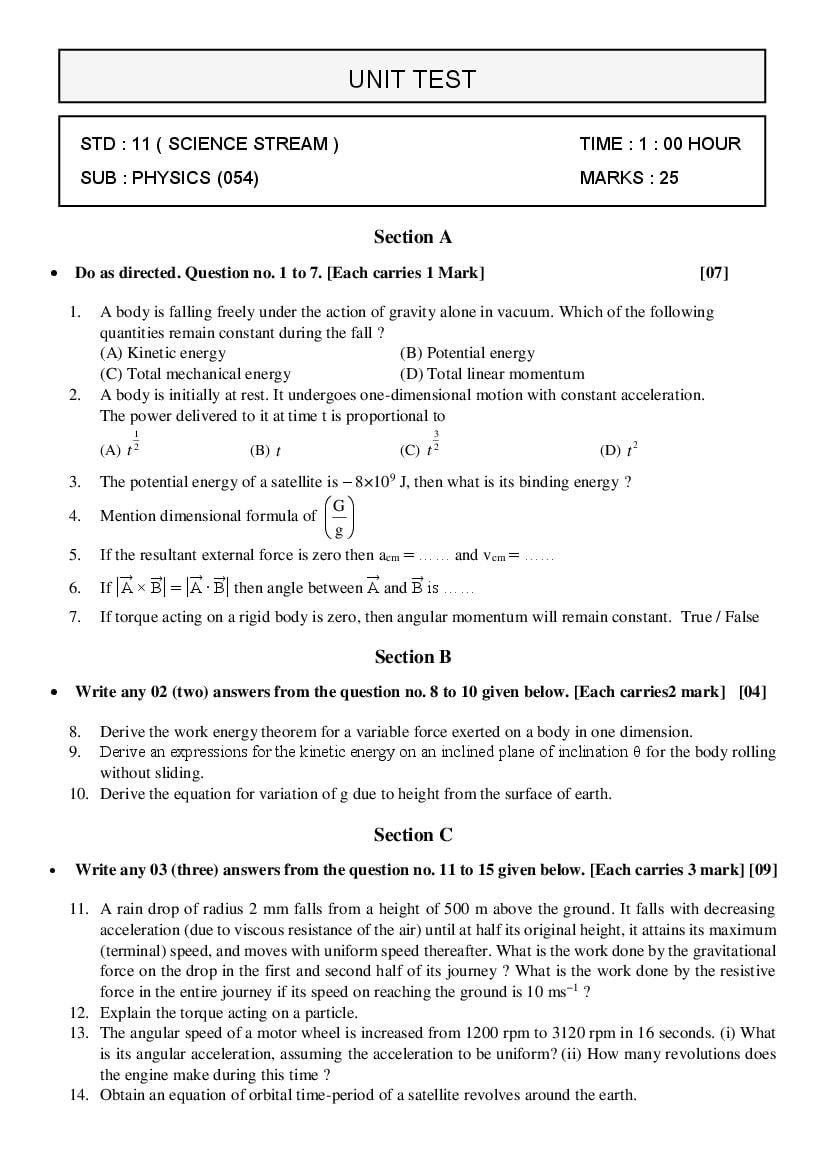
UNIT TEST STD : 11 ( SCIENCE STREAM ) TIME : 1 : 00 HOUR SUB : PHYSICS (054) MARKS : 25 Section A Do as directed. Question no. 1 to 7. [Each carries 1 Mark] [07] 1. A body is falling freely under the action of gravity alone in vacuum. Which of the following quantities remain constant during the fall ? (A) Kinetic energy (B) Potential energy (C) Total mechanical energy (D) Total linear momentum 2. A body is initially at rest. It undergoes one-dimensional motion with constant acceleration. The power delivered to it at time t is proportional to 1 3 (A) t 2 (B) t (C) t 2 (D) t 2 3. The potential energy of a satellite is – 8×10⁹ J, then what is its binding energy ? G 4. Mention dimensional formula of g 5. If the resultant external force is zero then acm = …… and vcm = …… 6. ⃗⃗ × B If |A ⃗⃗ ∙ B ⃗⃗ | = |A ⃗⃗ | then angle between ⃗A ⃗ and B ⃗ is …… 7. If torque acting on a rigid body is zero, then angular momentum will remain constant. True / False Section B Write any 02 (two) answers from the question no. 8 to 10 given below. [Each carries2 mark] [04] 8. Derive the work energy theorem for a variable force exerted on a body in one dimension. 9. Derive an expressions for the kinetic energy on an inclined plane of inclination θ for the body rolling without sliding. 10. Derive the equation for variation of g due to height from the surface of earth. Section C Write any 03 (three) answers from the question no. 11 to 15 given below. [Each carries 3 mark] [09] 11. A rain drop of radius 2 mm falls from a height of 500 m above the ground. It falls with decreasing acceleration (due to viscous resistance of the air) until at half its original height, it attains its maximum (terminal) speed, and moves with uniform speed thereafter. What is the work done by the gravitational force on the drop in the first and second half of its journey ? What is the work done by the resistive force in the entire journey if its speed on reaching the ground is 10 ms –1 ? 12. Explain the torque acting on a particle. 13. The angular speed of a motor wheel is increased from 1200 rpm to 3120 rpm in 16 seconds. (i) What is its angular acceleration, assuming the acceleration to be uniform? (ii) How many revolutions does the engine make during this time ? 14. Obtain an equation of orbital time-period of a satellite revolves around the earth.
Page 2
15. A rocket is fired from the earth towards the sun. At what distance from the earth’s centre is the gravitational force on the rocket zero ? Mass of the sun = 2 × 1030 kg mass of the earth = 6 × 1024 kg. Neglect the effect of other planets etc. (orbital radius = 1.5 × 10 11 m). Section D Write any 01 (one) answer from the question no. 16 & 17 given below. [Each carries 5 mark] [05] 16. A bob of mass m is suspended by a light string of length L. It is imparted a horizontal velocity v0 at the lowest point A such that it completes a semicircular trajectory in the vertical plane with the string becoming slack only on reaching the topmost point, C. This is shown in figure. Obtain an expression K for (i) v0 (ii) the speeds at points B and C (iii) the ratio of the kinetic energies B at B and C. KC Comment on the nature of the trajectory of the bob after it reaches the point C. 17. A cord of negligible mass is wound round the rim of a fly wheel of mass 20 kg and radius 20 cm. A steady pull of 25 N is applied on the cord as shown in figure. The flywheel is mounted on a horizontal axle with frictionless bearings. (a) Compute the angular acceleration of the wheel. (b) Find the work done by the pull, when 2m of the cord is unwound. (c) Find also the kinetic energy of the wheel at this point. Assume that the wheel starts from rest. (d) Compare answers to parts (b) and (c). * * * * *