Goa Board Class 12 Question Paper Mar 2019 Chemistry
Finished viewing? Save it for later —
Download Goa Board Class 12 Question Paper Mar 2019 Chemistry (PDF · 8 pages)About Goa Board Class 12 Question Paper Mar 2019 Chemistry
Goa Board Class 12 Question Paper Mar 2019 Chemistry is available here for free download. Published by Goa Board for Class 12, this question paper can be viewed online or downloaded as a PDF (8 pages). Candidates preparing for Class 12 can use Goa Board Class 12 Question Paper Mar 2019 Chemistry to understand the exam pattern, the type of questions asked, and the overall difficulty level.
Frequently Asked Questions
How can I download Goa Board Class 12 Question Paper Mar 2019 Chemistry?
Open this page and click the Download button to save Goa Board Class 12 Question Paper Mar 2019 Chemistry as a PDF. It is completely free on AglaSem Docs.
Is Goa Board Class 12 Question Paper Mar 2019 Chemistry free to download?
Yes. Goa Board Class 12 Question Paper Mar 2019 Chemistry can be viewed online and downloaded as a PDF free of cost on AglaSem Docs.
How many pages does Goa Board Class 12 Question Paper Mar 2019 Chemistry have?
Goa Board Class 12 Question Paper Mar 2019 Chemistry contains 8 pages, which you can read online or download together as a single PDF.
Where can I find more Class 12 study material?
You can find more Class 12 question papers, sample papers, syllabus, and answer keys on AglaSem Docs.
Goa Board Class 12 Question Paper Mar 2019 Chemistry – Text
Read the full text of this question paper below — useful to quickly search, copy and reference the content online without downloading the PDF.
📄 View text version (8 pages)
Page 1
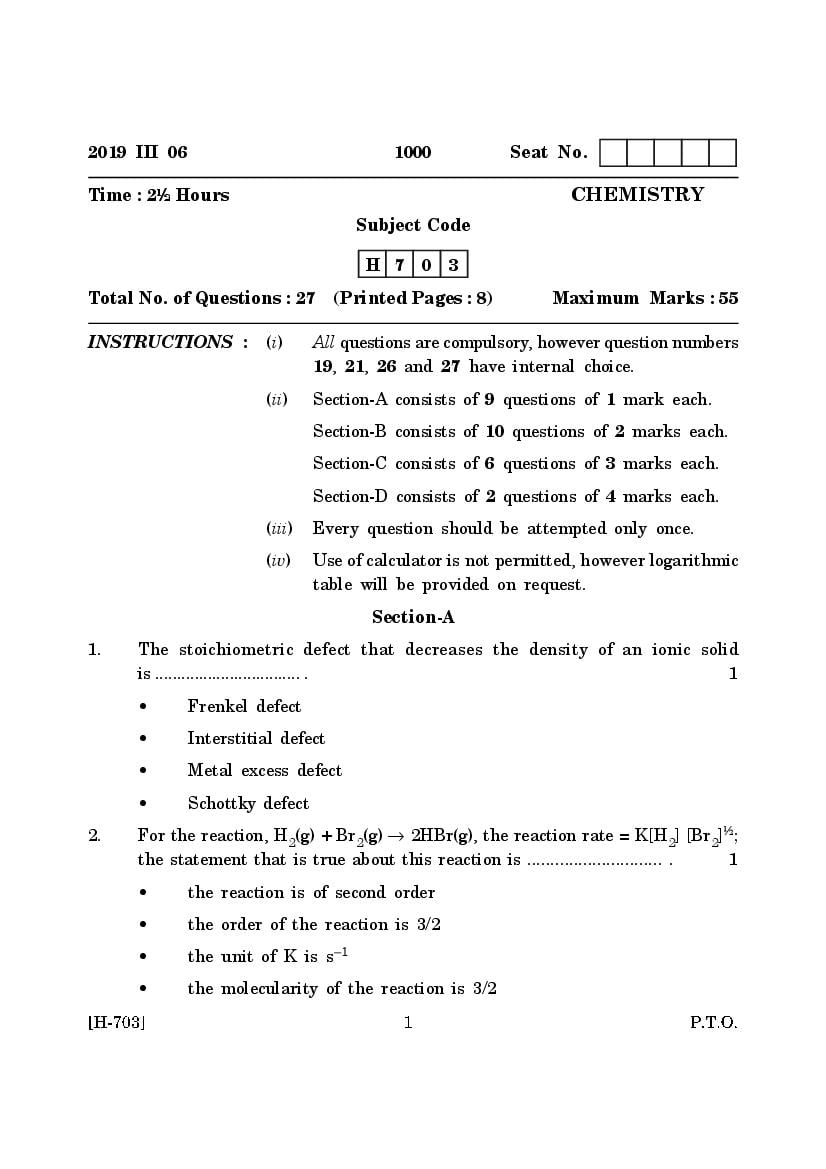
Time : 2½ Hours CHEMISTRY
Subject Code
H 7 0 3
Total No. of Questions : 27 (Printed Pages : 8) Maximum Marks : 55
INSTRUCTIONS : (i) All questions are compulsory, however question numbers
19, 21, 26 and 27 have internal choice.
(ii) Section-A consists of 9 questions of 1 mark each.
Section-B consists of 10 questions of 2 marks each.
Section-C consists of 6 questions of 3 marks each.
Section-D consists of 2 questions of 4 marks each.
(iii) Every question should be attempted only once.
(iv) Use of calculator is not permitted, however logarithmic
table will be provided on request.
Section-A
1. The stoichiometric defect that decreases the density of an ionic solid
is ................................. . 1
• Frenkel defect
• Interstitial defect
• Metal excess defect
• Schottky defect
2. For the reaction, H2(g) + Br2(g) 2HBr(g), the reaction rate = K[H2] [Br2]½;
the statement that is true about this reaction is ............................. . 1
• the reaction is of second order
• the order of the reaction is 3/2
• the unit of K is s–1
• the molecularity of the reaction is 3/2
Page 2
• stabiliser
• collector
• depressant
• leaching agent
4. The pair of ions which will have the same spin only magnetic moment
is ................................. . 1
• Fe+3 and Ni+2
• Mn+2 and Co+2
• Mn+2 and Fe+3
• Ni+2 and Mn+2
5. The co-ordination number and oxidation state of the central metal atom in
the complex [Cr(NH3)5(NO2)]SO4 are ................................... respectively. 1
• 4 and 3
• 6 and 3
• 6 and 2
• 6 and 4
6. Draw a neat labelled diagram of the Hydrogen-Oxygen fuel cell. 1
7. Why does the rate of decomposition of N2O5 increase when the temperature
changes from 0°C to 50°C ? 1
8. Draw a neat labelled diagram of the electrodialysis process used for the
purification of a colloidal solution. 1
9. Write only the structure of the major product formed when ethanal reacts
with each of the following reagents : 1
(a) HCN
(b) Zn-Hg/conc. HCl.
Page 3
10. Classify the following solids as metallic, molecular, ionic or covalent
solids : 2
(a) Sodium Chloride
(b) Silica.
Draw a neat labelled diagram of a tetrahedral void observed in a crystal
lattice.
11. Differentiate between positive deviation and negative deviation from Raoult’s
law, exhibited by binary solutions. (any two points) 2
12. A solution, prepared by dissolving 10 g of a non-volatile solute in 200 g of
water, has a vapour pressure of 31.84 mm of Hg at 308 K. The vapour
pressure of pure water at 308 K is 32 mm of Hg. Calculate the molar mass
of the solute. 2
13. Write only the mathematical expression used to calculate the activation
energy of a chemical reaction at two different temperatures.
Starting from the integrated rate law equation for a first order reaction, derive
the expression for its half life. 2
14. Give one point of distinction between the following : 2
(a) Homogeneous catalysis and heterogeneous catalysis
(b) Physisorption and chemisorption.
15. Draw a neat labelled diagram of the zone refining method used for purification
of elements.
Name the electrolytic process used in the extraction of Aluminium from
purified Al2O3. 2
16. Write any two anomalous properties of Fluorine.
State the geometry of : 2
(a) XeF4 and
(b) XeF6.
Page 4
Write the formula of Ammine bromido chlorido nitrito-N-platinate (II) ion. 2
18. When Rohan visited his grandmother in the village, he requested her to use
teflon coated utensils for cooking purpose.
(a) What is the advantage of using teflon coated cookware ?
(b) Write the name and structure of the monomer of teflon. 2
19. Name the following : 2
(a) An analgesic that also prevents platelet coagulation.
(b) The class of detergents with germicidal property.
(c) The artificial sweetener with the highest sweetness value.
(d) An antibiotic with bactericidal effect.
Or
Name the following :
(a) A compound added to soaps to impart antiseptic properties.
(b) The class of drugs used in the treatment of mental disorders.
(c) The process by which esters of fatty acids are converted to soap.
(d) A broad spectrum antibiotic.
Section-C
20. State Faraday’s First Law of Electrolysis.
Calculate the standard Gibb’s free energy of an electrochemical cell in which
the following reaction occurs at 25°C : 3
2Al(s) + 3Fe+2(aq) 2Al+3(aq) + 3Fe(s)
Given :
E0 = – 1.66 V
Al 3 /Al
E0 2 = – 0.44 V
Fe /Fe
F = 96500 C.
Page 5
Given below are the transition metal ions of 3d series : 3
Zn+2, Cu+2, Cr+3, Sc+2
(a) Select the ion which is colourless, giving the reason.
(b) Select the ion which is most paramagnetic, giving the reason.
Or
Draw the structure of chromate ion.
Given below are the transition metals of 4d and 5d series :
Zr, Mo, Hf, Cd
(a) Select the softest metal, giving the reason.
(b) Select the pair of metals which occur together as minerals, giving the
reason.
22. Write the structures of the compounds ‘A’, ‘B’, ‘C’, ‘D’, ‘E’ and ‘F’ in the
following chemical equations : 3
CH3
| HBr
(a) CH3 —C—CH3 ‘A’ ‘B’
| alc KOH Peroxide
Br
uv aq KOH
(b) + Cl2 ‘C’ ‘D’
dry ether H2O
(c) CH3—Cl + Mg ‘E’ ‘F’
Page 6
(a) Phenol reacts with Bromine water.
(b) Ethanol reacts with conc. sulphuric acid at 413 K.
(c) Methanal is treated with ethyl magnesium bromide followed by
hydrolysis.
24. An aromatic compound ‘X’ having molecular formula C7H7ON undergoes a
series of reactions as shown below. Write the formulae and names of compounds
‘X’, ‘Y’ and ‘Z’. 3
25. Give scientific reasons for the following : 3
(a) Tryptophan is classified as an essential amino acid.
(b) DNA is the chemical basis of heredity.
(c) Product of hydrolysis of sucrose is known as invert sugar.
Section-D
26. Answer the following : 4
(a) Why does the stability of +5 oxidation state of group 15 elements decrease
down the group ?
(b) Write the hydrides of group 15 elements in the decreasing order of their
basicity.
(c) Write a balanced chemical equation to show the hydrolysis of calcium
phosphide.
(d) Name the oxoacid of phosphorus which shows reducing property.
Page 7
Answer the following :
(a) Why does H2O exist as a liquid while H2S is a gas ?
(b) Write the hydrides of group 16 elements in the decreasing order of their
thermal stability.
(c) Write chemical equation to show how sulphuric acid is converted to
oleum.
(d) Name the allotropic form of oxygen.
27. Do as directed : 4
(a) Write the reagent used to bring about the following conversion :
(b) Write labelled chemical equation to show, what happens when Benzoyl
chloride is hydrogenated in the presence of palladium and barium
sulphate.
(c) Arrange the following compounds in the increasing order of their acidic
strength :
CCl3COOH, NC—CH2COOH, CF3COOH, NO2CH2COOH.
(d) State the name of the reaction in the following conversion :
Page 8
Do as directed :
(a) Write the reagent used to bring about the following conversion :
(b) Write labelled chemical equation to show, what happens when Benzene
is treated with acetylchloride in the presence of anhydrous AlCl3.
(c) Arrange the following compounds in the increasing order of their
reactivity towards nucleophilic addition reaction :
HCHO, C6H5CHO, CH3CHO, CH3CH2CHO.
(d) State the name of the reaction in the following conversion :
(i) dil NaOH
2CH3CHO CH3—CH = CH—CHO
(ii)
Document Details
| Board / Org | Goa Board |
| Exam | Class 12 |
| Type | Question Paper |
| Pages | 8 |
| Updated | 22 Jul 2026 |