Goa Board Class 12 Question Paper Mar 2019 Economics
Finished viewing? Save it for later —
Download Goa Board Class 12 Question Paper Mar 2019 Economics (PDF · 10 pages)About Goa Board Class 12 Question Paper Mar 2019 Economics
Goa Board Class 12 Question Paper Mar 2019 Economics is available here for free download. Published by Goa Board for Class 12, this question paper can be viewed online or downloaded as a PDF (10 pages). Candidates preparing for Class 12 can use Goa Board Class 12 Question Paper Mar 2019 Economics to understand the exam pattern, the type of questions asked, and the overall difficulty level.
Frequently Asked Questions
How can I download Goa Board Class 12 Question Paper Mar 2019 Economics?
Open this page and click the Download button to save Goa Board Class 12 Question Paper Mar 2019 Economics as a PDF. It is completely free on AglaSem Docs.
Is Goa Board Class 12 Question Paper Mar 2019 Economics free to download?
Yes. Goa Board Class 12 Question Paper Mar 2019 Economics can be viewed online and downloaded as a PDF free of cost on AglaSem Docs.
How many pages does Goa Board Class 12 Question Paper Mar 2019 Economics have?
Goa Board Class 12 Question Paper Mar 2019 Economics contains 10 pages, which you can read online or download together as a single PDF.
Where can I find more Class 12 study material?
You can find more Class 12 question papers, sample papers, syllabus, and answer keys on AglaSem Docs.
Goa Board Class 12 Question Paper Mar 2019 Economics – Text
Read the full text of this question paper below — useful to quickly search, copy and reference the content online without downloading the PDF.
📄 View text version (10 pages)
Page 1
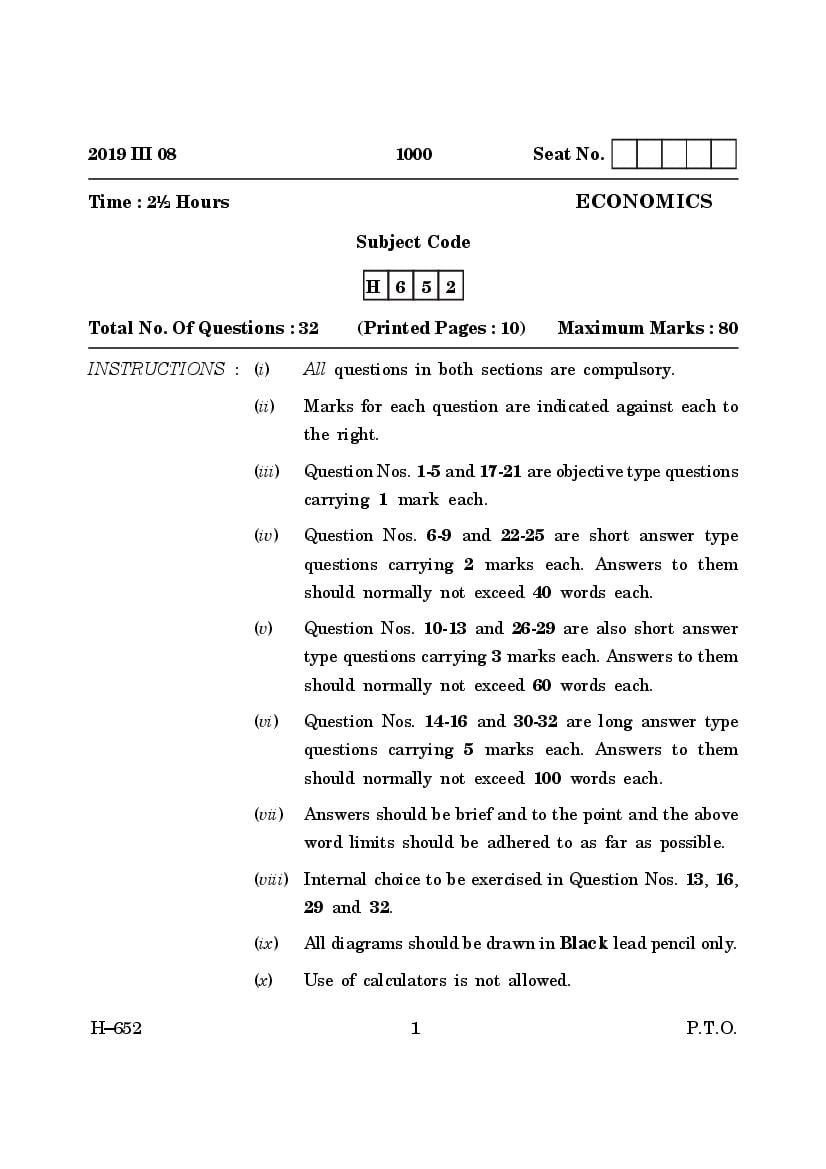
Time : 2½ Hours ECONOMICS
Subject Code
H 6 5 2
Total No. Of Questions : 32 (Printed Pages : 10) Maximum Marks : 80
INSTRUCTIONS : (i) All questions in both sections are compulsory.
(ii) Marks for each question are indicated against each to
the right.
(iii) Question Nos. 1-5 and 17-21 are objective type questions
carrying 1 mark each.
(iv) Question Nos. 6-9 and 22-25 are short answer type
questions carrying 2 marks each. Answers to them
should normally not exceed 40 words each.
(v) Question Nos. 10-13 and 26-29 are also short answer
type questions carrying 3 marks each. Answers to them
should normally not exceed 60 words each.
(vi) Question Nos. 14-16 and 30-32 are long answer type
questions carrying 5 marks each. Answers to them
should normally not exceed 100 words each.
(vii) Answers should be brief and to the point and the above
word limits should be adhered to as far as possible.
(viii) Internal choice to be exercised in Question Nos. 13, 16,
29 and 32.
(ix) All diagrams should be drawn in Black lead pencil only.
(x) Use of calculators is not allowed.
H–652 1 P.T.O.
Page 2
1. A diagrammatic presentation showing the different combinations of two
commodities between which a consumer is indifferent to .................. . 1
• Indifference set
• Indifference map
• Indifference curve
• Indifference schedule
2. If the price of mobile phones decreases, the demand for simcards
will .................. . 1
• Increase
• Remain constant
• Decrease
• Contract
3. A table showing different quantities of a commodity that all the buyers in
the market are ready to buy at different prices .................... . 1
• Individual demand curve
• Market demand schedule
• Individual demand schedule
• Market demand curve
H–652 2
Page 3
supply of wheat will ................... . 1
• Remain constant
• Expand
• Increase
• Decrease
5. The functional relationship between physical inputs and physical output of
a commodity is known as the .................. . 1
• Income function
• Production function
• Consumption function
• Expenditure function
6. A consumer can buy 10 units of good-1 and 20 units of good-2, if she spends
her entire income. If the prices of the two goods are ` 10 per unit and
` 20 per unit, calculate the income of the consumer. 2
7. Calculate the price elasticity of demand, when quantity demanded increases
from 100 units to 150 units due to a 5% fall in price of the commodity.2
H–652 3 P.T.O.
Page 4
` 5,800 when the 6th unit of the good is sold, then compute the marginal
revenue of the last unit. 2
9. Draw a neat labelled diagram showing the effect on equilibrium price in the
following situation :
Increase in the demand for bus drivers due to the growing demand for bus
transportation in Goa. 2
10. What is meant by the following : 3
(i) Normal goods
(ii) Inferior goods
(iii) Substitute goods
11. What is meant by the following : 3
(i) Cartel
(ii) Equilibrium price
(iii) Monopoly
12. Explain three determinants of supply. 3
H–652 4
Page 5
(i) Total cost
(ii) Average cost
(iii) Marginal cost
Or
(i) Extension of supply
(ii) Unit elastic supply
(iii) Relatively elastic supply.
14. Explain the law of diminishing marginal utility with the help of a schedule
and a neat labelled diagram. 5
15. Explain the law of demand with the help of a schedule and a neat labelled
diagram. 5
16. Explain five features of perfect competition. 5
Or
Explain five features of monopolistic competition.
H–652 5 P.T.O.
Page 6
17. Unilateral payments for which no productive services are rendered like
scholarship, old age pension etc. are called .................... . 1
• Factor payments
• Transfer payments
• Operating surplus
• Capital transfer
18. The ratio of change in saving to change in income called ................ . 1
• Average propensity to consume
• Average propensity to save
• Marginal propensity to consume
• Marginal propensity to save
19. The sum total of expenditure on the domestically produced goods and services
during the period of an accounting year is called .................. . 1
• Aggregate demand
• Consumption function
• Aggregate supply
• Demand function
H–652 6
Page 7
are ....................... . 1
• Primary deposits
• Demand deposits
• Fixed deposits
• Secondary deposits
21. When the exchange rate changes from $ 1 = ` 60 to $ 1 = ` 70, India’s exports
to USA will ................... . 1
• Decrease
• Remain constant
• Increase
• Diminish
22. State whether the following items are ‘to be included’ or ‘not included’ in the
measurement of National Income. 2
(i) Mr. Ramesh purchased a new house for ` 15 lakh
(ii) On account of the sale and purchase of a second hand car Mr. Narayan
earned a commission of ` 20,000
H–652 7 P.T.O.
Page 8
(iv) Reshma received ` 1 lakh as assistance by Goa government under Ladli
Laxmi Scheme.
23. In an economy the marginal propensity to consume is 0.75. Find out the value
of the Multiplier. 2
24. What is meant by the following : 2
(i) Balanced budget
(ii) Primary deficit.
25. A panchayat wants to spend ` 50,000 in the year 2019-20. Prepare a budget
for the panchayat, if the panchayat wants to spend 10% expenditure on
educational facilities, 30% expenditure on salary, 40% expenditure on
maintenance and 20% expenditure on health measures. 2
26. What is meant by the following : 3
(i) Involuntary unemployment
(ii) Fiscal policy
(iii) The savings function
H–652 8
Page 9
(i) Bank rate
(ii) Open market operations
(iii) Margin requirement.
28. State the motives of holding money in the following situations : 3
(i) Rohan is a trader, who has a liquidity preference so that he can invest
his money in bonds, when the interest on bonds is high and the price
of bonds are low.
(ii) Vimal’s mother keeps aside ` 10,000 in cash to meet the unforseen
circumstances.
(iii) Rahul’s father keep aside ` 20,000 for day to day expenditure of his
family.
29. Explain three functions of the Central Bank of India. 3
Or
Explain three functions of money.
30. Explain the circular flow of National Income with the help of a neat labelled
diagram. 5
H–652 9 P.T.O.
Page 10
diagram. 5
32. Explain five types of non-tax receipts. 5
Or
Explain the components of the Balance of Payments Accounts.
H–652 10
Document Details
| Board / Org | Goa Board |
| Exam | Class 12 |
| Type | Question Paper |
| Pages | 10 |
| Updated | 22 Jul 2026 |