Goa Board Class 12 Question Paper Mar 2019 Geology
Finished viewing? Save it for later —
Download Goa Board Class 12 Question Paper Mar 2019 Geology (PDF · 7 pages)About Goa Board Class 12 Question Paper Mar 2019 Geology
Goa Board Class 12 Question Paper Mar 2019 Geology is available here for free download. Published by Goa Board for Class 12, this question paper can be viewed online or downloaded as a PDF (7 pages). Candidates preparing for Class 12 can use Goa Board Class 12 Question Paper Mar 2019 Geology to understand the exam pattern, the type of questions asked, and the overall difficulty level.
Frequently Asked Questions
How can I download Goa Board Class 12 Question Paper Mar 2019 Geology?
Open this page and click the Download button to save Goa Board Class 12 Question Paper Mar 2019 Geology as a PDF. It is completely free on AglaSem Docs.
Is Goa Board Class 12 Question Paper Mar 2019 Geology free to download?
Yes. Goa Board Class 12 Question Paper Mar 2019 Geology can be viewed online and downloaded as a PDF free of cost on AglaSem Docs.
How many pages does Goa Board Class 12 Question Paper Mar 2019 Geology have?
Goa Board Class 12 Question Paper Mar 2019 Geology contains 7 pages, which you can read online or download together as a single PDF.
Where can I find more Class 12 study material?
You can find more Class 12 question papers, sample papers, syllabus, and answer keys on AglaSem Docs.
Goa Board Class 12 Question Paper Mar 2019 Geology – Text
Read the full text of this question paper below — useful to quickly search, copy and reference the content online without downloading the PDF.
📄 View text version (7 pages)
Page 1
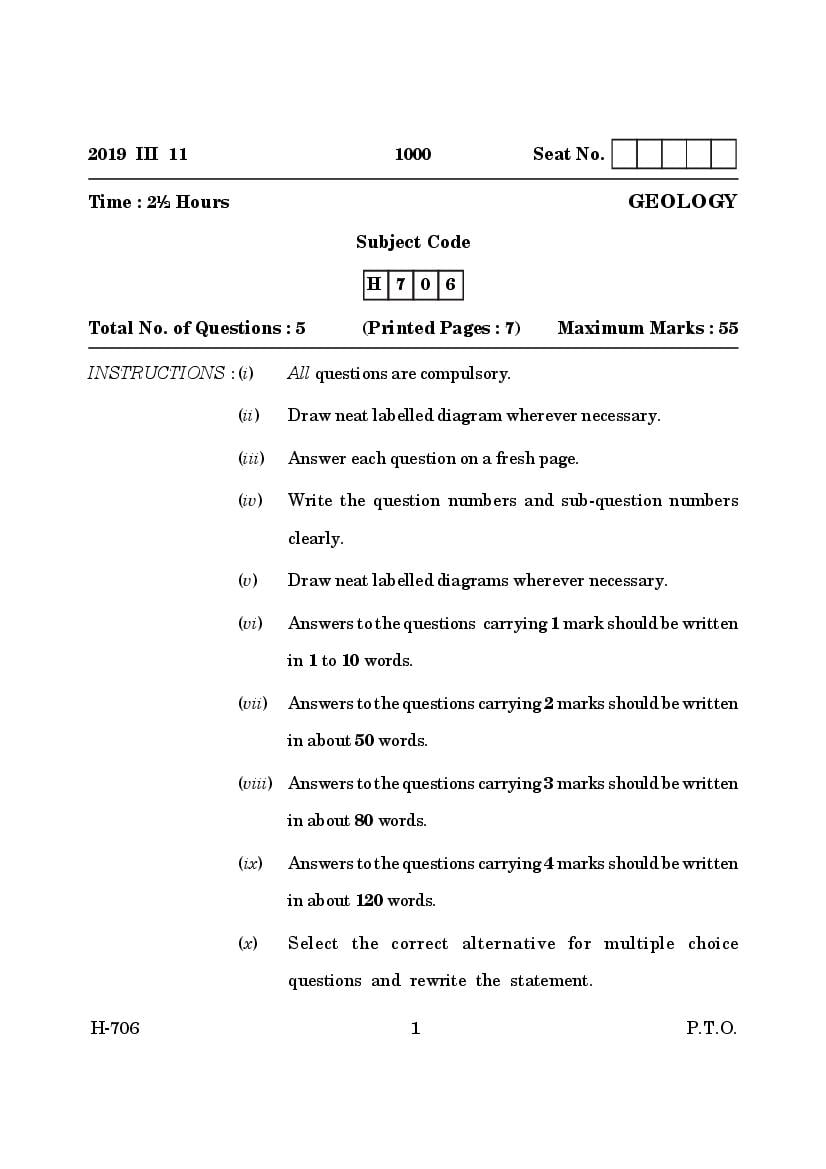
Time : 2½ Hours GEOLOGY
Subject Code
H 7 0 6
Total No. of Questions : 5 (Printed Pages : 7) Maximum Marks : 55
INSTRUCTIONS : (i) All questions are compulsory.
(ii) Draw neat labelled diagram wherever necessary.
(iii) Answer each question on a fresh page.
(iv) Write the question numbers and sub-question numbers
clearly.
(v) Draw neat labelled diagrams wherever necessary.
(vi) Answers to the questions carrying 1 mark should be written
in 1 to 10 words.
(vii) Answers to the questions carrying 2 marks should be written
in about 50 words.
(viii) Answers to the questions carrying 3 marks should be written
in about 80 words.
(ix) Answers to the questions carrying 4 marks should be written
in about 120 words.
(x) Select the correct alternative for multiple choice
questions and rewrite the statement.
H-706 1 P.T.O.
Page 2
alternative given below the statement and write the completed
statement : 1
The continuous outermost solid layer of the earth is ....................
• Asthenosphere
• Oceanic crust
• Mantle
• Continental crust
(B) What do you understand by the term ‘‘Volcanic Block’’ ? 1
(C) Which landform is created at an initial stage of divergence of two
continental plates ? State an example. 2
(D) How are cinder cones formed ? 2
Or
How are Dome mountains formed ?
(E) What is Gutenberg discontinuity ? State its significance. 2
(F) Explain in brief : 3
• Formation of Andes mountains
• Formation of Composite volcano.
H-706 2
Page 3
given below the statement and write the completed statement : 1
A very coarse grained clastic sedimentary rock of varied composition
is termed as ....................
• Argillaceous rock
• Arenaceous rock
• Rudaceous rock
• Calcareous rock
(B) State the parent rock of Gneiss. 1
(C) Give an account of grain size and its relationship with rate of cooling
in igneous rocks. Give an example of igneous rock of inequigranular
texture. 2
(D) Distinguish between shale and sandstone based on grain size and
mineral composition. 2
(E) Explain the various grades of metamorphism. 2
(F) Explain the following : 3
• Contact metamorphism
• Directive texture.
H-706 3 P.T.O.
Page 4
Explain the following :
• Degree of crystallinity
• Clastic texture.
3. (A) Complete the following statement by choosing the correct alternative
given below the statement and write the completed statement : 1
A joint that strikes parallel to the dip of a bed is known as ..............
• Bedding joint
• Oblique joint
• Strike joint
• Dip joint
(B) Draw a neat labelled diagram of a plunging fold. 1
(C) Define the term outcrop. Which structural feature is observed in the
rocks outcropped at Gilbert Hill, Andheri Mumbai ? 2
(D) With a neat labelled diagram explain the formation of an angular
unconformity. 2
(E) Explain the following : 2
• Tensional joints
• Master joints.
H-706 4
Page 5
• Normal fault
• Chevron fold.
Or
With a neat labelled diagram explain the following :
• Reverse fault
• Fan fold.
4. (A) Complete the following statement by choosing the correct alternative
given below the statement and write the completed statement : 1
The mineral that occurs as beach sand is ..................
• Hematite
• Galena
• Pyrolusite
• Monazite
(B) Which metal is mined from Khetri area of Rajasthan ? 1
(C) Define ore mineral. With an example state the chemical composition
of the ore mineral of chromium. 2
H-706 5 P.T.O.
Page 6
• Magmatic segregation
• Cut off grade.
(E) Explain the following : 4
• Formation of placer deposits.
• Various kinds of vien type of hydrothermal deposits.
5. (A) Complete the following statement by choosing the correct
alternative given below the statement and write the completed
statement : 1
The largest expanse of time on the standard Geological Time Scale
is ..................
• Era
• Epoch
• Period
• Eon
(B) State the age of Deccan trap volcanism. 1
(C) State the classification of Dharwar and Cuddapah supergroups. 2
H-706 6
Page 7
• Cretaceous period
• Principle of inclusion
• Lithostratigraphic units.
(E) Explain the various methods of stratigraphic correlation. 4
Or
Explain the various modes of preservation of fossils.
H-706 7 P.T.O.
Document Details
| Board / Org | Goa Board |
| Exam | Class 12 |
| Type | Question Paper |
| Pages | 7 |
| Updated | 22 Jul 2026 |