DUET 2021 Question Paper MA Linguistics
Finished viewing? Save it for later —
Download DUET 2021 Question Paper MA Linguistics (PDF · 9 pages)About DUET 2021 Question Paper MA Linguistics
DUET 2021 Question Paper MA Linguistics is available here for free download. Published by NTA for DUET, this question paper can be viewed online or downloaded as a PDF (9 pages). Candidates preparing for DUET can use DUET 2021 Question Paper MA Linguistics to understand the exam pattern, the type of questions asked, and the overall difficulty level.
Frequently Asked Questions
How can I download DUET 2021 Question Paper MA Linguistics?
Open this page and click the Download button to save DUET 2021 Question Paper MA Linguistics as a PDF. It is completely free on AglaSem Docs.
Is DUET 2021 Question Paper MA Linguistics free to download?
Yes. DUET 2021 Question Paper MA Linguistics can be viewed online and downloaded as a PDF free of cost on AglaSem Docs.
How many pages does DUET 2021 Question Paper MA Linguistics have?
DUET 2021 Question Paper MA Linguistics contains 9 pages, which you can read online or download together as a single PDF.
Where can I find more DUET study material?
You can find more DUET question papers, sample papers, syllabus, and answer keys on AglaSem Docs.
DUET 2021 Question Paper MA Linguistics – Text
Read the full text of this question paper below — useful to quickly search, copy and reference the content online without downloading the PDF.
📄 View text version (9 pages)
Page 1
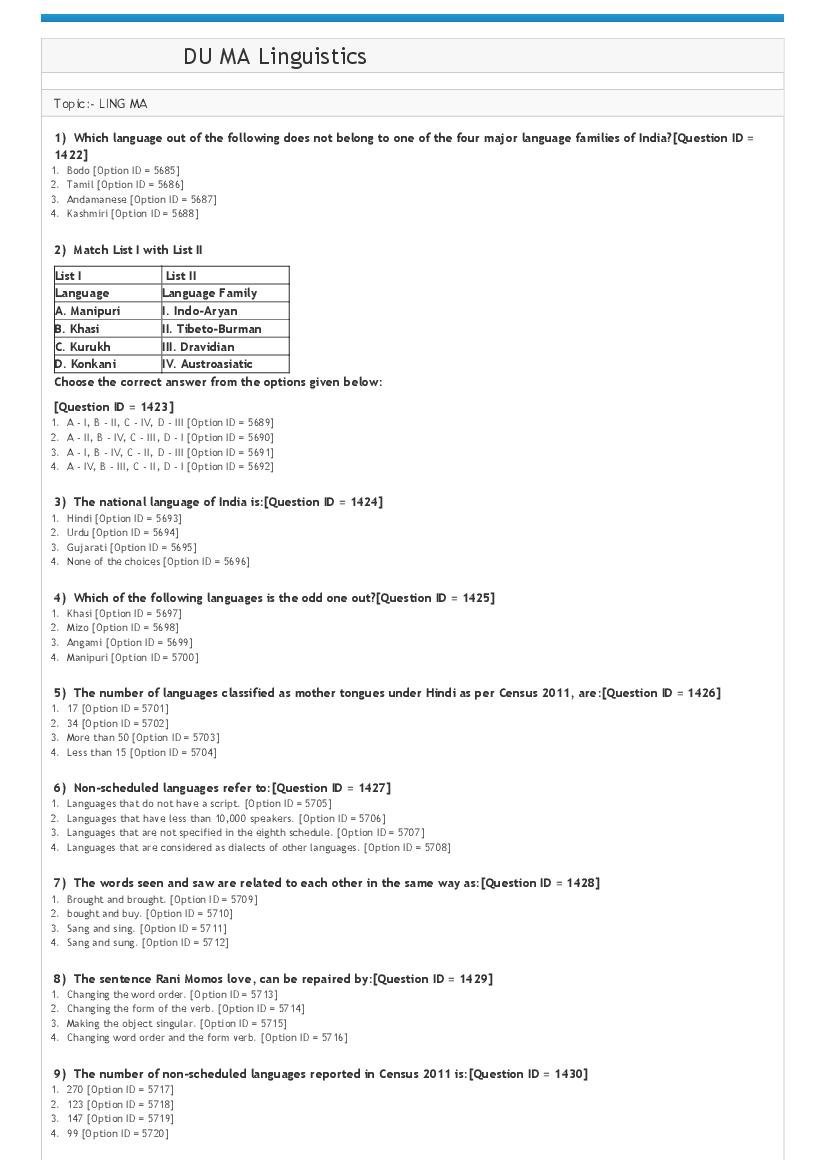
Topic:‐ LING MA
1) Which language out of the following does not belong to one of the four major language families of India?[Question ID =
1422]
1. Bodo [Option ID = 5685]
2. Tamil [Option ID = 5686]
3. Andamanese [Option ID = 5687]
4. Kashmiri [Option ID = 5688]
2) Match List I with List II
List I List II
Language Language Family
A. Manipuri I. Indo‐Aryan
B. Khasi II. Tibeto‐Burman
C. Kurukh III. Dravidian
D. Konkani IV. Austroasiatic
[Question ID = 1423]
1. A ‐ I, B ‐ II, C ‐ IV, D ‐ III [Option ID = 5689]
2. A ‐ II, B ‐ IV, C ‐ III, D ‐ I [Option ID = 5690]
3. A ‐ I, B ‐ IV, C ‐ II, D ‐ III [Option ID = 5691]
4. A ‐ IV, B ‐ III, C ‐ II, D ‐ I [Option ID = 5692]
3) The national language of India is:[Question ID = 1424]
1. Hindi [Option ID = 5693]
2. Urdu [Option ID = 5694]
3. Gujarati [Option ID = 5695]
4. None of the choices [Option ID = 5696]
4) Which of the following languages is the odd one out?[Question ID = 1425]
1. Khasi [Option ID = 5697]
2. Mizo [Option ID = 5698]
3. Angami [Option ID = 5699]
4. Manipuri [Option ID = 5700]
5) The number of languages classified as mother tongues under Hindi as per Census 2011, are:[Question ID = 1426]
1. 17 [Option ID = 5701]
2. 34 [Option ID = 5702]
3. More than 50 [Option ID = 5703]
4. Less than 15 [Option ID = 5704]
6) Non‐scheduled languages refer to:[Question ID = 1427]
1. Languages that do not have a script. [Option ID = 5705]
2. Languages that have less than 10,000 speakers. [Option ID = 5706]
3. Languages that are not specified in the eighth schedule. [Option ID = 5707]
4. Languages that are considered as dialects of other languages. [Option ID = 5708]
7) The words seen and saw are related to each other in the same way as:[Question ID = 1428]
1. Brought and brought. [Option ID = 5709]
2. bought and buy. [Option ID = 5710]
3. Sang and sing. [Option ID = 5711]
4. Sang and sung. [Option ID = 5712]
8) The sentence Rani Momos love, can be repaired by:[Question ID = 1429]
1. Changing the word order. [Option ID = 5713]
2. Changing the form of the verb. [Option ID = 5714]
3. Making the object singular. [Option ID = 5715]
4. Changing word order and the form verb. [Option ID = 5716]
9) The number of non‐scheduled languages reported in Census 2011 is:[Question ID = 1430]
1. 270 [Option ID = 5717]
2. 123 [Option ID = 5718]
3. 147 [Option ID = 5719]
4. 99 [Option ID = 5720]
Page 2
1. Western and Southern parts of India. [Option ID = 5721]
2. Eastern and Central parts of India. [Option ID = 5722]
3. Northeastern, Eastern and Central parts of India. [Option ID = 5723]
4. Northeastern, Eastern, Central and Western parts of India. [Option ID = 5724]
11) Which of the following regions in India is the most diverse in terms of number of languages?[Question ID = 1432]
1. Northwestern. [Option ID = 5725]
2. Southeastern. [Option ID = 5726]
3. Western. [Option ID = 5727]
4. Northeastern. [Option ID = 5728]
12) The relation between the language pair Khasi and Assamese is same as between:[Question ID = 1433]
1. Haryanvi and Hindi. [Option ID = 5729]
2. Santali and Maithili. [Option ID = 5730]
3. Tamil and Malayalam. [Option ID = 5731]
4. Bodo and Manipuri. [Option ID = 5732]
13) Observe the phonetic transcriptions of the words given below:
What will be the correct transcription for bring?
[Question ID = 1434]
1.
[Option ID = 5733]
2.
[Option ID = 5734]
3.
[Option ID = 5735]
4.
[Option ID = 5736]
14) The sound of ‘s’ in ‐ leisure, measure, closure, treasure – is similar to[Question ID = 1435]
1. ‘s’ in soar [Option ID = 5737]
2. ‘s’ in sure [Option ID = 5738]
3. ‘s’ in vision [Option ID = 5739]
4. ‘s’ in pressure [Option ID = 5740]
15) Find the odd one out among the following words, in terms of correspondence between letters and sounds: plight,
plant, plough, pledge[Question ID = 1436]
1. plight [Option ID = 5741]
2. plant [Option ID = 5742]
3. plough [Option ID = 5743]
4. pledge [Option ID = 5744]
16) Which among the following Dravidian languages is spoken primarily outside of India?[Question ID = 1437]
1. Malto [Option ID = 5745]
2. Kodava [Option ID = 5746]
3. Brahui [Option ID = 5747]
4. Kurukh [Option ID = 5748]
17) Which of the following sentences does not correctly describe the picture given below?
[Question ID = 1438]
1. Most of the circles are yellow
[Option ID = 5749]
2. All of the circles are yellow
[Option ID = 5750]
Page 3
[Option ID = 5751]
4. Some of the circles are yellow
[Option ID = 5752]
18) In a planet called Twin‐earth, a language called Twinglish is spoken. The grammar and vocabulary of Twinglish is almost
the same as English, except, in Twinglish adjectives are placed after the nouns, and certain words have different
meanings. Below is a small fragment of a Twinglish to English dictionary.
Twinglish English
blue NOUN sky
blue ADJECTIVE the color blue
life NOUN breath
sky NOUN universe
Translate the following English sentence into Twinglish:
She gazed at the deep blue sky and took a deep breath
[Question ID = 1439]
1. She gazed at the blue deep blue and took a life deep
[Option ID = 5753]
2. She gazed at the blue deep blue and took a deep life
[Option ID = 5754]
3. She gazed at the blue blue deep and took a deep life
[Option ID = 5755]
4. She gazed at the deep blue blue and took a life deep
[Option ID = 5756]
19) The region of the brain found to be related to language production and comprehension is called[Question ID = 1440]
1. Lingua Franca [Option ID = 5757]
2. Broca’s area [Option ID = 5758]
3. Aphasia [Option ID = 5759]
4. Area 40 [Option ID = 5760]
20) Match List I with List II
List I List II
Child English words Adult English words
A. bu I. slippery
B. pun II. snap
C. sap III. small
D. sipali IV. prune
E. mao V. blue
[Question ID = 1441]
1. A ‐ V, B ‐ IV, C ‐ II, D ‐ III, E ‐ I [Option ID = 5761]
2. A ‐ IV, B ‐ V, C ‐ III, D ‐ II, E ‐ I [Option ID = 5762]
3. A ‐ V, B ‐ IV, C ‐ I, D ‐ II, E ‐ III [Option ID = 5763]
4. A ‐ V, B ‐ IV, C ‐ II, D ‐ I, E ‐ III [Option ID = 5764]
21) Find the direct object of the sentence: Trisha emailed the documents to Sudha.
[Question ID = 1442]
1. The documents
[Option ID = 5765]
2. Trisha
[Option ID = 5766]
3. Sudha
[Option ID = 5767]
4. To Sudha
[Option ID = 5768]
22) Match the names of the great grammarians in List 1 with the texts in List 2.
List I List II
A. Patañjali I. Aṣṭādhyāyī
B. BhartṛhariII. Nirukta
C. Pāṇini III.Vākyapadīya
Page 4
[Question ID = 1443]
1. A ‐ IV, B ‐ III, C ‐ I, D ‐ II [Option ID = 5769]
2. A ‐ III, B ‐ II, C ‐ I, D ‐ IV [Option ID = 5770]
3. A ‐ IV, B ‐ II, C ‐ I, D ‐ III [Option ID = 5771]
4. A ‐ II, B ‐ III, C ‐ I, D ‐ IV [Option ID = 5772]
23) What type of sentence is the following?
What a beautiful day it is!
[Question ID = 1444]
1. Imperative
[Option ID = 5773]
2. Interrogative
[Option ID = 5774]
3. Exclamative
[Option ID = 5775]
4. Declarative
[Option ID = 5776]
24) What is the subject of the sentence: Anjana’s sister in Dubai owns a bookshop in Delhi?
[Question ID = 1445]
1. A bookshop
[Option ID = 5777]
2. Anjana’s sister in Dubai
[Option ID = 5778]
3. Anjana
[Option ID = 5779]
4. Anjana’s sister in Delhi
[Option ID = 5780]
25) Which of the following statements is true?
(i) Alexa and Siri can only speak the sentences they have been programmed to utter.
(ii) Alexa and Siri can speak language as creatively as we humans do.
[Question ID = 1446]
1. (i)
[Option ID = 5781]
2. (ii)
[Option ID = 5782]
3. Both (i) and (ii)
[Option ID = 5783]
4. Neither (i) and (ii)
[Option ID = 5784]
26) Flying planes could be dangerous.
Which of the following statements is true?
[Question ID = 1447]
1. The sentence given is unambiguous.
[Option ID = 5785]
2. The sentence given is ambiguous.
[Option ID = 5786]
3. The sentence is ungrammatical.
[Option ID = 5787]
4. None of these.
[Option ID = 5788]
27) The acquisition of language by children is studied under which sub‐discipline of Linguistics?[Question ID = 1448]
1. Neurolinguistics [Option ID = 5789]
2. Pragmatics [Option ID = 5790]
3. Psycholinguistics [Option ID = 5791]
4. Historical Linguistics [Option ID = 5792]
Page 5
the Verlan versions of some French words:
French <span times="" new="" "=""> Verlan
bonjour jourbon
bizarre zarbi
me´tro trome´
de´mon monde´
What will the Verlan version for the word cafe´ sound like?
[Question ID = 1449]
1. kafe´
[Option ID = 5793]
2. fe´ka
[Option ID = 5794]
3. ke´fa
[Option ID = 5795]
4. fake´
[Option ID = 5796]
29) Which of the following statements is true?
(i) Gesture is part of natural language and is scientifically studied by linguists.
(ii) Study of Gesture does not fall within the purview of linguistics.
[Question ID = 1450]
1. (i)
[Option ID = 5797]
2. (ii)
[Option ID = 5798]
3. Both (i) and (ii)
[Option ID = 5799]
4. Neither (i) nor (ii)
[Option ID = 5800]
30) When the sentence All flowers are beautiful is true, which of the following statements is necessarily true?
[Question ID = 1451]
1. Plastic bags are beautiful.
[Option ID = 5801]
2. The hibiscus in my balcony is beautiful.
[Option ID = 5802]
3. The pumpkin I bought today is beautiful.
[Option ID = 5803]
4. This exam paper is beautiful.
[Option ID = 5804]
31) Which of the following is derived from a noun?[Question ID = 1452]
1. championship [Option ID = 5805]
2. alignment [Option ID = 5806]
3. happiness [Option ID = 5807]
4. assertion [Option ID = 5808]
32) Pick the odd one out of the following list of words:
few, many, some, above
[Question ID = 1453]
1. few
[Option ID = 5809]
2. some
[Option ID = 5810]
3. many
[Option ID = 5811]
4. above
[Option ID = 5812]
Page 6
[Question ID = 1454]
1. prettier [Option ID = 5813]
2. more pretty [Option ID = 5814]
3. pretty [Option ID = 5815]
4. prettiness [Option ID = 5816]
34) Which of the following is closest in meaning to destruction?
[Question ID = 1455]
1. demolition
[Option ID = 5817]
2. demonstration
[Option ID = 5818]
3. expediency
[Option ID = 5819]
4. utility
[Option ID = 5820]
35) Knowing correct grammar will help you write ________. (pick the correct answer)[Question ID = 1456]
1. good [Option ID = 5821]
2. well [Option ID = 5822]
3. goodly [Option ID = 5823]
4. best [Option ID = 5824]
36) Choose the odd one out of the following list of words:
behind, by, ahead, start
[Question ID = 1457]
1. ahead
[Option ID = 5825]
2. by
[Option ID = 5826]
3. start
[Option ID = 5827]
4. behind
[Option ID = 5828]
37) Which of the following is farthest in meaning from important?[Question ID = 1458]
1. crucial [Option ID = 5829]
2. principal [Option ID = 5830]
3. paramount [Option ID = 5831]
4. trivial [Option ID = 5832]
38) Which of the following statements is false?[Question ID = 1459]
1. Several new languages have emerged over the years. [Option ID = 5833]
2. Languages constantly influence each other. [Option ID = 5834]
3. Indo‐Pakistani sign language is an artificial language. [Option ID = 5835]
4. Mandarin is the second most spoken language in the world. [Option ID = 5836]
39) In the sentence "I took my big brown cat to the vet yesterday,"
which of the following does not appear?
[Question ID = 1460]
1. Conjunction
[Option ID = 5837]
2. Adjective
[Option ID = 5838]
3. Pronoun
[Option ID = 5839]
4. Verb
[Option ID = 5840]
40) Languages are learnt______________________. (pick the correct option)[Question ID = 1461]
1. exclusively in a classroom [Option ID = 5841]
2. by imitation [Option ID = 5842]
3. through pattern recognition [Option ID = 5843]
Page 7
41) Indicate the appropriate grammatical category of the underlined word in the following example:
KKR finished well again
[Question ID = 1462]
1. verb
[Option ID = 5845]
2. adjective
[Option ID = 5846]
3. noun
[Option ID = 5847]
4. adverb
[Option ID = 5848]
42) Which would you___________ have, tea or coffee?[Question ID = 1463]
1. rather [Option ID = 5849]
2. could [Option ID = 5850]
3. prefer [Option ID = 5851]
4. better [Option ID = 5852]
43) Rearrange the following in a proper sequence to obtain a correct sentence.
A. sat at
B. the long dining table
C. Mr. Smith
D. the head of
[Question ID = 1464]
1. A, B, D, C
[Option ID = 5853]
2. C, A, D, B
[Option ID = 5854]
3. C, B, A, D
[Option ID = 5855]
4. B, A, D, C
[Option ID = 5856]
44) Which Venn diagram best describes the relation between 'Language', 'Hindi', and 'Tamil' ?
[Question ID = 1465]
1.
[Option ID = 5857]
2.
[Option ID = 5858]
Page 8
[Option ID = 5859]
4.
[Option ID = 5860]
45) ‘Red’ is related to 'Blood' in the same way as ‘Blue’ is related to
[Question ID = 1466]
1. Ink
[Option ID = 5861]
2. Sapphire
[Option ID = 5862]
3. Sky
[Option ID = 5863]
4. All of these
[Option ID = 5864]
46) Which of the following language families does not have a representation in India?[Question ID = 1467]
1. Indo‐Aryan [Option ID = 5865]
2. Austro‐Asiatic [Option ID = 5866]
3. Tibeto‐Burman [Option ID = 5867]
4. Afro‐Asiatic [Option ID = 5868]
47) Find the odd one out[Question ID = 1468]
1. Cycling [Option ID = 5869]
2. Jumping [Option ID = 5870]
3. Walking [Option ID = 5871]
4. Morning [Option ID = 5872]
48) Match List I with List II
List I List II
A. Phonetics I. Word Structure
B. Morphology II. Meaning
C. Syntax III. Sound
D. Semantics IV. Sentence Structure
[Question ID = 1469]
1. A ‐ IV, B ‐ II, C ‐ I, D ‐ III [Option ID = 5873]
2. A ‐ II, B ‐ I, C ‐ IV, D ‐ III [Option ID = 5874]
3. A ‐ I, B ‐ III, C ‐ II D ‐ IV [Option ID = 5875]
4. A ‐ III, B ‐ I, C ‐ IV, D ‐ II [Option ID = 5876]
49) Study the data below and answer the questions that follow.
List 1 List 2
el “the hand”
elele “to hands”
elim “my hand”
ev “the house”
elelimim “our hands”
evden “from the house”
evevde “in the houses”
Page 9
"from my house"
[Question ID = 1470]
1. evimden
[Option ID = 5877]
2. evimime
[Option ID = 5878]
3. evevimimden
[Option ID = 5879]
4. evimimden
[Option ID = 5880]
50) What is the translation of the following phrase in the language in List 1?
"in my hand"
[Question ID = 1471]
1. elelimden
[Option ID = 5881]
2. elimimde
[Option ID = 5882]
3. elimde
[Option ID = 5883]
4. elelimde
[Option ID = 5884]
Document Details
| Board / Org | NTA |
| Exam | DUET |
| Type | Question Paper |
| Pages | 9 |
| Language | english |
| Updated | 30 Apr 2026 |