DUET Question Paper 2020 for DU MSc Zoology
Finished viewing? Save it for later —
Download DUET Question Paper 2020 for DU MSc Zoology (PDF · 16 pages)About DUET Question Paper 2020 for DU MSc Zoology
DUET Question Paper 2020 for DU MSc Zoology is available here for free download. Published by NTA for DUET, this question paper can be viewed online or downloaded as a PDF (16 pages). Candidates preparing for DUET can use DUET Question Paper 2020 for DU MSc Zoology to understand the exam pattern, the type of questions asked, and the overall difficulty level.
Frequently Asked Questions
How can I download DUET Question Paper 2020 for DU MSc Zoology?
Open this page and click the Download button to save DUET Question Paper 2020 for DU MSc Zoology as a PDF. It is completely free on AglaSem Docs.
Is DUET Question Paper 2020 for DU MSc Zoology free to download?
Yes. DUET Question Paper 2020 for DU MSc Zoology can be viewed online and downloaded as a PDF free of cost on AglaSem Docs.
How many pages does DUET Question Paper 2020 for DU MSc Zoology have?
DUET Question Paper 2020 for DU MSc Zoology contains 16 pages, which you can read online or download together as a single PDF.
Where can I find more DUET study material?
You can find more DUET question papers, sample papers, syllabus, and answer keys on AglaSem Docs.
DUET Question Paper 2020 for DU MSc Zoology – Text
Read the full text of this question paper below — useful to quickly search, copy and reference the content online without downloading the PDF.
📄 View text version (16 pages)
Page 1
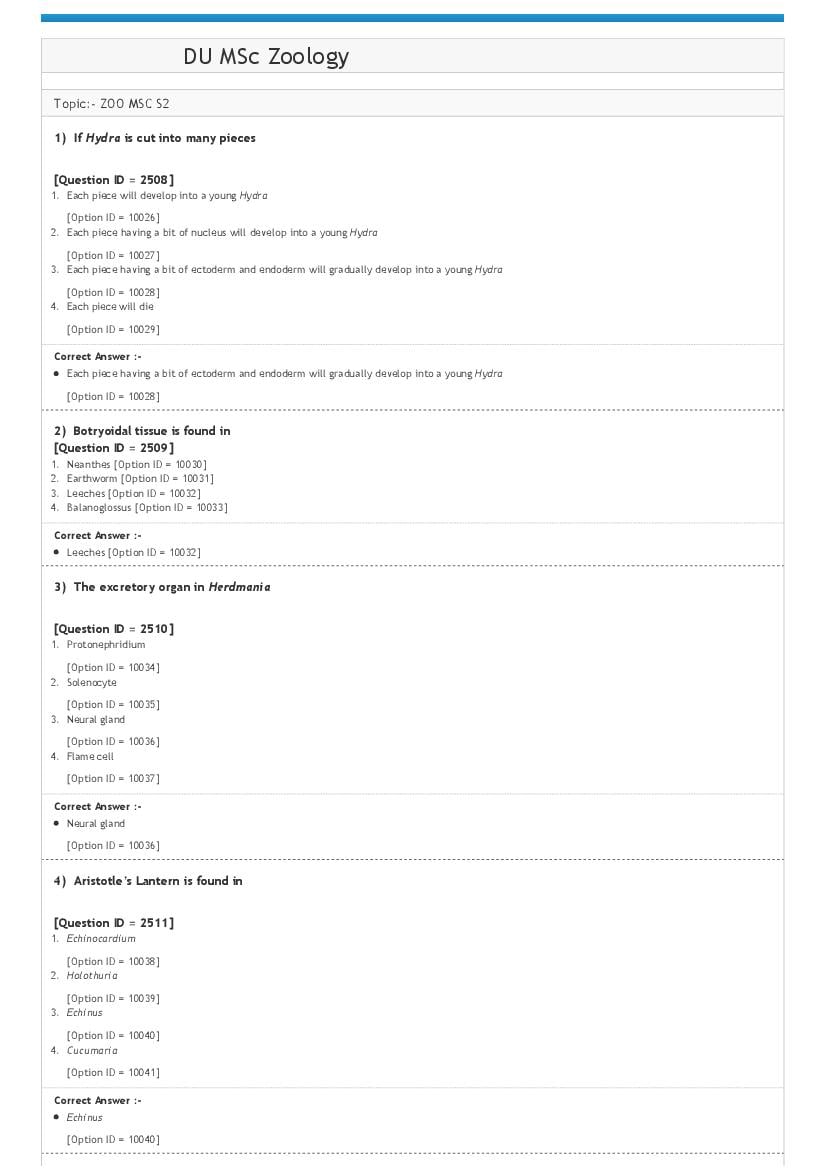
Topic:‐ ZOO MSC S2
1) If Hydra is cut into many pieces
[Question ID = 2508]
1. Each piece will develop into a young Hydra
[Option ID = 10026]
2. Each piece having a bit of nucleus will develop into a young Hydra
[Option ID = 10027]
3. Each piece having a bit of ectoderm and endoderm will gradually develop into a young Hydra
[Option ID = 10028]
4. Each piece will die
[Option ID = 10029]
Each piece having a bit of ectoderm and endoderm will gradually develop into a young Hydra
[Option ID = 10028]
2) Botryoidal tissue is found in
[Question ID = 2509]
1. Neanthes [Option ID = 10030]
2. Earthworm [Option ID = 10031]
3. Leeches [Option ID = 10032]
4. Balanoglossus [Option ID = 10033]
Leeches [Option ID = 10032]
3) The excretory organ in Herdmania
[Question ID = 2510]
1. Protonephridium
[Option ID = 10034]
2. Solenocyte
[Option ID = 10035]
3. Neural gland
[Option ID = 10036]
4. Flame cell
[Option ID = 10037]
Neural gland
[Option ID = 10036]
4) Aristotle’s Lantern is found in
[Question ID = 2511]
1. Echinocardium
[Option ID = 10038]
2. Holothuria
[Option ID = 10039]
3. Echinus
[Option ID = 10040]
4. Cucumaria
[Option ID = 10041]
Echinus
[Option ID = 10040]
Page 2
[Question ID = 2512]
1. Termite [Option ID = 10042]
2. Spider [Option ID = 10043]
3. Mosquito [Option ID = 10044]
4. Ant [Option ID = 10045]
Spider [Option ID = 10043]
6) Gynacophoral canal is found in:‐
[Question ID = 2513]
1. Ancylostoma duodenale
[Option ID = 10046]
2. Schistosoma haematobium
[Option ID = 10047]
3. Ascaris lumbricoides
[Option ID = 10048]
4. Wuchereria bancrofti
[Option ID = 10049]
Schistosoma haematobium
[Option ID = 10047]
7) The powerful muscle by which the bird raises and propell itself through the air is peformed by:‐
[Question ID = 2514]
1. Pectoralis minor [Option ID = 10050]
2. Flexor perforans [Option ID = 10051]
3. Pectoralis major [Option ID = 10052]
4. Flexor major [Option ID = 10053]
Pectoralis major [Option ID = 10052]
8) Neuromast organ in fishes are useful as:‐
[Question ID = 2515]
1. Current receptors [Option ID = 10054]
2. Touch receptors [Option ID = 10055]
3. Thermoreceptors [Option ID = 10056]
4. Electroreceptors [Option ID = 10057]
Current receptors [Option ID = 10054]
9) Balanoglossus also known as:‐
[Question ID = 2516]
1. Pin worms [Option ID = 10058]
2. Acron worm [Option ID = 10059]
3. Tape worms [Option ID = 10060]
4. Ring worms [Option ID = 10061]
Acron worm [Option ID = 10059]
10) In rabbit, sigmoid notch is present in:‐
[Question ID = 2517]
1. Pectoral girdle [Option ID = 10062]
2. Pelvic girdle [Option ID = 10063]
3. Tibio‐fibula [Option ID = 10064]
4. Radius‐ulna [Option ID = 10065]
Radius‐ulna [Option ID = 10065]
11) Synsacrum in fowl is formed by the fusion of:‐
[Question ID = 2518]
1. Thoracic vertebrae [Option ID = 10066]
2. Thoracic and lumbar vertebrae [Option ID = 10067]
3. Thoracic, lumbar and sacral vertebrae [Option ID = 10068]
4. Thoracic, lumbar, sacral and caudal vertebrae [Option ID = 10069]
Page 3
12) Which of the following reptiles has four chambered heart?
[Question ID = 2519]
1. Turtle [Option ID = 10070]
2. Sphenodon [Option ID = 10071]
3. King cobra [Option ID = 10072]
4. Crocodile [Option ID = 10073]
Crocodile [Option ID = 10073]
13) Female Anopheles can be distinguished from female Culex because it sits
[Question ID = 2520]
1. At an angle with substratum
[Option ID = 10074]
2. Parallel to surface of substratum
[Option ID = 10075]
3. At right angles to surface of substratum
[Option ID = 10076]
4. Without using all six legs
[Option ID = 10077]
At an angle with substratum
[Option ID = 10074]
14) The variant hemoglobin in sickle cell anemia binds O2 less efficiently. However, the abnormal allele has not been
eliminated from the affected population as it has a selection advantage against
[Question ID = 2521]
1. Pernicious anemia [Option ID = 10078]
2. Leukemia [Option ID = 10079]
3. Malaria [Option ID = 10080]
4. Thalassemia [Option ID = 10081]
Malaria [Option ID = 10080]
15) Which one of the following is an incorrect match?
[Question ID = 2522]
1. Symbiosis‐Trichonympha
[Option ID = 10082]
2. Commensalism‐Balantidium
[Option ID = 10083]
3. Parasitism‐Trypanosoma
[Option ID = 10084]
4. Free living‐Paramecium
[Option ID = 10085]
Commensalism‐Balantidium
[Option ID = 10083]
16) Aortic acrh VI gives rise to the pulmonary artery but maintains its connection with the dorsal aorta through:‐
[Question ID = 2523]
1. Ductus arterious [Option ID = 10086]
2. Ductus caroticus [Option ID = 10087]
3. Ductus bulbus [Option ID = 10088]
4. Ductus pneumaticus [Option ID = 10089]
Ductus arterious [Option ID = 10086]
17) Which one of the following amphibians has partial interventicular septum in heart?
Page 4
1. Siren
[Option ID = 10090]
2. Proteus
[Option ID = 10091]
3. Rana
[Option ID = 10092]
4. Uraeotyphlus
[Option ID = 10093]
Siren
[Option ID = 10090]
18) Which part of the middle ear transmits sound vibrations to fenestra rotunda of internal ear:‐
[Question ID = 2525]
1. Stapes [Option ID = 10094]
2. Incus [Option ID = 10095]
3. Malleus [Option ID = 10096]
4. Tympanum [Option ID = 10097]
Stapes [Option ID = 10094]
19) Third chamber in the stomach of a ruminant mammal is:‐
[Question ID = 2526]
1. Abomasum [Option ID = 10098]
2. Omasum [Option ID = 10099]
3. Rumen [Option ID = 10100]
4. Reticulum [Option ID = 10101]
Omasum [Option ID = 10099]
20) The type of jaw suspensorium in shark is:‐
[Question ID = 2527]
1. Autodiastylic [Option ID = 10102]
2. Amphistylic [Option ID = 10103]
3. Hyostylic [Option ID = 10104]
4. Streptostylic [Option ID = 10105]
Hyostylic [Option ID = 10104]
21) Which of the following continents is included in the Neotropical faunal realm?
[Question ID = 2528]
1. North America [Option ID = 10106]
2. South America [Option ID = 10107]
3. Africa [Option ID = 10108]
4. Australia [Option ID = 10109]
South America [Option ID = 10107]
22) Darwin’s finches represent the example of
[Question ID = 2529]
1. Convergent evolution [Option ID = 10110]
2. Parallel evolution [Option ID = 10111]
3. Adaptive radiation [Option ID = 10112]
4. Co‐evolution [Option ID = 10113]
Adaptive radiation [Option ID = 10112]
23) A novel phenotypic trait that helps in success of a taxonomic group and its subsequent radiation is called
[Question ID = 2530]
1. Key innovation [Option ID = 10114]
2. Adaptive trait [Option ID = 10115]
3. Evolutionary novelty [Option ID = 10116]
4. Crucial trait [Option ID = 10117]
Key innovation [Option ID = 10114]
Page 5
[Question ID = 2531]
1. End of Devonian period [Option ID = 10118]
2. End of Cretaceous period [Option ID = 10119]
3. End of Triassic period [Option ID = 10120]
4. End of Permian period [Option ID = 10121]
End of Cretaceous period [Option ID = 10119]
25) Presence of which of the following is an important evidence for organic evolution?
[Question ID = 2532]
1. homologous organs only [Option ID = 10122]
2. homologous and vestigial organs [Option ID = 10123]
3. homologous and analogous organs [Option ID = 10124]
4. analogous and vestigial organs [Option ID = 10125]
homologous and vestigial organs [Option ID = 10123]
26) Bergman’s rule refers to a general tendency of mammals to be
[Question ID = 2533]
1. large in size in colder areas of the their distribution [Option ID = 10126]
2. smaller in size in areas of the their distribution [Option ID = 10127]
3. darker pigments in warmer areas of the their distribution [Option ID = 10128]
4. lighter pigments in warmer areas of the their distribution [Option ID = 10129]
large in size in colder areas of the their distribution [Option ID = 10126]
27) Which of the following statement is TRUE?
[Question ID = 2534]
1. Evolution is goal oriented [Option ID = 10130]
2. Mutations are always harmful [Option ID = 10131]
3. Variations are necessary for natural selection [Option ID = 10132]
4. Speciation always requires geographical isolation [Option ID = 10133]
Variations are necessary for natural selection [Option ID = 10132]
28) ‘Philosophie Zoologique’ was written by:‐
[Question ID = 2535]
1. Charles Darwin [Option ID = 10134]
2. Jean‐Baptiste Lamarck [Option ID = 10135]
3. Richard Dawkins [Option ID = 10136]
4. Russel Wallace [Option ID = 10137]
Jean‐Baptiste Lamarck [Option ID = 10135]
29) Within a small population, variations can occur in gene frequencies by chance rather than natural selection. It may be
referred as
[Question ID = 2536]
1. Genetic flow [Option ID = 10138]
2. Genetic load [Option ID = 10139]
3. Genetic drift [Option ID = 10140]
4. Genetic equilibrium [Option ID = 10141]
Genetic drift [Option ID = 10140]
30) Monarch and Viceroy butterflies are an example of:‐
[Question ID = 2537]
1. Mullerian mimicry [Option ID = 10142]
2. Batesian mimicry [Option ID = 10143]
3. Peckhamian mimicry [Option ID = 10144]
4. Vavilovian mimicry [Option ID = 10145]
Batesian mimicry [Option ID = 10143]
31) The correct route through which pulse making impulses in the heart is:‐
[Question ID = 2538]
Page 6
2. SA node> AV node>bundles of His> Purkinjee fibre > heart muscles [Option ID = 10147]
3. AV node> Purkinjee fibre> SA node> bundle of His> heart muscles [Option ID = 10148]
4. AV node> SA node> Purkinjee fibre> bundles of His> heart muscles [Option ID = 10149]
SA node> AV node>bundles of His> Purkinjee fibre > heart muscles [Option ID = 10147]
32) Which of the following is controlled by autonomous nervous system?
[Question ID = 2539]
1. Papillary reflex [Option ID = 10150]
2. Swallowing food [Option ID = 10151]
3. Knee jerk response [Option ID = 10152]
4. Peristalsis [Option ID = 10153]
Peristalsis [Option ID = 10153]
33) Match List I with List II
List I List II
Vitamins Diseases
A. K I. Beri‐beri
B. D II. Haemorrhagic disease of new born
C. B1 III. Night blindness
D. A IV. Rickets
Choose the correct answer from the options given below:
[Question ID = 2540]
1. A ‐ III, B ‐ II, C ‐ IV, D ‐ I
[Option ID = 10154]
2. A ‐ I, B ‐ II, C ‐ IV, D ‐ III
[Option ID = 10155]
3. A ‐ III, B ‐ I, C ‐ IV, D ‐ II
[Option ID = 10156]
4. A ‐ II, B ‐ IV, C ‐ I, D ‐ III
[Option ID = 10157]
A ‐ II, B ‐ IV, C ‐ I, D ‐ III
[Option ID = 10157]
34) Which of the following is a light compass response?
[Question ID = 2541]
1. Geomagnetaxis [Option ID = 10158]
2. Hydrotaxis [Option ID = 10159]
3. Menotaxis [Option ID = 10160]
4. Mnemotaxis [Option ID = 10161]
Menotaxis [Option ID = 10160]
35) The non‐descendence of testis into the scrotal sac is referred as
[Question ID = 2542]
1. Orchidectomy [Option ID = 10162]
2. Vasectomy [Option ID = 10163]
3. Hypogonadism [Option ID = 10164]
4. Cryptorchidism [Option ID = 10165]
Cryptorchidism [Option ID = 10165]
36) Hypophysectomy of the adult female rat prevents the development of:‐
[Question ID = 2543]
1. Primordial follicle [Option ID = 10166]
2. Primary follicle [Option ID = 10167]
3. Secondary follicle [Option ID = 10168]
4. Graffian follicle [Option ID = 10169]
Graffian follicle [Option ID = 10169]
Page 7
[Question ID = 2544]
1. ZP1 [Option ID = 10170]
2. ZP2 [Option ID = 10171]
3. ZP2f [Option ID = 10172]
4. ZP3 [Option ID = 10173]
ZP3 [Option ID = 10173]
38) Vasopressin is synthesized by:‐
[Question ID = 2545]
1. Pars distalis [Option ID = 10174]
2. Pars intermedia [Option ID = 10175]
3. Pars nervosa [Option ID = 10176]
4. Hypothalamus [Option ID = 10177]
Hypothalamus [Option ID = 10177]
39) In the organ of Corti, apical projections of hair cells are in intimate contact with:‐
[Question ID = 2546]
1. Reissners’s membrane [Option ID = 10178]
2. Basilar membrane [Option ID = 10179]
3. Decemet’s membrane [Option ID = 10180]
4. Tectorial membrane [Option ID = 10181]
Tectorial membrane [Option ID = 10181]
40) The hormone which causes moulting in arthropods is:‐
[Question ID = 2547]
1. Thyroxin [Option ID = 10182]
2. Ecdysone [Option ID = 10183]
3. Prolactin [Option ID = 10184]
4. Juvenile hormone [Option ID = 10185]
Ecdysone [Option ID = 10183]
41) End product of glycolysis in red blood cells is
[Question ID = 2548]
1. Acetyl CoA [Option ID = 10186]
2. Pyruvic acid [Option ID = 10187]
3. Lactic acid [Option ID = 10188]
4. 3‐Phosphoglycerate [Option ID = 10189]
Lactic acid [Option ID = 10188]
42) For a given fixed length of double stranded DNA, melting temperature (Tm) is
[Question ID = 2549]
1. Directly proportional to GC base content [Option ID = 10190]
2. Inversely proportional to GC base content [Option ID = 10191]
3. Directly proportional to AT base content [Option ID = 10192]
4. Not related to base composition of DNA [Option ID = 10193]
Directly proportional to GC base content [Option ID = 10190]
43) At pH value greater than pKa of COOH group in the amino acid, the amino acid will be
[Question ID = 2550]
1. Positive charged [Option ID = 10194]
2. Negative charged [Option ID = 10195]
3. No charge [Option ID = 10196]
4. Both positive and negative charges [Option ID = 10197]
Negative charged [Option ID = 10195]
44) Calcium is stored in the muscle cell
[Question ID = 2551]
1. In the cytoplasm [Option ID = 10198]
2. In the sarcoplasmic reticulum [Option ID = 10199]
Page 8
4. In the nucleus as free calcium [Option ID = 10201]
In the sarcoplasmic reticulum [Option ID = 10199]
45) ATP is synthesized in mitochondria and also in glycolysis. During synthesis of ATP in glycolysis, phosphate is provided by
[Question ID = 2552]
1. glucose‐6‐phosphate and fructose‐6‐phosphate [Option ID = 10202]
2. 3‐phospho‐gyceraldhyde and di‐hydroxyacetone phosphate [Option ID = 10203]
3. 1,6 bis‐phosphofuctose and 3‐phosphogyceric acid [Option ID = 10204]
4. 1,3 bis‐phospho glycerate and phosphoenol pyruvate [Option ID = 10205]
1,3 bis‐phospho glycerate and phosphoenol pyruvate [Option ID = 10205]
46) Fructose intolerance is due to
[Question ID = 2553]
1. Increased production of lactase [Option ID = 10206]
2. Increased production of amylase [Option ID = 10207]
3. Reduced production of aldolase [Option ID = 10208]
4. Reduced production of cellulase [Option ID = 10209]
Reduced production of aldolase [Option ID = 10208]
47) In presence of oxygen, glycolysis is suppressed and it is called
[Question ID = 2554]
1. Bohr’s Effect [Option ID = 10210]
2. Warburg Effect [Option ID = 10211]
3. Pasteur Effect [Option ID = 10212]
4. Haldane’s Effect [Option ID = 10213]
Pasteur Effect [Option ID = 10212]
48) What is the pH of a solution whose hydrogen ion concentration is 3.2 x 10⁻⁴ mol/L?
[Question ID = 2555]
1. 3.5 [Option ID = 10214]
2. 4.5 [Option ID = 10215]
3. 4.0 [Option ID = 10216]
4. 3.0 [Option ID = 10217]
3.5 [Option ID = 10214]
49) The detection of restriction fragment length polymorphisms relies on a specialized hybridization technique called
[Question ID = 2556]
1. Southern blotting [Option ID = 10218]
2. northern blotting [Option ID = 10219]
3. western blotting [Option ID = 10220]
4. north‐western blotting [Option ID = 10221]
Southern blotting [Option ID = 10218]
50) Muscle phosphorylase deficiency cause a glycogen storage disease known as
[Question ID = 2557]
1. McArdle’s Disease [Option ID = 10222]
2. von Gierke’s Disease [Option ID = 10223]
3. Cori’s Disease [Option ID = 10224]
4. Andersen’s Disease [Option ID = 10225]
McArdle’s Disease [Option ID = 10222]
51) A symmetrical molecule that reacts asymmetrically in Krebs cycle
[Question ID = 2558]
1. Citrate [Option ID = 10226]
2. Succinate [Option ID = 10227]
3. Malate [Option ID = 10228]
4. Fumerate [Option ID = 10229]
Citrate [Option ID = 10226]
Page 9
[Question ID = 2559]
1. Acyl carrier protein [Option ID = 10230]
2. Acetyl co‐A ACP transacetylase [Option ID = 10231]
3. Malonyl co‐A ACP transferase [Option ID = 10232]
4. β‐ketoacyl ACP synthase [Option ID = 10233]
Malonyl co‐A ACP transferase [Option ID = 10232]
53) Transamination reactions essentially require coenzyme
[Question ID = 2560]
1. NAD [Option ID = 10234]
2. Thiamine pyrophosphate [Option ID = 10235]
3. Pyridoxal phosphate [Option ID = 10236]
4. Coenzyme A [Option ID = 10237]
Pyridoxal phosphate [Option ID = 10236]
54) Which of the following trisomy karyotypes has the mildest effect on human development?
[Question ID = 2561]
1. 47, XXX [Option ID = 10238]
2. 47, XXY [Option ID = 10239]
3. 47, XX,+13 [Option ID = 10240]
4. 47, XY,+21 [Option ID = 10241]
47, XXX [Option ID = 10238]
55) Which of the following conditions shows anticipation in paternal transmission?
[Question ID = 2562]
1. Huntington disease [Option ID = 10242]
2. Marfan syndrome [Option ID = 10243]
3. Cystic fibrosis [Option ID = 10244]
4. Fragile X syndrome [Option ID = 10245]
Huntington disease [Option ID = 10242]
56) Which of the following conditions DOES NOT show multifactorial inheritance?
[Question ID = 2563]
1. Pyloric stenosis [Option ID = 10246]
2. Schizophrenia [Option ID = 10247]
3. Spina bifida (neural tube defects) [Option ID = 10248]
4. Marfan syndrome [Option ID = 10249]
Marfan syndrome [Option ID = 10249]
57) Mendel discovered principles of inheritance because he
[Question ID = 2564]
1. Observed simultaneously all the characteristics in which the parents differed [Option ID = 10250]
2. Believed that the hereditary characteristics of two individuals became thoroughly blended in the offspring [Option ID = 10251]
3. Ignored all characteristics except a few markedly contrasting ones he studied [Option ID = 10252]
4. Studied only the offspring obtained from a single mating [Option ID = 10253]
Ignored all characteristics except a few markedly contrasting ones he studied [Option ID = 10252]
58) Cornea transplant in humans is almost never rejected, because
[Question ID = 2565]
1. It is composed of enucleated cells [Option ID = 10254]
2. It is a non – living layer [Option ID = 10255]
3. Its cells are not penetrable by bacteria [Option ID = 10256]
4. It is avascular [Option ID = 10257]
It is avascular [Option ID = 10257]
59) The most sensitive area of the entire larynx and respiratory tract for triggering a cough reflex is
[Question ID = 2566]
1. Glottis [Option ID = 10258]
2. Respiratory bronchioles [Option ID = 10259]
Page 10
4. Mucus membrane of carina [Option ID = 10261]
Mucus membrane of carina [Option ID = 10261]
60) The conjugation between F’ and F – cells will be:‐
[Question ID = 2567]
1. Two F + cells [Option ID = 10262]
2. Two F – cells [Option ID = 10263]
3. Two F’ cells [Option ID = 10264]
4. Two Hfr cells [Option ID = 10265]
Two F’ cells [Option ID = 10264]
61) The modified dihybrid ratio due to recessive epistasis is
[Question ID = 2568]
1. 9:7 [Option ID = 10266]
2. 9:3:4 [Option ID = 10267]
3. 12:3:1 [Option ID = 10268]
4. 15:1 [Option ID = 10269]
9:3:4 [Option ID = 10267]
62) Which of the following aberrations DOES NOT change in chromosomal arm ratio?
[Question ID = 2569]
1. Pericentric inversion [Option ID = 10270]
2. Paracentric inversion [Option ID = 10271]
3. Reciprocal translocation [Option ID = 10272]
4. Non‐reciprocal translocation [Option ID = 10273]
Pericentric inversion [Option ID = 10270]
63) If AaBbccDdEe is crossed with AaBbCcddEe, the proportion of aabbccddee among progenies will be
[Question ID = 2570]
1. 1/32 [Option ID = 10274]
2. 1/64 [Option ID = 10275]
3. 1/128 [Option ID = 10276]
4. 1/256 [Option ID = 10277]
1/256 [Option ID = 10277]
64) In a population of 60 individuals, 42 people were found to have an allele for polydactyly, out of which 38 were found
to have an extra digit. The penetrance is:‐
[Question ID = 2571]
1. 0.6 [Option ID = 10278]
2. 0.70 [Option ID = 10279]
3. 0.90 [Option ID = 10280]
4. 1.00 [Option ID = 10281]
0.90 [Option ID = 10280]
65) The agent used to fuse the membranes of cells from two different cell lines in somatic cell hybridization is
[Question ID = 2572]
1. HAT [Option ID = 10282]
2. PEG [Option ID = 10283]
3. HGPRT [Option ID = 10284]
4. TK [Option ID = 10285]
PEG [Option ID = 10283]
66) Lampbrush chromosomes are found in
[Question ID = 2573]
1. Brain cells of cat [Option ID = 10286]
2. Germ cells of mammalia [Option ID = 10287]
3. Ovarian cells of amphibians [Option ID = 10288]
4. Salivary glands of diptera [Option ID = 10289]
Page 11
67) Anoikis is a form of cell death which arises when one of the following proteins detaches from extracellular matrix.
Identify the cell adhesion molecule
[Question ID = 2574]
1. Cadherin [Option ID = 10290]
2. Integrin [Option ID = 10291]
3. Selectin [Option ID = 10292]
4. I‐CAM [Option ID = 10293]
Integrin [Option ID = 10291]
68) Which pathway relies on activated Smads to transduce its signals?
[Question ID = 2575]
1. Notch signaling [Option ID = 10294]
2. TGF‐ beta signaling [Option ID = 10295]
3. Wnt signaling [Option ID = 10296]
4. TNF‐signalling [Option ID = 10297]
Wnt signaling [Option ID = 10296]
69) Which of the following is observed during Anaphase B?
[Question ID = 2576]
1. Depolymerisation of microtubules [Option ID = 10298]
2. Shortening of polar microtubules [Option ID = 10299]
3. Consumption of ATP [Option ID = 10300]
4. Sliding of kinetochore microtubules [Option ID = 10301]
Consumption of ATP [Option ID = 10300]
70) Import of glucose by the intestinal epithelial cell:‐
[Question ID = 2577]
1. Is dependent on hydrolysis of ATP [Option ID = 10302]
2. Requires expression of GLUT1 on the plasma membrane [Option ID = 10303]
3. Occurs throughout the phospholipid bilayer [Option ID = 10304]
4. Is facilitated by GLUT2 [Option ID = 10305]
Is dependent on hydrolysis of ATP [Option ID = 10302]
71) Integrity of tight junctions is essential for
[Question ID = 2578]
1. Transfer of second messengers [Option ID = 10306]
2. Metabolic coupling [Option ID = 10307]
3. Peristalsis [Option ID = 10308]
4. Transepithelial transport [Option ID = 10309]
Transepithelial transport [Option ID = 10309]
72) If cardiolipin biosynthesis decreases in eukaryotic cells
[Question ID = 2579]
1. ATP synthesis would be unaffected [Option ID = 10310]
2. The function of the ETC would be affected adversely [Option ID = 10311]
3. The potential would remain at 140 mV [Option ID = 10312]
4. ADP would be imported into the matrix [Option ID = 10313]
The function of the ETC would be affected adversely [Option ID = 10311]
73) Fleming’s bacterial culture during the discovery of penicillin was of
[Question ID = 2580]
1. Enterobacteria
[Option ID = 10314]
2. Salmonella
[Option ID = 10315]
3. Staphylococcus
[Option ID = 10316]
4. Streptococcus
Page 12
Staphylococcus
[Option ID = 10316]
74) Mad cow disease is caused by a
[Question ID = 2581]
1. Virus [Option ID = 10318]
2. Viroid [Option ID = 10319]
3. PPLO [Option ID = 10320]
4. Prion [Option ID = 10321]
Prion [Option ID = 10321]
75) The recognition sequence for BamHI is 5' G/GATCC 3'. The '/' represents the cutting site. What can be inferred about
the ends from it?
[Question ID = 2582]
1. The ends created are double stranded [Option ID = 10322]
2. The single stranded end is 5' in nature [Option ID = 10323]
3. The single stranded ends are 3' in nature [Option ID = 10324]
4. The nature of the ends cannot be inferred [Option ID = 10325]
The single stranded end is 5' in nature [Option ID = 10323]
76) If you have a DNA fragment, with blunt ends on both side, in order to make it sticky which enzyme would you select?
[Question ID = 2583]
1. DNA polymerase [Option ID = 10326]
2. Terminal nucleotydyl transferase [Option ID = 10327]
3. Alkaline phosphatase [Option ID = 10328]
4. Reverse transcriptase [Option ID = 10329]
Terminal nucleotydyl transferase [Option ID = 10327]
77) Even after replication in E. coli, how does the modified DNA remain protected?
[Question ID = 2584]
1. It remains protected because of conservative mode of replication
[Option ID = 10330]
2. It remains protected because of semi‐conservative mode of replication
[Option ID = 10331]
3. The mode of replication has no role to play in the protection
[Option ID = 10332]
4. It is again modified after replication
[Option ID = 10333]
It remains protected because of semi‐conservative mode of replication
[Option ID = 10331]
78) Among following DNA polymerases, which one is required for the mitochondrial DNA replication?
[Question ID = 2585]
1. DNA pol epsilon [Option ID = 10334]
2. DNA pol zeta [Option ID = 10335]
3. DNA pol gamma [Option ID = 10336]
4. DNA pol lambda [Option ID = 10337]
DNA pol gamma [Option ID = 10336]
79) What is the role of SDS in SDS‐PAGE?
[Question ID = 2586]
1. Protein denaturing and imparting negative charge [Option ID = 10338]
2. Imparting overall a uniform positive charge to protein [Option ID = 10339]
3. Imparting equal mass to all proteins [Option ID = 10340]
4. Protein unfolding and imparting net positive charge [Option ID = 10341]
Page 13
80) Sabin polio vaccine consists of
[Question ID = 2587]
1. Three attenuated strains of polio virus [Option ID = 10342]
2. Two live strains of polio virus [Option ID = 10343]
3. Three killed strains of polio virus [Option ID = 10344]
4. Two attenuated strains of polio virus [Option ID = 10345]
Three attenuated strains of polio virus [Option ID = 10342]
81) Which type of hypersensitivity is due to antigen‐ antibody complex accumulation?
[Question ID = 2588]
1. Type I [Option ID = 10346]
2. Type II [Option ID = 10347]
3. Type III [Option ID = 10348]
4. Type IV [Option ID = 10349]
Type III [Option ID = 10348]
82) Bence –Jones proteins discovered in urine of myeloma patients are:‐
[Question ID = 2589]
1. Excess light chains [Option ID = 10350]
2. Excess heavy chains [Option ID = 10351]
3. Mixture of heavy and light chains [Option ID = 10352]
4. Fab fragments [Option ID = 10353]
Excess light chains [Option ID = 10350]
83) Negative selection of thymocytes during their maturation ensures
[Question ID = 2590]
1. MHC restriction [Option ID = 10354]
2. Self‐tolerance [Option ID = 10355]
3. Both self‐tolerance and MHC restriction [Option ID = 10356]
4. Neither self‐tolerance nor MHC restriction [Option ID = 10357]
Self‐tolerance [Option ID = 10355]
84) Antimicrobial peptides of silkmoth are called
[Question ID = 2591]
1. Cecropins [Option ID = 10358]
2. Alpha defensins [Option ID = 10359]
3. Beta defensins [Option ID = 10360]
4. Cathelicidins [Option ID = 10361]
Cecropins [Option ID = 10358]
85) The hinge region of antibody is rich in
[Question ID = 2592]
1. Glycine and alanine [Option ID = 10362]
2. Leucine and valine [Option ID = 10363]
3. Proline and cysteine [Option ID = 10364]
4. Arginine and histidine [Option ID = 10365]
Proline and cysteine [Option ID = 10364]
86) ‘Freund’s complete adjuvant' developed by Jules Freund had an additional component that was absent in ‘Freund’s
incomplete adjuvant', it was
[Question ID = 2593]
1. mineral oil [Option ID = 10366]
2. emulsifying agent [Option ID = 10367]
3. mycobacteria [Option ID = 10368]
4. the antigen [Option ID = 10369]
mycobacteria [Option ID = 10368]
87) The mouse major histocompatibility complex is a collection of genes arrayed on long continuous DNA stretch on
Page 14
1. Chromosome 11 [Option ID = 10370]
2. Chromosome X [Option ID = 10371]
3. Chromosome 6 [Option ID = 10372]
4. Chromosome 17 [Option ID = 10373]
Chromosome 17 [Option ID = 10373]
88) Peptide fragments generated in the cell’s cytoplasm are transported into the endoplasmic reticulum by
[Question ID = 2595]
1. MHC‐I [Option ID = 10374]
2. TAP‐I and TAP‐2 [Option ID = 10375]
3. HLA‐DM [Option ID = 10376]
4. Invariant chain [Option ID = 10377]
TAP‐I and TAP‐2 [Option ID = 10375]
89) Which of the following is not a professional antigen presenting cell?
[Question ID = 2596]
1. B cell [Option ID = 10378]
2. T cell [Option ID = 10379]
3. Macrophage [Option ID = 10380]
4. Dendritic cell [Option ID = 10381]
T cell [Option ID = 10379]
90) Radioimmunoassay is one of the most sensitive technique for detecting antigen or antibody. It was first developed by
[Question ID = 2597]
1. Kohler and Milestein [Option ID = 10382]
2. Berson and Yalow [Option ID = 10383]
3. Zinkernagel and Doherty [Option ID = 10384]
4. Porter and Edelman [Option ID = 10385]
Berson and Yalow [Option ID = 10383]
91) Cell to cell communication is important in development of an organism. The ability of cells to respond to a specific
inductive signal is called
[Question ID = 2598]
1. Induction [Option ID = 10386]
2. Competence [Option ID = 10387]
3. Specificity [Option ID = 10388]
4. Instructive interaction [Option ID = 10389]
Competence [Option ID = 10387]
92) Acrosome of the sperm is formed from
[Question ID = 2599]
1. Golgi body [Option ID = 10390]
2. Mitochondria [Option ID = 10391]
3. Centriole [Option ID = 10392]
4. Endoplasmic reticulum [Option ID = 10393]
Golgi body [Option ID = 10390]
93) The type of cleavage in an insect egg is
[Question ID = 2600]
1. Holoblastic [Option ID = 10394]
2. Meroblastic [Option ID = 10395]
3. Superficial [Option ID = 10396]
4. Discoidal [Option ID = 10397]
Superficial [Option ID = 10396]
94) The gastrular movement involved in migration of individual cells from the surface to interior of embryo is termed as
[Question ID = 2601]
1. Ingression [Option ID = 10398]
2. Involution [Option ID = 10399]
3. Invagination [Option ID = 10400]
Page 15
Ingression [Option ID = 10398]
95) In following model organisms, which one is pseudotetraploid?
[Question ID = 2602]
1. Danio rerio
[Option ID = 10402]
2. Xenopus laevis
[Option ID = 10403]
3. Drosophila melanogaster
[Option ID = 10404]
4. Xenopus tropicalis
[Option ID = 10405]
Xenopus laevis
[Option ID = 10403]
96) Match List I with List II
List I List II
A. Mouse I. meroblastic cleavage, discoblastula
B. Xenopus II. holoblastic cleavage, amphiblastula
C. Chick III. rotational cleavage, blastocyst
D. Danio rerio IV. discoidal cleavage, discoblastula, cledoic egg
Choose the correct answer from the options given below:‐
[Question ID = 2603]
1. A ‐ IV, B ‐ I, C ‐ II, D ‐ III
[Option ID = 10406]
2. A ‐ III, B ‐ II, C ‐ IV, D ‐ I
[Option ID = 10407]
3. A ‐ IV, B ‐ II, C ‐ I, D ‐ III
[Option ID = 10408]
4. A ‐ I, B ‐ II, C ‐ III, D ‐ IV
[Option ID = 10409]
A ‐ III, B ‐ II, C ‐ IV, D ‐ I
[Option ID = 10407]
97) Which one of the following provides fast block to polyspermy during sea urchin fertilization?
[Question ID = 2604]
1. Wave of calcium release [Option ID = 10410]
2. Release of the contents from cortical granules [Option ID = 10411]
3. Depolarization of egg membrane [Option ID = 10412]
4. Activation of phospholipase C zeta [Option ID = 10413]
Depolarization of egg membrane [Option ID = 10412]
98) Following are the events that occur during fertilization.
A. Activation of egg metabolism to start development
B. Fusion of genetic material from the two gametes
C. Regulation of sperm entry into the egg
D. Contact and recognition between sperm and egg
Choose answer from the options given below.
representing correct order of the events.
[Question ID = 2605]
1. A, B, C, D
Page 16
2. B, C, D, A
[Option ID = 10415]
3. D, C, B, A
[Option ID = 10416]
4. C, D, A, B
[Option ID = 10417]
D, C, B, A
[Option ID = 10416]
99) During development of Xenopus embryo, mesoderm elongation towards the anterior results from intercalation of cells
during a process called:‐
[Question ID = 2606]
1. Involution
[Option ID = 10418]
2. Convergent extension
[Option ID = 10419]
3. Proliferation
[Option ID = 10420]
4. Invagination
[Option ID = 10421]
Convergent extension
[Option ID = 10419]
100) The dorsal‐most vegetal cells of the blastula which are capable of inducing the organizer are called:‐
[Question ID = 2607]
1. Dorsal lip of the blastopore [Option ID = 10422]
2. Grey crescent [Option ID = 10423]
3. Nieuwkoop center [Option ID = 10424]
4. Bottle cells [Option ID = 10425]
Nieuwkoop center [Option ID = 10424]