MAHA SET 2025 Paper II Economics Set A Question Paper
Finished viewing? Save it for later —
Download MAHA SET 2025 Paper II Economics Set A Question Paper (PDF · 48 pages)About MAHA SET 2025 Paper II Economics Set A Question Paper
MAHA SET 2025 Paper II Economics Set A Question Paper is available here for free download. Published by Maharashtra Exams for MAHA SET, this question paper can be viewed online or downloaded as a PDF (48 pages). Candidates preparing for MAHA SET can use MAHA SET 2025 Paper II Economics Set A Question Paper to understand the exam pattern, the type of questions asked, and the overall difficulty level.
Frequently Asked Questions
How can I download MAHA SET 2025 Paper II Economics Set A Question Paper?
Open this page and click the Download button to save MAHA SET 2025 Paper II Economics Set A Question Paper as a PDF. It is completely free on AglaSem Docs.
Is MAHA SET 2025 Paper II Economics Set A Question Paper free to download?
Yes. MAHA SET 2025 Paper II Economics Set A Question Paper can be viewed online and downloaded as a PDF free of cost on AglaSem Docs.
How many pages does MAHA SET 2025 Paper II Economics Set A Question Paper have?
MAHA SET 2025 Paper II Economics Set A Question Paper contains 48 pages, which you can read online or download together as a single PDF.
Where can I find more MAHA SET study material?
You can find more MAHA SET question papers, sample papers, syllabus, and answer keys on AglaSem Docs.
MAHA SET 2025 Paper II Economics Set A Question Paper – Text
Read the full text of this question paper below — useful to quickly search, copy and reference the content online without downloading the PDF.
📄 View text version (49 pages)
Page 1
MAHA SET 2025
Paper II Economics
Set A Question Paper
EXAM YEAR TYPE
MAHA SET 2025 Question Paper
Notes · Sample Papers · Previous Year Papers · Mock Tests
Page 2
m .co s e m
l a
ag
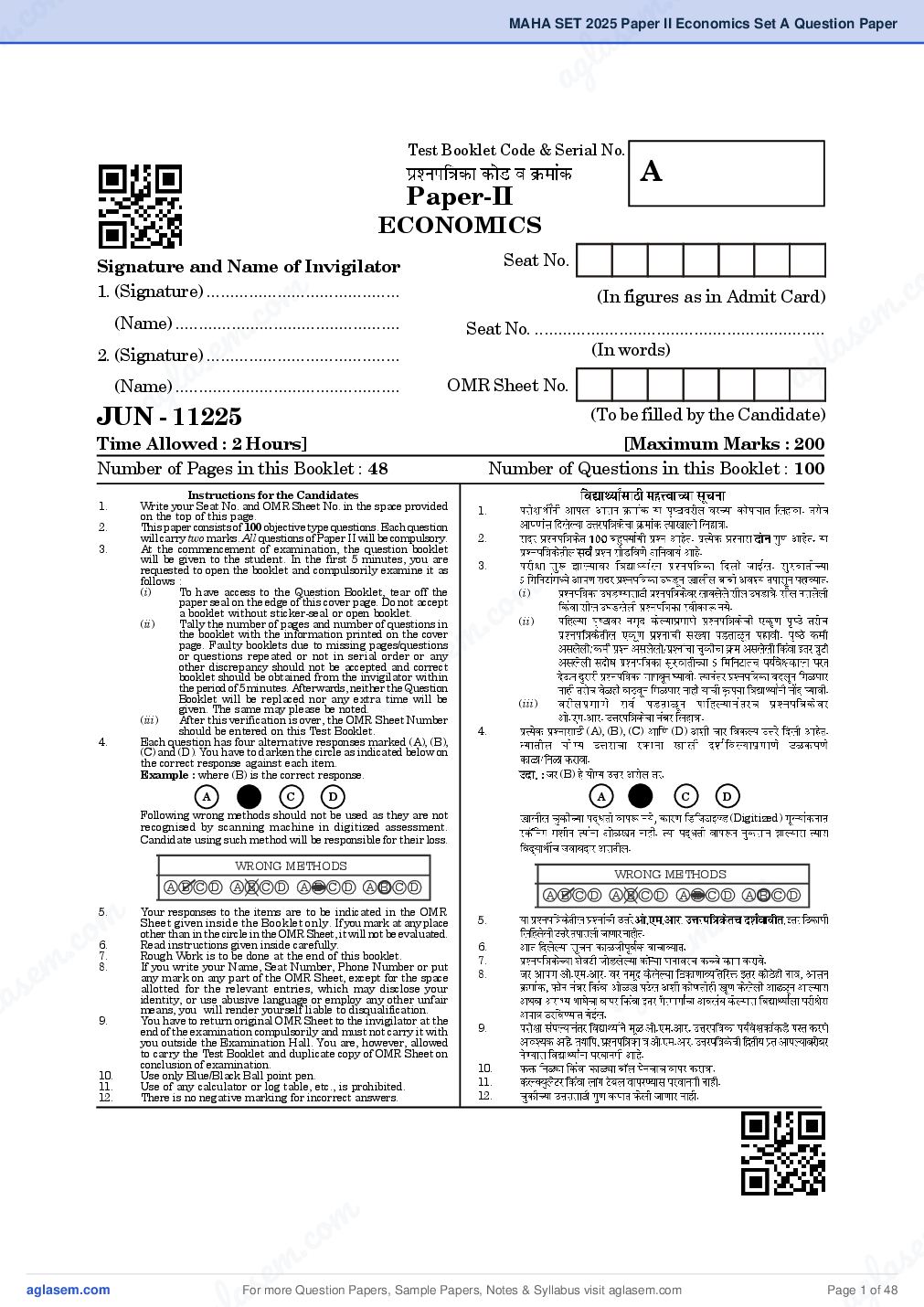
Test Booklet Code & Serial No.
A
Paper-II
ECONOMICS
Signature and Name of Invigilator Seat No.
m
1. (Signature) .........................................
. co
c. o
(In figures as in Admit Card)
e m
(Name) ................................................
em
Seat No. ..............................................................
l as
s
2. (Signature) .........................................
la
(In words)
ag
g
(Name) ................................................
JUNa- 11225
OMR Sheet No.
(To be filled by the Candidate)
Time Allowed : 2 Hours] [Maximum Marks : 200
Number of Pages in this Booklet : 48 Number of Questions in this Booklet : 100
Instructions for the Candidates
1. Write your Seat No. and OMR Sheet No. in the space provided 1.
on the top of this page.
2. This paper consists of 100 objective type questions. Each question
will carry two marks. All questions of Paper II will be compulsory. 2.
3. At the commencement of examination, the question booklet
will be given to the student. In the first 5 minutes, you are
requested to open the booklet and compulsorily examine it as 3.
m
follows :
c. o
(i) To have access to the Question Booklet, tear off the (i)
paper seal on the edge of this cover page. Do not accept
a booklet without sticker-seal or open booklet.
(ii)
m
(ii) Tally the number of pages and number of questions in
e
the booklet with the information printed on the cover
s
page. Faulty booklets due to missing pages/questions
a
or questions repeated or not in serial order or any
l
other discrepancy should not be accepted and correct
ag
booklet should be obtained from the invigilator within
the period of 5 minutes. Afterwards, neither the Question
Booklet will be replaced nor any extra time will be (iii)
given. The same may please be noted.
(iii) After this verification is over, the OMR Sheet Number
should be entered on this Test Booklet. 4. (A), (B), (C) (D)
4. Each question has four alternative responses marked (A), (B),
(C) and (D). You have to darken the circle as indicated below on
the correct response against each item.
Example : where (B) is the correct response. (B)
A C D A C D
Following wrong methods should not be used as they are not (Digitized)
recognised by scanning machine in digitized assessment.
Candidate using such method will be responsible for their loss.
CORRECT METHOD WRONG METHODS
CORRECT METHOD WRONG METHODS
C D A B C D A B C D A B C D A B C D
m
c. o
C D A B C D A B C D A B C D A B C D
m
5. Your responses to the items are to be indicated in the OMR
.co
5.
m
Sheet given inside the Booklet only. If you mark at any place
e
other than in the circle in the OMR Sheet, it will not be evaluated.
s
6. Read instructions given inside carefully. 6.
e m 7.
8.
Rough Work is to be done at the end of this booklet.
If you write your Name, Seat Number, Phone Number or put
7.
la
s g
any mark on any part of the OMR Sheet, except for the space 8.
la a
allotted for the relevant entries, which may disclose your
identity, or use abusive language or employ any other unfair
means, you will render yourself liable to disqualification.
9. You have to return original OMR Sheet to the invigilator at the
end of the examination compulsorily and must not carry it with 9.
you outside the Examination Hall. You are, however, allowed
to carry the Test Booklet and duplicate copy of OMR Sheet on
conclusion of examination. 10.
10. Use only Blue/Black Ball point pen.
11. Use of any calculator or log table, etc., is prohibited. 11.
12. There is no negative marking for incorrect answers. 12.
m
.co s e
s em
For more Question Papers, Sample Papers, Notes & Syllabus visit
gl a
Page 1 of 48
Page 3
For more Question Papers, Sample Papers, Notes & Syllabus visit Page 2 of 48
Page 4
m .co s e m
l a
ag
Economics
Paper II
om . co
. c II e m
e m l as
l as
Time Allowed : 120 Minutes] [Maximum Marks : 200
Note : This Paper contains Hundred (100) multiple choice questions. Each question
ag
agcarrying Two (2) marks. Attempt All questions.
(100) (2)
1. Why does a firm under perfect
1.
competition continue to operate in
the long run despite earning only
m
.co
normal/zero profits ?
(A) The firm operates at socially
e m
a s
optimum level of output inlthe
(A)
long run ag
(B) The firm achieves maximum
(B)
productive efficiency in the long
run
(C) The opportunity cost of the self- (C)
m
.co
owned factors is already being
m
.co m
recovered by the firm in the
m s e
s e long run
g la
la (D) All the firms are operating
(D)
a
under identical cost conditions
in the long run
3 [P.T.O.
m
.co s e
s em
For more Question Papers, Sample Papers, Notes & Syllabus visit
gl a
Page 3 of 48
Page 5
2.
of a firm in a perfectly competitive
market ?
(A) The part of the marginal cost (A)
curve that lies above the
average cost curve
(B) The part of the marginal cost (B)
curve that lies above the
average fixed cost curve
(C) The part of the marginal cost (C)
curve that lies above the
average variable cost curve
(D) The part of the average variable (D)
cost curve that lies above the
marginal cost curve
3. When the Total Product (TP) is 3.
maximum, the Average Product
(AP) is ................. and the Marginal
Product (MP) is ................... .
(A)
(A) maximum, minimum
(B)
(B) minimum, maximum
(C)
(C) Decreasing, zero
(D) Zero, decreasing (D)
4
For more Question Papers, Sample Papers, Notes & Syllabus visit Page 4 of 48
Page 6
m .co s e m
l a
ag
4. According to Bergson-Samuelson 4.
social welfare function approach,
social welfare
omis maximized . co
. c e m
when ..................... .
e m l as
a s
(A) The social indifference curve is
ltangent to the utility possibility ag
g
a curve
(B) The social indifference curve
intersects the utility possibility
curve
(C) The social indifference curve is
tangent to the production
m
.co
possibility curve
(D) The social indifference curve
e m
intersects
l as
the production
possibility curve
ag
5. To maintain price leadership,
a dominant firm must ensure
that ...................... .
(A) the small firms do not produce
more or less than the level
agreed upon market sharing
m
.co
agreement
m (B) it does not charge a price higher
m .co s e m
la
than the market price
s e g
la a
(C) the small firms do not improve
the quality of the product
(D) the small firms do not introduce
innovations
5 [P.T.O.
m
.co s e
s em
For more Question Papers, Sample Papers, Notes & Syllabus visit
gl a
Page 5 of 48
Page 7
approach, why does the excess
capacity of a monopolistically
competitive firm emerge ?
(A)
(A) Absence of active price
competition despite free entry
and exit (B)
(B) Active price competition and
free entry and exit
(C)
(C) Active price competition
(D) Free entry and exit (D)
7. Which of the following term is more 7.
important in welfare economics and
in designing government policy ?
(A) Indifference curve (A)
(B) Consumer surplus (B)
(C) Equi-marginal utility (C)
(D) Revealed preference (D)
6
For more Question Papers, Sample Papers, Notes & Syllabus visit Page 6 of 48
Page 8
m .co s e m
l a
ag
8. Which of the following is an example 8.
om
of adverse selection ?
. co
. c e m
em
(A) Buying a used car (A)
l as
(B) l as ag
ag Buying health insurance (B)
(C) Buying a high-quality product (C)
(D) Investing in capital market (D)
9. Which of the theorems of welfare 9.
economics considered that the
m
m .co
general competitive equilibrium is
s e
l a
ag
Pareto Optimal ?
(A)
(A) Only first theorem of welfare
economics
(B)
(B) Only second theorem of welfare
economics
m
m (C) Both the first and second (C)
.co
m .co s e m
s e theorem of welfare economics
g la
la (D) Neither the first nor second (D)
a
theorem of welfare economics
7 [P.T.O.
m
.co s e
s em
For more Question Papers, Sample Papers, Notes & Syllabus visit
gl a
Page 7 of 48
Page 9
concept of risk ?
(A)
(A) When the variability of possible
outcomes is very high
(B) When the variability of possible (B)
outcomes is very low
(C) When the variability of possible (C)
outcomes is constant
(D) When the variability of possible (D)
outcomes is highly accurate
11. Which of the following statement(s) 11.
is/are true for the assumption of Pure
Competition ?
Select the correct answer from the
codes given below :
(i) The firm in pure competition is (i)
a price taker
(ii)
(ii) The firms produced
homogeneous products (iii)
(iii) This market includes a large
number of firms
(iv)
(iv) The firms produce heterogeneous
products (A) (i), (iii) (iv)
(A) (i), (iii) and (iv)
(B) (i) (ii)
(B) (i) and (ii) only
(C) (ii) (iii)
(C) (ii) and (iii) only
(D) (i), (ii) and (iii) (D) (i), (ii) (iii)
8
For more Question Papers, Sample Papers, Notes & Syllabus visit Page 8 of 48
Page 10
m .co s e m
l a
ag
12. In the equation CP = kYP, k is 12. CP = kYP k
determined by .................. .
(i)
m
Interest Rate (i)
. co
c. o of Non-human
(ii) The Proportion (ii)
s e m
s emto Human Wealth
Wealth
g l a
(iii) l
g a to add to One’s Wealth
Desire (iii) a
a
(iv) Inflation Rate (iv)
(v) Permanent Income (v)
(A) (i), (ii) and (iii) (A) (i), (ii) (iii)
(B) (i) and (ii) (B) (i) (ii)
(C) (ii) and (iv) (C) (ii) (iv)
(D) (iii), (iv) and (v)
o m (D) (iii), (iv) (v)
. c
m
13. Which is the short run Keynesian 13.
e
consumption function ?
l as
(A) C = a + bY
ag (A) C = a + bY
(B) C = a – bY (B) C = a – bY
(C) C = bY (C) C = bY
(D) C = abY (D) C = abY
14. When income of individuals or 14.
households falls, their consumption
m
.co
expenditure does not fall to that
m extent. This is known as ............... .
m .co (A)
s e m
s e (A) Demonstration Effect
g la
la (B) Income Effect
(B)
a
(C) Ratchet Effect (C)
(D) Uprise Effect (D)
9 [P.T.O.
m
.co s e
s em
For more Question Papers, Sample Papers, Notes & Syllabus visit
gl a
Page 9 of 48
Page 11
(A) Transfer Payments and Net
(A)
Interest Payments on public
debt are included as payment
in Foreign Account in Social
Accounting System
(B) Transfer Payments and Net
(B)
Interest Payments on public
debt are included as payment
in Consumption Account in
Social Accounting System
(C) Transfer Payments and Net
(C)
Interest Payments on public
debt are included as receipts
in Capital Account in Social
Accounting System
(D) Transfer Payments and Net
(D)
Interest Payments on public
debt are included as receipts in
Consumption Account in Social
Accounting System
10
For more Question Papers, Sample Papers, Notes & Syllabus visit Page 10 of 48
Page 12
m .co s e m
l a
ag
16. Which of the following statements 16.
is false ?
co
(A)
. c om
(A) India experienced the dual
(B)
e m .
exchange rate system
e m l as
as
(B) Indian rupee was linked with
l ag
ag Pound Sterling (C) IMF
(C) India is the founding member
of IMF
(D)
(D) India is using flexible exchange
rate system since independence
17. In the Keynesian range of the LM 17. LM
curve .................. . (A)
m
(A) Monetary Policy is fully effective c. o(B)
e m (C) (A) (B)
(B) Fiscal Policy is ineffective
l as
ag
(C) Both (A) and (B) are true (D) (A) (B)
(D) Both (A) and (B) are false
18. Balanced Budget Multiplier (BBM) 18. (BBM)
states that, if government spending
and taxes change in equal amount,
then income will change by an
amount equal to change in
m
.co
government expenditure and the
m value of multiplier will be ............ .
m .co (A) 1
s e m
s e (A) 1
(B) 0.5
g la
la (B) 0.5
(C) 3.5
a
(C) 3.5
(D) 3
(D) 3
11 [P.T.O.
m
.co s e
s em
For more Question Papers, Sample Papers, Notes & Syllabus visit
gl a
Page 11 of 48
Page 13
(as a result of disinflation policy) to
the reduction of inflation that is
actually achieved is .................. .
(A) Inflation-Unemployment Trade-
(A)
off
(B)
(B) Sacrifice Ratio
(C)
(C) Growth-Inflation Trade-off
(D) Growth-Price Trade-off (D)
20. Which of the following are not the 20.
classical principles ?
(i) Supply is equal to Demand (i)
(ii) Money is used as a Store of (ii)
Value
(iii) Interest Rate is Flexible
(iii)
(iv) Capitalist Economy is not self-
(iv)
equilibrating
(v) No government intervention in
(v)
an economy
(A) (i) (ii)
(A) (i) and (ii)
(B) (ii) and (iii) (B) (ii) (iii)
(C) Only (ii) (C) (ii)
(D) (ii) and (iv) (D) (ii) (iv)
12
For more Question Papers, Sample Papers, Notes & Syllabus visit Page 12 of 48
Page 14
m .co s e m
l a
ag
21. Liquidity preference curve is
21.
downward sloping from left to right,
om
because .................... . . co
. c e m
e m
(A) When the rate of interest is low, (A)
l as
as
lsupply of money
the Central Bank reduces the
ag
ag
(B) As rate of interest falls, the (B)
opportunity cost of holding
money does not change
(C) As rate of interest rises, the (C)
opportunity cost of holding
m
money rises
m .co
s e
a
(D) As rate of interest rises, the
l
(D)
ag
opportunity cost of holding
money falls
22. The technological relationship 22.
between the change in capital stock
and the change in the level of output
is defined as .................... .
m
m (A) The Output Coefficient (A)
.co
m .co s e m
la
(B) The Multiplier Coefficient
s e (B)
g
la (C) Incremental Capital-Output
(C)
a
Ratio
(D) Investment Multiplier (D)
13 [P.T.O.
m
.co s e
s em
For more Question Papers, Sample Papers, Notes & Syllabus visit
gl a
Page 13 of 48
Page 15
expectations using all available
information and intelligently predict
the changes in prices and form their
expectations on that basis. This
statement relates to ................ .
(A) Classical Theory (A)
(B) Keynesian Theory (B)
(C) Adaptive Expectations Approach (C)
(D) Rational Expectations Approach (D)
24. Which of the following is not an 24.
example of negative externality ?
(A) Air pollution (A)
(B) Vaccination (B)
(C) Contamination of water (C)
(D) Crime (D)
14
For more Question Papers, Sample Papers, Notes & Syllabus visit Page 14 of 48
Page 16
m .co s e m
l a
ag
25. Which of the following statements 25.
is true in case of the principle of
equal marginal sacrifice ?
m . co
c. o bears the same
(A) Each taxpayer (A)
s e m
s em loss of utility from
absolute
g l a
g a
ltaxation a
a Each taxpayer bears the tax
(B) (B)
burden in such a way that the
pre-tax marginal utility of
income is the same for everyone
(C) Each taxpayer bears tax burden (C)
in such a way that the post-tax
m
.co
marginal utility of income is the
same for everyone
e m
(D) Each taxpayer bears tax burden
l as (D)
ag
in such a way that the marginal
utility of all commodities is the
same for everyone
26. In a closed economy, if the marginal 26.
propensity to consume is 0.75 and 0.75 30%
the average tax rate is 30%, what
would be the size or the value of
m
.co
the government expenditure
m multiplier ?
m .co (A) 3.2
s e m
e la
(A) 3.2
las (B) 2.1
(B) 2.1
ag
(C) 4.25 (C) 4.25
(D) 3.1 (D) 3.1
15 [P.T.O.
m
.co s e
s em
For more Question Papers, Sample Papers, Notes & Syllabus visit
gl a
Page 15 of 48
Page 17
2023-24, total transfers to the states
and union territories are estimated
to be ................... of total public
expenditure for the financial year
2023-24.
(A) 37.36%
(A) 37.36%
(B) 41.36%
(B) 41.36%
(C) 44.36%
(C) 44.36%
(D) 31.36% (D) 31.36%
28. When individuals with unequal tax 28.
paying ability are taxed unequally
in order to equalise the sacrifice is
called :
(A)
(A) Horizontal equity
(B)
(B) Vertical equity
(C)
(C) Taxable capacity
(D) Tax avoidance (D)
29. Which of the following is an example 29.
of built in flexibility ?
(A) Welfare grants (A)
(B) Infrastructure spending (B)
(C) Fiscal deficit (C)
(D) Unemployment insurance (D)
16
For more Question Papers, Sample Papers, Notes & Syllabus visit Page 16 of 48
Page 18
m .co s e m
l a
ag
30. Balanced Budget Multiplier works 30.
only if :
om . co
. c e m
m
(A) Transfer payments are zero
e
(A)
l as
l as
(B) Y/G is negative (B) Y/G ag
ag
(C) Taxes are regressive (C)
(D) Tax base is small (D)
31. Arrange the following in descending 31. 2023-24
order according to the extent of
m
expenditure of Union Government in
c. o(i)
Budget 2023-24.
e m
(i) Central Sector Schemes gl
as (ii)
a (iii)
(ii) Interest Payments
(iii) States’ share of taxes and duties
(iv)
(iv) Centrally sponsored schemes
Options :
m
m (A) (i) (ii) (iii) (iv) .co
.co
(A) (i) (ii) (iii) (iv)
e m
e m (B) (iii) (ii)
l a s
(i) (iv)
las (B) (iii) (ii) (i) (iv)
a g
(C) (ii) (iii) (i) (iv) (C) (ii) (iii) (i) (iv)
(D) (iv) (iii) (ii) (i) (D) (iv) (iii) (ii) (i)
17 [P.T.O.
m
.co s e
s em
For more Question Papers, Sample Papers, Notes & Syllabus visit
gl a
Page 17 of 48
Page 19
recommendations are related to :
(A) Fiscal consolidation (A)
(B) Guidelines for the privatization (B)
of PSUs
(C) Power sector reforms (C)
(D) Tax incidence (D)
33. Diffusion theory of tax incidence 33.
states that :
(i)
(i) Tax burden is shifted and
reshifted until it is spread
throughout the society (ii)
(ii) Possibility of diffusion of the tax
burden is more in indirect taxes (iii)
(iii) New taxes are preferable than
old taxes (iv)
(iv) Tax diffusion deals with tax
incidence.
Which of the above statement/
statements is/are correct ?
Options :
(A) (iii)
(A) Only (iii)
(B) (i), (ii), (iv) (B) (i), (ii), (iv)
(C) (ii) and (iii) (C) (ii) (iii)
(D) Only (i) (D) (i)
18
For more Question Papers, Sample Papers, Notes & Syllabus visit Page 18 of 48
Page 20
m .co s e m
l a
ag
34. According to Harrod model, the 34.
natural rate of the growth is
om
determined by the current growth . co
. c e m
e m
rate of the working population and
l as
as
current potential for ...................
l ag
ag
progress. (A)
(A) Economic
(B)
(B) Social
(C)
(C) Technical
(D) Socio-economic (D)
m
.co
35. What is correct sequence of stages 35.
in the Marxian theory of economic
e m
growth ?
l as
ag
(1)
(1) Slavery
(2)
(2) Capitalism
(3)
(3) Primitive communism
(4)
(4) Feudalism
(5)
(5) Socialism
m
.co
(6)
m (6) Communism
m .co (A) (1)–(2)–(3)–(4)–(5)–(6) s em
(A) (1)–(2)–(3)–(4)–(5)–(6)
s e g la
la (B) (1)–(4)–(5)–(2)–(3)–(6)
a
(B) (1)–(4)–(5)–(2)–(3)–(6)
(C) (3)–(1)–(4)–(6)–(2)–(5) (C) (3)–(1)–(4)–(6)–(2)–(5)
(D) (3)–(1)–(4)–(2)–(5)–(6) (D) (3)–(1)–(4)–(2)–(5)–(6)
19 [P.T.O.
m
.co s e
s em
For more Question Papers, Sample Papers, Notes & Syllabus visit
gl a
Page 19 of 48
Page 21
use of capital-output ratio for
development planning ?
(A) The Harrod-Domar model (A)
(B) Solow’s model (B)
(C) Kaldor’s model (C)
(D) Feldman’s model (D)
37. How does neoliberalism affect 37.
economic growth ?
(A) Free market – economic
(A)
freedom – allocative efficiency
– economic growth
(B) Market regulation – fiscal
(B)
intervention – market
distortion – economic growth
(C) Market regulation –
displacement – social change – (C)
economic growth
(D) Free market – social barriers –
(D)
efficient society – economic
growth
20
For more Question Papers, Sample Papers, Notes & Syllabus visit Page 20 of 48
Page 22
m .co s e m
l a
ag
38. Kenya was the first country where 38.
................... model was implemented
om
to control the high unemployment
. co
. c
in their cities.
e m
e m (A)
l as
s
(A) Lewis model
a ag
(B)gl
(B)
a Harris–Todaro model (C)
(C) Cobb–Douglas production theory
(D)
(D) Unbalanced growth theory
39. The Solow growth model describes : 39.
(A) How output is determined at a
point in time
(A)
m
c. o(B)
(B) How output is determined with
fixed amount of labour and
e m
capital
l as
ag
(C) How saving, population growth
(C)
and technological change affect
output over time
(D) The static allocation, production
(D)
and distribution of the economy’s
output
40. According to Joan Robinson’s Golden 40.
m
.co
Age equilibrium model, national
m
m .co income is the sum of :
s e m
s e (A) Total wage bill and total profit (A)
g la
la (B) Total output and total demand (B) a
(C) Total capital and total labour (C)
(D) Total rent and total inputs (D)
21 [P.T.O.
m
.co s e
s em
For more Question Papers, Sample Papers, Notes & Syllabus visit
gl a
Page 21 of 48
Page 23
about unbalanced growth is right ?
(A) Deliberate imbalance in favour
(A)
of some sectors
(B) Simultaneous investment in all
(B)
sectors
(C)
(C) Big push
(D)
(D) Balanced regional development
42. In Solow’s model, the economy 42.
achieves steady state growth path
because .................. .
(A)
(A) capital-labour ratio adjusts
through time to the equilibrium
value of the ratio
(B)
(B) the coefficients of production are
fixed (C)
(C) population growth is constant
(D)
(D) the technological change is
labour saving
22
For more Question Papers, Sample Papers, Notes & Syllabus visit Page 22 of 48
Page 24
m .co s e m
l a
ag
43. In endogenous growth models, which 43.
of the following variables is considered
endogenous ?
om . co
. c (i)
e m
(i)
m
Learning by doing
e (ii)
l as
a s
lInvestment in human capital
(ii) Technological advancement
ag
a g
(iii)
(iii)
(iv)
(iv) Population growth
(A) (ii)
(A) Only (ii)
(B) (i) (iii)
(B) Only (i) and (iii)
(C) (i), (iii) (iv)
(C) Only (i), (iii) and (iv)
(D) Only (i), (ii) and (iii)
o m (D) (i), (ii) (iii)
. c
44. In case of Hirschman’s unbalanced 44.
e m
a
growth theory, which of the following
l s
statements is not true ?
a g (A)
(A) The unbalanced growth
strategy is especially applicable
to underdeveloped nations (B)
(B) Development occurs via excess
capacity of social overhead
capital
m
.co
(C)
m (C) Development occurs via shortage
m .co of social overhead capital
s e m
s e (D)
g la
la (D) Development occurs via equal
simultaneous growth of social
a
overhead capital and directly
productive activity
23 [P.T.O.
m
.co s e
s em
For more Question Papers, Sample Papers, Notes & Syllabus visit
gl a
Page 23 of 48
Page 25
of the following forces is the main
driver of wealth inequality ?
(A) rate of saving < rate of (A) <
investment (B) >
(B) rate of saving > rate of
investment (C) >
(C) rate of return on capital > rate
of economic growth
(D) <
(D) rate of return on capital < rate
of economic growth
46. If the bank purchases more of 46.
foreign exchange than the selling of
it, then it will have a ...................
position.
(A)
(A) Short
(B)
(B) Long
(C)
(C) Oversold
(D)
(D) Squared
47. An economy with long history of 47.
extensive trade barriers, decides to
switch to totally free trade. What
is most likely to increase in the
short-run ?
(A)
(A) Government Revenue
(B) Inflationary pressure (B)
(C) Consumers’ surplus (C)
(D) Profits of all domestic companies (D)
24
For more Question Papers, Sample Papers, Notes & Syllabus visit Page 24 of 48
Page 26
m .co s e m
l a
ag
48. Which of the following is included 48.
in the capital account of India’s
Balance of Payment ?
om . co
. c trade (A)
e m
em
(A) Merchandise
l as
(B) l
s
a overseas deposits
(B)
ag
ag Banks’
(C)
(C) Insurance payment
(D)
(D) Services rendered to US citizens
by Indian hotels
49. State which of the following 49.
statements are correct or incorrect ?
m
c. o(I)
(I) Mercantalists believe that a
nation could gain in trade only
e m
as
at the expense of other nations,
l
ag
as trade is zero-sum game.
(II) Mercantalism, though declining,
is alive and well in the twenty-
(II)
first century.
(A) Statement (I) is correct and (II)
is incorrect
m
.co
(B) Statement (I) is incorrect and (A) (I) (II)
m
m .co (II) is correct
s e m
s e (C) Statement (I) and (II) both are (I) la
la ag
(B) (II)
correct
(C) (I) (II)
(D) Statement (I) and (II) both are
incorrect (D) (I) (II)
25 [P.T.O.
m
.co s e
s em
For more Question Papers, Sample Papers, Notes & Syllabus visit
gl a
Page 25 of 48
Page 27
production possibility frontier is
also its ................... .
(A) Opportunity cost (A)
(B) Exchange frontier (B)
(C) Consumption frontier (C)
(D) Autarky frontier (D)
51. (I) The volatility of the bond 51. (I)
market is in direct proportion to
the monetary and economic
policy of the country of the
participant.
(II) Bond market is a part of capital (II)
market, serving platform to
raise funds for the public sector
companies, govt., and corporates.
(A) Statement (I) and (II) both are
incorrect
(B) Statement (I) is correct but (II) (A) (I) (II)
is incorrect
(B) (I) (II)
(C) Statement (I) is incorrect and
(II) is correct
(C) (I) (II)
(D) Statement (I) and (II) both are
correct (D) (I) (II)
26
For more Question Papers, Sample Papers, Notes & Syllabus visit Page 26 of 48
Page 28
m .co s e m
l a
ag
52. Match the following : 52.
co
(a) Absorption Approach (a)
m .
c. o financial assets
(b) Banking sector (b)
s e m
em
and liabilities
s g l a
(c) l
g a
Propensity to inflation (c) a
a
(d) Inflation (d)
(i) Relative PPP (i)
(ii) Capital Account (ii)
(iii) Alexander 1952 (iii) 1952
om
(iv) Magnifico 1971 (iv) 1971
(a) (b) (c) (d)
m .c (a) (b) (c) (d)
s e (A) (iii) (ii) (iv) (i)
(A) (iii) (ii) (iv) (i)
l a
(B) (iv) (i) (iii) (ii) ag (B) (iv) (i) (iii) (ii)
(C) (iv) (iii) (i) (ii) (C) (iv) (iii) (i) (ii)
(D) (ii) (iii) (i) (iv) (D) (ii) (iii) (i) (iv)
53. Besides the static gains, which of the 53.
following dynamic gains nations
would receive after forming the
m
m .co
.co
customs union ?
e m
e m (A) Economics of scale
(A)
las
las (B) Administrative savings
(B)
ag
(C) Greater bargaining (C)
(D) Trade creation (D)
27 [P.T.O.
m
.co s e
s em
For more Question Papers, Sample Papers, Notes & Syllabus visit
gl a
Page 27 of 48
Page 29
assumption of the Heckscher Ohlin
theory ?
(A)
(A) The production functions are
same for commodities and for
countries
(B)
(B) All production functions are
(returns to scale)
constant returns to scale
(C)
(C) There are differences in the
factor intensities for two
commodities
(D)
(D) Labour and capital are perfectly
immobile between countries
55. Intra-industry trade : 55.
(I) Widens the choices for consumers (I)
in each nation.
(II) Reduces the degree of
(II)
competition among
manufacturers of the same class
of product in each country.
(A)
(A) Both the statements are true
(B) (I) (II)
(B) (I) is true and (II) is false
(C) (I) is false and (II) is true (C) (I) (II)
(D) Both the statements are false (D)
28
For more Question Papers, Sample Papers, Notes & Syllabus visit Page 28 of 48
Page 30
m .co s e m
l a
ag
56. For the production function 56. Q = 20K0.5L0.5
Q = 20K0.5L0.5 derive K = f(L) when Q = 100 K = f(L)
om (A) 25K–1 . co
the isoquant Q = 100.
. c e m
(A) 25K–1
e m (B) 25L–1
l as
(B) l as ag
ag 25L –1 (C) 25K
(C) 25K (D) 25L
(D) 25L 4 6 1
57. Find the determinant of matrix 57. A 2 5 2
9 0 4
4 6 1
A 2 5 2
m
9 0
.
4
m .co
s e (A) 31
l a
ag
(A) 31
(B) 63
(B) 63
(C) 80
(C) 80
(D) 95
(D) 95
58. Derive the marginal revenue 58. q = 400 – 0.1p
function for the demand function
m
m q = 400 – 0.1p.
.co
.co m
(A) 4000 – 20q
m
(A) 4000 – 20q
s e
s e g la
(B) 4000 + 20q
la (B) 4000 + 20q
a
(C) 4000 – 20p (C) 4000 – 20p
(D) 4000 + 20p (D) 4000 + 20p
29 [P.T.O.
m
.co s e
s em
For more Question Papers, Sample Papers, Notes & Syllabus visit
gl a
Page 29 of 48
Page 31
price is 12 rupees for the demand
function P = 60 – 3q.
(A) 0.25 (A) 0.25
(B) 0.5 (B) 0.5
(C) – 0.25 (C) – 0.25
(D) – 0.5 (D) – 0.5
60. What will be the status of average 60.
variable cost (AVC) marginal cost
(MC) is less than AVS ?
(A) declining (A)
(B) increasing (B)
(C) constant (C)
(D) unpredictable (D)
61. If the value of r (coefficient of 61. r
correlation) is less than the probable
error, it means :
(A) The value of r is not at all
(A) r
significant
(B) The value of r is significant (B) r
(C) The value of r is moderately
significant (C) r
(D) The value of r is very highly
(D) r
significant
30
For more Question Papers, Sample Papers, Notes & Syllabus visit Page 30 of 48
Page 32
m .co s e m
l a
ag
62. If we toss three coins, the possible 62.
co
outcomes of appearing two heads can
be written as :o
m m .
c. s e
(A) 3Cse
m l a
la 3 (A) 3C 3
ag
g
a 3C
(B) 1 (B) 3C 1
(C) 3C 2 (C) 3C 2
(D) 3C0 (D) 3C0
63. The ‘Bernoulli Distribution’ is 63.
m
c. o(A)
associated with :
(A) Multinominal Distribution
e m
l as (B)
(B) Binomial Distribution g
a
(C)
(C) Hypergeometric Distribution
(D) Poisson Distribution (D)
64. Which of the following is not 64.
described as a dependent variable ?
m
m (A) Endogenous .co
.co m
(A)
m s e
s e (B) Regressand (B)
g la
la (C) Controlled Variable (C)
a
(D) Stimulus (D)
31 [P.T.O.
m
.co s e
s em
For more Question Papers, Sample Papers, Notes & Syllabus visit
gl a
Page 31 of 48
Page 33
series varies over time, which of the
following models is more suitable ?
(A) AR
(A) AR
(B) MA
(B) MA
(C) ARMA
(C) ARMA
(D) ARCH GARCH
(D) ARCH and GARCH
66. OLS
66. The direct application of OLS method
for Simultaneous Equations leads
to :
(A) Consistent and Unbiased (A)
Estimation
(B) Unbiased and Inconsistent (B)
Estimation
(C) Consistent and Biased (C)
Estimation
(D) Biased and Inconsistent (D)
estimation
67. Type one error refers to : 67.
(A) The probability of rejecting the
false hypothesis (A)
(B) The probability of rejecting the
true hypothesis (B)
(C) The probability of accepting the
false hypothesis (C)
(D) The probability of accepting the
(D)
true hypothesis
32
For more Question Papers, Sample Papers, Notes & Syllabus visit Page 32 of 48
Page 34
m .co s e m
l a
ag
68. Which of the following is a Dorbish 68.
co
and Bowley’s method of constructing
m
an index, whereoL
m .
c. is Laspeyres and L P
s e
s em index ?
P is Paasche’s
g l a
la
(A)g L + P
a
a (A) L + P
(B) L × P
(B) L × P
L
(C) L
P (C)
P
L+P L+P
(D)
m
.co
2 (D)
2
e m69.
as
69. Which of the following is correctly
defined as coefficientgl of
determination ?
a
uˆ i2
(A) 1
uˆ i2 yi2
(A) 1
yi2
xˆ i2
xˆ i2 (B) 1
1 yi2
(B)
m
.co
yi2
m
m .co uˆ i2 (C) 1
uˆ i2
s e m
s e (C) 1
xi2
xi2
g la
la a
uˆ i2 uˆ i2
(D)
(D)
yi2 yi2
33 [P.T.O.
m
.co s e
s em
For more Question Papers, Sample Papers, Notes & Syllabus visit
gl a
Page 33 of 48
Page 35
conceptualized by :
(A) Warren Thompson
(A)
(B) Landry
(B)
(C) C.P. Blacker
(C)
(D) David Bloom and David
Canning (D)
71. The first stage of demographic
71.
transition is not so harmful
because .................... .
(A) Birth rate high and death rates
(A)
are low
(B) Birth rate and death rates are
medium
(B)
(C) Birth rate and death rates are
low (C)
(D) Birth rate and death rates are
(D)
high
34
For more Question Papers, Sample Papers, Notes & Syllabus visit Page 34 of 48
Page 36
m .co s e m
l a
ag
72. Choose the correct statement for the 72.
Positive Externality :
co
(a)
. c om
(a) People living nearby area and
e m .
the factory workers suffer from
em l as
l as
the deteriorating air quality
ag
(b)g Real estate price would likely to
a increase because of construction (b)
of metro
(c)
(c) Research and development
creates benefits that helps
society as a whole (d)
m
c. o(A) (a)
(d) People living near airport suffer
from high noise levels
e m (b)
(A) (a) and (b)
l as
ag
(B) (b) (c)
(B) (b) and (c)
(C) (a) (d)
(C) (a) and (d)
(D) (a)
(D) Only (a)
73. Which of the following is the largest 73.
source of water pollution in major
rivers of India ?
m
m (A) Untreated sewage .co
.co
(A)
e m
e m (B) Agricultural Development (B)
las
las (C) Unregulated small scale ag
(C)
industries
(D) Religious practices (D)
35 [P.T.O.
m
.co s e
s em
For more Question Papers, Sample Papers, Notes & Syllabus visit
gl a
Page 35 of 48
Page 37
responsibilities for developed and
developing nations.
(A) higher
(B) common but differentiated
(C) equal
(D) narrow
75. Which one of the following is the
correct sequence with reference to
the density of population of the
states according to census 2011 ?
(A) Karnataka < Maharashtra <
Bihar < Uttar Pradesh
(B) Maharashtra < Karnataka <
Bihar < Uttar Pradesh
(C) Karnataka < Maharashtra <
Uttar Pradesh < Bihar
(D) Maharashtra < Karnataka <
Uttar Pradesh < Bihar
36
For more Question Papers, Sample Papers, Notes & Syllabus visit Page 36 of 48
Page 38
m .co s e m
l a
ag
76. Population explosion happened in 76.
India because of ................. .
co
(a) a high birth rate
om .
(a)
. c
(b) a relatively low death rate
(b)
e m
m
(c) Immigration
e l as
as
(d) a relatively moderate birth and
l
(c)
(d) ag
g death rate
a correct option :
Choose
(A) (a) and (b) (A) (a) (b)
(B) (a) and (c) (B) (a) (c)
(C) (b) and (c) (C) (b) (c)
(D) (a) and (d) (D) (a) (d)
77. Consider the following lists and 77.
choose the correct code given below :
m
Religion Group
m .co
(a) Hindus
s e (a)
(b) Muslims
l a
ag
(b)
(c) Sikhs (c)
(d) Christians
(d)
Population Growth
2001-2011
Rate 2001-2011
(i) 15.5%
(i) 15.5%
(ii) 16.8%
(ii) 16.8%
(iii) 24.6%
(iii) 24.6%
m
.co
(iv) 8.4%
(iv) 8.4%
m Codes :
m .co s em(d)
s e (a) (b) (c) (d) (a)
a
(b)
(A) (i) (ii) gl(iii) (iv)
(c)
la (A) (i)
(B) (ii)
(ii)
(iii)
(iii)
(iv)
(iv)
(i)
a
(B) (ii) (iii) (iv) (i)
(C) (iii) (ii) (iv) (i) (C) (iii) (ii) (iv) (i)
(D) (ii) (iii) (i) (iv) (D) (ii) (iii) (i) (iv)
37 [P.T.O.
m
.co s e
s em
For more Question Papers, Sample Papers, Notes & Syllabus visit
gl a
Page 37 of 48
Page 39
population falling in the age
group ..................... .
(A) 1 15
(A) 1 to 15
(B) 1 10
(B) 1 to 10
(C) 10 19
(C) 10 to 19
(D) 10 25
(D) 10 to 25
79. Who identified industrialization, 79.
urbanization and modernization as
the causal mechanism in bringing
decline in mortality and fertility ?
(A)
(A) Frank Notestein
(B)
(B) Malthus
(C) Marks (C)
(D) Coal and Hoover (D)
38
For more Question Papers, Sample Papers, Notes & Syllabus visit Page 38 of 48
Page 40
m .co s e m
l a
ag
80. Match the following : 80.
co
List I I
m .
c. o
(Economists)
s e m
(a) J. s
m
H.e Boeke l a
l a (a)
ag
(b) g
a Benjamin Higgins (b)
(c) H. Myint (c)
(d) Simon Kuznets (d)
List II
II
(Name of the books)
m
(i) Economics and economic policy c. o(i)
e m
of dual societies
l as
(ii) Economic development g
a (ii)
(iii) The economics of the developing
(iii)
countries
(iv)
(iv) Modern economic growth
Codes :
(a) (b) (c)
o (d) m
m
(a) (b) (c) (d)
. c
m .co (A) (i) (ii) (iii) (iv)
(A) (i) (ii) (iii) m
e (iv)
s (iv)
s e a
(B) (ii) (i) l(iii)
g
la (B) (ii) (i) (iii) (iv)
a
(C) (iii) (i) (ii) (iv)
(C) (iii) (i) (ii) (iv)
(D) (iv) (i) (ii) (iii) (D) (iv) (i) (ii) (iii)
39 [P.T.O.
m
.co s e
s em
For more Question Papers, Sample Papers, Notes & Syllabus visit
gl a
Page 39 of 48
Page 41
underdeveloped countries could be
broken through ................. .
(A) a gradualist approach of (A)
development
(B)
(B) family planning
(C) planning for increased (C)
productivity in rural sector
(D) focusing on Information
(D)
Technology sector
82. ‘Digit ALL : Innovation and 82.
Technology for Gender Equality’ was
the theme for International Women’s UN
Day in the year ................... by UN
(Theme)
Women.
(A) 2020
(A) 2020
(B) 2021
(B) 2021
(C) 2022
(C) 2022
(D) 2023 (D) 2023
83. In 1947, C.P. Blacker attempted to 83. 1947
identify the ................ phases of
demographic transition.
(A) Three (A)
(B) Four (B)
(C) Five (C)
(D) Six (D)
40
For more Question Papers, Sample Papers, Notes & Syllabus visit Page 40 of 48
Page 42
m .co s e m
l a
ag
84. With reference to the ‘Banks Board 84.
Bureau (BBB)’, which of the following
om
statements are correct ?
. co
. c e m
e m
(1) The Governor of RBI is the
l as
l as
Chairman of BBB.
ag
(2)g BBB recommends for the
a selection of heads for Public
Sector Banks.
(3) BBB helps the Public Sector
Banks in developing strategies
and capital raising plans.
m
.co
Select the correct answer using the
codes given below :
e m
(A) (1) and (2) only
l as
(B) (2) and (3) only ag
(C) (1) and (3) only
(D) (1), (2) and (3)
85. ‘Rapid Financing Instrument’ and
‘Rapid Credit Facility’ are related to
the provisions of lending by ........... .
m
m (A) Asian Development Bank .co
m .co s e m
e la
(B) International Monetary Fund
las (C) United Nations Environment ag
Programme Finance Initiative
(D) World Bank
41 [P.T.O.
m
.co s e
s em
For more Question Papers, Sample Papers, Notes & Syllabus visit
gl a
Page 41 of 48
Page 43
G20 Engagement Groups :
Group
(a) B20
(a) B20
(b) C20
(b) C20
(c) L20
(c) L20
(d) T20
(d) T20
Working Area
(i) Energy, Climate and Resource
Efficiency (i)
(ii) Climate policy and finance (ii)
(iii) Sustainability (Energy and (iii)
Climate)
(iv)
(iv) Interests of Workers
Codes :
(a) (b) (c) (d)
(a) (b) (c) (d)
(A) (i) (ii) (iii) (iv)
(A) (i) (ii) (iii) (iv)
(B) (i) (iv) (iii) (ii)
(B) (i) (iv) (iii) (ii)
(C) (i) (iii) (iv) (ii) (C) (i) (iii) (iv) (ii)
(D) (ii) (iii) (iv) (i) (D) (ii) (iii) (iv) (i)
87. Which of the following is not a 87. MUDRA
scheme offered by MUDRA Bank ?
(A) Shishu (A)
(B) Kishor (B)
(C) Tarun (C)
(D) Nari (D)
42
For more Question Papers, Sample Papers, Notes & Syllabus visit Page 42 of 48
Page 44
m .co s e m
l a
ag
88. National Health Policy 2017 has 88. 2017 2025
recommended an increase in the GDP
Government’s health expenditure
om . co
c
upto .................. percent of GDP by
. e m
2025.
e m l as
l a
(A) 2.0s (A) 2.0
ag
g
a 2.5
(B)
(B) 2.5
(C) 3.0
(C) 3.0
(D) 3.5
(D) 3.5
89. Which of the following sequence is 89.
correct about share capital in
Regional Rural Banks ?
m(A) > >
(A) Central Government > Sponsor
c. o
Bank > State Government
e m
l a
(B) Sponsor Bank > Centrals (B) > >
Government >
agState
Government
(C) > >
(C) State Government > Central
Government > Sponsor Bank
(D) > >
(D) Central Government > State
Government > Sponsor Bank
90. Atmanirbhar Bharat Abhiyan was 90.
m
m announced on .................. by Prime
.co
m .co Minister Narendra Modi.
s e m
la
(A) 12 2020
s e (A) March 12, 2020
g
la (B) April 12, 2020 (B) 12 a 2020
(C) May 12, 2020 (C) 12 2020
(D) June 12, 2020 (D) 12 2020
43 [P.T.O.
m
.co s e
s em
For more Question Papers, Sample Papers, Notes & Syllabus visit
gl a
Page 43 of 48
Page 45
Zero Carbon emissions is by the
year .................... .
(A) 2050
(A) 2050
(B) 2040
(B) 2040
(C) 2060
(C) 2060
(D) 2070
(D) 2070
92.
92. Match the following :
I
List I
(Finance Commission)
(a) 12
(a) 12th Finance Commission
(b) 13
(b) 13th Finance Commission
(c) 14
(c) 14th Finance Commission
(d) 15
(d) 15th Finance Commission
II
List II
(Chairman)
(i) Dr. Vijay Kelkar (i)
(ii) Dr. C. Rangarajan (ii)
(iii) N. K. Singh (iii)
(iv) Y. V. Reddy (iv)
Codes :
(a) (b) (c) (d) (a) (b) (c) (d)
(A) (i) (ii) (iii) (iv) (A) (i) (ii) (iii) (iv)
(B) (ii) (i) (iv) (iii) (B) (ii) (i) (iv) (iii)
(C) (iii) (iv) (ii) (i) (C) (iii) (iv) (ii) (i)
(D) (iv) (iii) (i) (ii) (D) (iv) (iii) (i) (ii)
44
For more Question Papers, Sample Papers, Notes & Syllabus visit Page 44 of 48
Page 46
m .co s e m
l a
ag
93. The Non-Scheduled Banks are those 93.
which have not been included in the 1934
om
.............. Schedule of RBI Act 1934.
. co
. c e m
(A) First
e m
(A)
l as
as
(B) Fifth
lThird
(B)
ag
ag
(C) (C)
(D) Second (D)
94. Mutual Funds in India have to be 94.
formed as .................. .
(A) Trusts (A)
(B) A Joint Stock Company
m (B)
c. o(C)
(C) A Non-Bank Financial Company
e m
(D) An Agency
l as (D)
ag
95. The Tarapore Committee appointed 95. 1997
in 1997 was for which of the
following purposes ?
(A)
(A) To work on Current Account
Convertibility of Rupee
(B) To work on Capital Account (B)
m
m Convertibility of Rupee
.co
m .co (C) To work on Current and (C) s e m
s e Capital Account Convertibility
g la
la of Rupee a
(D)
(D) To work on Partial Convertibility
of Rupee
45 [P.T.O.
m
.co s e
s em
For more Question Papers, Sample Papers, Notes & Syllabus visit
gl a
Page 45 of 48
Page 47
96. The Prevention of Money Laundering 96.
Act was passed in the year ............. .
(A) 2002 (A) 2002
(B) 2003 (B) 2003
(C) 2004 (C) 2004
(D) 2005 (D) 2005
97. Which of the following is established 97.
for resolution of the Non-Performing
Assets in India ?
(A) National Non-Performing Asset (A)
Company Ltd.
(B) National Performing Asset (B)
Company Ltd.
(C) National Reconstruction Capital (C)
Company Ltd.
(D) National Asset Reconstruction (D)
Company Ltd.
46
For more Question Papers, Sample Papers, Notes & Syllabus visit Page 46 of 48
Page 48
m .co s e m
l a
ag
98. Which of the following is a Refinance 98.
co
Institution in India ?
om Bank
(A) National.cHousing e m .
e m (A)
l as
l as
(B) Exim Bank
ag
ag
(C) General Insurance Corporation
(B)
(C)
(D) Tourism Finance Corporation
(D)
of India
99. The National Stock Exchange was 99.
m
c. o(A) 1990
setup in .................. .
(A) 1990
e m
l as
(B) 1991
ag (B) 1991
(C) 1992 (C) 1992
(D) 1993 (D) 1993
100. The reserve money in India is also 100.
known as ................ .
m
m (A) Low powered money .co
.co m
(A)
m s e
s e (B) High powered money (B)
g la
la (C) Secondary money (C)
a
(D) Advanced money (D)
47 [P.T.O.
m
.co s e
s em
For more Question Papers, Sample Papers, Notes & Syllabus visit
gl a
Page 47 of 48
Page 49
48
For more Question Papers, Sample Papers, Notes & Syllabus visit Page 48 of 48
Document Details
| Board / Org | Maharashtra Exams |
| Exam | MAHA SET |
| Type | Question Paper |
| Pages | 48 |
| Updated | 17 Nov 2026 |