DUET 2021 Question Paper M.Sc Anthropology
Finished viewing? Save it for later —
Download DUET 2021 Question Paper M.Sc Anthropology (PDF · 16 pages)About DUET 2021 Question Paper M.Sc Anthropology
DUET 2021 Question Paper M.Sc Anthropology is available here for free download. Published by NTA for DUET, this question paper can be viewed online or downloaded as a PDF (16 pages). Candidates preparing for DUET can use DUET 2021 Question Paper M.Sc Anthropology to understand the exam pattern, the type of questions asked, and the overall difficulty level.
Frequently Asked Questions
How can I download DUET 2021 Question Paper M.Sc Anthropology?
Open this page and click the Download button to save DUET 2021 Question Paper M.Sc Anthropology as a PDF. It is completely free on AglaSem Docs.
Is DUET 2021 Question Paper M.Sc Anthropology free to download?
Yes. DUET 2021 Question Paper M.Sc Anthropology can be viewed online and downloaded as a PDF free of cost on AglaSem Docs.
How many pages does DUET 2021 Question Paper M.Sc Anthropology have?
DUET 2021 Question Paper M.Sc Anthropology contains 16 pages, which you can read online or download together as a single PDF.
Where can I find more DUET study material?
You can find more DUET question papers, sample papers, syllabus, and answer keys on AglaSem Docs.
DUET 2021 Question Paper M.Sc Anthropology – Text
Read the full text of this question paper below — useful to quickly search, copy and reference the content online without downloading the PDF.
📄 View text version (16 pages)
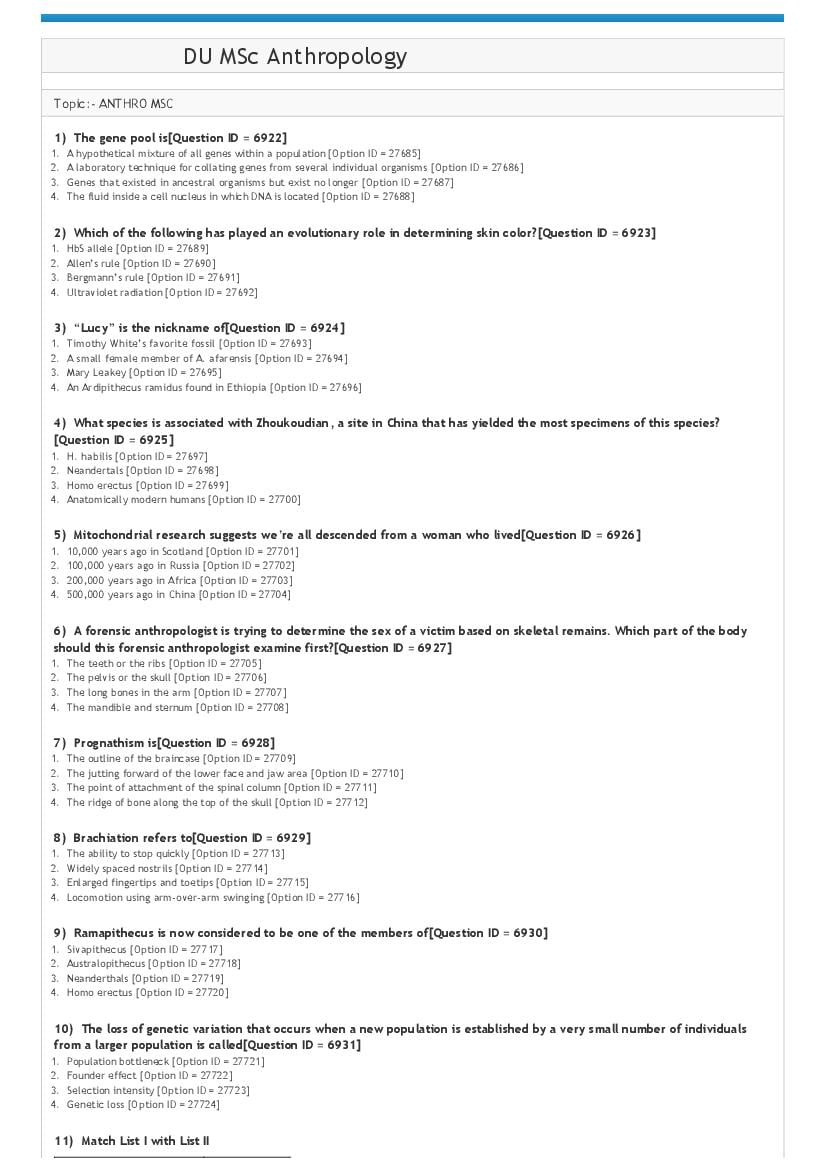
Page 1
Topic:‐ ANTHRO MSC
1) The gene pool is[Question ID = 6922]
1. A hypothetical mixture of all genes within a population [Option ID = 27685]
2. A laboratory technique for collating genes from several individual organisms [Option ID = 27686]
3. Genes that existed in ancestral organisms but exist no longer [Option ID = 27687]
4. The fluid inside a cell nucleus in which DNA is located [Option ID = 27688]
2) Which of the following has played an evolutionary role in determining skin color?[Question ID = 6923]
1. HbS allele [Option ID = 27689]
2. Allen’s rule [Option ID = 27690]
3. Bergmann’s rule [Option ID = 27691]
4. Ultraviolet radiation [Option ID = 27692]
3) “Lucy” is the nickname of[Question ID = 6924]
1. Timothy White’s favorite fossil [Option ID = 27693]
2. A small female member of A. afarensis [Option ID = 27694]
3. Mary Leakey [Option ID = 27695]
4. An Ardipithecus ramidus found in Ethiopia [Option ID = 27696]
4) What species is associated with Zhoukoudian, a site in China that has yielded the most specimens of this species?
[Question ID = 6925]
1. H. habilis [Option ID = 27697]
2. Neandertals [Option ID = 27698]
3. Homo erectus [Option ID = 27699]
4. Anatomically modern humans [Option ID = 27700]
5) Mitochondrial research suggests we’re all descended from a woman who lived[Question ID = 6926]
1. 10,000 years ago in Scotland [Option ID = 27701]
2. 100,000 years ago in Russia [Option ID = 27702]
3. 200,000 years ago in Africa [Option ID = 27703]
4. 500,000 years ago in China [Option ID = 27704]
6) A forensic anthropologist is trying to determine the sex of a victim based on skeletal remains. Which part of the body
should this forensic anthropologist examine first?[Question ID = 6927]
1. The teeth or the ribs [Option ID = 27705]
2. The pelvis or the skull [Option ID = 27706]
3. The long bones in the arm [Option ID = 27707]
4. The mandible and sternum [Option ID = 27708]
7) Prognathism is[Question ID = 6928]
1. The outline of the braincase [Option ID = 27709]
2. The jutting forward of the lower face and jaw area [Option ID = 27710]
3. The point of attachment of the spinal column [Option ID = 27711]
4. The ridge of bone along the top of the skull [Option ID = 27712]
8) Brachiation refers to[Question ID = 6929]
1. The ability to stop quickly [Option ID = 27713]
2. Widely spaced nostrils [Option ID = 27714]
3. Enlarged fingertips and toetips [Option ID = 27715]
4. Locomotion using arm‐over‐arm swinging [Option ID = 27716]
9) Ramapithecus is now considered to be one of the members of[Question ID = 6930]
1. Sivapithecus [Option ID = 27717]
2. Australopithecus [Option ID = 27718]
3. Neanderthals [Option ID = 27719]
4. Homo erectus [Option ID = 27720]
10) The loss of genetic variation that occurs when a new population is established by a very small number of individuals
from a larger population is called[Question ID = 6931]
1. Population bottleneck [Option ID = 27721]
2. Founder effect [Option ID = 27722]
3. Selection intensity [Option ID = 27723]
4. Genetic loss [Option ID = 27724]
11) Match List I with List II
Page 2
A. Turner's Syndrome I. 18 Trisomy
B. Klinefelter's SyndromeII. 44, XO
C. Edward's Syndrome III. 44, XXY
D. Down's Syndrome IV. 21 Trisomy
[Question ID = 6932]
1. A ‐ II, B ‐ IV, C ‐ I, D ‐ III [Option ID = 27725]
2. A ‐ I, B ‐ III, C ‐ II , D ‐ IV [Option ID = 27726]
3. A ‐ III, B ‐ I, C ‐ II, D ‐ IV [Option ID = 27727]
4. A ‐ II, B ‐ III, C ‐ I, D ‐ IV [Option ID = 27728]
12) Match List I with List II
List I List II
A. Sewall Wright I. Inborn Errors of Metabolism
B. Alec Jeffereys II. Inheritence of ABO Blood Groups
C. Felix BernsteinIII. Genetic Drift
D. A.E. Garrod IV. DNA Fingerprinting
[Question ID = 6933]
1. A ‐ III, B ‐I, C ‐II, D ‐ IV [Option ID = 27729]
2. A ‐ I, B ‐II, C ‐ IV, D ‐ III [Option ID = 27730]
3. A ‐ III, B ‐ IV, C ‐ II, D ‐ I [Option ID = 27731]
4. A ‐ II, B ‐ I, C ‐ IV, D ‐ III [Option ID = 27732]
13) Match List I with List II
List I List II
A.Foramen magnumI. Femur
B.Manubrium II. Cervical
C Linea aspera III.Cranium
D.Atlas IV.Sternum
[Question ID = 6934]
1. A ‐ I, B ‐ III, C ‐ II, D ‐ IV [Option ID = 27733]
2. A ‐ III, B ‐ IV, C ‐ I, D ‐ II [Option ID = 27734]
3. A ‐ II, B ‐ I, C ‐ IV, D ‐ III [Option ID = 27735]
4. A ‐ IV, B ‐ III, C ‐ II, D ‐ I [Option ID = 27736]
14) The concept of eugenics was given by[Question ID = 6935]
1. Francis Galton [Option ID = 27737]
2. Gregor Mendel [Option ID = 27738]
3. Sewall Wright [Option ID = 27739]
4. Bertrand Russel [Option ID = 27740]
15) Given below are two statements
Statement I: Xga is the only sex‐linked blood group system
Statement II: ABO is the only clinically important blood group system
In light of the above statements, choose the correct answer from the options given below
[Question ID = 6936]
1. Both Statement I and Statement II are true
[Option ID = 27741]
2. Both Statement I and Statement II are false
[Option ID = 27742]
3. Statement I is true but Statement II is false
[Option ID = 27743]
4. Statement I is false but Statement II is true
[Option ID = 27744]
16) Given below are two statements
Statement I: G6PD deficiency is an X‐linked disease
Statement II: G6PD deficiency is more common among males In light of the above statements,
choose the most appropriate answer from the options given below
Page 3
1. Both Statement I and Statement II are correct
[Option ID = 27745]
2. Both Statement I and Statement II are incorrect
[Option ID = 27746]
3. Statement I is correct but Statement II is incorrect
[Option ID = 27747]
4. Statement I is incorrect but Statement II is correct
[Option ID = 27748]
17) Given below are two statements
Statement I: Study of nonhuman primate behaviour helps us understand our own behaviour
Statement II: Jane Goodall is known for her work on Orangutans In light of the above statements,
choose the most appropriate answer from the options given below
[Question ID = 6938]
1. Both Statement I and Statement II are correct
[Option ID = 27749]
2. Both Statement I and Statement II are incorrect
[Option ID = 27750]
3. Statement I is correct but Statement II is incorrect
[Option ID = 27751]
4. Statement I is incorrect but Statement II is correct
[Option ID = 27752]
18) Match List I with List II
List I List II
A. Australopithecus I. Germany
B. Ramapithecus II. Africa
C. Neanderthal ManIII.France
D. Cro‐Magnon Man IV. India
[Question ID = 6939]
1. A ‐ I, B ‐III, C ‐ IV, D ‐ II [Option ID = 27753]
2. A ‐ IV, B ‐ I, C ‐ II, D ‐ III [Option ID = 27754]
3. A ‐III, B ‐ IV, C ‐ I, D ‐ II [Option ID = 27755]
4. A ‐ II, B ‐ IV, C ‐ I, D ‐ III [Option ID = 27756]
19) 'Milk teeth' in humans have the dental formula[Question ID = 6940]
1. 2.1.1.2 [Option ID = 27757]
2. 2.1.2.0 [Option ID = 27758]
3. 2.1.0.2 [Option ID = 27759]
4. 2.1.1.0 [Option ID = 27760]
20) Erythroblastosis foetalis majorly occurs due to[Question ID = 6941]
1. G6PD deficiency [Option ID = 27761]
2. MN incompatibility [Option ID = 27762]
3. Rh incompatibility [Option ID = 27763]
4. Thalassemia [Option ID = 27764]
21) Mutation Theory was proposed by[Question ID = 6942]
1. Hugo de Vries [Option ID = 27765]
2. R. A. Fischer [Option ID = 27766]
3. August Weismann [Option ID = 27767]
4. Gregor Mendel [Option ID = 27768]
22) Who included the Proto‐Australoid racial element in the classification of Indian populations?[Question ID = 6943]
1. H.H. Risley [Option ID = 27769]
2. S.S. Sarkar [Option ID = 27770]
3. A.C. Haddon [Option ID = 27771]
4. B.S. Guha [Option ID = 27772]
23) One of the distinct characteristics of Prosimians is[Question ID = 6944]
1. Highly developed sense of smell [Option ID = 27773]
2. Highly evolved brain [Option ID = 27774]
3. High degree of colour vision [Option ID = 27775]
4. Absence of tail [Option ID = 27776]
Page 4
6945]
1. Transient polymorphism [Option ID = 27777]
2. Genetic balance [Option ID = 27778]
3. Balanced polymorphism [Option ID = 27779]
4. Genetic equilibrium [Option ID = 27780]
25) A deficiency disease relating to protein‐energy malnutrition characterized by growth retardation, oedema, irritability
and pigment changes in the skin is known as[Question ID = 6946]
1. Kwashiorkor [Option ID = 27781]
2. Marasmus [Option ID = 27782]
3. Nutritional deficit [Option ID = 27783]
4. Rickets [Option ID = 27784]
26) An inborn error of metabolism causing mental retardation due to lack of enzyme for conversion of phenylalanine to
tyrosine is called[Question ID = 6947]
1. Alkaptonuria [Option ID = 27785]
2. Phenylketonuria [Option ID = 27786]
3. Galactosemia [Option ID = 27787]
4. Tyrosinemia [Option ID = 27788]
27) Identify the correct cephalo‐caudal sequence of the bones of human skeleton
A. Skull
B. Sternum
C. Femur
D. Pelvis
E. Tibia
Choose the correct answer from the options given below
[Question ID = 6948]
1. A, B, C, D, E
[Option ID = 27789]
2. A, B, D, C, E
[Option ID = 27790]
3. A, C, E, B, D
[Option ID = 27791]
4. A, D, B, C, E
[Option ID = 27792]
28) Identify the correct sequence of development of Racial Classification of Indian people by different Anthropologists
A. B.S. Guha
B. S.S. Sarkar
C. A.C. Haddon
D. E.F. von Eickstedt
Choose the correct answer from the options given below
[Question ID = 6949]
1. A, B, C, D
[Option ID = 27793]
2. A, D, B, C
[Option ID = 27794]
3. C, D, A, B
[Option ID = 27795]
4. D, C, B, A
[Option ID = 27796]
29) Biological Fitness
A. is best measured in terms of physical strength
B. varies with environmental conditions
C. is a meaningless concept since the idea of “fitness” is an ethnocentric, value laden tool
D. is best measured in terms of reproductive success
Page 5
1. B and D only
[Option ID = 27797]
2. B and C only
[Option ID = 27798]
3. A and D only
[Option ID = 27799]
4. A and B only
[Option ID = 27800]
30) When Mendel crossed peas with Rr and Rr alleles, the chances of getting rr offspring was[Question ID = 6951]
1. 100% [Option ID = 27801]
2. 75% [Option ID = 27802]
3. 25% [Option ID = 27803]
4. 50% [Option ID = 27804]
31) Endogamy means[Question ID = 6952]
1. having very similar genotypes [Option ID = 27805]
2. having very similar phenotypes [Option ID = 27806]
3. picking a mate from outside the population [Option ID = 27807]
4. picking a mate from within the population [Option ID = 27808]
32) An Rh incompatibility between mother and fetus
A. can only occur if the mother in Rh‐
B. can occur only in European populations
C. can only occur if the father is Rh+
D. can only occur if the fetus is Rh+
[Question ID = 6953]
1. A, B and D only
[Option ID = 27809]
2. A, C and D only
[Option ID = 27810]
3. B, C and D only
[Option ID = 27811]
4. A, B and C only
[Option ID = 27812]
33) While reading a thick book you have developed a callus on your index finger from turning so many pages. Someone tells
you that your children will now have a greater tendency towards developing callused index fingers. This reflects the ideas
of[Question ID = 6954]
1. Darwin [Option ID = 27813]
2. Malthus [Option ID = 27814]
3. Lamarck [Option ID = 27815]
4. Wallace [Option ID = 27816]
34) A cell or an organism having the same allele at a given locus on a homologous chromosome is referred to as[Question ID
= 6955]
1. Homology [Option ID = 27817]
2. Homozygous [Option ID = 27818]
3. Holotype [Option ID = 27819]
4. Homoplasy [Option ID = 27820]
35) The shape of the lower molars with 5 cusps, typical of hominoids is designated in the shape of[Question ID = 6956]
1. Y [Option ID = 27821]
2. X [Option ID = 27822]
3. W [Option ID = 27823]
4. M [Option ID = 27824]
36) Which one of the following apes belongs to the genus Pongo?[Question ID = 6957]
1. Gorilla [Option ID = 27825]
2. Orangutan [Option ID = 27826]
3. Chimpanzee [Option ID = 27827]
4. Gibbon [Option ID = 27828]
Page 6
1. Non‐random mating [Option ID = 27829]
2. A fairly small population [Option ID = 27830]
3. Frequent mutational events [Option ID = 27831]
4. No migration into and out of population [Option ID = 27832]
38) Yale Cambridge expedition to the Sohan Valley was led by[Question ID = 6959]
1. R. B. Foote and V.D. Krishnaswamy [Option ID = 27833]
2. H. De. Terra and T. T. Paterson [Option ID = 27834]
3. H. D. Sankalia and B. Subba rao [Option ID = 27835]
4. G. R. Sharma and V.D. Mishra [Option ID = 27836]
39) In India, the first Prehistoric tool was found at [Question ID = 6960]
1. Kondapeta [Option ID = 27837]
2. Pallavaram [Option ID = 27838]
3. Adamgarh [Option ID = 27839]
4. Hunsgi [Option ID = 27840]
40) Given below are two statements
Statement I: The inhabitants of Ahar culture practiced smelting and metallurgy
Statement II: The orginal name of Ahar was Tambarati or a place that has copper
In light of the above statements, choose the most appropriate answer from the options given below
[Question ID = 6961]
1. Both Statement I and Statement II are correct
[Option ID = 27841]
2. Both Statement I and Statement II are incorrect
[Option ID = 27842]
3. Statement I is correct but Statement II is incorrect
[Option ID = 27843]
4. Statement I is incorrect but Statement II is correct
[Option ID = 27844]
41) Match List I with List II
List I List II
(Book/Theory proposed/Characteristic, etc.) (Author/Thinker/Name of Theory, etc.)
A. J. P. Joshi I. Rakhigarhi
B. Suraj Bhan II. Lothal
C. E. Mockler III. Dholavira
D. S. R. Rao IV. Sutkagendor
[Question ID = 6962]
1. A ‐ IV, B ‐ III, C ‐ I, D ‐ II [Option ID = 27845]
2. A ‐ I, B ‐ IV, C ‐ III, D ‐ II [Option ID = 27846]
3. A ‐ III, B ‐ I, C ‐ IV, D ‐ II [Option ID = 27847]
4. A ‐ II, B ‐ I, C ‐ IV, D ‐ III [Option ID = 27848]
42) Attirampakkam is a/an[Question ID = 6963]
1. Lower Palaeolithic site [Option ID = 27849]
2. Upper Palaeolithic site [Option ID = 27850]
3. Indus Valley Civilization site [Option ID = 27851]
4. Mesolithic site [Option ID = 27852]
43) The site Isampur is located in[Question ID = 6964]
1. Bihar [Option ID = 27853]
2. Madhya Pradesh [Option ID = 27854]
3. Karnatka [Option ID = 27855]
4. Uttar Pradesh [Option ID = 27856]
44) What is the earliest date of Indian Lower Paleolithic culture?[Question ID = 6965]
1. 1.71 mya [Option ID = 27857]
2. 1.8 mya [Option ID = 27858]
3. 1.51 mya [Option ID = 27859]
4. 1.2 mya [Option ID = 27860]
45) Arrange the following in chronological sequence from the earliest to the recent event
A. Potter’s wheel
Page 7
C. Earliest date for Chirand Neolithic
D. Jorwe culture
Choose the correct answer from the options given below
[Question ID = 6966]
1. A, B, C, D
[Option ID = 27861]
2. B, C, D, A
[Option ID = 27862]
3. B, D, C, A
[Option ID = 27863]
4. D, A, C, B
[Option ID = 27864]
46) Given below are two statements
Statement I: Proto Shiva found by Mackay is an exemplary evidence of a predecessor of Hindu Deity
Statement II: There is absence of temple and monumental religious architecture
In light of the above statements, choose the most appropriate answer from the options given below
[Question ID = 6967]
1. Both Statement I and Statement II are correct
[Option ID = 27865]
2. Both Statement I and Statement II are incorrect
[Option ID = 27866]
3. Statement I is correct but Statement II is incorrect
[Option ID = 27867]
4. Statement I is incorrect but Statement II is correct
[Option ID = 27868]
47) Match List I with List II
List I List II
(Book/Theory proposed/Characteristic, etc.) (Author/Thinker/Name of Theory, etc.)
A. Le Vallonet I. Open air site
B. Terra Amata II. Along river Thames
C. Torralba‐ Ambrona III. Cave site
D. Swanscombe IV. Along river Jalon
[Question ID = 6968]
1. A‐IV, B ‐III, C‐ I, D‐ II [Option ID = 27869]
2. A‐III, B‐I, C‐ IV, D‐ II [Option ID = 27870]
3. A‐II, B –IV, C‐ I, D‐ III [Option ID = 27871]
4. A‐III, B –II, C‐ I, D‐ IV [Option ID = 27872]
48) Which prehistoric sites are known as Mode I Industry?
A. Monte Poggiollo
B. Lazaret
C. Pirro Nord
D. Dmanisi
[Question ID = 6969]
1. A, B and D only
[Option ID = 27873]
2. A and B only
[Option ID = 27874]
3. A, B and C only
[Option ID = 27875]
4. A, C and D only
[Option ID = 27876]
Page 8
1. Clactonian technique [Option ID = 27877]
2. Cylinder hammer technique [Option ID = 27878]
3. Levalloisean technique [Option ID = 27879]
4. Punching technique [Option ID = 27880]
50) Match List I with List II
List I List II
(Book/Theory proposed/Characteristic, etc.) (Author/Thinker/Name of Theory, etc.)
A. Acheulian Handaxe I. Upper Palaeolithic Culture
B. Levalloisean Flake II. Mesolithic Culture
C. Burin III. Lower Palaeolithic Culture
D. Lunate IV. Middle Palaeolithic Culture
[Question ID = 6971]
1. A‐IV, B –III, C‐ I, D‐ II [Option ID = 27881]
2. A‐III, B –I, C‐ IV, D‐ II [Option ID = 27882]
3. A‐III, B‐IV, C‐ I, D‐II [Option ID = 27883]
4. A‐III, B –II, C‐ I, D‐ IV [Option ID = 27884]
51) Arrange the following sites in order of their location from North to South
A. Burzahom
B. Isampur
C. Bhimbetka
D. Teri
Choose the correct answer from the options given below
[Question ID = 6972]
1. D, C, B, A
[Option ID = 27885]
2. C, D, B, A
[Option ID = 27886]
3. A, B, C, D
[Option ID = 27887]
4. A, C, B, D
[Option ID = 27888]
52) The first Alpine glaciation is known as[Question ID = 6973]
1. Mindel [Option ID = 27889]
2. Riss [Option ID = 27890]
3. Wurm [Option ID = 27891]
4. Gunz [Option ID = 27892]
53) First Himalayan glaciation is known as[Question ID = 6974]
1. Pinjaur [Option ID = 27893]
2. Tatrot [Option ID = 27894]
3. Boulder Conglomerate [Option ID = 27895]
4. Terrace 1 [Option ID = 27896]
54) Foz Coa valley is famous for[Question ID = 6975]
1. Open air rock art [Option ID = 27897]
2. Cave art [Option ID = 27898]
3. Neolithic site [Option ID = 27899]
4. Megalithic site [Option ID = 27900]
55) Arrange the following tools according to their cultural evolution
A. Core tools
B. Flake tools
C. Neolithic tools
D. Blade tools
Choose the correct answer from the options given below
[Question ID = 6976]
1. A, B, C, D
Page 9
2. A, C, D, B
[Option ID = 27902]
3. A, B, D, C
[Option ID = 27903]
4. B, A, C, D
[Option ID = 27904]
56) Neolithic site Lahura Dewa is situated in[Question ID = 6977]
1. Uttar Pradesh [Option ID = 27905]
2. Bihar [Option ID = 27906]
3. Madhya Pradesh [Option ID = 27907]
4. Jharkhand [Option ID = 27908]
57) Who among the following excavated Kuliana , a Paleolithic site in Odisha[Question ID = 6978]
1. Bose and Sen [Option ID = 27909]
2. Ghosh and Sen [Option ID = 27910]
3. Foote and Jacobson [Option ID = 27911]
4. Allchin and Allchin [Option ID = 27912]
58) The concept of symbolic community is by[Question ID = 6979]
1. Bernard Cohen [Option ID = 27913]
2. Marvin Harris [Option ID = 27914]
3. Anthony Cohen [Option ID = 27915]
4. Erving Goffman [Option ID = 27916]
59) Which of the following communities was used as an example by Julian Steward to explain cultural ecology?[Question ID
= 6980]
1. Kwakiutl [Option ID = 27917]
2. Arapesh [Option ID = 27918]
3. Iroquois [Option ID = 27919]
4. Shoshonean [Option ID = 27920]
60) Attempts to account for facts by means of general hypothesis or research questions is known as[Question ID = 6981]
1. induction [Option ID = 27921]
2. deduction [Option ID = 27922]
3. phenomenology [Option ID = 27923]
4. reduction [Option ID = 27924]
61) Who among the following worked on the complicity between colonial agencies and anthropologists?[Question ID = 6982]
1. Talal Asad [Option ID = 27925]
2. Ibn Khaldun [Option ID = 27926]
3. Akbar Ahmed [Option ID = 27927]
4. Ralph Linton [Option ID = 27928]
62) The statement,‘human nature is almost unbelievably malleable, responding accurately and contrastingly to
contrasting cultural conditions' is by
[Question ID = 6983]
1. Ruth Benedict
[Option ID = 27929]
2. Claude Lèvi Strauss
[Option ID = 27930]
3. Sherry B. Ortner
[Option ID = 27931]
4. Margaret Mead
[Option ID = 27932]
63) The Fifth Schedule of the Constitution of India deals with[Question ID = 6984]
1. reservations for the Scheduled Tribes [Option ID = 27933]
2. administration of the Scheduled Areas [Option ID = 27934]
3. atrocities and crime against Scheduled Tribes [Option ID = 27935]
4. economic development and educational opportunities for Scheduled Tribes [Option ID = 27936]
64) Match List I with List II
List I List II
(Book/Theory proposed/Characteristic, etc.) (Author/Thinker/Name of Theory, etc.)
A. Himalyan Polyandry I. G. D. Berreman
B. Hindus of the Himalayas II. D N Majumdar
C. Tribes in Perspective III.S.C. Dube
Page 10
V. B. K. Roy‐Burman
[Question ID = 6985]
1. A ‐I, B ‐II, C‐V, D ‐IV [Option ID = 27937]
2. A ‐ II, B ‐I, C ‐III, D ‐ IV [Option ID = 27938]
3. A ‐ II, B ‐I, C ‐V, D ‐ III [Option ID = 27939]
4. A ‐II, B ‐I, C ‐V, D ‐ IV [Option ID = 27940]
65) Levels of socio‐cultural integration is associated with the work of[Question ID = 6986]
1. Max Gluckman [Option ID = 27941]
2. Julian H. Steward [Option ID = 27942]
3. Anthony Walker [Option ID = 27943]
4. Paul Radin [Option ID = 27944]
66) Match List I with List II
List I List II
(Book/Theory proposed/Characteristic, etc.) (Author/Thinker/Name of Theory, etc.)
A. Totemism I. Lévi‐Strauss
B. Needs theory II. Sol Tax
C. Structural functionalism III. Radcliffe‐Brown
D. Action Anthropology IV. Evans‐Pritchard
V. Bronislaw Malinowski
[Question ID = 6987]
1. A ‐V, B ‐II, C ‐IV, D ‐I [Option ID = 27945]
2. A ‐ I, B ‐V, C ‐IV, D ‐III [Option ID = 27946]
3. A ‐ I, B ‐V, C ‐III, D ‐II [Option ID = 27947]
4. A ‐II, B ‐V, C ‐III, D ‐I [Option ID = 27948]
67) Which of the following are examples of 'total institution' ?
A. club
B. monastery
C. orphanage
D. classroom
E. prison
[Question ID = 6988]
1. B, C and D only
[Option ID = 27949]
2. B, D and E only
[Option ID = 27950]
3. A, C and D only
[Option ID = 27951]
4. B, C and E only
[Option ID = 27952]
68) Match List I with List II
List I List II
(Book/Theory proposed/Characteristic, etc.) (Author/Thinker/Name of Theory, etc.)
A. Social Organisation I. A.L. Kroeber
B. Superorganic II. Raymond Firth
C. Culture Area III. M.J. Herskovits
D. Status and Role IV. Clark Wissler
V. Ralph Linton
[Question ID = 6989]
1. A ‐ I, B ‐III, C ‐ IV, D ‐ V [Option ID = 27953]
2. A ‐II, B ‐I, C ‐IV, D ‐ V [Option ID = 27954]
3. A ‐ II, B ‐I, C‐ II , D ‐ V [Option ID = 27955]
4. A ‐II, B ‐ III, C ‐IV, D ‐ V [Option ID = 27956]
Page 11
Assertion A: Cultural evolution is linked to amount of energy harnessed per capita per year in a culture increases
Reason R: Energy harnassed per capita per year in a culture increases either if the nature of technology changes or
efficiency of technology improves
In light of the above statements, choose the most appropriate answer from the options given below
[Question ID = 6990]
1. Both A and R are correct and R is the correct explanation of A
[Option ID = 27957]
2. Both A and R are correct but R is NOT the correct explanation of A
[Option ID = 27958]
3. A is correct but R is not correct
[Option ID = 27959]
4. A is not correct but R is correct
[Option ID = 27960]
70) The concept of ‘agricultural involution’ was given by[Question ID = 6991]
1. Clifford Geertz [Option ID = 27961]
2. Teodre Shanin [Option ID = 27962]
3. Raymond Firth [Option ID = 27963]
4. A.L. Kroeber [Option ID = 27964]
71) Match List I with List II
List I List II
(Book/Theory proposed/Characteristic, etc.) (Author/Thinker/Name of Theory, etc.)
A. Mahasu Cult I. Bakerwals
B. Sarna II. Gonds
C. Badadeo III. Apatanis
D. Donyi‐Polo IV. Jaunsari
V. Oraon
[Question ID = 6992]
1. A ‐I, B ‐II, C ‐IV, D ‐III [Option ID = 27965]
2. A ‐III, B ‐V, C ‐II, D ‐IV [Option ID = 27966]
3. A ‐I, B ‐V, C ‐ II, D ‐ III [Option ID = 27967]
4. A ‐ IV, B ‐ V, C ‐ II, D ‐III [Option ID = 27968]
72) Given below are two statements, one is labelled as Assertion A and the other is labelled as Reason R
Assertion A : Female is to male as nature is to culture.
Reason R : According to Sherry Ortner, universality of women subordination is because they are considered closer to nature
than men
In light of the above statements, choose the correct answer from the options given below
[Question ID = 6993]
1. Both A and R are true and R is the correct explanation of A
[Option ID = 27969]
2. Both A and R are true but R is NOT the correct explanation of A
[Option ID = 27970]
3. A is true but R is false
[Option ID = 27971]
4. A is false but R is true
[Option ID = 27972]
73) Match List I with List II
List I List II
Concept Author
A. Rites of passages I. Arnold Van Gennep
B. Social Network II. Max Weber
C. Great Tradition III. J. A. Barnes
D. Charismatic Authority IV. A.R. Radcliffe‐Brown
V. Robert Redfield
[Question ID = 6994]
Page 12
2. A ‐III, B ‐ V, C ‐II, D ‐IV [Option ID = 27974]
3. A ‐I, B ‐V, C ‐II, D ‐III [Option ID = 27975]
4. A ‐I, B ‐III, C ‐V, D ‐II [Option ID = 27976]
74) According to Claude Lévi‐Strauss elementary exchange include
A. exchange of women
B. exchange of goods
C. exchange of messages
D. exchange of money
E. exchange of visits
[Question ID = 6995]
1. A, B and D only
[Option ID = 27977]
2. A, B and C only
[Option ID = 27978]
3. B, C and D only
[Option ID = 27979]
4. B, D and E only
[Option ID = 27980]
75) Raymond Dart discovered[Question ID = 6996]
1. Neanderthal man [Option ID = 27981]
2. Ramapithecus [Option ID = 27982]
3. Australopithecus [Option ID = 27983]
4. Homo erectus [Option ID = 27984]
76) Match List I with List II
List I List II
(Book/Theory proposed/Characteristic, etc.) (Author/Thinker/Name of Theory, etc.)
A. Darwin I. Laws of Hereditary
B. Mullis II. Restriction Enzymes
C. Arber III. Natural Selection
D. Mendel IV. PCR Technique
[Question ID = 6997]
1. A ‐ I, B ‐ III, C ‐ IV, D ‐ II [Option ID = 27985]
2. A ‐ IV, B ‐ II, C ‐ III, D ‐ I [Option ID = 27986]
3. A ‐ III, B ‐ IV, C ‐ II, D ‐ I [Option ID = 27987]
4. A ‐ II, B ‐ I, C ‐ IV, D ‐ III [Option ID = 27988]
77) A stage in women’s life when they stop menstruating for ever is called[Question ID = 6998]
1. Menarche [Option ID = 27989]
2. Fecundity [Option ID = 27990]
3. Menopause [Option ID = 27991]
4. Conception [Option ID = 27992]
78) Match List I with List II
List I List II
(Book/Theory proposed/Characteristic, etc.) (Author/Thinker/Name of Theory, etc.)
A. Hindu Mode of Tribal absorption I. L.P. Vidyarthi
B. Sanskritisation II. M.N. Srinivas
C. Tribe‐caste continuum III. F.G. Bailey
D. Sacred Complex IV. N.K. Bose
[Question ID = 6999]
1. A ‐ IV, B ‐ II, C ‐ III, D ‐ I [Option ID = 27993]
2. A ‐ II, B ‐ IV, C ‐ III, D ‐ I [Option ID = 27994]
3. A ‐ II, B ‐ I, C ‐ IV, D ‐ III [Option ID = 27995]
4. A ‐ II, B ‐ III, C ‐ I, D ‐ IV [Option ID = 27996]
79) Swaddling hypothesis was used by[Question ID = 7000]
1. Cora Du Bois [Option ID = 27997]
Page 13
3. Geoffrey Gorer [Option ID = 27999]
4. Ruth Benedict [Option ID = 28000]
80) Match List I with List II
List I List II
(Book/Theory proposed/Characteristic, etc.) (Author/Thinker/Name of Theory, etc.)
A. Todas I. Nilgiri hills
B. Khasas II. Madhya Pradesh
C. Bondos III. Uttarakhand
D. Bharias IV. Rajasthan
V. Odisha
[Question ID = 7001]
1. A ‐I, B ‐III, C ‐ V, D ‐ II [Option ID = 28001]
2. A ‐ I, B ‐II, C ‐III, D ‐ IV [Option ID = 28002]
3. A ‐I, B ‐ IV, C ‐V, D ‐III [Option ID = 28003]
4. A ‐ I, B ‐ V, C ‐IV, D ‐II [Option ID = 28004]
81) Potlatch includes
A. feasting
B. fasting
C. destroying
D. gifting
E. bartering
[Question ID = 7002]
1. A, B and E only
[Option ID = 28005]
2. A, C and D only
[Option ID = 28006]
3. A, D and E only
[Option ID = 28007]
4. B, C and D only
[Option ID = 28008]
82) Contributions of Karl Marx can be best included under [Question ID = 7003]
1. Conflict theory [Option ID = 28009]
2. Evolutionism [Option ID = 28010]
3. Functionalism [Option ID = 28011]
4. Structuralism [Option ID = 28012]
83) Who among the following anthropologists carried out pioneering study of Bengal famine in 1941?[Question ID = 7004]
1. N. K. Bose [Option ID = 28013]
2. T. C. Das [Option ID = 28014]
3. B. S. Guha [Option ID = 28015]
4. S. S. Sarkar [Option ID = 28016]
84) Given below are two statements, one is labelled as Assertion A and the other is labelled as Reason R
Assertion A : Shifting Cultivation is unsustainable in certain conditions
Reason R : On account of demographic and ecological reasons fallow period is reducing in shifting cultivation cycle
In light of the above statements, choose the correct answer from the options given below
[Question ID = 7005]
1. Both A and R are true and R is the correct explanation of A
[Option ID = 28017]
2. Both A and R are true but R is NOT the correct explanation of A
[Option ID = 28018]
3. A is true but R is false
[Option ID = 28019]
4. A is false but R is true
[Option ID = 28020]
Page 14
Assertion A: Culture is learnt
Reason R: Culture is a system of symbols
In light of the above statements, choose the most appropriate answer from the options given below
[Question ID = 7006]
1. Both A and R are correct and R is the correct explanation of A
[Option ID = 28021]
2. Both A and R are correct but R is NOT the correct explanation of A
[Option ID = 28022]
3. A is correct but R is not correct
[Option ID = 28023]
4. A is not correct but R is correct
[Option ID = 28024]
86) Identify the chronological sequence of the following approches
A. diffusionism
B. evolutionism
C. structuralism
D. interpretive approach
E. functionalism
Choose the correct answer from the options given below
[Question ID = 7007]
1. B, A, E, D, C
[Option ID = 28025]
2. B, A, C, D, E
[Option ID = 28026]
3. B, A, E, C, D
[Option ID = 28027]
4. A, B, E, C, D
[Option ID = 28028]
87) Given below are two statements, one is labelled as Assertion A and the other is labelled as Reason R
Assertion A : Culture is an adaptive mechanism
Reason R : Many of the past cultures continue even when people migrate to other areas
In light of the above statements, choose the correct answer from the options given below
[Question ID = 7008]
1. Both A and R are true and R is the correct explanation of A
[Option ID = 28029]
2. Both A and R are true but R is NOT the correct explanation of A
[Option ID = 28030]
3. A is true but R is false
[Option ID = 28031]
4. A is false but R is true
[Option ID = 28032]
88) The Journal, Man in India was founded by
[Question ID = 7009]
1. M. N. Roy
[Option ID = 28033]
2. L. P. Vidyarthi
[Option ID = 28034]
3. T. C. Das
[Option ID = 28035]
4. S. C. Roy
[Option ID = 28036]
Page 15
1. G.H. Brunt [Option ID = 28037]
2. J.H. Hutton [Option ID = 28038]
3. A. Gait [Option ID = 28039]
4. H. H. Risley [Option ID = 28040]
90) The concept ‘culture of poverty’ is attributed to [Question ID = 7011]
1. Oscar Lewis [Option ID = 28041]
2. Robert Redfield [Option ID = 28042]
3. A. L. Kroeber [Option ID = 28043]
4. Karl Polanyi [Option ID = 28044]
91) Saoras are originally from [Question ID = 7012]
1. Chhattisgarh [Option ID = 28045]
2. Andhra Pradesh [Option ID = 28046]
3. Odisha [Option ID = 28047]
4. Madhya Pradesh [Option ID = 28048]
92) Match List I with List II
List I List II
(Book/Theory proposed/Characteristic, etc.) (Author/Thinker/Name of Theory, etc.)
A. Gumlao and Gumsa I. Garos
B. Kula II. Trobriand Islanders
C. Nokrom III. Kachins
D. Ghotuls IV. Kukis
V. Murias
[Question ID = 7013]
1. A ‐ IV, B ‐II, C ‐I, D ‐V [Option ID = 28049]
2. A ‐I, B ‐II, C ‐III, D ‐V [Option ID = 28050]
3. A ‐III, B ‐II, C ‐I, D ‐IV [Option ID = 28051]
4. A ‐III, B ‐II, C ‐I D ‐V [Option ID = 28052]
93) The concept of cultural lag refers to[Question ID = 7014]
1. differential rate of material ‐ non‐material cultural change [Option ID = 28053]
2. culture‐time gap [Option ID = 28054]
3. generational gap [Option ID = 28055]
4. differential rate of cultural change between two ethnic group [Option ID = 28056]
94) Binford‐ Flannery model talks about[Question ID = 7015]
1. food production [Option ID = 28057]
2. weapon production [Option ID = 28058]
3. housing changes [Option ID = 28059]
4. dress and clothing production [Option ID = 28060]
95) Match List I with List II
List I List II
(Book/Theory proposed/Characteristic, etc.) (Author/Thinker/Name of Theory, etc.)
A. Bewar I. Todas
B. Sheep herders II. Gaddis
C. Sacred buffalo III. Raikas
D. Camel breeders IV. Baigas
V. Santhals
[Question ID = 7016]
1. A ‐III, B ‐II, C ‐I, D ‐IV [Option ID = 28061]
2. A ‐ I, B ‐ III, C ‐ IV, D ‐ V [Option ID = 28062]
3. A ‐ I, B ‐ III, C ‐ II, D ‐ V [Option ID = 28063]
4. A ‐ IV, B ‐ II, C ‐ I, D ‐ III [Option ID = 28064]
96) The idea of ‘psychic unity of humankind’ is attributed to[Question ID = 7017]
1. A. Bastian [Option ID = 28065]
2. A.L. Kroeber [Option ID = 28066]
3. F. Boas [Option ID = 28067]
4. E.B. Tylor [Option ID = 28068]
97) Who argued that cultural practices are complex, integrated and often indirect responses to seven basic needs?
[Question ID = 7018]
1. Edward Tylor [Option ID = 28069]
Page 16
3. Bronislaw Malinowski [Option ID = 28071]
4. A.R. Radcliffe‐Brown [Option ID = 28072]
98) Hypercholesterolemia is a/an
A. autosomal genetic disorder
B. X‐chromosomal disorder
C. recessive genetic disorder
D. dominant genetic disorder
[Question ID = 7019]
1. A, C and D only
[Option ID = 28073]
2. A, B and C only
[Option ID = 28074]
3. A, B and D only
[Option ID = 28075]
4. B and D only
[Option ID = 28076]
99) The view that each culture must be understood in terms of the values and ideas of that culture and not be judged by
the standard of others is called[Question ID = 7020]
1. Cultural Relativism [Option ID = 28077]
2. Cultural Materialism [Option ID = 28078]
3. Agency [Option ID = 28079]
4. Reflexivity [Option ID = 28080]
100) Tibia is located in[Question ID = 7021]
1. Lower part of the leg [Option ID = 28081]
2. Upper part of the leg [Option ID = 28082]
3. Finger [Option ID = 28083]
4. Forearm [Option ID = 28084]
Document Details
| Board / Org | NTA |
| Exam | DUET |
| Type | Question Paper |
| Pages | 16 |
| Language | english |
| Updated | 30 Apr 2026 |