DUET 2021 Question Paper M.Sc Biochemistry
Finished viewing? Save it for later —
Download DUET 2021 Question Paper M.Sc Biochemistry (PDF · 12 pages)About DUET 2021 Question Paper M.Sc Biochemistry
DUET 2021 Question Paper M.Sc Biochemistry is available here for free download. Published by NTA for DUET, this question paper can be viewed online or downloaded as a PDF (12 pages). Candidates preparing for DUET can use DUET 2021 Question Paper M.Sc Biochemistry to understand the exam pattern, the type of questions asked, and the overall difficulty level.
Frequently Asked Questions
How can I download DUET 2021 Question Paper M.Sc Biochemistry?
Open this page and click the Download button to save DUET 2021 Question Paper M.Sc Biochemistry as a PDF. It is completely free on AglaSem Docs.
Is DUET 2021 Question Paper M.Sc Biochemistry free to download?
Yes. DUET 2021 Question Paper M.Sc Biochemistry can be viewed online and downloaded as a PDF free of cost on AglaSem Docs.
How many pages does DUET 2021 Question Paper M.Sc Biochemistry have?
DUET 2021 Question Paper M.Sc Biochemistry contains 12 pages, which you can read online or download together as a single PDF.
Where can I find more DUET study material?
You can find more DUET question papers, sample papers, syllabus, and answer keys on AglaSem Docs.
DUET 2021 Question Paper M.Sc Biochemistry – Text
Read the full text of this question paper below — useful to quickly search, copy and reference the content online without downloading the PDF.
📄 View text version (12 pages)
Page 1
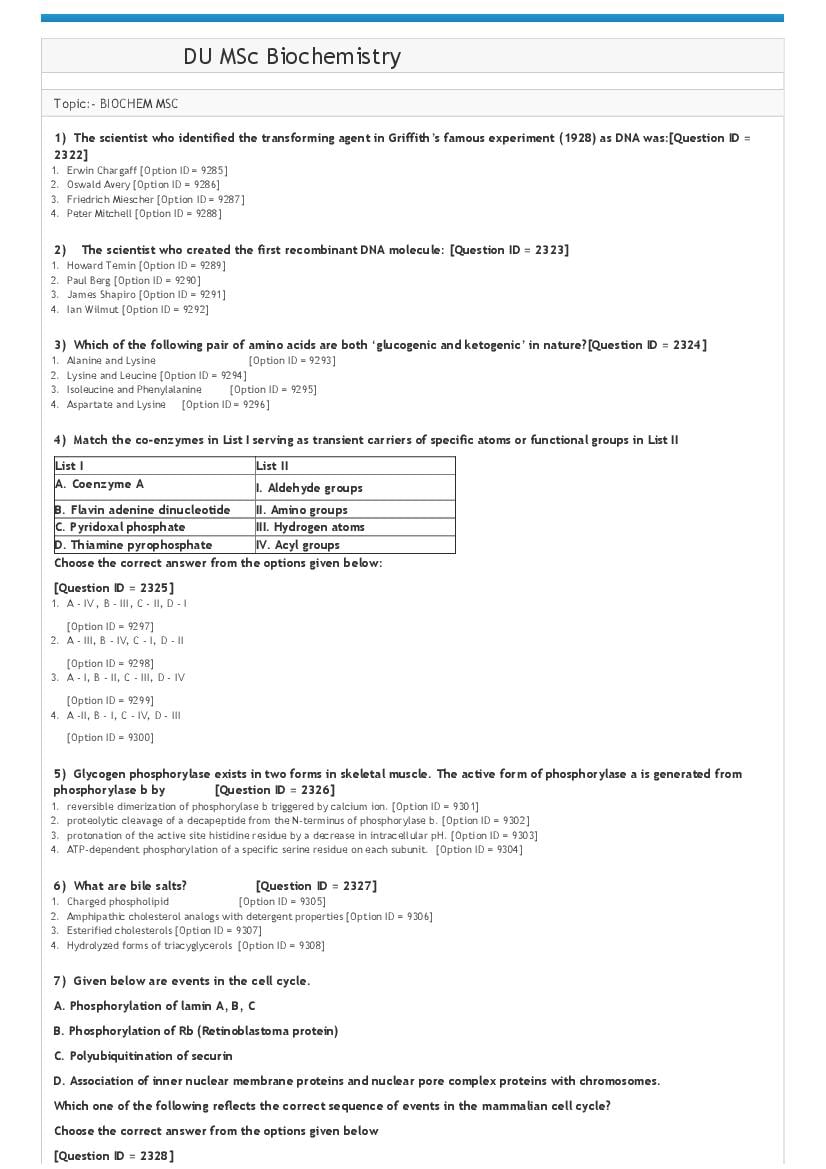
Topic:‐ BIOCHEM MSC
1) The scientist who identified the transforming agent in Griffith’s famous experiment (1928) as DNA was:[Question ID =
2322]
1. Erwin Chargaff [Option ID = 9285]
2. Oswald Avery [Option ID = 9286]
3. Friedrich Miescher [Option ID = 9287]
4. Peter Mitchell [Option ID = 9288]
2) The scientist who created the first recombinant DNA molecule: [Question ID = 2323]
1. Howard Temin [Option ID = 9289]
2. Paul Berg [Option ID = 9290]
3. James Shapiro [Option ID = 9291]
4. Ian Wilmut [Option ID = 9292]
3) Which of the following pair of amino acids are both ‘glucogenic and ketogenic’ in nature?[Question ID = 2324]
1. Alanine and Lysine [Option ID = 9293]
2. Lysine and Leucine [Option ID = 9294]
3. Isoleucine and Phenylalanine [Option ID = 9295]
4. Aspartate and Lysine [Option ID = 9296]
4) Match the co‐enzymes in List I serving as transient carriers of specific atoms or functional groups in List II
List I List II
A. Coenzyme A I. Aldehyde groups
B. Flavin adenine dinucleotide II. Amino groups
C. Pyridoxal phosphate III. Hydrogen atoms
D. Thiamine pyrophosphate IV. Acyl groups
Choose the correct answer from the options given below:
[Question ID = 2325]
1. A ‐ IV , B ‐ III, C ‐ II, D ‐ I
[Option ID = 9297]
2. A ‐ III, B ‐ IV, C ‐ I, D ‐ II
[Option ID = 9298]
3. A ‐ I, B ‐ II, C ‐ III, D ‐ IV
[Option ID = 9299]
4. A ‐II, B ‐ I, C ‐ IV, D ‐ III
[Option ID = 9300]
5) Glycogen phosphorylase exists in two forms in skeletal muscle. The active form of phosphorylase a is generated from
phosphorylase b by [Question ID = 2326]
1. reversible dimerization of phosphorylase b triggered by calcium ion. [Option ID = 9301]
2. proteolytic cleavage of a decapeptide from the N‐terminus of phosphorylase b. [Option ID = 9302]
3. protonation of the active site histidine residue by a decrease in intracellular pH. [Option ID = 9303]
4. ATP‐dependent phosphorylation of a specific serine residue on each subunit. [Option ID = 9304]
6) What are bile salts? [Question ID = 2327]
1. Charged phospholipid [Option ID = 9305]
2. Amphipathic cholesterol analogs with detergent properties [Option ID = 9306]
3. Esterified cholesterols [Option ID = 9307]
4. Hydrolyzed forms of triacyglycerols [Option ID = 9308]
7) Given below are events in the cell cycle.
A. Phosphorylation of lamin A, B, C
B. Phosphorylation of Rb (Retinoblastoma protein)
C. Polyubiquitination of securin
D. Association of inner nuclear membrane proteins and nuclear pore complex proteins with chromosomes.
Which one of the following reflects the correct sequence of events in the mammalian cell cycle?
Choose the correct answer from the options given below
[Question ID = 2328]
Page 2
[Option ID = 9309]
2. B, C, D, A
[Option ID = 9310]
3. C, A, B, D
[Option ID = 9311]
4. B, A, C, D
[Option ID = 9312]
8) Which of the following diseases are related to corona virus?[Question ID = 2329]
1. MERS [Option ID = 9313]
2. Cholera [Option ID = 9314]
3. Polio [Option ID = 9315]
4. Small Pox [Option ID = 9316]
9) Balls and sticks in Rasmol are[Question ID = 2330]
1. Solid spheres and rods, representing atoms and bonds, respectively. [Option ID = 9317]
2. Cylinders or spiral ribbons to represent α‐helices and broad, flat arrows to represent β‐strands. [Option ID = 9318]
3. Line drawing representing bonds between atoms. [Option ID = 9319]
4. Solid spheres and rods, representing bonds and atoms, respectively. [Option ID = 9320]
10) The acid hydrolases of lysosome do not digest the organelle itself because:[Question ID = 2331]
1. lysosomal milieu does not provide optimal pH [Option ID = 9321]
2. these enzymes are present as zymogens [Option ID = 9322]
3. lysosomal membrane is heavily glycosylated [Option ID = 9323]
4. ultimately the lysosomes are also degraded [Option ID = 9324]
11) Which chemical you will use for quantifying DNA?[Question ID = 2332]
1. Dansyl Chloride [Option ID = 9325]
2. Diphenylamine [Option ID = 9326]
3. Orcinol [Option ID = 9327]
4. Ninhydrin [Option ID = 9328]
12) Which of the following bonds inside a cell can be formed by the ‐COOH group of cellular amino acids:[Question ID =
2333]
1. Amide and carboxylic anhydride bonds [Option ID = 9329]
2. Ether and ester bonds [Option ID = 9330]
3. Amide and ether bonds [Option ID = 9331]
4. Ester and amide bonds [Option ID = 9332]
13) A protein sample when subjected to reducing SDS‐PAGE displayed two bands of molecular weight 20 and 25 kDa. When
the same protein sample was subjected to non‐reducing isoelectric focusing, a single band was observed. These
observations are best explained with the following relevant reasoning:[Question ID = 2334]
1. The sample either contains two proteins of different molecular weight and same net charge or one protein with two subunits that differ in molecular
weight but share same net charge [Option ID = 9333]
2. The sample contains two proteins of different molecular weight and same net charge [Option ID = 9334]
3. The sample is a heterodimer with the subunits sharing the same net charge but differing in molecular weight [Option ID = 9335]
4. The experiment had some errors and the results cannot be explained [Option ID = 9336]
14) Uncouplers like DNP or thermogenin uncouple electron transport and oxidative phosphorylation by:[Question ID = 2335]
1. Inhibiting cytochrome oxidase [Option ID = 9337]
2. Blocking electron transfer [Option ID = 9338]
3. Dissipating the proton gradient [Option ID = 9339]
4. Blocking ATP‐ADP translocase [Option ID = 9340]
15) An enzyme (E) has a kcat value of 600s‐1. Calculate the Km value when reaction proceeds at a rate of 9.6µM/sec and
substrate concentration is 40 µM. (Total concentration of enzyme (E) is 0.02 µM)[Question ID = 2336]
1. 20 µM [Option ID = 9341]
2. 15 µM [Option ID = 9342]
3. 10 µM [Option ID = 9343]
4. 5 µM [Option ID = 9344]
16) Which one of the following is not a heme protein?[Question ID = 2337]
1. Catalase [Option ID = 9345]
2. Tryptophan pyrrolase [Option ID = 9346]
3. δ‐aminolevulinic acid synthetase [Option ID = 9347]
4. Cytochrome oxidase [Option ID = 9348]
17) Mutienzyme systems include[Question ID = 2338]
1. Fatty acyl synthetases [Option ID = 9349]
2. Hexokinases [Option ID = 9350]
3. Phosphatases [Option ID = 9351]
Page 3
18) The pI (isoelectric point) of a protein is 6.0. When electric field is applied at pH 8.0, the protein:
[Question ID = 2339]
1. Moves towards anode
[Option ID = 9353]
2. Moves towards cathode
[Option ID = 9354]
3. Does not move
[Option ID = 9355]
4. Moves in a random fashion
[Option ID = 9356]
19) In glycolysis, pyruvate dehydrogenase is subject to feedback inhibition by its products. The chemical compounds which
might be involved in the process, are listed below: A. NADH B. FAD C. Acetyl‐CoA D. Acetaldehyde Which one of the
following combination of the above chemical compounds is involved in the feedback inhibition of pyruvate dehydrogenase?
[Question ID = 2340]
1. A and B [Option ID = 9357]
2. B and C [Option ID = 9358]
3. C and D [Option ID = 9359]
4. A and C [Option ID = 9360]
20) The approximate molecular weight (kDa) of the product after the translation of a 390 bases mRNA, will be[Question ID
= 2341]
1. 48 [Option ID = 9361]
2. 26 [Option ID = 9362]
3. 39 [Option ID = 9363]
4. 14 [Option ID = 9364]
21) Natural proteins are composed of 20 alpha‐amino acids. Which one of the following statements is true for any of these
amino acids in a solution of pH 1.5?[Question ID = 2342]
1. Only amino group is ionized [Option ID = 9365]
2. Only carboxylic group is ionized [Option ID = 9366]
3. Both amino and carboxylic group are ionized [Option ID = 9367]
4. Both the amino and carboxylic groups are neutral [Option ID = 9368]
22) The arrangement of nucleotides in DNA can be seen by:[Question ID = 2343]
1. Ultracentrifugation [Option ID = 9369]
2. X‐Ray crystallography [Option ID = 9370]
3. Light microscope [Option ID = 9371]
4. Electron microscope [Option ID = 9372]
23) Amino acid residues which are predominantly involved in the protein‐DNA interactions are:[Question ID = 2344]
1. Alanines [Option ID = 9373]
2. Negatively charged [Option ID = 9374]
3. Prolines [Option ID = 9375]
4. Positively charged [Option ID = 9376]
24) Select the amino acid which can exit as a diastereomer[Question ID = 2345]
1. Val [Option ID = 9377]
2. Pro [Option ID = 9378]
3. Gly [Option ID = 9379]
4. Ile [Option ID = 9380]
25) All the below‐given amino acids are optically active except[Question ID = 2346]
1. Glycine [Option ID = 9381]
2. Phenylalanine [Option ID = 9382]
3. Valine [Option ID = 9383]
4. Tryptophan [Option ID = 9384]
26) Select the true statement about phosphodiester linkage?[Question ID = 2347]
1. 3’‐phosphate group of one nucleotide unit is joined to the 5’‐hydroxyl group of the next nucleotide [Option ID = 9385]
2. 5’‐phosphate group of one nucleotide unit is joined to the 3’‐hydroxyl group of the next nucleotide [Option ID = 9386]
3. 5’‐phosphate group of one nucleotide unit is joined to the 5’‐hydroxyl group of the next nucleotide [Option ID = 9387]
4. 3’‐phosphate group of one nucleotide unit is joined to the 3’‐hydroxyl group of the next nucleotide [Option ID = 9388]
27) Lecithins are composed of[Question ID = 2348]
1. Glycerol + Fatty acids + Phosphoric acid + Serine [Option ID = 9389]
2. Glycerol + Fatty acids + Phosphoric acid + Ethanolamine [Option ID = 9390]
3. Glycerol + Fatty acids + Phosphoric acid + Choline [Option ID = 9391]
4. Glycerol + Fatty acids + Phosphoric acid + Betaine [Option ID = 9392]
Page 4
1. Small and hydrophobic [Option ID = 9393]
2. Large and polar [Option ID = 9394]
3. Ions [Option ID = 9395]
4. Monosaccharides [Option ID = 9396]
29) Which of the following molecules can be utilized for establishing early evolutionary process[Question ID = 2350]
1. rRNA [Option ID = 9397]
2. Mitochondrial DNA [Option ID = 9398]
3. Chloroplast [Option ID = 9399]
4. Nuclear DNA [Option ID = 9400]
30) The enzyme responsible for conversion of negatively supercoiled DNA into a relaxed circular DNA is:[Question ID =
2351]
1. DNA gyrase [Option ID = 9401]
2. DNA topoisomerase I [Option ID = 9402]
3. DNA topoisomerase II [Option ID = 9403]
4. DNA ligase [Option ID = 9404]
31) Which of the following is not served by the plasma proteins?[Question ID = 2352]
1. Blood clotting [Option ID = 9405]
2. O2 transport [Option ID = 9406]
3. Hormone binding and transport [Option ID = 9407]
4. Buffering capacity of blood [Option ID = 9408]
32) Only one X chromosome in the aneuploidy females is a characteristic of individuals with[Question ID = 2353]
1. Cri du Chat syndrome [Option ID = 9409]
2. Klinefelter syndrome [Option ID = 9410]
3. Down syndrome [Option ID = 9411]
4. Turner syndrome [Option ID = 9412]
33) Which of the following signal molecules does not interact with cell surface receptors?[Question ID = 2354]
1. Insulin [Option ID = 9413]
2. Gastrin [Option ID = 9414]
3. Glucagon [Option ID = 9415]
4. Testosterone [Option ID = 9416]
34) Coenzymes involved in the formation of Acetyl CoA from pyruvate are[Question ID = 2355]
1. Thiamine pyrophosphate, Lipoic acid and FAD [Option ID = 9417]
2. Pyridoxyl phosphate, Biotin and FAD [Option ID = 9418]
3. Vitamin B‐12, Folic acid and vitamin C [Option ID = 9419]
4. NADH, Lipoic acid and vitamin E [Option ID = 9420]
35) There are various subclasses of antibodies found in body fluids and body secretions. Many different functions may be
attributed to these subclasses. Given below in List I is major functions of different subclasses and List II consists of the name
of the subclass.
List I List II
A.Binds to macrophages by Fc I. IgA
B.Binds to mast cells by basophils II. IgD
C. First B cells receptor III. IgE
D. No major specific function known other than antigen bindingIV. IgG
E. Protector of mucous membrane V. IgM
Choose the correct answer from the options given below:
[Question ID = 2356]
1. A ‐ I, B ‐ II, C ‐ III, D ‐ IV, E ‐ V
[Option ID = 9421]
2. A ‐ II, B ‐ III, C ‐ IV, D ‐ V, E ‐ I
[Option ID = 9422]
3. A ‐ III, B ‐ IV, C ‐ V, D ‐ I, E ‐ II
[Option ID = 9423]
4. A ‐ IV, B ‐ III, C ‐ V, D ‐ II, E ‐ I
[Option ID = 9424]
36) Match the techniques in List I with applications given in List II
List I List II
A. Salting out I. pI determination
B. Ultracentrifugation II. Protein precipitation
Page 5
D. Isoelectric focusing IV. Removal of low molecular weight impurities
Choose the correct answer from the options given below:
[Question ID = 2357]
1. A ‐ II, B ‐ III, C ‐ IV, D ‐ I [Option ID = 9425]
2. A ‐ I, B ‐ III, C ‐ II, D ‐ IV [Option ID = 9426]
3. A ‐ IV, B ‐ I, C ‐ III, D ‐ II [Option ID = 9427]
4. A ‐ II, B ‐ IV, C ‐ III, D ‐ I [Option ID = 9428]
37) 5’ end capping of mRNA transcripts in eukaryotes involves the following events:
A. Addition of GMP on the 5’end
B. Removal of gamma‐phosphate of the triphosphate on first base at the 5’ end
C. 5’‐5’ linkage between GMP and the first base at 5’ end
D. Addition of methyl group to N7 position of guanine
Choose the correct answer from the options given below
[Question ID = 2358]
1. A, B, C, D
[Option ID = 9429]
2. A, C, B, D
[Option ID = 9430]
3. B, A, C, D
[Option ID = 9431]
4. B, A, D, C
[Option ID = 9432]
38) Arrange the following events of meiosis in correct sequence
A. Crossing over
B. Synapsis
C. Terminalisation of chiasmata
D. Disappearance of nucleolus
Choose the correct answer from the options given below
[Question ID = 2359]
1. A, B, C, D
[Option ID = 9433]
2. B, A, C, D
[Option ID = 9434]
3. A, C, D, B
[Option ID = 9435]
4. B, C, A, D
[Option ID = 9436]
39) Identify the correct name of a protein present only in biological membrane:[Question ID = 2360]
1. Influenza Haemagglutinin (HA) [Option ID = 9437]
2. BSA [Option ID = 9438]
3. Insulin [Option ID = 9439]
4. Trypsin [Option ID = 9440]
40) The protein involved in photosynthesis:[Question ID = 2361]
1. Hemoglobin [Option ID = 9441]
2. Collagen [Option ID = 9442]
3. RUBPase [Option ID = 9443]
4. Albumin [Option ID = 9444]
41) Sialic acid is part of:[Question ID = 2362]
1. Phosphatidyl choline [Option ID = 9445]
2. Ganglioside [Option ID = 9446]
3. Cholesterol [Option ID = 9447]
4. Triglycerides [Option ID = 9448]
42) Photon capturing moiety of chlorophyll molecule is known as:[Question ID = 2363]
1. Porphyrin [Option ID = 9449]
2. Mg Porphyrin [Option ID = 9450]
Page 6
4. Chlorophyll “a” [Option ID = 9452]
43) Receptors present on macrophages can bind to:[Question ID = 2364]
1. Fc regions [Option ID = 9453]
2. Heavy chains [Option ID = 9454]
3. Sugar residues of heavy chain [Option ID = 9455]
4. Hypervariable regions in its antigen‐binding sites [Option ID = 9456]
44) Humoral immune response in higher mammals is involved with:[Question ID = 2365]
1. B cells [Option ID = 9457]
2. T Cells [Option ID = 9458]
3. Both B and T cells [Option ID = 9459]
4. Macrophages [Option ID = 9460]
45) Which one below can break a peptide bond enzymatically?[Question ID = 2366]
1. Papain [Option ID = 9461]
2. Myosin [Option ID = 9462]
3. CNBr [Option ID = 9463]
4. Performic acid [Option ID = 9464]
46) During UV irradiation of DNA, the following compound is formed:[Question ID = 2367]
1. Thymine dimer [Option ID = 9465]
2. Adenine dimer [Option ID = 9466]
3. Guanine dimer [Option ID = 9467]
4. Cytosine dimer [Option ID = 9468]
47) Protein is degraded inside living cell through a key process of:[Question ID = 2368]
1. Farnesylation [Option ID = 9469]
2. Ubiquitination [Option ID = 9470]
3. Methylation [Option ID = 9471]
4. Palmitoylation [Option ID = 9472]
48) The observation that plasma membrane proteins mix after cell fusion provides evidence for:[Question ID = 2369]
1. Rotational movement of plasma membrane proteins. [Option ID = 9473]
2. The bilayer structure of biomolecules. [Option ID = 9474]
3. The fluid mosaic model [Option ID = 9475]
4. Interactions of plasma membrane proteins of two different cell types [Option ID = 9476]
49) Several classes of hydrolases are localized in: [Question ID = 2370]
1. Late endosome [Option ID = 9477]
2. Clathrin‐coated endosome [Option ID = 9478]
3. Lysosomes [Option ID = 9479]
4. Golgi vesicles [Option ID = 9480]
50) Which co‐factor is crucial in catalyzing enzymatic conversion of Pyruvate to Lactate?
[Question ID = 2371]
1. NAD+ [Option ID = 9481]
2. NADH [Option ID = 9482]
3. FAD [Option ID = 9483]
4. FADH2 [Option ID = 9484]
51) The chemical nature of covalent linkage in sucrose is known as:
[Question ID = 2372]
1. N‐glycoside [Option ID = 9485]
2. O‐glycoside bond [Option ID = 9486]
3. Amide [Option ID = 9487]
4. Diester [Option ID = 9488]
52) In sickle‐cell hemoglobin, which one out of the following is true? [Question ID = 2373]
1. A Glutamate is substituted by a Valine [Option ID = 9489]
2. A Glutamine is substituted by a Valine [Option ID = 9490]
3. A Valine is substituted by Glycine [Option ID = 9491]
4. A Glycine is substituted by Valine [Option ID = 9492]
53) Cellular membranes are self‐sealing in nature‐ if they are punctured or disrupted mechanically, they quickly and
automatically reseal. What properties of such sealing are responsible for this feature? [Question ID =
2374]
1. Due to hydrophobic effect of membrane lipids [Option ID = 9493]
2. Due to hydrophilic effect of membrane lipids [Option ID = 9494]
3. Because of charge‐charge interaction among lipids [Option ID = 9495]
4. Due to protein‐lipid interactions [Option ID = 9496]
Page 7
List I List II
A. Watson and Crick I. DNA fingerprinting
B. R.W. Holley II.Decipher genetic code
C. Marshal Nirenberg III. Double helix of DNA
D. Jacob and Monod IV. Clover model of tRNA
E. Alec Jeffrey V. Lac operon concept
Choose the correct answer from the options given below:
[Question ID = 2375]
1. A ‐ III, B ‐ IV, C ‐ I, D ‐ V, E ‐ II [Option ID = 9497]
2. A ‐ III, B ‐ IV, C ‐ II, D ‐ V, E ‐ I [Option ID = 9498]
3. A ‐ III, B ‐ II, C ‐ I, D ‐ V, E ‐ IV [Option ID = 9499]
4. A ‐ III, B ‐ V, C ‐ IV, D ‐ I, E ‐ II [Option ID = 9500]
55) The blood volume decreased when a mammal was bled rapidly. However, the cardiovascular changes resulting from
hemorrhage could be maintained by the following compensatory mechanisms.
A. Increased cerebral flow
B. Reduction of baroreceptor activity and stimulation of chemoreceptors
C. Reabsorption of tissue fluid in blood
D. Increased release of enkephalins and beta‐endorphins
Choose the correct answer from the options given below:
[Question ID = 2376]
1. A and B only
[Option ID = 9501]
2. B and C only
[Option ID = 9502]
3. C and D only
[Option ID = 9503]
4. A, B and D only
[Option ID = 9504]
56) From the given intermediates in the fat metabolism, correct intermediates series is:[Question ID = 2377]
1. Fatty acyl‐CoA → trans enoyl‐CoA → hydroxy acyl‐CoA → Keto acyl –CoA [Option ID = 9505]
2. Fatty acyl‐CoA → trans enoyl‐CoA → Keto acyl –CoA → hydroxy acyl‐CoA [Option ID = 9506]
3. Fatty acyl‐CoA → Keto acyl –CoA → hydroxy acyl‐CoA → trans enoyl‐CoA [Option ID = 9507]
4. Fatty acyl‐CoA → hydroxy acyl‐CoA → Keto acyl –CoA → trans enoyl‐CoA [Option ID = 9508]
57) Given below are two statements, one is labelled as Assertion A and the other is labelled as Reason R
Assertion A : Bile juice help in digestion of food in small intestine
Reason R : Bile juice contains sodium salt
In light of the above statements, choose the correct answer from the options given below
[Question ID = 2378]
1. Both A and R are true and R is the correct explanation of A
[Option ID = 9509]
2. Both A and R are true but R is NOT the correct explanation of A
[Option ID = 9510]
3. A is true but R is false
[Option ID = 9511]
4. A is false but R is true
[Option ID = 9512]
58) All the membrane proteins known as G proteins:[Question ID = 2379]
1. Have a subunit that activates adenylate cyclase [Option ID = 9513]
2. Hydrolyze GTP [Option ID = 9514]
3. Are gated ion channels [Option ID = 9515]
4. Mediate the effects of insulin on cells [Option ID = 9516]
59) Which of the following techniques is used to obtain the three‐dimensional structure of large proteins at atomic
resolution?[Question ID = 2380]
1. X‐ray crystallography [Option ID = 9517]
2. NMR spectroscopy [Option ID = 9518]
3. Electron microscopy [Option ID = 9519]
Page 8
60) Rifampicin is an inhibitor of[Question ID = 2381]
1. DNA Replication [Option ID = 9521]
2. DNA gyrase [Option ID = 9522]
3. Translation [Option ID = 9523]
4. Transcription [Option ID = 9524]
61) HIV infected patients exhibit preferential decrease in:[Question ID = 2382]
1. CD4+ cell count [Option ID = 9525]
2. CD8+ cell count [Option ID = 9526]
3. CD20+ cell count [Option ID = 9527]
4. CD40+ cell count [Option ID = 9528]
62) In a biochemical reaction, the thermodynamic parameter that reaches a minimum is:[Question ID = 2383]
1. Enthalpy [Option ID = 9529]
2. Entropy [Option ID = 9530]
3. Free energy [Option ID = 9531]
4. Enthalpy and Entropy both [Option ID = 9532]
63) Which one of the following radioisotopes does not emit β rays?[Question ID = 2384]
1. 14C [Option ID = 9533]
2. 3H [Option ID = 9534]
3. 32P [Option ID = 9535]
4. 125I [Option ID = 9536]
64) Molarity of a solution is the number of:[Question ID = 2385]
1. Gram equivalents of solute/no of litres of solute [Option ID = 9537]
2. Moles of solute/litre of solution [Option ID = 9538]
3. Moles of solute/100 ml of solution [Option ID = 9539]
4. Gram equivalents/100 ml of solution [Option ID = 9540]
65) Which of the following is a non‐membranous structure?[Question ID = 2386]
1. Golgi bodies [Option ID = 9541]
2. Microbodies [Option ID = 9542]
3. Inclusion bodies [Option ID = 9543]
4. Glyoxisomes [Option ID = 9544]
66) Ribulose‐5‐phosphate epimerase is involved in:[Question ID = 2387]
1. Glycolysis [Option ID = 9545]
2. TCA cycle [Option ID = 9546]
3. Pentose phosphate pathway [Option ID = 9547]
4. Fatty acid synthesis [Option ID = 9548]
67) Proteolytic enzymes synthesized as large inactive precursors are known as:[Question ID = 2388]
1. Ribozyme [Option ID = 9549]
2. Zymogen [Option ID = 9550]
3. Holoenzyme [Option ID = 9551]
4. Apoenzyme [Option ID = 9552]
68) B cells acquire immune competence in:[Question ID = 2389]
1. Thymus [Option ID = 9553]
2. Bone marrow [Option ID = 9554]
3. Liver [Option ID = 9555]
4. Spleen [Option ID = 9556]
69) Absorbance of a DNA solution can be measured using:[Question ID = 2390]
1. Fluorimeter [Option ID = 9557]
2. Spectrophotometer [Option ID = 9558]
3. Thermometer [Option ID = 9559]
4. Radiometer [Option ID = 9560]
70) The enzyme that hydrolyses starch to maltose is[Question ID = 2391]
1. glucoamylase [Option ID = 9561]
2. alpha‐amylase [Option ID = 9562]
3. beta‐amylase [Option ID = 9563]
4. glucotransferase [Option ID = 9564]
71) Prolactin is a:[Question ID = 2392]
1. Peptide [Option ID = 9565]
2. Steroid [Option ID = 9566]
3. Nucleic acid [Option ID = 9567]
4. Vitamin [Option ID = 9568]
Page 9
1. Liver [Option ID = 9569]
2. Muscles [Option ID = 9570]
3. Gall Bladder [Option ID = 9571]
4. Pancreas [Option ID = 9572]
73) RNA‐dependent DNA polymerase are known as:[Question ID = 2394]
1. Transcriptase [Option ID = 9573]
2. Primase [Option ID = 9574]
3. Recombinase [Option ID = 9575]
4. Reverse transcriptase [Option ID = 9576]
74) “Statins” a popular class of drug is known to inhibit:[Question ID = 2395]
1. HMG‐CoA oxidase [Option ID = 9577]
2. GAPDH [Option ID = 9578]
3. HMG‐CoA reductase [Option ID = 9579]
4. Pyruvate decarboxylase [Option ID = 9580]
75) Which of the following scientists was responsible for the first database in bioinformatics?[Question ID = 2396]
1. Max Perutz [Option ID = 9581]
2. Margaret Dayhoff [Option ID = 9582]
3. Linus Pauling [Option ID = 9583]
4. Dorothy Hodgkin [Option ID = 9584]
76) Specific functional group in an amino acid undergoes specific chemical reaction producing a typical colour that helps in
the detection of the relevant amino acid. Match the amino acids in List I to their specific tests with List II.
List I List II
Name of test Amino acid
A. Hopkins Cole I. Tyrosine
B. Pauly’s II. Tryptophan
C. Nitroprusside III. Histidine
D. Millon’s IV. Cysteine
Choose the correct answer from the options given below:
[Question ID = 2397]
1. A ‐ II, B ‐ III, C ‐ IV, D ‐ I [Option ID = 9585]
2. A ‐ II, B ‐ I, C ‐ IV, D ‐ III [Option ID = 9586]
3. A ‐ IV , B ‐ III, C ‐ II, D ‐ I [Option ID = 9587]
4. A ‐ III, B ‐ IV, C ‐ I, D ‐ II [Option ID = 9588]
77) The citric acid cycle in respiration yields:[Question ID = 2398]
1. 1 GTP, 3 NADH, 1 FADH2, 2 CO2 [Option ID = 9589]
2. 2 GTP, 2 FADH2, 6 NADH, 2 CO2 [Option ID = 9590]
3. 4 GTP, 6 NADH, 4 FADH2, 2 CO2 [Option ID = 9591]
4. 32 GTP, 2 NADH, 4 FADH2, 4 CO2 [Option ID = 9592]
78) Which of the following property is not exhibited by an allosteric enzyme?[Question ID = 2399]
1. Sigmoidal substrate binding curve [Option ID = 9593]
2. Adherence to Henri‐Michaelis‐Menten’s equation [Option ID = 9594]
3. Cooperative substrate binding [Option ID = 9595]
4. Presence of separate substrate binding and regulatory sites [Option ID = 9596]
79) In the enzyme‐catalyzed biosynthetic pathway shown below, what will be the effect on the substrates A, B, C and D if
the enzyme E2 is inactivated?
A‐[E1] ⇢ B‐[E2] ⇢ C‐[E3] ⇢ D
[Question ID = 2400]
1. B, C and D will all be produced
[Option ID = 9597]
2. B and C will be produced but not D
[Option ID = 9598]
3. B will be produced, but not C or D
[Option ID = 9599]
4. A will be produced, but not B, C or D
[Option ID = 9600]
80) A certain small molecule inhibits an enzyme by binding only to the enzyme‐substrate complex or in other words by
binding only after the substrate binds the enzyme. This particular inhibition is typical of which class of inhibition?[Question
ID = 2401]
1. Non‐competitive inhibition [Option ID = 9601]
Page 10
3. Competitive inhibition [Option ID = 9603]
4. Uncompetitive inhibition [Option ID = 9604]
81) Select the true statement regarding nitric oxide (NO)[Question ID = 2402]
1. NO is a vasoconstrictor. [Option ID = 9605]
2. NO activates adenylate cyclase. [Option ID = 9606]
3. NO activates guanylate cyclase. [Option ID = 9607]
4. NO stimulates platelet aggregation. [Option ID = 9608]
82) Which of the following proteins is not synthesized as zymogen or proproteins?[Question ID = 2403]
1. Pepsin [Option ID = 9609]
2. Lysozyme [Option ID = 9610]
3. Collagen [Option ID = 9611]
4. Trypsin [Option ID = 9612]
83) Heme‐containing proteins that function as electron carriers in oxidative phosphorylation and photosynthesis are:
[Question ID = 2404]
1. Hemoglobins [Option ID = 9613]
2. Catalases [Option ID = 9614]
3. Chlorophyll [Option ID = 9615]
4. Cytochromes [Option ID = 9616]
84) A drug which prevents uric acid synthesis by inhibiting the enzyme xanthine oxidase is[Question ID = 2405]
1. Aspirin [Option ID = 9617]
2. Allopurinol [Option ID = 9618]
3. Colchicine [Option ID = 9619]
4. Probenecid [Option ID = 9620]
85) Which of the following statements about enzymes is true?[Question ID = 2406]
1. Enzymes increase the equilibrium constant of the reaction they catalyze. [Option ID = 9621]
2. Enzymes do not alter the overall change in free energy for a reaction. [Option ID = 9622]
3. Enzymes do not influence the rate constant of the forward reaction they catalyze. [Option ID = 9623]
4. Enzymes speed up reactions by increasing the activation energy of the reaction they catalyze. [Option ID = 9624]
86) Arrange the following steps of protein synthesis in the order in which they occur within a cell
A. DNA unzips in the nucleus.
B. tRNA brings in proper amino acid from cytoplasm
C. mRNA attaches to ribosome and first codon is read
D. mRNA nucleotides transcribe the complementary DNA message.
E. mRNA leaves nucleus and goes to ribosome.
F. a second tRNA brings in new amino acid
Choose the correct answer from the options given below
[Question ID = 2407]
1. A, E, D, C, B, F
[Option ID = 9625]
2. A, C, B, E, D, F
[Option ID = 9626]
3. A, D, E, C, B, F
[Option ID = 9627]
4. A, D, E, B, C, F
[Option ID = 9628]
87) Arrange the following landmark achievements in a chronological order:
A. Crystal structure of DNA
B. Draft sequence of human genome
C. Sequence of insulin
D. Crystal structure of myoglobin
Choose the correct answer from the options given below:
[Question ID = 2408]
1. C, A, D and B
[Option ID = 9629]
2. A, C, D, B
Page 11
3. C, D, A, B
[Option ID = 9631]
4. A, D, C, B
[Option ID = 9632]
88) A Ramachandran plot[Question ID = 2409]
1. represents the sterically allowed conformations of a polypeptide backbone [Option ID = 9633]
2. gives the frequency of occurrence of amino acids in alpha‐helical and beta‐sheet structures [Option ID = 9634]
3. predicts alpha‐helical and beta‐sheet conformations of peptides and proteins [Option ID = 9635]
4. shows the X‐ray diffraction pattern of a protein [Option ID = 9636]
89) Which of the following statements is true?[Question ID = 2410]
1. Ribonuclease (RNase) can be treated with urea to produce a random coil [Option ID = 9637]
2. If one oxidizes random‐coil RNase in urea, it quickly regains its enzymatic activity [Option ID = 9638]
3. If one removes the urea and oxidizes RNase slowly, it will renature and regain its enzymatic activity [Option ID = 9639]
4. Although renatured RNase has enzymatic activity, it can be readily distinguished from native RNase [Option ID = 9640]
90) Which of the following statements about the salvage pathway for the synthesis of purine nucleotides is correct?
[Question ID = 2411]
1. Increased PRPP levels in cells inactivate hypoxanthine‐guanine phosphoribosyl transferase (HGPRT). [Option ID = 9641]
2. Decreased PRPP levels in cells lead to the activation of hypoxanthine‐guanine phosphoribosyl transferase (HGPRT). [Option ID = 9642]
3. Increased PRPP levels in cells lead to the activation of hypoxanthine‐guanine phosphoribosyl transferase (HGPRT). [Option ID = 9643]
4. Purine nucleotides competitively inhibit hypoxanthine‐guanine phosphoribosyl transferase (HGPRT). [Option ID = 9644]
91) The absorption of glucose in the digestive tract[Question ID = 2412]
1. Occurs in the small intestine [Option ID = 9645]
2. Is stimulated by the hormone Glucagon [Option ID = 9646]
3. Occurs more rapidly than the absorption of any other sugar [Option ID = 9647]
4. Is impaired in cases of diabetes mellitus [Option ID = 9648]
92) Which one is the heaviest particulate component of the cell?[Question ID = 2413]
1. Nucleus [Option ID = 9649]
2. Mitochondria [Option ID = 9650]
3. Cytoplasm [Option ID = 9651]
4. Golgi apparatus [Option ID = 9652]
93) Transketolase activity is affected in[Question ID = 2414]
1. Biotin deficiency [Option ID = 9653]
2. Ascorbic acid deficiency [Option ID = 9654]
3. PABA deficiency [Option ID = 9655]
4. Thiamine deficiency [Option ID = 9656]
94) Chymotrypsin is specific for peptide bonds containing[Question ID = 2415]
1. Uncharged amino acid residues [Option ID = 9657]
2. Acidic amino acids [Option ID = 9658]
3. Basic amino acid [Option ID = 9659]
4. Small amino acid residues [Option ID = 9660]
95) All the following statements about phenylketonuria are correct except[Question ID = 2416]
1. Phenylalanine cannot be converted into tyrosine [Option ID = 9661]
2. Urinary excretion of phenylpyruvate and phenyllactate is increased [Option ID = 9662]
3. It can be controlled by giving a lowphenylalanine diet [Option ID = 9663]
4. It leads to decreased synthesis of thyroid hormones, catecholamines and melanin [Option ID = 9664]
96) The most of the ultraviolet absorption of proteins above 240 nm is due to their content of[Question ID = 2417]
1. Tryptophan [Option ID = 9665]
2. Aspartate [Option ID = 9666]
3. Glutamate [Option ID = 9667]
4. Alanine [Option ID = 9668]
97) One international unit (I.U) of vitamin D is defined as the biological activity of [Question ID = 2418]
1. 0.025 µg of cholecalciferol [Option ID = 9669]
2. 0.025 µg of 7‐dehydrocholecalciferol [Option ID = 9670]
3. 0.025 µg of ergosterol [Option ID = 9671]
4. 0.025 µg of ergocalciferol [Option ID = 9672]
98) The vitamin having the highest daily requirement among the following is[Question ID = 2419]
1. Thiamin [Option ID = 9673]
2. Riboflavin [Option ID = 9674]
3. Pyridoxine [Option ID = 9675]
4. Ascorbic acid [Option ID = 9676]
Page 12
1. Chemically, immunologically and electrophoretically different forms of an enzyme [Option ID = 9677]
2. Different forms of an enzyme similar in all properties [Option ID = 9678]
3. Catalysing different reactions [Option ID = 9679]
4. Having the same quaternary structures like the enzyme [Option ID = 9680]
100) A deficiency of folate leads to[Question ID = 2421]
1. Beri‐beri [Option ID = 9681]
2. Megaloblastic anemia [Option ID = 9682]
3. Pernicious anemia [Option ID = 9683]
4. Hypochromic microcytic anemia [Option ID = 9684]
Document Details
| Board / Org | NTA |
| Exam | DUET |
| Type | Question Paper |
| Pages | 12 |
| Language | english |
| Updated | 30 Apr 2026 |