UPSC IFS 2018 Question Paper for Agriculture Paper - I
Finished viewing? Save it for later —
Download UPSC IFS 2018 Question Paper for Agriculture Paper - I (PDF · 4 pages)About UPSC IFS 2018 Question Paper for Agriculture Paper - I
UPSC IFS 2018 Question Paper for Agriculture Paper - I is available here for free download. Published by UPSC for Indian Forest Service Examination, this question paper can be viewed online or downloaded as a PDF (4 pages). Candidates preparing for Indian Forest Service Examination can use UPSC IFS 2018 Question Paper for Agriculture Paper - I to understand the exam pattern, the type of questions asked, and the overall difficulty level.
Frequently Asked Questions
How can I download UPSC IFS 2018 Question Paper for Agriculture Paper - I?
Open this page and click the Download button to save UPSC IFS 2018 Question Paper for Agriculture Paper - I as a PDF. It is completely free on AglaSem Docs.
Is UPSC IFS 2018 Question Paper for Agriculture Paper - I free to download?
Yes. UPSC IFS 2018 Question Paper for Agriculture Paper - I can be viewed online and downloaded as a PDF free of cost on AglaSem Docs.
How many pages does UPSC IFS 2018 Question Paper for Agriculture Paper - I have?
UPSC IFS 2018 Question Paper for Agriculture Paper - I contains 4 pages, which you can read online or download together as a single PDF.
Where can I find more Indian Forest Service Examination study material?
You can find more Indian Forest Service Examination question papers, sample papers, syllabus, and answer keys on AglaSem Docs.
UPSC IFS 2018 Question Paper for Agriculture Paper - I – Text
Read the full text of this question paper below — useful to quickly search, copy and reference the content online without downloading the PDF.
📄 View text version (4 pages)
Page 1
F.SFP-A-gRC
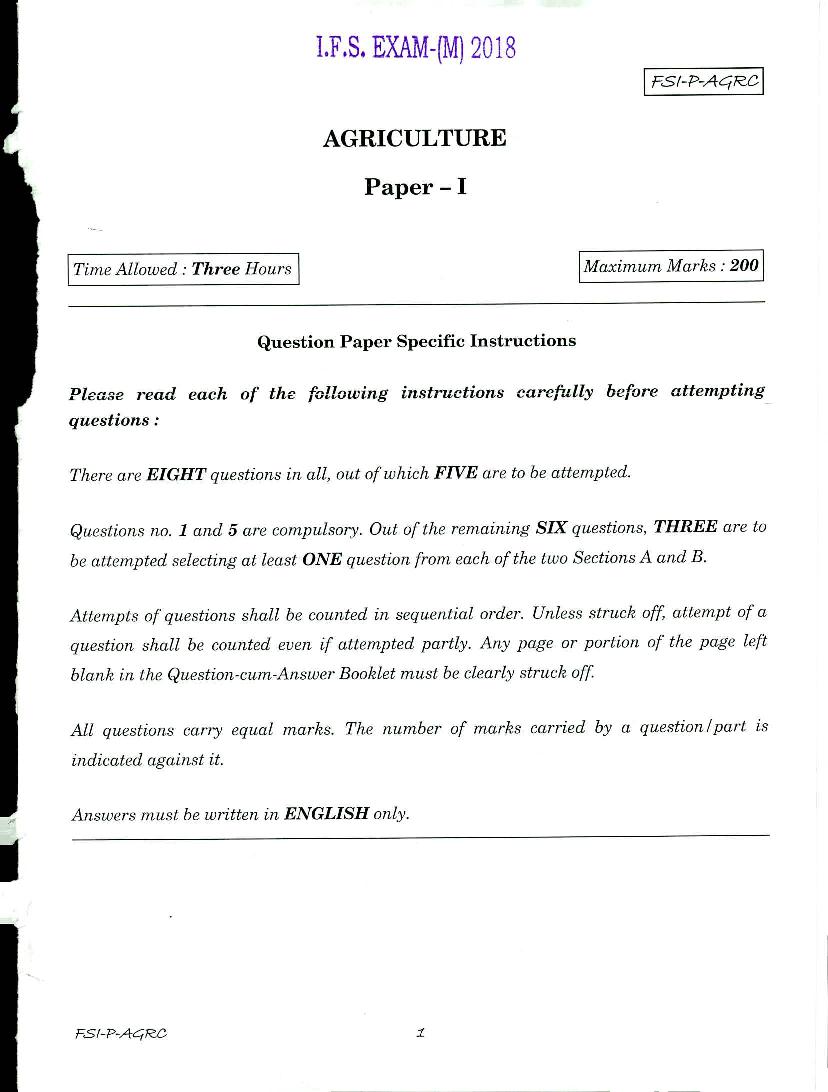
AGRICULTURE
Paper - I
Time Allowed: Three Hours Maximum Marks : 200
Question Paper Specific Instructions
Please read each of the following instructions carefully before attempting
questions:
There are EIGHT questions in all, out of which FIVE are to be attempted.
Questions no. 1 and 5 are compulsory. Out of the remaining SIX questions, THREE are to
be attempted selecting at least ONE question from each of the two Sections A and B.
Attempts of questions shall be counted in sequential order. Unless struck off, attempt of a
question shall be counted even if attempted partly. Any page or portion of the page left
blank in the Question-cum-Answer Booklet must be clearly struck off.
All questions carry equal marks. The number of marks carried by a question/part is
indicated against it.
Answers must be written in ENGLISH only.
FSP-P-A-4120 1
Page 2
Ql. Answer the following in about 150 words each: 8x5=40
Enlist the agroclimatic zones of India and give their important cropping
patterns. 8
What is rainfed farming ? Discuss the technologies for stabilizing
agriculture production in rainfed areas. 8
Maintenance of soil health needs regular recycling of lignocellulolytic
materials to the soil. Justify. 8
What is multiple cropping? Give its significance in increasing the crop
production. 8
Discuss the effect of environmental factors on crop distribution and
production. 8
Q2. Answer the following in about 200 words each: 10x4=40
Discuss how the agroforestry system helps in improving the livelihood of
rural people. /0
Mention the principles of weed management and give their merits and
demerits. /0
Define runoff, give factors affecting it and explain soil loss equation
during water erosion. /0
Highlight the effects of environmental pollution on living beings. /0
Q3. Answer the following in about 200 words each: 10x4=40
Justify the importance of forms of nutrients, their concentrations and
ratios to other nutrients in soil for their uptake and crop growth. /0
Discuss how contingent crop planning helps in dryland agriculture. /0
Explain green-house effect and sources of their emission. /0
Describe aquatic weeds and their control management. /0
Q4. Answer the following in about 200 words each: 10x4=40
Discuss the major constraints in pulse production in India. /0
What is propagation ? Give advantages of micro-propagation with
reference to plantation plants. /0
What is soil genesis ? Discuss the role of factors of soil formation. /0
What soil and water conservation practices are required to be adopted
under hilly regions? /0
FSI-P-A-4720 2
Page 3
Q5. Answer the following in about 150 words each: 8x5=40
Define and explain consumptive use of water, evapotranspiration and
water use efficiency. 8
Discuss the significance of advance farm planning for optimum use of
resources. 8
What is agricultural cooperative farming ? In what way is cooperative
farming helpful to small and marginal farmers? 8
(d) Describe agricultural price policy and instruments of price policy. 8
Discuss the role of farmers' participation in identifying needs of the area
for planning and development. 8
Q6. Answer the following in about 200 words each: 10x4=40
What are drip and sprinkler irrigation? Give their merits and demerits. 10
How does the principle of opportunity cost help farmers to decide what
to grow ? 10
Explain marketing of farm products and marketing functions. 10
What is programme planning? Explain its evaluation. 10
Q7. Answer the following in about 200 words each: 10x4=40
How is drainage important? Explain its types. 10
What is farm budgeting ? How is it important to farmers? 10
Give different approaches to study marketing and problems in
marketing of agricultural produce. 10
How do self-help groups help to provide economic empowerment to rural
women? 10
FS!-P-,4472,C 3
Page 4
What is selective mechanization and progress of farm mechanization ?
Explain advantages and disadvantages of farm mechanization. /0
How is indigenous technical knowledge (ITK) useful to formulate the
future programmes? /0
Specify the criteria for time of irrigation. /0
Discuss the importance of farm management and its scope, with
characteristics. /0
FS/-P-.4472C
Document Details
| Board / Org | UPSC |
| Exam | Indian Forest Service Examination |
| Type | Question Paper |
| Pages | 4 |
| Updated | 30 Apr 2026 |