DUET 2021 Question Paper M.Sc Botany
Finished viewing? Save it for later —
Download DUET 2021 Question Paper M.Sc Botany (PDF · 13 pages)About DUET 2021 Question Paper M.Sc Botany
DUET 2021 Question Paper M.Sc Botany is available here for free download. Published by NTA for DUET, this question paper can be viewed online or downloaded as a PDF (13 pages). Candidates preparing for DUET can use DUET 2021 Question Paper M.Sc Botany to understand the exam pattern, the type of questions asked, and the overall difficulty level.
Frequently Asked Questions
How can I download DUET 2021 Question Paper M.Sc Botany?
Open this page and click the Download button to save DUET 2021 Question Paper M.Sc Botany as a PDF. It is completely free on AglaSem Docs.
Is DUET 2021 Question Paper M.Sc Botany free to download?
Yes. DUET 2021 Question Paper M.Sc Botany can be viewed online and downloaded as a PDF free of cost on AglaSem Docs.
How many pages does DUET 2021 Question Paper M.Sc Botany have?
DUET 2021 Question Paper M.Sc Botany contains 13 pages, which you can read online or download together as a single PDF.
Where can I find more DUET study material?
You can find more DUET question papers, sample papers, syllabus, and answer keys on AglaSem Docs.
DUET 2021 Question Paper M.Sc Botany – Text
Read the full text of this question paper below — useful to quickly search, copy and reference the content online without downloading the PDF.
📄 View text version (12 pages)
Page 1
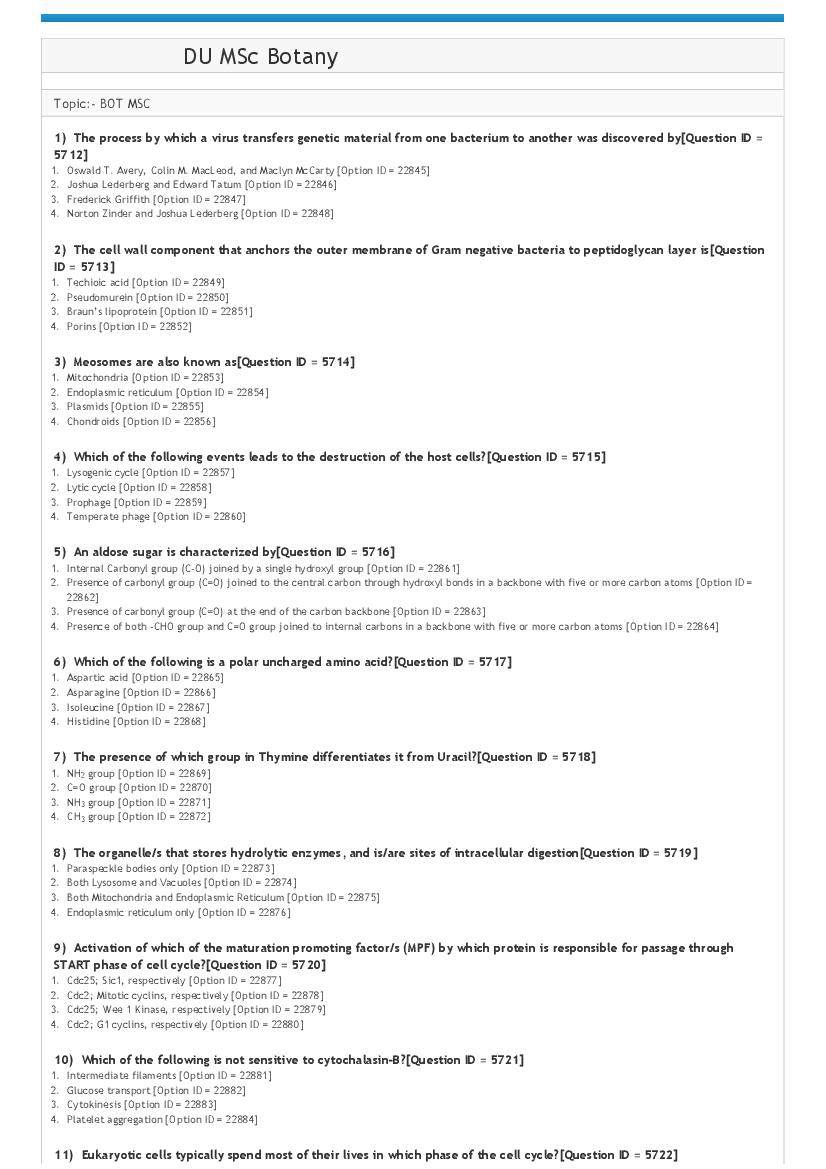
Topic:‐ BOT MSC
1) The process by which a virus transfers genetic material from one bacterium to another was discovered by[Question ID =
5712]
1. Oswald T. Avery, Colin M. MacLeod, and Maclyn McCarty [Option ID = 22845]
2. Joshua Lederberg and Edward Tatum [Option ID = 22846]
3. Frederick Griffith [Option ID = 22847]
4. Norton Zinder and Joshua Lederberg [Option ID = 22848]
2) The cell wall component that anchors the outer membrane of Gram negative bacteria to peptidoglycan layer is[Question
ID = 5713]
1. Techioic acid [Option ID = 22849]
2. Pseudomurein [Option ID = 22850]
3. Braun’s lipoprotein [Option ID = 22851]
4. Porins [Option ID = 22852]
3) Meosomes are also known as[Question ID = 5714]
1. Mitochondria [Option ID = 22853]
2. Endoplasmic reticulum [Option ID = 22854]
3. Plasmids [Option ID = 22855]
4. Chondroids [Option ID = 22856]
4) Which of the following events leads to the destruction of the host cells?[Question ID = 5715]
1. Lysogenic cycle [Option ID = 22857]
2. Lytic cycle [Option ID = 22858]
3. Prophage [Option ID = 22859]
4. Temperate phage [Option ID = 22860]
5) An aldose sugar is characterized by[Question ID = 5716]
1. Internal Carbonyl group (C‐O) joined by a single hydroxyl group [Option ID = 22861]
2. Presence of carbonyl group (C=O) joined to the central carbon through hydroxyl bonds in a backbone with five or more carbon atoms [Option ID =
22862]
3. Presence of carbonyl group (C=O) at the end of the carbon backbone [Option ID = 22863]
4. Presence of both ‐CHO group and C=O group joined to internal carbons in a backbone with five or more carbon atoms [Option ID = 22864]
6) Which of the following is a polar uncharged amino acid?[Question ID = 5717]
1. Aspartic acid [Option ID = 22865]
2. Asparagine [Option ID = 22866]
3. Isoleucine [Option ID = 22867]
4. Histidine [Option ID = 22868]
7) The presence of which group in Thymine differentiates it from Uracil?[Question ID = 5718]
1. NH2 group [Option ID = 22869]
2. C=O group [Option ID = 22870]
3. NH3 group [Option ID = 22871]
4. CH3 group [Option ID = 22872]
8) The organelle/s that stores hydrolytic enzymes, and is/are sites of intracellular digestion[Question ID = 5719]
1. Paraspeckle bodies only [Option ID = 22873]
2. Both Lysosome and Vacuoles [Option ID = 22874]
3. Both Mitochondria and Endoplasmic Reticulum [Option ID = 22875]
4. Endoplasmic reticulum only [Option ID = 22876]
9) Activation of which of the maturation promoting factor/s (MPF) by which protein is responsible for passage through
START phase of cell cycle?[Question ID = 5720]
1. Cdc25; Sic1, respectively [Option ID = 22877]
2. Cdc2; Mitotic cyclins, respectively [Option ID = 22878]
3. Cdc25; Wee 1 Kinase, respectively [Option ID = 22879]
4. Cdc2; G1 cyclins, respectively [Option ID = 22880]
10) Which of the following is not sensitive to cytochalasin‐B?[Question ID = 5721]
1. Intermediate filaments [Option ID = 22881]
2. Glucose transport [Option ID = 22882]
3. Cytokinesis [Option ID = 22883]
4. Platelet aggregation [Option ID = 22884]
11) Eukaryotic cells typically spend most of their lives in which phase of the cell cycle?[Question ID = 5722]
Page 2
2. Metaphase [Option ID = 22886]
3. Interphase [Option ID = 22887]
4. S‐Phase [Option ID = 22888]
12) Biosynthesis of which of the following membrane lipid/s starts in the endoplasmic reticulum and ends in Golgi complex?
[Question ID = 5723]
1. Only sphingomyelin [Option ID = 22889]
2. Only cholesterol [Option ID = 22890]
3. Both sphingomyelins and glycolipids [Option ID = 22891]
4. Both cholesterol and glycolipids [Option ID = 22892]
13) Catalytic hydrolysis of polysaccharides such as starch and glycogen, by β‐amylase releases[Question ID = 5724]
1. Fructose [Option ID = 22893]
2. Maltose [Option ID = 22894]
3. Glucose [Option ID = 22895]
4. Mannose [Option ID = 22896]
14) Which one of the following pairs is not correctly matched?
[Question ID = 5725]
1. Multinucleate coenocytic hyphae ‐‐‐ Zygomycota
[Option ID = 22897]
2. Cell wall made up of chitin ‐‐‐ Oomycota
[Option ID = 22898]
3. Dolipore septa in the hyphae ‐‐‐ Basidiomycota
[Option ID = 22899]
4. Crozier formation ‐‐‐ Ascomycota
[Option ID = 22900]
15) An erumpent crowded cluster of conidiophores arising from a stroma in the form of a cushion is known as[Question ID =
5726]
1. Sporodochium [Option ID = 22901]
2. Pycnidium [Option ID = 22902]
3. Acervulus [Option ID = 22903]
4. Synnema [Option ID = 22904]
16) Ergot alkaloids used to treat severe, throbbing headache, such as migraine and cluster headache are obtained from
[Question ID = 5727]
1. Claviceps purpurea
[Option ID = 22905]
2. Tolypocladium inflatum
[Option ID = 22906]
3. Amanita muscaria
[Option ID = 22907]
4. Aspergillus flavus
[Option ID = 22908]
17) The taxon with suffix mycotina belongs to rank[Question ID = 5728]
1. Kingdom [Option ID = 22909]
2. Subkingdom [Option ID = 22910]
3. Phylum/Division [Option ID = 22911]
4. Subphylum/Subdivision [Option ID = 22912]
18) A large, sessile, round myxomycete fruiting body formed from one plasmodium that does not differentiate into
individual sporangium is known as
[Question ID = 5729]
1. Phaneroplasmodium
[Option ID = 22913]
2. Plasmodiocarp
[Option ID = 22914]
3. Aethalium
[Option ID = 22915]
4. Pseudoaethalium
[Option ID = 22916]
19) The famous Bengal famine in 1943 was due to[Question ID = 5730]
Page 3
2. Black rust of wheat [Option ID = 22918]
3. Late blight of potato [Option ID = 22919]
4. Downy mildew of grapes [Option ID = 22920]
20) Outgrowths of vessel‐associated parenchyma cells that protrude into the xylem vessel through pits and obstruct the
expansion of pathogens are known as[Question ID = 5731]
1. Tyloses [Option ID = 22921]
2. Scleroids [Option ID = 22922]
3. Casparian strips [Option ID = 22923]
4. Callose depositions [Option ID = 22924]
21) One of the theories proposed for algal‐fungal relationship in lichens is “helotism”. It refers to a type of[Question ID =
5732]
1. Tripartite relationship [Option ID = 22925]
2. Mutualistic relationship [Option ID = 22926]
3. Master‐slave relationship [Option ID = 22927]
4. Symbiotic relationship [Option ID = 22928]
22) In which one of the following plants, a single chloroplast with associated pyrenoid is found in each cell of the plant
body?
[Question ID = 5733]
1. Anthoceros
[Option ID = 22929]
2. Riccia
[Option ID = 22930]
3. Marchantia
[Option ID = 22931]
4. Funaria
[Option ID = 22932]
23) In Funaria, the buds of gametophores appear on
[Question ID = 5734]
1. Chloronema
[Option ID = 22933]
2. Chlorocysts
[Option ID = 22934]
3. Caulonema
[Option ID = 22935]
4. Rhizoids
[Option ID = 22936]
24) Which one of the following is not a feature of Equisetum?
[Question ID = 5735]
1. Prominent silica deposition in the epidermal cells
[Option ID = 22937]
2. Each vascular bundle is associated with a carinal canal
[Option ID = 22938]
3. Spores are wrapped with elaters
[Option ID = 22939]
4. The plant body totally lacks stomata
[Option ID = 22940]
25) Which one of the following features of sporophyte of Sphagnum is not shared with that of Anthoceros?
[Question ID = 5736]
1. Presence of columella
[Option ID = 22941]
2. Presence of pseudoelaters
[Option ID = 22942]
3. Large bulbous foot with rudimentary seta
[Option ID = 22943]
4. Development of archesporium from amphethecium
[Option ID = 22944]
Page 4
[Question ID = 5737]
1. Riccia
[Option ID = 22945]
2. Marchantia
[Option ID = 22946]
3. Funaria
[Option ID = 22947]
4. Sphagnum
[Option ID = 22948]
27) Chilgoza seeds are obtained from
[Question ID = 5738]
1. Cycas revoluta
[Option ID = 22949]
2. Pinus gerardiana
[Option ID = 22950]
3. Ephedra gerardiana
[Option ID = 22951]
4. Gnetum ula
[Option ID = 22952]
28) In pteridophytes, the gametophyte produced as a result of apospory will be[Question ID = 5739]
1. Haploid [Option ID = 22953]
2. Diploid [Option ID = 22954]
3. Polyploid [Option ID = 22955]
4. Aneuploid [Option ID = 22956]
29) Coralloid roots are [Question ID = 5740]
1. Phototropic [Option ID = 22957]
2. Positively geotropic [Option ID = 22958]
3. Apogeotropic [Option ID = 22959]
4. Chemotropic [Option ID = 22960]
30) Which of the following is not a characteristic feature of Gnetum?
[Question ID = 5741]
1. Leaves with reticulate venation
[Option ID = 22961]
2. Presence of vessels in the xylem
[Option ID = 22962]
3. Monosporic development of female gametophyte
[Option ID = 22963]
4. Absence of Archegonia
[Option ID = 22964]
31) The stony layer of endocarp in peaches and almonds is comprised of[Question ID = 5742]
1. Macrosclereids [Option ID = 22965]
2. Brachysclereids [Option ID = 22966]
3. Osteosclereids [Option ID = 22967]
4. Trichosclereids [Option ID = 22968]
32) Vasacular bundles in which primary phloem surrounds the primary xylem are known as[Question ID = 5743]
1. Closed bundles [Option ID = 22969]
2. Bilcollateral [Option ID = 22970]
3. Collateral [Option ID = 22971]
4. Amhicribal bundles [Option ID = 22972]
33) Which one of the following statements is correct about vessel members?
[Question ID = 5744]
1. Vessel members are longer and of smaller diameter than the tracheids, and lack perforate end walls.
[Option ID = 22973]
2. Transport of water and inorganic solutes follow a helical course in the xylem.
[Option ID = 22974]
3. Vessel members are ancestral to tracheids.
[Option ID = 22975]
Page 5
[Option ID = 22976]
34) In angiosperms, the function similar to that of the Strasburger cells of gymnosperms, is played by[Question ID = 5745]
1. Sieve elements [Option ID = 22977]
2. Companion cells [Option ID = 22978]
3. Phloem fibers [Option ID = 22979]
4. Axial parenchyma [Option ID = 22980]
35) Annular growth rings among the temperate trees are represented by[Question ID = 5746]
1. Secondary phloem [Option ID = 22981]
2. Phellogen [Option ID = 22982]
3. Phelloderm [Option ID = 22983]
4. Secondary xylem [Option ID = 22984]
36) Crystalline calcium carbonate inclusion in plants cells are known as[Question ID = 5747]
1. Cystolith [Option ID = 22985]
2. Druses [Option ID = 22986]
3. Raphides [Option ID = 22987]
4. Phytoliths [Option ID = 22988]
37) A structural component of plasmodesmata with helically arranged proteinaceous particles is known as[Question ID =
5748]
1. Cytoplasmic annulus [Option ID = 22989]
2. Desmotubule [Option ID = 22990]
3. Central column [Option ID = 22991]
4. Orifice [Option ID = 22992]
38) A phyllotactic pattern represented by two vertical rows of leaves is termed[Question ID = 5749]
1. Opposite decussate [Option ID = 22993]
2. Whorled [Option ID = 22994]
3. Generative spiral [Option ID = 22995]
4. Opposite superposed [Option ID = 22996]
39) Specialised epidermal cells of grasses that contain oil, tannins or crystals are known as[Question ID = 5750]
1. Velamen cells [Option ID = 22997]
2. Cork cells [Option ID = 22998]
3. Bulliform cells [Option ID = 22999]
4. Guard cells [Option ID = 23000]
40) Which one of the following represents fibers located in the tension wood?[Question ID = 5751]
1. Libriform fibers [Option ID = 23001]
2. Gelatinous fibers [Option ID = 23002]
3. Substitute fibers [Option ID = 23003]
4. Fiber‐tracheids [Option ID = 23004]
41) Match List I with List II
List I List II
A. Jute I. Textile fibre
B. Sisal II. Bast fibre
C. Cotton III. Structural fibre
D. Sorghum IV. Brush fibre
Choose the correct answer from the options given below:
[Question ID = 5752]
1. A ‐ I, B ‐ III, C ‐ II, D ‐ IV [Option ID = 23005]
2. A ‐ I, B ‐ IV, C ‐ II, D ‐ III [Option ID = 23006]
3. A ‐ III, B ‐ II, C ‐ I, D ‐ IV [Option ID = 23007]
4. A ‐ III, B ‐ II, C ‐ IV, D ‐ I [Option ID = 23008]
42) The term 'Paddy' refers to[Question ID = 5753]
1. Rice straw [Option ID = 23009]
2. Rice husk and bran [Option ID = 23010]
3. Rice grain with husk [Option ID = 23011]
4. Rice grain without husk [Option ID = 23012]
43) Rubber is obtained from
[Question ID = 5754]
1. Hevea brasiliensis
[Option ID = 23013]
2. Cedrus deodara
Page 6
3. Tectona grandis
[Option ID = 23015]
4. Michelia champaca
[Option ID = 23016]
44) Ac‐Ds transposable elements were discovered in
[Question ID = 5755]
1. Antirrhinum majus
[Option ID = 23017]
2. Zea mays
[Option ID = 23018]
3. Pinus roxburghii
[Option ID = 23019]
4. Ophioglossum pendulum
[Option ID = 23020]
45) For a population in a Hardy‐Weinberg equilibrium, the frequency of a recessive allele of a certain hereditary trait is
0.20. What would be the expected percentage of individuals with dominant trait?[Question ID = 5756]
1. 8% [Option ID = 23021]
2. 64% [Option ID = 23022]
3. 96% [Option ID = 23023]
4. 16% [Option ID = 23024]
46) In a diploid organism, two genes ‘A’ and ‘B’ are present on two different chromosomes. In a cross between individuals
of the genotype AB/ab and ab/ab, what fraction of the progeny is expected to be AB/ab?[Question ID = 5757]
1. 75% [Option ID = 23025]
2. 50% [Option ID = 23026]
3. 100% [Option ID = 23027]
4. 25% [Option ID = 23028]
47) Microspore derived plants of a high yielding crop variety were treated with colchicine and then used subsequently in a
breeding programme. The meiotic analysis of these plants is expected to show[Question ID = 5758]
1. All bivalents [Option ID = 23029]
2. All univalents [Option ID = 23030]
3. All multivalents [Option ID = 23031]
4. A mix of bivalents and univalents [Option ID = 23032]
48) Which one of the following statements is false for cis‐trans complementation test?
[Question ID = 5759]
1. In most conditions, mutant alleles of the same gene fail to complement each other.
[Option ID = 23033]
2. The test is done for mutants exhibiting similar phenotype.
[Option ID = 23034]
3. Mutations recessive to the wild type can only be considered for the test.
[Option ID = 23035]
4. Mutations that are present on the same chromosome cannot be used for complementation test.
[Option ID = 23036]
49) A plant has 2n=10. What would be the number of chromosomes present at metaphase I and metaphase II stages of
meiosis?[Question ID = 5760]
1. 10 each in both metaphase I and II [Option ID = 23037]
2. 20 at metaphase I and 10 in metaphase II [Option ID = 23038]
3. 10 in metaphase I and 5 in metaphase II [Option ID = 23039]
4. 5 each in both metaphase I and II [Option ID = 23040]
50) Which one of the following statements is false?
[Question ID = 5761]
1. Lethal alleles can survive in the population in the heterozygous state.
[Option ID = 23041]
2. A single gene can have multiple alleles.
[Option ID = 23042]
3. Epistasis results from interaction of alleles of different genes.
[Option ID = 23043]
4. All recessive alleles are non‐functional.
[Option ID = 23044]
Page 7
1. Frameshift mutation [Option ID = 23045]
2. Transition [Option ID = 23046]
3. Tautomerization [Option ID = 23047]
4. Transversion [Option ID = 23048]
52) A gene contains the following double‐stranded sequence:
5'‐ ATGTTTAGCGCC ‐3'
3'‐ TACAAATCGCGG ‐5'
If the top strand is the sense strand and codes for a messenger RNA whose sequence begins with 'ATG', which of the
following would represent the sequence of the corresponding segment of antisense RNA?
[Question ID = 5763]
1. 5'‐AUGUUUAGCGCC‐3'
[Option ID = 23049]
2. 5'‐CCGCGAUUUGUA‐3'
[Option ID = 23050]
3. 5'‐UACAAAUCGCGG‐3'
[Option ID = 23051]
4. 5'‐GGCGCUAAACAU‐3'
[Option ID = 23052]
53) Scientists identified a new virus from a dead animal. Further experiments demonstrated that the DNA of this virus has
35% A, 35% G, 20% T and 10% C residues. The DNA of this virus cannot be cut by an exonuclease. Based on the above
information, which one of the following is a correct statement?[Question ID = 5764]
1. The virus has a double‐stranded, and linear DNA [Option ID = 23053]
2. The virus has a double‐stranded, and circular DNA [Option ID = 23054]
3. The virus has a single‐stranded, and linear DNA [Option ID = 23055]
4. The virus has a single‐stranded, and circular DNA [Option ID = 23056]
54) Which one of the following is not a palindrome in a double stranded DNA?[Question ID = 5765]
1. CTAGAG [Option ID = 23057]
2. CTTAAG [Option ID = 23058]
3. GCTAGC [Option ID = 23059]
4. CTATAG [Option ID = 23060]
55) A short peptide has a sequence of amino acids: valine‐serine‐methionine‐proline. The t‐RNAs used in its synthesis have
the following corresponding anticodons: 3’‐ CAG ‐ 5’, 3’‐ UCG ‐ 5’, 3’‐ UAC ‐ 5’, 3’‐ UUU ‐ 5’. What is the sequence of DNA
that encodes the peptide?[Question ID = 5766]
1. 5’ ‐ GACGCTCATTTT ‐ 3’ [Option ID = 23061]
2. 5’ ‐ UUUCAUGCUGAC ‐ 3’ [Option ID = 23062]
3. 5’ ‐ CAGTCGTACTTT ‐ 3’ [Option ID = 23063]
4. 5’ ‐ TTTCATGCTGAC ‐ 3’ [Option ID = 23064]
56) Which one of the following is not a component of mature eukaryotic mRNA?
[Question ID = 5767]
1. Coding exons
[Option ID = 23065]
2. UTRs
[Option ID = 23066]
3. Coding introns
[Option ID = 23067]
4. Non‐coding introns
[Option ID = 23068]
57) Which one of the following is a correct general feature of DNA replication for prokaryotes and/or eukaryotes?
[Question ID = 5768]
1. Prokaryotes – single replication origin and unidirectional progress of replication
[Option ID = 23069]
2. Eukaryotes – multiple replication origins and unidirectional progress of replication
[Option ID = 23070]
3. Prokaryotes – single replication origin and bidirectional progress of replication
[Option ID = 23071]
4. Eukaryotes – single replication origin and bidirectional progress of replication
Page 8
58) In eukaryotes, transcription of small nuclear RNAs is done by[Question ID = 5769]
1. RNA polymerase I only [Option ID = 23073]
2. Both RNA polymerase I and RNA polymerase II [Option ID = 23074]
3. Both RNA polymerase II and RNA polymerase III [Option ID = 23075]
4. RNA polymerase III only [Option ID = 23076]
59) The following figure shows an interpretive diagram of the RNA‐DNA hybrid of an eukaryotic gene as visualized by
electron microscopy:
Based on the above diagram, which one of the following statements is most likely to be correct?
[Question ID = 5770]
1. The RNA was isolated from the nucleus and has no introns.
[Option ID = 23077]
2. The mRNA was isolated from the cytoplasm and has seven introns.
[Option ID = 23078]
3. The RNA was isolated from the nucleus and has eight exons.
[Option ID = 23079]
4. The mRNA was isolated from the cytoplasm and has no introns.
[Option ID = 23080]
60) Which one of the following statements is correct?
[Question ID = 5771]
1. Transcriptionally active regions of the chromosome are not susceptible to DNaseI.
[Option ID = 23081]
2. Chromatin remodeling occurs by acetylation/deacetylation of core histones.
[Option ID = 23082]
3. Gene silencing is not an epigenetic phenomenon.
[Option ID = 23083]
4. Methylation‐induced repression of gene expression does not involve chromatin remodeling.
[Option ID = 23084]
61) Plants adapted to low light intensity have:
[Question ID = 5772]
1. extended root system
[Option ID = 23085]
2. higher rate of water uptake
[Option ID = 23086]
3. leaves modified to spines
[Option ID = 23087]
4. higher photosynthetic rate
[Option ID = 23088]
62) Gaia hypothesis states that:[Question ID = 5773]
1. Distribution of species is governed by certain limiting factors [Option ID = 23089]
2. No two organisms having the same ecological niche can coexist together indefinitely [Option ID = 23090]
3. Microroganisms create a conducive self‐regulating control system for other species to exist [Option ID = 23091]
4. Species with less gestation period needs more parental care [Option ID = 23092]
63) Ecosystem cybernetics has which one of the following?[Question ID = 5774]
1. Positive feedback mechanism [Option ID = 23093]
2. No feedback mechanism [Option ID = 23094]
3. Neutral feedback mechanism [Option ID = 23095]
4. Negative feedback mechanism [Option ID = 23096]
Page 9
following[Question ID = 5775]
1. Plant population [Option ID = 23097]
2. Predator population [Option ID = 23098]
3. Prey population [Option ID = 23099]
4. Water availability [Option ID = 23100]
65) The best groundwater reservoir areas have[Question ID = 5776]
1. Low permeability and high porosity [Option ID = 23101]
2. Low permeability and low porosity [Option ID = 23102]
3. High permeability and high porosity [Option ID = 23103]
4. High permeability and low porosity [Option ID = 23104]
66) Which one of the following adaptions is found in desert plants?[Question ID = 5777]
1. Presence of cutinized epidermal cells [Option ID = 23105]
2. Presence of spongy stem [Option ID = 23106]
3. Absence of root system [Option ID = 23107]
4. Presence of pneumatophores [Option ID = 23108]
67) Which plant growth hormone production decreases with the decrease in soil water availability below critical level?
[Question ID = 5778]
1. Cytokinin [Option ID = 23109]
2. Gibberellin [Option ID = 23110]
3. Auxin [Option ID = 23111]
4. Abscisic acid [Option ID = 23112]
68) Ecosystem resilience is maximum in which one of the following?[Question ID = 5779]
1. Forest ecosystem [Option ID = 23113]
2. Grassland ecosystem [Option ID = 23114]
3. Desert ecosystem [Option ID = 23115]
4. Tundra ecosystem [Option ID = 23116]
69) Environmental resistance is a characteristic feature of which one of the following curves?[Question ID = 5780]
1. Exponential growth curve [Option ID = 23117]
2. Logistic growth curve [Option ID = 23118]
3. Polynomial curve [Option ID = 23119]
4. Linear curve [Option ID = 23120]
70) The reaction catalysed by Phospholipase D can use all of the following as substrate except[Question ID = 5781]
1. Phosphatidylcholine [Option ID = 23121]
2. Phosphatidylethanolamine [Option ID = 23122]
3. Structural phospholipids [Option ID = 23123]
4. Phosphatidic acid [Option ID = 23124]
71) Which of the following statements is correct about APG IV system of classification?
[Question ID = 5782]
1. It is shown that basal angiosperms represent the first stage of angiosperm evolution.
[Option ID = 23125]
2. It is not a phylogenetic system of classification.
[Option ID = 23126]
3. The position of Ceratophyllaceae is considered to be uncertain.
[Option ID = 23127]
4. Asclepiadaceae and Apocynaceae are recognized as two distinct families.
[Option ID = 23128]
72) Which of the following databases contains listing of all‐important herbaria of the world?[Question ID = 5783]
1. Index Holmiensis [Option ID = 23129]
2. Index Herbariorum [Option ID = 23130]
3. Index Kewensis [Option ID = 23131]
4. International Plant Names Index [Option ID = 23132]
73) Which one of the following explants would be most appropriate for in vitro regeneration of virus‐free plants?[Question
ID = 5784]
1. Cotyledonary leaves [Option ID = 23133]
2. Mature leaves [Option ID = 23134]
3. Shoot apex [Option ID = 23135]
4. Hypocotyls [Option ID = 23136]
74) Which one of the following is not a chloroplast DNA‐based marker?
Page 10
1. rbcL
[Option ID = 23137]
2. ETS
[Option ID = 23138]
3. atpB
[Option ID = 23139]
4. matK
[Option ID = 23140]
75) The study of intraspecific populations, speciation, and evolutionary rates and trends is called[Question ID = 5786]
1. Alpha taxonomy [Option ID = 23141]
2. Beta taxonomy [Option ID = 23142]
3. Gamma taxonomy [Option ID = 23143]
4. Omega taxonomy [Option ID = 23144]
76) A specimen or an illustration designated from a non‐original collection to serve as the type when all the originally cited
material is lost or missing is known as[Question ID = 5787]
1. Holotype [Option ID = 23145]
2. Holotype [Option ID = 23146]
3. Lectotype [Option ID = 23147]
4. Epitype [Option ID = 23148]
77) Which one of the following is no longer in use following the rules of ICNafp?[Question ID = 5788]
1. Use of ex [Option ID = 23149]
2. Use of Parenthesis [Option ID = 23150]
3. Use of Square bracket [Option ID = 23151]
4. Use of “in” [Option ID = 23152]
78) The acronym BOLD stands for[Question ID = 5789]
1. Barcode of Life Data System [Option ID = 23153]
2. Barcode of Living DNA [Option ID = 23154]
3. Barcode of Life’s DNA matrix [Option ID = 23155]
4. Barcode of Living organisms Database [Option ID = 23156]
79) Which one of the following forms of a plasmid of size 3kb is expected to migrate the fastest during agarose gel
electrophoresis on a 0.8% agarose gel?[Question ID = 5790]
1. Supercoiled [Option ID = 23157]
2. Open circle [Option ID = 23158]
3. Nicked circle [Option ID = 23159]
4. Linear [Option ID = 23160]
80) Fate of the second male gamete in sexual reproduction of flowering plants was first demonstrated by[Question ID =
5791]
1. William Hofmeister [Option ID = 23161]
2. Sergius Nawaschin [Option ID = 23162]
3. William A. Jenson [Option ID = 23163]
4. John Heslop‐Harrison [Option ID = 23164]
81) Occurrence of fibrous thickenings in the epidermal cells of anthers is seen in
[Question ID = 5792]
1. Archeuthobium
[Option ID = 23165]
2. Abelmoschus
[Option ID = 23166]
3. Amoora
[Option ID = 23167]
4. Amorphophallus
[Option ID = 23168]
82) During differentiation of an anther, the tapetum originates from[Question ID = 5793]
1. Only the parietal cells [Option ID = 23169]
2. Both parietal as well as connective cells [Option ID = 23170]
3. Only the sporogenous cells [Option ID = 23171]
4. Both sporogenous as well as parietal cells [Option ID = 23172]
83) Callose degradation during the release of microspores from tetrads is facilitated by
[Question ID = 5794]
Page 11
[Option ID = 23173]
2. β‐1,3‐D‐glucanase
[Option ID = 23174]
3. Acetylcholine acetyl‐hydrolase
[Option ID = 23175]
4. Catalase
[Option ID = 23176]
84) Rafflesia, known for its largest flowers among angiosperms, is pollinated by
[Question ID = 5795]
1. Lemurs
[Option ID = 23177]
2. Elephants
[Option ID = 23178]
3. Flies
[Option ID = 23179]
4. Mosquitos
[Option ID = 23180]
85) Pollination between flowers of two different genets is termed[Question ID = 5796]
1. Geitonogamy [Option ID = 23181]
2. Xenogamy [Option ID = 23182]
3. Autogamy [Option ID = 23183]
4. Porogamy [Option ID = 23184]
86) Which one of the following pairs is matched incorrectly?
[Question ID = 5797]
1. Golden rice – psy gene
[Option ID = 23185]
2. Herbicide resistance – bar
[Option ID = 23186]
3. vir genes – Helper plasmid
[Option ID = 23187]
4. T‐DNA borders – inverted repeats
[Option ID = 23188]
87) The process of formation of seeds without fertilization in flowering plants is known as[Question ID = 5798]
1. Budding [Option ID = 23189]
2. Apomixis [Option ID = 23190]
3. Somatic hybridization [Option ID = 23191]
4. Sporulation [Option ID = 23192]
88) Which one of the following activities of a DNA polymerase reduces errors during PCR?[Question ID = 5799]
1. 5’ – 3’ exonuclease [Option ID = 23193]
2. 3’ – 5’ endonuclease [Option ID = 23194]
3. 3’ – 5’ exonuclease [Option ID = 23195]
4. 5’ – 3’ endonuclease [Option ID = 23196]
89) The point of attachment of the body of the ovule to its funicle is known as[Question ID = 5800]
1. Chalaza [Option ID = 23197]
2. Raphe [Option ID = 23198]
3. Rilum [Option ID = 23199]
4. Stalk [Option ID = 23200]
90) The sequential events that happen during seed formation are[Question ID = 5801]
1. Megasporogenesis, megagametogenesis, pollination, fertilization [Option ID = 23201]
2. Megasporogenesis, megagametogenesis, fertilization, pollination [Option ID = 23202]
3. Megagametogenesis, megasporogenesis, pollination, fertilization [Option ID = 23203]
4. Megagametogenesis, megasporogenesis, fertilization, pollination [Option ID = 23204]
91) The formation of female gametophyte directly from sporophytic cell without meiosis is called[Question ID = 5802]
1. Apogamy [Option ID = 23205]
2. Parthenogenesis [Option ID = 23206]
3. Amphimixis [Option ID = 23207]
4. Apospory [Option ID = 23208]
Page 12
5’ – GACGATGACGATGACGATGACGATAGCAGAT – 3’
In the absence of any other confounding factors (including length, Tm, etc.), which one of the following pairs of primers
would hypothetically be able to amplify the target DNA sequence?
[Question ID = 5803]
1. 5’ – ATCGTC – 3’ and 5’ – GCAGAT – 3’
[Option ID = 23209]
2. 5’ – GACGAT – 3’ and 5’ – ATCTGC – 3’
[Option ID = 23210]
3. 5’ – CTGCTA – 3’ and 5’ – ATCTGC – 3’
[Option ID = 23211]
4. 5’ – GACGAT – 3’ and 5’ – GCAGAT – 3’
[Option ID = 23212]
93) Pyruvate carboxylase enzyme involved in gluconeogenesis is located in the[Question ID = 5804]
1. Mitochondria [Option ID = 23213]
2. Cytosol [Option ID = 23214]
3. Nucleus [Option ID = 23215]
4. Endoplasmic reticulum [Option ID = 23216]
94) Negative selection marker genes are lethal to the cells in which they express. Therefore, for development of
transgenic plants, negative selection markers cannot be placed under transcriptional control of a[Question ID = 5805]
1. developmentally‐regulated promoter [Option ID = 23217]
2. tissue‐specific promoter [Option ID = 23218]
3. constitutive promoter [Option ID = 23219]
4. substrate‐induced promoter [Option ID = 23220]
95) Which one of the following is not included as a component for amplification of a target gene by PCR?
[Question ID = 5806]
1. Buffer
[Option ID = 23221]
2. Forward and Reverse Primers
[Option ID = 23222]
3. Proofreading polymerase
[Option ID = 23223]
4. Dideoxy NTPs
[Option ID = 23224]
96) Oxidative phosphorylation results in formation of[Question ID = 5807]
1. ATP and water [Option ID = 23225]
2. NADH [Option ID = 23226]
3. Oxygen [Option ID = 23227]
4. ADP [Option ID = 23228]
97) How many molecules of ATP are required to fix one molecule of nitrogen?[Question ID = 5808]
1. 12 [Option ID = 23229]
2. 20 [Option ID = 23230]
3. 6 [Option ID = 23231]
4. 16 [Option ID = 23232]
98) Chloroplast dimorphism is a characteristic feature found in[Question ID = 5809]
1. C3‐Plants [Option ID = 23233]
2. C4‐Plants [Option ID = 23234]
3. Bacteria [Option ID = 23235]
4. Only in algae [Option ID = 23236]
99) Law of limiting factors in photosynthesis was proposed by[Question ID = 5810]
1. Aron [Option ID = 23237]
2. Blackman [Option ID = 23238]
3. Hill [Option ID = 23239]
4. Emerson [Option ID = 23240]
100) The site of the beta‐ oxidation of fatty acids in the cell is[Question ID = 5811]
1. Peroxisome and ER [Option ID = 23241]
2. Peroxisome [Option ID = 23242]
3. Mitochondria [Option ID = 23243]
4. Nucleus [Option ID = 23244]
Document Details
| Board / Org | NTA |
| Exam | DUET |
| Type | Question Paper |
| Pages | 13 |
| Language | english |
| Updated | 30 Apr 2026 |