UGC NET Psychology Question Paper 2018
Finished viewing? Save it for later —
Download UGC NET Psychology Question Paper 2018 (PDF · 56 pages)About UGC NET Psychology Question Paper 2018
UGC NET Psychology Question Paper 2018 is available here for free download. Published by NTA for UGC NET, this question paper can be viewed online or downloaded as a PDF (56 pages). Candidates preparing for UGC NET can use UGC NET Psychology Question Paper 2018 to understand the exam pattern, the type of questions asked, and the overall difficulty level.
Frequently Asked Questions
How can I download UGC NET Psychology Question Paper 2018?
Open this page and click the Download button to save UGC NET Psychology Question Paper 2018 as a PDF. It is completely free on AglaSem Docs.
Is UGC NET Psychology Question Paper 2018 free to download?
Yes. UGC NET Psychology Question Paper 2018 can be viewed online and downloaded as a PDF free of cost on AglaSem Docs.
How many pages does UGC NET Psychology Question Paper 2018 have?
UGC NET Psychology Question Paper 2018 contains 56 pages, which you can read online or download together as a single PDF.
Where can I find more UGC NET study material?
You can find more UGC NET question papers, sample papers, syllabus, and answer keys on AglaSem Docs.
UGC NET Psychology Question Paper 2018 – Text
Read the full text of this question paper below — useful to quickly search, copy and reference the content online without downloading the PDF.
📄 View text version (56 pages)
Page 1
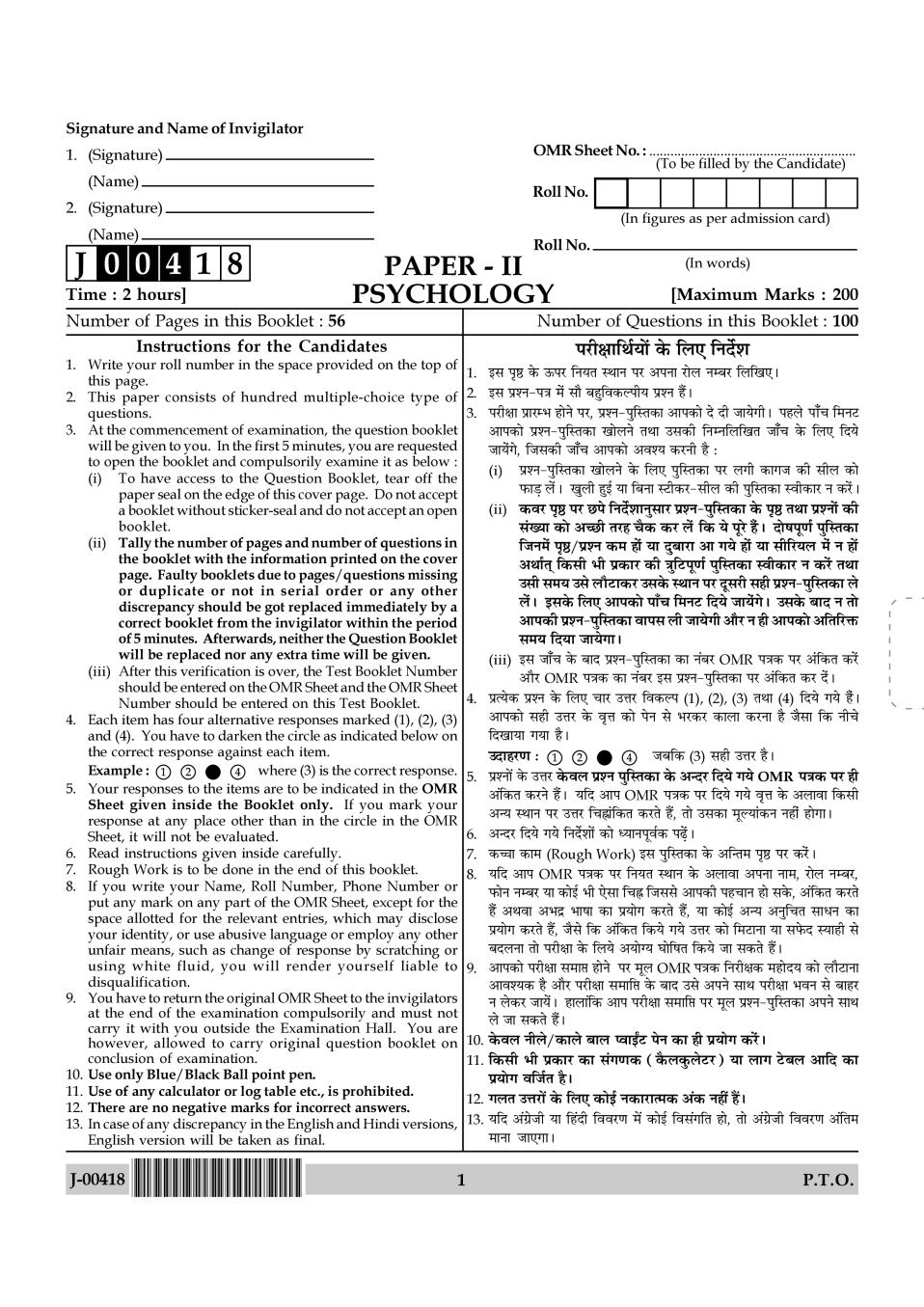
1. (Signature) OMR Sheet No. : ..........................................................
(To be filled by the Candidate)
(Name)
Roll No.
2. (Signature)
(In figures as per admission card)
(Name)
Roll No.
J 0 0 4 1 8 PAPER - II (In words)
Time : 2 hours] PSYCHOLOGY [Maximum Marks : 200
Number of Pages in this Booklet : 56 Number of Questions in this Booklet : 100
Instructions for the Candidates ¬⁄UˡÊÊÁÕ¸ÿÙ¢ ∑§ Á‹∞ ÁŸŒ¸‡Ê
1. Write your roll number in the space provided on the top of
1. ß‚ ¬ÎDU ∑§ ™§¬⁄U ÁŸÿà SÕÊŸ ¬⁄U •¬ŸÊ ⁄UÙ‹U Ÿê’⁄U Á‹Áπ∞–
this page.
2. This paper consists of hundred multiple-choice type of 2. ß‚ ¬˝‡Ÿ-¬òÊ ◊¢ ‚ÊÒ ’„ÈÁfl∑§À¬Ëÿ ¬˝‡Ÿ „Ò¥–
questions. 3. ¬⁄UˡÊÊ ¬˝Ê⁄êU÷ „ÙŸ ¬⁄U, ¬˝‡Ÿ-¬ÈÁSÃ∑§Ê •Ê¬∑§Ù Œ ŒË ¡ÊÿªË– ¬„‹U ¬UÊ°ø Á◊Ÿ≈U
3. At the commencement of examination, the question booklet •Ê¬∑§Ù ¬˝‡Ÿ-¬ÈÁSÃ∑§Ê πÙ‹Ÿ ÃÕÊ ©‚∑§Ë ÁŸêŸÁ‹Áπà ¡Ê°ø ∑§ Á‹∞ ÁŒÿ
will be given to you. In the first 5 minutes, you are requested ¡Êÿ¢ª, Á¡‚∑§Ë ¡Ê°ø •Ê¬∑§Ù •fl‡ÿ ∑§⁄UŸË „Ò —
to open the booklet and compulsorily examine it as below :
(i) ¬˝‡Ÿ-¬ÈÁSÃ∑§Ê πÙ‹Ÿ ∑§ Á‹∞ ¬ÈÁSÃ∑§Ê ¬⁄U ‹ªË ∑§Êª¡ ∑§Ë ‚Ë‹ ∑§Ê
(i) To have access to the Question Booklet, tear off the
paper seal on the edge of this cover page. Do not accept »§Ê«∏ ‹¢U– πÈ‹Ë „È߸ ÿÊ Á’ŸÊ S≈UË∑§⁄U-‚Ë‹U ∑§Ë ¬ÈÁSÃ∑§Ê SflË∑§Ê⁄U Ÿ ∑§⁄¢U–
a booklet without sticker-seal and do not accept an open (ii) ∑§fl⁄U ¬ÎDU ¬⁄U ¿U¬ ÁŸŒ¸‡ÊÊŸÈ‚Ê⁄U ¬˝‡Ÿ-¬ÈÁSÃ∑§Ê ∑§ ¬ÎDU ÃÕÊ ¬˝‡ŸÙ¢ ∑§Ë
booklet. ‚¢ÅÿÊ ∑§Ù •ë¿UË Ã⁄U„ øÒ∑§ ∑§⁄U ‹¢U Á∑§ ÿ ¬Í⁄U „Ò¢U– ŒÙ·¬Íáʸ ¬ÈÁSÃ∑§Ê
(ii) Tally the number of pages and number of questions in Á¡Ÿ◊¢ ¬ÎDU/¬˝‡Ÿ ∑§◊ „Ù¢ ÿÊ ŒÈ’Ê⁄UÊ •Ê ªÿ „Ù¢ ÿÊ ‚ËÁ⁄Uÿ‹U ◊¢ Ÿ „Ù¢
the booklet with the information printed on the cover •ÕʸØ Á∑§‚Ë ÷Ë ¬˝∑§Ê⁄U ∑§Ë òÊÈÁ≈U¬Íáʸ ¬ÈÁSÃ∑§Ê SflË∑§Ê⁄U Ÿ ∑§⁄¢U ÃÕÊ
page. Faulty booklets due to pages/questions missing
or duplicate or not in serial order or any other ©‚Ë ‚◊ÿ ©‚ ‹Uı≈UÊ∑§⁄U ©‚∑§ SÕÊŸ ¬⁄U ŒÍ‚⁄UË ‚„Ë ¬˝‡Ÿ-¬ÈÁSÃ∑§Ê ‹
discrepancy should be got replaced immediately by a ‹¢– U ß‚∑§ Á‹∞ •Ê¬∑§Ù ¬Ê°ø Á◊Ÿ≈U ÁŒÿ ¡Êÿ¢ª– ©‚∑§ ’ÊŒ Ÿ ÃÙ
correct booklet from the invigilator within the period •Ê¬∑§Ë ¬˝‡Ÿ-¬ÈÁSÃ∑§Ê flʬ‚ ‹Ë ¡ÊÿªË •ı⁄U Ÿ „Ë •Ê¬∑§Ù •ÁÃÁ⁄UQ§
of 5 minutes. Afterwards, neither the Question Booklet ‚◊ÿ ÁŒÿÊ ¡ÊÿªÊ–
will be replaced nor any extra time will be given. (iii) ß‚ ¡Ê°ø ∑§ ’ÊŒ ¬˝‡Ÿ-¬ÈÁSÃ∑§Ê ∑§Ê Ÿ¥’⁄U OMR ¬òÊ∑§ ¬⁄U •¢Á∑§Ã ∑§⁄¢U
(iii) After this verification is over, the Test Booklet Number
•Uı⁄U OMR ¬òÊ∑§ ∑§Ê Ÿ¥’⁄U ß‚ ¬˝‡Ÿ-¬ÈÁSÃ∑§Ê ¬⁄U •¢Á∑§Ã ∑§⁄U Œ¢–
should be entered on the OMR Sheet and the OMR Sheet
Number should be entered on this Test Booklet. 4. ¬˝ àÿ∑§ ¬˝‡Ÿ ∑§ Á‹∞ øÊ⁄U ©ûÊ⁄U Áfl∑§À¬ (1), (2), (3) ÃÕÊ (4) ÁŒÿ ªÿ „Ò¢–
4. Each item has four alternative responses marked (1), (2), (3) •Ê¬∑§Ù ‚„Ë ©ûÊ⁄U ∑§ flÎûÊ ∑§Ù ¬Ÿ ‚ ÷⁄U∑§⁄U ∑§Ê‹Ê ∑§⁄UŸÊ „Ò ¡Ò‚Ê Á∑§ ŸËø
and (4). You have to darken the circle as indicated below on ÁŒπÊÿÊ ªÿÊ „Ò–
the correct response against each item. ©ŒÊ„⁄UáÊ — ¡’Á∑§ (3) ‚„Ë ©ûÊ⁄U „Ò–
Example : where (3) is the correct response. 5. ¬˝‡ŸÊ¥ ∑§ ©ûÊ⁄U ∑§fl‹ ¬˝‡Ÿ ¬ÈÁSÃ∑§Ê ∑§ •ãŒ⁄U ÁŒÿ ªÿ OMRU ¬òÊ∑§ ¬⁄U „Ë
5. Your responses to the items are to be indicated in the OMR •¥Á∑§Ã ∑§⁄UŸ „Ò¥– ÿÁŒ •Ê¬ OMRU ¬òÊ∑§ ¬⁄U ÁŒÿ ªÿ flÎûÊ ∑§ •‹ÊflÊ Á∑§‚Ë
Sheet given inside the Booklet only. If you mark your
response at any place other than in the circle in the OMR •ãÿ SÕÊŸ ¬⁄U ©ûÊ⁄U ÁøqÊ¢Á∑§Ã ∑§⁄Uà „Ò¥, ÃÙ ©‚∑§Ê ◊ÍÀUÿÊ¢∑§Ÿ Ÿ„Ë¢ „٪ʖ
Sheet, it will not be evaluated. 6. •ãŒ⁄U ÁŒÿ ªÿ ÁŸŒ¸‡ÊÙ¢ ∑§Ù äÿÊŸ¬Ífl¸∑§ ¬…∏¢U–
6. Read instructions given inside carefully. 7. ∑§ìÊÊ ∑§Ê◊ (Rough Work) ß‚ ¬ÈÁSÃ∑§Ê ∑§ •ÁãÃ◊ ¬ÎDU ¬⁄U ∑§⁄¢U–
7. Rough Work is to be done in the end of this booklet. 8. ÿÁŒ •Ê¬ OMR ¬òÊ∑§ ¬⁄U ÁŸÿà SÕÊŸ ∑§ •‹ÊflÊ •¬ŸÊ ŸÊ◊, ⁄UÊ‹ Ÿê’⁄U,
8. If you write your Name, Roll Number, Phone Number or »§ÊŸ Ÿê’⁄U ÿÊ ∑§Ê߸ ÷Ë ∞‚Ê Áøq Á¡‚‚ •Ê¬∑§Ë ¬„øÊŸ „Ê ‚∑§, •¥Á∑§Ã ∑§⁄UÃ
put any mark on any part of the OMR Sheet, except for the
space allotted for the relevant entries, which may disclose „Ò¥ •ÕflÊ •÷Œ˝ ÷Ê·Ê ∑§Ê ¬˝ÿʪ ∑§⁄Uà „Ò¥, ÿÊ ∑§Ê߸ •ãÿ •ŸÈÁøà ‚ÊœŸ ∑§Ê
your identity, or use abusive language or employ any other ¬˝ÿʪ ∑§⁄Uà „Ò¥, ¡Ò‚ Á∑§ •¥Á∑§Ã Á∑§ÿ ªÿ ©ûÊ⁄U ∑§Ê Á◊≈UÊŸÊ ÿÊ ‚»§Œ SÿÊ„Ë ‚
unfair means, such as change of response by scratching or ’Œ‹ŸÊ ÃÊ ¬⁄UˡÊÊ ∑§ Á‹ÿ •ÿÊÇÿ ÉÊÊÁ·Ã Á∑§ÿ ¡Ê ‚∑§Ã „Ò¥–
using white fluid, you will render yourself liable to 9. •Ê¬∑§Ù ¬⁄UˡÊÊ ‚◊Ê# „ÙŸ §¬⁄U ◊Í‹ OMR ¬òÊ∑§ ÁŸ⁄UˡÊ∑§ ◊„ÙŒÿ ∑§Ù ‹Uı≈UÊŸÊ
disqualification. •Êfl‡ÿ∑§ „Ò •ı⁄U ¬⁄UˡÊÊ ‚◊ÊÁ# ∑§ ’ÊŒ ©‚ •¬Ÿ ‚ÊÕ ¬⁄UˡÊÊ ÷flŸ ‚ ’Ê„⁄U
9. You have to return the original OMR Sheet to the invigilators Ÿ ‹∑§⁄U ¡Êÿ¢– „Ê‹Ê¥Á∑§ •Ê¬ ¬⁄UˡÊÊ ‚◊ÊÁ# ¬⁄U ◊Í‹ ¬˝‡Ÿ-¬ÈÁSÃ∑§Ê •¬Ÿ ‚ÊÕ
at the end of the examination compulsorily and must not
carry it with you outside the Examination Hall. You are
‹ ¡Ê ‚∑§Ã „Ò¥–
however, allowed to carry original question booklet on 10. ∑§fl‹ ŸË‹/∑§Ê‹ ’Ê‹U åflÊßZ≈U ¬Ÿ ∑§Ê „Ë ¬˝ÿʪ ∑§⁄¢U–
conclusion of examination. 11. Á∑§‚Ë ÷Ë ¬˝∑§Ê⁄U ∑§Ê ‚¢ªáÊ∑§ (∑Ò§‹∑ȧ‹≈U⁄U) UÿÊ ‹Êª ≈U’‹ •ÊÁŒ ∑§Ê
10. Use only Blue/Black Ball point pen. ¬˝ÿÙª flÁ¡¸Ã „Ò–
11. Use of any calculator or log table etc., is prohibited.
12. ª‹Ã ©ûÊ⁄UÊ¥ ∑§ Á‹∞ ∑§Ê߸ Ÿ∑§Ê⁄UÊà◊∑§ •¥∑§ Ÿ„Ë¥ „Ò¥–
12. There are no negative marks for incorrect answers.
13. In case of any discrepancy in the English and Hindi versions, 13. ÿÁŒ •¥ª˝¡Ë ÿÊ Á„¥ŒË Áflfl⁄UáÊ ◊¥ ∑§Ê߸ Áfl‚¥ªÁà „Ê, ÃÊ •¥ª˝¡Ë Áflfl⁄UáÊ •¥ÁÃ◊
English version will be taken as final. ◊ÊŸÊ ¡Ê∞ªÊ–
J-00418 !J-00418-PAPER-II! 1 P.T.O.
Page 2
PAPER - II
Note : This paper contains hundred (100) objective type questions of two (2) marks each. All
questions are compulsory.
1. In Erikson’s theory, which psycho-social crises preceed and succeed Autonomy v/s
Shame :
(1) Basic trust v/s mistrust and Industry v/s Inferiority.
(2) Initiative v/s Guilt and Industry v/s Inferiority.
(3) Industry v/s Inferiority and Identity v/s Role confusion.
(4) Basic trust v/s mistrust and Initiative v/s Guilt.
2. Read each of the following statements - Assertion (A) and Reason (R); and indicate your
answer using code given below :
Assertion (A) : Horner found high level of motive to avoid success or fear of success in
females.
Reason (R) : As a result of success, the threat of social rejection and fear concerning
perceived lack of feminity are aroused in women.
Code :
(1) Both (A) and (R) are true, and (R) is the correct explanation of (A).
(2) Both (A) and (R) are true, but (R) is not the correct explanation of (A).
(3) (A) is true, but (R) is false.
(4) (A) is false, but (R) is true.
3. Match List - I with List - II and select the correct answer by choosing from code given
below :
List - I List - II
(Concept) (Explanation)
(a) Life Space (i) Unlearned, fixed stereotyped pattern of activity.
(b) Instinctual Behaviour (ii) Psychological reality depicting the totality of facts
that determine behaviour at a moment in true. It
counts of environment as perceived by the person.
(c) Vacuum Behaviour (iii) Tendency to resume the previously unfinished task
during intervening period.
(d) Task Resumption (iv) Behaviour patterns that appear when the sign
stimulus is not identifiable.
Code :
(a) (b) (c) (d)
(1) (i) (ii) (iii) (iv)
(2) (ii) (i) (iv) (iii)
(3) (iii) (iv) (i) (ii)
(4) (iv) (iii) (ii) (i)
J-00418 !J-00418-PAPER-II! 2 Paper-II
Page 3
¬˝‡Ÿ-¬òÊ - II
ÁŸŒ¸‡Ê — ß‚ ¬˝‡Ÿ-¬òÊ ◊¥ ‚ÊÒ (100) ’„È-Áfl∑§À¬UËÿ ¬˝‡Ÿ „Ò¥– ¬˝àÿ∑§ ¬˝‡Ÿ ∑§ ŒÙ (2) •¢∑§ „Ò¥– ‚÷Ë ¬˝‡Ÿ •ÁŸflÊÿ¸ „Ò¥–
1. ∞Á⁄UÄ‚Ÿ Á‚hÊãà ◊¥ ∑§ÊÒŸ‚Ë ◊ŸÊ-‚Ê◊ÊÁ¡∑§ ‚¥∑§≈U SflÊÿûÊÃÊ ’ŸÊ◊ ‹í¡Ê ‡ÊË‹ÃÊ ‚ ¬„‹ ∞fl¥ ’ÊŒ ◊¥ •ÊÃÊ „Ò —
(1) ◊ÊÒÁ‹∑§ Áfl‡flÊ‚ ’ŸÊ◊ •Áfl‡flÊ‚ •ÊÒ⁄U ©à∑§·¸ ’ŸÊ◊ „ËŸÃÊ–
(2) ‚ÍòʬÊà ’ŸÊ◊ •¬⁄UÊœ ’Êœ •ÊÒ⁄U ©à∑§·¸ ’ŸÊ◊ „ËŸÃÊ–
(3) ©à∑§·¸ ’ŸÊ◊ „ËŸÃÊ •ÊÒ⁄U •Á÷ôÊÊŸ ’ŸÊ◊ ‡Ê¥‚ÿ-÷ÍÁ◊∑§Ê–
(4) ◊ÊÒÁ‹∑§ Áfl‡flÊ‚ ’ŸÊ◊ •Áfl‡flÊ‚ •ÊÒ⁄U ©à∑§·¸ ’ŸÊ◊ •¬⁄UÊœ ’Êœ–
2. ÁŸêŸÁ‹Áπà ŒÊ ∑§ÕŸÊ¥ - •Á÷∑§ÕŸ (A) •ÊÒ⁄U Ã∑¸§ (R) ∑§Ê ¬Á…∏∞ ÃÕÊ ŸËø ÁŒ∞ ª∞ ∑ͧ≈U ∑§Ê ©¬ÿʪ ∑§⁄Uà „È∞ •¬ŸÊ
©ûÊ⁄U ŒËÁ¡∞ —
•Á÷∑§ÕŸ (A) : „ÊŸ¸⁄U Ÿ ¬ÊÿÊ Á∑§ ◊Á„‹Ê•Ê¥ ◊¥ “‚»§‹ÃÊ ‚ ’øŸ” ÿÊ “‚»§‹ÃÊ ∑§Ê ÷ÿ” ∑§Ê ©ìÊ SÃ⁄UËÿ
•Á÷¬˝⁄UáÊ „Ò–
Ã∑¸§ (R) : ‚»§‹ÃÊ ∑§ ¬Á⁄UáÊÊ◊SflM§¬ ◊Á„‹Ê•Ê¥ ◊¥ ‚Ê◊ÊÁ¡∑§ •SflË∑ΧÃË ∑§Ë •Ê‡Ê¥∑§Ê ÃÕÊ SòÊËàfl ∑§Ë ∑§◊Ë
∑§Ë œÊ⁄UáÊÊ ‚ ¡È«∏ ÷ÿ ©à¬ÛÊ „Ê ¡Êà „Ò¥–
∑ͧ≈U —
(1) (A) •ÊÒ⁄U (R) ŒÊŸÊ¥ ‚„Ë „Ò¥ ÃÕÊ (R), (A) ∑§Ë ‚„Ë √ÿÊÅÿÊ ∑§⁄UÃÊ „Ò–
(2) (A) •ÊÒ⁄U (R) ŒÊŸÊ¥ ‚„Ë „Ò¥, ¬⁄UãÃÈ (R), (A) ∑§Ë ‚„Ë √ÿÊÅÿÊ Ÿ„Ë¥ „Ò–
(3) (A) ‚„Ë „Ò, ¬⁄UãÃÈ (R) ª‹Ã „Ò–
(4) (A) ª‹Ã „Ò, ¬⁄UãÃÈ (R) ‚„Ë „Ò–
3. ‚ÍøË - I •ÊÒ⁄U ‚ÍøË - II ∑§Ê ‚È◊Á‹Ã ∑§ËÁ¡∞ •ÊÒ⁄U ŸËø ÁŒ∞ ª∞ ∑ͧ≈U ◊¥ ‚ ‚„Ë ©ûÊ⁄U øÈÁŸ∞ —
‚ÍøË - I ‚ÍøË - II
(•flœÊ⁄UáÊÊ) (√ÿÊÅÿÊ)
(a) ¡ËflŸ ¬ÿʸfl⁄UáÊ (i) ’¥œŸ◊ÈÄÃ, ªÁÃÁflÁœÿÊ¥ ∑§Ê ’¥œÊ-’¥œÊÿÊ Œ⁄Uʸ–
(b) ◊Í‹ ¬˝flÎûÊËÿ √ÿfl„Ê⁄U (ii) ÃâÿÊ¥ ∑§Ë ‚ê¬ÍáʸÃÊ ¬˝ŒÁ‡Ê¸Ã ∑§⁄UÃË ◊ŸÊflÒôÊÊÁŸ∑§ flÊSÃÁfl∑§ÃÊ ¡Ê
Á∑§‚Ë ˇÊáÊ Áfl‡Ê· ∑§ √ÿfl„Ê⁄U ∑§Ê ÁŸœÊ¸⁄UáÊ ∑§⁄UÃË „Ò– ÿ„ √ÿÁÄÃ
mÊ⁄UÊ •flœÊÁ⁄Uà flÊÃÊfl⁄UáÊ ‚ ªÁ∆Uà „ÊÃÊ „Ò–
(c) ÷Êfl‡ÊÍãÿ √ÿfl„Ê⁄U (iii) ¬„‹ ¿ÍU≈U „È∞ ∑§Ê◊ ∑§Ê ’Ëø-’Ëø ◊¥ Á»§⁄U ‚ ‡ÊÈM§ ∑§⁄UŸ ∑§Ë ¬˝flÎÁûÊ–
(d) ∑§Êÿ¸ ¬ÈŸ⁄UÊ⁄Uê÷ (iv) √ÿfl„Ê⁄U •Á÷⁄UøŸÊ ¡Ê Ã’ ‚Ê◊Ÿ •ÊÃË „Ò ¡’ Áøq ©gˬŸ ¬„øÊŸ
¡ÊŸ ÿÊÇÿ Ÿ „Ê–
∑ͧ≈U —
(a) (b) (c) (d)
(1) (i) (ii) (iii) (iv)
(2) (ii) (i) (iv) (iii)
(3) (iii) (iv) (i) (ii)
(4) (iv) (iii) (ii) (i)
J-00418 !J-00418-PAPER-II! 3 Paper-II
Page 4
answer using code given below :
Assertion (A) : Perceived fairness of the interpersonal treatment is used to determine
organizational outcomes.
Reason (R) : People expect informational transparency and respect in organizations.
Code :
(1) Both (A) and (R) are true, and (R) is the correct explanation of (A).
(2) Both (A) and (R) are true, but (R) is not the correct explanation of (A).
(3) (A) is true, but (R) is false.
(4) (A) is false, but (R) is true.
5. Match List - I with List - II and select the correct answer by choosing from code given
below :
List - I List - II
(Concept) (Explanation)
(a) Episodic retrieval (i) Physical environment at retrieval matching
that at encoding.
(b) Context-dependent retrieval (ii) Mood at retrieval matching that at encoding.
(c) State-dependent retrieval (iii) Retrieval stimulated by hints from the external
and internal environment.
(d) Cue-dependent retrieval (iv) Subsequent reactivation of stored memory
traces.
Code :
(a) (b) (c) (d)
(1) (i) (ii) (iii) (iv)
(2) (ii) (iv) (iii) (i)
(3) (iii) (iv) (ii) (i)
(4) (iv) (i) (ii) (iii)
6. Read each of the following statements - Assertion (A) and Reason (R); and indicate your
answer using code given below :
Assertion (A) : Rational persuation refers to the use of logical arguments and facts to
persuade others for achieving a desired result.
Reason (R) : Managers use several techniques to influence others in organizations.
Code :
(1) Both (A) and (R) are true, and (R) is the correct explanation of (A).
(2) Both (A) and (R) are true, but (R) is not the correct explanation of (A).
(3) (A) is true, but (R) is false.
(4) (A) is false, but (R) is true.
J-00418 !J-00418-PAPER-II! 4 Paper-II
Page 5
©ûÊ⁄U ŒËÁ¡∞ —
•Á÷∑§ÕŸ (A) : ‚¥ª∆UŸÊà◊∑§ ÁŸc∑§·ÊZ ∑§Ê ÁŸœÊ¸⁄UáÊ ∑§⁄UŸ ∑§ Á‹∞ •¥Ã⁄U-flÒÿÁÄÃ∑§ •flª◊Ë ÁŸc¬ˇÊÃÊ ∑§Ê ©¬ÿʪ
Á∑§ÿÊ ¡ÊÃÊ „Ò–
Ã∑¸§ (R) : ‹Êª ‚¥ª∆UŸÊ¥ ∑§ ‚¥Œ÷¸ ◊¥ ‚ÍøŸÊ¬⁄U∑§ ¬Ê⁄UŒÁ‡Ê¸ÃÊ •ÊÒ⁄U ‚ê◊ÊŸ ∑§Ë •¬ˇÊÊ ∑§⁄Uà „Ò¥–
∑ͧ≈U —
(1) (A) •ÊÒ⁄U (R) ŒÊŸÊ¥ ‚„Ë „Ò¥ •ÊÒ⁄U (R), (A) ∑§Ë ‚„Ë √ÿÊÅÿÊ „Ò–
(2) (A) •ÊÒ⁄U (R) ŒÊŸÊ¥ ‚„Ë „Ò¥, ¬⁄UãÃÈ (R), (A) ∑§Ë ‚„Ë √ÿÊÅÿÊ Ÿ„Ë¥ „Ò–
(3) (A) ‚„Ë „Ò, ¬⁄UãÃÈ (R) ª‹Ã „Ò–
(4) (A) ª‹Ã „Ò, ¬⁄UãÃÈ (R) ‚„Ë „Ò–
5. ‚ÍøË - I •ÊÒ⁄U ‚ÍøË - II ∑§Ê ‚È◊Á‹Ã ∑§ËÁ¡∞ •ÊÒ⁄U ŸËø ÁŒ∞ ª∞ ∑ͧ≈U ◊¥ ‚ ‚„Ë ©ûÊ⁄U øÈÁŸ∞ —
‚ÍøË - I ‚ÍøË - II
(•flœÊ⁄UáÊÊ) (S¬c≈UË∑§⁄UáÊ)
(a) ÉÊ≈UŸÊ¡ãÿ ¬ÈŸ¬˝Ê¸Áåà (i) ¬ÈŸ¬˝Ê¸Áåà ¬⁄U ÷ÊÒÁÃ∑§ flÊÃÊfl⁄UáÊ ∑§Ê ∑ͧ≈UË∑§⁄UáÊ ∑§ ‚◊ÿ
flÊÃÊfl⁄UáÊ ‚ ◊Á‹Ã ∑§⁄UŸÊ–
(b) ‚¥Œ÷¸-•ÊÁüÊà ¬ÈŸ¬˝Ê¸Áåà (ii) ¬ÈŸ¬˝Ê¸Áåà ∑§ ‚◊ÿ ¬⁄U ◊Í«U ∑§Ê ∑ͧ≈UË∑§⁄UáÊ ∑§ ‚◊ÿ ◊Í«U ‚
◊Á‹Ã ∑§⁄UŸÊ–
(c) ⁄UÊíÿ-•ÊÁüÊà ¬ÈŸ¬˝Ê¸Áåà (iii) ’Ê„⁄UË •ÊÒ⁄U •ÊãÃÁ⁄U∑§ flÊÃÊfl⁄UáÊ ‚¥∑§ÃÊ¥ mÊ⁄UÊ ©gËåà ¬ÈŸ¬˝Ê¸ÁåÖ
(d) ‚¥∑§Ã-•ÊÁüÊà ¬ÈŸ¬˝Ê¸Áåà (iv) ‚¥Áøà S◊ÎÁà •fl‡Ê·Ê¥ ∑§Ê •ŸÈflÃ˸ ¬ÈŸ—‚Á∑˝§ÿáÊ–
∑ͧ≈U —
(a) (b) (c) (d)
(1) (i) (ii) (iii) (iv)
(2) (ii) (iv) (iii) (i)
(3) (iii) (iv) (ii) (i)
(4) (iv) (i) (ii) (iii)
6. ÁŸêŸÁ‹Áπà ŒÊ ∑§ÕŸÊ¥ - •Á÷∑§ÕŸ (A) •ÊÒ⁄U Ã∑¸§ (R) ∑§Ê ¬Á…∏∞ ÃÕÊ ŸËø ÁŒ∞ ª∞ ∑ͧ≈U ∑§Ê ©¬ÿʪ ∑§⁄Uà „È∞ •¬ŸÊ
©ûÊ⁄U ŒËÁ¡∞ —
•Á÷∑§ÕŸ (A) : Ã∑¸§ÿÈÄà •ŸÈŸÿŸ flÊ¥Á¿Uà ¬Á⁄UáÊÊ◊ ¬˝Êåà ∑§⁄UŸ ∑§ Á‹∞ ŒÍ‚⁄UÊ¥ ∑§Ê ‚◊¤ÊÊŸ ∑§ Á‹∞ ÃÊÁ∑¸§∑§ ’„‚
•ÊÒ⁄U ÃâÿÊ¥ ∑§ ©¬ÿʪ ∑§Ê ∑§„ÃÊ „Ò–
Ã∑¸§ (R) : ¬˝’¥œ∑§ ‚¥ª∆UŸÊ¥ ◊¥ ŒÍ‚⁄UÊ¥ ∑§Ê ¬˝÷ÊÁflà ∑§⁄UŸ ∑§ Á‹∞ ∑§ß¸ Á∑˝§ÿÊÁflÁœ ∑§Ê ©¬ÿʪ ∑§⁄UÃÊ „Ò–
∑ͧ≈U —
(1) (A) •ÊÒ⁄U (R) ŒÊŸÊ¥ ‚„Ë „Ò¥ ÃÕÊ (R), (A) ∑§Ë ‚„Ë √ÿÊÅÿÊ ∑§⁄UÃÊ „Ò–
(2) (A) •ÊÒ⁄U (R) ŒÊŸÊ¥ ‚„Ë „Ò¥, ¬⁄UãÃÈ (R), (A) ∑§Ë ‚„Ë √ÿÊÅÿÊ Ÿ„Ë¥ „Ò–
(3) (A) ‚„Ë „Ò, ¬⁄UãÃÈ (R) ª‹Ã „Ò–
(4) (A) ª‹Ã „Ò, ¬⁄UãÃÈ (R) ‚„Ë „Ò–
J-00418 !J-00418-PAPER-II! 5 Paper-II
Page 6
below :
List - I List - II
(Concept) (Description)
(a) Counter-conditioning (i) After conditioning, a new CS(B) when paired with
already conditioned stimulus CS(A) and presented
as a compound stimulus, little or no conditioning
occurs to CS(B).
(b) Blocking (ii) Elimination of undesirable behaviour by pairing CS
with US other than the one that originally reinforced
that behaviour.
(c) Overshadowing (iii) Inhibition of conditioned response caused by
conditioned emotional response.
(d) Conditioned Suppression (iv) While using compound CS where one of its
components is more salient than the other, only the
salient component is conditioned.
Code :
(a) (b) (c) (d)
(1) (ii) (i) (iii) (iv)
(2) (ii) (i) (iv) (iii)
(3) (iv) (iii) (i) (ii)
(4) (iv) (iii) (ii) (i)
8. Match List - I with List - II and select the correct answer by choosing from code given
below :
List - I List - II
(Concept) (Explanation)
(a) Convergence (i) If you see a distant mountain range on a crystal -
clear day, it looks like it was only a few miles away.
(b) Frame of reference (ii) When the two images are fused into one overall
image.
(c) Stereoscopic vision (iii) When we look at a distant object, the lines of vision
from our eyes are parallel. Looking at a nearby
object, the eyes turn in.
(d) Aerial perspective (iv) An internal perspective relative to which events are
perceived.
Code :
(a) (b) (c) (d)
(1) (i) (ii) (iii) (iv)
(2) (iii) (iv) (ii) (i)
(3) (ii) (iii) (iv) (i)
(4) (iv) (i) (iii) (ii)
J-00418 !J-00418-PAPER-II! 6 Paper-II
Page 7
‚ÍøË - I ‚ÍøË - II
(•flœÊ⁄UáÊÊ) (√ÿÊÅÿÊ)
(a) ¬˝Áà •ŸÈ’¥œŸ (i) •ŸÈ’¥œŸ ∑§ ’ÊŒ, ŸflËŸ CS(B) ¡’ ¬„‹ ‚ „Ë •ŸÈ’¥ÁœÃ ©gˬ∑§
CS(A) ∑§ ‚ÊÕ ÿÈÁÇ◊à Á∑§ÿÊ ¡ÊÃÊ „Ò •ÊÒ⁄U Á◊ÁüÊà ©gˬ∑§ ∑§ M§¬
◊¥ ¬˝SÃÈà Á∑§ÿÊ ¡ÊÃÊ „Ò, ÃÊ CS(B) ◊¥ ∑§◊ •ŸÈ’¥œŸ „ÊÃÊ „Ò ÿÊ „ÊÃÊ
„Ë Ÿ„Ë¥ „Ò–
(b) •fl⁄UÊœŸ (ii) CS ∑§Ë US ∑§ ‚ÊÕ ÿÈÁÇ◊à ∑§⁄U ∑§ •flÊ¥¿UŸËÿ √ÿfl„Ê⁄U ∑§Ê Áfl‹Ê¬Ÿ
’¡Êÿ ©‚∑§ Á¡‚Ÿ ©‚ √ÿfl„Ê⁄U ∑§Ê ◊͋× ¬˝’Á‹Ã Á∑§ÿÊ–
(c) •Áà ¿UÊÿʟȪ◊Ÿ (iii) •ŸÈ’¥ÁœÃ ‚¥flªÊà◊∑§ •ŸÈÁ∑˝§ÿÊ mÊ⁄UÊ ©à¬ÛÊ •ŸÈ’¥ÁœÃ •ŸÈÁ∑˝§ÿÊ
∑§Ê ¬˝Êfl⁄UÊœ–
(d) •ŸÈ’¥ÁœÃ Œ◊Ÿ (iv) Á◊üÊ CS ∑§Ê ©¬ÿʪ ∑§⁄Uà ‚◊ÿ ¡„Ê° CS ∑§Ê ∞∑§ Á◊üÊ ŒÍ‚⁄U ∑§Ë
ÃÈ‹ŸÊ ◊¥ íÿÊŒÊ ©À‹πŸËÿ „Ò, ÃÊ ∑§fl‹ ©À‹πŸËÿ Á◊üÊ •ŸÈ’¥ÁœÃ
„ÊÃÊ „Ò–
∑ͧ≈U —
(a) (b) (c) (d)
(1) (ii) (i) (iii) (iv)
(2) (ii) (i) (iv) (iii)
(3) (iv) (iii) (i) (ii)
(4) (iv) (iii) (ii) (i)
8. ‚ÍøË - I •ÊÒ⁄U ‚ÍøË - II ∑§Ê ‚È◊Á‹Ã ∑§ËÁ¡∞ •ÊÒ⁄U ŸËø ÁŒ∞ ª∞ ∑ͧ≈U ◊¥ ‚ ‚„Ë ©ûÊ⁄U øÈÁŸ∞ —
‚ÍøË - I ‚ÍøË - II
(•flœÊ⁄UáÊÊ) (√ÿÊÅÿÊ)
(a) •Á÷‚⁄UáÊ (i) ÿÁŒ •Ê¬ S»§Á≈U∑§ ‚◊ÊŸ ‚Ê»§ ÁŒŸ ∑§Ê ŒÍ⁄U ¬„Ê«∏ oÎ¥ÅÊ‹Ê Œπà „Ò¥,
•Ê¬∑§Ê ‹ªÃÊ „Ò ÿ„ ∑ȧ¿U „Ë ◊Ë‹ ŒÍ⁄UË ¬⁄U „Ò–
(b) ‚¥Œ÷¸ M§¬⁄UπÊ (ii) ¡’ ŒÊ ¿UÁflÿÊ° ∞∑§ ‚ê¬Íáʸ ¿UÁfl ◊¥ Á◊‹Ê ŒË ¡ÊÃË „Ò¥–
(c) S≈UËÁ⁄U•ÊS∑§ÊÁ¬∑§ ŒÎ‡ÿ (iii) ¡’ „◊ ŒÍ⁄U ∑§Ë flSÃÈ ∑§Ê Œπà „Ò¥, ÃÊ „◊Ê⁄U ŸòÊÊ¥ ‚ ŒÎ‡ÿ ∑§Ë ⁄UπÊ∞°
‚◊ÊãÃ⁄U „ÊÃË „Ò¥– ∑§◊ ŒÍ⁄UË ¬⁄U ⁄UπË flSÃÈ ∑§Ê ŒπŸ ¬⁄U ŸòÊ •ãŒ⁄U
∑§Ë •Ê⁄U ◊È«∏ ¡Êà „Ò¥–
(d) „flÊ߸ ¬Á⁄U¬˝ˇÿ (iv) •ÊãÃÁ⁄U∑§ ŒÎÁc≈U∑§ÊáÊ Á¡‚∑§, ‚ʬˇÊ ÉÊ≈UŸÊ•Ê¥ ∑§Ê ¬˝àÿˇÊáÊ Á∑§ÿÊ
¡ÊÃÊ „Ò–
∑ͧ≈U —
(a) (b) (c) (d)
(1) (i) (ii) (iii) (iv)
(2) (iii) (iv) (ii) (i)
(3) (ii) (iii) (iv) (i)
(4) (iv) (i) (iii) (ii)
J-00418 !J-00418-PAPER-II! 7 Paper-II
Page 8
answer using code given below :
Assertion (A) : Perception remains constant although the proximal sensation changes.
Reason (R) : Our perceptual system has mechanisms that adjust our perception of the
proximal stimulus.
Code :
(1) Both (A) and (R) are true, and (R) is the correct explanation of (A).
(2) Both (A) and (R) are true, but (R) is not the correct explanation of (A).
(3) (A) is true, but (R) is false.
(4) (A) is false, but (R) is true.
10. Match List - I with List - II and select the correct answer by choosing from code given
below :
List - I List - II
(Concept) (Description)
(a) Physiological Psychology (i) Studies the psychological effects of brain damage in
human patients.
(b) Neuropsychology (ii) Studies the neural mechanisms of behaviour by
manipulating the nervous systems of non-human
animals in controlled experiments.
(c) Psychophysiology (iii) Studies the relation between physiological activity
and psychological processes in human subjects by
non-invasive physiological recording.
(d) Cognitive Neuroscience (iv) Studies the neural mechanisms of human cognition,
mainly by using functional brain imaging
techniques.
Code :
(a) (b) (c) (d)
(1) (i) (ii) (iii) (iv)
(2) (iii) (iv) (i) (ii)
(3) (ii) (i) (iv) (iii)
(4) (iv) (iii) (ii) (i)
11. Which of the following explains the Threshold Hypothesis regarding Intelligence - Creativity
relationship ?
(1) There is a positive correlation between Intelligence and Creativity.
(2) There is a positive correlation between Intelligence and Creativity upto a particular
level of Intelligence.
(3) There is a positive correlation between Intelligence and Creativity beyond a particular
level of Intelligence.
(4) There is a negative correlation between Intelligence and Creativity beyond a particular
level of Intelligence.
J-00418 !J-00418-PAPER-II! 8 Paper-II
Page 9
©ûÊ⁄U ŒËÁ¡∞ —
•Á÷∑§ÕŸ (A) : ¬˝àÿˇÊË∑§⁄UáÊ ÁSÕ⁄U ⁄U„ÃÊ „Ò ÿlÁ¬ ‚◊Ë¬Ë ‚¥flŒŸ ’Œ‹ ¡ÊÃÊ „Ò–
Ã∑¸§ (R) : „◊Ê⁄UË ¬˝ÊàÿÁˇÊ∑§ ¬˝áÊÊ‹Ë ∑§Ë ’ŸÊfl≈U ∞‚Ë „Ò Á∑§ ÿ„ ÁŸ∑§≈USÕ ©gˬ∑§ ∑§ „◊Ê⁄U ¬˝àÿˇÊáÊ ∑§Ê
‚◊ÊÿÊÁ¡Ã ∑§⁄U ‹ÃË „Ò–
∑ͧ≈U —
(1) (A) •ÊÒ⁄U (R) ŒÊŸÊ¥ ‚„Ë „Ò¥ ÃÕÊ (R), (A) ∑§Ë ‚„Ë √ÿÊÅÿÊ ∑§⁄UÃÊ „Ò–
(2) (A) •ÊÒ⁄U (R) ŒÊŸÊ¥ ‚„Ë „Ò¥, ¬⁄UãÃÈ (R), (A) ∑§Ë ‚„Ë √ÿÊÅÿÊ Ÿ„Ë¥ „Ò–
(3) (A) ‚„Ë „Ò, ¬⁄UãÃÈ (R) ª‹Ã „Ò–
(4) (A) ª‹Ã „Ò, ¬⁄UãÃÈ (R) ‚„Ë „Ò–
10. ‚ÍøË - I •ÊÒ⁄U ‚ÍøË - II ∑§Ê ‚È◊Á‹Ã ∑§ËÁ¡∞ •ÊÒ⁄U ŸËø ÁŒ∞ ª∞ ∑ͧ≈U ◊¥ ‚ ‚„Ë ©ûÊ⁄U øÈÁŸ∞ —
‚ÍøË - I ‚ÍøË - II
( •flœÊ⁄UáÊÊ ) ( S¬c≈Ë∑§⁄UáÊ )
(a) ‡Ê⁄UË⁄U flÎÁûÊ∑§ ◊ŸÊÁflôÊÊŸ (i) ◊ÊŸfl ⁄UÊÁªÿÊ¥ ◊¥ ◊ÁSÃˇÊ∑§ ˇÊÁà ∑§ ◊ŸÊflÒôÊÊÁŸ∑§ ¬„‹È•Ê¥ ∑§Ê •äÿÿŸ
∑§⁄UÃÊ „Ò–
(b) Ã¥ÁòÊ∑§Ê ◊ŸÊÁflôÊÊŸ (ii) ÁŸÿÁãòÊà ¬˝ÿʪʥ ◊¥ ªÒ⁄U-◊ÊŸfl ¬‡ÊÈ•Ê¥ ∑§ Ã¥ÁòÊ∑§Ê Ã¥òÊÊ¥ ◊¥ „⁄U»§⁄U
∑§⁄U∑§ √ÿfl„Ê⁄U ∑§Ë Ã¥ÁòÊ∑§Ê ∑§Êÿ¸ÁflÁœ ∑§Ê •äÿÿŸ ∑§⁄UÃÊ „Ò–
(c) ◊ŸÊ-‡Ê⁄UË⁄UÁ∑˝§ÿÊ ÁflôÊÊŸ (iii) ◊ÊŸfl Áfl·ÁÿÿÊ¥ ◊¥ ∑§ÊÁÿ∑§ Á∑˝§ÿÊ •ÊÒ⁄U ◊ŸÊflÒôÊÊÁŸ∑§ ¬˝Á∑˝§ÿÊ•Ê¥ ∑§
’Ëø ‚ê’㜠∑§Ê •Ê∑˝§◊áʇÊË‹ ∑§ÊÁÿ∑§ Á⁄U∑§ÊÚÁ«ZUª mÊ⁄UÊ •äÿÿŸ–
(d) ‚¥ôÊÊŸÊà◊∑§ Ã¥ÁòÊ∑§Ê ÁflôÊÊŸ (iv) ◊ÈÅÿ× ¬˝∑§Êÿʸà◊∑§ ’̋Ÿ ß◊Á¡¥ª Ã∑§ŸË∑§Ê¥ ∑§Ê ©¬ÿʪ ∑§⁄U∑§ ◊ÊŸflËÿ
‚¥ôÊÊŸ ∑§ Ã¥ÁòÊ∑§Ëÿ Á∑˝§ÿÊÁflÁœÿÊ¥ •äÿÿŸ–
∑ͧ≈U —
(a) (b) (c) (d)
(1) (i) (ii) (iii) (iv)
(2) (iii) (iv) (i) (ii)
(3) (ii) (i) (iv) (iii)
(4) (iv) (iii) (ii) (i)
11. ÁŸêŸÁ‹Áπà ◊¥ ‚ ∑§ÊÒŸ ’ÈÁh-‚ΡŸ‡ÊË‹ÃÊ ‚¥’¥œ ∑§ ’Ê⁄U ◊¥ Œ„‹Ëÿ ¬˝ÊÄ∑§À¬ŸÊ ∑§Ë √ÿÊÅÿÊ ∑§⁄UÃÊ „Ò?
(1) ’ÈÁh •ÊÒ⁄U ‚ΡŸ‡ÊË‹ÃÊ ∑§ ’Ëø ∞∑§ ‚∑§Ê⁄UÊà◊∑§ ‚„‚¥’¥œ „Ò–
(2) ’ÈÁh •ÊÒ⁄U ‚ΡŸ‡ÊË‹ÃÊ ∑§ ’Ëø ’ÈÁh ∑§ ∞∑§ Áfl‡Ê· SÃ⁄U Ã∑§ ∞∑§ ‚∑§Ê⁄UÊà◊∑§ ‚„‚¥’¥œ „Ò–
(3) ’ÈÁh •ÊÒ⁄U ‚ΡŸ‡ÊË‹ÃÊ ∑§ ’Ëø ’ÈÁh ∑§ ∞∑§ Áfl‡Ê· SÃ⁄U ∑§ ¬⁄U ∞∑§ ‚∑§Ê⁄UÊà◊∑§ ‚„‚¥’¥œ „Ò–
(4) ’ÈÁh •ÊÒ⁄U ‚ΡŸ‡ÊË‹ÃÊ ∑§ ’Ëø ’ÈÁh ∑§ ∞∑§ Áfl‡Ê· SÃ⁄U ∑§ ¬⁄U ∞∑§ Ÿ∑§Ê⁄UÊà◊∑§ ‚„‚¥’¥œ „Ò–
J-00418 !J-00418-PAPER-II! 9 Paper-II
Page 10
below :
List - I List - II
(Concept) (Explanation)
(a) Concordance (i) Percentage of cases in which, if specific gene is present, a
particular trait, characteristic or disease will actually manifest
itself in the fully developed organism.
(b) Penetrance (ii) Relationship between twins or other family members with
respect to a given trait.
(c) Prevalence (iii) Number of new cases of specific condition or disease that arise
during a particular period of time.
(d) Incidence (iv) Frequency of occurrence of a given condition among a certain
population at a particular point of time.
Code :
(a) (b) (c) (d)
(1) (i) (ii) (iii) (iv)
(2) (iii) (iv) (i) (ii)
(3) (ii) (i) (iv) (iii)
(4) (iv) (iii) (ii) (i)
13. Which of the following significant changes have been incorporated in DSM-5 ?
(a) The title of the manual is not DSM-V, but DSM-5, a deliberate shift from traditional
Roman numerals used in previous editions toward Arabic numerals.
(b) Multiaxial Assessment System - a central feature of DSM since its introduction in
DSM - III in 1980, has been dropped altogether from DSM-5.
(c) DSM-5 authors have overhauled the manual to emphasise neuropsychological or
biological roots of mental disorders.
(d) DSM-5 authors have removed 5 of 10 personality disorders previously included in that
section. Dropped disorders are paranoid, schizoid, histrionic, dependent and narcissistic
personality disorders.
Code :
(1) (a), (b), (c) are correct; (d) is incorrect.
(2) (b), (c) and (d) are correct; (a) is incorrect.
(3) (a) and (b) are correct; (c) and (d) are incorrect.
(4) (c) and (d) are correct; (a) and (b) are incorrect.
14. Which one of the trait theories/models is/are NOT based on factor analytic methodology ?
(a) Allport’s Theory (b) Costa and McCrae’s Model
(c) Goldberg’s Model (d) Eysenck’s Theory
Code :
(1) (a) only (2) (a) and (c) only
(3) (b) and (c) only (4) (b) and (d) only
J-00418 !J-00418-PAPER-II! 10 Paper-II
Page 11
‚ÍøË - I ‚ÍøË - II
(•flœÊ⁄UáÊÊ) (S¬c≈Ë∑§⁄UáÊ)
(a) ‚Ê◊¥¡Sÿ (i) √ÿÁÄÃÿÊ¥ ∑§Ê ∞∑§ ¬˝ÁÇÊà Á¡Ÿ◊¥ ∞∑§ Áfl‡Ê· ¡ËŸ ©¬ÁSÕà „Ò ÃÊ ∞∑§ Áfl‡Ê· ‚Ë‹
ªÈáÊ, Áfl‡Ê·ÃÊ •ÊÒ⁄U ’Ë◊Ê⁄UË ∞∑§ √ÿÁÄà ◊¥ •Á÷√ÿÄà „Ê ¡Ê∞ªË–
(b) ÷lÃÊ (ii) ∞∑§ ÁŒ∞ ª∞ ‚Ë‹ ªÈáÊ ∑§ ‚¥Œ÷¸ ◊¥ ¡È«∏flÊ •ÕflÊ ¬Á⁄UflÊ⁄U ∑§ •ãÿ ‚ŒSÿÊ¥ ∑§
’Ëø ‚¥’¥œ–
(c) ¬˝ø‹Ÿ (iii) ÁflÁ‡Êc≈U ¬Á⁄UÁSÕÁÃÿÊ¥ ∑§ Ÿ∞ ⁄UÊÁªÿÊ¥ ∑§Ë ‚¥ÅÿÊ •ÕflÊ ⁄Uʪ ¡Ê ∞∑§ Áfl‡Ê· ‚◊ÿ ∑§
ŒÊÒ⁄UÊŸU ¬˝∑§≈U „Êà „Ò¥–
(d) •Ê¬ÃŸ (iv) ∞∑§ Áfl‡Ê· ‚◊ÿÊflÁœ ¬⁄U ∞∑§ Áfl‡Ê· Ã⁄U„ ∑§ ‹ÊªÊ¥ ◊¥ ∞∑§ Áfl‡Ê· ¬Á⁄UÁSÕÁà ◊¥
⁄Uʪ ∑§Ë •ÊflÎÁûÊ–
∑ͧ≈U —
(a) (b) (c) (d)
(1) (i) (ii) (iii) (iv)
(2) (iii) (iv) (i) (ii)
(3) (ii) (i) (iv) (iii)
(4) (iv) (iii) (ii) (i)
13. DSM-5 ◊¥ ÁŸêŸÁ‹Áπà ◊¥ ‚ Á∑§‚ ’Œ‹Êfl ∑§Ê ‡ÊÊÁ◊‹ Á∑§ÿÊ ªÿÊ „Ò?
(a) ◊ÒãÿÈ•‹ ∑§Ê ‡ÊË·¸∑§ «UË.∞‚.∞◊.-V Ÿ„Ë¥ „Ò •Á¬ÃÈ «UË.∞‚.∞◊.-5 „Ò, ¬Ífl¸ ∑§ ‚¥S∑§⁄UáÊÊ¥ ◊¥ ©¬ÿʪ ∑§Ë ªß¸
¬Ê⁄¥U¬Á⁄U∑§ ⁄UÊ◊Ÿ ‚¥ÅÿÊ•Ê¥ ∑§Ê ¡ÊŸ’ͤÊ∑§⁄U •⁄U’Ë ‚¥ÅÿÊ•Ê¥ ◊¥ ¬Á⁄UfløŸ–
(b) ’„ÈœÈ⁄UËÿ ◊ÍÀÿÊ¥∑§Ÿ ¬˝áÊÊ‹Ë - 1980 ◊¥ «UË.∞‚.∞◊ - III ◊¥ ß‚∑§Ë ¬˝SÃÈÁà ∑§ ’ÊŒ ‚ «UË.∞‚.∞◊. ∑§Ë ∞∑§ ◊ÈÅÿ
Áfl‡Ê·ÃÊ ∑§Ê «UË.∞‚.∞◊.-5 ‚ ∑ȧ‹ Á◊‹Ê∑§⁄U „≈UÊ ÁŒÿÊ ªÿÊ–
(c) «UË.∞‚.∞◊.-5 ∑§ ‹π∑§Ê¥ Ÿ ◊ŸÊÁfl∑§Ê⁄UÊ¥ ∑§ SŸÊÿÈ-◊ŸÊÁflôÊÊŸ •ÕflÊ ¡ÒÁfl∑§ •ÊœÊ⁄UÊ¥ ¬⁄U ’‹ ŒŸ ∑§ Á‹∞
◊ÒãÿÈ•‹ ◊¥ ‚ÈœÊ⁄U Á∑§ÿÊ–
(d) «UË.∞‚.∞◊.-5 ‹π∑§Ê¥ Ÿ ©‚ πá«U ◊¥ ‡ÊÊÁ◊‹ ¬Ífl¸ ∑§ 10 ◊¥ ‚ 5 √ÿÁÄÃàfl Áfl∑§Ê⁄UÊ¥ ∑§Ê „≈UÊ ÁŒÿÊ– „≈UÊ∞ ª∞
◊ŸÊÁfl∑§Ê⁄UÊ¥ ◊¥ √ÿÊ◊Ê„, S∑§Ë¡Êß«U, Á„ÁS≈˛UÿÊÁŸ∑§, Á«U¬¥«¥U≈U •ÊÒ⁄U •Êà◊¬˝◊Ë √ÿÁÄÃàfl ◊ŸÊÁfl∑§Ê⁄U–
∑ͧ≈U —
(1) (a), (b), (c) ‚„Ë „Ò¥, (d) ª‹Ã „Ò–
(2) (b), (c) •ÊÒ⁄U (d) ‚„Ë „Ò¥, (a) ª‹Ã „Ò–
(3) (a) •ÊÒ⁄U (b) ‚„Ë „Ò¥, (c) •ÊÒ⁄U (d) ª‹Ã „Ò¥–
(4) (c) •ÊÒ⁄U (d) ‚„Ë „Ò¥, (a) •ÊÒ⁄U (b) ª‹Ã „¥Ò–
14. ÁŸêŸ ‡ÊË‹ ªÈáÊ Á‚hÊãÃÊ¥ ◊¥ ‚ ∑§ÊÒŸ ‚ ∑§Ê⁄U∑§ Áfl‡‹·áÊ ÁflÁœ ¬⁄U •ÊœÊÁ⁄Uà Ÿ„Ë¥ „Ò?
(a) •Ê‹¬Ê≈¸U Á‚hÊãà (b) ∑§ÊS≈UÊ ∞fl¥ ◊∑˝§ ∑§Ê Á‚hÊãÃ
(c) ªÊÀ«U’ª¸ ◊ÊÚ«U‹ (d) •Êß¡ã∑§ Á‚hÊãÃ
∑ͧ≈U —
(1) ∑§fl‹ (a) (2) ∑§fl‹ (a) ÃÕÊ (c)
(3) ∑§fl‹ (b) ÃÕÊ (c) (4) ∑§fl‹ (b) ÃÕÊ (d)
J-00418 !J-00418-PAPER-II! 11 Paper-II
Page 12
(a) Distinctiveness (b) Sameness
(c) Elaboration (d) Physical contours
Code :
(1) (a) and (b) only (2) (b) and (c) only
(3) (b) and (d) only (4) (a) and (c) only
16. Observation learning involves following processes. Arrange them in the correct sequence :
(a) Attentional processes (b) Retention processes
(c) Production processes (d) Motivational processes
Code :
(1) (a) → (b) → (c) → (d) (2) (a) → (d) → (b) → (c)
(3) (d) → (a) → (b) → (c) (4) (a) → (b) → (d) → (c)
17. Key issues in the study of environmental effects on intelligence are :
(a) Reaction Range (b) Proximal and Distal Causation
(c) Colinearity (d) Environment Sphere
Code :
(1) (a), (b) and (c) only (2) (a), (b) and (d) only
(3) (b), (c) and (d) only (4) (a), (c) and (d) only
18. Read each of the following statements - Assertion (A) and Reason (R); and indicate your
answer using code given below :
Assertion (A) : According to two factor theory, cognitive appraisal of cues in the
environment helps the individual label the emotions.
Reason (R) : An individual is aroused when he confronts any emotion producing event.
Code :
(1) Both (A) and (R) are true, and (R) is the correct explanation of (A).
(2) Both (A) and (R) are true, but (R) is not the correct explanation of (A).
(3) (A) is true, but (R) is false.
(4) (A) is false, but (R) is true.
19. Whether we can be affected by stimuli that remain outside our conscious awareness has
been examined by researches using a technique called :
(1) Cuing (2) Visualization (3) Imagery (4) Priming
J-00418 !J-00418-PAPER-II! 12 Paper-II
Page 13
(a) Á÷ÛÊÃÊ (b) ‚◊ÊŸÃÊ
(c) ÁflSÃÊ⁄U (d) ÷ÊÒÁÃ∑§ ¬Á⁄U⁄UπÊ∞°
∑ͧ≈U —
(1) ∑§fl‹ (a) •ÊÒ⁄U (b) (2) ∑§fl‹ (b) •ÊÒ⁄U (c)
(3) ∑§fl‹ (b) •ÊÒ⁄U (d) (4) ∑§fl‹ (a) •ÊÒ⁄U (c)
16. ¬˝ˇÊáÊ •Áœª◊ ‚ ÁŸêŸÁ‹Áπà ¬˝Á∑˝§ÿÊ∞° ¡È«∏Ë „Ò¥– ©ã„¥ ‚„Ë •ŸÈ∑˝§◊ ◊¥ √ÿflÁSÕà ∑§ËÁ¡∞ —
(a) äÿÊŸ ‚ê’ãœË ¬˝Á∑˝§ÿÊ∞° (b) ¬˝ÁÃœÊ⁄UáÊ ¬˝Á∑˝§ÿÊ∞°
(c) ©à¬ÊŒŸ ¬˝Á∑˝§ÿÊ∞° (d) •Á÷¬˝⁄UáÊÊà◊∑§ ¬˝Á∑˝§ÿÊ∞°
∑ͧ≈U —
(1) (a) → (b) → (c) → (d) (2) (a) → (d) → (b) → (c)
(3) (d) → (a) → (b) → (c) (4) (a) → (b) → (d) → (c)
17. ’ÈÁh ¬⁄U ¬ÿʸfl⁄UáÊ ∑§ ¬˝÷ÊflÊ¥ ∑§ •äÿÿŸ ◊¥ ¬˝◊Èπ ◊‚‹ „Ò¥ —
(a) ¬˝ÁÃÁ∑˝§ÿÊ ¬˝‚Ê⁄U (b) ‚◊ˬSÕ •ÊÒ⁄U ŒÍ⁄USÕ ∑§Ê⁄U∑§
(c) ‚„-‚ÃÃÃÊ (d) ¬ÿʸfl⁄UáÊ ˇÊòÊ
∑ͧ≈U —
(1) ∑§fl‹ (a), (b) •ÊÒ⁄U (c) (2) ∑§fl‹ (a), (b) •ÊÒ⁄U (d)
(3) ∑§fl‹ (b), (c) •ÊÒ⁄U (d) (4) ∑§fl‹ (a), (c) •ÊÒ⁄U (d)
18. ÁŸêŸÁ‹Áπà ŒÊ ∑§ÕŸÊ¥ - •Á÷∑§ÕŸ (A) •ÊÒ⁄U Ã∑¸§ (R) ∑§Ê ¬Á…∏∞ ÃÕÊ ŸËø ÁŒ∞ ª∞ ∑ͧ≈U ∑§Ê ©¬ÿʪ ∑§⁄Uà „È∞ •¬ŸÊ
©ûÊ⁄U ŒËÁ¡∞ —
•Á÷∑§ÕŸ (A) : Ám-∑§Ê⁄U∑§ Á‚hʥà ∑§ •ŸÈ‚Ê⁄U ¬ÿʸfl⁄UáÊ ◊¥ ‚¥∑§ÃÊ¥ ∑§Ê ‚¥ôÊÊŸÊà◊∑§ ◊ÍÀÿÊ¥∑§Ÿ ‚¥flªÊ¥ ∑§ flÒÿÁÄÃ∑§
ŸÊ◊∑§⁄UáÊ ◊¥ ‚„ÊÿÃÊ ∑§⁄UÃÊ „Ò–
Ã∑¸§ (R) : √ÿÁÄà Ò ©mÁ‹Ã „ÊÃÊ „Ò, ¡’ fl„ ‚¥flª ¬ÒŒÊ ∑§⁄UŸ flÊ‹Ë ÉÊ≈UŸÊ ∑§Ê ‚Ê◊ŸÊ ∑§⁄UÃÊ „Ò–
∑ͧ≈U —
(1) (A) •ÊÒ⁄U (R) ŒÊŸÊ¥ ‚„Ë „¥Ò ÃÕÊ (R), (A) ∑§Ë ‚„Ë √ÿÊÅÿÊ ∑§⁄UÃÊ „Ò–
(2) (A) •ÊÒ⁄U (R) ŒÊŸÊ¥ ‚„Ë „Ò¥, ¬⁄UãÃÈ (R), (A) ∑§Ë ‚„Ë √ÿÊÅÿÊ Ÿ„Ë¥ „Ò–
(3) (A) ‚„Ë „Ò, ¬⁄UãÃÈ (R) ª‹Ã „Ò–
(4) (A) ª‹Ã „Ò, ¬⁄UãÃÈ (R) ‚„Ë „Ò–
19. ÄÿÊ „◊ ©Ÿ ©gˬŸÊ¥ mÊ⁄UÊ ¡Ê „◊Ê⁄UË øß ¡ÊªM§∑§ÃÊ ‚ ’Ê„⁄U „Êà „Ò¥, ©Ÿ‚ ¬˝÷ÊÁflà „Ê ‚∑§Ã „Ò¥? ‡ÊÊœ mÊ⁄UÊ Á∑§‚
Ã∑§ŸË∑§ ∑§Ê ¬˝ÿʪ ∑§⁄U∑§ ß‚∑§Ë ¬⁄UˡÊÊ ∑§Ë ªß¸?
(1) •ŸÈ‚¥∑§ÃŸ (2) ◊ÊŸ‚ ¬˝àÿˇÊË∑§⁄UáÊ (3) Á’¥’ ÿÊ¡ŸÊ (4) ¬˝Ê⁄UÁê÷∑§ ∑§Ê≈U
J-00418 !J-00418-PAPER-II! 13 Paper-II
Page 14
(1) Oral Sensory → Muscular anal → Locomotor genital → Latency → Adolescence →
Adulthood.
(2) Muscular anal → Oral Sensory → Locomotor genital → Latency → Adolescence →
Adulthood.
(3) Oral Sensory → Muscular anal → Latency → Locomotor genital → Adolescence →
Adulthood.
(4) Muscular anal → Locomotor genital → Oral Sensory → Latency → Adolescence →
Adulthood.
21. Match List - I with List - II and select the correct answer by choosing from code given
below :
List - I List - II
(Concept) (Explanation)
(a) Magnocellular System (i) Discrimination of fine detail and color
(b) Parvocellular System (ii) Specialised for brightness contrast and for
movement.
(c) Fourier Analysis (iii) Neurons that fire most when they receive input
from both ears at the same time.
(d) Coincidence Detectors (iv) Analysis of a complex wave into sine wave
components.
Code :
(a) (b) (c) (d)
(1) (i) (ii) (iii) (iv)
(2) (iii) (iv) (i) (ii)
(3) (ii) (i) (iv) (iii)
(4) (iv) (iii) (ii) (i)
22. Match List - I with List - II and select the correct answer by choosing from code given
below :
List - I List - II
(Concept) (Explanation)
(a) Inductive thought (i) Thought that is intuitive and haphazard.
(b) Logical thought (ii) Thought that applies a general set of rules to specific
situations.
(c) Deductive thought (iii) Drawing conclusions on the basis of principles of learning.
(d) Illogical thought (iv) Thinking in which a principle is inferred from a series of
specific examples.
Code :
(a) (b) (c) (d)
(1) (i) (ii) (iii) (iv)
(2) (ii) (iii) (iv) (i)
(3) (iii) (iv) (i) (ii)
(4) (iv) (iii) (ii) (i)
J-00418 !J-00418-PAPER-II! 14 Paper-II
Page 15
(1) ◊ÊÒÁπ∑§ ‚¥flŒË → ◊Ê¥‚¬‡ÊËÿ ªÈŒÊ → ‹Ê∑§Ê◊Ê≈U⁄U ¡ŸŸÊ¥ª → ‚È‚ÈåÃÃÊ → Á∑§‡ÊÊ⁄UÊflSÕÊ → flÿS∑§ÃÊ
(2) ◊Ê¥‚¬‡ÊËÿ ªÈŒÊ → ◊ÊÒÁπ∑§ ‚¥flŒË → ‹Ê∑§Ê◊Ê≈U⁄U ¡ŸŸÊ¥ª → ‚È‚ÈåÃÃÊ → Á∑§‡ÊÊ⁄UÊflSÕÊ → flÿS∑§ÃÊ
(3) ◊ÊÒÁπ∑§ ‚¥flŒË → ◊Ê¥‚¬‡ÊËÿ ªÈŒÊ → ‚È‚ÈåÃÃÊ → ‹Ê∑§Ê◊Ê≈U⁄U ¡ŸŸÊ¥ª → Á∑§‡ÊÊ⁄UÊflSÕÊ → flÿS∑§ÃÊ
(4) ◊Ê¥‚¬‡ÊËÿ ªÈŒÊ → ‹Ê∑§Ê◊Ê≈U⁄U ¡ŸŸÊ¥ª → ◊ÊÒÁπ∑§ ‚¥flŒË → ‚È‚ÈåÃÃÊ → Á∑§‡ÊÊ⁄UÊflSÕÊ → flÿS∑§ÃÊ
21. ‚ÍøË - I •ÊÒ⁄U ‚ÍøË - II ∑§Ê ‚È◊Á‹Ã ∑§ËÁ¡∞ •ÊÒ⁄U ŸËø ÁŒ∞ ª∞ ∑ͧ≈U ◊¥ ‚ ‚„Ë ©ûÊ⁄U øÈÁŸ∞ —
‚ÍøË - I ‚ÍøË - II
(•flœÊ⁄UáÊÊ) (S¬c≈UË∑§⁄UáÊ)
(a) ◊ÒÇŸÊ‚ÒÀÿÈ‹⁄U Ã¥òÊ (i) ‚͡◊ Áflfl⁄UáÊ •ÊÒ⁄U ⁄¥Uª ∑§Ê Áfl÷ŒË∑§⁄UáÊ–
(b) ¬Êflʸ‚ÒÀÿÈ‹⁄U Ã¥òÊ (ii) ŒËÁåà flÒ·êÿ •ÊÒ⁄U ‚¥ø‹Ÿ ◊¥ ÁflÁ‡Êc≈UÃÊ ¬˝ÊåÖ
(c) »Í§Á⁄Uÿ⁄U Áfl‡‹·áÊ (iii) ãÿÍ⁄UÊŸ ¡Ê ¡’ ∞∑§ „Ë ‚◊ÿ ¬⁄U ŒÊŸÊ¥ ∑§ÊŸÊ¥ ‚ ‚ÍøŸÊ ª˝„áÊ ∑§⁄Uà „Ò¥,
ÃÊ ‚flʸÁœ∑§ ©mÁ‹Ã „Êà „Ò¥–
(d) ‚¥ÿʪ ‚¥‚Íø∑§ (iv) ¡Á≈U‹ Ã⁄¥Uª ∑§Ê Á‚Ÿ Ã⁄¥Uª ÉÊ≈U∑§Ê¥ ∑§ M§¬ ◊¥ Áfl‡‹·áÊ–
∑ͧ≈U —
(a) (b) (c) (d)
(1) (i) (ii) (iii) (iv)
(2) (iii) (iv) (i) (ii)
(3) (ii) (i) (iv) (iii)
(4) (iv) (iii) (ii) (i)
22. ‚ÍøË - I ∑§Ê ‚ÍøË - II ∑§ ‚ÊÕ ‚È◊Á‹Ã ∑§ËÁ¡∞ •ÊÒ⁄U ÁŸêŸÁ‹Áπà ∑ͧ≈U ∑§Ê ¬˝ÿʪ ∑§⁄Uà „È∞ ‚„Ë ©ûÊ⁄U ∑§Ê øÿŸ
∑§ËÁ¡∞ —
‚ÍøË - I ‚ÍøË - II
(•flœÊ⁄UáÊÊ) (S¬c≈Ë∑§⁄UáÊ)
(a) ¬˝⁄U∑§ ÁfløÊ⁄U (i) fl„ ÁfløÊ⁄UœÊ⁄UÊ ¡Ê •¥Ã—¬˝ôÊÊà◊∑§ •ÊÒ⁄U •√ÿflÁSÕà „Ò–
(b) ÃÊÁ∑¸§∑§ ÁfløÊ⁄ (ii) fl„ ÁfløÊ⁄UœÊ⁄UÊ ¡Ê ÁflÁ‡Êc≈U ¬Á⁄UÁSÕÁÃÿÊ¥ ∑§ ¬˝Áà ÁŸÿ◊Ê¥ ∑§ ∞∑§ ‚Ê◊Êãÿ
‚◊Èëøÿ ∑§Ê ‹ÊªÍ ∑§⁄UÃË „Ò–
(c) ÁŸª◊ŸÊà◊∑§ ÁfløÊ⁄ (iii) •Áœª◊ ∑§ Á‚hÊ¥ÃÊ¥ ∑§ •ÊœÊ⁄U ¬⁄U ÁŸc∑§·¸ ÁŸ∑§Ê‹ŸÊ–
(d) •ÃÊÁ∑¸§∑§ ÁfløÊ⁄U (iv) fl„ ÁfløÊ⁄UœÊ⁄UÊ Á¡‚◊¥ Á‚hʥà ÁflÁ‡Êc≈U ©ŒÊ„⁄UáÊÊ¥ ∑§Ë ∞∑§ oÎ¥π‹Ê ‚
•ŸÈ◊ÊÁŸÃ ∑§Ë ¡ÊÃË „Ò–
∑ͧ≈U —
(a) (b) (c) (d)
(1) (i) (ii) (iii) (iv)
(2) (ii) (iii) (iv) (i)
(3) (iii) (iv) (i) (ii)
(4) (iv) (iii) (ii) (i)
J-00418 !J-00418-PAPER-II! 15 Paper-II
Page 16
(a) Edward Personality Preference Schedule
(b) Eysenck Personality Questionnaire
(c) Minnesota Multiphasic Personality Questionnaire - 2
(d) Rotter’s Locus of Control Scale.
Code :
(1) (a) and (b) only (2) (a) and (c) only
(3) (b) and (c) only (4) (a), (b) and (c) only
24. Read the following statements and describe which are correct :
(a) Archetypes are themes that have existed in all cultures through history.
(b) Personal unconscious is the region next to ego which consists of all the forgotten
experiences that have lost their intensity.
(c) Masculine archetype in men is called animus.
(d) Persona is a compromise between demands of the environment and necessities of
individuals.
Code :
(1) (a), (b) and (c) are correct ; (d) is not correct.
(2) (b), (c) and (d) are correct ; (a) is not correct.
(3) (a), (b) and (d) are correct ; (c) is not correct.
(4) (a), (c) and (d) are correct ; and (b) is not correct.
25. George Sperling (1960) studied iconic memory using :
(a) Partial-report procedure (b) Whole-report procedure
(c) Self-report procedure (d) Backward procedure
Code :
(1) (a) only (2) (d) only
(3) (a) and (c) only (4) (b) and (d) only
26. Match List - I with List - II and select the correct answer by choosing from code given
below :
List - I List - II
(Sub Test) (Test)
(a) Visual Puzzles (i) WAIS - IV
(b) Famous people (ii) Kaulfman Adult Intelligence Test (KAIT).
(c) Matrix Task (iii) Cognitive Assessment System (CAS)
(d) Matrix Patterns (iv) Otis-Lenon Test
Code :
(a) (b) (c) (d)
(1) (i) (ii) (iii) (iv)
(2) (ii) (i) (iv) (iii)
(3) (iii) (iv) (i) (ii)
(4) (iv) (iii) (ii) (i)
J-00418 !J-00418-PAPER-II! 16 Paper-II
Page 17
(a) ∞«Ufl«¸U √ÿÁÄÃàfl ∑§Êÿ¸∑ȧ‡Ê‹ÃÊ •ŸÈ‚ÍøË
(b) •Ê߸¡¥∑§ √ÿÁÄÃàfl ¬˝‡ŸÊfl‹Ë
(c) Á◊ŸU‚Ê≈UÊ ’„ÈSÃ⁄UËÿ √ÿÁÄÃàfl ¬˝‡ŸÊfl‹Ë - 2
(d) ⁄UÊ≈U‚¸ ‹Ê∑§‚ •ÊÚ»§ ∑§ã≈˛UÊ‹ S∑§‹
∑ͧ≈U —
(1) ∑§fl‹ (a) •ÊÒ⁄U (b) (2) ∑§fl‹ (a) •ÊÒ⁄U (c)
(3) ∑§fl‹ (b) •ÊÒ⁄U (c) (4) ∑§fl‹ (a), (b) •ÊÒ⁄U (c)
24. ÁŸêŸÁ‹Áπà ∑§ÕŸÊ¥ ∑§Ê ¬…∏¥ •ÊÒ⁄U ߟ◊¥ ‚ fláʸŸ ∑§⁄UŸ flÊ‹Ê ∑§ÊÒŸ‚Ê ∑§ÕŸ ‚„Ë „Ò?
(a) •Êl ¬˝M§¬ fl Áfl·ÿ „Ò¥, ¡Ê ‚ê¬Íáʸ ßÁÄʂ ◊¥ ¬˝øÁ‹Ã ⁄U„ „Ò¥–
(b) √ÿÁÄêà •øß •„◊ ∑§Ê •ª‹Ê ÷ʪ „Ò, Á¡‚◊¥ ÷È‹Ê ÁŒ∞ ª∞ fl ‚÷Ë •ŸÈ÷fl „Êà „Ò¥, Á¡Ÿ∑§Ë ÃËfl˝ÃÊ
Áfl‹Èåà „Ê ªß¸ „Ò–
(c) ¬ÈL§·Ê¥ ◊¥ ¬ÊÒL§·Ëÿ •Êl ¬˝M§¬ ∑§Ê ∞ÁŸ◊‚ ∑§„Ê ¡ÊÃÊ „Ò–
(d) “¬‚ʸŸÊ” ¬ÿʸfl⁄UáÊ ∑§Ë ¬˝àÿʇÊÊ•Ê¥ •ÊÒ⁄U √ÿÁÄÃÿÊ¥ ∑§Ë •Êfl‡ÿ∑§ÃÊ•Ê¥ ∑§ ’Ëø ∞∑§ ‚¥ÃÈ‹Ÿ „Ò–
∑ͧ≈U —
(1) (a), (b) •ÊÒ⁄U (c) ‚„Ë „Ò¥ ; (d) ‚„Ë Ÿ„Ë¥ „Ò–
(2) (b), (c) •ÊÒ⁄U (d) ‚„Ë „Ò¥ ; (a) ‚„Ë Ÿ„Ë¥ „Ò–
(3) (a), (b) •ÊÒ⁄U (d) ‚„Ë „Ò¥ ; •ÊÒ⁄U (c) ‚„Ë Ÿ„Ë¥ „Ò–
(4) (a), (c) •ÊÒ⁄U (d) ‚„Ë „Ò¥ ; •ÊÒ⁄U (b) ‚„Ë Ÿ„Ë¥ „Ò–
25. ¡ÊÚ¡¸ S¬Á‹Zª (1960) Ÿ ÁŸêŸÁ‹Áπà ◊¥ Á∑§‚∑§Ê ©¬ÿʪ ∑§⁄Uà „È∞ ¬˝ÁÃ◊Ê ‚ê’ãœË S◊ÎÁà ∑§Ê •äÿÿŸ Á∑§ÿÊ?
(a) •Ê¥Á‡Ê∑§-Á⁄U¬Ê≈¸U ∑§Êÿ¸ÁflÁœ (b) ‚ê¬Íáʸ-Á⁄U¬Ê≈¸U ∑§Êÿ¸ÁflÁœ
(c) Sfl-Á⁄U¬Ê≈¸U ∑§Êÿ¸ÁflÁœ (d) Á¬¿U‹Ë ∑§Êÿ¸ÁflÁœ
∑ͧ≈U —
(1) ∑§fl‹ (a) (2) ∑§fl‹ (d)
(3) ∑§fl‹ (a) •ÊÒ⁄U (c) (4) ∑§fl‹ (b) •ÊÒ⁄U (d)
26. ‚ÍøË - I •ÊÒ⁄U ‚ÍøË - II ∑§Ê ‚È◊Á‹Ã ∑§ËÁ¡∞ •ÊÒ⁄U ŸËø ÁŒ∞ ª∞ ∑ͧ≈U ◊¥ ‚ ‚„Ë ©ûÊ⁄U øÈÁŸ∞ —
‚ÍøË - I ‚ÍøË - II
(©¬-¬⁄UˡÊáÊ) (¬⁄UˡÊáÊ)
(a) øÊˇÊÈ· ¬„Á‹ÿÊ° (i) «UéÀÿÍ.∞.•Ê߸.∞‚. - IV
(b) ¬˝Á‚h √ÿÁÄà (ii) ∑§ÊÚ»§◊ÒŸ flÿS∑§ ’ÈÁh ¬⁄UˡÊáÊ (∑§.∞.•Ê߸.≈UË.)
(c) ◊ÒÁ≈˛UÄ‚ ∑§Êÿ¸ (iii) ‚¥ôÊÊŸÊà◊∑§ ◊ÍÀÿÊ¥∑§Ÿ ¬˝áÊÊ‹Ë (‚Ë.∞.∞‚.)
(d) ◊ÒÁ≈˛UÄ‚ ¬˝ÁÃ◊ÊŸ (iv) •ÊÁ≈U‚-‹ŸŸ ¬⁄UˡÊáÊ
∑ͧ≈U —
(a) (b) (c) (d)
(1) (i) (ii) (iii) (iv)
(2) (ii) (i) (iv) (iii)
(3) (iii) (iv) (i) (ii)
(4) (iv) (iii) (ii) (i)
J-00418 !J-00418-PAPER-II! 17 Paper-II
Page 18
response is made ?
(1) Concurrent Reinforcement (2) Incremental Reinforcement
(3) Contingency Contract (4) Contingent Reinforcement
28. Read each of the following statements - Assertion (A) and Reason (R); and indicate your
answer using code given below :
Assertion (A) : A person scored high on Hope of Success (as measured by TAT) and high
on Fear of Failure (as measured by Mandler and Sarason’s TAQ). As per
Atkinson’s theory, his resultant achievement motivation will be
intermediate.
Reason (R) : As per Atkinson, the resultant achievement motivation is a product of Hope
of Success and Fear of Failure.
Code :
(1) Both (A) and (R) are true, and (R) is the correct explanation of (A).
(2) Both (A) and (R) are true, but (R) is not the correct explanation of (A).
(3) (A) is true, but (R) is false.
(4) (A) is false, but (R) is true.
29. Read each of the following statements - Assertion (A) and Reason (R); and indicate your
answer using code given below :
Assertion (A) : Personality factors such as D, J, K and P are not incorporated in Cattell’s
16 PF test.
Reason (R) : Some personality factors appeared only in Life - data (L-data) measures.
Code :
(1) Both (A) and (R) are true, and (R) is the correct explanation of (A).
(2) Both (A) and (R) are true, but (R) is not the correct explanation of (A).
(3) (A) is true, but (R) is false.
(4) (A) is false, but (R) is true.
30. During which stage most of the creative thinking occurs ?
(1) Preparation (2) Incubation (3) Illumination (4) Evaluation
J-00418 !J-00418-PAPER-II! 18 Paper-II
Page 19
„ÊÃË „Ò?
(1) ‚¥ªÊ◊Ë ¬˝’‹Ÿ (2) flÊÁœ¸∑§ ¬˝’‹Ÿ
(3) •Ê∑§ÁS◊∑§ ‚¥ÁflŒÊ (4) •Ê∑§ÁS◊∑§ ¬˝’‹Ÿ
28. ÁŸêŸÁ‹Áπà ŒÊ ∑§ÕŸÊ¥ - •Á÷∑§ÕŸ (A) •ÊÒ⁄U Ã∑¸§ (R) ∑§Ê ¬Á…∏∞ ÃÕÊ ŸËø ÁŒ∞ ª∞ ∑ͧ≈U ∑§Ê ©¬ÿʪ ∑§⁄Uà „È∞ •¬ŸÊ
©ûÊ⁄U ŒË¡Á∞ —
•Á÷∑§ÕŸ (A) : ∞∑§ √ÿÁÄà Ÿ ‚»§‹ÃÊ ¬˝àÿʇÊÊ (¡Ò‚Ê Á∑§ ≈UË.∞.≈UË. mÊ⁄UÊ ◊Ê¬Ê ªÿÊ) •ÊÒ⁄U •‚»§‹ÃÊ ∑§ «U⁄U
(¡Ò‚Ê Á∑§ ◊Ò¥«‹⁄U •ÊÒ⁄U ‚Ê⁄UÊ‚ã‚ mÊ⁄UÊ ◊Ê¬Ê ªÿÊ) ¬⁄U •Áœ∑§ •¥∑§ ¬˝Êåà Á∑§∞– ∞≈UÁ∑§ã‚Ÿ ∑§
Á‚hʥà ∑§ •ŸÈ‚Ê⁄U ©‚∑§Ê ¬Á⁄UáÊÊÁ◊à ‹éœ •Á÷¬˝⁄UáÊÊ ◊äÿflÃ˸ „ʪ˖
Ã∑¸§ (R) : ∞≈UÁ∑§ã‚Ÿ ∑§ •ŸÈ‚Ê⁄U ¬Á⁄UáÊÊÁ◊à ‹éœ •Á÷¬˝⁄UáÊÊ ‚»§‹ÃÊ ¬˝àÿʇÊÊ •ÊÒ⁄U •‚»§‹ÃÊ ∑§ «U⁄U ∑§Ê
∞∑§ ©à¬ÊŒ „ÊÃË „Ò–
∑ͧ≈U —
(1) (A) •ÊÒ⁄U (R) ŒÊŸÊ¥ ‚„Ë „Ò¥ ÃÕÊ (R), (A) ∑§Ë ‚„Ë √ÿÊÅÿÊ ∑§⁄UÃÊ „Ò–
(2) (A) •ÊÒ⁄U (R) ŒÊŸÊ¥ ‚„Ë „Ò¥, ¬⁄UãÃÈ (R), (A) ∑§Ë ‚„Ë √ÿÊÅÿÊ Ÿ„Ë¥ „Ò–
(3) (A) ‚„Ë „Ò, ¬⁄UãÃÈ (R) ª‹Ã „Ò–
(4) (A) ª‹Ã „Ò, ¬⁄UãÃÈ (R) ‚„Ë „Ò–
29. ÁŸêŸÁ‹Áπà ŒÊ ∑§ÕŸÊ¥ - •Á÷∑§ÕŸ (A) •ÊÒ⁄U Ã∑¸§ (R) ∑§Ê ¬Á…∏∞ ÃÕÊ ŸËø ÁŒ∞ ª∞ ∑ͧ≈U ∑§Ê ©¬ÿʪ ∑§⁄Uà „È∞ •¬ŸÊ
©ûÊ⁄U ŒËÁ¡∞ —
•Á÷∑§ÕŸ (A) : «UË.¡.∑§. •ÊÒ⁄U P ¡Ò‚ √ÿÁÄÃàfl ∑§Ê⁄U∑§ ∑Ò§≈U‹ ∑§ 16 ¬Ë.∞»§. ¬⁄UˡÊáÊ ◊¥ ‚◊ÊÁ„à Ÿ„Ë¥ Á∑§∞ ª∞
„Ò–¥
Ã∑¸§ (R) : ∑ȧ¿U √ÿÁÄÃàfl ∑§Ê⁄U∑§ ∑§fl‹ ¡ËflŸË ¬˝ŒûÊ ◊ʬʥ ◊¥ •flÃÁ⁄Uà „È∞–
∑ͧ≈U —
(1) (A) •ÊÒ⁄U (R) ŒÊŸÊ¥ ‚„Ë „Ò¥ ÃÕÊ (R), (A) ∑§Ë ‚„Ë √ÿÊÅÿÊ ∑§⁄UÃÊ „Ò–
(2) (A) •ÊÒ⁄U (R) ŒÊŸÊ¥ ‚„Ë „Ò¥, ¬⁄UãÃÈ (R), (A) ∑§Ë ‚„Ë √ÿÊÅÿÊ Ÿ„Ë¥ „Ò–
(3) (A) ‚„Ë „Ò, ¬⁄UãÃÈ (R) ª‹Ã „Ò–
(4) (A) ª‹Ã „Ò, ¬⁄UãÃÈ (R) ‚„Ë „Ò–
30. Á∑§‚ ø⁄UáÊ ∑§ ŒÊÒ⁄UÊŸ •Áœ∑§Ã⁄U ‚ΡŸ‡ÊË‹ Áø¥ÃŸ ÉÊÁ≈Uà „ÊÃÊ „Ò?
(1) ÃÒÿÊ⁄UË (2) ©Œ˜÷flŸ (3) ¬˝ŒË¬Ÿ (4) ◊ÍÀÿÊ¥∑§Ÿ
J-00418 !J-00418-PAPER-II! 19 Paper-II
Page 20
below :
List - I List - II
(Concept) (Explanation)
(a) Disjunctive Concept (i) A class of objects that have two or more features in
common.
(b) Prototype (ii) Showing relationship between object and surroundings.
(c) Conjunctive Concept (iii) Showing the presence of at least one of several possible
features.
(d) Relational Concept (iv) An ideal model referring to a particular concept.
Code :
(a) (b) (c) (d)
(1) (i) (ii) (iii) (iv)
(2) (iii) (iv) (i) (ii)
(3) (ii) (iii) (iv) (i)
(4) (iv) (iii) (i) (ii)
32. Chimpanzee Sarah’s one of the most outstanding achievements was the construction of
sentences involving :
(1) Negation (2) Conditional relationship
(3) Adult grammar (4) Unprompted questions
33. In a typical ‘Learning’ experiment which of the following are used as dependent variables ?
(a) Probability of Response (b) Latency
(c) Rate of Presentation (d) Trials to Extinction
Code :
(1) (a) and (b) only (2) (b) and (d) only
(3) (a), (b) and (c) only (4) (a), (b) and (d) only
34. Explanation of the moon illusion given by __________ is, “The horizon seems more distant
than the night sky.”
(1) Perceptual learning hypothesis (2) Expectancy hypothesis
(3) Apparent - distance hypothesis (4) Frame of reference hypothesis
35. Absorptive phase of energy mobilization involves the following events. Arrange them in the
correct sequence.
(a) Glucose increases.
(b) Parasympathetic activation.
(c) Pancreas secretes insulin.
(d) Glucose enters the body cells.
(e) Glucose is stored in liver and muscles as glycogen.
(f) Fat stored in adipose cells as triglycerides.
Code :
(1) (a) → (b) → (c) → (e) → (d) → (f)
(2) (a) → (b) → (c) → (d) → (e) → (f)
(3) (a) → (c) → (b) → (d) → (f) → (e)
(4) (a) → (d) → (b) → (f) → (e) → (c)
J-00418 !J-00418-PAPER-II! 20 Paper-II
Page 21
‚ÍøË - I ‚ÍøË - II
(•flœÊ⁄UáÊÊ) (S¬c≈Ë∑§⁄UáÊ)
(a) ÁflÿÊ¡∑§ ‚¥¬˝àÿÿ (i) flSÃÈ•Ê¥ ∑§Ë ∞∑§ üÊáÊË Á¡Ÿ◊¥ ŒÊ ÿÊ •Áœ∑§ ÁflÁ‡Êc≈UÃÊ∞° ‚fl¸ÁŸc∆U „Ê¥–
(b) •ÊÁŒ ¬˝M§¬ (ii) flSÃÈ •ÊÒ⁄U ¬Á⁄Ufl‡ÊÊ¥ ∑§ Á’ø ‚¥’¥œ Œ‡ÊʸŸÊ–
(c) ‚¥ÿÊ¡∑§ ‚¥¬˝àÿÿ (iii) ∑§ß¸ ‚¥÷fl ÁflÁ‡Êc≈UÃÊ•Ê¥ ◊¥ ‚ ∑§◊-‚ ∑§◊ ∞∑§ ∑§Ë ©¬ÁSÕÁà Œ‡ÊʸŸÊ–
(d) ‚ʬˇÊ ‚¥¬˝àÿÿ (iv) ∞∑§ Áfl‡Ê· ‚¥¬˝àÿÿ ∑§Ê ‚¥ŒÁ÷¸Ã ∑§⁄UŸ flÊ‹Ê ∞∑§ •ÊŒ‡Ê¸ ¬˝ÁÃM§¬–
∑ͧ≈U —
(a) (b) (c) (d)
(1) (i) (ii) (iii) (iv)
(2) (iii) (iv) (i) (ii)
(3) (ii) (iii) (iv) (i)
(4) (iv) (iii) (i) (ii)
32. Áøê¬Ê¥¡Ë ‚Ê⁄UÊ ∑§Ë ‚’‚ •‚ÊœÊ⁄UáÊ ©¬‹ÁéœÿÊ¥ ◊¥ ‚ ∞∑§ ©¬‹Áéœ Á∑§‚ ’Êà ∑§Ê ‡ÊÊÁ◊‹ ∑§⁄UŸ flÊ‹ flÊÄÿÊ¥ ∑§Ë ⁄UøŸÊ
∑§⁄UŸÊ ÕÊ?
(1) ÁŸ·œ (2) ‚‡Êø ‚¥’¥œ
(3) flÿS∑§ √ÿÊ∑§⁄UáÊ (4) •ŸŸÈ’ÊÁœÃ ¬˝‡Ÿ
33. ¬˝ÊM§Á¬∑§ “•Áœª◊” ¬˝ÿʪ ◊¥ •ÊÁüÊà ø⁄U ÁŸêŸÁ‹Áπà ◊¥ ‚ ∑§ÊÒŸ ‚ „Ò¥?
(a) •ŸÈÁ∑˝§ÿÊ ∑§Ë ¬˝‚¥÷Ê√ÿÃÊ (b) ¬˝‚ÈÁåÃ
(c) ¬˝SÃÈÁà ∑§Ë Œ⁄U (d) Áfl‹Ê¬Ÿ ∑§ ¬⁄UˡÊáÊ
∑ͧ≈U —
(1) ∑§fl‹ (a) •ÊÒ⁄U (b) (2) ∑§fl‹ (b) •ÊÒ⁄U (d)
(3) ∑§fl‹ (a), (b) •ÊÒ⁄U (c) (4) ∑§fl‹ (a), (b) •ÊÒ⁄U (d)
34. ““ÁˇÊÁá ⁄UÊòÊË •Ê∑§Ê‡Ê ‚ íÿÊŒÊ ŒÍ⁄U ¬˝ÃËà „ÊÃÊ „Ò–”” ÿ„ __________ mÊ⁄UÊ ŒË ªß¸ øãŒ˝◊Ê ÷˝◊ ∑§Ë √ÿÊÅÿÊ „Ò–
(1) ¬˝ÊàÿÁˇÊ∑§ •Áœª◊ ¬˝ÊÄ∑§À¬ŸÊ (2) ¬˝àÿʇÊÊ ¬˝ÊÄ∑§À¬ŸÊ
(3) ¬˝àÿˇÊ-ŒÍ⁄UË ¬˝ÊÄ∑§À¬ŸÊ (4) ‚¥Œ÷¸ M§¬⁄UπÊ ¬˝ÊÄ∑§À¬ŸÊ
35. ™§¡Ê¸ ¡È≈UÊfl ∑§ •fl‡ÊÊ·Ë ø⁄UáÊ ∑§ ‚ÊÕ ÁŸêŸÁ‹Áπà ÉÊ≈UŸÊ∞° ¡È«∏Ë „Ò¥– ©ã„¥ ‚„Ë •ŸÈ∑˝§◊ ◊¥ √ÿflÁSÕà ∑§ËÁ¡∞ —
(a) Ç‹Í∑§Ê‚ ’…∏ÃÊ „Ò–
(b) ¬Ò⁄UÊ-•ŸÈ∑¥§¬Ë ‚Á∑˝§ÿáÊ–
(c) •ÇŸÊ‡Êÿ ߥ‚ÈÁ‹Ÿ dÊÁflà ∑§⁄UÃÊ „Ò–
(d) Ç‹Í∑§Ê‚ Œ„ ∑§Ë ∑§ÊÁ‡Ê∑§Ê•Ê¥ ◊¥ ¬˝fl‡Ê ∑§⁄UÃÊ „Ò–
(e) Ç‹Í∑§Ê‚ ÿ∑Χà •ÊÒ⁄U ◊Ê‚¬Á‡ÊÿÊ¥ ◊¥ Ç‹Êß∑§Ê¡Ÿ ∑§ M§¬ ◊¥ ‚¥Áøà „ÊÃÊ „Ò–
(f) fl‚Ê fl‚Ê◊ÿ ∑§ÊÁ‡Ê∑§Ê•Ê¥ ◊¥ ≈˛UÊßÁÇ‹‚⁄UÊß«U ∑§ M§¬ ◊¥ ‚¥Áøà „ÊÃÊ „Ò–
∑ͧ≈U —
(1) (a) → (b) → (c) → (e) → (d) → (f)
(2) (a) → (b) → (c) → (d) → (e) → (f)
(3) (a) → (c) → (b) → (d) → (f) → (e)
(4) (a) → (d) → (b) → (f) → (e) → (c)
J-00418 !J-00418-PAPER-II! 21 Paper-II
Page 22
criterion variable. What would be the value of multiple correlation ?
(1) 0.30 (2) 0.49 (3) 0.51 (4) 0.70
37. Read each of the following statements - Assertion (A) and Reason (R); and indicate your
answer using code given below :
Assertion (A) : The analysis of time series designs often involve the problem of auto
correlation.
Reason (R) : Quasi - experiments, as compared to laboratory experiments, do not control
secondary variance efficiently.
Code :
(1) Both (A) and (R) are true, and (R) is the correct explanation of (A).
(2) Both (A) and (R) are true, but (R) is not the correct explanation of (A).
(3) (A) is true, but (R) is false.
(4) (A) is false, but (R) is true.
38. Future oriented performance appraisal techniques consist of :
(a) MBO (b) 3608 Appraisal
(c) Psychological Appraisal (d) BARS
Code :
(1) (a), (b) and (d) (2) (a), (b) and (c) (3) (b), (c) and (d) (4) (a), (c) and (d)
39. In group counselling, what is the correct sequence of stages of group development ?
(a) Forming (b) Norming (c) Mourning
(d) Storming (e) Performing
Code :
(1) (b) → (c) → (a) → (e) → (d) (2) (a) → (d) → (b) → (e) → (c)
(3) (a) → (c) → (e) → (b) → (d) (4) (d) → (a) → (b) → (c) → (e)
40. Read each of the following statements - Assertion (A) and Reason (R); and indicate your
answer using code given below :
Assertion (A) : Pre-operational child is incapable of performing operations.
Reason (R) : Pre-operational child cannot mentally re-arrange a sequence of events into
reverse order.
Code :
(1) Both (A) and (R) are true, and (R) is the correct explanation of (A).
(2) Both (A) and (R) are true, but (R) is not the correct explanation of (A).
(3) (A) is true, but (R) is false.
(4) (A) is false, but (R) is true.
J-00418 !J-00418-PAPER-II! 22 Paper-II
Page 23
’„È-‚„‚ê’㜠◊ÍÀÿ ◊¥ ÁŸêŸÁ‹Áπà ◊¥ ‚ ∑§ÊÒŸ ‚Ê „Ò?
(1) 0.30 (2) 0.49 (3) 0.51 (4) 0.70
37. ÁŸêŸÁ‹Áπà ŒÊ ∑§ÕŸÊ¥ - •Á÷∑§ÕŸ (A) •ÊÒ⁄U Ã∑¸§ (R) ∑§Ê ¬Á…∏∞ ÃÕÊ ŸËø ÁŒ∞ ª∞ ∑ͧ≈U ∑§Ê ©¬ÿʪ ∑§⁄Uà „È∞ •¬ŸÊ
©ûÊ⁄U ŒËÁ¡∞ —
•Á÷∑§ÕŸ (A) : ‚◊ÿ üÊáÊË •Á÷∑§À¬ ∑§Ê Áfl‡‹·áÊ Sflÿ¥ ‚„-‚¥’¥œ ∑§Ë ‚◊SÿÊ∞° ¬˝Êÿ— ‡ÊÊÁ◊‹ „Ò–
Ã∑¸§ (R) : ¬˝ÿʪ‡ÊÊ‹Ê ¬⁄UˡÊáÊ ∑§Ë ÃÈ‹ŸÊ ◊¥ •h¸ ¬⁄UˡÊáÊ ÁmÃËÿ∑§ Áfl‚¥ªÁà ∑§Ë ˇÊ◊ÃÊ ∑§Ë ÁŸÿ¥ÁòÊà Ÿ„Ë¥
∑§⁄UÃÊ „Ò–
∑ͧ≈U —
(1) (A) •ÊÒ⁄U (R) ŒÊŸÊ¥ ‚„Ë „Ò¥ ÃÕÊ (R), (A) ∑§Ë ‚„Ë √ÿÊÅÿÊ ∑§⁄UÃÊ „Ò–
(2) (A) •ÊÒ⁄U (R) ŒÊŸÊ¥ ‚„Ë „Ò¥, ¬⁄UãÃÈ (R), (A) ∑§Ë ‚„Ë √ÿÊÅÿÊ Ÿ„Ë¥ „Ò–
(3) (A) ‚„Ë „Ò, ¬⁄UãÃÈ (R) ª‹Ã „Ò–
(4) (A) ª‹Ã „Ò, ¬⁄UãÃÈ (R) ‚„Ë „Ò–
38. ÷ÁflcÿÊã◊Èπ ∑§Êÿ¸-ÁŸc¬ÊŒŸ ◊ÍÀÿÊ¥∑§Ÿ ¬˝ÁflÁœÿÊ¥ ◊¥ ÄÿÊ-ÄÿÊ ‚◊ÊÁ„à „Ò¥?
(a) ∞◊.’Ë.•Ê. (b) 3608 ◊ÍÀÿÊ¥∑§Ÿ
(c) ◊ŸÊflÒôÊÊÁŸ∑§ ◊ÍÀÿÊ¥∑§Ÿ (d) ’Ë.∞.•Ê⁄U.∞‚.
∑ͧ≈U —
(1) (a), (b) •ÊÒ⁄U (d) (2) (a), (b) •ÊÒ⁄U (c) (3) (b), (c) •ÊÒ⁄U (d) (4) (a), (c) •ÊÒ⁄U (d)
39. ‚◊Í„ ¬⁄UÊ◊‡Ê¸ ◊¥, ‚◊Í„ Áfl∑§Ê‚ ∑§ ø⁄UáÊ ∑§ ‚„Ë ∑˝§◊ ÄÿÊ „Ò?
(a) ÁflœÊŸ (b) ªÒ⁄UÁflœÊŸ (c) Áfl‹Ê¬
(d) •Ê∑˝§◊∑§ÃÊ (e) ÁŸc¬ÊŒŸ
∑ͧ≈U —
(1) (b) → (c) → (a) → (e) → (d) (2) (a) → (d) → (b) → (e) → (c)
(3) (a) → (c) → (e) → (b) → (d) (4) (d) → (a) → (b) → (c) → (e)
40. ÁŸêŸÁ‹Áπà ŒÊ ∑§ÕŸÊ¥ - •Á÷∑§ÕŸ (A) •ÊÒ⁄U Ã∑¸§ (R) ∑§Ê ¬Á…∏U∞ ÃÕÊ ŸËø ÁŒ∞ ª∞ ∑ͧ≈U ∑§Ê ©¬ÿʪ ∑§⁄Uà „È∞ •¬ŸÊ
©ûÊ⁄U ŒËÁ¡∞ —
•Á÷∑§ÕŸ (A) : ¬˝øÊ‹Ÿ ¬Ífl¸ •flSÕÊ ∑§Ê ’ìÊÊ ‚Á∑˝§ÿÊ ∑§⁄UŸ ◊¥ •ˇÊ◊ „Ò–
Ã∑¸§ (R) : ¬˝øÊ‹Ÿ ¬Ífl¸ •flSÕÊ ∑§Ê ’ìÊÊ ◊ÊŸÁ‚∑§ ÃÊÒ⁄U ¬⁄U ÉÊ≈UŸÊ∑˝§◊ ∑§Ê ©à∑˝§◊áÊ ∑˝§◊ ◊¥ ¬ÈŸ√ÿ¸flÁSÕÃ
Ÿ„Ë¥ ∑§⁄U ‚∑§ÃÊ „Ò–
∑ͧ≈U —
(1) (A) •ÊÒ⁄U (R) ŒÊŸÊ¥ ‚„Ë „Ò¥ ÃÕÊ (R), (A) ∑§Ë ‚„Ë √ÿÊÅÿÊ ∑§⁄UÃÊ „Ò–
(2) (A) •ÊÒ⁄U (R) ŒÊŸÊ¥ ‚„Ë „Ò¥, ¬⁄UãÃÈ (R), (A) ∑§Ë ‚„Ë √ÿÊÅÿÊ Ÿ„Ë¥ „Ò–
(3) (A) ‚„Ë „Ò, ¬⁄UãÃÈ (R) ª‹Ã „Ò–
(4) (A) ª‹Ã „Ò, ¬⁄UãÃÈ (R) ‚„Ë „Ò–
J-00418 !J-00418-PAPER-II! 23 Paper-II
Page 24
answer using code given below :
Assertion (A) : For extraversion, monozygotic twins correlated more than the dizygotic
twins.
Reason (R) : Extraversion has genetic basis.
Code :
(1) Both (A) and (R) are true, and (R) is the correct explanation of (A).
(2) Both (A) and (R) are true, but (R) is not the correct Explanation of (A).
(3) (A) is true, but (R) is false.
(4) (A) is false, but (R) is true.
42. During autobiographical recall, we often reveal a __________, as a consequence, our memory
of the past may be __________.
(1) inconsistency bias; distorted (2) consistency bias; distorted
(3) inconsistency bias; enhanced (4) consistency bias; enhanced
43. Persons with a leison at the ventromedial nucleus are likely to :
(1) Overeat (2) Undereat
(3) Eat normally (4) Eat normally or undereat
44. The percepts are based on :
(a) What we sense (b) What we know
(c) What we infer (d) What we conform
Code :
(1) (a) and (b) only (2) (b) and (c) only
(3) (a), (b) and (c) only (4) (a), (b) and (d) only
J-00418 !J-00418-PAPER-II! 24 Paper-II
Page 25
©ûÊ⁄U ŒËÁ¡∞ —
•Á÷∑§ÕŸ (A) : ’Á„◊ȸπÃÊ ∑§ Á‹∞ ∞∑§ ÿÈÇ◊Ÿ¡ ÿÈÇ◊, ÁmÿÈÇ◊Ÿ¡ ÿÈÇ◊Ê¥ ∑§Ë ÃÈ‹ŸÊ ◊¥ •Áœ∑§ ‚„-‚¥’¥ÁœÃ „ÊÃ
„Ò–¥
Ã∑¸§ (R) : ’Á„◊ȸπÃÊ ∑§Ê •ÊŸÈfl¥Á‡Ê∑§ •ÊœÊ⁄U „ÊÃÊ „Ò–
∑ͧ≈U —
(1) (A) •ÊÒ⁄U (R) ŒÊŸÊ¥ ‚„Ë „Ò¥ •ÊÒ⁄U (R), (A) ∑§Ë ‚„Ë √ÿÊÅÿÊ „Ò–
(2) (A) •ÊÒ⁄U (R) ŒÊŸÊ¥ ‚„Ë „Ò¥, ¬⁄UãÃÈ (R), (A) ∑§Ë ‚„Ë √ÿÊÅÿÊ Ÿ„Ë¥ „Ò–
(3) (A) ‚„Ë „Ò, ¬⁄UãÃÈ (R) ª‹Ã „Ò–
(4) (A) ª‹Ã „Ò, ¬⁄UãÃÈ (R) ‚„Ë „Ò–
42. •Êà◊∑§ÕÊà◊∑§ ¬ÈŸ—S◊⁄UáÊ, ∑§ ŒÊÒ⁄UÊŸ, „◊ ¬˝Êÿ— __________ ∑§Ê ¬˝∑§≈U ∑§⁄Uà „Ò, »§‹SflM§¬, •ÃËà ∑§ ’Ê⁄U ◊¥ „◊Ê⁄UË
S◊ÎÁà __________ „Ê ‚∑§ÃË „Ò–
(1) •‚¥ªÃÃÊ ¬Íflʸª˝„ ; ÁflM§Á¬Ã (2) ‚¥ªÃÃÊ ¬Íflʸª˝„ ; ÁflM§Á¬Ã
(3) •‚¥ªÃÃÊ ¬Íflʸª˝„ ; flÁœ¸Ã (4) ‚¥ªÃÃÊ ¬Íflʸª˝„ ; flÁœ¸Ã
43. flã≈˛UÊ◊Á«Uÿ‹ ∑§ãŒ˝∑§ ¬⁄U »§Ê«∏Ê-»¥È§‚Ë flÊ‹ ‹ÊªÊ¥ mÊ⁄UÊ Á∑§‚∑§Ë ‚¥÷ÊflŸÊ „ÊÃË „Ò?
(1) •Áœ∑§ πÊŸÊ (2) ∑§◊ πÊŸÊ
(3) ‚Ê◊Êãÿ M§¬ ‚ πÊŸÊ (4) ‚Ê◊Êãÿ M§¬ ‚ ÿÊ ∑§◊ πÊŸÊ
44. ¬˝àÿˇÊ Á∑§‚ ¬⁄U •ÊœÊÁ⁄Uà „ÊÃÊ „Ò¥?
(a) „◊ ¡Ê ◊„‚Í‚ ∑§⁄Uà „Ò¥ (b) „◊ ¡Ê ¡ÊŸÃ „Ò¥
(c) „◊ ¡Ê ÁŸc∑§·¸ ÁŸ∑§Ê‹Ã „Ò¥ (d) „◊ Á¡‚ ¬˝ÕÊ ∑§Ê ¬Ê‹Ÿ ∑§⁄Uà „Ò¥
∑ͧ≈U —
(1) ∑§fl‹ (a) •ÊÒ⁄U (b) (2) ∑§fl‹ (b) •ÊÒ⁄U (c)
(3) ∑§fl‹ (a), (b) •ÊÒ⁄U (c) (4) ∑§fl‹ (a), (b) •ÊÒ⁄U (d)
J-00418 !J-00418-PAPER-II! 25 Paper-II
Page 26
below :
List - I List - II
(Concept) (Explanation)
(a) Phrenology (i) Field that locates areas of the brain responsible for specific
aspects of emotional and behaviour functioning.
(b) Selective Breeding (ii) An approach to establish genetic - behaviour relationship
through mating of successive generations with a particular
trait.
(c) Plasticity (iii) Ability of parts of neurobiological system to change
temporarily and for extended period time.
(d) Twin studies (iv) An approach to establish of genetic - behaviour
relationship through the comparison degree of similarity
among identical twins, fraternal twins, and non-twins
siblings.
Code :
(a) (b) (c) (d)
(1) (i) (ii) (iii) (iv)
(2) (ii) (i) (iv) (iii)
(3) (iii) (iv) (i) (ii)
(4) (iv) (iii) (ii) (i)
Instructions for Questions 46 to 50.
Read the following paragraph and answer the five questions which follow :
A researcher in experimental psychology hypothesized that a particular ‘Reward System’
for fast reactions would improve the reaction time. To verify this hypothesis, he selected forty
subjects in the age range of 25 to 35 years from an organization. Following the standard reaction
time experiment, he measured the simple reaction time without the reward system. While taking
each trial in the experiment, the time-interval between the ready signal and the onset of stimulus
was randomly varied between two to five seconds. In the second part of the experiment, the
reward system was introduced and the simple reaction time was measured again for the same
subjects. The mean reaction time before the introduction of reward system was 210 milliseconds
and the mean reaction time after the introduction of reward system was 250 milliseconds. The
difference between the two means was statistically significant at .01 level.
46. In the above study, the researcher’s hypothesis is :
(1) Correlational hypothesis (2) Directional hypothesis
(3) Non-directional hypothesis (4) Null hypothesis
J-00418 !J-00418-PAPER-II! 26 Paper-II
Page 27
‚ÍøË - I ‚ÍøË - II
(•flœÊ⁄UáÊÊ) (√ÿÊÅÿÊ)
(a) ∑§¬Ê‹ ÁflôÊÊŸ (i) fl„ •äÿÿŸ ˇÊòÊ, Á¡‚◊¥ ◊ÁSÃc∑§ ∑§ ©Ÿ ÁflÁ÷ÛÊ ˇÊòÊÊ¥ ∑§Ê SÕÊŸË∑§⁄UáÊ
Á∑§ÿÊ ¡ÊÃÊ „Ò, ¡Ê ‚¥flªÊ¥ •ÊÒ⁄U √ÿfl„Ê⁄U Á∑˝§ÿÊà◊∑§ÃÊ ∑§ ÁflÁ÷ÛÊ ¬„‹È•Ê¥ ∑§
Á‹∞ Á¡ê◊flÊ⁄U „Ò¥–
(b) øÿŸÊà◊∑§ ¬˝¡ŸŸ (ii) ∞∑§ ©¬Êª◊, Á¡‚∑§ •¥Ãª¸Ã ∞∑§ Áfl‡Ê· ‡ÊË‹ ªÈáÊ flÊ‹ √ÿÁÄÃÿÊ¥ ∑§ ’Ëø
¬˝¡ŸŸ ∑§⁄UflÊ ∑§⁄U •ÊŸÈfl¥Á‡Ê∑§ •ÊÒ⁄U √ÿfl„Ê⁄U ∑§ ’Ëø ‚¥’¥œ ∑§Ê •äÿÿŸ
Á∑§ÿÊ ¡ÊÃÊ „Ò–
(c) ‚ÈÉÊ≈˜UÿÃÊ (iii) SŸÊÿÈÁÿ∑§ •Ê¥Áª∑§ Ã¥òÊ ∑§Ë ˇÊÁáÊ∑§ •ÊÒ⁄U ‹¥’ ‚◊ÿ ∑§ Á‹∞ ¬Á⁄UfløŸ‡ÊË‹ÃÊ
∑§Ë ÿÊÇÿÃÊ–
(d) ÿ◊¡ •äÿÿŸ (iv) •ÊŸÈfl¥Á‡Ê∑§ √ÿfl„Ê⁄U ‚¥’¥œ ∑§ •äÿÿŸ ∑§Ê ©¬Êª◊, Á¡‚◊¥ ‚◊M§¬ ÿ◊¡,
ÁflM§¬ ÿ◊¡ •ÊÒ⁄U ÷Ê߸-’„ŸÊ¥ ∑§ ’Ëø ‚◊ÊŸÃÊ ÃÕÊ ©Ÿ∑§Ë ÃÈ‹ŸÊ ∑§Ë
¡ÊÃË „Ò–
∑ͧ≈U —
(a) (b) (c) (d)
(1) (i) (ii) (iii) (iv)
(2) (ii) (i) (iv) (iii)
(3) (iii) (iv) (i) (ii)
(4) (iv) (iii) (ii) (i)
ÁŸêŸÁ‹Áπà ¬Á⁄Uë¿UŒ ∑§Ê ¬Á…∏∞ •ÊÒ⁄U ŸËø ÁŒ∞ ¬Ê°ø ¬˝‡ŸÊ¥ 46 ‚ 50 ∑§Ê ©ûÊ⁄U ŒËÁ¡∞ —
¬˝ÊÿÊÁª∑§ ◊ŸÊÁflôÊÊŸ ∑§ ‡ÊÊœ∑§ûÊʸ ¬˝ÊÄ∑§À¬ŸÊ ∑§⁄Uà „Ò¥ Á∑§ àflÁ⁄Uà ¬˝ÁÃÁ∑˝§ÿÊ•Ê¥ ∑§ Á‹∞ ∞∑§ Áfl‡Ê· ¬ÊÁ⁄UÃÊÁ·∑§ ¬˝áÊÊ‹Ë
¬˝ÁÃÁ∑˝§ÿÊ ∑§Ê‹ ∑§Ê ‚ÈœÊ⁄U ŒªË– ß‚ ¬˝ÊÄ∑§À¬ŸÊ ∑§Ê ‚àÿʬŸ ∑§⁄UŸ ∑§ Á‹∞, ©ã„Ê¥Ÿ ∞∑§ ‚¥ª∆UŸ ‚ 25 ‚ 35 fl·¸ ∑§ •ÊÿÈ
‚Ë◊Ê ◊¥ øÊ‹Ë‚ Áfl·ÁÿÿÊ¥ ∑§Ê øÿŸ Á∑§ÿÊ– ◊ÊŸ∑§ ¬˝ÁÃÁ∑˝§ÿÊ ∑§Ê‹ ¬˝ÿʪ ∑§ ø‹Ã, ©ã„Ê¥Ÿ ’ªÒ⁄U ¬ÊÁ⁄UÃÊÁ·∑§ ¬˝áÊÊ‹Ë ∑§ ‚⁄U‹
¬˝ÁÃÁ∑˝§ÿÊ ∑§Ê‹ ∑§Ê ◊ʬŸ Á∑§ÿÊ– ¬˝ÿʪ ◊¥ ¬˝àÿ∑§ ¬⁄UˡÊáÊ ∑§Ê ‹Ã ‚◊ÿ, ÃÒÿÊ⁄U ‚¥∑§Ã •ÊÒ⁄U ‚¥flŒŸ ∑§ ¬˝Ê⁄Uê÷ ∑§ ’Ëø ‚◊ÿ
•¥Ã⁄UÊ‹ ∑§Ê ÿÊŒÎÁë¿U∑§ M§¬ ‚ ŒÊ ‚ ¬Ê°ø ‚Ò∑§á«U Á÷ÛÊ ⁄UπÊ ªÿÊ– ¬˝ÿʪ ∑§ ŒÍ‚⁄U ÷ʪ ◊¥, ¬ÊÁ⁄UÃÊÁ·∑§ ¬˝áÊÊ‹Ë ∑§Ê ¬˝ÿʪ Á∑§ÿÊ
ªÿÊ •ÊÒ⁄U ©ã„Ë¥ Áfl·ÁÿÿÊ¥ ∑§ Á‹∞ ‚⁄U‹ ¬˝ÁÃÁ∑˝§ÿÊ ∑§Ê‹ Á»§⁄U ‚ ◊Ê¬Ê ªÿÊ– ¬ÊÁ⁄UÃÊÁ·∑§ ¬˝áÊÊ‹Ë ∑§Ê ©¬ÿʪ ∑§⁄UŸ ‚ ¬„‹
•ÊÒ‚Ã ¬˝ÁÃÁ∑˝§ÿÊ ∑§Ê‹U 210 Á◊.‚Ò∑§á«U ÕÊ •ÊÒ⁄U ¬ÊÁ⁄UÃÊÁ·∑§ ¬˝áÊÊ‹Ë ∑§Ê ©¬ÿʪ ∑§⁄UŸ ∑§ ’ÊŒ •ÊÒ‚Ã ¬˝ÁÃÁ∑˝§ÿÊ ∑§Ê‹ 250
Á◊.‚Ò∑§á«U ÕÊ– ŒÊ •ÊÒ‚Ã ◊ÊŸÊ¥ ∑§ ’Ëø •ãÃ⁄U .01 SÃ⁄U ¬⁄U ‚Ê¥ÁÅÿ∑§Ëÿ M§¬ ‚ ‚ÊÕ¸∑§ ÕÊ–
46. ©¬ÿ¸ÈÄà •äÿÊÿŸ ◊¥, ‡ÊÊœ∑§ûÊʸ ∑§Ë ¬˝ÊÄ∑§À¬ŸÊ ÄÿÊ „Ò?
(1) ‚„‚ê’ãœË ¬˝ÊÄ∑§À¬ŸÊ (2) ÁŸŒ¸‡ÊŸËÿ ¬˝ÊÄ∑§À¬ŸÊ
(3) •ÁŸŒ¸‡ÊŸËÿ ¬˝ÊÄ∑§À¬ŸÊ (4) ‡ÊÍãÿ ¬˝ÊÄ∑§À¬ŸÊ
J-00418 !J-00418-PAPER-II! 27 Paper-II
Page 28
differences ?
(a) Independent samples t-test (b) Paired samples t-test
(c) Mann-Whitney U-test (d) Repeated measures ANOVA
Code :
(1) (b) only (2) (a) and (b) only
(3) (b) and (d) only (4) (a), (b) and (d) only
48. Which one of the following conclusions can be drawn on the basis of the above study ?
(1) The researcher’s hypothesis has been accepted.
(2) The researcher’s hypothesis has been rejected.
(3) The researcher’s hypothesis has been partially accepted.
(4) Inadequate hypothesis to verify the hypothesis.
49. Read each of the following statements - Assertion (A) and Reason (R); and indicate your
answer using codes given below :
Assertion (A) : In the above study, the foreperiods were randomly varied.
Reason (R) : Random variation of the foreperiods reduces the false reactions.
Code :
(1) Both (A) and (R) are true, and (R) is the correct explanation of (A).
(2) Both (A) and (R) are true, but (R) is not the correct explanation of (A).
(3) (A) is true, but (R) is false.
(4) (A) is false, but (R) is true.
50. In this experiment, reaction time can be labelled as :
(a) Continuous variable (b) Dependent variable
(c) Stimulus variable (d) Behavioural variable
Code :
(1) (a) only (2) (a) and (b) only
(3) (a), (b) and (c) only (4) (a), (b) and (d) only
51. In Vertebrates, myelin is produced in the brain and spinal cord by __________, and in rest of
nervous system by __________.
(1) Oligodendrocytes ; Schwann cells
(2) Schwann cells ; Oligodendrocytes
(3) Astrocytes ; Microglia
(4) Microglia ; Astrocytes
J-00418 !J-00418-PAPER-II! 28 Paper-II
Page 29
‚∑§ÃÊ „Ò?
(a) SflÃãòÊ ¬˝ÁÃŒ‡Ê¸ t-¬⁄UˡÊáÊ (b) ÿÈÁÇ◊à ¬˝ÁÃŒ‡Ê¸ t-¬⁄UˡÊáÊ
(c) ◊ÊŸ-Áfl≈UŸ U-¬⁄UˡÊáÊ (d) ’Ê⁄Uê’Ê⁄U •ŸÊflÊ ∑§Ê ◊ʬ
∑ͧ≈U —
(1) ∑§fl‹ (b) (2) ∑§fl‹ (a) •ÊÒ⁄U (b)
(3) ∑§fl‹ (b) •ÊÒ⁄U (d) (4) ∑§fl‹ (a), (b) •ÊÒ⁄U (d)
48. ©¬ÿ¸ÈÄà •äÿÿŸ ∑§ •ÊœÊ⁄U ¬⁄U ÁŸêŸÁ‹Áπà ◊¥ ‚ ∑§ÊÒŸ-‚Ê ÁŸc∑§·¸ ÁŸ∑§Ê‹Ê ¡Ê ‚∑§ÃÊ „Ò?
(1) ‡ÊÊœ∑§ûÊʸ ∑§Ë ¬˝ÊÄ∑§À¬ŸÊ ∑§Ê SflË∑§Ê⁄U ∑§⁄U Á‹ÿÊ ªÿÊ „Ò–
(2) ‡ÊÊœ∑§ûÊʸ ∑§Ë ¬˝ÊÄ∑§À¬ŸÊ ∑§Ê •SflË∑§Ê⁄U ∑§⁄U ÁŒÿÊ ªÿÊ „Ò–
(3) ‡ÊÊœ∑§ûÊʸ ∑§Ë ¬˝ÊÄ∑§À¬ŸÊ ∑§Ê •Ê¥Á‡Ê∑§ M§¬ ‚ SflË∑§Ê⁄U Á∑§ÿÊ „Ò–
(4) ¬˝ÊÄ∑§À¬ŸÊ ∑§Ê ‚àÿʬŸ ∑§⁄UŸ ∑§ Á‹∞ •¬ÿʸåà ¬˝ÊÄ∑§À¬ŸÊ–
49. ÁŸêŸÁ‹Áπà ŒÊ ∑§ÕŸÊ¥ - •Á÷∑§ÕŸ (A) •ÊÒ⁄U Ã∑¸§ (R) ∑§Ê ¬Á…∏∞ ÃÕÊ ŸËø ÁŒ∞ ª∞ ∑ͧ≈U ∑§Ê ©¬ÿʪ ∑§⁄Uà „È∞ •¬ŸÊ
©ûÊ⁄U ŒËÁ¡∞ —
•Á÷∑§ÕŸ (A) : ©¬ÿ¸ÈÄà •äÿÿŸ ◊¥, •ª˝ ∑§Ê‹Ê¥ ∑§Ê ÿÊŒÎÁë¿U∑§ M§¬ ‚ Á÷ÛÊ ⁄UπÊ ªÿÊ–
Ã∑¸§ (R) : •ª˝ ∑§Ê‹Ê¥ ∑§Ë ÿÊŒÎÁë¿U∑§ ÁflÁ÷ÛÊÃÊ ∑ΧÁòÊ◊ ¬˝ÁÃÁ∑˝§ÿÊ•Ê¥ ∑§Ê ÉÊ≈UÊ ŒÃË „Ò–
∑ͧ≈U —
(1) (A) •ÊÒ⁄U (R) ŒÊŸÊ¥ ‚„Ë „Ò¥ ÃÕÊ (R), (A) ∑§Ë ‚„Ë √ÿÊÅÿÊ ∑§⁄UÃÊ „Ò–
(2) (A) •ÊÒ⁄U (R) ŒÊŸÊ¥ ‚„Ë „Ò¥, ¬⁄UãÃÈ (R), (A) ∑§Ë ‚„Ë √ÿÊÅÿÊ Ÿ„Ë¥ „Ò–
(3) (A) ‚„Ë „Ò, ¬⁄UãÃÈ (R) ª‹Ã „Ò–
(4) (A) ª‹Ã „Ò, ¬⁄UãÃÈ (R) ‚„Ë „Ò–
50. ß‚ ¬˝ÿʪ ◊¥, ¬˝ÁÃÁ∑˝§ÿÊ ∑§Ê‹ ∑§Ê ÁŸêŸÁ‹Áπà ◊¥ ‚ ÄÿÊ ŸÊ◊ ÁŒÿÊ ¡Ê ‚∑§ÃÊ „Ò?
(a) ‚Ãà ø⁄U (b) •ÊÁüÊà ø⁄U
(c) ©gˬŸ ø⁄U (d) √ÿfl„Ê⁄U¬⁄U∑§ ø⁄U
∑ͧ≈U —
(1) ∑§fl‹ (a) (2) ∑§fl‹ (a) •ÊÒ⁄U (b)
(3) ∑§fl‹ (a), (b) •ÊÒ⁄U (c) (4) ∑§fl‹ (a), (b) •ÊÒ⁄U (d)
51. fl⁄UÁ≈’˝≈U ◊¥, ◊ÁSÃc∑§ •ÊÒ⁄U ⁄UË…∏ ∑§Ë „aË ◊¥ __________ mÊ⁄UÊ ◊ÊßÁ‹Ÿ ©à¬ÛÊ „ÊÃË „Ò •ÊÒ⁄U ‡Ê· Ã¥ÁòÊ∑§Ê Ã¥òÊ ◊¥
__________ mÊ⁄UÊ ©à¬ÛÊ „ÊÃË „Ò–
(1) •Ê‹ËªÊ«¥U«˛UÊ‚Êß≈˜U‚ ; ‡flÊŸ ∑§ÊÁ‡Ê∑§Ê∞°
(2) ‡flÊŸ ∑§ÊÁ‡Ê∑§Ê∞° ; •Ê‹ËªÊ«¥U«˛UÊ‚Êß≈˜U‚
(3) ∞S≈˛UÊ‚Êß≈˜U‚ ; ◊Êß∑˝§ÊÁÇ‹•Ê
(4) ◊Êß∑˝§ÊÁÇ‹•Ê ; ∞S≈˛UÊ‚Êß≈˜U‚
J-00418 !J-00418-PAPER-II! 29 Paper-II
Page 30
answer using code given below :
Assertion (A) : Algorithm is a logical rule that guarantees solving a particular problem.
Reason (R) : One can find the solution even to complex problems by following step by
step procedure.
Code :
(1) Both (A) and (R) are true, and (R) is the correct explanation of (A).
(2) Both (A) and (R) are true, but (R) is not the correct explanation of (A).
(3) (A) is true, but (R) is false.
(4) (A) is false, but (R) is true.
53. Match List - I with List - II and select the correct answer by choosing from code given
below :
List - I List - II
(Personality tests) (Dimensions covered)
(a) EPQ-R (i) Need for power
(b) NEO-PI-3 (ii) Psychoticism
(c) TAT (iii) Anxiety as a state
(d) STAI (iv) Openness to experience
Code :
(a) (b) (c) (d)
(1) (ii) (iv) (i) (iii)
(2) (iv) (ii) (i) (iii)
(3) (ii) (iv) (iii) (i)
(4) (i) (iv) (iii) (ii)
54. The basic speech sounds are called __________ ; and the meaningful smallest units of speech
are called __________.
(1) Phonemes ; Fixation (2) Phonemes ; Lexigram
(3) Morphemes ; Phonemes (4) Phonemes ; Morphemes
55. Which of the following concept/s is/are not found in Freudian Psychoanalysis ?
(a) Unconscious motivation (b) Collective unconscious
(c) Striving for superiority (d) Instincts
Code :
(1) (a) and (b) only (2) (b) and (c) only
(3) (c) and (d) only (4) (a), (b) and (d) only
J-00418 !J-00418-PAPER-II! 30 Paper-II
Page 31
©ûÊ⁄U ŒËÁ¡∞ —
•Á÷∑§ÕŸ (A) : ∞ÀªÊÁ⁄Uâ◊ ∞∑§ ÃÊÁ∑¸§∑§ ÁŸÿ◊ „Ò ¡Ê ∞∑§ Áfl‡Ê· ‚◊SÿÊ ∑§ ‚◊ʜʟ ∑§Ë ªÊ⁄¥U≈UË ŒÃÊ „Ò–
Ã∑¸§ (R) : ∞∑§ √ÿÁÄà ∑§Œ◊-Œ⁄U-∑§Œ◊ ∑§Êÿ¸ÁflÁœ ∑§Ê ¬Ê‹Ÿ ∑§⁄U∑§ ¡Á≈U‹ ‚◊SÿÊ•Ê¥ ∑§Ê ‚◊ʜʟ ÷Ë
¬˝Êåà ∑§⁄U ‚∑§ÃÊ „Ò–
∑ͧ≈U —
(1) (A) •ÊÒ⁄U (R) ŒÊŸÊ¥ ‚„Ë „Ò¥ •ÊÒ⁄U (R), (A) ∑§Ë ‚„Ë √ÿÊÅÿÊ „Ò–
(2) (A) •ÊÒ⁄U (R) ŒÊŸÊ¥ ‚„Ë „Ò¥, ¬⁄UãÃÈ (R), (A) ∑§Ë ‚„Ë √ÿÊÅÿÊ Ÿ„Ë¥ „Ò–
(3) (A) ‚„Ë „Ò, ¬⁄UãÃÈ (R) ª‹Ã „Ò–
(4) (A) ª‹Ã „Ò, ¬⁄UãÃÈ (R) ‚„Ë „Ò–
53. ‚ÍøË - I •ÊÒ⁄U ‚ÍøË - II ∑§Ê ‚È◊Á‹Ã ∑§ËÁ¡∞ •ÊÒ⁄U ŸËø ÁŒ∞ ª∞ ∑ͧ≈U ◊¥ ‚ ‚„Ë ©ûÊ⁄U øÈÁŸ∞ —
‚ÍøË - I ‚ÍøË - II
(√ÿÁÄÃàfl ¬⁄UˡÊáÊ) (•ÊÿÊ◊ ◊ʬŸ)
(a) EPQ-R (i) ‡ÊÁÄà •Êfl‡ÿ∑§ÃÊ
(b) NEO-PI-3 (ii) ◊ŸÊÁflÁŒ‹ÃÊflÊŒ
(c) TAT (iii) Áø¥ÃÊ ∑§Ë •flSÕÊ
(d) STAI (iv) •ŸÈ÷fl ∑§Ê πȋʬŸ
∑ͧ≈U —
(a) (b) (c) (d)
(1) (ii) (iv) (i) (iii)
(2) (iv) (ii) (i) (iii)
(3) (ii) (iv) (iii) (i)
(4) (i) (iv) (iii) (ii)
54. ◊Í‹÷Íà flÊ∑˜§ äflÁŸÿÊ° __________ ∑§„‹ÊÃË „Ò¥ •ÊÒ⁄U flÊ∑˜§ ∑§Ë ‚ÊÕ¸∑§ ‹ÉÊÈÃ◊ ß∑§Ê߸ÿÊ° __________ ∑§„‹ÊÃË „Ò¥–
(1) SflÁŸ◊; ÁŸœÊ¸⁄UáÊ (2) SflÁŸ◊; ‹ÁÄ‚ª˝Ê◊
(3) M§Á¬◊; SflÁŸ◊ (4) SflÁŸ◊; M§Á¬◊
55. ÁŸêŸÁ‹Áπà ◊¥ ‚ ∑§ÊÒŸ-‚Ë •flœÊ⁄UáÊÊ∞¥ »˝§Êÿ«U ∑§ ◊ŸÊ-Áfl‡‹·áÊ ◊¥ Ÿ„Ë¥ ¬Ê߸ ¡ÊÃË „Ò¥?
(a) •øß •Á÷¬˝⁄UáÊÊ (b) ‚Ê◊ÍÁ„∑§ •øß
(c) üÊc∆UÃÊ ∑§ Á‹∞ ‚¥ÉÊ·¸ (d) ◊Í‹ ¬˝flÎÁûÊÿÊ°
∑ͧ≈U —
(1) ∑§fl‹ (a) •ÊÒ⁄U (b) (2) ∑§fl‹ (b) •ÊÒ⁄U (c)
(3) ∑§fl‹ (c) •ÊÒ⁄U (d) (4) ∑§fl‹ (a), (b) •ÊÒ⁄U (d)
J-00418 !J-00418-PAPER-II! 31 Paper-II
Page 32
memory are termed as __________ tests.
(1) Long-term memory ; explicit memory
(2) Short-term memory ; implicit memory
(3) Implicit memory ; explicit memory
(4) Explicit memory ; implicit memory
57. Which method is used for memorising a poem ?
(1) Massed practice (2) Distributed practice
(3) Serial memorising (4) Syntactic memorising
58. __________ makes neurons stand out visibly depicting which neurons are active ; whereas
__________ uses antibodies attached to a dye to identify cellular components such as receptors,
neurotransmitters, or enzymes.
(1) Immunocytochemistry ; Autoradiography
(2) Autoradiography ; Immunocytochemistry
(3) Myelin staining ; Nissl Staining
(4) Nissl Staining ; Myelin Staining
59. Which of the following are predictors of good prognosis in Schizophrenia.
(a) Positive symptoms (b) Late onset
(c) Acute onset (d) No precipitating factors
Code :
(1) (a), (b) and (c) are correct ; (d) is incorrect
(2) (b), (c) and (d) are correct ; (a) is incorrect
(3) (c), (d) and (b) are correct ; (a) is incorrect
(4) (a), (c) and (d) are correct ; (b) is incorrect
60. The body’s response to danger is triggered by the release of __________ by the __________
glands.
(1) Acetylcholine ; adrenal
(2) Epinephrine and norepinephrine; adrenal
(3) Acetylcholine ; pituitary
(4) Epinephrine and norepinephrine; pituitary
J-00418 !J-00418-PAPER-II! 32 Paper-II
Page 33
¡ÊŸÊ ¡ÊÃÊ „Ò–
(1) ŒËÉʸ∑§ÊÁ‹∑§ S◊ÎÁÃ; ‚È√ÿÄà S◊ÎÁÃ
(2) •À¬∑§ÊÁ‹∑§ S◊ÎÁÃ; •¥ÃÁŸ¸Á„à S◊ÎÁÃ
(3) •¥ÃÁŸ¸Á„à S◊ÎÁÃ; ‚È√ÿÄà S◊ÎÁÃ
(4) ‚È√ÿÄà S◊ÎÁÃ; •¥ÃÁŸ¸Á„à S◊ÎÁÃ
57. ∑§ÁflÃÊ ∑§Ê ∑¥§∆USÕ ∑§⁄UŸ ◊¥ S◊ÎÁà ∑§Ë Á∑§‚ ÁflÁœ ∑§Ê ©¬ÿʪ Á∑§ÿÊ ¡ÊÃÊ „Ò?
(1) ¬È¥Á¡ÿ (◊ÊS«U) •èÿÊ‚ (2) ÁflÃÁ⁄Uà •èÿÊ‚
(3) ∑˝§Á◊∑§ ∑¥§∆USÕÃÊ (4) flÊÄÿÊà◊∑§ ∑¥§∆USÕÃÊ
58. __________ ãÿÍ⁄UÊŸ˜‚ ∑§Ê ŒÎÁc≈UªÃ M§¬ ‚ •‹ª ∑§⁄U ŒÃÊ „Ò ¡Ê ÁŸM§Á¬Ã ∑§⁄UÃÊ „Ò Á∑§ ∑§ÊÒŸ-‚ ãÿÍ⁄UÊŸ˜‚ ‚Á∑˝§ÿ „Ò;
¡’Á∑§ __________ ∑§ÊÁ‡Ê∑§Ëÿ •flÿflÊ¥ ∑§Ë ¬„øÊŸ ∑§⁄UŸ ∑§ Á‹∞ ⁄¥U¡∑§ ‚ Áø¬∑§ ¬˝ÁÃ⁄UÁˇÊÿÊ¥ ∑§Ê ©¬ÿʪ ∑§⁄UÃÊ „Ò
¡Ò‚ ‚¥ª˝Ê„∑§, Ã¥ÁòÊ∑§Ê‚¥øÊ⁄U∑§, •ÕflÊ ∞Ÿ¡Êß◊–
(1) ßêÿÍŸÊ‚Êß≈UÊ∑Ò§Á◊S≈˛UË; •ÊÚ≈UÊ⁄UÁ«Uÿʪ˝Ê»§Ë
(2) •ÊÚ≈UÊ⁄UÁ«Uÿʪ˝Ê»§Ë; ßêÿÍŸÊ‚Êß≈UÊ∑Ò§Á◊S≈˛UË
(3) ◊ÊßÁ‹Ÿ S≈UÁŸ¥ª; ÁŸ‚‹ S≈UÁŸ¥ª
(4) ÁŸ‚‹ S≈UÁŸ¥ª; ◊ÊßÁ‹Ÿ S≈UÁŸ¥ª
59. Á‚¡Ê»˝§ÁŸÿÊ ◊¥ ÁøÁ∑§à‚Ëÿ ‚ê÷ÊflŸÊ ∑§ ÁŸêŸ ◊¥ ‚ ∑§ÊÒŸ ‚ ¬ÍflʸŸÈ◊ÊŸ∑§ „Ò¥?
(a) ‚∑§Ê⁄UÊà◊∑§ ‚¥‹ˇÊáÊ (b) Áfl‹ê’ ©à¬ÁûÊ
(c) ÃËfl˝ ©à¬ÁûÊ (d) ∑§Ê߸ flø◊ÊŸ ‚ê’ÁœÃ ∑§Ê⁄U∑§ Ÿ„Ë¥
∑ͧ≈U —
(1) (a), (b) •ÊÒ⁄U (c) ‚„Ë „Ò¥, (d) ª‹Ã „Ò–
(2) (b), (c) •ÊÒ⁄U (d) ‚„Ë „Ò¥, (a) ª‹Ã „Ò–
(3) (c), (d) •ÊÒ⁄U (b) ‚„Ë „Ò¥, (a) ª‹Ã „Ò–
(4) (a), (c) •ÊÒ⁄U (d) ‚„Ë „Ò¥, (b) ª‹Ã „Ò–
60. πÃ⁄U ∑§ ¬˝Áà ‡Ê⁄UË⁄U ∑§Ë ¬˝ÁÃÁ∑˝§ÿÊ ª˝¥ÁÕÿÊ¥ ∑§ Á∑§Ÿ dÊflÊ¥ ∑§ mÊ⁄UÊ ©à¬ÛÊ „ÊÃË „Ò —
(1) ∞Á‚Á≈U‹∑§ÊÁ‹Ÿ, •ÁœflÎÄ∑§
(2) ∞Á¬ÁŸ»˝§Êߟ •ÊÒ⁄U ŸÊÚ⁄U¬Ÿ»˝§Êߟ, •ÁœflÎÄ∑§
(3) ∞Á‚Á≈U‹∑§ÊÁ‹Ÿ, ¬ËÿÍÁ·∑§Ê
(4) ∞Á¬ÁŸ»˝§Êߟ •ÊÒ⁄U ŸÊÚ⁄U¬Ÿ»˝§Êߟ, ¬ËÿÍÁ·∑§Ê
J-00418 !J-00418-PAPER-II! 33 Paper-II
Page 34
(1) They see ability as improvable.
(2) They feel competent when they succeed.
(3) They feel worthless when they fail.
(4) They set unrealistically high goals.
62. A child’s cognitive transition from external influences to internal thoughts occurs in four
stages. What is the correct order of this transition ?
(a) Naive Stage (b) Natural / Primitive Stage
(c) Ego-centric speech Stage (d) Ingrowth Stage
Code :
(1) (a) → (b) → (c) → (d) (2) (b) → (a) → (c) → (d)
(3) (a) → (b) → (d) → (c) (4) (b) → (a) → (d) → (c)
63. Match List - I with List - II and select the correct answer by choosing from code given
below :
List - I List - II
(Psychologist) (Concept)
(a) Bruner (i) Conservation
(b) Vygotsky (ii) Iconic mode of representation
(c) Sternberg (iii) Scaffolding
(d) Piaget (iv) Componential Analysis
Code :
(a) (b) (c) (d)
(1) (ii) (iii) (iv) (i)
(2) (iv) (ii) (iii) (i)
(3) (ii) (iii) (i) (iv)
(4) (iii) (ii) (iv) (i)
64. Which of the following issues are addressed in the field of Personality Psychology :
(a) Human Universals (b) Individual Differences
(c) Uniqueness (d) Modification of Behaviour
Code :
(1) (a) and (b) Only (2) (b) and (c) Only
(3) (a), (b) and (c) Only (4) (b), (c) and (d) Only
J-00418 !J-00418-PAPER-II! 34 Paper-II
Page 35
(1) ©Ÿ◊¥ ‚ÈœÊ⁄U ∑§Ë ˇÊ◊ÃÊ ÁŒπŸË øÊÁ„∞–
(2) ©Ÿ◊¥ ‚◊Õ¸ÃÊ ∑§Ë ÷ÊflŸÊ, ‚»§‹ÃÊ Á◊‹Ÿ ¬⁄U •ŸÈ÷fl ∑§Ë ¡ÊŸË øÊÁ„∞–
(3) •‚»§‹ „ÊŸ ¬⁄U ©Ÿ◊¥ ◊ÍÀÿ-„ËŸÃÊ ∑§Ê •ŸÈ÷fl „ÊŸÊ øÊÁ„∞–
(4) ©Ÿ◊¥ •flÊSÃÁfl∑§ ©ìÊ ◊ÊŸŒá«U SÕÊÁ¬Ã ∑§⁄UŸ ∑§Ë ˇÊ◊ÃÊ „Ê–
62. Á∑§‚Ë ’ìÊ ∑§ ôÊÊŸ ∑§Ê ’Ês ¬˝÷Êfl ‚ •ÊãÃÁ⁄U∑§ ÁfløÊ⁄UÊ¥ ◊¥ ¬Ê⁄Uª◊Ÿ ∑§ Á‹∞ øÊ⁄U ø⁄UáÊ „Êà „Ò ß‚ ¬Ê⁄Uª◊Ÿ ∑§ ‚„Ë ∑˝§◊
ÄÿÊ „Ò?
(a) •ÊÁŒ◊ ø⁄UáÊ (b) ‚„¡/•ÁŒ◊ÊŸfl ø⁄UáÊ
(c) •Êà◊∑¥§ÁŒ˝Ã flÊ∑˜§ ø⁄UáÊ (d) ‚¥flÎÁh ø⁄UáÊ
∑ͧ≈U —
(1) (a) → (b) → (c) → (d) (2) (b) → (a) → (c) → (d)
(3) (a) → (b) → (d) → (c) (4) (b) → (a) → (d) → (c)
63. ‚ÍøË - I •ÊÒ⁄U ‚ÍøË - II ∑§Ê ‚È◊Á‹Ã ∑§ËÁ¡∞ •ÊÒ⁄U ŸËø ÁŒ∞ ª∞ ∑ͧ≈U ◊¥ ‚ ‚„Ë ©ûÊ⁄U øÈÁŸ∞ —
‚ÍøË - I ‚ÍøË - II
(◊ŸÊflÒôÊÊÁŸ∑§) (•flœÊ⁄UáÊÊ)
(a) ’˝ÍŸ⁄U (i) M§Á…∏ÃÊ
(b) flÊߪÊ≈˜US∑§Ë (ii) ¬˝ÁÃÁŸÁœàfl ∑§Ê M§¬∑§ ÁflÁœ
(c) S≈UŸ¸’ª¸ (iii) S∑Ò§»§ÊÀ«UË¥ª
(d) Á¬ÿÊ¡ (iv) ‚¥ÉÊ≈U∑§Ëÿ Áfl‡‹·áÊ
∑ͧ≈U —
(a) (b) (c) (d)
(1) (ii) (iii) (iv) (i)
(2) (iv) (ii) (iii) (i)
(3) (ii) (iii) (i) (iv)
(4) (iii) (ii) (iv) (i)
64. √ÿÁÄÃàfl ◊ŸÊÁflôÊÊŸ ∑§ ˇÊòÊ ◊¥ ÁŸêŸÁ‹Áπà ◊¥ ‚ Á∑§‚ Áfl·ÿÊ¥ ∑§Ê ÁŸ⁄UÊ∑§⁄UáÊ Á∑§ÿÊ ¡ÊÃÊ „Ò?
(a) ◊ÊŸfl ‚◊Ác≈Uÿ (b) √ÿÁÄÃ∑§ Á÷ÛÊÃÊ
(c) •ÁmÃËÿÃÊ (d) √ÿfl„Ê⁄U ∑§Ê ‚¥‡ÊÊœŸ
∑ͧ≈U —
(1) ∑§fl‹ (a) •ÊÒ⁄U (b) (2) ∑§fl‹ (b) •ÊÒ⁄U (c)
(3) ∑§fl‹ (a), (b) •ÊÒ⁄U (c) (4) ∑§fl‹ (b), (c) •ÊÒ⁄U (d)
J-00418 !J-00418-PAPER-II! 35 Paper-II
Page 36
below :
List - I List - II
(Psychologist) (Concept)
(a) Thorndike (i) Equipotentiality premise
(b) Pavlov (ii) Cortical Mosaic
(c) Wertheimer (iii) Neural Bond
(d) Seligman (iv) Isomorphism
Code :
(a) (b) (c) (d)
(1) (i) (iv) (iii) (ii)
(2) (ii) (iii) (iv) (i)
(3) (iii) (ii) (iv) (i)
(4) (iv) (i) (ii) (iii)
66. In case of visual stimulus “Where” pathways in the brain are mainly responsible for
processing :
(a) Location (b) Colour (c) Motion (d) Shape
Code :
(1) (a) and (b) only (2) (b) and (c) only
(3) (c) and (d) only (4) (a) and (c) only
67. Which of the following sequences describes the Cranial Nerves in ascending order ?
(1) Optic → Trochlear → Abducens → Auditory - Vestibular → Vagus
(2) Trochlear → Optic → Auditory - Vestibular → Abducens → Vagus
(3) Optic → Abducens → Trochlear → Vagus → Auditory - Vestibular
(4) Abducens → Trochlear → Optic → Auditory - Vestibular → Vagus
68. Many psychologists played pivotal role in the emergence of the field of Social Psychology.
Arrange them in correct chronological sequence.
(1) F. Allport; William McDougall; Kurt Lewin; Muzafer Sherif.
(2) Kurt Lewin; William McDougall; Muzafer Sherif; F. Allport.
(3) William McDougall; F. Allport; Kurt Lewin; Muzafer Sherif.
(4) F. Allport; William McDougall; Muzafer Sherif; Kurt Lewin.
J-00418 !J-00418-PAPER-II! 36 Paper-II
Page 37
‚ÍøË - I ‚ÍøË - II
(◊ŸÊÁflôÊÊŸË) (•flœÊ⁄UáÊÊ)
(a) ÕÊŸ¸«UÊ߸∑§ (i) ‚◊-‚Ê◊âÿ¸ ˇÊòÊ
(b) ¬Òfl‹ÊÚfl (ii) ∑§ÊÁ≈¸U∑§‹ ◊Ê$¡∑§
(c) fl⁄UŒÊ߸◊⁄U (iii) Ã¥ÁòÊ∑§Ê ’¥œ
(d) ‚Á‹ª◊ÒŸ (iv) ‚◊Ê∑§ÊÁ⁄U∑§ÃÊ
∑ͧ≈U —
(a) (b) (c) (d)
(1) (i) (iv) (iii) (ii)
(2) (ii) (iii) (iv) (i)
(3) (iii) (ii) (iv) (i)
(4) (iv) (i) (ii) (iii)
66. ŒÎÁc≈UªÃ ©gˬŸ ∑§Ë ÁSÕÁà ◊¥, ““¡„Ê°”” ◊ÁSÃc∑§Ëÿ ◊ʪ¸ ◊¥ ¬˝Á∑˝§ÿáÊ ∑§ Á‹∞ ◊ÈÅÿ× Á¡ê◊ŒÊ⁄U „Ò¥ —
(a) •flÁSÕÁà (b) ⁄¥Uª (c) ªÁà (d) •Ê∑ΧÁÃ
∑ͧ≈U —
(1) ∑§fl‹ (a) •ÊÒ⁄U (b) (2) ∑§fl‹ (b) •ÊÒ⁄U (c)
(3) ∑§fl‹ (c) •ÊÒ⁄U (d) (4) ∑§fl‹ (a) •ÊÒ⁄U (c)
67. ÁŸêŸÁ‹Áπà ◊¥ ‚ ∑§ÊÒŸ-‚Ê ∞∑§ •ŸÈ∑˝§◊ ∑§¬Ê‹Ëÿ Ã¥ÁòÊ∑§Ê•Ê¥ ∑§Ê ’…∏à „È∞ ∑˝§◊ ◊¥ ¬Á⁄U÷ÊÁ·Ã ∑§⁄UÃÊ „Ò?
(1) øˇÊÈ → ø∑˝§∑§ → •¬flø∑§ → üÊfláÊ - ¬˝ÉÊÊáÊËÿ → flª‚
(2) ø∑˝§∑§ → øˇÊÈ → üÊfláÊ - ¬˝ÉÊÊáÊËÿ → •¬flø∑§ → flª‚
(3) øˇÊÈ → •¬flø∑§ → ø∑˝§∑§ → flª‚ → üÊfláÊ - ¬˝ÉÊÊáÊËÿ
(4) •¬flø∑§ → ø∑˝§∑§ → øˇÊÈ → üÊfláÊ - ¬˝ÉÊÊáÊËÿ → flª‚
68. ‚◊Ê¡-◊ŸÊÁflôÊÊŸ ∑§ ˇÊòÊ ◊¥ •ÊÁfl÷ʸfl ◊¥ ∑§ß¸ ◊ŸÊflÒôÊÊÁŸ∑§Ê¥ Ÿ •„◊ ÷ÍÁ◊∑§Ê ÁŸ÷Ê߸ „Ò– ©Ÿ flÒôÊÊÁŸ∑§Ê¥ ∑§Ê ©Ÿ∑§
ÿʪŒÊŸ ∑§ fl·¸ ∑§Ê ∑§Ê‹∑˝§◊ÊŸÈ‚Ê⁄U ∑˝§◊’h ∑§⁄¥U —
(1) ∞»§. •À»§Ê≈¸U; ÁflÁ‹ÿ◊ ◊Ò∑§«Uͪ‹; ∑§≈¸U ‹ÁflŸ; ◊È$¡Ê»§⁄U ‡ÊÁ⁄U»§–
(2) ∑§≈¸U ‹ÁflŸ; ÁflÁ‹ÿ◊ ◊Ò∑§«ÍUª‹; ◊È$¡Ê»§⁄ ‡ÊÁ⁄U»§; ∞»§. •À¬Ê≈¸U–
(3) ÁflÁ‹ÿ◊ ◊Ò∑§«Uͪ‹; ∞»§. •À»§Ê≈¸U; ◊È$¡Ê»§⁄ ‡ÊÁ⁄U»§; ∑§≈¸U ‹ÁflŸ–
(4) ∞»§. •À»§Ê≈¸U; ÁflÁ‹ÿ◊ ◊Ò∑§«ÍUª‹; ◊È$¡Ê»§⁄ ‡ÊÁ⁄U»§; ∑§≈¸U ‹ÁflŸ–
J-00418 !J-00418-PAPER-II! 37 Paper-II
Page 38
increases the likelihood that our __________ shall be __________ to future __________.
(1) Character; transferred; population
(2) Genes; transmitted; population.
(3) Genes; transmitted; generation.
(4) Genes; transferred; population.
70. Read each of the following statements - Assertion (A) and Reason (R); and indicate your
answer using code given below :
Assertion (A) : Results of experimental studies of bilateral lesion effects are considered more
promising than those of unilateral lesions.
Reason (R) : Behaviour effects of bilateral lesions are milder than those of unilateral
lesions.
Code :
(1) Both (A) and (R) are true, and (R) is the correct explanation of (A).
(2) Both (A) and (R) are true, but (R) is not the correct explanation of (A).
(3) (A) is true, but (R) is false.
(4) (A) is false, but (R) is true.
71. Which of the following are the basic forms of intelligence in Triarchic Theory ?
(a) Dimensional (b) Componential (c) Contextual (d) Experiential
Code :
(1) (a), (b) and (c) only (2) (a), (b) and (d) only
(3) (b), (c) and (d) only (4) (a), (c) and (d) only
72. In a single factor repeated measures design, the F-ratio, evaluating the effect of independent
variable (treatment) is evaluated as :
(1) MStreatment/MSsubjects
(2) MS treatment/MStreatment×subjects
(3) MStreatment/(MSsubjects)+(MStreatment×subjects)
(4) MStreatment/MStotal
J-00418 !J-00418-PAPER-II! 38 Paper-II
Page 39
‚¥÷ÊflŸÊ ∑§Ê ’…∏ÊÃÊ „Ò Á∑§ „◊Ê⁄U __________ ÷ÊflË __________ ◊¥ __________ „Ê¥ª–
(1) øÁ⁄UòÊ, •¥ÃÁ⁄UÃ, ¡Ÿ‚¥ÅÿÊ
(2) ¡ËŸ, ¬Ê⁄UªÁ◊Ã, ¡Ÿ‚¥ÅÿÊ
(3) ¡ËŸ, ¬Ê⁄UªÁ◊Ã, ¬Ë…∏Ë
(4) ¡ËŸ, SÕÊŸÊ¥ÃÁ⁄UÃ, ¡Ÿ‚¥ÅÿÊ
70. ÁŸêŸÁ‹Áπà ŒÊ ∑§ÕŸÊ¥ - •Á÷∑§ÕŸ (A) •ÊÒ⁄U Ã∑¸§ (R) ∑§Ê ¬Á…∏∞ ÃÕÊ ŸËø ÁŒ∞ ª∞ ∑ͧ≈U ∑§Ê ©¬ÿʪ ∑§⁄Uà „È∞ •¬ŸÊ
©ûÊ⁄U ŒËÁ¡∞ —
•Á÷∑§ÕŸ (A) : ∞∑§ ¬ÊÁ‡fl¸ÿ ÁflˇÊÁà ∑§Ë ÃÈ‹ŸÊ ◊¥ Ám¬ÊÁ‡fl¸ÿ ÁflˇÊÁà ¬˝÷ÊflÊ¥ ∑§ ¬˝ÊÿÊÁª∑§ •äÿÿŸÊ¥ ∑§ ¬Á⁄UáÊÊ◊
íÿÊŒÊ ◊„àfl¬Íáʸ „Ò¥–
Ã∑¸§ (R) : ∞∑§ ¬ÊÁ‡fl¸ÿ ÁflˇÊÁà ∑§Ë ÃÈ‹ŸÊ ◊¥ Ám¬ÊÁ‡fl¸ÿ ÁflˇÊÁà ∑§ √ÿfl„Ê⁄U ¬⁄U∑§ ¬˝÷Êfl íÿÊŒÊ „À∑§ „Êà „Ò¥–
∑ͧ≈U —
(1) (A) •ÊÒ⁄U (R) ŒÊŸÊ¥ ‚„Ë „Ò¥ ÃÕÊ (R), (A) ∑§Ë ‚„Ë √ÿÊÅÿÊ ∑§⁄UÃÊ „Ò–
(2) (A) •ÊÒ⁄U (R) ŒÊŸÊ¥ ‚„Ë „Ò¥, ¬⁄UãÃÈ (R), (A) ∑§Ë ‚„Ë √ÿÊÅÿÊ Ÿ„Ë¥ „Ò–
(3) (A) ‚„Ë „Ò, ¬⁄UãÃÈ (R) ª‹Ã „Ò–
(4) (A) ª‹Ã „Ò, ¬⁄UãÃÈ (R) ‚„Ë „Ò–
71. ÁŸêŸÁ‹Áπà ◊¥ ‚ ∑§ÊÒŸ ÁòÊ◊ÈπËÿ Á‚hʥà ◊¥ ’ÈÁh ∑§ ◊Í‹÷Íà M§¬ „Ò¥?
(a) Áfl◊Ëÿ (b) •flÿflË (c) ‚Ê¥ŒÁ÷¸∑§ (d) •ŸÈ÷flÊà◊∑§
∑ͧ≈U —
(1) ∑§fl‹ (a), (b) •ÊÒ⁄U (c) (2) ∑§fl‹ (a), (b) •ÊÒ⁄U (d)
(3) ∑§fl‹ (b), (c) •ÊÒ⁄U (d) (4) ∑§fl‹ (a), (c) •ÊÒ⁄U (d)
72. ∞∑§‹ Ãâÿ ¬ÈŸ⁄UÊflÃ˸ ◊ʬ •Á÷∑§À¬ ◊¥, ∞»§. •ŸÈ¬ÊÃ, SflÃ¥òÊ ¬Á⁄UflÃ˸ (©¬ÊÿÊ¥) ∑§ ¬˝÷Êfl ∑§Ê ◊ÍÀÿÊ¥∑§Ÿ ÁŸêŸ ∑§ M§¬
◊¥ Á∑§ÿÊ ¡ÊÃÊ „Ò —
(1) ∞◊.∞‚.©¬øÊ⁄U/∞◊.∞‚.Áfl·ÿË
(2) ∞◊.∞‚.©¬øÊ⁄U/∞◊.∞‚.©¬øÊ⁄U×Áfl·ÿË
(3) ∞◊.∞‚.©¬øÊ⁄U/(∞◊.∞‚.Áfl·ÿË)+(∞◊.∞‚.©¬øÊ⁄U×Áfl·ÿË)
(4) ∞◊.∞‚.©¬øÊ⁄U/∞◊.∞‚.‚ê¬Íáʸ
J-00418 !J-00418-PAPER-II! 39 Paper-II
Page 40
below :
List - I List - II
(Leadership style) (Description)
(a) Task Management (i) Less focus on both production and workers
(b) Team Management (ii) More Focus on both production and workers
(c) Impoverished Management (iii) Less focus on production but more on workers
(d) Country Club Management (iv) More focus on production but less on workers
Code :
(a) (b) (c) (d)
(1) (i) (ii) (iii) (iv)
(2) (iv) (iii) (ii) (i)
(3) (iii) (iv) (i) (ii)
(4) (iv) (ii) (i) (iii)
74. Read each of the following statements - Assertion (A) and Reason (R); and indicate your
answer using code given below :
Assertion (A) : Behaviour therapy helps people to respond to life situations in the way they
would like to respond.
Reason (R) : Positive therapeutic relationship is a necessary but not sufficient condition
for effective behaviour therapy.
Code :
(1) Both (A) and (R) are true, and (R) is the correct explanation of (A).
(2) Both (A) and (R) are true, but (R) is not the correct explanation of (A).
(3) (A) is true, but (R) is false.
(4) (A) is false, but (R) is true.
75. Decentration and reversible thought processes are the characteristics of which of the following
stage ?
(1) Sensory - Motor (2) Pre - Operational
(3) Concrete - Operational (4) Formal Operations
J-00418 !J-00418-PAPER-II! 40 Paper-II
Page 41
∑§ËÁ¡∞ —
‚ÍøË - I ‚ÍøË - II
(ŸÃÎàfl ‡ÊÒ‹Ë) (Áflfl⁄UáÊ)
(a) ∑Χàÿ ¬˝’¥œŸ (i) ©à¬ÊŒŸ •ÊÒ⁄U ∑§Ê◊ªÊ⁄UÊ¥ ŒÊŸÊ¥ ¬⁄U ∑§◊ »§Ê∑§‚
(b) Œ‹ ¬˝’¥œŸ (ii) ∑§fl‹ ©à¬ÊŒŸ ∞fl¥ ∑§Ê◊ªÊ⁄UÊ¥ ŒÊŸÊ¥ ¬⁄ •Áœ∑§ »§Ê∑§‚
(c) ¬Á⁄UˇÊËáÊŸ ¬˝’¥œŸ (iii) ©à¬ÊŒŸ ¬⁄U ∑§◊, ‹Á∑§Ÿ ∑§Ê◊ªÊ⁄UÊ¥ ¬⁄U •Áœ∑§ »§Ê∑§‚
(d) Œ„ÊÃË Ä‹’ ¬˝’¥œŸ (iv) ©à¬ÊŒŸ ¬⁄U •Áœ∑§, ‹Á∑§Ÿ ∑§Ê◊ªÊ⁄UÊ¥ ¬⁄U ∑§◊ »§Ê∑§‚
∑ͧ≈U —
(a) (b) (c) (d)
(1) (i) (ii) (iii) (iv)
(2) (iv) (iii) (ii) (i)
(3) (iii) (iv) (i) (ii)
(4) (iv) (ii) (i) (iii)
74. ÁŸêŸÁ‹Áπà ŒÊ ∑§ÕŸÊ¥ - •Á÷∑§ÕŸ (A) •ÊÒ⁄U Ã∑¸§ (R) ∑§Ê ¬Á…∏∞ ÃÕÊ ŸËø ÁŒ∞ ª∞ ∑ͧ≈U ∑§Ê ©¬ÿʪ ∑§⁄Uà „È∞ •¬ŸÊ
©ûÊ⁄U ŒËÁ¡∞ —
•Á÷∑§ÕŸ (A) : √ÿfl„Ê⁄UflÊŒË ÁøÁ∑§àSÿÊ √ÿÁÄà ∑§Ê ¡ËflŸ ∑§Ë ¬Á⁄UÁSÕÁÃÿÊ¥ ∑§ •ŸÈ‚Ê⁄U √ÿfl„Ê⁄U ∑§⁄UŸ ◊¥ ‚„ÊÿÃÊ
∑§⁄UÃË „Ò ¡Ò‚Ê ∑§Ë √ÿÁÄà •¬Ÿ Á‹∞ √ÿfl„Ê⁄U ∑§Ê ¬‚¥Œ ∑§⁄UÃÊ „Ò–
Ã∑¸§ (R) : ‚∑§Ê⁄UÊà◊∑§ ‚ÒhÊÁãÃ∑§ ‚¥’¥œ •ÁŸflÊÿ¸ „Ò ‹Á∑§Ÿ ¬˝÷ÊflË √ÿfl„Ê⁄UflÊŒË ÁøÁ∑§àSÿÊ ∑§ Á‹∞ ¬ÿʸåÃ
Ÿ„Ë¥ „Ò–
∑ͧ≈U —
(1) (A) •ÊÒ⁄U (R) ŒÊŸÊ¥ ‚„Ë „Ò¥ ÃÕÊ (R), (A) ∑§Ë ‚„Ë √ÿÊÅÿÊ ∑§⁄UÃÊ „Ò–
(2) (A) •ÊÒ⁄U (R) ŒÊŸÊ¥ ‚„Ë „Ò¥, ¬⁄UãÃÈ (R), (A) ∑§Ë ‚„Ë √ÿÊÅÿÊ Ÿ„Ë¥ „Ò–
(3) (A) ‚„Ë „Ò, ¬⁄UãÃÈ (R) ª‹Ã „Ò¥–
(4) (A) ª‹Ã „Ò, ¬⁄UãÃÈ (R) ‚„Ë „Ò–
75. Áfl∑§ãŒ˝áÊ ∞fl¥ ¬ÈŸ⁄UÊflÃ˸ Á‚hÊãà ¬˝Á∑˝§ÿÊ•Ê¥ ∑§Ë Áfl‡Ê·ÃÊ•Ê¥ ∑§ ÁŸêŸÁ‹Áπà ø⁄UáÊ „Ò —
(1) ‚¥flŒË - ªàÿÊà◊∑§ (2) ¬Ífl¸-¬˝øÊ‹Ÿ
(3) ¬˝àÿˇÊ - ¬˝øÊ‹Ÿ (4) •ÊÒ¬øÊÁ⁄U∑§ ¬˝øÊ‹Ÿ
J-00418 !J-00418-PAPER-II! 41 Paper-II
Page 42
below :
List - I List - II
(Concept) (Explanation)
(a) Central executive (i) Helps us in playing videogames, jigsaw puzzles, etc.
(b) Visuospatial sketchpad (ii) Helps us in solving new problems and plan future
activities.
(c) Episodic buffer (iii) Helps us decide what to do next and what not to
do.
(d) Phonological loop (iv) Helps us in reading and mathematical calculations.
Code :
(a) (b) (c) (d)
(1) (i) (ii) (iii) (iv)
(2) (iii) (i) (ii) (iv)
(3) (iv) (iii) (i) (ii)
(4) (ii) (iii) (iv) (i)
77. Read each of the following statements - Assertion (A) and Reason (R); and indicate your
answer using codes given below :
Assertion (A) : Working memory is like a workbench where material is constantly being
handled, combined and transformed.
Reason (R) : Both new material and old material retrieved from long-term memory are
held in working memory.
Code :
(1) Both (A) and (R) are true, and (R) is the correct explanation of (A).
(2) Both (A) and (R) are true, but (R) is not the correct explanation of (A).
(3) (A) is true, but (R) is false.
(4) (A) is false, but (R) is true.
78. Read each of the following statements - Assertion (A) and Reason (R); and indicate your
answer using code given below :
Assertion (A) : Galton developed anthropometric tests of intelligence.
Reason (R) : Psychometric tests were low in reliability and validity.
Code :
(1) Both (A) and (R) are true, and (R) is the correct explanation of (A).
(2) Both (A) and (R) are true, but (R) is not the correct explanation of (A).
(3) (A) is true, but (R) is false.
(4) (A) is false, but (R) is true.
J-00418 !J-00418-PAPER-II! 42 Paper-II
Page 43
‚ÍøË - I ‚ÍøË - II
(•flœÊ⁄UáÊÊ) (Áflfl⁄UáÊ)
(a) ∑§ãŒ˝Ëÿ ∑§Êÿ¸¬Ê‹∑§ (i) flËÁ«UÿÊ ª◊, Á¡ª‚ÊÚ ¬„‹Ë •ÊÁŒ π‹Ÿ ◊¥ „◊Ê⁄UË ◊ŒŒ ∑§⁄UÃÊ „Ò–
(b) ŒÎ‡ÿ SÕÊÁŸ∑§ •Ê⁄UπËÿ¬Ò«U (ii) ŸflËŸ ‚◊SÿÊ•Ê¥ ∑§Ê „‹ ∑§⁄UŸ •ÊÒ⁄U ÷ÊflË ªÁÃÁflÁœÿÊ¥ ∑§Ê ÁŸÿÊÁ¡Ã
∑§⁄UŸ ◊¥ ◊ŒŒ ∑§⁄UÃÊ „Ò–
(c) ©¬ÊÅÿÊà◊∑§ ’»§⁄U (iii) „◊ •Êª ÄÿÊ ∑§⁄¥U •ÊÒ⁄U ÄÿÊ Ÿ ∑§⁄UŸ, »Ò§‚‹Ê ∑§⁄UŸ ◊¥ „◊Ê⁄UË ◊ŒŒ
∑§⁄UÃÊ „Ò–
(d) SflÁŸÁ◊∑§ ‹Í¬ (iv) ¬∆UŸ •ÊÒ⁄U ªÁáÊÃËÿ ¬Á⁄UªáÊŸÊ•Ê¥ ◊¥ „◊Ê⁄UË ◊ŒŒ ∑§⁄UÃÊ „Ò–
∑ͧ≈U —
(a) (b) (c) (d)
(1) (i) (ii) (iii) (iv)
(2) (iii) (i) (ii) (iv)
(3) (iv) (iii) (i) (ii)
(4) (ii) (iii) (iv) (i)
77. ÁŸêŸÁ‹Áπà ŒÊ ∑§ÕŸÊ¥ - •Á÷∑§ÕŸ (A) •ÊÒ⁄U Ã∑¸§ (R) ∑§Ê ¬Á…∏∞ ÃÕÊ ŸËø ÁŒ∞ ª∞ ∑ͧ≈U ∑§Ê ©¬ÿʪ ∑§⁄Uà „È∞ •¬ŸÊ
©ûÊ⁄U ŒËÁ¡∞ —
•Á÷∑§ÕŸ (A) : ∑§Êÿ¸‡ÊË‹ S◊ÎÁà fl∑¸§’¥ø ∑§ ‚◊ÊŸ „Ò ¡„Ê° ‚Ê◊ª˝Ë ÁŸ⁄UãÃ⁄U ‚¥÷Ê‹Ë ¡ÊÃË „Ò, ‚¥ÿÊÁ¡Ã ∑§Ë ¡ÊÃË „Ò
•ÊÒ⁄U M§¬ÊãÃÁ⁄Uà ∑§Ë ¡ÊÃË „Ò–
Ã∑¸§ (R) : ŒËÉʸ∑§ÊÁ‹∑§ S◊ÎÁà ‚ ¬ÈŸ—¬˝Êåà ŸflËŸ •ÊÒ⁄U ¬È⁄UÊŸË ‚Ê◊ª˝Ë ŒÊŸÊ¥ ∑§Êÿ¸‡ÊË‹ S◊ÎÁà ◊¥ ⁄UπË ¡ÊÃË „Ò¥–
∑ͧ≈U —
(1) (A) •ÊÒ⁄U (R) ŒÊŸÊ¥ ‚„Ë „Ò¥ ÃÕÊ (R), (A) ∑§Ë ‚„Ë √ÿÊÅÿÊ ∑§⁄UÃÊ „Ò–
(2) (A) •ÊÒ⁄U (R) ŒÊŸÊ¥ ‚„Ë „Ò¥, ¬⁄UãÃÈ (R), (A) ∑§Ë ‚„Ë √ÿÊÅÿÊ Ÿ„Ë¥ „Ò–
(3) (A) ‚„Ë „Ò, ¬⁄UãÃÈ (R) ª‹Ã „Ò–
(4) (A) ª‹Ã „Ò, ¬⁄UãÃÈ (R) ‚„Ë „Ò–
78. ÁŸêŸÁ‹Áπà ŒÊ ∑§ÕŸÊ¥ - •Á÷∑§ÕŸ (A) •ÊÒ⁄U Ã∑¸§ (R) ∑§Ê ¬Á…∏U∞ ÃÕÊ ŸËø ÁŒ∞ ª∞ ∑ͧ≈U ∑§Ê ©¬ÿʪ ∑§⁄Uà „È∞ •¬ŸÊ
©ûÊ⁄U ŒËÁ¡∞ —
•Á÷∑§ÕŸ (A) : ªÊÀ≈UŸ Ÿ ’ÈÁh ∑§ ◊ÊŸflÁ◊ÃËÿ ¬⁄UˡÊáÊÊ¥ ∑§Ê Áfl∑§Ê‚ Á∑§ÿÊ–
Ã∑¸§ (R) : ◊ŸÊÁ◊ÃËÿ ¬⁄UˡÊáÊ Áfl‡fl‚ŸËÿÃÊ •ÊÒ⁄U flÒlÃÊ ◊¥ ÁŸêŸ Õ–
∑ͧ≈U —
(1) (A) •ÊÒ⁄U (R) ŒÊŸÊ¥ ‚„Ë „Ò¥ ÃÕÊ (R), (A) ∑§Ë ‚„Ë √ÿÊÅÿÊ ∑§⁄UÃÊ „Ò–
(2) (A) •ÊÒ⁄U (R) ŒÊŸÊ¥ ‚„Ë „Ò¥, ¬⁄UãÃÈ (R), (A) ∑§Ë ‚„Ë √ÿÊÅÿÊ Ÿ„Ë¥ „Ò–
(3) (A) ‚„Ë „Ò, ¬⁄UãÃÈ (R) ª‹Ã „Ò–
(4) (A) ª‹Ã „Ò, ¬⁄UãÃÈ (R) ‚„Ë „Ò–
J-00418 !J-00418-PAPER-II! 43 Paper-II
Page 44
answer using code given below :
Assertion (A) : Proprioceptive stimuli result from the firing of the kinesthetic receptors in
the muscles, joints and tendons of the body.
Reason (R) : A response is conditioned to the stimuli present prior to the ingestion of a
primary reinforcer.
Code :
(1) Both (A) and (R) are true, and (R) is the correct explanation of (A).
(2) Both (A) and (R) are true, but (R) is not the correct explanation of (A).
(3) (A) is true, but (R) is false.
(4) (A) is false, but (R) is true.
80. Activation of anterior portions of both hemispheres is associated with the __________ of
emotions, while activation of the posterior portions of the hemispheres is associated with
__________ .
(1) expressions; moods (2) valence; arousal
(3) intensity; expressions (4) arousal; valence
81. Signal detection theory identifies two distinct processes in sensory detection :
(a) sensory process (b) decision process
(c) motivational process (d) response bias
Code :
(1) (a) and (b) only (2) (c) and (d) only
(3) (a) and (c) only (4) (a) and (d) only
82. Read each of the following statements - Assertion (A) and Reason (R); and indicate your
answer using code given below :
Assertion (A) : Visual Simple Reaction Time is more than Auditory Simple Reaction Time.
Reason (R) : Visual system involves more complex photochemical processes.
Code :
(1) Both (A) and (R) are true, and (R) is the correct explanation of (A).
(2) Both (A) and (R) are true, but (R) is not the correct explanation of (A).
(3) (A) is true, but (R) is false.
(4) (A) is false, but (R) is true.
J-00418 !J-00418-PAPER-II! 44 Paper-II
Page 45
©ûÊ⁄U ŒËÁ¡∞ —
•Á÷∑§ÕŸ (A) : SflÁSÕÃËÿ ‚¥flŒŸ ‡Ê⁄UË⁄U ∑§Ë ◊Ê‚¬Á‡ÊÿÊ¥, ¡Ê«∏ •ÊÒ⁄U ∑¥§«U⁄UÊ•Ê¥ ◊¥ ªÁÂ¥flŒË ‚¥ª˝Ê„∑§Ê¥ ◊¥ ©ŒÊ‹Ÿ
‚ ©à¬ÛÊ „ÊÃÊ „Ò–
Ã∑¸§ (R) : •ŸÈÁ∑˝§ÿÊ ¬˝ÊÕÁ◊∑§ ¬˝’‹∑§ ∑§ •¥Ã—ª˝„áÊ ‚ ¬Ífl¸ ©¬ÁSÕà ‚¥flŒŸ ‚ •ŸÈ∑ͧÁ‹Ã „ÊÃË „Ò–
∑ͧ≈U —
(1) (A) •ÊÒ⁄U (R) ŒÊŸÊ¥ ‚„Ë „Ò¥ ÃÕÊ (R), (A) ∑§Ë ‚„Ë √ÿÊÅÿÊ ∑§⁄UÃÊ „Ò–
(2) (A) •ÊÒ⁄U (R) ŒÊŸÊ¥ ‚„Ë „Ò¥, ¬⁄UãÃÈ (R), (A) ∑§Ë ‚„Ë √ÿÊÅÿÊ Ÿ„Ë¥ „Ò–
(3) (A) ‚„Ë „Ò, ¬⁄UãÃÈ (R) ª‹Ã „Ò–
(4) (A) ª‹Ã „Ò, ¬⁄UãÃÈ (R) ‚„Ë „Ò–
80. ŒÊŸÊ¥ ªÊ‹ÊœÊZ ∑§ ‚ê◊ÈπŸËÿ ÷ʪʥ ∑§Ë ©ûÊ¡Ÿ‡ÊË‹ÃÊ ‚¥flªÊ¥ ∑§ __________ ‚ ‚¥’ÁœÃ „Ò, ¡’Á∑§ ªÊ‹ÊœÊZ ∑§ ¬‡ÿ
÷ʪʥ ∑§Ë ©ûÊ¡Ÿ‡ÊË‹ÃÊ __________ ‚ ‚¥’¥ÁœÃ „Ò–
(1) •Á÷√ÿÁÄÃÿÊ°; ◊Ÿ—ÁSÕÁÃÿÊ° (2) ∑§·¸áÊ ‡ÊÁÄÃ; ©Œ˜fl‹Ÿ
(3) ÃËfl˝ÃÊ; •Á÷√ÿÁÄÃÿÊ° (4) ©Œ˜fl‹Ÿ; ∑§·¸áÊ ‡ÊÁÄÃ
81. ‚¥∑§Ã ÷Ê°¬ Á‚hÊãà ‚¥flŒŸ ÷Ê°¬Ÿ ◊¥ ŒÊ •‹ª ¬˝Á∑˝§ÿÊ•Ê¥ ∑§Ë ¬„øÊŸ ∑§⁄UÃÊ „Ò —
(a) ‚¥flŒË ¬˝Á∑˝§ÿÊ (b) ÁŸáʸÿ ¬˝Á∑˝§ÿÊ
(c) •Á÷¬˝⁄UáÊ ¬˝Á∑˝§ÿÊ (d) •ŸÈÁ∑˝§ÿÊ •Á÷ŸÁÃ
∑ͧ≈U —
(1) ∑§fl‹ (a) •ÊÒ⁄U (b) (2) U∑§fl‹ (c) •ÊÒ⁄U (d)
(3) ∑§fl‹ (a) •ÊÒ⁄U (c) (4) ∑§fl‹ (a) •ÊÒ⁄U (d)
82. ÁŸêŸÁ‹Áπà ŒÊ ∑§ÕŸÊ¥ - •Á÷∑§ÕŸ (A) •ÊÒ⁄U Ã∑¸§ (R) ∑§Ê ¬Á…∏∞ ÃÕÊ ŸËø ÁŒ∞ ª∞ ∑ͧ≈U ∑§Ê ©¬ÿʪ ∑§⁄Uà „È∞ •¬ŸÊ
©ûÊ⁄U ŒËÁ¡∞ —
•Á÷∑§ÕŸ (A) : ŒÎÁc≈UªÃ ‚⁄U‹ ¬˝ÁÃÁ∑˝§ÿÊ ∑§Ê‹ üÊfláÊ ‚⁄U‹ ¬˝ÁÃÁ∑˝§ÿÊ ∑§Ê‹ ‚ íÿÊŒÊ „ÊÃÊ „Ò–
Ã∑¸§ (R) : øÊˇÊÈ· Ã¥òÊ íÿÊŒÊ ¡Á≈U‹ ¬˝∑§Ê‡Ê ⁄UÊ‚ÊÿÁŸ∑§ ¬˝Á∑˝§ÿÊ•Ê¥ ‚ ¡È«∏Ê „Ò–
∑ͧ≈U —
(1) (A) •ÊÒ⁄U (R) ŒÊŸÊ¥ ‚„Ë „Ò¥ ÃÕÊ (R), (A) ∑§Ë ‚„Ë √ÿÊÅÿÊ ∑§⁄UÃÊ „Ò–
(2) (A) •ÊÒ⁄U (R) ŒÊŸÊ¥ ‚„Ë „Ò¥, ¬⁄UãÃÈ (R), (A) ∑§Ë ‚„Ë √ÿÊÅÿÊ Ÿ„Ë¥ „Ò–
(3) (A) ‚„Ë „Ò, ¬⁄UãÃÈ (R) ª‹Ã „Ò–
(4) (A) ª‹Ã „Ò, ¬⁄UãÃÈ (R) ‚„Ë „Ò–
J-00418 !J-00418-PAPER-II! 45 Paper-II
Page 46
(a) Fluency (b) Flexibility (c) Originality (d) Day dreaming
Code :
(1) (a) and (b) (2) (b) and (c) (3) (c) and (d) (4) (a), (b) and (c)
84. The Wechsler type deviation IQ of 115 corresponds to which value of percentile rank ?
(1) 68 (2) 84 (3) 90 (4) 9
85. Match List - I with List - II and select the correct answer by choosing from code given
below :
List - I List - II
(Term) (Description)
(a) Conformity (i) Rules indicating how individuals are expected to
behave in a specific situation.
(b) Compliance (ii) Social influence involving direct request from other
(c) Social norms (iii) Social influence wherein individuals change their.
attitude to go along with existing norms.
(d) Intense indoctorinization (iv) Process in which members of extreme group accept
the beliefs and rules in unquestioning way.
Code :
(a) (b) (c) (d)
(1) (i) (ii) (iii) (iv)
(2) (ii) (iii) (iv) (i)
(3) (iii) (iv) (i) (ii)
(4) (iii) (iv) (ii) (i)
86. Spatial processing of location relies on :
(a) Dorsal pathway (b) Inferior temporal cortex
(c) Subcortical pathway (d) Ventral pathway
Code :
(1) (a) only (2) (d) only
(3) (b) and (c) only (4) (a) and (d) only
J-00418 !J-00418-PAPER-II! 46 Paper-II
Page 47
(a) ¬∆UŸ ¬˝flÊ„ (b) ‚ÈŸêÿÃÊ (c) ◊ÊÒÁ‹∑§ÃÊ (d) ÁŒflÊ SflåŸ ŒπŸÊ
∑ͧ≈U —
(1) (a) •ÊÒ⁄U (b) (2) (b) •ÊÒ⁄U (c) (3) (c) •ÊÒ⁄U (d) (4) (a), (b) •ÊÒ⁄U (c)
84. flë‚‹⁄U ¬˝∑§Ê⁄U ∑§ ◊ÍÀÿ OÊ‚ •Ê߸.ÄÿÍ. 115 ÁŸêŸ ◊¥ Á∑§‚ ¬˝ÁÇÊÃÊ¥∑§ ∑§ ‚◊ÊŸ „Ò?
(1) 68 (2) 84 (3) 90 (4) 9
85. ‚ÍøË - I •ÊÒ⁄U ‚ÍøË - II ∑§Ê ‚È◊Á‹Ã ∑§ËÁ¡∞ •ÊÒ⁄U ŸËø ÁŒ∞ ª∞ ∑ͧ≈U ◊¥ ‚ ‚„Ë ©ûÊ⁄U øÈÁŸ∞ —
‚ÍøË - I ‚ÍøË - II
(‡ÊéŒÊfl‹Ë) (√ÿÊÅÿÊ)
(a) ‚◊M§¬ÃÊ (i) ÁŸÿ◊ ’ÃÊÃÊ „Ò Á∑§ Á∑§‚ Ã⁄U„ ‚ √ÿÁÄà Áfl‡Ê· ¬Á⁄UÁSÕÁà ◊¥
√ÿfl„Ê⁄U ∑§Ë •¬ˇÊÊ ∑§⁄UÃÊ „Ò–
(b) ∑§ÊÿʸãflÿŸ (ii) ‚Ê◊ÊÁ¡∑§ ¬˝÷Êfl ŒÍ‚⁄U ‚ ¬˝àÿˇÊ •ŸÈ⁄UÊœ Á‚πÊÃÊ „Ò–
(c) ‚Ê◊ÊÁ¡∑§ ÁŸÿ◊ (iii) ‚Ê◊ÊÁ¡∑§ ¬˝÷Êfl, flø◊ÊŸ ÁŸÿ◊Ê¥ ∑§ ‚ÊÕ •¬Ÿ ◊¥ ¬Á⁄UfløŸ ∑§
‚ÊÕ SflË∑§Ê⁄UÃÊ „Ò–
(d) ÃËfl˝ ߟ«UÊÚÄ≈U⁄UËÁŸ¡‡ÊŸ (iv) •ÁÃflÊŒË ‚◊Í„ ∑§ ‚ŒSÿ ¬˝‡Ÿ flÊø∑§ …∏¥ª ‚ Áfl‡flÊ‚ ∞fl¥ ÁŸÿ◊Ê¥
∑§Ê SflË∑§Ê⁄U ∑§⁄UŸ ∑§Ë ¬˝Á∑˝§ÿÊ ◊¥ „Êà „Ò–
∑ͧ≈U —
(a) (b) (c) (d)
(1) (i) (ii) (iii) (iv)
(2) (ii) (iii) (iv) (i)
(3) (iii) (iv) (i) (ii)
(4) (iii) (iv) (ii) (i)
86. •flÁSÕÁà ∑§Ê SÕÊÁŸ∑§ ¬˝Á∑˝§ÿáÊ Á∑§‚ ¬⁄U •ÊÁüÊà „Ò?
(a) •Á÷¬Îc∆U ◊ʪ¸ ¬⁄U (b) ÁŸêŸ ‡Ê¥π ¬˝ÊãÃSÕÊ (∑§Ê≈¸UÄ‚) ¬⁄U
(c) •fl¬˝ÊãÃSÕÊ ◊ʪ¸ ¬⁄U (d) •èÿÈŒ⁄U ◊ʪ¸ ¬⁄U
∑ͧ≈U —
(1) ∑§fl‹ (a) (2) ∑§fl‹ (d)
(3) ∑§fl‹ (b) •ÊÒ⁄U (c) (4) ∑§fl‹ (a) •ÊÒ⁄U (d)
J-00418 !J-00418-PAPER-II! 47 Paper-II
Page 48
answer using code given below :
Assertion (A) : Jensen has put forward Regression argument in favour of his theory.
Reason (R) : Children of parents having very high intelligence levels will have below
average intelligence scores.
Code :
(1) Both (A) and (R) are true, and (R) is the correct explanation of (A).
(2) Both (A) and (R) are true, but (R) is not the correct explanation of (A).
(3) (A) is true, but (R) is false.
(4) (A) is false, but (R) is true.
88. Handling feelings appropriately, ability to soothe oneself, and ability to shake off rampant
anxiety are the characteristics of which of the components of Emotional Intelligence as
proposed by Goleman ?
(1) Knowing one’s emotions (2) Managing emotions
(3) Motivating oneself (4) Handling relationships
89. Which of the following new disorders have been introduced in DSM-5 ?
(a) Premenstrual Dysphoric Disorder
(b) Mild Neurocognitive Disorder
(c) Disruptive Mood Dysregulation Disorder
(d) Road Rage Behaviour Disorder
Code :
(1) (a), (b) and (c) are correct ; (d) is incorrect.
(2) (a), (b) and (d) are correct ; (c) is incorrect.
(3) (a), (c) and (d) are correct ; (b) is incorrect.
(4) All (a), (b), (c) and (d) are correct.
90. In selection process, Guilford - Zimmerman Test assesses :
(1) Mathematical and Verbal skills.
(2) Mental and Personal profile.
(3) Extent of temperamental adaptability.
(4) Analytical and Verbal Skills.
J-00418 !J-00418-PAPER-II! 48 Paper-II
Page 49
∑ͧ≈U ◊¥ ‚ ‚„Ë ©ûÊ⁄U øÈÁŸ∞ —
•Á÷∑§ÕŸ (A) : ¡Ÿ‚Ÿ Ÿ •¬Ÿ Á‚hʥà ∑§ ¬ˇÊ ◊¥ ‚◊ÊüÊÿáÊ ÿÈÁÄà ¬˝ÁìÊÁŒÃ ∑§Ë „Ò–
∑§Ê⁄UáÊ (R) : ©ìÊ ’ÈÁh SÃ⁄UÊ¥ flÊ‹ ◊ÊÃÊ-Á¬ÃÊ ∑§ ’ìÊÊ¥ ∑§ •ÊÒ‚Ã ‚ ∑§◊ ’ÈÁh •¥∑§ „Ê¥ª–
∑ͧ≈U —
(1) (A) •ÊÒ⁄U (R) ŒÊŸÊ¥ ‚„Ë „Ò¥ •ÊÒ⁄U (R), (A) ∑§Ë ‚„Ë √ÿÊÅÿÊ „Ò–
(2) (A) •ÊÒ⁄U (R) ŒÊŸÊ¥ ‚„Ë „Ò¥, ¬⁄UãÃÈ (R), (A) ‚„Ë √ÿÊÅÿÊ Ÿ„Ë¥ „Ò–
(3) (A) ‚„Ë „Ò, ¬⁄UãÃÈ (R) ª‹Ã „Ò–
(4) (A) ª‹Ã „Ò, ¬⁄UãÃÈ (R) ‚„Ë „Ò–
88. ÷ÊflÊ¥ ∑§Ê ‚¥÷Ê‹ŸÊ ÃÊÁ∑§ fl ©¬ÿÈÄà „Ê¥, •¬Ÿ •Ê¬∑§Ê ¬˝‡ÊÁ◊à ∑§⁄UŸ ∑§Ë ÿÊÇÿÃÊ •ÊÒ⁄U ©ë¿Î¥Uπ‹ ŒÈÁ‡ø¥ÃÊ•Ê¥ ‚ ¬Ë¿UÊ
¿ÈU«∏ÊŸÊ ªÊ‹◊ÒŸ mÊ⁄UÊ ÿÕÊ-¬˝SÃÊÁflà ‚¥flªÊà◊∑§ ’ÈÁh ∑§ Á∑§‚ ‚¥ÉÊ≈U∑§ ∑§ •Á÷‹ˇÊáÊ „Ò?
(1) •¬Ÿ ÷ÊflÊ¥ ∑§Ê ¡ÊŸŸÊ (2) ÷ÊflÊ¥ ∑§Ê ÁŸÿ¥ÁòÊà ∑§⁄UŸÊ
(3) •¬Ÿ •Ê¬∑§Ê ¬˝Á⁄Uà ∑§⁄UŸÊ (4) ‚¥’¥œÊ¥ ∑§Ê ‚¥÷Ê‹ŸÊ
89. «UË.∞‚.∞◊.-5 ◊¥ ÁŸêŸÁ‹Áπà Ÿÿ Áfl∑§Ê⁄UÊ¥ ◊¥ ‚ Á∑§‚ ∑§Ê ¬˝SÃÈà Á∑§ÿÊ ªÿÊ „Ò?
(a) ◊ÊÁ‚∑§ œ◊¸ ‚ ¬Ífl¸ ŒÈ—πÊ÷Ê‚ Áfl∑§Ê⁄U
(b) „À∑§Ê SŸÊÿÈÁfl∑§ ‚¥ôÊÊŸÊà◊∑§ Áfl∑§Ê⁄U
(c) ÁflÉÊÁ≈Uà ◊Ÿ—ÁSÕÁà ŒÈÁ‡flÁŸÿ◊Ÿ Áfl∑§Ê⁄U
(d) ‚«∏∑§ ¬⁄U ÁflflÊŒ √ÿfl„Ê⁄U Áfl∑§Ê⁄U
∑ͧ≈U —
(1) (a), (b) •ÊÒ⁄U (c) ‚„Ë „Ò¥, (d) ª‹Ã „Ò–
(2) (a), (b) •ÊÒ⁄U (d) ‚„Ë „Ò¥, (c) ª‹Ã „Ò–
(3) (a), (c) •ÊÒ⁄U (d) ‚„Ë „Ò¥, (b) ª‹Ã „Ò–
(4) ‚÷Ë (a), (b), (c) •ÊÒ⁄U (d) ‚„Ë „Ò–
90. øÿŸ ¬˝Á∑˝§ÿÊ ◊¥ Áª‹»§Ê«¸U-Á¡ê◊⁄U◊ÒŸ ¬⁄UˡÊáÊ Á∑§‚ Ã⁄U„ ∑§Ë ÿÊÇÿÃÊ•Ê¥ ∑§Ê •Ê∑§‹Ÿ ∑§⁄UÃÊ „Ò?
(1) ªÁáÊÃËÿ ∞fl¥ ‡ÊÊÁéŒ∑§ ∑§Ê҇ʋ–
(2) ◊ÊŸÁ‚∑§ ∞fl¥ √ÿÁÄêà ¬˝Ê»§Êß‹–
(3) •ŸflÁSÕà Sfl÷Êfl •ŸÈ∑ͧ‹ÃÊ ∑§Ë ‚Ë◊Ê–
(4) Áfl‡‹·Ë ∞fl¥ ‡ÊÊÁéŒ∑§ ∑§Ê҇ʋ–
J-00418 !J-00418-PAPER-II! 49 Paper-II
Page 50
(a) Behaviour is instigated by the onset of external or internal stimuli.
(b) Direction of behaviour is determined by S-R bonds or habits.
(c) Behaviour directed toward the goal persists till the achievement of goal.
(d) Events related to the goal achievement are encoded, categorised, and transformed into
a belief.
Code :
(1) (a) and (b) correct ; (c) and (d) are incorrect.
(2) (b) and (c) correct ; (a) and (d) are incorrect.
(3) (a), (b) and (c) are correct ; (d) is incorrect.
(4) (b), (c) and (d) are correct ; (a) is incorrect.
92. Guilford (1981) in his modified SOI model mentioned hierarchical structure of intellectual
abilities reporting that there are __________ first order factors ; __________ second order
factors; and __________ third order factors.
(1) 150 ; 85 ; 20 (2) 120 ; 80 ; 20 (3) 150 ; 85 ; 16 (4) 180 ; 75 ; 18
93. Read each of the following statements - Assertion (A) and Reason (R); and indicate your
answer using code given below :
Assertion (A) : Children have remarkable ability to create mental representation of the
world in the form of language.
Reason (R) : Reasoning and problem solving are the ways of manipulating the ideas.
Code :
(1) Both (A) and (R) are true, and (R) is the correct explanation of (A).
(2) Both (A) and (R) are true, but (R) is not the correct explanation of (A).
(3) (A) is true, but (R) is false.
(4) (A) is false, but (R) is true.
94. Read each of the following statements - Assertion (A) and Reason (R); and indicate your
answer using code given below :
Assertion (A) : Forgetting of everyday events in young people is not an indication of a poor
memory.
Reason (R) : Ineffective encoding due to failure to attend to an event while it is happening
results in failure to remember.
Code :
(1) Both (A) and (R) are true, and (R) is the correct explanation of (A).
(2) Both (A) and (R) are true, but (R) is not the correct explanation of (A).
(3) (A) is true, but (R) is false.
(4) (A) is false, but (R) is true.
J-00418 !J-00418-PAPER-II! 50 Paper-II
Page 51
(a) √ÿfl„Ê⁄U ∑§Ê ’Ês •ÊÒ⁄U •Ê¥ÃÁ⁄U∑§ ©gˬ∑§ ∑§Ë ©à¬ÁûÊ ∑§ mÊ⁄UÊ ©à¬˝Á⁄Uà Á∑§ÿÊ ¡ÊÃÊ „Ò–
(b) √ÿfl„Ê⁄U ∑§Ë •flÁœ ∞‚.-•Ê⁄U. ‚¥’¥œ •ÕflÊ •ÊŒÃÊ¥ ‚ ÁŸœÊ¸Á⁄Uà ∑§Ë ¡ÊÃË „Ò–
(c) √ÿfl„Ê⁄U ‹ˇÿ ∑§Ê ¬˝Êåà ∑§⁄UŸ Ã∑§ ŒÎ…∏ ’Ÿ ⁄U„Ÿ ∑§ ‹ˇÿ ∑§ Á‹∞ ÁŸŒ¸‡Ê ŒÃÊ „Ò–
(d) ‹ˇÿ ¬˝ÊÁåà ‚ ‚¥’¥ÁœÃ ÉÊ≈UŸÊ•Ê¥ ∑§Ê üÊáÊË’h Ã⁄UË∑§ ‚ ∑ͧ≈U’h Á∑§ÿÊ ¡ÊÃÊ „Ò •ÊÒ⁄U ÿ„ Áfl‡flÊ‚ ◊¥ M§¬ÊãÃÁ⁄UÃ
„Ê ¡ÊÃÊ „Ò–
∑ͧ≈U —
(1) (a) •ÊÒ⁄U (b) ‚„Ë „Ò¥, (c) •ÊÒ⁄U (d) ª‹Ã „Ò¥–
(2) (b) •ÊÒ⁄U (c) ‚„Ë „Ò¥, (a) •ÊÒ⁄U (d) ª‹Ã „Ò¥–
(3) (a), (b) •ÊÒ⁄U (c) ‚„Ë „Ò¥, (d) ª‹Ã „Ò–
(4) (b), (c) •ÊÒ⁄U (d) ‚„Ë „Ò¥, (a) ª‹Ã „Ò–
92. Áª‹»§Ê«¸U (1981) Ÿ •¬Ÿ ‚¥‡ÊÊÁœÃ ∞‚.•Ê.•Ê߸. ¬˝ÁÃM§¬ ◊¥ ’ÈÁh ∑§ ¬˝ŒÊŸÈ∑˝§Á◊∑§ ‚¥⁄UøŸÊ ∑§Ë ÿÊÇÿÃÊ•Ê¥ ∑§Ë
Á⁄U¬ÊÁ≈ZUª ∑§⁄Uà „È∞ ©À‹π Á∑§ÿÊ „Ò Á∑§ ¬˝Õ◊ SÃ⁄UËÿ ∑§Ê⁄U∑§ __________ ÁmÃËÿ SÃ⁄UËÿ ∑§Ê⁄U∑§ __________ •ÊÒ⁄U
ÃÎÃËÿ SÃ⁄UËÿ ∑§Ê⁄U∑§ __________ „¥Ò–
(1) 150 ; 85 ; 20 (2) 120 ; 80 ; 20 (3) 150 ; 85 ; 16 (4) 180 ; 75 ; 18
93. ŸËø ŒÊ ∑§ÕŸ ÁŒ∞ ª∞ „Ò¥, ∞∑§ ∑§Ê •Á÷∑§ÕŸ (A) •ÊÒ⁄U ŒÈ‚⁄U ∑§Ê ∑§Ê⁄UáÊ (R) ∑§ M§¬ ◊¥ ÁŒÿÊ ªÿÊ „Ò– ŸËø ÁŒ∞ ª∞
∑ͧ≈U ◊¥ ‚ ‚„Ë ©ûÊ⁄U øÈÁŸ∞ —
•Á÷∑§ÕŸ (A) : ’ëøÊ¥ ◊¥ ÷Ê·Ê ∑§ M§¬ ◊¥ ŒÈÁŸÿÊ ∑§Ê ◊ÊŸÁ‚∑§ ÁŸM§¬áÊ ‚ÎÁ¡Ã ∑§⁄UŸ ∑§Ë •‚ÊœÊ⁄UáÊ ÿÊÇÿÃÊ „ÊÃË
„Ò–
∑§Ê⁄UáÊ (R) : Ã∑¸§ •ÊÒ⁄U ‚◊SÿÊ ∑§Ê ‚◊ʜʟ ∑§⁄UŸÊ ÁfløÊ⁄UÊ¥ ◊¥ „⁄U-»§⁄U ∑§⁄UŸ ∑§ Ã⁄UË∑§ „Ò¥–
∑ͧ≈U —
(1) (A) •ÊÒ⁄U (R) ŒÊŸÊ¥ ‚„Ë „Ò¥ •ÊÒ⁄U (R), (A) ∑§Ë ‚„Ë √ÿÊÅÿÊ „Ò–
(2) (A) •ÊÒ⁄U (R) ŒÊŸÊ¥ ‚„Ë „Ò¥, ¬⁄UãÃÈ (R), (A) ∑§Ë ‚„Ë √ÿÊÅÿÊ Ÿ„Ë¥ „Ò–
(3) (A) ‚„Ë „Ò, ¬⁄UãÃÈ (R) ª‹Ã „Ò–
(4) (A) ª‹Ã „Ò, ¬⁄UãÃÈ (R) ‚„Ë „Ò–
94. ÁŸêŸÁ‹Áπà ŒÊ ∑§ÕŸÊ¥ - •Á÷∑§ÕŸ (A) •ÊÒ⁄U Ã∑¸§ (R) ∑§Ê ¬Á…∏∞ ÃÕÊ ŸËø ÁŒ∞ ª∞ ∑ͧ≈U ∑§Ê ©¬ÿʪ ∑§⁄Uà „È∞ •¬ŸÊ
©ûÊ⁄U ŒËÁ¡∞ —
•Á÷∑§ÕŸ (A) : ÿÈflÊ ‹ÊªÊ¥ ◊¥ ¬˝ÁÃÁŒŸ ∑§Ë ÉÊ≈UŸÊ•Ê¥ ∑§Ê ÷Í‹ ¡ÊŸÊ ÁŸ’¸‹ ÿʌʇà ∑§Ê ‚¥∑§Ã Ÿ„Ë¥ „Ò–
Ã∑¸§ (R) : ÉÊ≈UŸÊ ∑§ ÉÊ≈Uà ‚◊ÿ ©‚ ¬⁄U äÿÊŸ ŒŸ ◊¥ •‚»§‹ ⁄U„Ÿ ∑§ ∑§Ê⁄UáÊ •¬˝÷Êfl¬Íáʸ ∑ͧ≈UË∑§⁄UáÊ
ÁflS◊⁄UáÊ ◊¥ »§Á‹Ã „ÊÃÊ „Ò–
∑ͧ≈U —
(1) (A) •ÊÒ⁄U (R) ŒÊŸÊ¥ ‚„Ë „Ò¥ ÃÕÊ (R), (A) ∑§Ë ‚„Ë √ÿÊÅÿÊ ∑§⁄UÃÊ „Ò–
(2) (A) •ÊÒ⁄U (R) ŒÊŸÊ¥ ‚„Ë „Ò¥, ¬⁄UãÃÈ (R), (A) ∑§Ë ‚„Ë √ÿÊÅÿÊ Ÿ„Ë¥ „Ò–
(3) (A) ‚„Ë „Ò, ¬⁄UãÃÈ (R) ª‹Ã „Ò–
(4) (A) ª‹Ã „Ò, ¬⁄UãÃÈ (R) ‚„Ë „Ò–
J-00418 !J-00418-PAPER-II! 51 Paper-II
Page 52
answer using code given below :
Assertion (A) : Premack principle, based on Probability-Differential Hypothesis, states that
the opportunity to engage in a frequently occurring activity can be used to
reinforce less frequently activity.
Reason (R) : According to Probability-Differential Hypothesis, restricted access to a
response makes that response reinforcing and excessive access to that
response makes that response punishing.
Code :
(1) Both (A) and (R) are true, and (R) is the correct explanation of (A).
(2) Both (A) and (R) are true, but (R) is not the correct explanation of (A).
(3) (A) is true, but (R) is false.
(4) (A) is false, but (R) is true.
Instructions for questions 96 to 100 :
Read the following paragraph and answer the five questions which follow :
An educational psychologist wanted to develop an achievement test in physics for graduate
students. After going through the usual test construction procedure, he retained 100 items; each
item having five alternatives, one of them being correct. The psychologist wanted to examine the
factor structure of the resulting achievement test. Using a sample of 1,000 subjects, the psychologist
obtained the inter-item correlations. He obtained the initial estimates of communality and then
decided to factor analyze the inter-item correlations matrix by following the common-factor model.
He extracted the unrotated factors and retained the first nine factors for rotaion. The nine unrotated
factors explained 67.5 percent of variance. After factor rotation, all the inter-factor correlations
were found to be zero. The factor structure of the achievement test of physics was found to be
interpretable.
96. The inter-item correlations would be :
(1) Biserial correlations (2) Kendall’s tau
(3) Phi-coefficients (4) Point-biserial correlations
97. Read each of the following statements - Assertion (A) and Reason (R); and indicate your
answer using code given below :
Assertion (A) : For the factor analysis of item scores, Common-Factor model is quite often
more suitable.
Reason (R) : Item scores are quite often less reliable than the psychometrically measured
trait variables.
Code :
(1) Both (A) and (R) are true, and (R) is the correct explanation of (A).
(2) Both (A) and (R) are true, but (R) is not the correct explanation of (A).
(3) (A) is true, but (R) is false.
(4) (A) is false, but (R) is true.
J-00418 !J-00418-PAPER-II! 52 Paper-II
Page 53
’ÃÊßÿ —
•Á÷∑§ÕŸ (A) : ¬˝‚¥÷Ê√ÿÃÊ-Áfl÷Œ∑§ ¬Á⁄U∑§À¬ŸÊ ¬⁄U •ÊœÊÁ⁄Uà ¬˝Ë◊Ò∑§ Á‚hÊãà ∑§Ê ◊ÊŸŸÊ „Ò Á∑§ ’Ê⁄¥U’Ê⁄U „ÊŸ
flÊ‹Ë ªÁÃÁflÁœ ∑§Ê ∑§◊ ¬˝Êÿ— „ÊŸ flÊ‹Ë ªÁÃÁflÁœ ∑§Ê ¬˝’Á‹Ã ∑§⁄UŸ ∑§ Á‹∞ ©¬ÿʪ Á∑§ÿÊ ¡Ê
‚∑§ÃÊ „Ò–
Ã∑¸§ (R) : ¬˝‚¥÷Ê√ÿÃÊ-Áfl÷Œ∑§ ¬Á⁄U∑§À¬ŸÊ ∑§ •ŸÈ‚Ê⁄U, •ŸÈÁ∑˝§ÿÊ ∑§Ë ¬˝ÁÃ’¥ÁœÃ ªêÿÃÊ ©‚ •ŸÈÁ∑˝§ÿÊ ∑§Ê
¬˝’‹ ’ŸÊ ŒÃË „Ò •ÊÒ⁄U ©‚ •ŸÈÁ∑˝§ÿÊ ∑§Ë •àÿÊÁœ∑§ ªêÿÃÊ ©‚ •ŸÈÁ∑˝§ÿÊ ∑§Ê Œ¥Á«Uà ’ŸÊ ŒÃË
„Ò–
∑ͧ≈U —
(1) (A) •ÊÒ⁄U (R) ŒÊŸÊ¥ ‚àÿ „Ò¥ •ÊÒ⁄U (R), (A) ∑§Ë ‚„Ë √ÿÊÅÿÊ „Ò–
(2) (A) •ÊÒ⁄U (R) ŒÊŸÊ¥ ‚àÿ „Ò¥ ¬⁄UãÃÈ (R), (A) ∑§Ë ‚„Ë √ÿÊÅÿÊ Ÿ„Ë¥ „Ò–
(3) (A) ‚àÿ „Ò, ¬⁄UãÃÈ (R) •‚àÿ „Ò–
(4) (A) •‚àÿ „Ò, ¬⁄UãÃÈ (R) ‚àÿ „Ò–
¬˝‡Ÿ Ÿ¥. 96 ‚ 100 Ã∑§ Á‹∞ ÁŸŒ¸‡Ê —
ÁŸêŸ ªl ∑§Ê ¬…∏∑§⁄U •Êª ÁŒ∞ ¬Ê°ø ¬˝‡ŸÊ¥ ∑§Ê ©ûÊ⁄U Œ¥–
∞∑§ Á‡ÊˇÊÊ ◊ŸÊflÒôÊÊÁŸ∑§ Ÿ øÊ„Ê Á∑§ SŸÊÃ∑§ ÁfllÊÁÕ¸ÿÊ¥ ∑§ Á‹∞ ÷ÊÒÁÃ∑§‡ÊÊSòÊ ‹Áéœ ∑§Ê ¬⁄UˡÊáÊ ÃÒÿÊ⁄U Á∑§ÿÊ ¡Ê∞–
¬⁄UˡÊáÊ ‚¥⁄UøŸÊ ∑§Ë ‚Ê◊Êãÿ ¬˝Á∑˝§ÿÊ ∑§ ’ÊŒ, 100 ◊Œ ⁄Uπ¥, Á¡Ÿ◊¥ ¬˝àÿ∑§ ◊Œ ∑§ 5 Áfl∑§À¬Ëÿ ©ûÊ⁄UÊ¥ ◊¥ ∞∑§ ‚„Ë „Ò¥–
◊ŸÊÁflôÊÊÁŸ∑§ ¬˝Êåà ‹Áéœ ¬⁄UˡÊáÊ ∑§Ë ∑§Ê⁄U∑§ ‚¥⁄UøŸÊ ¡ÊŸŸÊ øÊ„ÃÊ ÕÊ– Á¡‚∑§ Á‹∞ ©‚ ¬⁄UˡÊáÊ ∑§Ê 1,000 Áfl·ÁÿÿÊ¥ ¬⁄U
‹ÊªÍ Á∑§ÿÊ ÃÕÊ ¬˝Êåà ¬˝ŒÃ ∑§ •ÊœÊ⁄U ¬⁄U •ã×◊Œ ‚„‚ê’㜠ÁŸ∑§Ê‹Ê– ∑§êÿÈŸÊÁ‹≈UË ∑§ ¬˝Ê⁄UÁê÷∑§ ◊ʬ ¬˝Êåà ∑§⁄U∑§ Sfl¸ÁŸc∆U
∑§Ê⁄U∑§ ◊ÊÚ«U‹ ∑§ •Êœ⁄U ¬⁄U ‚„‚¥’¥œ ◊Ò≈˛UËÄ‚ ∑§Ê ∑§Ê⁄U∑§ Áfl‡‹·áÊ Á∑§ÿÊ ÃÕÊ 9 ◊ÊÒÁ‹∑§ ∑§Ê⁄U∑§ ¬˝Êåà Á∑§∞, Á¡ã„Ê¥Ÿ 67.5%
flÁ⁄Uÿã‚ ∑§Ë √ÿÊÅÿÊ ∑§Ë– ∑§Ê⁄U∑§ ÉÊÍáʸŸ ∑§ ¬‡øÊà •ã×∑§Ê⁄U∑§ ‚„‚ê’㜠‡ÊÍãÿ ¬Êÿ ª∞– ¬˝Êåà ¬⁄UˡÊáÊ ∑§Ê⁄U∑§ ‚¥⁄UøŸÊ
√ÿÊÅÿÊ ÿÊÇÿ ÕÊ–
96. •ã×◊Œ ‚„-‚ê’㜠ÄÿÊ „ʪÊ?
(1) ’Ê߸ ‚ËÁ⁄Uÿ‹ ‚„‚ê’㜠(2) ∑§ã«UÊ‹ ∑§Ê ≈UÊ™§ ¬⁄UˡÊáÊ
(3) »§Ê߸-ªÈáÊÊ¥∑§ (4) åflÊßã≈U-’Ê߸‚ËÁ⁄Uÿ‹ ‚„‚ê’ãœ
97. ÁŸêŸÁ‹Áπà ŒÊ ∑§ÕŸÊ¥ - •Á÷∑§ÕŸ (A) •ÊÒ⁄U Ã∑¸§ (R) ∑§Ê ¬Á…∏∞ ÃÕÊ ŸËø ÁŒ∞ ª∞ ∑ͧ≈U ∑§Ê ©¬ÿʪ ∑§⁄Uà „È∞ •¬ŸÊ
©ûÊ⁄U ŒËÁ¡∞ —
•Á÷∑§ÕŸ (A) : ¬˝Êåà ◊ŒÊ∑§Ê¥ ∑§ ∑§Ê⁄U∑§ Áfl‡‹·áÊ ∑§ Á‹∞ ‚◊ÊÁflc≈U ∑§Ê⁄U∑§ ◊ÊÚ«U‹ ©¬ÿÈÄà „Ò–
Ã∑¸§ (R) : ◊ŸÊÁ◊ÁÃÿ ◊ÊÁ¬Ã ‡ÊË‹ªÈáÊ ø⁄U ∑§Ë ÃÈ‹ŸÊ ◊¥ ◊ŒÊ¥∑§ ∑§◊ Áfl‡fl‚ŸËÿ „Êà „¥Ò–
∑ͧ≈U —
(1) (A) •ÊÒ⁄U (R) ŒÊŸÊ¥ ‚„Ë „Ò¥ ÃÕÊ (R), (A) ∑§Ë ‚„Ë √ÿÊÅÿÊ ∑§⁄UÃÊ „Ò–
(2) (A) •ÊÒ⁄U (R) ŒÊŸÊ¥ „Ë „Ò¥, ¬⁄UãÃÈ (R), (A) ∑§Ë ‚„Ë √ÿÊÅÿÊ Ÿ„Ë¥ „Ò–
(3) (A) ‚„Ë „Ò, ¬⁄UãÃÈ (R) ª‹Ã „Ò–
(4) (A) ª‹Ã „Ò, ¬⁄UãÃÈ (R) ‚„Ë „Ò–
J-00418 !J-00418-PAPER-II! 53 Paper-II
Page 54
the present study ?
(1) Principal axes method
(2) Principal components method
(3) Psychometric (alpha) factor analysis
(4) Maximum likelihood method
99. Which method/s of rotation has/have most probably been used in the present study ?
(a) Oblimin (b) Promax (c) Quartimax (d) Varimax
Code :
(1) (a) only (2) (c) only
(3) (c) and (d) only (4) (b), (c) and (d) only
100. The second-order factor analysis of the nine rotated factors is not recommended in the present
study because :
(1) There are only nine first-order factors.
(2) The interfactor correlations are zero.
(3) The factors obtained by common-factor model are not subjected to second-order factor
analysis.
(4) Unrotated factors are more suitable for second-order factor analysis.
-oOo-
J-00418 !J-00418-PAPER-II! 54 Paper-II
Page 55
(1) Á¬˝¥Á‚¬‹ œÈ⁄UË ÁflÁœ
(2) Á¬˝¥Á‚¬‹ ÉÊ≈U∑§ ÁflÁœ
(3) ◊ŸÊÁ◊ÁûÊÿ (•À»§Ê) ∑§Ê⁄U∑§ Áfl‡‹·áÊ
(4) ‚flʸÁœ∑§ ‚ê÷ÊflŸÊ ÁflÁœ
99. flø◊ÊŸ •äÿÿŸ ◊¥ Á∑§‚ ÉÊÍ⁄UáÊŸ ÁflÁœ/ÿÊ¥ ∑§Ê ¬˝ÿʪ Á∑§ÿÊ „ʪÊ?
(a) •ÊéÊ‹ËÁ◊Ÿ (b) ¬˝Ê◊ÒÄ‚ (c) ÄÿÈ•Ê⁄U≈UË◊ÒÄ‚ (d) fl⁄UË◊ÒÄ‚
∑ͧ≈U —
(1) ∑§fl‹ (a) (2) ∑§fl‹ (c)
(3) ∑§fl‹ (c) •ÊÒ⁄U (d) (4) ∑§fl‹ (b), (c) •ÊÒ⁄U (d)
100. ŸÊÒ ÉÊÍ⁄UÁáÊà ∑§Ê⁄U∑§Ê¥ ∑§ Ám-∑˝§◊ ∑§Ê⁄U∑§ Áfl‡‹·áÊ ∑§Ë ‚¥‚ÈÁà ߂ •äÿÿŸ ◊¥ Ÿ„Ë¥ ∑§Ë ªß¸ ÄÿÊ¥ Á∑§?
(1) ∑§fl‹ ŸÊÒ ¬˝Õ◊-∑˝§◊ ∑§Ê⁄U∑§ „Ò¥–
(2) •ã×∑§Ê⁄U∑§ ‚„‚ê’㜠‡ÊÍãÿ „Ò¥–
(3) ‚fl¸ÁŸc≈U ∑§Ê⁄U∑§ ◊ÊÚ«U‹ ‚ ¬˝Êåà ∑§Ê⁄U∑§Ê¥ ∑§Ê Ám-∑˝§◊ ∑§Ê⁄U∑§ Áfl‡‹·áÊ Ÿ„Ë¥ Á∑§ÿÊ ¡ÊÃÊ–
(4) •ÉÊÍÁáʸà ∑§Ê⁄U∑§ Ám-∑˝§◊ ∑§Ê⁄U∑§ Áfl‡‹·áÊ ∑§ Á‹∞ •Áœ∑§ ©¬ÿÈÄà „Ò–
-oOo-
J-00418 !J-00418-PAPER-II! 55 Paper-II
Page 56
J-00418 !J-00418-PAPER-II! 56 Paper-II
Document Details
| Board / Org | NTA |
| Exam | UGC NET |
| Type | Question Paper |
| Pages | 56 |
| Updated | 01 May 2026 |