DUET 2021 Question Paper M.Sc Chemistry
Finished viewing? Save it for later —
Download DUET 2021 Question Paper M.Sc Chemistry (PDF · 20 pages)About DUET 2021 Question Paper M.Sc Chemistry
DUET 2021 Question Paper M.Sc Chemistry is available here for free download. Published by NTA for DUET, this question paper can be viewed online or downloaded as a PDF (20 pages). Candidates preparing for DUET can use DUET 2021 Question Paper M.Sc Chemistry to understand the exam pattern, the type of questions asked, and the overall difficulty level.
Frequently Asked Questions
How can I download DUET 2021 Question Paper M.Sc Chemistry?
Open this page and click the Download button to save DUET 2021 Question Paper M.Sc Chemistry as a PDF. It is completely free on AglaSem Docs.
Is DUET 2021 Question Paper M.Sc Chemistry free to download?
Yes. DUET 2021 Question Paper M.Sc Chemistry can be viewed online and downloaded as a PDF free of cost on AglaSem Docs.
How many pages does DUET 2021 Question Paper M.Sc Chemistry have?
DUET 2021 Question Paper M.Sc Chemistry contains 20 pages, which you can read online or download together as a single PDF.
Where can I find more DUET study material?
You can find more DUET question papers, sample papers, syllabus, and answer keys on AglaSem Docs.
DUET 2021 Question Paper M.Sc Chemistry – Text
Read the full text of this question paper below — useful to quickly search, copy and reference the content online without downloading the PDF.
📄 View text version (20 pages)
Page 1
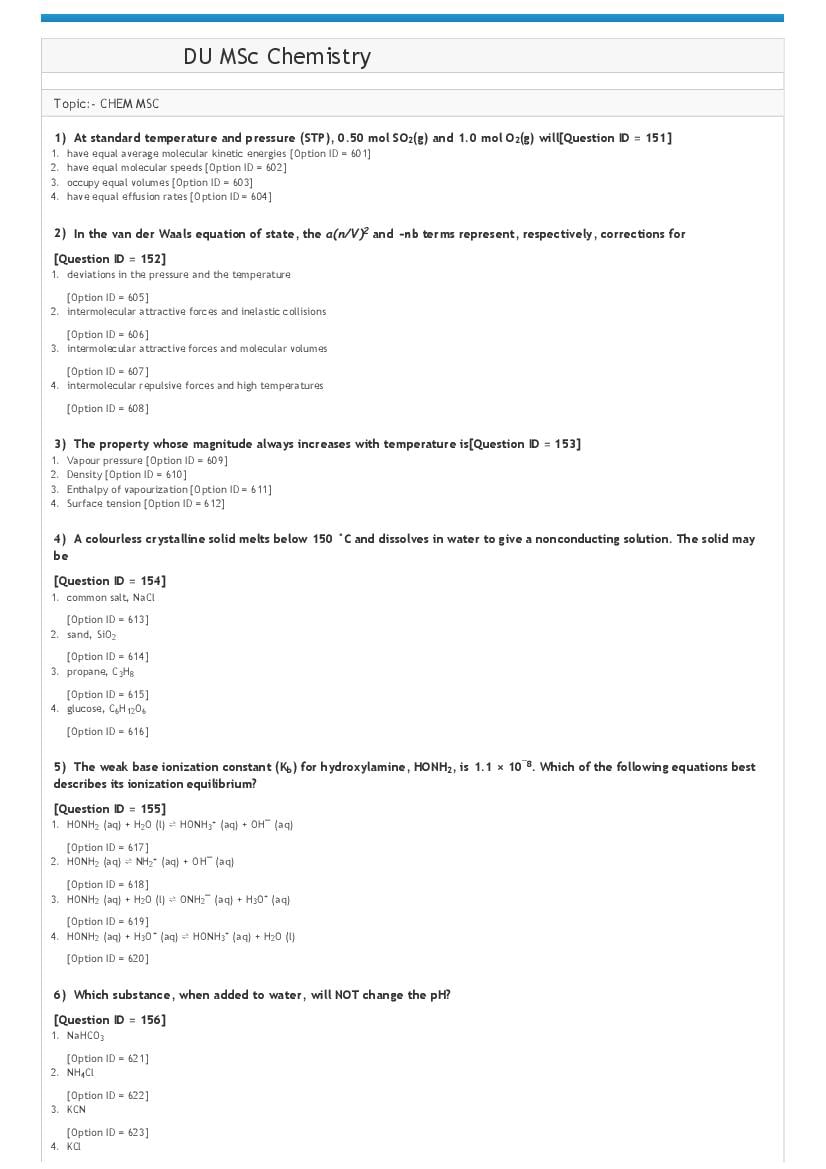
Topic:‐ CHEM MSC
1) At standard temperature and pressure (STP), 0.50 mol SO2(g) and 1.0 mol O2(g) will[Question ID = 151]
1. have equal average molecular kinetic energies [Option ID = 601]
2. have equal molecular speeds [Option ID = 602]
3. occupy equal volumes [Option ID = 603]
4. have equal effusion rates [Option ID = 604]
2) In the van der Waals equation of state, the a(n/V)2 and -nb terms represent, respectively, corrections for
[Question ID = 152]
1. deviations in the pressure and the temperature
[Option ID = 605]
2. intermolecular attractive forces and inelastic collisions
[Option ID = 606]
3. intermolecular attractive forces and molecular volumes
[Option ID = 607]
4. intermolecular repulsive forces and high temperatures
[Option ID = 608]
3) The property whose magnitude always increases with temperature is[Question ID = 153]
1. Vapour pressure [Option ID = 609]
2. Density [Option ID = 610]
3. Enthalpy of vapourization [Option ID = 611]
4. Surface tension [Option ID = 612]
4) A colourless crystalline solid melts below 150 °C and dissolves in water to give a nonconducting solution. The solid may
be
[Question ID = 154]
1. common salt, NaCl
[Option ID = 613]
2. sand, SiO2
[Option ID = 614]
3. propane, C3H 8
[Option ID = 615]
4. glucose, C6H 12O6
[Option ID = 616]
5) The weak base ionization constant (Kb ) for hydroxylamine, HONH2, is 1.1 × 10¯8. Which of the following equations best
describes its ionization equilibrium?
[Question ID = 155]
1. HONH2 (aq) + H2O (l) ⇌ HONH3+ (aq) + OH¯ (aq)
[Option ID = 617]
2. HONH2 (aq) ⇌ NH2+ (aq) + OH¯ (aq)
[Option ID = 618]
3. HONH2 (aq) + H2O (l) ⇌ ONH2¯ (aq) + H3O+ (aq)
[Option ID = 619]
4. HONH2 (aq) + H3O+ (aq) ⇌ HONH3+ (aq) + H2O (l)
[Option ID = 620]
6) Which substance, when added to water, will NOT change the pH?
[Question ID = 156]
1. NaHCO3
[Option ID = 621]
2. NH4Cl
[Option ID = 622]
3. KCN
[Option ID = 623]
4. KCl
Page 2
7) Important commercial extraction processes as well as analytical techniques utilize carbon dioxide above its critical
temperature (31.1 °C) and pressure (7.4 MPa). Under these conditions
[Question ID = 157]
1. carbon dioxide is no longer fluid.
[Option ID = 625]
2. one cannot condense the gas to a separate liquid state by applying pressure.
[Option ID = 626]
3. carbon dioxide is known commonly as dry ice.
[Option ID = 627]
4. carbon dioxide cannot dissolve materials like a liquid or effuse through solids like a gas.
[Option ID = 628]
8) In the equation (1/p) is known as the
[Question ID = 158]
1. volume factor
[Option ID = 629]
2. pressure factor
[Option ID = 630]
3. differential factor
[Option ID = 631]
4. integration factor
[Option ID = 632]
9) Use the following data to determine the molar enthalpy of combustion of propene, C3H6, for which the combustion
reaction is
2 C3H6(g) + 9 O2(g) → 6 CO2(g) + 6 H2O
(l) Given:
Enthalpy of hydrogenation of propene:
C3H6(g) + H2(g) → C3H8(g) ΔH° = ‐128 kJ/mol
Enthalpy of combustion of propane:
C3H8(g) + 5O2(g) → 3CO2(g) + 4H2O(l) ΔH° = ‐2220 kJ/mol
Enthalpy of formation of H2O(l) ΔHf° = ‐286 kJ/mol
[Question ID = 159]
1. ‐4124 kJ/mol
[Option ID = 633]
2. +4124 kJ/mol
[Option ID = 634]
3. ‐2062 kJ/mol
[Option ID = 635]
4. +2062 kJ/mol
[Option ID = 636]
10) Consider a pure, crystalline solid being heated from absolute zero to some very high temperature. Which one of the
following processes produces the greatest increase in the entropy of the substance?
[Question ID = 160]
1. melting the solid
[Option ID = 637]
2. heating the liquid
[Option ID = 638]
3. boiling the liquid
[Option ID = 639]
4. heating the gas
[Option ID = 640]
11) When crystalline solid hydrated barium hydroxide and crystalline solid ammonium chloride are mixed in a beaker at
room temperature, the temperature of the beaker contents rapidly falls to about ‐20 ºC. From these observations, decide
whether the reaction is endothermic or exothermic, and the signs of ΔH and ΔS for the reaction are.
Page 3
1. endothermic; ΔH > 0;Δ S > 0
[Option ID = 641]
2. exothermic; ΔH < 0;Δ S > 0
[Option ID = 642]
3. endothermic; ΔH < 0;Δ S < 0
[Option ID = 643]
4. exothermic; ΔH > 0;Δ S < 0
[Option ID = 644]
12) For the reaction A + B ⇌ C + D at a certain temperature, the equilibrium constant K = 0.50, and [A] = 0.10, [B] =
0.02, [C] = 0.01, [D] = 0.10 mol L‐1. The reaction is:
[Question ID = 162]
1. going from L → R
[Option ID = 645]
2. going from R→ L
[Option ID = 646]
3. at equilibrium
[Option ID = 647]
4. has gone to completion
[Option ID = 648]
13) The osmotic pressure of a 0.36 g dm‐3 glucose (C6H12O 6) solution at 27 °C is[Question ID = 163]
1. 4990 Pa [Option ID = 649]
2. 4.99 Pa [Option ID = 650]
3. 0.00499 Pa [Option ID = 651]
4. 0.33 Pa [Option ID = 652]
14) The triple point of CO2 is at 5.2 atm and –57 °C. Under normal atmospheric conditions, solid CO2 will[Question ID = 164]
1. remain solid [Option ID = 653]
2. boil [Option ID = 654]
3. melt [Option ID = 655]
4. sublime [Option ID = 656]
15) At equilibrium the total Gibbs free energy for all phases is[Question ID = 165]
1. a minimum [Option ID = 657]
2. a maximum [Option ID = 658]
3. infinity [Option ID = 659]
4. zero [Option ID = 660]
16) The Gibbs phase rule for a general system is[Question ID = 166]
1. P + F = C + 1 [Option ID = 661]
2. P + F = C ‐ 1 [Option ID = 662]
3. P + F = C ‐ 2 [Option ID = 663]
4. P + F = C + 2 [Option ID = 664]
17) The triple point is[Question ID = 167]
1. The point on the graph where solid and gas are in equilibrium [Option ID = 665]
2. The point where the temperature and pressure conditions are right for all three states ‐ solid, liquid, and gas ‐ to exist together at equilibrium
[Option ID = 666]
3. The point where the temperature and pressure conditions are right for two of the three states ‐ solid, liquid, and gas ‐ to exist together at
equilibrium [Option ID = 667]
4. The point on the graph where supercritical fluid is found [Option ID = 668]
18) A current of 20.0 amperes flows for 1.00 hour through an electrolytic cell containing a molten salt of metal X. This
results in the decomposition of 0.375 mole of metal X at the cathode. The oxidation state of X in the molten salt is[Question
ID = 168]
1. 1+ [Option ID = 669]
2. 2+ [Option ID = 670]
3. 3+ [Option ID = 671]
4. 4+ [Option ID = 672]
19) Given the standard electrode (reduction) potentials:
Fe2+(aq) + 2e¯ → Fe(s) E° = ‐ 0.44 V
Cr3+(aq) + 3e¯ → Cr(s) E° = ‐ 0.74 V
Which pair of substances will react spontaneously?
[Question ID = 169]
Page 4
[Option ID = 673]
2. Fe with Cr3+
[Option ID = 674]
3. Fe2+ with Cr
[Option ID = 675]
4. Fe with Cr
[Option ID = 676]
20) Which of the following statements is correct regarding Electrochemical cells?[Question ID = 170]
1. Cell potential is an extensive property [Option ID = 677]
2. Cell potential is an intensive property [Option ID = 678]
3. The Gibbs free energy of an electrochemical cell is an intensive property [Option ID = 679]
4. Gibbs free energy is undefined for an electrochemical cell [Option ID = 680]
21) Which of the following statements about physisorption is incorrect? It is characterised by[Question ID = 171]
1. attraction due to weak van der Waals forces [Option ID = 681]
2. irreversible nature of adsorption [Option ID = 682]
3. multimolecular adsorption layers [Option ID = 683]
4. decrease in adsorption with increase in temperature [Option ID = 684]
22) In an electrochemical cell, the electrode having a higher reduction potential will act as[Question ID = 172]
1. salt bridge [Option ID = 685]
2. electrolyte [Option ID = 686]
3. anode [Option ID = 687]
4. cathode [Option ID = 688]
23) During electrolysis, the reaction that takes place at the cathode is[Question ID = 173]
1. hydrolysis [Option ID = 689]
2. reduction [Option ID = 690]
3. oxidation [Option ID = 691]
4. neutralization [Option ID = 692]
24) The rate constant (k) for a first order reaction is 6.93 s‐1 at 25 °C. How long will it take for the reaction to be 75%
complete?
[Question ID = 174]
1. 0.1 s
[Option ID = 693]
2. 0.2 s
[Option ID = 694]
3. 1 s
[Option ID = 695]
4. 2 s
[Option ID = 696]
25) The reaction A → B +2C is second order. Which of the following statements is incorrect?[Question ID = 175]
1. ‐d [A] / dt = d [B] /dt [Option ID = 697]
2. Rate = k [A]2 [Option ID = 698]
3. d [A] /dt = ½ d [ C] /dt [Option ID = 699]
4. The reaction is unimolecular [Option ID = 700]
26) By what factor does the rate of the base catalyzed saponification of ethyl acetate change if the pOH is increased by 2
units, other conditions remaining the same?[Question ID = 176]
1. It increases 100 times [Option ID = 701]
2. It decreases 100 times [Option ID = 702]
3. It increases two times [Option ID = 703]
4. It decreases two times [Option ID = 704]
27) The quantum efficiency of a photochemical reaction is defined as[Question ID = 177]
1. the number of molecules decomposed in a given time [Option ID = 705]
2. the number of quanta absorbed per unit time [Option ID = 706]
3. the ratio of molecules decomposed in a given time to the number of quanta emitted in the same time [Option ID = 707]
4. the ratio of molecules decomposed in a given time to the number of quanta absorbed in the same time [Option ID = 708]
28) For the energy level 9h2/8mL2, the wavefunction for a particle of mass m in a one dimensional potential box of width L
is given by
[Question ID = 178]
Page 5
[Option ID = 709]
2.
[Option ID = 710]
3.
[Option ID = 711]
4.
[Option ID = 712]
29) Using the trial wavefunction ψ = N exp{‐Z’(r1 + r2)} for the helium atom, where N is the normalization constant and Z’
is the variational parameter, the expression for the energy is found to be
E = (Z’)2 – (27/8) Z’ (in a.u.)
Then the best value of Z’ for the helium atom should be
[Question ID = 179]
1. 1.00
[Option ID = 713]
2. 1.69
[Option ID = 714]
3. 2.00
[Option ID = 715]
4. 2.85
[Option ID = 716]
30) Which one of the following statements is true?
[Question ID = 180]
1. The product of wavelength and frequency of light is a constant
[Option ID = 717]
2. As energy increases, the frequency of radiation decreases
[Option ID = 718]
3. As the wavelength of light increases, the frequency increases
[Option ID = 719]
4. The energy of visible light is higher than that of ultraviolet radiation
[Option ID = 720]
31) Which of these statements is false?
[Question ID = 181]
1. The spacings between adjacent molecular translational, rotational and vibrational levels satisfy Δεt r <Δεrot <Δεvib.
[Option ID = 721]
2. At room temperature, many rotational levels of gas‐phase molecules are substantially populated.
[Option ID = 722]
3. At room temperature, many vibrational levels of O2(g) are substantially populated
[Option ID = 723]
4. As the vibrational quantum number increases, the spacing between adjacent vibrational levels of a diatomic molecule decreases.
[Option ID = 724]
32) The average distance of an electron from the nucleus in a hydrogen atom is indicated by the quantum number
[Question ID = 182]
1. n
[Option ID = 725]
Page 6
[Option ID = 726]
3. ml
[Option ID = 727]
4. ms
[Option ID = 728]
33) The number of vibrational modes of C2H2 is[Question ID = 183]
1. 4 [Option ID = 729]
2. 5 [Option ID = 730]
3. 6 [Option ID = 731]
4. 7 [Option ID = 732]
34) Which of the following is NOT a solution of the differential equation
y" (x) + k2y(x) = 0?
[Question ID = 184]
1. exp(-ikx)
[Option ID = 733]
2. exp(-kx)
[Option ID = 734]
3. coskx
[Option ID = 735]
4. sinkx
[Option ID = 736]
35) Identify A and B in the given reaction sequence:
[Question ID = 185]
1. A = 3‐Phenylpropene; B = 1‐Phenyl‐2‐propanol
[Option ID = 737]
2. A = 1‐Phenylpropene; B = 1‐Phenyl‐2‐propanol
[Option ID = 738]
3. A = 3‐Phenylpropene; B = 3‐Phenylpropanol
[Option ID = 739]
4. A = 1‐Phenylpropene; B = 3‐Phenylpropanol
[Option ID = 740]
36) Which of the following compound(s) are not aromatic according to Huckel’s rule:
[Question ID = 186]
1. I
[Option ID = 741]
2. IV
[Option ID = 742]
3. I and II
[Option ID = 743]
4. III and IV
[Option ID = 744]
37) Identify A and B in the given reaction sequence:
[Question ID = 187]
1.
Page 7
2.
[Option ID = 746]
3.
[Option ID = 747]
4.
[Option ID = 748]
38) Which one of the following statements concerning the elements in the periodic table is correct?[Question ID = 188]
1. Elements of the same group all have the same number of electrons in the outermost occupied electron shell. [Option ID = 749]
2. Elements of Group 16 occur as cations in cation compounds [Option ID = 750]
3. Oxides of Groups 16 and 17 are basic [Option ID = 751]
4. The halogens (Group 17) are all gases at room temperature. [Option ID = 752]
39) Which of the following describes the intermolecular forces in I2 solid?[Question ID = 189]
1. Covalent bonds [Option ID = 753]
2. Dipole‐dipole forces [Option ID = 754]
3. Dispersion forces [Option ID = 755]
4. Ionic bonds [Option ID = 756]
40) How many bonding and non‐bonding electron pairs are found in the BF3 molecule?
[Question ID = 190]
1. 1 bonding and 3 non‐bonding
[Option ID = 757]
2. 2 bonding and 2 non‐bonding
[Option ID = 758]
3. 3 bonding and 1 non‐bonding
[Option ID = 759]
4. 3 bonding and 0 non‐bonding
[Option ID = 760]
41) What is the oxidation number of phosphorus in KH2PO4?[Question ID = 191]
1. ‐VI [Option ID = 761]
2. ‐II [Option ID = 762]
3. 0 [Option ID = 763]
4. +V [Option ID = 764]
42) Which one of the following statements regarding a catalyst is not correct?[Question ID = 192]
1. An enzyme is a catalyst that only binds certain substrates [Option ID = 765]
2. An enzyme is a protein that is a highly efficient catalyst for one or more chemical reactions in a living system. [Option ID = 766]
3. Catalysts increase the reaction rate by altering the mechanism, thereby increasing the activation energy. [Option ID = 767]
4. Catalysts do not alter the equilibrium constant of a chemical reaction. [Option ID = 768]
43) The most stable +2 oxidation state is exhibited by[Question ID = 193]
1. Pb [Option ID = 769]
2. Fe [Option ID = 770]
3. Sn [Option ID = 771]
4. Si [Option ID = 772]
44) Which of the following is/are not correctly matched?
A. GeO2‐acidic
B. PbO2‐amphoteric
C. CO‐neutral
D. SiO2‐amphoteric
Choose the correct answer from the options given below
Page 8
1. D only
[Option ID = 773]
2. C only
[Option ID = 774]
3. A and D
[Option ID = 775]
4. B only
[Option ID = 776]
45) The bonds present in N2O 5 are[Question ID = 195]
1. covalent and coordinate [Option ID = 777]
2. covalent and ionic [Option ID = 778]
3. only ionic [Option ID = 779]
4. only covalent [Option ID = 780]
46) Which of the following is correct?[Question ID = 196]
1. Monoclinic sulfur is stable below 369 K [Option ID = 781]
2. Specific gravity of rhombic sulfur > specific gravity of monoclinic sulfur [Option ID = 782]
3. Melting point of monoclinic sulfur > melting point of rhombic sulfur [Option ID = 783]
4. Both rhombic and monoclinic sulfur have S8 molecules [Option ID = 784]
47) Read the following statements regarding the chemical reactivity of Group 15 elements
(i) The only compound of Bi with a +5‐oxidation state is BiF5.
(ii) Intermediate oxidation states for both nitrogen and phosphorus disproportionate in both acid and alkali.
(iii) Nitrogen, due to the absence of d‐orbitals in its valence shell, cannot form a dπ‐pπ bond as the heavier elements. Thus
R3P=O exists, but R3N=O does not exist.
(iv) BiH3 is the strongest reducing agent amongst the hydrides of the nitrogen family.
(v) P2O 3 is more acidic than P2O 5.
Which of the following is the correct code for the statements above?
[Question ID = 197]
1. TFTTF
[Option ID = 785]
2. FTFFT
[Option ID = 786]
3. FFTTF
[Option ID = 787]
4. TFTFT
[Option ID = 788]
48) Match List I with List II
Choose the correct answer from the options given below:
[Question ID = 198]
1. A ‐ IV, B ‐III , C ‐II , D ‐I
[Option ID = 789]
2. A ‐I , B ‐III , C ‐II , D ‐ IV
[Option ID = 790]
3. A ‐IV , B ‐III , C ‐I , D ‐ II
[Option ID = 791]
4. A ‐II , B ‐III , C ‐I , D ‐IV
[Option ID = 792]
49) Match List I with List II
Page 9
[Question ID = 199]
1. A ‐ I, IV , B ‐ IV , C ‐ I, III , D ‐ II, IV
[Option ID = 793]
2. A ‐ IV , B ‐ I, IV , C ‐ I, III , D ‐ II, IV
[Option ID = 794]
3. A ‐ IV , B ‐ I, III , C ‐ I, IV , D ‐ II, IV
[Option ID = 795]
4. A ‐ I, IV , B ‐ IV , C ‐ II, IV , D ‐ I, III
[Option ID = 796]
50) Which of the following statements are correct?
(i) As a result of lanthanoid contraction, members of the 4d and 5d series exhibit similar radii.
(ii) IE2 is high for Cr and Cu, whereas IE3 is very high for Zn
(iii) Heavier members of d‐block elements like p‐block favor lower oxidation states.
(iv) In any transition metal series, the maximum number of oxidation states is shown by middle elements or elements under
middle elements[Question ID = 200]
1. (i), (ii), (iv) [Option ID = 797]
2. (ii) and (iv) [Option ID = 798]
3. (i) and (ii) [Option ID = 799]
4. (i), (ii) and (iii) [Option ID = 800]
51) Match List I with List II
Choose the correct answer from the options given below:
[Question ID = 201]
1. A ‐ III, B ‐ I, C ‐ II
[Option ID = 801]
2. A ‐ III, B ‐ II, C ‐ I
[Option ID = 802]
3. A ‐ II, B ‐ I, C ‐ II
[Option ID = 803]
4. A ‐ I, B ‐ III, C ‐ II
[Option ID = 804]
52) The standard redox potentials for the reactions Mn2++ 2e = Mn and Mn3++ e = Mn2+ are ‐1.18 and 1.51 V, respectively.
What will be the redox potential for the reaction Mn3++ 3e = Mn
[Question ID = 202]
1. ‐0.28 V
[Option ID = 805]
2. 0.33 V
[Option ID = 806]
3. 1.69 V
[Option ID = 807]
4. ‐0.85 V
[Option ID = 808]
53) Among the following sulfosalts, which one shows a magnetic moment of 5.92 BM?[Question ID = 203]
Page 10
2. CoSO4.9H2O [Option ID = 810]
3. MnSO4.4H2O [Option ID = 811]
4. ZnSO4.7H2O [Option ID = 812]
54) In the form of dichromate, Cr(VI) is a strong oxidizing agent in an acidic medium. But Mo(VI) in MoO3 and W(VI) in WO3
are not because
(i) Cr(VI) is more stable than Mo(VI) and W(VI)
(ii) Mo(VI) and W(VI) are more stable than Cr(VI)
(iii) Higher oxidation state of heavier series are more stable
(iv) Lower oxidation states of heavier members of Group 6 of transition metal series are more stable.
[Question ID = 204]
1. (ii) and (iv)
[Option ID = 813]
2. (ii) and (iii)
[Option ID = 814]
3. (i) and (ii)
[Option ID = 815]
4. (i) and (iv)
[Option ID = 816]
55) An explosion takes place when conc. H2SO4 is added to KMnO4. Which of the following is formed from this reaction?
[Question ID = 205]
1. MnSO4 [Option ID = 817]
2. Mn2O7 [Option ID = 818]
3. MnO2 [Option ID = 819]
4. Mn2O3 [Option ID = 820]
56) Which of the following structure represents ferrimagnetism?[Question ID = 206]
1. ↑↑↓↑↓↓ [Option ID = 821]
2. ↑↑↑↑↑↑ [Option ID = 822]
3. ↑↓↓↑↑↓ [Option ID = 823]
4. ↓↓↓↓↓↓ [Option ID = 824]
57) On heating, a white crystal of ZnO
(i) Metal excess defect is created
(ii) Crystal becomes p‐type semiconductor
(iii) Crystal becomes yellow in color
(iv) Free electron is created
[Question ID = 207]
1. (i), (ii), (iv)
[Option ID = 825]
2. (ii) and (iv)
[Option ID = 826]
3. (i), (iii), (iv)
[Option ID = 827]
4. (i), (ii), (iii)
[Option ID = 828]
58) Match List I with List II
Choose the correct answer from the options given below:
[Question ID = 208]
1. A ‐ III, B ‐ IV, C ‐ I, D ‐ II
Page 11
2. A ‐ III, B ‐ II, C ‐ I, D ‐ IV
[Option ID = 830]
3. A ‐ II, B ‐ IV, C ‐ I, D ‐ III
[Option ID = 831]
4. A ‐ IV, B ‐ III, C ‐ I, D ‐ II
[Option ID = 832]
59) Given below are two statements, one is labelled as Assertion A and the other is labelled as Reason R
Assertion A :In crystal lattice, the size of a tetrahedral hole is larger than an octahedral hole
Reason R : The cations occupy less space than anions in crystal packing
In light of the above statements, choose the correct answer from the options given below
[Question ID = 209]
1. Both assertion and reason are CORRECT, and the reason is not the CORRECT explanation of the assertion.
[Option ID = 833]
2. Assertion is CORRECT, but the reason is INCORRECT
[Option ID = 834]
3. Assertion is INCORRECT, but the reason is CORRECT
[Option ID = 835]
4. Both assertion and reason are CORRECT, and the reason is the CORRECT explanation of the assertion.
[Option ID = 836]
60) In a compound, atoms of element Y forms CCP lattice, and those of element X occupy 2/3 rd of tetrahedral voids. The
formula of the compound will be[Question ID = 210]
1. X2Y3 [Option ID = 837]
2. X3Y3 [Option ID = 838]
3. X4Y3 [Option ID = 839]
4. X2Y [Option ID = 840]
61) When molten zinc is converted into the solid state, it acquires an hcp structure. The number of nearest neighbors of Zn
will be[Question ID = 211]
1. 4 [Option ID = 841]
2. 6 [Option ID = 842]
3. 8 [Option ID = 843]
4. 12 [Option ID = 844]
62) In the disproportionation reaction 3HClO3 → HClO4 + Cl2 + 2O2 + H2O, the equivalent mass of the oxidizing agent is,
given the molar mass of HClO3 to be 84.45[Question ID = 212]
1. 32.22 [Option ID = 845]
2. 28.15 [Option ID = 846]
3. 16.89 [Option ID = 847]
4. 84.45 [Option ID = 848]
63) In the balanced chemical reaction, IO3‐ +a I‐ + b H+ → c H2O + d I2, a, b, c, and d, respectively, correspond to[Question
ID = 213]
1. 3, 5, 3, 6 [Option ID = 849]
2. 5, 6, 3, 3 [Option ID = 850]
3. 5, 3, 6, 3 [Option ID = 851]
4. 5, 6, 5, 5 [Option ID = 852]
64) Which of the following does not show disproportionation reaction?
ClO4‐, F2, Cl2, ClO2‐, P4, S8, and ClO‐
[Question ID = 214]
1. ClO4‐ only
[Option ID = 853]
2. F2 and ClO4‐
[Option ID = 854]
3. ClO2‐, ClO4‐ and ClO‐
[Option ID = 855]
4. F2 only
[Option ID = 856]
65) Given, x Na2HAsO3 + y NaBrO3 + z HCl → NaBr + H3AsO4 +NaCl, the values of x, y and z are
[Question ID = 215]
Page 12
[Option ID = 857]
2. 2, 1, 3
[Option ID = 858]
3. 3, 1, 6
[Option ID = 859]
4. 3, 1, 4
[Option ID = 860]
66) Beryllium shows a diagonal relationship with aluminium. Which of the following similarity is incorrect?[Question ID =
216]
1. Beryllium forms beryllates, and aluminium forms aluminates [Option ID = 861]
2. Be like Al is rendered passive by HNO3 [Option ID = 862]
3. Be(OH)2 like Al(OH)3 is basic [Option ID = 863]
4. Be is a metal, Al is a metalloid [Option ID = 864]
67) Match List I with List II
Choose the correct answer from the options given below:
[Question ID = 217]
1. A ‐ I, B ‐ III, C ‐ II
[Option ID = 865]
2. A ‐ II, B ‐ III, C ‐ I
[Option ID = 866]
3. A ‐ III, B ‐ II, C ‐ I
[Option ID = 867]
4. A ‐ II, B ‐ I, C ‐ III
[Option ID = 868]
68) Which of the following oxides of potassium is not known?[Question ID = 218]
1. K2O3 [Option ID = 869]
2. K2O4 [Option ID = 870]
3. K2O [Option ID = 871]
4. KO3 [Option ID = 872]
69) Which of the following is incorrect regarding spectrochemical series?
[Question ID = 219]
1. F‐ > C2O42‐
[Option ID = 873]
2. en > edta4‐
[Option ID = 874]
3. NH3 > H2O
[Option ID = 875]
4. NCS‐ > SCN‐
[Option ID = 876]
70) Read the following statements
(i) Macromolecules cannot behave as a ligand.
(ii) (EDTA)4‐ can bind through two oxygen and four nitrogen atoms
(iii) Chelate complexes are more stable than similar complexes containing unidentate ligands
(iv) Coordination number of the central atom/ion is determined only by the number of sigma bonds formed by the ligand
with the central atom/ion
Which of the following is the correct code for the statements above?
[Question ID = 220]
1. TFTF
[Option ID = 877]
2. FTFT
Page 13
3. FFTT
[Option ID = 879]
4. FFFT
[Option ID = 880]
71) Which of the following statements are correct?
(i) Square planar complexes of the type MABXLtype shows 3‐isomers‐ two cis and one trans
(ii) Complexes of MA3B3 type show 3 isomers‐two cis and one trans
(iii) Optical isomerism is common in octahedral complexes involving bidentate ligands
(iv) [Co(NH3) 4Cl(NO2)] shows linkage isomerism
(v) Hydrate isomerism is another name for solvate isomerism
[Question ID = 221]
1. (iii), (iv), (v)
[Option ID = 881]
2. (i), (iii), (iv)
[Option ID = 882]
3. (i), (ii), (iii)
[Option ID = 883]
4. (ii), (iii), (v)
[Option ID = 884]
72) The product formed in the given reaction is:
[Question ID = 222]
1.
[Option ID = 885]
2.
[Option ID = 886]
3.
[Option ID = 887]
4.
[Option ID = 888]
73) Identify the major product formed in the given reaction:
[Question ID = 223]
1.
[Option ID = 889]
Page 14
[Option ID = 890]
3.
[Option ID = 891]
4.
[Option ID = 892]
74) Which of the following compounds will give a positive test for both nitrogen and halogen with sodium fusion extract:
[Question ID = 224]
1. NH4Br
[Option ID = 893]
2. NH2OH.HCl
[Option ID = 894]
3. Ni(NH3)6Br2
[Option ID = 895]
4. (CH3)2NH.HCl
[Option ID = 896]
75) Given below are two statements, one is labelled as Assertion A and the other is labelled as Reason R
Assertion A: Tetramethylsilane (TMS) is used as a reference sample in NMR spectroscopy.
Reason R: The methyl groups of TMS resonate at a frequency a little less than that of most organic compounds.
In light of the above statements, choose the most appropriate answer from the options given below
[Question ID = 225]
1. Both A and R are correct and R is the correct explanation of A
[Option ID = 897]
2. Both A and R are correct but R is NOT the correct explanation of A
[Option ID = 898]
3. A is correct but R is not correct
[Option ID = 899]
4. A is not correct but R is correct
[Option ID = 900]
76) How many peaks are expected in the 1H NMR of the compound given below:
[Question ID = 226]
1. 4
[Option ID = 901]
2. 5
[Option ID = 902]
3. 6
[Option ID = 903]
4. 7
[Option ID = 904]
77) The IR spectrum of paracetamol shows a peak at 1667 cm‐1 for:
Page 15
1. N‐H stretching
[Option ID = 905]
2. O‐H stretching
[Option ID = 906]
3. C=O stretching
[Option ID = 907]
4. C‐H stretching
[Option ID = 908]
78) Which of the following statements is incorrect:
[Question ID = 228]
1. I and III are diastereomers
[Option ID = 909]
2. II and IV are enantiomers
[Option ID = 910]
3. I and II are diastereomers
[Option ID = 911]
4. I and IV are diastereomers
[Option ID = 912]
79) Which of the following will not have zero dipole moment:
[Question ID = 229]
1. CCl4
[Option ID = 913]
2. 1,4‐dichlorobenzene
[Option ID = 914]
3. BF3
[Option ID = 915]
4. NH3
[Option ID = 916]
80) Among the following compounds the most acidic is: ICH2COOH, BrCH2COOH, FCH2COOH, C6H5CH2COOH[Question ID =
230]
1. ICH2COOH [Option ID = 917]
2. BrCH2COOH [Option ID = 918]
3. FCH2COOH [Option ID = 919]
4. C6H 5CH2COOH [Option ID = 920]
81) The product formed in the following transformation is:
[Question ID = 231]
1.
[Option ID = 921]
2.
[Option ID = 922]
Page 16
[Option ID = 923]
4.
[Option ID = 924]
82) In which of the following compounds will bromination occur faster than benzene?[Question ID = 232]
1. Nitrobenzene [Option ID = 925]
2. Benzoic acid [Option ID = 926]
3. Aniline [Option ID = 927]
4. Chlorobenzene [Option ID = 928]
83) The major product obtained in the following transformation is:
[Question ID = 233]
1.
[Option ID = 929]
2.
[Option ID = 930]
3.
[Option ID = 931]
4.
[Option ID = 932]
84) Which of the following compounds does not have a sp2 hybridized carbon? [Question ID = 234]
1. Acetone [Option ID = 933]
2. Formic acid [Option ID = 934]
3. Acetonitrile [Option ID = 935]
4. Acetamide [Option ID = 936]
85) Treatment of propanoic acid with aqueous sodium bicarbonate solution liberates carbon dioxide gas. The source of
carbon dioxide gas is:[Question ID = 235]
1. Methyl group [Option ID = 937]
2. Methylene group [Option ID = 938]
3. Carboxylic acid group [Option ID = 939]
4. Sodium bicarbonate [Option ID = 940]
86) Which of the following is an achiral molecule?
[Question ID = 236]
1. IV
[Option ID = 941]
2. III
[Option ID = 942]
3. II
[Option ID = 943]
4. I
Page 17
87) In the reactions given below, identify products A and B.
[Question ID = 237]
1. A= No reaction; B = Pentanal
[Option ID = 945]
2. A = No reaction; B = Pentanoic acid
[Option ID = 946]
3. A= Pentan‐3‐one; B = Pentanal
[Option ID = 947]
4. A= Pentan‐3‐one; B = Pentanoic acid
[Option ID = 948]
88) The major product of the given reaction is:
[Question ID = 238]
1.
[Option ID = 949]
2.
[Option ID = 950]
3.
[Option ID = 951]
4.
[Option ID = 952]
89) The partial hydrolysis of a pentapeptide gives the following fragments:
Val‐Asp + Glu‐His + Phe‐Val + Asp‐Glu
The correct sequence of the amino acid residues in the pentapeptide is:
[Question ID = 239]
1. Val‐Asp‐Glu‐His‐Phe
[Option ID = 953]
2. Phe‐Val‐Asp‐Glu‐His
[Option ID = 954]
3. His‐Glu‐Asp‐Val‐Phe
[Option ID = 955]
4. Asp‐Glu‐Val‐Phe‐His
[Option ID = 956]
90) Identify the compound with lowest heterolytic bond dissociation energy:
CH2=CH‐Cl, C6H5CH2Cl, CH2=CH‐CH2‐Cl, C6H5Cl
[Question ID = 240]
Page 18
[Option ID = 957]
2. C6H 5CH2Cl
[Option ID = 958]
3. CH2=CH‐CH2‐Cl
[Option ID = 959]
4. C6H 5Cl
[Option ID = 960]
91) Which reagent is used in Sanger’s method to identify the N‐terminal residue of a polypeptide sequence:
[Question ID = 241]
1. 2,4‐Dinitrofluorobenzene
[Option ID = 961]
2. 2,4‐Dinitrophenylhydrazone
[Option ID = 962]
3. 2,4‐Dinitro‐3‐fluorobenzoic acid
[Option ID = 963]
4. 2,4‐Dinitrobenzoic acid
[Option ID = 964]
92) Fill in the blank with the correct option: Heme is a _______________ of hemoglobin:[Question ID = 242]
1. Prosthetic group [Option ID = 965]
2. Apoenzyme [Option ID = 966]
3. Inhibitor [Option ID = 967]
4. Functional group [Option ID = 968]
93)
The product formed in the given reaction is:
[Question ID = 243]
1.
[Option ID = 969]
2.
[Option ID = 970]
3.
[Option ID = 971]
4.
[Option ID = 972]
94) An organic compound (C4H9Br) gave the following set of NMR data: δ 1.04 (6H, doublet), 1.95 (1H, multiplet), 3.33
(2H, doublet) The structure consistent with the given data is:
[Question ID = 244]
1.
[Option ID = 973]
2.
[Option ID = 974]
3.
[Option ID = 975]
Page 19
[Option ID = 976]
95) Identify the products formed in this reaction:
[Question ID = 245]
1.
[Option ID = 977]
2.
[Option ID = 978]
3.
[Option ID = 979]
4.
[Option ID = 980]
96) Which of the following compounds will show the highest wavelength of absorption (λmax):
[Question ID = 246]
1.
[Option ID = 981]
2.
[Option ID = 982]
3.
[Option ID = 983]
4.
[Option ID = 984]
97) The products formed on the hydrolysis of diastereomer (X) are:
[Question ID = 247]
1. A + B = (R)‐alcohol + (R)‐acid
[Option ID = 985]
2. A + B = (S)‐alcohol + (S)‐acid
[Option ID = 986]
3. A + B = (R)‐alcohol + (S)‐acid
[Option ID = 987]
4. A + B = (S)‐alcohol + (R)‐acid
[Option ID = 988]
98) Choose the incorrect statement:[Question ID = 248]
1. All monosaccharides are reducing sugars. [Option ID = 989]
2. Most disaccharides are reducing sugars. [Option ID = 990]
3. Kiliani‐Fischer synthesis can lengthen the carbon chain of ketoses. [Option ID = 991]
Page 20
99) Match List I with List II
Choose the correct answer from the options given below:
[Question ID = 249]
1. A ‐III , B ‐IV , C ‐I , D ‐II
[Option ID = 993]
2. A ‐II , B ‐I , C ‐ I, D ‐III
[Option ID = 994]
3. A ‐V , B ‐IV , C ‐I , D ‐ III
[Option ID = 995]
4. A ‐II , B ‐ I, C ‐ IV, D ‐V
[Option ID = 996]
100) Identify the incorrect statement:[Question ID = 250]
1. Fatty acids have straight chains with no branching. [Option ID = 997]
2. Fatty acids have odd number of carbon atoms. [Option ID = 998]
3. Some fatty acids do not have double bonds. [Option ID = 999]
4. Fats are carboxylic esters derived from glycerol. [Option ID = 1000]
Document Details
| Board / Org | NTA |
| Exam | DUET |
| Type | Question Paper |
| Pages | 20 |
| Language | english |
| Updated | 30 Apr 2026 |