UPSC IFS 2018 Question Paper for Botany Paper - I
Finished viewing? Save it for later —
Download UPSC IFS 2018 Question Paper for Botany Paper - I (PDF · 4 pages)About UPSC IFS 2018 Question Paper for Botany Paper - I
UPSC IFS 2018 Question Paper for Botany Paper - I is available here for free download. Published by UPSC for Indian Forest Service Examination, this question paper can be viewed online or downloaded as a PDF (4 pages). Candidates preparing for Indian Forest Service Examination can use UPSC IFS 2018 Question Paper for Botany Paper - I to understand the exam pattern, the type of questions asked, and the overall difficulty level.
Frequently Asked Questions
How can I download UPSC IFS 2018 Question Paper for Botany Paper - I?
Open this page and click the Download button to save UPSC IFS 2018 Question Paper for Botany Paper - I as a PDF. It is completely free on AglaSem Docs.
Is UPSC IFS 2018 Question Paper for Botany Paper - I free to download?
Yes. UPSC IFS 2018 Question Paper for Botany Paper - I can be viewed online and downloaded as a PDF free of cost on AglaSem Docs.
How many pages does UPSC IFS 2018 Question Paper for Botany Paper - I have?
UPSC IFS 2018 Question Paper for Botany Paper - I contains 4 pages, which you can read online or download together as a single PDF.
Where can I find more Indian Forest Service Examination study material?
You can find more Indian Forest Service Examination question papers, sample papers, syllabus, and answer keys on AglaSem Docs.
UPSC IFS 2018 Question Paper for Botany Paper - I – Text
Read the full text of this question paper below — useful to quickly search, copy and reference the content online without downloading the PDF.
📄 View text version (4 pages)
Page 1
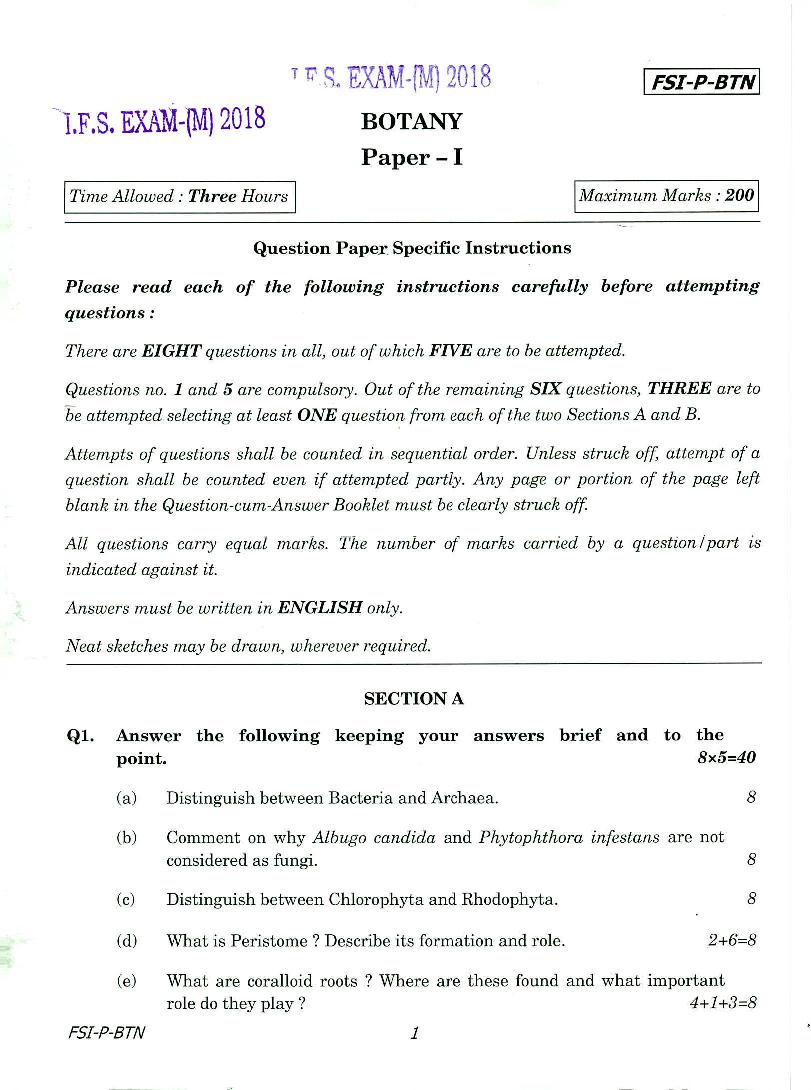
EXAM-p) 2018 BOTANY
Paper - I
Time Allowed: Three Hours Maximum Marks : 200
Question Paper Specific Instructions
Please read each of the following instructions carefully before attempting
questions:
There are EIGHT questions in all, out of which FIVE are to be attempted.
Questions no. 1 and 5 are compulsory. Out of the remaining SIX questions, THREE are to
Se attempted selecting at least ONE question from each of the two Sections A and B.
Attempts of questions shall be counted in sequential order. Unless struck off attempt of a
question shall be counted even if attempted partly. Any page or portion of the page left
blank in the Question-cum-Answer Booklet must be clearly struck off
All questions carry equal marks. The number of marks carried by a question/part is
indicated against it.
Answers must be written in ENGLISH only.
Neat sketches may be drawn, wherever required.
SECTION A
Ql. Answer the following keeping your answers brief and to the
point. 8x5=40
Distinguish between Bacteria and Archaea. 8
Comment on why Albugo candida and Phytophthora infestans are not
considered as fungi. 8
Distinguish between Chlorophyta and Rhodophyta. 8
What is Peristome ? Describe its formation and role. 2+6=8
What are coralloid roots ? Where are these found and what important
role do they play? 4+1+3=8
PSI-P-8 TN 1
Page 2
symptoms, casual organism, disease cycle and disease management.
5+5+5=15
Describe the evolutionary significance of various stellar structures found
in Pteridophytes. Give one suitable example in each case. 10+5=15
Describe the diversity of photosynthetic pigments found in the major
classes of Algae. 10
Q3. (a) What are the recent developments in the use of microbes in industrial
products ? Why do microbes serve as most ideal organisms in industrial
applications? 8+7=15
Explain the progressive sterilization of potentially sporogenous tissue
found in Bryophyta. Add a note on the role of elaters. 5+5=10
Describe the structure and chemical composition of TMV. How does it
infect the host? 10+5=15
Q4. (a) Describe the organization of female cone in Pinus. Discuss on the
morphological nature of ovuliferous scale. 10+5=15
Comment on how far Selaginella advances towards seed habit. 10
What is Systemic Acquired Resistance (SAR) ? Discuss the role of
salicylic acid in SAR. 7+8=15
FSI-P-BTN 2
Page 3
Q5. Answer the following keeping your answers brief and to the
point. 8x5=40
How do you justify Asteraceae as a phylogenetically advanced family in
dicotyledons? 8
Explain 'Nemec phenomenon' and its significance. 8
What are cortical vascular bundles ? How are they formed? 3+5=8
Discuss the role of Botanical Gardens in conservation of plants. 8
What is haploid cell culture ? How is this technique useful in
agriculture? 8
Q6. (a) Give an account of Cronquist's classification of flowering plants. Add a
note on merits and demerits of this system of classification. 10+5=15
What is totipotency ? Give an experimental evidence to demonstrate
it. 5+10=15
What is Helobial type of endosperm ? Describe the process of its
development. 4+6=10
Q7. (a) What is polyembryony ? How is it induced ? Discuss its
applications. 5+5+5=15
(b) Write the botanical name of the plants, their family, economically
important plant parts and uses for the following:
Cinnamon
Clove
Saffron
Nutmeg
Lesser Cardamom 15
(c) Compare the floral characters of Malvaceae and Solanaceae. Give the
floral diagrams of the two families. 5+5=10
F5I-P-8TN 3
Page 4
properties and methods of processing? 2+6+7=15
Describe the organization of essential organs of Asclepiadaceae family.
Discuss the pollination mechanism in it 6+9=15
Give an account on hydrocarbon plants and their potential as a source of
sustainable energy. 10
FSI-P-STN 4
Document Details
| Board / Org | UPSC |
| Exam | Indian Forest Service Examination |
| Type | Question Paper |
| Pages | 4 |
| Updated | 30 Apr 2026 |