UPSC IFS 2018 Question Paper for Botany Paper - II
Finished viewing? Save it for later —
Download UPSC IFS 2018 Question Paper for Botany Paper - II (PDF · 4 pages)About UPSC IFS 2018 Question Paper for Botany Paper - II
UPSC IFS 2018 Question Paper for Botany Paper - II is available here for free download. Published by UPSC for Indian Forest Service Examination, this question paper can be viewed online or downloaded as a PDF (4 pages). Candidates preparing for Indian Forest Service Examination can use UPSC IFS 2018 Question Paper for Botany Paper - II to understand the exam pattern, the type of questions asked, and the overall difficulty level.
Frequently Asked Questions
How can I download UPSC IFS 2018 Question Paper for Botany Paper - II?
Open this page and click the Download button to save UPSC IFS 2018 Question Paper for Botany Paper - II as a PDF. It is completely free on AglaSem Docs.
Is UPSC IFS 2018 Question Paper for Botany Paper - II free to download?
Yes. UPSC IFS 2018 Question Paper for Botany Paper - II can be viewed online and downloaded as a PDF free of cost on AglaSem Docs.
How many pages does UPSC IFS 2018 Question Paper for Botany Paper - II have?
UPSC IFS 2018 Question Paper for Botany Paper - II contains 4 pages, which you can read online or download together as a single PDF.
Where can I find more Indian Forest Service Examination study material?
You can find more Indian Forest Service Examination question papers, sample papers, syllabus, and answer keys on AglaSem Docs.
UPSC IFS 2018 Question Paper for Botany Paper - II – Text
Read the full text of this question paper below — useful to quickly search, copy and reference the content online without downloading the PDF.
📄 View text version (4 pages)
Page 1
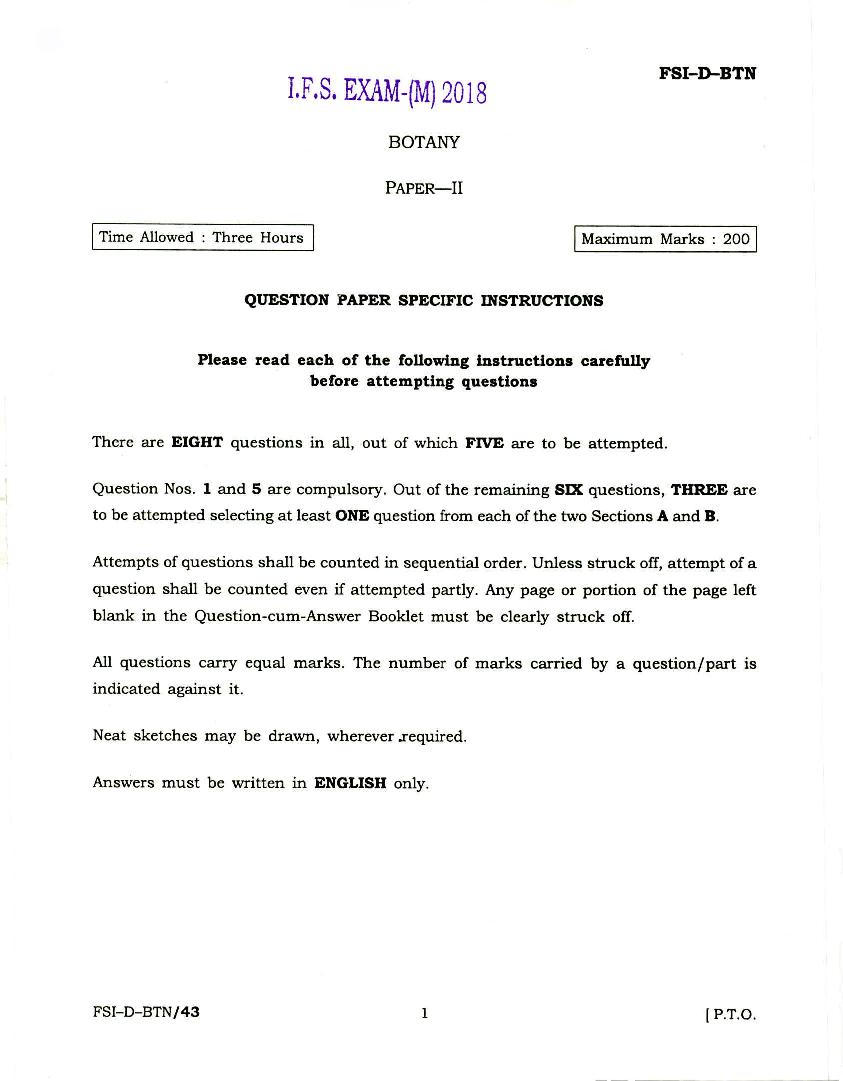
I.F.S. EXAM-(M) 2018
BOTANY
PAPER—II
Time Allowed : Three Hours Maximum Marks: 200
QUESTION PAPER SPECIFIC INSTRUCTIONS
Please read each of the following instructions carefully
before attempting questions
There are EIGHT questions in all, out of which FIVE are to be attempted.
Question Nos. I and 5 are compulsory. Out of the remaining SIX questions, THREE are
to be attempted selecting at least ONE question from each of the two Sections A and B.
Attempts of questions shall be counted in sequential order. Unless struck off, attempt of a
question shall be counted even if attempted partly. Any page or portion of the page left
blank in the Question-cum-Answer Booklet must be clearly struck off.
All questions carry equal marks. The number of marks carried by a question/part is
indicated against it.
Neat sketches may be drawn, wherever .required.
Answers must be written in ENGLISH only.
FSI-D-BTN/43 1 P.T.O.
Page 2
•
1. Write a short note on each of the following : 8x5=40
Packaging of DNA in chromatin
Chloroplast dimorphism
Post-transcriptional modifications of mRNA
Role of endoplasmic reticulum in protein sorting and targeting
Objectives and properties of probability
2. (a) Describe the molecular basis of cell cycle transitions with suitable illustrations.
Explain the role of CDKs in controlling transitions between cell cycle stages.
10+10=20
(b) Discuss the mechanism of transport of molecules across the cell membrane by
uniport, symport and antiport. Add a note on co-transport by symporter and
uniporter. 15+5=20
3. (a) Describe the molecular mechanism of gene linkage and crossing-over. Explain
how gene mapping is constructed using gene linkage with suitable diagrams.
10+10=20
(b) Describe different methods of selection and hybridization in plant breeding.
Give a note on heterosis breeding. 15+5=20
4. (a) Describe different stages of micropropagation in detail, mentioning the
significances of each stage. Give a brief account on commercial
micropropagation. 15+5=20
(b) Describe the initiation of translation process in prokaryotes with suitable
illustrations. How does it differ from eukaryotes? 15+5=20
SECTION—B
5. Write a brief note on each of the following : 8x5=40
Role of Rubisco in carbon metabolism
Importancg of different types of secondary, metabolites ip plant defense and as
pharmaceuticals •
FSI-D-BTN/43 2
Page 3
Hot spots in India : Characteristics and conservations
(e) Allosteric enzymes and metabolic control
(a) Illustrate the structure of ATP synthase and discuss the mechanism of
ATP synthesis in higher plants. 5+15=20
(b) Explain elaborately the molecular basis of fruit ripening. How can this process
be manipulated? 15+5=20
(a) Discuss the mechanism of nitrogen fixation associated with legumes and
elaborate the factors controlling the process. 10+10=20
(b) Describe the adaptive responses at the morphological and physiological levels
in higher plants to water deficit stress conditions. 10+10=20
(a) Explain the ecological characteristics of different types of forests found in
India. Describe briefly about the dominance of vegetation types of tropical and
alpine forests. 10+10=20
(b) Discuss the concept of climax community. Write a note on succession of
estuarine ecosystem. 10+10=20
* * *
FSI-D-BTN/43 3 BS9-90
Page 4
-.
Document Details
| Board / Org | UPSC |
| Exam | Indian Forest Service Examination |
| Type | Question Paper |
| Pages | 4 |
| Updated | 30 Apr 2026 |