DUET 2021 Question Paper MA Sociology
Finished viewing? Save it for later —
Download DUET 2021 Question Paper MA Sociology (PDF · 15 pages)About DUET 2021 Question Paper MA Sociology
DUET 2021 Question Paper MA Sociology is available here for free download. Published by NTA for DUET, this question paper can be viewed online or downloaded as a PDF (15 pages). Candidates preparing for DUET can use DUET 2021 Question Paper MA Sociology to understand the exam pattern, the type of questions asked, and the overall difficulty level.
Frequently Asked Questions
How can I download DUET 2021 Question Paper MA Sociology?
Open this page and click the Download button to save DUET 2021 Question Paper MA Sociology as a PDF. It is completely free on AglaSem Docs.
Is DUET 2021 Question Paper MA Sociology free to download?
Yes. DUET 2021 Question Paper MA Sociology can be viewed online and downloaded as a PDF free of cost on AglaSem Docs.
How many pages does DUET 2021 Question Paper MA Sociology have?
DUET 2021 Question Paper MA Sociology contains 15 pages, which you can read online or download together as a single PDF.
Where can I find more DUET study material?
You can find more DUET question papers, sample papers, syllabus, and answer keys on AglaSem Docs.
DUET 2021 Question Paper MA Sociology – Text
Read the full text of this question paper below — useful to quickly search, copy and reference the content online without downloading the PDF.
📄 View text version (15 pages)
Page 1
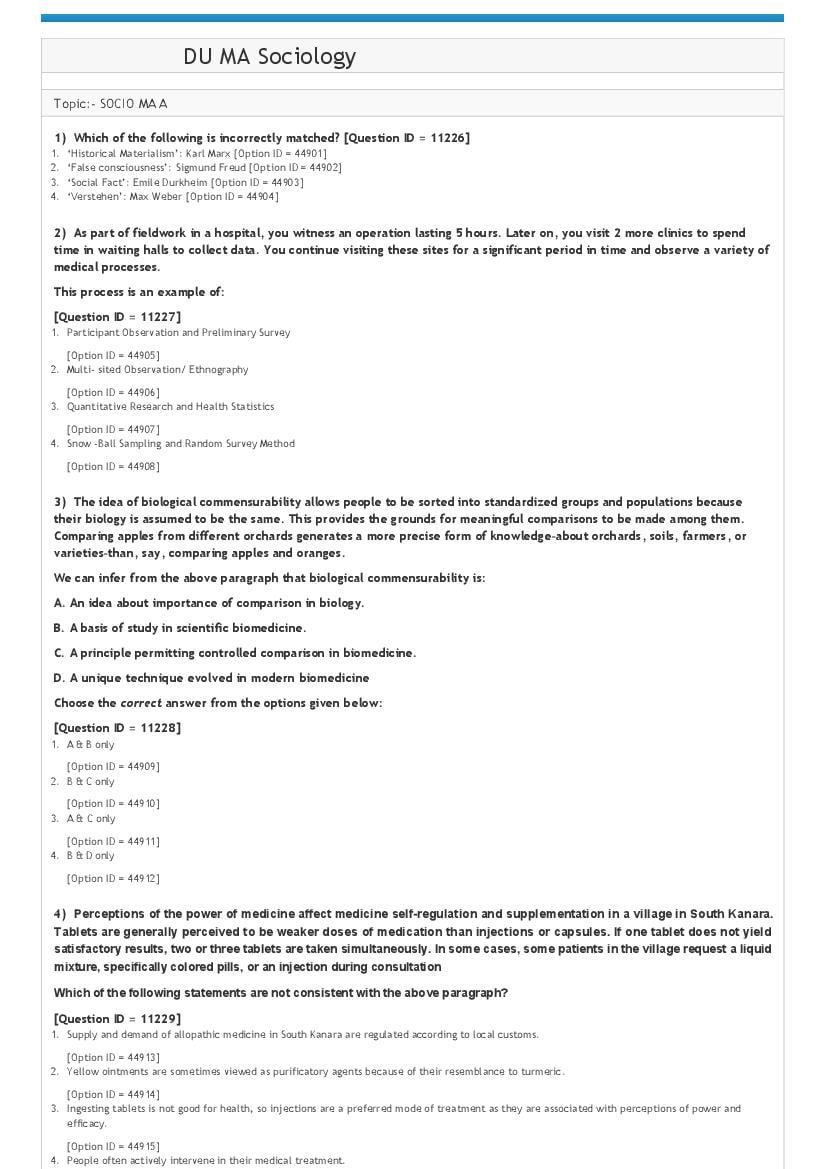
Topic:‐ SOCIO MA A
1) Which of the following is incorrectly matched? [Question ID = 11226]
1. ‘Historical Materialism’: Karl Marx [Option ID = 44901]
2. ‘False consciousness’: Sigmund Freud [Option ID = 44902]
3. ‘Social Fact’: Emile Durkheim [Option ID = 44903]
4. ‘Verstehen’: Max Weber [Option ID = 44904]
2) As part of fieldwork in a hospital, you witness an operation lasting 5 hours. Later on, you visit 2 more clinics to spend
time in waiting halls to collect data. You continue visiting these sites for a significant period in time and observe a variety of
medical processes.
This process is an example of:
[Question ID = 11227]
1. Participant Observation and Preliminary Survey
[Option ID = 44905]
2. Multi‐ sited Observation/ Ethnography
[Option ID = 44906]
3. Quantitative Research and Health Statistics
[Option ID = 44907]
4. Snow ‐Ball Sampling and Random Survey Method
[Option ID = 44908]
3) The idea of biological commensurability allows people to be sorted into standardized groups and populations because
their biology is assumed to be the same. This provides the grounds for meaningful comparisons to be made among them.
Comparing apples from different orchards generates a more precise form of knowledge–about orchards, soils, farmers, or
varieties–than, say, comparing apples and oranges.
We can infer from the above paragraph that biological commensurability is:
A. An idea about importance of comparison in biology.
B. A basis of study in scientific biomedicine.
C. A principle permitting controlled comparison in biomedicine.
D. A unique technique evolved in modern biomedicine
Choose the correct answer from the options given below:
[Question ID = 11228]
1. A & B only
[Option ID = 44909]
2. B & C only
[Option ID = 44910]
3. A & C only
[Option ID = 44911]
4. B & D only
[Option ID = 44912]
4) Perceptions of the power of medicine affect medicine selfregulation and supplementation in a village in South Kanara.
Tablets are generally perceived to be weaker doses of medication than injections or capsules. If one tablet does not yield
satisfactory results, two or three tablets are taken simultaneously. In some cases, some patients in the village request a liquid
mixture, specifically colored pills, or an injection during consultation
Which of the following statements are not consistent with the above paragraph?
[Question ID = 11229]
1. Supply and demand of allopathic medicine in South Kanara are regulated according to local customs.
[Option ID = 44913]
2. Yellow ointments are sometimes viewed as purificatory agents because of their resemblance to turmeric.
[Option ID = 44914]
3. Ingesting tablets is not good for health, so injections are a preferred mode of treatment as they are associated with perceptions of power and
efficacy.
[Option ID = 44915]
4. People often actively intervene in their medical treatment.
Page 2
5) The obligation to give is no less important. If we understood this, we should also know how men came to exchange things
with each other…To refuse to give, or to fail to invite, is—like refusing to accept — the equivalent of a declaration of war; it
is a refusal of friendship and intercourse. Again, one gives because one is forced to do so, because the recipient has a sort
of proprietary right over everything which belongs to the donor.
On the basis of the above, we can say that refusing to give is like declaring a war because:
A. It is a refusal to engage in a social relation
B. It is impolite and insulting
C. It is a refusal to honour a promise and return what belongs to the other
D. Is a refusal to recognize a social obligation
Choose the correct answer from the options given below:
[Question ID = 11230]
1. A & B only
[Option ID = 44917]
2. A, B & C only
[Option ID = 44918]
3. A, C & D only
[Option ID = 44919]
4. A, B, C & D
[Option ID = 44920]
6) But then, even to speak of “the economy” of a primitive society is an exercise in unreality. Structurally, “the economy”
does not exist. Rather than a distinct and specialized organization, “economy” is something that generalized social groups
and relations, notably kinship groups and relations, do. Economy is rather a function of the society than a structure, for the
armature of the economic process is provided by groups classically conceived “noneconomic.”
It follows from the above passage that economy in ‘Primitive society’:
A. is embedded in kinship relations
B. has no distinct existence
C. is a process
D. is non‐existent
Choose the correct answer from the options given below:
[Question ID = 11231]
1. A, B & C only
[Option ID = 44921]
2. B & D only
[Option ID = 44922]
3. B & C only
[Option ID = 44923]
4. A, B, C & D
[Option ID = 44924]
7) Every culture must satisfy the biological system of needs, such as those dictated by metabolism, reproduction, the
physiological conditions of temperature, protection from moisture…The second axiom in the science of culture is that every
cultural achievement that implies the use of artifacts and symbolism is an instrumental enhancement of human anatomy,
and refers directly or indirectly to the satisfaction of bodily needs.
According to the above passage:
[Question ID = 11232]
1. Fulfilment of human needs is the primary function of human culture
[Option ID = 44925]
2. Biological needs are always satisfied through cultural means
[Option ID = 44926]
3. Biology poses definite limits to form taken by culture
[Option ID = 44927]
4. All of the other options
[Option ID = 44928]
8) The aim is to draw large conclusions from small, but very densely textured facts; to support broad assertions about the
Page 3
The above statement is an example of:
A. The aims of social science
B. An argument in support of study of minutiae of everyday life
C. A description of the importance of culture in collective life
D. A claim about the complexity of social life
[Question ID = 11233]
1. A & C Only
[Option ID = 44929]
2. B & D Only
[Option ID = 44930]
3. A, B, C & D
[Option ID = 44931]
4. None
[Option ID = 44932]
9) It is certainly clear that caste has been utilized to keep the poor divided, but that alone is not enough. The blurring of
class lines among the lower categories has also been significant. )
It follows from the above statement that
[Question ID = 11234]
1. The only function of caste is that it keeps the poor divided.
[Option ID = 44933]
2. There is a complex relation between caste and class.
[Option ID = 44934]
3. Caste system has both, pros and cons.
[Option ID = 44935]
4. Caste and class are significantly overlapping.
[Option ID = 44936]
10) The cultural association of male hair, especially long hair, with magical or sacred ideas is known from many parts of the
world. It is well recognized in general terms to be a symbol of manliness, virility, honour, power, aggression and so on. For
example, in very early Europe the Achaeans, who conquered Greece, customarily wore their hair long and wild. The
Semitic story of Samson and Delilah as told in the Old Testament well illustrates the virtue of remaining unshorn. We can
readily locate many similar examples in classical Hinduism.
From the above passage, we come to know that:
[Question ID = 11235]
1. The practice of being unshorn has many positive symbolic associations.
[Option ID = 44937]
2. The practice of keeping long male hair is universal.
[Option ID = 44938]
3. People remain unshorn so as to practice magic.
[Option ID = 44939]
4. Hindu males maintain long hair due to its symbolic significance.
[Option ID = 44940]
11) This increased spiritual inventiveness, along with the dispersion and diffusion of the sacred outside of major institutions
like the church or the state, has opened up a wide range of possibilities for mutuality and interaction. Some of these
possibilities are as risky as they are ambiguous. In China the spread of a well‐organized religious group devoted to traditional
shamanic and meditative practices, Falun Gong, is seen to pose a threat to the state and is vilified as fomenting
superstition, “evil thinking,” and social instability. Its leader’s use of the Internet to communicate with tens of millions of
followers compounds the appearance of a cohesive and disciplined body capable of instant mobilization. Other religious
groups, with an international leadership and with followers in a variety of nations may also pose a threat to the cohesiveness
of particular societies, whether they support paramilitary and terrorist organizations or declare the independence of their
members from traditional sources of discrimination and oppression. The international Pentecostal movement is a prime
example of such liberation from below.
Which of the following does not follow from the above passage:
[Question ID = 11236]
1. Some religious groups cause social disturbance and aid anti‐social activities.
Page 4
2. Significant changes in religious organisation are challenging the definition of religion.
[Option ID = 44942]
3. New communication technologies are transforming the potential of expanding religious groups.
[Option ID = 44943]
4. Falun Gong as well as Pentecostal movements are instances of new forms of religious organisations.
[Option ID = 44944]
12) The idea of the denizen, which can be traced back to Roman times, has usually been applied to foreigners given
residency rights and rights to ply their trade, but not full citizenship rights. The idea can be extended by thinking of the
range of rights to which people are entitled – civil (equality before the law and right to protection against crime and
physical harm), cultural (equal access to enjoyment of culture and entitlement to participate in the cultural life of the
community), social (equal access to forms of social protection, including pensions and health care), economic (equal
entitlement to undertake income‐earning activity) and political (equal right to vote, stand for elections and participate in
the political life of the community). A growing number of people around the world lack at least one of these rights, and as
such belong to the ‘denizenry’ rather than the citizenry, wherever they are living.
On the basis of the above, it can be inferred that:
[Question ID = 11237]
1. Denizens don’t have civil rights.
[Option ID = 44945]
2. Legal Migrants cannot be seen as Denizens.
[Option ID = 44946]
3. A denizen may have some citizenship rights.
[Option ID = 44947]
4. Most nations now deny citizenship rights to their members.
[Option ID = 44948]
13) The biggest shift that occurred was the explicit acknowledgement of social development‐in addition to economic
development and environmental protection‐as a core component in the Johannesburg Declaration's definition of sustainable
development. Although the Rio Declaration (and other agreements since then) certainly referenced poverty eradication and
other aspects of social development, it primarily emphasized the need to balance environment and development.
It follows from the above passage that:
A. The Rio declaration modified the Johannesburg declaration.
B. The Rio Declaration was not concerned with sustainable development
C. Social development includes more than poverty eradication
D. Sustainable development is a relative concept
Which of the above options are correct?
[Question ID = 11238]
1. A & B
[Option ID = 44949]
2. B & D
[Option ID = 44950]
3. A & C
[Option ID = 44951]
4. C only
[Option ID = 44952]
14) Some profound institutional changes in the economic domain of production and consumption have been discernible
from the late 1980s onward. Among these changes were the widespread emergence of environmental management
systems, the introduction of an economic valuation of environmental goods via the introduction of eco‐taxes, the
emergence of environment‐inspired liability and insurance arrangements, the increasing importance attached to
environmental goals such as natural resource saving and recycling among public and private utility enterprises, and the
articulation of environmental considerations in economic supply and demand. The fact that we analyze these
transformations as institutional changes indicates their semi‐permanent character. Although the process of ecology‐induced
transformation should not be interpreted as linear and irreversible, as was common in the modernization theories in the
1950s and 1960s, these changes have some permanency and would be difficult to reverse.It follows from the passage that:
A. There are negative ecology‐induced changes in the economic domain.
B. The impact of the environment in the economic domain is largely irreversible.
C. Economic domain has responded to changes in the environment.
D. In the past environment did not have a role to play in the economy.
Page 5
1. A, B & C
[Option ID = 44953]
2. B, C & D
[Option ID = 44954]
3. B & C
[Option ID = 44955]
4. A, C & D
[Option ID = 44956]
15) ln one sense, Sennett and Cobb are concerned with a traditional problem: the class consciousness (or seeming lack of
it) among American workers. But they do not approach this in a traditional way; they are interested in portraying in depth
the experience of class relations as expressed in day‐to‐day life. Hence they do not employ a conventional survey or
sampling approach, depending instead upon a limited number of extended interviews which allow the workers to talk for
themselves. …. Sennett and Cobb treat interviewing, as it should be treated, as a form of social interaction in its own right,
in which the interviewer himself cannot remain anonymous.
From this passage you can infer that:
A. American workers don’t have a sense of class consciousness
B. Conventional sampling methods are inappropriate for the study of class relations
C. Sennet and Cobb chose a research technique they considered appropriate to their objective
D. Extended interviews involve participation by both the interviewer and interviewee
[Question ID = 11240]
1. A & B
[Option ID = 44957]
2. C & D
[Option ID = 44958]
3. B & D
[Option ID = 44959]
4. None
[Option ID = 44960]
16) The decline in agriculture accompanied by the inadequate availability of non‐farm jobs would lead economists to
expect an exodus from the village to the town. But there are few signs of an exodus in either village.….It is sometimes
convenient while interpreting large data, to assume that workers residing in a village also work there. Thus when individual
and household surveys, including the Census, provide data confirming that a substantial portion of workers living in villages
is not working in agriculture, it is easy to take it for granted that they are working in non‐ agricultural activities in the
village. The absence of substantial non‐farm activities in both Yellupuram and Kadalaipattu quickly dispels this notion. It is
evident that a number of potential workers who reside in the village and hence form a part of household surveys, work
outside the village.
We can infer from the above passage that:
A. Agricultural activities constitute the bulk of work available in these villages
B. Not everyone who works in an urban area resides there
C. Census data and surveys identify a number of resident non‐agricultural workers in villages
D. The large‐scale surveys sometimes do not capture the separation of place of residence from place of work
[Question ID = 11241]
1. A, B & C
[Option ID = 44961]
2. C & D
[Option ID = 44962]
3. B & D
[Option ID = 44963]
4. All
[Option ID = 44964]
17) How does structural analysis proceed? The first step is the definition of the constitution units of an institution…Once the
Page 6
permutation and transformation between these elements can be defined. Homologies between institutions can be
explained…Correspondences or isomorphisms should be sought not between empirical data pertaining to different
institutions but between different systematized forms or models which can be abstracted…can compared either intra or
cross‐culturally.
According to the above passage, structural anthropology proceeds:
A. By analyzing the constituent units of cultural institutions.
B. By establishing correspondences between different structural models
C. By establishing relations of opposition and correlation between structural elements in these systematized forms.
D. By disregarding empirical facts.
[Question ID = 11242]
1. A, B & C
[Option ID = 44965]
2. B, C & D
[Option ID = 44966]
3. B & C
[Option ID = 44967]
4. All
[Option ID = 44968]
18) Far… from man classifying spontaneously …humanity in the beginning lacks the most indispensable conditions for the
classificatory function. Further, it is enough to examine the very idea of classification to understand that man could not
have found its essential elements in himself. A class is a group of things; and things do not present themselves to
observation grouped in such a way…. to classify is not only to form groups; it means arranging these groups according to
particular relations…Every classification implies a hierarchical order for which neither the tangible world nor our mind gives
us the model. We therefore have reason to ask where it was found. The very terms which we use in order to characterize it
allow us to presume that all these logical notions have an extra‐logical origin. We say that species of the same genera are
connected by relations of kinship; we call certain classes ‘families’; did not the very word genus (genre) itself originally
designate a group of relatives? (Source: Emile Durkheim and Marcel Mauss 2009 Primitive Classification. Pp 4‐5)
What reasons do the authors give for saying that the classificatory process is not spontaneously given in nature or to the
human mind?
[Question ID = 11243]
1. Because things do not present themselves grouped into classes.
[Option ID = 44969]
2. Because classification necessarily implies a hierarchical arrangement.
[Option ID = 44970]
3. Because hierarchical arrangements are not given in nature.
[Option ID = 44971]
4. All three options
[Option ID = 44972]
19) Women are not drawn to labour organization not because they are naturally ‘docile’ and ‘submissive’ as multinational
corporations have claimed for female workers across the global assembly line, but because of their work in informatics offers
them symbolic as well as economic capital that they are deeply interested in securing.
It can be inferred from the above passage that:
[Question ID = 11244]
1. Women workers are naturally obedient and dutiful.
[Option ID = 44973]
2. Women are drawn to labour organization because they are law‐abiding.
[Option ID = 44974]
3. Women are not interested in any economic security.
[Option ID = 44975]
4. Women’s work in informatics gives them an opportunity to ensure economic security.
[Option ID = 44976]
20) In the badold days, so the story goes, anthropologists used to think that kinship was based on the fact that people go in
and out of each other’s bodies. …Such naïveté, however, was soon to be severely disciplined by developments in our
subject. First, anthropologists stressed the old platonic point that humans do not live in the world as God or the scientists see
it, but via their own understanding of it …From this they argued that the foundation (i.e., going in and out of each other’s
Page 7
severe enough. It was not simply that people saw the world “through a glass darkly”; it was that they did not see it at all. There
was no such fact as that people went in and out of each other’s bodies; they were just accidental cultural representations of
which my particular formulation is only one among many. Thus… culturally constructed kinship systems as if they were cultural
interpretations of a single reality was a fallacy.
According to the author of the above passage, what happened in the 'bad old days'?
[Question ID = 11245]
1. Anthropologists had access to scientific facts.
[Option ID = 44977]
2. Anthropologists felt that their own understanding of kinship was divinely ordained.
[Option ID = 44978]
3. Anthropologists did not realize that cultures are relative and that their views are also shaped by culture.
[Option ID = 44979]
4. Anthropologists did not realize that we see the world “through a glass darkly”.
[Option ID = 44980]
21) When most people think of the Chipko movement, the primary image that comes to mind is of a group of village women
in the Himalaya, hugging trees to protect them from felling by forest contractors. While that was the key moment when
Chipko ignited, eminent historian Shekhar Pathak successfully unravels many other tangled threads of a story that is much
more complicated, with far‐reaching consequences for the people and forests of Uttarakhand, as well as conservation
movements around the world. Which of the following can be inferred from the above passage?
A. Villagers in Uttarakhand are affected by forest felling
B. Only village women were concerned about forest felling
C. Forest felling by contractors was a trigger for the Chipko movement
D. The Chipko movement is often understood simplistically as a single‐issue movement.
[Question ID = 11246]
1. A, B and C
[Option ID = 44981]
2. A, C and D
[Option ID = 44982]
3. B, C and D
[Option ID = 44983]
4. A, B, C & D
[Option ID = 44984]
22) The phenomenon of caste is too complex, and subsumes too baffling a variety of patterns to yield to simple
explanations. It may be mentioned, however, that due to a variety of factors contributing towards social change the
boundaries of endogamy are widening: distinctions between 'sub‐castes' are not considered relevant by many. There is also
greater tolerance of inter‐caste marriages, provided the ritual distance between concerned caste groups is not too wide,
and there are no problems of disparity in economic and social status. But, these changes are limited in scope and extent and
have not radically affected people's ideas. The phenomenon of boundary maintenance is a crucial element in the definition
of the cultural apprehension of the vulnerability of young girls and the emphasis on their purity and restraint in behaviour.
This is expressed in the construction of 'legitimate' and 'proper' modes of speech, demeanour and behaviour for young girls
and in the organisation of their space and time.
According to the passage, which of the following practices ensure caste boundary maintenance?
A. Through gender specific codes of conduct
B. Greater tolerance of Inter‐caste marriages
C. Control over behaviour of young girls
D. Erasure of difference between sub‐castes
Choose the correct answer from the options given below:
[Question ID = 11247]
1. A & B only
[Option ID = 44985]
2. A & D only
[Option ID = 44986]
3. A & C only
[Option ID = 44987]
4. B & D only
Page 8
23) One of the reasons that many people would not use the term "oppression" to describe our society is that they do not
understand the term in the same way as the radicals. In its traditional usage, which most people retain, "oppression" means
the exercise of tyranny by a ruling group.
We can infer from this passage that 'oppression':
[Question ID = 11248]
1. is universally found
[Option ID = 44989]
2. is used incorrectly by many people
[Option ID = 44990]
3. is traditionally related to structures of rule in society
[Option ID = 44991]
4. is evil perpetrated by others
[Option ID = 44992]
24) The early ethnographers were not clear about the distinction between caste and tribe in India. The 18th century
writers, for example, showed synonymous use of the term tribe with caste. Later it was even used in a cognate manner as
one could see in the use of phrase ‘caste and tribes’ by Risley and many others in their writings.
The above passage suggests that writers such as Risley:
A. Used the terms caste and tribe interchangeably.
B. Felt that there was no distinction between caste and tribe
C. Used caste and tribe as related terms
D. Redefined the terms caste and tribe.
[Question ID = 11249]
1. A & C only
[Option ID = 44993]
2. C only
[Option ID = 44994]
3. D Only
[Option ID = 44995]
4. C & D only
[Option ID = 44996]
25) Grounded historically, the question about origins of rights becomes a naturalistic one: How have European people
acquired enforceable claims on the states to which they were subject? More narrowly, how have rights of citizenship come
into being? How did authorities come to owe goods, services, and protections to people merely on the ground of their
belonging to a category, the category of people in the political community attached to a state? How did that political
community expand to include most people, or at least most households, in the population at large?
Which of the following is not part of the argument made by the author in the above passage?
[Question ID = 11250]
1. The claims on the states acquired by European people.
[Option ID = 44997]
2. Extension of protection to people in the political community attached to a state.
[Option ID = 44998]
3. The question about the origin of citizen’s duties towards the state.
[Option ID = 44999]
4. The expansion of political community expanded to include most households.
[Option ID = 45000]
26) These totemic decorations enable us to see that the totem is not merely a name and an emblem. It is in the course of
the religious ceremonies that they are employed; they are a part of the liturgy; so while the totem is a collective label, it
also has a religious character. In fact, it is in connection with it, that things are classified as sacred or profane. It is the very
type of sacred thing (Source: Durkheim, Emile. 1976. The Elementary Forms of the Religious Life, p.119).
According to the above passage, the totem is a/an
A. sacred object that is part of the liturgy
B. name for a set of objects used in religious ceremonies
Page 9
D. emblem that allows for the classification of other objects
Choose the correct option
[Question ID = 11251]
1. A & B
[Option ID = 45001]
2. A & C
[Option ID = 45002]
3. B, C & D
[Option ID = 45003]
4. A, B C & D
[Option ID = 45004]
27) Studies in migration stemmed from two theoretical sources: culture contact theories and the Marxian analysis of
colonization, and alienation. While the former approach is dated, the latter is highly significant in studying the process of
migration and its consequences in the context of the capitalist mode of production. For instance, colonization of tribal areas
in different parts of India (and of the world) by peasants and merchants from the plains has led to severe conflicts between
the migrants and the native tribes
Which of the following statements CANNOT be inferred from the above passage?
[Question ID = 11252]
1. Culture contact theory is an outmoded theoretical model to study migration.
[Option ID = 45005]
2. Marxian analysis is useful to study the impacts of migration in capitalism
[Option ID = 45006]
3. Conflicts in tribal areas of India can be connected to process of internal colonization.
[Option ID = 45007]
4. According to Marx tribal areas are colonized by peasants and merchants of the plains through the process of migration.
[Option ID = 45008]
28) The State needs to be analyzed as such a structural effect. That is to say, it should be examined not as an actual
structure, but as the powerful, metaphysical effect of practices that make such structures appear to exist. In fact the
nation state is arguably the paramount structural effect of the modern social world. It includes within itself many of the
particular institutions already discussed, such as armies, schools, and bureaucracies.
The above passage makes the argument that:
A. The State should not be analysed as an institutional structure
B. Institutional structures must be seen not as the state itself but parts of it
C. State structures appear to exist as a result of practices
D. The State is supreme and sovereign.
[Question ID = 11253]
1. A & B
[Option ID = 45009]
2. A & C
[Option ID = 45010]
3. A, B & C
[Option ID = 45011]
4. B, C & D
[Option ID = 45012]
29) Characteristically, urbanites meet one another in highly segmental roles. They are, to be sure, dependent upon more
people for the satisfactions of their life‐needs than are rural people and thus are associated with a greater number of
organized groups, but they less dependent upon particular person, and their dependence upon others is confined to a
highly fractionalized aspect of the other’s round of activity.
Which of the following statements best support the above passage?
[Question ID = 11254]
1. Segmentation of human relationships fulfils the requirements of urban life.
[Option ID = 45013]
2. Urbanites are less dependent on others than rural people.
[Option ID = 45014]
Page 10
[Option ID = 45015]
4. All of the other options.
[Option ID = 45016]
30) For the women who acquire the necessary ‘human capital’ to enter the technical professions, the labor market is only
partially open. In an industry with a long history of male social closure, there is evidence to suggest that employers,
including those known for their good practice, remain hostile to women.
According to the above passage:
[Question ID = 11255]
1. Some women are able to enter technical profession today but face hostility.
[Option ID = 45017]
2. Women were legally barred from entering technical professions in the past
[Option ID = 45018]
3. Some employers in technical professions are known for their good gender practices
[Option ID = 45019]
4. All women should be allowed to work in technical professions
[Option ID = 45020]
Topic:‐ SOCIO MA B
1)
Read Table‐1 carefully before you answer the following question. How many cells in the table show values greater than 42%
and 53% or less?[Question ID = 11256]
1. Seven [Option ID = 45021]
2. Six [Option ID = 45022]
3. Five [Option ID = 45023]
4. Four [Option ID = 45024]
2)
Read Table‐1 carefully before you answer the following question. The table shows that urban‐rural differences for men are
the least for the indicator:[Question ID = 11257]
1. ‘Ever used the internet’ in Kerala [Option ID = 45025]
2. ‘Literates’ in Karnataka [Option ID = 45026]
3. ‘10 or more years of schooling’ in Kerala [Option ID = 45027]
4. ‘Literates’ in Kerala [Option ID = 45028]
3)
Read Table‐1 carefully before you answer the following question. Comparing Bihar and Karnataka, male‐female differences
are the least for the indicator:[Question ID = 11258]
1. ‘Literates’ in Bihar [Option ID = 45029]
2. ‘Literates’ in Karnataka [Option ID = 45030]
3. ‘10 or more years of schooling’ in Karnataka [Option ID = 45031]
4. ‘10 or more years of schooling’ in Bihar [Option ID = 45032]
Page 11
Read Table‐1 carefully before you answer the following question. Considering all indicators, which state shows the highest
urban‐rural differences for women?[Question ID = 11259]
1. Gujarat [Option ID = 45033]
2. Bihar [Option ID = 45034]
3. Karnataka [Option ID = 45035]
4. Kerala [Option ID = 45036]
5)
Read Table‐1 carefully before you answer the following question. The female‐to‐male proportion (or ratio) is the lowest for:
[Question ID = 11260]
1. ‘Ever used the internet’ in rural Bihar [Option ID = 45037]
2. ‘Ever used the internet’ in rural Karnataka [Option ID = 45038]
3. ‘Ever used the internet’ in rural Gujarat [Option ID = 45039]
4. ‘10 or more years of schooling’ in rural Gujarat [Option ID = 45040]
Topic:‐ SOCIO MA C
1) Contemporary thinking about the cultural effects of the migration of goods within the world market system has tended to
be dominated by the paradigm of global homogenization. According to this paradigm, cultural differences are increasingly
being eroded through the world‐wide replacement of local products with mass‐produced goods which usually originate in the
west. This process of colonization (or re‐colonization) of the non‐Western world through the institutions of new regimes of
consumption is sometimes referred to as ‘Coca‐colonization’
Which of the following can be seen as examples of 'coca‐colonization'?
1. The preference for Burgers and Pizza over local food in North India
2. The popularity of Chicken Tikka and Butter Chicken in UK
3. The popularity of Coca Cola in America and Europe
4. The popularity of Korean Pop in North East India
[Question ID = 11261]
1. A only
[Option ID = 45041]
2. A & C only
[Option ID = 45042]
3. A, B & C only
[Option ID = 45043]
4. All
[Option ID = 45044]
2) According to Italian social theorist Antonio Gramsci…, hegemony is domination achieved through consent rather than by
force. In terms of biomedical hegemony over women’s health, physicians have rarely forced women to accept them as
medical practitioners. Such consent has come from women themselves, who have actively participated in this process of
medicalization and have often demonstrated their desire for cutting‐edge medical technologies. To take but one example,
epidural anesthesia in childbirth would not exist were it not for women demanding more effective forms of analgesia (or,
alternatively, take a comfortable, pain free nap) that would also allow them to remain awake during the birthing process.
According to the above passage:
A. Birthing technologies are free from use of power.
B. Some medical innovations owe their origin to women’s initiatives.
Page 12
D. Birthing has increasingly been medicalized by women’s consent.
[Question ID = 11262]
1. A & C only
[Option ID = 45045]
2. A, B & C only
[Option ID = 45046]
3. B & D only
[Option ID = 45047]
4. A, B, C & D
[Option ID = 45048]
3) The schedule for the 1901 Census of India included a query to collect ‘caste if Hindu, sect if of other religion.’ The
household schedule for the 2001 Census of India included the following directions – ‘if Scheduled Caste, write name of the
Scheduled Caste from the list supplied,’ and ‘if Scheduled Tribe, write name of the Scheduled Tribe from the list supplied.’
Both the schedules included a separate question to collect information on religion.
A sociologist studying these two census schedules can conclude that:
[Question ID = 11263]
1. Those who planned the census schedule were biased towards other religions
[Option ID = 45049]
2. The census officials believed caste and religion to be independent of each other
[Option ID = 45050]
3. The census operations have used caste and religion as basis of categorisations in the past as well as the present
[Option ID = 45051]
4. The 2001 census schedule has more objective criteria than the 1901 census schedule, which was dictated by British divide and rule policy
[Option ID = 45052]
4) Even the portion of money that the wife did receive and control was limited to housekeeping money. As with wealthier
women, the working‐class wife had no right and much less access to a personal fund. Pocket money for personal expenses
was a male prerogative or a working child’s right. The working‐class husband’s allowance was thus a very different kind of
money from the allowance of middle‐class wives. Although partly allocated for useful expenses, food or clothing or
transportation, it was also a legitimate fund for personal pleasures.
On the basis of the context being described in above passage, we can argue that the following were likely to be part of
both men’s and women’s ‘Money’?
A. Movie tickets
B. Household expenses
C. Children’s school expenses
D. Alcohol and Tobacco
[Question ID = 11264]
1. All
[Option ID = 45053]
2. None
[Option ID = 45054]
3. A & D only
[Option ID = 45055]
4. B & C only
[Option ID = 45056]
5) Several early antiracists were also feminists. The women's movement questioned the myth that woman was biologically
inferior to man, and some in the movement went on to doubt the racists' related statement that blacks were biologically
inferior to whites.
From this passage we can infer that:
A. Those who reject one form of inequality will automatically reject all other forms of inequality
B. Since both race and patriarchy are justified on biological grounds, a challenge in one sphere may lead to a challenge in
the other
C. Not all anti‐racists were feminists; not all feminists were anti‐racist
Page 13
[Question ID = 11265]
1. A & B only
[Option ID = 45057]
2. C & D only
[Option ID = 45058]
3. A & D only
[Option ID = 45059]
4. B & C only
[Option ID = 45060]
6) The small peasants form a vast mass, the members of which live in similar conditions, but without entering into manifold
relations with one another… Each individual peasant family is almost self‐sufficient; it itself directly produces the major part
of its consumption…In this way the great mass of the French nation is formed by simple addition of homologous magnitudes,
much as potatoes in a sack form a sacksful of potatoes.
In the above statement, Marx can be seen as suggesting that peasants are:
[Question ID = 11266]
1. A rural class made of hostile entities.
[Option ID = 45061]
2. A fragmented social category
[Option ID = 45062]
3. Just concerned about how to survive
[Option ID = 45063]
4. Not further divided into social classes
[Option ID = 45064]
7) In a sense, the 'commodification' of women through calendar art is implicit in the function of 'display’, but it is made
explicit by the consociation of images of women with a range of material products, rather after the manner of commercial
advertising.
According to the above passage, we can say women are commodified in calendar art because:
[Question ID = 11267]
1. The purpose of art is display of women
[Option ID = 45065]
2. Calendars display Images of women in association with material products
[Option ID = 45066]
3. Calendars are vehicle of commercial advertising
[Option ID = 45067]
4. Calendars use Art to sell commodities
[Option ID = 45068]
8) It is not assumed… that it is more rational to wish to live than to wish to die, or that, in the first case, it is more rational
to seek a long life through the means of science than through those of superstition. For whatever the end, it is rational to
choose one's means accordingly; and as to the means, it would not be rational to act upon any other test than that which
one happens to believe in. Thus it is rational for the suicide to select means that will accomplish his death; and if he be an
adept of black magic, to pay a witch doctor to contrive that end.
From the above passage, we can infer that:
[Question ID = 11268]
1. Some ends are more rational than others
[Option ID = 45069]
2. All ends are equally rational
[Option ID = 45070]
3. Religious behaviour may be rational in some contexts
[Option ID = 45071]
4. Superstition is more rational than science
[Option ID = 45072]
9) Productive work came to be defined as money‐earning work (primarily wage‐earning work), and non‐productive work as
work that, albeit very necessary, was merely ‘subsistence’ activity and therefore was said to produce no ‘surplus’ which
anyone else could possibly appropriate. This work was either totally non‐commodified or involved petty (but then truly
petty) commodity production.
Page 14
[Question ID = 11269]
1. Making pickles at home to avoid buying any from the market
[Option ID = 45073]
2. Making pickles at home to sell in the market
[Option ID = 45074]
3. Making pickles with products bought from the market
[Option ID = 45075]
4. Making pickles to share with one’s friends and relatives
[Option ID = 45076]
10) __________involves intermarriage and complete identification with the host society. The earlier group identity of the
migrants disappears, and a new group identity, that of the host society, emerges. Fill in the blank:[Question ID = 11270]
1. Integration [Option ID = 45077]
2. Accommodation [Option ID = 45078]
3. Assimilation [Option ID = 45079]
4. Adaptation [Option ID = 45080]
11) My personal view is that the Notes and Queries definition of marriage is too limited and that it is desirable to include
under the category 'marriage' several distinguishable sub‐types of institution. The institutions commonly classed as marriage
are concerned with the allocation of a number of distinguishable classes of rights.
From the above passage, one can infer that:
[Question ID = 11271]
1. Marriage is an institution that distributes rights
[Option ID = 45081]
2. Marriage institutionalises control over women’s sexuality
[Option ID = 45082]
3. The issue of paternity is central to marriage
[Option ID = 45083]
4. Marriage is form of sexual division of labour
[Option ID = 45084]
12) An Iban long‐house community is a corporate group only in certain restricted ways. Thus a long‐house community holds
virtually no property in common ownership, nor is there collective ownership of farm land; and again, there is an absence of
any kind of economic activity by the long‐house as a corporate group. However, membership of a longhouse does impose
upon each family group many common duties and obligations, for it is universally accepted that the well‐being of any long‐
house is dependent upon its ritual state, and for the maintaining of this all are responsible. In jural matters also the long‐
house community is a corporate entity, for all its family groups do place themselves under the jurisdiction of their tuai
rumah, or house headman, whose principal duty is the safeguarding and administering of the customary law, or adat.
On the basis of the above, which of the following is not a feature of a corporate group:
[Question ID = 11272]
1. Common ownership of property and common economic activities
[Option ID = 45085]
2. Common responsibility for religious well being
[Option ID = 45086]
3. A common customary jurisdiction
[Option ID = 45087]
4. Co‐residence in a shared dwelling
[Option ID = 45088]
13) When, for example, the largest and one of the most well established surrogate mother programs changed the wording
of its advertising copy from "Help an Infertile Couple" to "Give the Gift of Life," the vastly increased volume of response
revealed that the program had discovered a successful formula with which to reach the surrogate population. With
surrogacy, the gift is conceptualized as a child, a formulation that is widely used in Euro‐American culture
The above passage suggests the motivation for surrogacy:
[Question ID = 11273]
1. Is not monetary at all
[Option ID = 45089]
2. Resonates with the cultural values associated with childbearing
[Option ID = 45090]
3. Is the innate desire women have for children
[Option ID = 45091]
Page 15
[Option ID = 45092]
14) While writing an essay, students were instructed to adhere to the following format in preparing a bibliographic entry for
a book:
Author Last Name, First Initial. Middle Initial. (Year Published). Title of book in sentence case. Publisher name.
Which of the following entries is correct according to the required format:
[Question ID = 11274]
1. André Béteille. 1965. Caste, Class, and Power: Changing Patterns of Stratification in a Tanjore Village. Berkeley and Los Angeles: University of
California Press, Pp. 238.
[Option ID = 45093]
2. Béteille, A. (1965). Caste, class, and power: Changing patterns of stratification in a Tanjore village. University of California Press.
[Option ID = 45094]
3. Béteille, André. 1965. Caste, Class, and Power. Berkeley and Los Angeles: University of California Press.
[Option ID = 45095]
4. Béteille, A. (1965). Caste, class, and power: Changing patterns of stratification in a Tanjore village, Berkeley and Los Angeles: University of
California Press.
[Option ID = 45096]
15) Which of the following is the most appropriate example of downward social mobility?[Question ID = 11275]
1. A government officer retiring from his job [Option ID = 45097]
2. A science student opting for an arts course in college [Option ID = 45098]
3. A candidate failing in a competitive exam four times [Option ID = 45099]
4. A domestic worker who lost all their jobs due to pandemic lockdown. [Option ID = 45100]
Document Details
| Board / Org | NTA |
| Exam | DUET |
| Type | Question Paper |
| Pages | 15 |
| Language | english |
| Updated | 30 Apr 2026 |