UPSC IFS 2018 Question Paper for Chemical Engineering Paper - I
Finished viewing? Save it for later —
Download UPSC IFS 2018 Question Paper for Chemical Engineering Paper - I (PDF · 10 pages)About UPSC IFS 2018 Question Paper for Chemical Engineering Paper - I
UPSC IFS 2018 Question Paper for Chemical Engineering Paper - I is available here for free download. Published by UPSC for Indian Forest Service Examination, this question paper can be viewed online or downloaded as a PDF (10 pages). Candidates preparing for Indian Forest Service Examination can use UPSC IFS 2018 Question Paper for Chemical Engineering Paper - I to understand the exam pattern, the type of questions asked, and the overall difficulty level.
Frequently Asked Questions
How can I download UPSC IFS 2018 Question Paper for Chemical Engineering Paper - I?
Open this page and click the Download button to save UPSC IFS 2018 Question Paper for Chemical Engineering Paper - I as a PDF. It is completely free on AglaSem Docs.
Is UPSC IFS 2018 Question Paper for Chemical Engineering Paper - I free to download?
Yes. UPSC IFS 2018 Question Paper for Chemical Engineering Paper - I can be viewed online and downloaded as a PDF free of cost on AglaSem Docs.
How many pages does UPSC IFS 2018 Question Paper for Chemical Engineering Paper - I have?
UPSC IFS 2018 Question Paper for Chemical Engineering Paper - I contains 10 pages, which you can read online or download together as a single PDF.
Where can I find more Indian Forest Service Examination study material?
You can find more Indian Forest Service Examination question papers, sample papers, syllabus, and answer keys on AglaSem Docs.
UPSC IFS 2018 Question Paper for Chemical Engineering Paper - I – Text
Read the full text of this question paper below — useful to quickly search, copy and reference the content online without downloading the PDF.
📄 View text version (10 pages)
Page 1
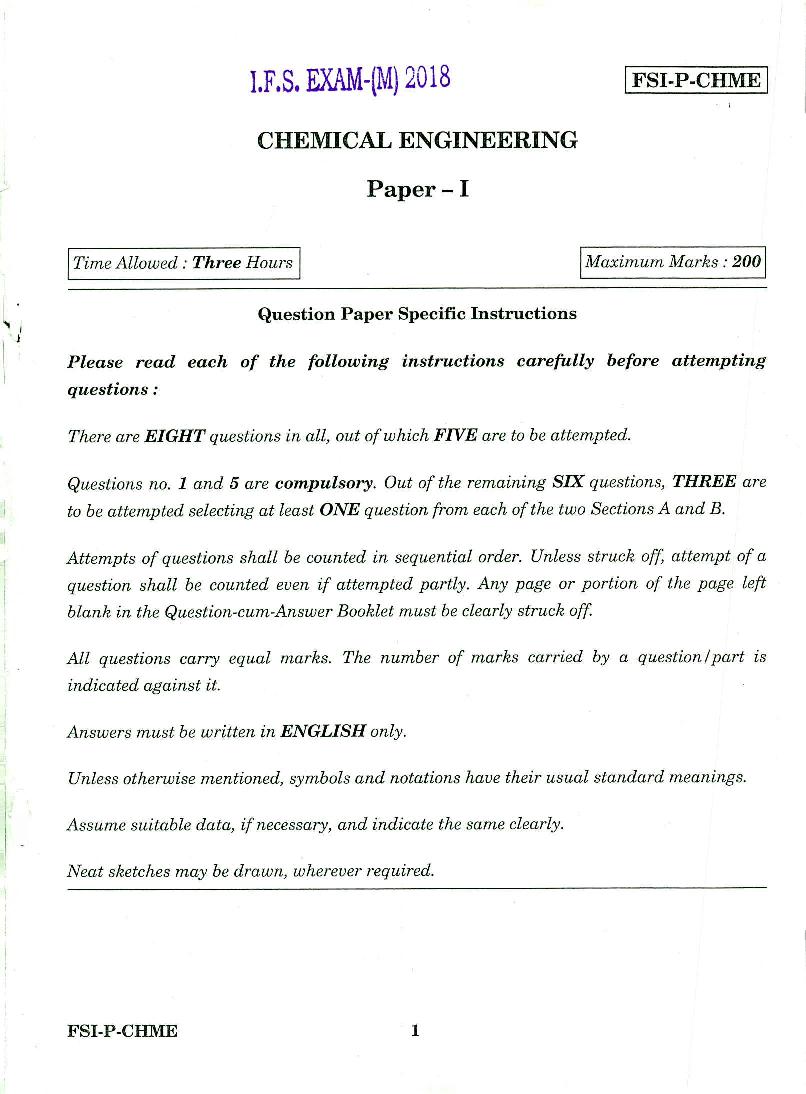
CHEMICAL ENGINEERING
Paper - I
Time Allowed: Three Hours Maximum Marks : 200
Question Paper Specific Instructions
Please read each of the following instructions carefully before attempting
questions:
There are EIGHT questions in all, out of which FIVE are to be attempted.
Questions no. 1 and 5 are compulsory. Out of the remaining SIX questions, THREE are
to be attempted selecting at least ONE question from each of the two Sections A and B.
Attempts of questions shall be counted in sequential order. Unless struck off attempt of a
question shall be counted even if attempted partly. Any page or portion of the page left
blank in the Question-cum-Answer Booklet must be clearly struck off
All questions carry equal marks. The number of marks carried by a question/part is
indicated against it.
Answers must be written in ENGLISH only.
Unless otherwise mentioned, symbols and notations have their usual standard meanings.
Assume suitable data, if necessary, and indicate the same clearly.
Neat sketches may be drawn, wherever required.
Page 2
Ql. State Fick's first law of diffusion. Prove that DAB = DBA• 5
Calculate the critical speed of a ball mill, 1200 ram in diameter, charged
with 75 mm balls. 5
Air at 300 K and FO atm pressure flows over a flat plate at a speed of
3.0 m/sec. Find out whether the flow would be laminar or turbulent at a
distance of 40 cm from the leading edge of the plate. Consider
momentum diffusivity of air as = F572 x 10-5 m2/s. 5
Give the selection criteria of choosing the solvent in gas absorption
column 5
A solution of organic colloids; 10,000 kg/hr is to be concentrated from
15% to 50% solids in a vertical tube evaporator by supplying heat of
4.624 MW. The saturated steam is available at 0-8 atm absolute
pressure, latent heat = 2272-62 J/kg. Calculate the economy for the
evaporator. 5
Draw and explain the characteristic curves for centrifugal pump. 5
The x-directed momentum transfer equation for constant density and
viscosity is given by
(ay
Dv x + v Dvx + v ayx a 2v a 2v
BP x+ x+
at ± vx ax Y ay Z 8Z , ax + Pgx.
ax2 ay2 8z2
Write the assumptions of creeping flow and inviscid flow. Also reduce
the above expression for both types of flows. 5
For fluid allocation in a shell and tube heat exchanger, discuss the
general design criteria considering corrosion, fouling, fluid temperature
and operating pressure. 5
FSI-P-CHME 2
Page 3
Dropwise condensation and Film condensation
Space and Surface resistance
Forced and Free convection
Black body and Grey body
Conduction and Convection 15
A liquid mixture of benzene and toluene containing 50 mole percent
benzene is to be separated in a distillation column to achieve 98 mole
percent benzene in distillate and 2 mole percent benzene in residue. The
feed is a saturated liquid. If the reflux ratio of 4.0 is to be used, find the
number of theoretical plates needed for a feed rate of 100 kmoles/hr by
McCabe-Thiele method. Use relative volatility of
benzene-toluene = 2.16. Also, calculate the production rates. 15
Explain the batch sedimentation process showing different zones formed
at various stages of settling. 10
Q3. (a) Explain the working of rotary vacuum drum filter with the help of neat
sketch. 10
(b) Suppose a 3 inch schedule 80 pipe (inside diameter = 73.66 mm; outside
diameter = 88.9 mm) having thermal conductivity of 43 is covered
m°C
with 25.4 mm of an insulation having thermal conductivity of 0.06
m°C
The outside of the insulation is exposed to an environment having heat
transfer coefficient of 10 na 2 oc
and temperature is 20°C. The
temperature of the inside surface of the pipe is 250°C. Calculate the
overall thermal resistance and heat loss for unit length of the pipe with
insulation. 15
3
Page 4
initially at 80°C. To what temperature does the solution have to be
cooled to crystallize 95% of the oxalic acid as the dihydrate ? 151
Solubility data vs Temperature of oxalic acid
Temp °C 0 10 20 40 60 80
Solubility
3-5 6 9-5 21.6 44.3 84.4
c gms/100 gmol H20
Q4. (a) Explain briefly the following terms: 10
Relative humidity
Adiabatic saturation temperature
Wet bulb temperature
Equilibrium moisture content
HETP
(b) A shell and tube heat exchanger with one shell pass and two tube passes
is used to heat 5 kg/s of water from 30°C to 80°C. The water flows in the
tubes and condensing steam at 1 atm is used in the shell side. Calculate
the area of the heat exchanger, if overall heat transfer coefficient is
900 . Suppose, this same heat exchanger is used with entering
m2 cic
water at 30°C, but with a water flow rate of 1-3 kg/s. What would be the
exit water temperature under these conditions, if overall heat transfer
coefficient is 700 - ? The specific heat of water may be considered
m 2 °C
as 4179 . The relation of effectiveness (s) and number of transfer
kg°C
units (NTU) may be expressed as e = 1— expk NTU]. 15
FSI-P-CHME 4
Page 5
rate of 5 litre/s through a 4 inch schedule 40 pipe (Inside
Diameter = 04023 m) as shown in the figure below. Calculate the power
required for the pump considering pump efficiency as 65%. 15
Given Data:
density of water = 998.2 kg/m3
viscosity of water = 1.005 x 10⁻³ Pa-s
loss coefficient for elbow = 0.75
16
friction factor (f) = (Laminar flow)
Reynolds number (NRe )
f= 0.079 Nit25 (4000< NRe < 105)
Neglect contraction and expansion losses.
15 m
m
Pump
FSI-P-CHME 5
Page 6
Q5. (a) List the important characteristics to be considered while selecting a
material of construction. 5
(b) Define the following:
Flux
Permeability
Trans-membrane pressure
Molecular weight cut-off 5
(c) Estimate the thickness of the cylindrical vessel having 1.5 m diameter.
The vessel is to operate at a pressure of 15 bar absolute and
temperature of 300°C. 5
Given — MOC : Steel (Design stress = 85 1\11mm2); A corrosion allowance
of 3 mm and Joint efficiency (J) = FO.
(d) What are Horton spheres? Give its applications. 5
(e) Define controller's gain, lc and discuss the effect of value of lc on the
offset. 5
(0 Find the transfer function Y(s)/X(s) of the system shown in the figure. 5
1 0.5
x TS 1
y
(g) List the 'devices used for high temperature measurement in industry
giving their applications. 5
FSI-P-CHME 6
Page 7
. Y(s) 10
transfer function
X(s) 52 + 1.6s + 4
Determine :
Overshoot
Maximum value of y(t)
Ultimate value of y(t)
Q6. (a) Discuss the algorithm for the design of a skirt support for a tall vertical
vessel. 15
Find the value of Ice for a stable system having the characteristic
equation
s3 + 6s2 + 12s + 6(1 + Ice) = 0
using Routh Array test. 10
Discuss the different membrane modules used for reverse osmosis. 15
FSI-P-CHME 7
Page 8
Q7. (a) Construct the Bode plot for the system having G(s) — 20
(s + 1) (s + 5)
Semi log graph paper
UT
FSI-P-CHME 8
Page 9
MI= MI _MN 1111/In111011111111111111
111111111111111111•11111111111111111011111111111111•11•11111011111111111111M1111111111111SIMMIIII
1111111111011101111111S
.1111111011111111111•111111111M1111111111111011111111
1111.1101111111
NEM Minna ini...1111111•111111111111111a1111111111111111111111111
11111111111•1111111111111111111 110111111111111
•MEM
•
1111111M 1111101111111111111
111111111111111111111111•0111111011111111111111111111111111111111111111011111111111111111111S111111111111=1111111111111 •
IIIIIIIMMISI11111111111111111111 01•11111111111•11•111=11111111111111111111111
EMS 111111111111111111611111111
NMI 111111111111111111111111111101111111111111MUNIIIIMINIM011111111111
111111,11.0111111
1111111111 1111111111.111 111111111
1111111111111111011 1111111
son1111111111a1111111•1•11111111111111•Wal1111111111111•111111111111111111111111
11111111111•111111111111=1EM NMI
.01111.11111111111111111111 M1111110111111111111111S1111111111111111111111111111111
111111111111011111111111
ni M. .13.110 11111111111111111111111111
11111111111111111111111111 1•1111111101111111111111111111111111111
.111111111111111111111111111111111111111111111111111111111
1111111111111011111 111111111111111111111111
1111111 11111111 11111111
What are the advantages of supercritical fluid separation technique ?
List four applications for the same. 10
List the different types of closures used for vessels under internal
pressure. Draw neat sketches of the same. On what factors does the
choice of closure depend? 10
FSI-P-CHME 9
Page 10
neat diagram. 10
Explain the principles of ion-exchange method and its application to
water softening process. 15
Answer the following in brief: 15
What are the various losses encountered while storing volatile
liquids?
What are wind girders ? Why are they provided?
What is reinforcement ? Why is it provided?
FSI-P-CHME 10
Document Details
| Board / Org | UPSC |
| Exam | Indian Forest Service Examination |
| Type | Question Paper |
| Pages | 10 |
| Updated | 30 Apr 2026 |