UPSC IFS 2018 Question Paper for Forestry Paper - II
Finished viewing? Save it for later —
Download UPSC IFS 2018 Question Paper for Forestry Paper - II (PDF · 4 pages)About UPSC IFS 2018 Question Paper for Forestry Paper - II
UPSC IFS 2018 Question Paper for Forestry Paper - II is available here for free download. Published by UPSC for Indian Forest Service Examination, this question paper can be viewed online or downloaded as a PDF (4 pages). Candidates preparing for Indian Forest Service Examination can use UPSC IFS 2018 Question Paper for Forestry Paper - II to understand the exam pattern, the type of questions asked, and the overall difficulty level.
Frequently Asked Questions
How can I download UPSC IFS 2018 Question Paper for Forestry Paper - II?
Open this page and click the Download button to save UPSC IFS 2018 Question Paper for Forestry Paper - II as a PDF. It is completely free on AglaSem Docs.
Is UPSC IFS 2018 Question Paper for Forestry Paper - II free to download?
Yes. UPSC IFS 2018 Question Paper for Forestry Paper - II can be viewed online and downloaded as a PDF free of cost on AglaSem Docs.
How many pages does UPSC IFS 2018 Question Paper for Forestry Paper - II have?
UPSC IFS 2018 Question Paper for Forestry Paper - II contains 4 pages, which you can read online or download together as a single PDF.
Where can I find more Indian Forest Service Examination study material?
You can find more Indian Forest Service Examination question papers, sample papers, syllabus, and answer keys on AglaSem Docs.
UPSC IFS 2018 Question Paper for Forestry Paper - II – Text
Read the full text of this question paper below — useful to quickly search, copy and reference the content online without downloading the PDF.
📄 View text version (4 pages)
Page 1
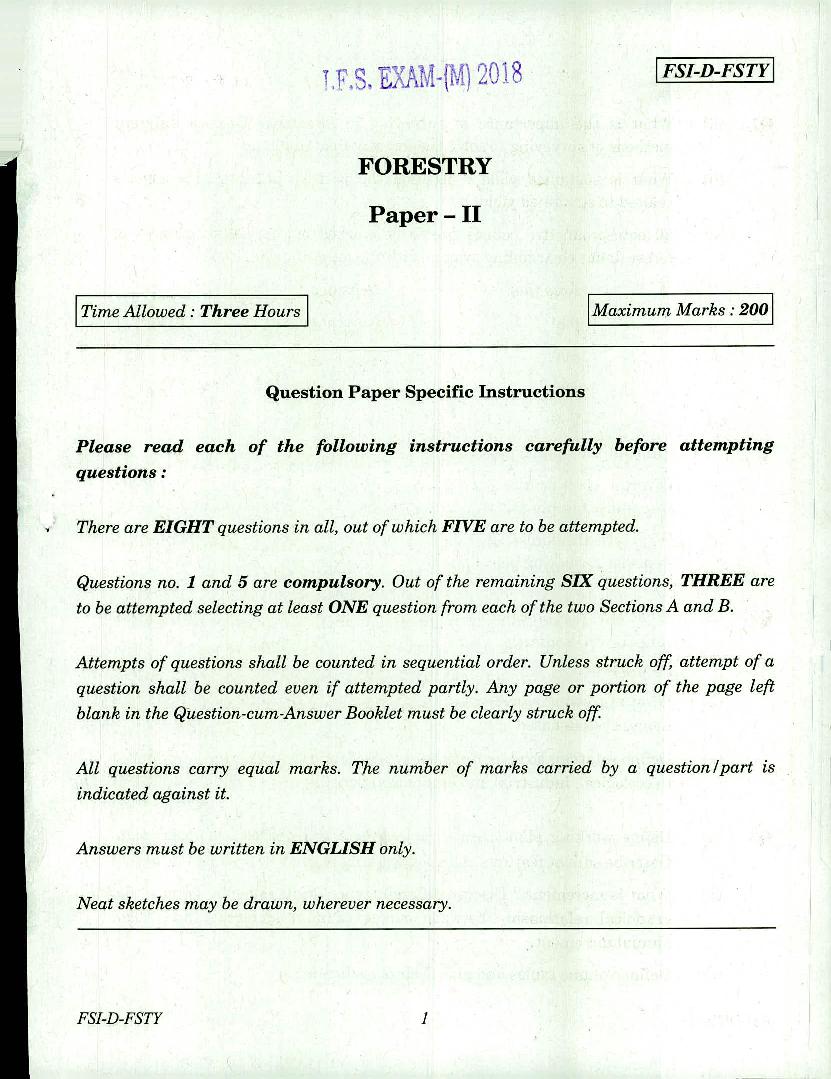
T.F.S, EXAM-(M) 2018
FORESTRY
Paper -II
Time Allowed: Three Hours Maximum Marks : 200
Question Paper Specific Instructions
Please read each of the following instructions carefully before attempting
questions:
There are EIGHT questions in all, out of which FIVE are to be attempted.
Questions no. 1 and 5 are compulsory. Out of the remaining SIX questions, THREE are
to be attempted selecting at least ONE question from each of the two Sections A and B.
Attempts of questions shall be counted in sequential order. Unless struck off attempt of a
question shall be counted even if attempted partly. Any page or portion of the page left
blank in the Question-cum-Answer Booklet must be clearly struck off
All questions carry equal marks. The number of marks carried by a question/part is
indicated against it.
Answers must be written in ENGLISH only.
Neat sketches may be drawn, wherever necessary.
FSI-D-FSTY
Page 2
Ql. (a) What is the importance of surveying in forestry ? Discuss different
methods of surveying to solve the forestry field problems.
What is sustained yield ? Mention the positive and negative aspects
related to sustained yield.
50 equi-productive coupes are to be worked out for 2000 hectares of
forest under clear felling system with the following densities:
Area (ha) Densities
600 Normal density
400 0.75 density
800 0.50 density
200 0.25 density
Find out the number of coupes in different densities.
Give the classification of forest roads. What features are required for a
reconnaissance for forest roads?
What are the forest stock maps ? Discuss the details shown in stock
maps for a working plan report.
Q2. (a) What are the precautions required for diameter measurements with
calipers ? Discuss the errors that occur due to non-observation of the
precautions. 15
What is growing stock? How is normal growing stock calculated in clear
felling system based on final MAT? 15
Define rotation. Explain different types of rotation with special reference
to ecological, industrial and economical benefits. 10
Q3. (a) Define working plan. Discuss objectives and scope of a working plan.
Describe salient features of a good working plan. 15
What is increment ? Discuss different types of increments. Discuss the
graphical relationship between current annual increment and mean
annual increment. 15
Define volume tables and give their classification. 10
FSI-D-FSTY 2
Page 3
the owner put impact on the management of forests? 15
Define forest sampling. Give advantages of sampling Discuss different
types of non-random sampling methods used in forestry. 15
Define remote sensing. Discuss its application in forest management
along with GIS applications. 10
FSI-D-FSTY 3
Page 4
Q5. What are the industrial uses of gums and resins ? Discuss the factors
affecting the production and supply of gums and resins. 8
What is carbon sink ? How do forest soils act as important carbon sinks? 8
Forest ecology is the study of complex interactions between organic and
inorganic components of the forest ecosystem. Explain organic and
inorganic components providing two examples of each as they relate to
the forest ecosystem. 8
What is the ecological and economical importance of biodiversity ?
Mention the salient measures for conservation of biodiversity. 8
Write down four advantages of timber seasoning and suggest which one
is commercially suitable over other methods, with suitable examples. 8
Q6. List out different types of preservatives used for protection of timber
against fungi and insects and classify them based on solvent used. 15
How is enumeration of animal population in natural forests carried out
in general ? Also specify the method(s) adopted in the case of tigers. 15
What is succession and climax? Give the causes of forest succession. 10
Q7. Define ethnobotany. Write in detail about the role of ethnobotany in
modern medicine and its approaches to the drug industry. 15
What are the objectives of Joint Forest Management (JFM). Give
methods used for preserving forest resources through JFM. 15
Enlist the common and scientific names of trees and shrubs (seven each)
having medicinal importance in ethnobotany. 10
Q8. What are the key elements of the wood industry and paper industry
strategies ? Explain. 15
What are the main differences between forest policy and forest laws ?
Give salient points of the National Forest Policy of 1952 and 1988. 15
Describe the defects that appear during seasoning in timbers. 10
FSI-D-FSTY 4
Document Details
| Board / Org | UPSC |
| Exam | Indian Forest Service Examination |
| Type | Question Paper |
| Pages | 4 |
| Updated | 30 Apr 2026 |