CBSE Class 11 Syllabus 2022-23 Home Science
Finished viewing? Save it for later —
Download CBSE Class 11 Syllabus 2022-23 Home Science (PDF · 21 pages)About CBSE Class 11 Syllabus 2022-23 Home Science
CBSE Class 11 Syllabus 2022-23 Home Science is available here for free download. Published by CBSE for Class 11, this syllabus can be viewed online or downloaded as a PDF (21 pages). Candidates preparing for Class 11 can use CBSE Class 11 Syllabus 2022-23 Home Science to understand the exam pattern, the type of questions asked, and the overall difficulty level.
Frequently Asked Questions
How can I download CBSE Class 11 Syllabus 2022-23 Home Science?
Open this page and click the Download button to save CBSE Class 11 Syllabus 2022-23 Home Science as a PDF. It is completely free on AglaSem Docs.
Is CBSE Class 11 Syllabus 2022-23 Home Science free to download?
Yes. CBSE Class 11 Syllabus 2022-23 Home Science can be viewed online and downloaded as a PDF free of cost on AglaSem Docs.
How many pages does CBSE Class 11 Syllabus 2022-23 Home Science have?
CBSE Class 11 Syllabus 2022-23 Home Science contains 21 pages, which you can read online or download together as a single PDF.
Where can I find more Class 11 study material?
You can find more Class 11 question papers, sample papers, syllabus, and answer keys on AglaSem Docs.
CBSE Class 11 Syllabus 2022-23 Home Science – Text
Read the full text of this syllabus below — useful to quickly search, copy and reference the content online without downloading the PDF.
📄 View text version (21 pages)
Page 1
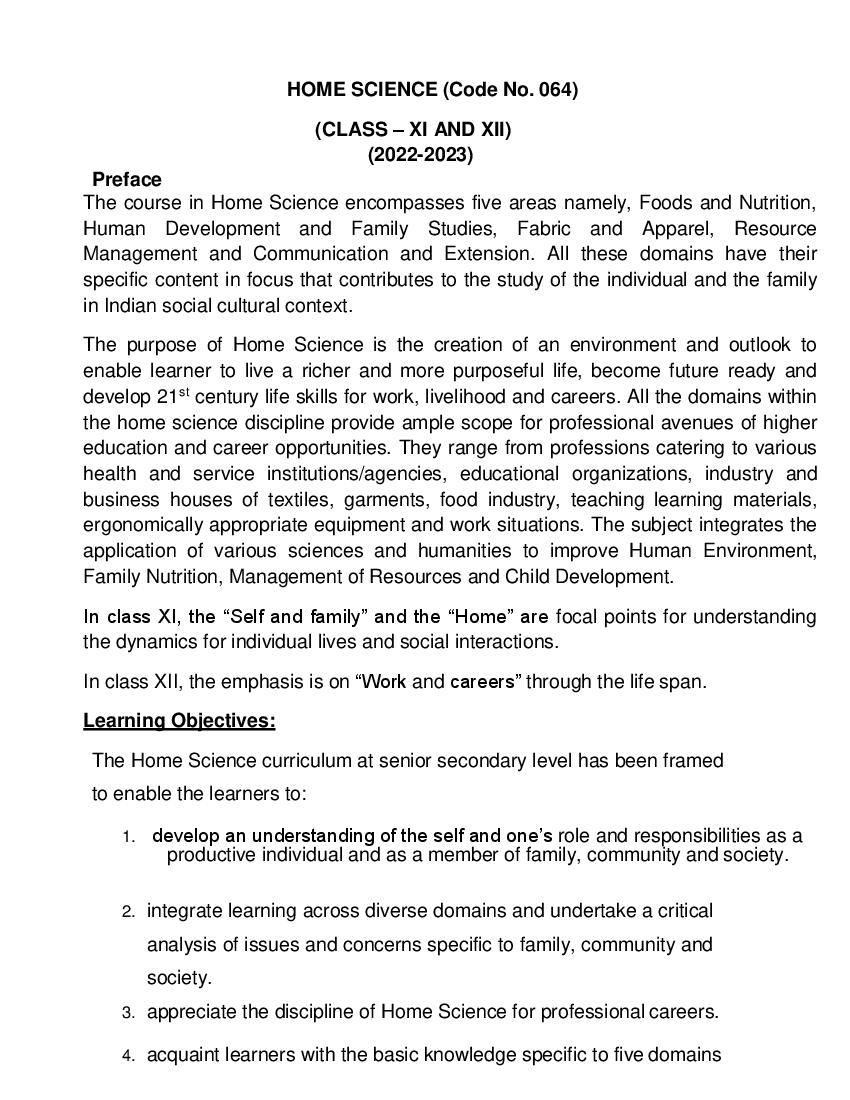
(CLASS – XI AND XII)
(2022-2023)
Preface
The course in Home Science encompasses five areas namely, Foods and Nutrition,
Human Development and Family Studies, Fabric and Apparel, Resource
Management and Communication and Extension. All these domains have their
specific content in focus that contributes to the study of the individual and the family
in Indian social cultural context.
The purpose of Home Science is the creation of an environment and outlook to
enable learner to live a richer and more purposeful life, become future ready and
develop 21st century life skills for work, livelihood and careers. All the domains within
the home science discipline provide ample scope for professional avenues of higher
education and career opportunities. They range from professions catering to various
health and service institutions/agencies, educational organizations, industry and
business houses of textiles, garments, food industry, teaching learning materials,
ergonomically appropriate equipment and work situations. The subject integrates the
application of various sciences and humanities to improve Human Environment,
Family Nutrition, Management of Resources and Child Development.
In class XI, the “Self and family” and the “Home” are focal points for understanding
the dynamics for individual lives and social interactions.
In class XII, the emphasis is on “Work and careers” through the life span.
Learning Objectives:
The Home Science curriculum at senior secondary level has been framed
to enable the learners to:
1. develop an understanding of the self and one’s role and responsibilities as a
productive individual and as a member of family, community and society.
2. integrate learning across diverse domains and undertake a critical
analysis of issues and concerns specific to family, community and
society.
3. appreciate the discipline of Home Science for professional careers.
4. acquaint learners with the basic knowledge specific to five domains
Page 2
Fabric and Apparel, Resource Management and Communication and
Extension.
5. develop functional skills in the five domains for career and employment.
6. equip learners for enrichment and higher studies.
Learning outcomes:
After undertaking the course students will be able to:
1. function as a productive and responsible individual in relation to self, family,
community and society.
2. apply the basics of human development with specific reference to self, family
and community.
3. utilize the skills of judicious management of various resources.
4. be sensitized to fabric and apparel, their selection and care.
5. inculcate healthy food habits and lifestyle to enable prevention and
management of diseases.
6. become alert and aware consumer.
7. appreciate the potential of entrepreneurship and other varied professional
opportunities to make informed career choices.
Page 3
CLASS XI
Introduction:
In class XI, the “Self and family” and the “Home” are focal points for understanding
the dynamics for individual lives and social interactions. The curriculum is divided in
five units. Unit I introduces the concept of home science. Unit II begins with the
stage of adolescence and related concerns. Unit III deals with the expanding
interactions of the adolescent with others in family, school, community and society,
and the needs emerging from each of these contexts. Unit IV and V focus on
childhood and adulthood respectively.
Course Structure: Theory & Practical
Time: 3 Hrs.
Theory: 70 Marks
Practical: 30 Marks
No. Units Marks No.of Pd.
1. Introduction to Home Science 02 04
2. Understanding oneself: Adolescence 20 35
3. Understanding Family, Community and Society 15 35
4. Childhood 15 24
5. Adulthood 18 28
Total 70 126
Practical 30 28
Grand Total 100 154
Page 4
Theory: 70Marks
Unit I Introduction to Home Science
Unit II: Understanding oneself: Adolescence
Ch.- Understanding the Self.
A. ‘Who am I’?
B. Development and Characteristics of the Self(Development characteristics
and needs of adolescents)
C. Influences on Identity
Ch.- Food, Nutrition, Health and Fitness
Ch. - Management of Resources
Ch.- Fabric Around us
Ch-Media and Communication Technology
Unit III: Understating family, community and society
Ch. - Concerns and needs in diverse contexts:
a. Nutrition, Health and Hygiene
b. Resources Availability and Management
Unit IV: Childhood
Ch.-Survival, Growth and Development
Ch.- Nutrition, Health and Wellbeing
Ch.- Our Apparel
UnitV: Adulthood
Ch.- Health and Wellness
Ch.- Financial Management and planning
Ch.- Care and Maintenance of fabrics
Page 5
CLASS XI
UNIT I: INTRODUCTION TO HOME SCIENCE
What is Home Science
Areas of Home Science
Home Science is important for both boys and girls
Career options of Home Science
UNIT II: UNDERSTANDING ONESELF: ADOLESCENCE
Unit II focus on the stage of adolescence – the stage of life to which you
belong at present. This unit deals with understanding your own self in terms of
your personal and social identity, your nutritional and health requirements,
management of basic resources of time and space, fabrics around you, and
your communication skills. The last chapter of the unit situates the adolescent
in the context of the family and larger society, thereby linking it to the next unit
that deals with the individual in relation to her/his family, school, community
and society.
CHAPTER : UNDERSTANDING THE SELF
What is Self?
Personal dimension
Social dimension
Self- concept
Self esteem
What is Identity?
Personal identity
Social identity
Self during Infancy: characteristics
Self during early childhood: characteristics
Self during middle childhood: characteristics
Self during adolescence: characteristics
Identity development
Identity crisis
Page 6
Influences on identity
Developing a sense of self and identity
Influences on formation of identity
Biological and physical changes
Socio-cultural context
Emotional changes
Cognitive changes
CHAPTER : FOOD, NUTRITION, HEALTH AND FITNESS
Introduction
Definition of
Food
Nutrition
Nutrients
Balanced diet
Definition
RDA
Health and Fitness
Using Basic food Groups for planning Balanced Diets
Food guide pyramid.
Vegetarian food Guide
Dietary patterns in Adolescence
Irregular meals and skipping meals
Snacking
Fast foods
Dieting
Modifying diet related behaviour
Diet journal
Exercise
Substance use and abuse
Healthy eating habits
Snacks
Drinking water
Factors influencing eating behaviour
Eating disorders at adolescence
Page 7
CHAPTER : MANAGEMENT OF RESOURCES
Introduction
Classification of resources
Human /non-human resources
Individual / shared resources
Natural / community resources
Human and non-human resources
Human resources
o Knowledge
o Motivation/ interest
o Skills/ strength/ aptitude
o Time
o Energy
Non-human resources
o Money
o Material resources
Individual and shared resources
Individual resources
shared resources
Natural and community resources
Natural resources
community resources
Characteristics of resources
Utility
Accessibility
Interchangeability
Manageable
Managing Resources
Management process
Planning
o Steps in planning
Organising
Implementing
Controlling
Evaluation
Page 8
Definition of yarns, fibres, textile products, finishing.
Introduction to fibre properties
Classification of textile fibres
Filament/staple fibres
Natural/Manufactured (manmade) fibres
Types of Natural Fibres
Cellulosic fibres
Protein fibres
Mineral fibres
Natural rubber
Types of Manufactured Fibres
Regenerated cellulosic fibres
Modified cellulosic fibres
Protein fibres
Non-cellulosic fibres
Mineral fibres
Some Important fibres and their properties
Cotton
Linen
Wool
Silk
Rayon
Nylon
Polyester
Acrylic
Elastomeric fibres
Yarns
Yarn processing
Cleaning
Making into a sliver
Attenuating, drawing out and twisting
Yarn terminology
Yarn number
Yarn twist
Yarn and thread
Fabric production
Weaving
Page 9
Braiding
Nets
Laces
Textile Finishing
Finishing with colour
Printing
CHAPTER-MEDIA COMMUNICATION TECHNOLOGY
Communication and Communication Technology
What is Communication
Classification of communication
How does communication takes place
What is media
Media classification and functions
What is communication technology
Classification of communication technologies
Modern communication technologies
Page 10
The chapters in Unit II were all addressed to you for the understanding of self
and of the factors that influence your decision making. Let us now move on to
understanding the family, the community and the society that you are a part of.
In the first section- the focus will be on relationships and interactions with
significant others, i.e. those important to you in these contexts. The second
section- will discuss concerns and needs, such as those of health, work,
resources, education and textile tradition in the adolescent’s diverse social
contexts.
CHAPTER : CONCERNS AND NEEDS IN DIVERSE CONTEXTS
A. NUTRITION, HEALTH AND HYGIENE
Health and its Dimensions
Social health
Mental health
Physical health
Health care Indicators of Health
Nutrition and Health
Importance of nutrients
Factors affecting nutritional well being
Food and nutrient security
Care for the vulnerable
Good health for all
Safe environment
Nutritional Problems and their consequences
Malnutrition
Under nutrition
Over nutrition
Hygiene and Sanitation
Personal Hygiene
Environmental Hygiene
Food Hygiene
Water safety-Qualities of potable water, methods of water
purification(Boiling, chlorine, storage and electric filter ,RO)
B. RESOURCES AVAILABILITY AND MANAGEMENT
Time Management
Page 11
How good is your time management (Activity)?
Steps in making time plan
Tips for effective time management
Tools in time management---Peak load period, Work curve, Rest
/break periods, Work simplification
Space Management
Space and the home
Principles of space planning
Page 12
The theme of this unit is ‘Childhood’. You may wonder why did the book
address the adolescent years first and childhood later. Well, it is because if
you as an adolescent understand issues about yourself first, it would be easier
to grasp the issues that are concerned with the stage of childhood, and later
with adulthood. In this unit you will be studying about children’s growth and
development, critical concerns about their health and nutrition, education and
clothing. As we would like children with disabilities to be an inclusive part of
our society, the chapters provide us important information on their needs and
ways to meet them.
CHAPTER : SURVIVAL GROWTH AND DEVELOPMENT
The meaning of survival
Growth and development
Areas of development
Physical development
Motor development
Cognitive development
Sensory development
Language development
Social development
Emotional development
Good Nutrition
Stages in development
Neonate
o Reflexes
o Sensory capabilities
Development across stages from infancy to adolescence
Physical and motor development
Language development
Socio –emotional development
Cognitive development
o Mental processes involved in thinking
o Stages of cognitive development
Sensory motor stage
Pre-operational stage
Concrete operational stage
Page 13
CHAPTER : NUTRITION, HEALTH AND WELL-BEING
Introduction
Nutrition, Health and Well-being during infancy (birth – 12 months)
Dietary requirements of infants
Breast feeding
o Benefits of breast feeding
Feeding the low birth weight infants
Complementary foods
Guidelines for complementary feeding
Immunization
Common health and nutrition problems in infants and young
children
Nutrition, Health and well-being of preschool children (1-6 years)
Nutritional needs of preschool children
Guidelines for healthy eating for pre-schoolers
Planning balanced meals for preschool children
Some examples of low-cost snacks
Feeding children with specific needs
Immunization
Nutrition, Health and well-being of school-age children (7-12 years)
Nutritional requirements of school children
Planning diets for school-age children
Factors that influence diet intake of preschool-age and school-age
children
Healthy habits
Health and nutrition issues of school age children
Page 14
Clothing functions and the selection of clothes
Modesty
Protection
Status and prestige
Adornment
Factors affecting selection of clothing in India
Age
Climate and season
Occasion
Fashion
Income
Understanding children’s basic clothing needs
Comfort
Safety
Self help
Appearance
Allowance for growth
Easy care
Fabrics
Clothing requirements at different childhood stages
Infancy (birth to six months)
Creeping age (6 months to one year)
Toddlerhood (1-2 years)
Preschool age (2-6 years)
Elementary school years (5-11 years)
Adolescents (11-19 years)
Clothes for children with special needs
Page 15
With the advent of adulthood, the adolescent passes through the portal of what
may be termed as the “real world”. One enters the world of higher education,
work and marriage, and gets involved in establishing one’s own family. Hence
responsibilities of the individual increases manifold. In this unit you will learn
about the major factors that play a role in determining the quality of adult life,
these being health and wellness, financial planning and management,
maintenance of fabrics and apparel that one uses personally as well as in the
home, and appreciation of different perspectives in communication. The unit
concludes with the chapter on individual responsibilities and rights, not only
for one’s own self, but also in relation to the family and larger society.
CHAPTER : HEALTH AND WELLNESS
Importance of health and fitness
Healthy & Unhealthy diet
BMI
Do’s and Don’ts for health promoting diets
Fitness
Importance of exercise and physical activities in adulthood
Wellness
Qualities of a person who is rated high on wellness
Dimensions of wellness
Social aspect
Physical aspect
Intellectual aspect
Occupational aspect
Emotional aspect
Spiritual aspect
Environmental aspect
Financial aspect
Stress and coping with stress
Simple techniques to cope with stress
Relaxation
Talking with friends/family
Reading
Spirituality
Music
Hobby
Page 16
CHAPTER : FINANCIAL MANAGEMENT AND PLANNING
Financial management
Financial planning
Management
Money and its importance
Family Income
Money income
Real income: Direct and Indirect income
Psychic income
Income management
Budget
Steps in making budget
Advantages of planning family budgets
Control in money management
Checking to see how well the plan is progressing
o Mental and mechanical check
o Records and accounts
Adjusting wherever necessary
Evaluation
Savings
Investment
Principles underlying sound investments
Safety to the principle amount
Reasonable rate of interest
Liquidity
Recognition of effect of world conditions
Easy accessibility and convenience
Investing in needed commodities
Tax efficiency
After investment service
Time period
Capacity
Savings and investment avenues
Post office
Banks
Page 17
NSC
Mutual funds
Provident funds
Chit fund
Life insurance and medical insurance
Pension scheme
Gold, house, land
Others (new schemes)
Credit
Need of credit
4C’s of credit: character, capacity, capital means, collateral,
CHAPTER : CARE AND MAINTENANCE OF FABRICS
Mending
Laundering
Stain removal
o Vegetable stains
o Animal stains
o Oil stains
o Mineral stains
o Dye bleeding
Techniques of stain removal
o Scraping
o Dipping
o Sponging
o Drop method
Reagent for stain removal
Common stains and method of removing
Removal of dirt: the cleaning process
Soaps and detergents
Methods of washing: friction, kneading & squeezing, suction, washing by
machine
Finishing
Blues and optical brighteners
Starches and stiffening agents
Ironing
Dry cleaning
Page 18
Factors affecting fabric care
Yarn structure
Fabric construction
Colour and finishes
Care label
NOTE:
Wherever required latest data/figures to be used.
Latest RDA’s to be used.
Page 19
1. Understanding oneself with reference to:
a) Physical development in terms of age, height, weight, hip and chest
circumference.
b) Sexual maturity (Age at menarche ,Development of breasts : girls).
Growth of beard, change in voice:boys)
2. Observe developmental norms: (Physical, Motor, Language and social -
emotional) birth to three years.
3. List and discuss 4-5 areas of agreement and disagreement with
a) Mother
b) Father
c) Siblings/ Friends
d) Teacher
4. a) Record own diet for a day
b) Evaluate qualitatively for adequacy
5. Preparation of different healthy snacks for an adolescent suitable in her/his
context.
6. a) Record one day’s activities relating to time use and work
b) Prepare a time plan for yourself
7. Plan a budget for a given situation/purpose.
8. a) Record the fabrics and apparel used in a day
b) Categorize them according to functionality
9. Relationship of fibre properties to their usage:
a) Thermal property and flammability
b) Moisture absorbency and comfort
10. (a) Analyze label of any one garment with respect to: Clarity, fiber content, size and
care instructions.
(b) Prepare one care label of any garment.
(c) Analyze two different fabric samples for color fastness.
Page 20
1. Observe developmental norms: (Physical, Motor, Language and social
emotional) birth to three years.
5 marks
OR
List and discuss 4-5 areas of agreement and disagreement with
a) Mother
b) Father
c) Siblings/ Friends
d) Teacher
2. Preparation of healthy snacks for an adolescent. 7marks
3. Plan a budget for a given situation/purpose. 3 marks
4. Prepare a time plan for yourself. 3 marks
5. Relationship of fibre properties to their usage: 5 marks
a) Thermal property and flammability
b) Moisture absorbency and comfort
OR
Prepare one care label of any garment.
6. File 5 marks
7. Viva 2 marks
Prescribed textbook: Human Ecology and Family Sciences(For class XI): Part I and
Part II
Page 21
HOME SCIENCE (CODE NO. 064)
CLASS- XI & XII
TIME: 3 HOURS Max. Marks: 70
S. Typology of Questions Total % Weightage
No Marks
.
1. Knowledge and understanding based
questionsterms, concepts, principles, or theories;
Identify, define, or recite 28 40%
interpret, compare, contrast, explain, paraphrase
information)
2. Application - or knowledge/concepts based
questions
(Use abstract information in concrete situation, to
apply knowledge to new situations. Use given 21 30%
content to interpret a
situation, provide an example, or solve a problem)
3.. Formulation, analysis, Evaluation and creativity
based question (Appraise, judge, and /or justify
the value or worth of a decision or outcome, or to 21 30%
predict outcomes)
Classify, compare, contrast, or differentiate
between different pieces of
integrate unique piece of information from a variety
of sources)
TOTAL 70 100
NOTE: Internal Choice of 30% will be given
Easy- 20%
Average- 60%
Difficult- 20%
Document Details
| Board / Org | CBSE |
| Exam | Class 11 |
| Type | Syllabus |
| Pages | 21 |
| Language | english |
| Updated | 15 Jul 2026 |