DUET 2021 Question Paper M.Sc Development Communication and Extension
Finished viewing? Save it for later —
Download DUET 2021 Question Paper M.Sc Development Communication and Extension (PDF · 22 pages)About DUET 2021 Question Paper M.Sc Development Communication and Extension
DUET 2021 Question Paper M.Sc Development Communication and Extension is available here for free download. Published by NTA for DUET, this question paper can be viewed online or downloaded as a PDF (22 pages). Candidates preparing for DUET can use DUET 2021 Question Paper M.Sc Development Communication and Extension to understand the exam pattern, the type of questions asked, and the overall difficulty level.
Frequently Asked Questions
How can I download DUET 2021 Question Paper M.Sc Development Communication and Extension?
Open this page and click the Download button to save DUET 2021 Question Paper M.Sc Development Communication and Extension as a PDF. It is completely free on AglaSem Docs.
Is DUET 2021 Question Paper M.Sc Development Communication and Extension free to download?
Yes. DUET 2021 Question Paper M.Sc Development Communication and Extension can be viewed online and downloaded as a PDF free of cost on AglaSem Docs.
How many pages does DUET 2021 Question Paper M.Sc Development Communication and Extension have?
DUET 2021 Question Paper M.Sc Development Communication and Extension contains 22 pages, which you can read online or download together as a single PDF.
Where can I find more DUET study material?
You can find more DUET question papers, sample papers, syllabus, and answer keys on AglaSem Docs.
DUET 2021 Question Paper M.Sc Development Communication and Extension – Text
Read the full text of this question paper below — useful to quickly search, copy and reference the content online without downloading the PDF.
📄 View text version (22 pages)
Page 1
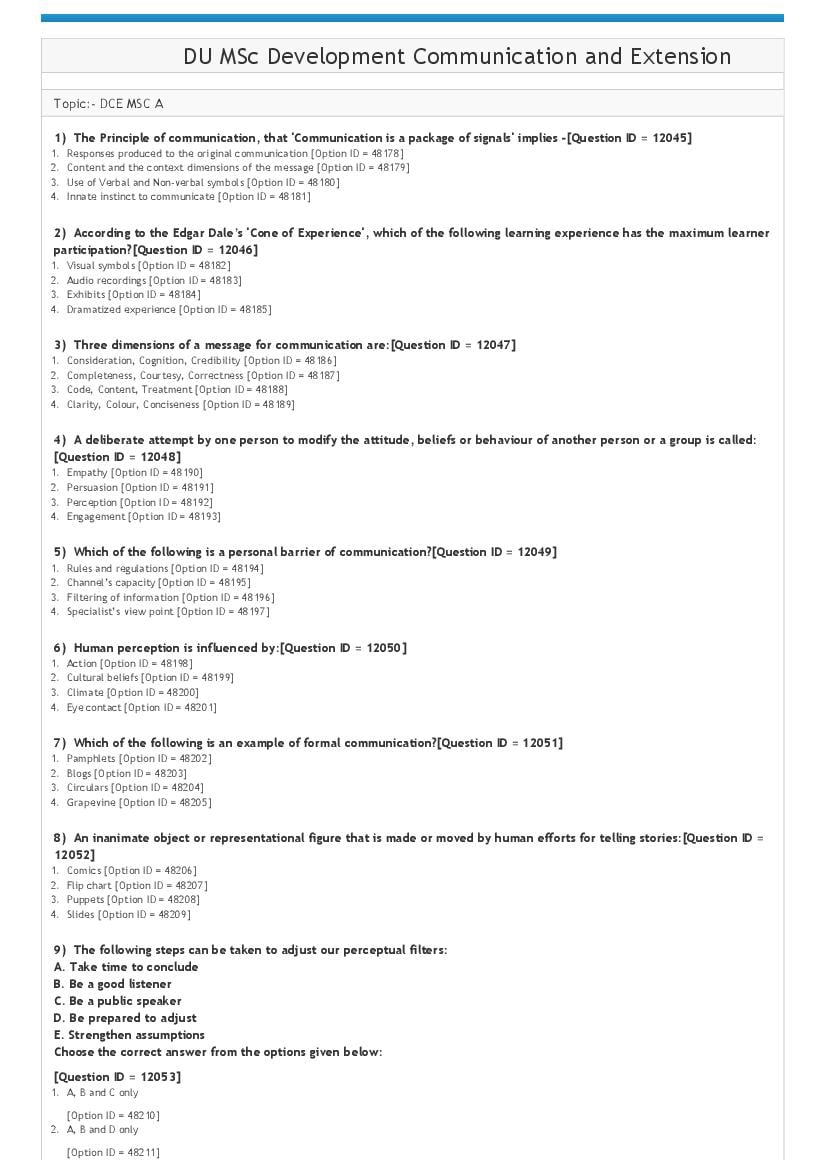
Topic:‐ DCE MSC A
1) The Principle of communication, that 'Communication is a package of signals' implies ‐[Question ID = 12045]
1. Responses produced to the original communication [Option ID = 48178]
2. Content and the context dimensions of the message [Option ID = 48179]
3. Use of Verbal and Non‐verbal symbols [Option ID = 48180]
4. Innate instinct to communicate [Option ID = 48181]
2) According to the Edgar Dale’s 'Cone of Experience', which of the following learning experience has the maximum learner
participation?[Question ID = 12046]
1. Visual symbols [Option ID = 48182]
2. Audio recordings [Option ID = 48183]
3. Exhibits [Option ID = 48184]
4. Dramatized experience [Option ID = 48185]
3) Three dimensions of a message for communication are:[Question ID = 12047]
1. Consideration, Cognition, Credibility [Option ID = 48186]
2. Completeness, Courtesy, Correctness [Option ID = 48187]
3. Code, Content, Treatment [Option ID = 48188]
4. Clarity, Colour, Conciseness [Option ID = 48189]
4) A deliberate attempt by one person to modify the attitude, beliefs or behaviour of another person or a group is called:
[Question ID = 12048]
1. Empathy [Option ID = 48190]
2. Persuasion [Option ID = 48191]
3. Perception [Option ID = 48192]
4. Engagement [Option ID = 48193]
5) Which of the following is a personal barrier of communication?[Question ID = 12049]
1. Rules and regulations [Option ID = 48194]
2. Channel’s capacity [Option ID = 48195]
3. Filtering of information [Option ID = 48196]
4. Specialist’s view point [Option ID = 48197]
6) Human perception is influenced by:[Question ID = 12050]
1. Action [Option ID = 48198]
2. Cultural beliefs [Option ID = 48199]
3. Climate [Option ID = 48200]
4. Eye contact [Option ID = 48201]
7) Which of the following is an example of formal communication?[Question ID = 12051]
1. Pamphlets [Option ID = 48202]
2. Blogs [Option ID = 48203]
3. Circulars [Option ID = 48204]
4. Grapevine [Option ID = 48205]
8) An inanimate object or representational figure that is made or moved by human efforts for telling stories:[Question ID =
12052]
1. Comics [Option ID = 48206]
2. Flip chart [Option ID = 48207]
3. Puppets [Option ID = 48208]
4. Slides [Option ID = 48209]
9) The following steps can be taken to adjust our perceptual filters:
A. Take time to conclude
B. Be a good listener
C. Be a public speaker
D. Be prepared to adjust
E. Strengthen assumptions
[Question ID = 12053]
1. A, B and C only
[Option ID = 48210]
2. A, B and D only
[Option ID = 48211]
Page 2
[Option ID = 48212]
4. B, C, and E only
[Option ID = 48213]
10) Following are the key features of non‐verbal communication;
A. Proxemics
B. Dynamics
C. Kinesics
D. Touch
E. Self disclosure
[Question ID = 12054]
1. A, B and C only
[Option ID = 48214]
2. A, C and D only
[Option ID = 48215]
3. B, C and D only
[Option ID = 48216]
4. B, C and E only
[Option ID = 48217]
11) In the history of Extension, the following were the objectives of work at Shanti Niketan:
A. To improve land.
B. To impart training in medicine.
C. To create a real interest in people for rural welfare work.
D. To study rural problems and to translates conclusions into action.
E. To improve village sanitation.
[Question ID = 12055]
1. A, B and C only
[Option ID = 48218]
2. A, B and D only
[Option ID = 48219]
3. B, C and D only
[Option ID = 48220]
4. C, D and E only
[Option ID = 48221]
12) Following are the characteristics of small group communication:
A. Interdependence
B. Common purpose
C. Hierarchial in nature
D. Collection of individuals
E. Never changing system
[Question ID = 12056]
1. A, B and C only
[Option ID = 48222]
2. A, B and D only
[Option ID = 48223]
3. B, C and D only
[Option ID = 48224]
4. B, C and E only
[Option ID = 48225]
13) The key aspects of Lasswell’s Model of communication include the following:
A. Investigative research
B. Control research
C. Medium research
D. Effect research
E. Descriptive research
Page 3
1. A, B and C only
[Option ID = 48226]
2. A, B and D only
[Option ID = 48227]
3. B, C and D only
[Option ID = 48228]
4. B, C and E only
[Option ID = 48229]
14) Match List I with List II
List I List II
(Type of Aid) (Example)
A. Two dimensional I. Field visit
B. Three dimensional II. Poster
C. Projected III. Model
D. Non‐projected IV. Films
V. Bulletin board
[Question ID = 12058]
1. A ‐ IV, B ‐ I, C ‐ V, D ‐ III [Option ID = 48230]
2. A ‐ V, B ‐ II, C ‐ I, D ‐ IV [Option ID = 48231]
3. A ‐ III, B ‐I , C ‐ V, D ‐ IV [Option ID = 48232]
4. A ‐ II, B ‐ III, C ‐ IV, D ‐ V [Option ID = 48233]
15) Match List I with List II
List I List II
(Functions of Communication) (Chracteristic)
A. Information I. Deal with Authority
B. Instruction II. Create Awareness
C. Influence III. Bring Social Change
D. Integration IV. Build Cohesiveness
V. Complete Figures
[Question ID = 12059]
1. A ‐ I, B ‐ II, C ‐ IV, D ‐ V [Option ID = 48234]
2. A ‐ II, B ‐ III, C ‐ I, D ‐ V [Option ID = 48235]
3. A ‐ II, B ‐ I, C ‐ III, D ‐ IV [Option ID = 48236]
4. A ‐ III, B ‐ II, C ‐ I, D ‐ V [Option ID = 48237]
16) Following are the purposes of audiovisual aids:
A. Make learning temporary
B. Illustrate the spoken words
C. Add joy and interest to learning
D. Retention of information
E. Distract the learner
[Question ID = 12060]
1. A, B and C only
[Option ID = 48238]
2. A, B and D only
[Option ID = 48239]
3. B, C and D only
[Option ID = 48240]
4. B, D and E only
[Option ID = 48241]
17) Given below are two statements, one is labelled as Assertion A and the other is labelled as Reason R
Assertion A : Extension professionals should not involve trained specialists.
Reason R : It is very important for Extension professionals to keep themselves abreast with all the latest research in
development sector.
In light of the above statements, choose the correct answer from the options given below:
[Question ID = 12061]
Page 4
[Option ID = 48242]
2. Both A and R are true but R is NOT the correct explanation of A
[Option ID = 48243]
3. A is true but R is false
[Option ID = 48244]
4. A is false but R is true
[Option ID = 48245]
18) Given below are two statements, one is labelled as Assertion A and the other is labelled as Reason R
Assertion A : AV Aids can assist in overcoming the language barrier between the communicator and the audience.
Reason R : AV Aids help create meaningful vocabulary and maintain continuity of thought.
In light of the above statements, choose the correct answer from the options given below
[Question ID = 12062]
1. Both A and R are true and R is the correct explanation of A
[Option ID = 48246]
2. Both A and R are true but R is NOT the correct explanation of A
[Option ID = 48247]
3. A is true but R is false
[Option ID = 48248]
4. A is false but R is true
[Option ID = 48249]
19) Given below are two statements
Statement I: Extension Education starts from theoretical framework and leads to practical work.
Statement II: The Extension activities are subject‐oriented.
In light of the above statements, choose the most appropriate answer from the options given below
[Question ID = 12063]
1. Both Statement I and Statement II are correct
[Option ID = 48250]
2. Both Statement I and Statement II are incorrect
[Option ID = 48251]
3. Statement I is correct but Statement II is incorrect
[Option ID = 48252]
4. Statement I is incorrect but Statement II is correct
[Option ID = 48253]
20) Arrange the following in the correct sequence of stages of listening process:
A. Receiving
B. Remembering
C. Responding
D. Evaluating
E. Understanding
[Question ID = 12064]
1. A, E, C, D, B
[Option ID = 48254]
2. A, E, B, D, C
[Option ID = 48255]
3. A, C, E, B, D
[Option ID = 48256]
4. C, A, E, B, D
[Option ID = 48257]
Topic:‐ DCE MSC B
1) Culture is one’s identification with and acceptance into a group that shares symbols, meanings, experiences, and
behavior. The context is an essential element of the communication process; culture perhaps is the most intrinsic context
Page 5
way of perceiving self; and its system of social organization. Knowing each of these helps individuals assign meaning to the
symbols. Because our communications are deeply influenced by our culture, hence communication and culture are
inseparable. While culture is a common code of conduct we learn and share based on the norms inherent in our traditions
and customs; it is the process of learning and sharing that requires communication. On the other hand, communication
requires coding and symbols that must be learned and shared. Every cultural pattern and every single act of social behavior
involves communication. Culture is transmitted from one generation to another through enculturation. It is the process
through which we learn the culture we are born in. People around us such as our parents, immediate relatives, kith and
kin, teachers, religious institutions teach us our culture. Another process of learning culture is that of acculturation, in
which we learn about a culture other than our native culture which can lead to modification of our native culture.
Communication across and between cultures, called cross‐cultural communication, has two facets that are intercultural
communication and intra‐cultural communication. Cross‐cultural communication is communication across two cultures; the
comparison between two cultures. Intercultural communication generally refers to face‐to‐face interactions among people
of diverse cultures. Intra‐cultural communication is generally communication among different individuals of the same
culture.
One’s identification with and acceptance into a group that shares symbols, meanings, experiences, and behavior is called:
[Question ID = 12065]
1. Coding
[Option ID = 48258]
2. Context
[Option ID = 48259]
3. Culture
[Option ID = 48260]
4. Channel
[Option ID = 48261]
2) Culture is one’s identification with and acceptance into a group that shares symbols, meanings, experiences, and
behavior. The context is an essential element of the communication process; culture perhaps is the most intrinsic context
for a communication process. Every culture has its worldview; its way of thinking of activity, time, and human nature; its
way of perceiving self; and its system of social organization. Knowing each of these helps individuals assign meaning to the
symbols. Because our communications are deeply influenced by our culture, hence communication and culture are
inseparable. While culture is a common code of conduct we learn and share based on the norms inherent in our traditions
and customs; it is the process of learning and sharing that requires communication. On the other hand, communication
requires coding and symbols that must be learned and shared. Every cultural pattern and every single act of social behavior
involves communication. Culture is transmitted from one generation to another through enculturation. It is the process
through which we learn the culture we are born in. People around us such as our parents, immediate relatives, kith and
kin, teachers, religious institutions teach us our culture. Another process of learning culture is that of acculturation, in
which we learn about a culture other than our native culture which can lead to modification of our native culture.
Communication across and between cultures, called cross‐cultural communication, has two facets that are intercultural
communication and intra‐cultural communication. Cross‐cultural communication is communication across two cultures; the
comparison between two cultures. Intercultural communication generally refers to face‐to‐face interactions among people
of diverse cultures. Intra‐cultural communication is generally communication among different individuals of the same
culture.
Culture is transmitted from one generation to another through the process of:
[Question ID = 12066]
1. Cultural context
[Option ID = 48262]
2. Enculturation
[Option ID = 48263]
3. Acculturation
[Option ID = 48264]
4. Coding
[Option ID = 48265]
3) Culture is one’s identification with and acceptance into a group that shares symbols, meanings, experiences, and
behavior. The context is an essential element of the communication process; culture perhaps is the most intrinsic context
for a communication process. Every culture has its worldview; its way of thinking of activity, time, and human nature; its
way of perceiving self; and its system of social organization. Knowing each of these helps individuals assign meaning to the
symbols. Because our communications are deeply influenced by our culture, hence communication and culture are
inseparable. While culture is a common code of conduct we learn and share based on the norms inherent in our traditions
and customs; it is the process of learning and sharing that requires communication. On the other hand, communication
requires coding and symbols that must be learned and shared. Every cultural pattern and every single act of social behavior
involves communication. Culture is transmitted from one generation to another through enculturation. It is the process
through which we learn the culture we are born in. People around us such as our parents, immediate relatives, kith and
kin, teachers, religious institutions teach us our culture. Another process of learning culture is that of acculturation, in
Page 6
Communication across and between cultures, called cross‐cultural communication, has two facets that are intercultural
communication and intra‐cultural communication. Cross‐cultural communication is communication across two cultures; the
comparison between two cultures. Intercultural communication generally refers to face‐to‐face interactions among people
of diverse cultures. Intra‐cultural communication is generally communication among different individuals of the same
culture.
The process by which we learn about a culture other than our native culture which can lead to modification of our native
culture is called:
[Question ID = 12067]
1. Cultural context
[Option ID = 48266]
2. Enculturation
[Option ID = 48267]
3. Customs
[Option ID = 48268]
4. Acculturation
[Option ID = 48269]
4) Culture is one’s identification with and acceptance into a group that shares symbols, meanings, experiences, and
behavior. The context is an essential element of the communication process; culture perhaps is the most intrinsic context
for a communication process. Every culture has its worldview; its way of thinking of activity, time, and human nature; its
way of perceiving self; and its system of social organization. Knowing each of these helps individuals assign meaning to the
symbols. Because our communications are deeply influenced by our culture, hence communication and culture are
inseparable. While culture is a common code of conduct we learn and share based on the norms inherent in our traditions
and customs; it is the process of learning and sharing that requires communication. On the other hand, communication
requires coding and symbols that must be learned and shared. Every cultural pattern and every single act of social behavior
involves communication. Culture is transmitted from one generation to another through enculturation. It is the process
through which we learn the culture we are born in. People around us such as our parents, immediate relatives, kith and
kin, teachers, religious institutions teach us our culture. Another process of learning culture is that of acculturation, in
which we learn about a culture other than our native culture which can lead to modification of our native culture.
Communication across and between cultures, called cross‐cultural communication, has two facets that are intercultural
communication and intra‐cultural communication. Cross‐cultural communication is communication across two cultures; the
comparison between two cultures. Intercultural communication generally refers to face‐to‐face interactions among people
of diverse cultures. Intra‐cultural communication is generally communication among different individuals of the same
culture.
Face‐to‐face interactions among people of diverse cultures is called:
[Question ID = 12068]
1. Enculturation
[Option ID = 48270]
2. Acculturation
[Option ID = 48271]
3. Intercultural communication
[Option ID = 48272]
4. Intra‐cultural communication
[Option ID = 48273]
5) Culture is one’s identification with and acceptance into a group that shares symbols, meanings, experiences, and
behavior. The context is an essential element of the communication process; culture perhaps is the most intrinsic context
for a communication process. Every culture has its worldview; its way of thinking of activity, time, and human nature; its
way of perceiving self; and its system of social organization. Knowing each of these helps individuals assign meaning to the
symbols. Because our communications are deeply influenced by our culture, hence communication and culture are
inseparable. While culture is a common code of conduct we learn and share based on the norms inherent in our traditions
and customs; it is the process of learning and sharing that requires communication. On the other hand, communication
requires coding and symbols that must be learned and shared. Every cultural pattern and every single act of social behavior
involves communication. Culture is transmitted from one generation to another through enculturation. It is the process
through which we learn the culture we are born in. People around us such as our parents, immediate relatives, kith and
kin, teachers, religious institutions teach us our culture. Another process of learning culture is that of acculturation, in
which we learn about a culture other than our native culture which can lead to modification of our native culture.
Communication across and between cultures, called cross‐cultural communication, has two facets that are intercultural
communication and intra‐cultural communication. Cross‐cultural communication is communication across two cultures; the
comparison between two cultures. Intercultural communication generally refers to face‐to‐face interactions among people
of diverse cultures. Intra‐cultural communication is generally communication among different individuals of the same
culture.
Communication among different individuals of the same culture is called:
Page 7
1. Enculturation
[Option ID = 48274]
2. Intra‐cultural communication
[Option ID = 48275]
3. Acculturation
[Option ID = 48276]
4. Intercultural communication
[Option ID = 48277]
Topic:‐ DCE MSC C
1) Which of the following theory suggests that the mass media predetermine what issues are regarded as important at any
given time?[Question ID = 12070]
1. Magic Bullet [Option ID = 48278]
2. Propaganda [Option ID = 48279]
3. Authoritarian [Option ID = 48280]
4. Agenda Setting [Option ID = 48281]
2) Information about ourselves that others know but we do not know is represented in the JoHari’s Window as:[Question ID
= 12071]
1. The Open Self [Option ID = 48282]
2. The Hidden Self [Option ID = 48283]
3. The Blind Self [Option ID = 48284]
4. The Unknown Self [Option ID = 48285]
3) Communication that takes place between individuals working at the same hierarchical levels within the organization is
known as:[Question ID = 12072]
1. Grapevine communication network [Option ID = 48286]
2. Vertical communication network [Option ID = 48287]
3. Diagonal communication network [Option ID = 48288]
4. Lateral communication network [Option ID = 48289]
4) Authoritarian Media Theory advocates:[Question ID = 12073]
1. Media as a free ‘market place’ [Option ID = 48290]
2. Media under complete control of government [Option ID = 48291]
3. Media under partial control of government [Option ID = 48292]
4. Media support for cultural pluralism [Option ID = 48293]
5) Body image refers to:[Question ID = 12074]
1. Provide information to others about yourself [Option ID = 48294]
2. The way we interact with others [Option ID = 48295]
3. Individual’s internal thoughts about personal values [Option ID = 48296]
4. The way we perceive ourselves in the social‐cultural system [Option ID = 48297]
6) The communication which takes place within ourselves as we plan to send a message to others is called:[Question ID =
12075]
1. Interpersonal communication [Option ID = 48298]
2. Group communication [Option ID = 48299]
3. Intrapersonal communication [Option ID = 48300]
4. Mass communication [Option ID = 48301]
7) Which of the following is a key feature of a newspaper as a medium and institution:[Question ID = 12076]
1. As a background medium [Option ID = 48302]
2. In public domain [Option ID = 48303]
3. Is a live medium [Option ID = 48304]
4. Has a high cost of production [Option ID = 48305]
8) An important aspect influencing the process of listening is:[Question ID = 12077]
1. Learning [Option ID = 48306]
2. Persuasion [Option ID = 48307]
3. Empathy [Option ID = 48308]
4. Participation [Option ID = 48309]
9) The tendency to evaluate the beliefs, attitudes, and values of our own culture positively and those of other cultures
negatively is called:[Question ID = 12078]
1. Assimilation [Option ID = 48310]
2. Acculturation [Option ID = 48311]
3. Stereotyping [Option ID = 48312]
4. Ethnocentrism [Option ID = 48313]
Page 8
differences:[Question ID = 12079]
1. Psychological noise [Option ID = 48314]
2. Physiological noise [Option ID = 48315]
3. Semantic noise [Option ID = 48316]
4. Physical noise [Option ID = 48317]
11) The three important aspects influencing interpersonal communication are:
A. Trust
B. Self‐disclosure
C. Delayed feedback
D. Self‐concept
E. Access to resources
[Question ID = 12080]
1. A, B and C only
[Option ID = 48318]
2. A, B and D only
[Option ID = 48319]
3. B, C and D only
[Option ID = 48320]
4. B, C and E only
[Option ID = 48321]
12) Following are the first three steps for developing a public speech:
A. Select the topic and purpose of the speech
B. Research on the speech topic
C. Formulate the speech context
D. Audience analysis
E. Give feedback
[Question ID = 12081]
1. A, B and D only
[Option ID = 48322]
2. A, C and E only
[Option ID = 48323]
3. B, C and D only
[Option ID = 48324]
4. B, D and E only
[Option ID = 48325]
13) Intrapersonal communication is largely influenced by our:
A. Affection
B. Motivation
C. Personality
D. Organizational structure
E. Values
[Question ID = 12082]
1. A, B and C only
[Option ID = 48326]
2. A, B and D only
[Option ID = 48327]
3. B, C and D only
[Option ID = 48328]
4. B, C and E only
Page 9
14) Following are the traits of an official small group:
A. Direct interaction
B. Common goal
C. High‐performing culture
D. Togetherness
E. Self‐disclosure
[Question ID = 12083]
1. A, B and C only
[Option ID = 48330]
2. A, B and D only
[Option ID = 48331]
3. B, C and D only
[Option ID = 48332]
4. B, C and E only
[Option ID = 48333]
15) Which of the following are the important features of radio as a mass medium?
A. Portable
B. Textual
C. Intimate
D. Future reference
E. Sound appeal
[Question ID = 12084]
1. A, B and C only
[Option ID = 48334]
2. A, C and E only
[Option ID = 48335]
3. B, C, D only
[Option ID = 48336]
4. B, C and E only
[Option ID = 48337]
16) A competent communicator is one who:
A. is politically connected
B. thinks critically and mindfully
C. is ethical
D. is culturally sensitive
E. is religious
[Question ID = 12085]
1. A, B and C only
[Option ID = 48338]
2. A, B and D only
[Option ID = 48339]
3. B, C and D only
[Option ID = 48340]
4. B, D and E only
[Option ID = 48341]
17) Arrange the following in the correct sequence of stages of relationship development:
A. Bonding
Page 10
C. Initiating
D. Intensifying
E. Integrating
[Question ID = 12086]
1. E, A, D, B and C
[Option ID = 48342]
2. B, A, C, D and E
[Option ID = 48343]
3. A, C, E, B and D
[Option ID = 48344]
4. C, B, D, E and A
[Option ID = 48345]
18) Given below are two statements, one is labelled as Assertion A and the other is labelled as Reason R
Assertion A: Community media ensure media pluralism.
Reason R: Community media encourage diversity of content, represent different marginalized groups, and promote counter‐
hegemonic discourse.
In light of the above statements, choose the most appropriate answer from the options given below
[Question ID = 12087]
1. Both A and R are correct and R is the correct explanation of A
[Option ID = 48346]
2. Both A and R are correct but R is NOT the correct explanation of A
[Option ID = 48347]
3. A is correct but R is not correct
[Option ID = 48348]
4. A is not correct but R is correct
[Option ID = 48349]
19) Given below are two statements
Statement I: Mass media refers to channels of communication that involve transmitting information to large number of
people.
Statement II: Mass media can be both alternative and mainstream media.
In light of the above statements, choose the correct answer from the options given below
[Question ID = 12088]
1. Both statement I and statement II are true
[Option ID = 48350]
2. Both statement I and statement II are false
[Option ID = 48351]
3. Statement I is true but statement II is false
[Option ID = 48352]
4. Statement I is false but statement II is true
[Option ID = 48353]
20) Given below are two statements
Statement I: The process of encoding in mass communication is always multistage.
Statement II: The messages in mass communication process are always private.
In light of the above statements, choose the correct answer from the options given below
[Question ID = 12089]
1. Both statement I and statement II are true
[Option ID = 48354]
2. Both statement I and statement II are false
[Option ID = 48355]
3. Statement I is true but statement II is false
[Option ID = 48356]
4. Statement I is false but statement II is true
Page 11
21) As per Lerner’s Model of Development, which of the following is an Index of Modernization?[Question ID = 12090]
1. Health [Option ID = 48358]
2. Urbanization [Option ID = 48359]
3. Security [Option ID = 48360]
4. Happiness [Option ID = 48361]
22) Match List I with List II
List I List II
(Participatory Learning and Action (PLA)
(Application)
Techniques)
A. Resource Map I. Institutions and people’s influence on local people
B.Venn Diagram II. Livelihood pattern, credit crunch, food security, diseases
C. Seasonal Diagram III. Topography, land and land use, watershed development
D. Daily Activity Schedule IV. Availability of leisure time, who does what, when & how
V. Behaviour, decisions, and coping strategies of households with different socio‐
economic characteristics
[Question ID = 12091]
1. A ‐ IV, B ‐ III, C ‐ II, D ‐ I [Option ID = 48362]
2. A ‐ II, B ‐ V, C ‐ IV, D ‐ III [Option ID = 48363]
3. A ‐ III, B ‐ I, C ‐ II, D ‐ IV [Option ID = 48364]
4. A ‐ IV, B ‐ II, C ‐ III, D ‐ I [Option ID = 48365]
23) Which one of the following is the major linear indicator of development?[Question ID = 12092]
1. Human Development Level [Option ID = 48366]
2. Gross Domestic Output [Option ID = 48367]
3. Human Poverty Index [Option ID = 48368]
4. Gross National Product [Option ID = 48369]
24) Which of the following is an important component of the Participatory Paradigm of Development?[Question ID = 12093]
1. GNP centered [Option ID = 48370]
2. Technologically deterministic [Option ID = 48371]
3. Equity based [Option ID = 48372]
4. Spiral of silence [Option ID = 48373]
25) Which one of the following is a salient feature of traditional folk media?[Question ID = 12094]
1. Reliance on electronic media [Option ID = 48374]
2. Unlimited reach [Option ID = 48375]
3. Preservation of culture [Option ID = 48376]
4. Messages are broadcasted [Option ID = 48377]
26) Match List I with List II
List I List II
(Training Methods) (Primary Purpose)
A. Lecture I. Awareness raising structured experience based on self experience
B. Games II. Knowledge building
C. Role play III. Education and Entertainment
D. Case study IV. Awareness raising structured experience based on others experience
V. Visualized explanation of an important fact, idea or process
[Question ID = 12095]
1. A ‐ IV, B ‐ I, C ‐ II, D ‐ III [Option ID = 48378]
2. A ‐ II, B ‐ III, C ‐ I, D ‐ IV [Option ID = 48379]
3. A ‐ III, B ‐ I, C ‐ II, D ‐ V [Option ID = 48380]
4. A ‐ IV, B ‐ I, C ‐ III, D ‐ II [Option ID = 48381]
27) Arrange the following steps in the correct sequence for designing a training programme:
A. Setting out training objectives
B. Identifying training needs
Page 12
D. Identifying training contents
E. Establishing mechanism for monitoring and evaluation
[Question ID = 12096]
1. A, B, C, E, D
[Option ID = 48382]
2. C, B, E, D, A
[Option ID = 48383]
3. E, C, B, A, D
[Option ID = 48384]
4. B, A, D, C, E
[Option ID = 48385]
28) Which of the following type of radio, broadcast for profit and depends upon advertising as its key source of funding:
[Question ID = 12097]
1. Community radio [Option ID = 48386]
2. Public radio [Option ID = 48387]
3. Commercial radio [Option ID = 48388]
4. Campus radio [Option ID = 48389]
29) Linear, one way model of communication conceptualized communication as a mechanical process that has:[Question ID
= 12098]
1. Active receiver [Option ID = 48390]
2. Active source [Option ID = 48391]
3. Passive source [Option ID = 48392]
4. Passive message [Option ID = 48393]
30) The Development Model that is also referred to as the Western Model of Development is:[Question ID = 12099]
1. New Paradigm of Development [Option ID = 48394]
2. Dependency Model [Option ID = 48395]
3. Dominant Paradigm [Option ID = 48396]
4. Interdependency Model [Option ID = 48397]
31) Following are the prerequisites of development communication:
A. Human and localized approach to communication
B. Credibility and role of communication links
C. Abstract approach to communication
D. Access to communication
E. Centralized approach to communication
[Question ID = 12100]
1. A, B and C only
[Option ID = 48398]
2. A, B and D only
[Option ID = 48399]
3. B, C and D only
[Option ID = 48400]
4. B, D and E only
[Option ID = 48401]
32) Social Progress Index considers the following parameters:
A. Basic human needs
B. Rate of corruption
C. Foundations of well‐being
D. Opportunity
E. Expected years of schooling
[Question ID = 12101]
Page 13
[Option ID = 48402]
2. A, C and D only
[Option ID = 48403]
3. B, C and D only
[Option ID = 48404]
4. B, D and E only
[Option ID = 48405]
33) Philosophy of Development Communication suggests that it should be:
A. Problematic
B. Purposive
C. Positive
D. Pragmatic
E. Productive
[Question ID = 12102]
1. A, B and C only
[Option ID = 48406]
2. A, B and D only
[Option ID = 48407]
3. B, C and D only
[Option ID = 48408]
4. B, D and E only
[Option ID = 48409]
34) According the Wood’s Triangle for Development Support Communication, following are the key elements in the
development linkage:
A. Knowledge managers
B. Knowledge commissions
C. Knowledge generators
D. Political leaders
E. Knowledge users
[Question ID = 12103]
1. A, B and C only
[Option ID = 48410]
2. A, B and D only
[Option ID = 48411]
3. B, C and D only
[Option ID = 48412]
4. B, D and E only
[Option ID = 48413]
35) In the dissemination of ideas and services, the ‘social marketing approach’ emphasises the following to maximize the
target groups’ response:
A. Product development
B. Audience segmentation
C. Policy development
D. Market research
E. Incentives
Choose the correct answer from the options given below
[Question ID = 12104]
1. A, B and C only
[Option ID = 48414]
2. A, B and E only
Page 14
3. B, C and D only
[Option ID = 48416]
4. B, D and E only
[Option ID = 48417]
36) Match List I with List II
List I List II
(Aspects of Alternative
(Description )
Media)
A. Organizational
I. Rejection of commercial motives, assertion of human, cultural, educational ends
structure
B. Purpose II. Local, diversity and multiplicity
C. Message content III. Small scale, horizontal organization allowing participation and democratization of communication
D. Composition of the IV. Carriers of non‐dominant, (possibly counter‐hegemonic) discourses and representations,
audience emphasis on self‐ representation
V. Political priority given to the bureaucrats and leaders
[Question ID = 12105]
1. A ‐ II, B ‐ III, C ‐ I, D ‐ IV
[Option ID = 48418]
2. A ‐ I, B ‐ IV, C ‐ III, D ‐ V
[Option ID = 48419]
3. A ‐ V, B ‐ IV, C ‐ III, D ‐ II
[Option ID = 48420]
4. A ‐ III, B ‐ I, C ‐ IV, D ‐ II
[Option ID = 48421]
37) Match List I with List II
List I List II
(Ingredients of the News) (Incidents)
A. Proximity I. related to important people
B. Conflict II.related to stories of people’s triumph and grief
C. Prominence III. around us
D. Human Interest IV. related to economic crisis
V. related to violence
[Question ID = 12106]
1. A ‐ IV, B ‐ V, C ‐ III, D ‐ II [Option ID = 48422]
2. A ‐ V, B ‐ I, C ‐ IV, D ‐ III [Option ID = 48423]
3. A ‐ III, B ‐ V, C ‐ I, D ‐ II [Option ID = 48424]
4. A ‐ I, B ‐ IV, C ‐ III, D ‐ V [Option ID = 48425]
38) Match List I with List II
List I List II
(Government of India Initiatives) (Key Focus)
A. Saakshar Bharat Mission I. Provide free access to healthcare for low income earners in the country
B. Ayushman Bharat Yojana II. Expand affordable access to financial service
C. Integrated Child Development Services
III. Provide services to children and their mother
Scheme
D. National Rural Livelihood Mission IV. Promote and strengthen adult learning
V. Promote self‐employment and organization of rural poor
[Question ID = 12107]
1. A ‐ I, B ‐ III, C ‐ II, D ‐ IV [Option ID = 48426]
2. A ‐ II, B ‐ III, C ‐ V, D ‐ I [Option ID = 48427]
3. A ‐ IV, B ‐ I, C ‐ III, D ‐ V [Option ID = 48428]
4. A ‐ V, B ‐ II, C ‐ IV, D ‐ I [Option ID = 48429]
39) Given below are two statements, one is labelled as Assertion A and the other is labelled as Reason R
Page 15
Reason R : The lead of the news summarizes the story by proximity, prominence and human interest.
In light of the above statements, choose the most appropriate answer from the options given below
[Question ID = 12108]
1. Both A and R are true and R is the correct explanation of A
[Option ID = 48430]
2. Both A and R are true but R is NOT the correct explanation of A
[Option ID = 48431]
3. A is true but R is false
[Option ID = 48432]
4. A is false but R is true
[Option ID = 48433]
40) Given below are two statements
Statement I: Economic marginalization as a process relates to economic structures, in particular to the structure of markets
and their integration.
Statement II: Economic marginality have both direct and indirect impact on people’s health and wellbeing.
In light of the above statements, choose the most appropriate answer from the options given below
[Question ID = 12109]
1. Both Statement I and Statement II are correct
[Option ID = 48434]
2. Both Statement I and Statement II are incorrect
[Option ID = 48435]
3. Statement I is correct but Statement II is incorrect
[Option ID = 48436]
4. Statement I is incorrect but Statement II is correct
[Option ID = 48437]
41) The Basic Needs approach emphasised both, basic fundamental needs of people as well as respect for:[Question ID =
12110]
1. Environmental conservation [Option ID = 48438]
2. Technological Advancement [Option ID = 48439]
3. Political growth [Option ID = 48440]
4. Human Rights [Option ID = 48441]
Topic:‐ DCE MSC D
1) In the history of development economics, Gross National Product (GNP) has been thought of as a key indicator in
measuring the development of a nation. Before the 1970s, economic development was evaluated in terms of the GNP and
per capita income, which stood alone as the ultimate standard of national progress and prosperity. However, over the years,
researchers have found that the GNP is not a single indicator that can be used to measure development. A breakthrough in
the thinking about development came with the work of Mahbub ul Haq (1995) and Amartya Sen (1999) which led to a re‐
definition of the development process from one that focuses solely on economic growth to one in which the fruit of
economic growth benefits the population in terms of higher literacy rates and education levels, better health and nutrition,
higher levels of social cohesion and social skills, and more equality (Van Der Gaag, 2011). In a similar line of thinking, the
United Nations Development Programme (UNDP) has developed the Human Development Index (HDI), which goes beyond
narrow monetary income definitions of development. The Human Development Report states that human development is a
process of enlarging people’s choices. Consequently, a new view of development has emerged which Todaro (1997)
describes as a multidimensional process involving major structural changes in social, attitudes, and national institutions, as
well as the acceleration of economic growth, the reduction of inequality and the eradication of poverty. Simply stated,
development refers to the process of improving the quality of life of all human lives. For instance, a major effort in this
direction was the development of a composite ‘Physical Quality of Life Index’ (PQLI). This index was based on a country’s
life expectancy, infant mortality rate, and literacy rate (Morris, 1979). Overall, good development measurement requires
researchers to develop indicators that consider economic, social, political, environmental, and technological concerns.
Which indicator in the history of development economics has been thought of as a key indicator in measuring the
development of a nation?
[Question ID = 12111]
1. Human Development Index
[Option ID = 48442]
2. Gross National Product
[Option ID = 48443]
3. Physical Quality of Life Index
Page 16
4. Happy Planet Index
[Option ID = 48445]
2) In the history of development economics, Gross National Product (GNP) has been thought of as a key indicator in
measuring the development of a nation. Before the 1970s, economic development was evaluated in terms of the GNP and
per capita income, which stood alone as the ultimate standard of national progress and prosperity. However, over the years,
researchers have found that the GNP is not a single indicator that can be used to measure development. A breakthrough in
the thinking about development came with the work of Mahbub ul Haq (1995) and Amartya Sen (1999) which led to a re‐
definition of the development process from one that focuses solely on economic growth to one in which the fruit of
economic growth benefits the population in terms of higher literacy rates and education levels, better health and nutrition,
higher levels of social cohesion and social skills, and more equality (Van Der Gaag, 2011). In a similar line of thinking, the
United Nations Development Programme (UNDP) has developed the Human Development Index (HDI), which goes beyond
narrow monetary income definitions of development. The Human Development Report states that human development is a
process of enlarging people’s choices. Consequently, a new view of development has emerged which Todaro (1997)
describes as a multidimensional process involving major structural changes in social, attitudes, and national institutions, as
well as the acceleration of economic growth, the reduction of inequality and the eradication of poverty. Simply stated,
development refers to the process of improving the quality of life of all human lives. For instance, a major effort in this
direction was the development of a composite ‘Physical Quality of Life Index’ (PQLI). This index was based on a country’s
life expectancy, infant mortality rate, and literacy rate (Morris, 1979). Overall, good development measurement requires
researchers to develop indicators that consider economic, social, political, environmental, and technological concerns.
The work of Mahbub ul Haq and Amartya Sen led a re‐definition of the development process from one that focuses solely on
economic growth to one in which the fruit of economic growth benefits the:
[Question ID = 12112]
1. Environment
[Option ID = 48446]
2. Market
[Option ID = 48447]
3. Population
[Option ID = 48448]
4. Technology
[Option ID = 48449]
3) In the history of development economics, Gross National Product (GNP) has been thought of as a key indicator in
measuring the development of a nation. Before the 1970s, economic development was evaluated in terms of the GNP and
per capita income, which stood alone as the ultimate standard of national progress and prosperity. However, over the years,
researchers have found that the GNP is not a single indicator that can be used to measure development. A breakthrough in
the thinking about development came with the work of Mahbub ul Haq (1995) and Amartya Sen (1999) which led to a re‐
definition of the development process from one that focuses solely on economic growth to one in which the fruit of
economic growth benefits the population in terms of higher literacy rates and education levels, better health and nutrition,
higher levels of social cohesion and social skills, and more equality (Van Der Gaag, 2011). In a similar line of thinking, the
United Nations Development Programme (UNDP) has developed the Human Development Index (HDI), which goes beyond
narrow monetary income definitions of development. The Human Development Report states that human development is a
process of enlarging people’s choices. Consequently, a new view of development has emerged which Todaro (1997)
describes as a multidimensional process involving major structural changes in social, attitudes, and national institutions, as
well as the acceleration of economic growth, the reduction of inequality and the eradication of poverty. Simply stated,
development refers to the process of improving the quality of life of all human lives. For instance, a major effort in this
direction was the development of a composite ‘Physical Quality of Life Index’ (PQLI). This index was based on a country’s
life expectancy, infant mortality rate, and literacy rate (Morris, 1979). Overall, good development measurement requires
researchers to develop indicators that consider economic, social, political, environmental, and technological concerns.
The Human Development Index (HDI) was developed by:
[Question ID = 12113]
1. Amartya Sen
[Option ID = 48450]
2. Van Der Gaag
[Option ID = 48451]
3. Todaro
[Option ID = 48452]
4. UNDP
[Option ID = 48453]
4) In the history of development economics, Gross National Product (GNP) has been thought of as a key indicator in
measuring the development of a nation. Before the 1970s, economic development was evaluated in terms of the GNP and
per capita income, which stood alone as the ultimate standard of national progress and prosperity. However, over the years,
researchers have found that the GNP is not a single indicator that can be used to measure development. A breakthrough in
Page 17
definition of the development process from one that focuses solely on economic growth to one in which the fruit of
economic growth benefits the population in terms of higher literacy rates and education levels, better health and nutrition,
higher levels of social cohesion and social skills, and more equality (Van Der Gaag, 2011). In a similar line of thinking, the
United Nations Development Programme (UNDP) has developed the Human Development Index (HDI), which goes beyond
narrow monetary income definitions of development. The Human Development Report states that human development is a
process of enlarging people’s choices. Consequently, a new view of development has emerged which Todaro (1997)
describes as a multidimensional process involving major structural changes in social, attitudes, and national institutions, as
well as the acceleration of economic growth, the reduction of inequality and the eradication of poverty. Simply stated,
development refers to the process of improving the quality of life of all human lives. For instance, a major effort in this
direction was the development of a composite ‘Physical Quality of Life Index’ (PQLI). This index was based on a country’s
life expectancy, infant mortality rate, and literacy rate (Morris, 1979). Overall, good development measurement requires
researchers to develop indicators that consider economic, social, political, environmental, and technological concerns.
Which of the following is an important component of the Physical Quality of Life Index?
[Question ID = 12114]
1. Financial products and services
[Option ID = 48454]
2. Sustainability
[Option ID = 48455]
3. Per capita income
[Option ID = 48456]
4. Infant mortality rate
[Option ID = 48457]
Topic:‐ DCE MSC E
1) In a research study, Gender and Attitude are examples of:[Question ID = 12115]
1. Design [Option ID = 48458]
2. Variables [Option ID = 48459]
3. Sample [Option ID = 48460]
4. Objectives [Option ID = 48461]
2) Which of the following is a secondary source of data collection?[Question ID = 12116]
1. Surveys [Option ID = 48462]
2. Interviews [Option ID = 48463]
3. Questionnaires [Option ID = 48464]
4. Journal articles [Option ID = 48465]
3) Which of the following is a probability sampling design?[Question ID = 12117]
1. Snowball sampling [Option ID = 48466]
2. Judgmental sampling [Option ID = 48467]
3. Stratified sampling [Option ID = 48468]
4. Expert sampling [Option ID = 48469]
4) Self‐esteem and Satisfaction are example of: [Question ID = 12118]
1. Variables [Option ID = 48470]
2. Image [Option ID = 48471]
3. Concepts [Option ID = 48472]
4. Sample [Option ID = 48473]
5) Methods of data collection in qualitative research are:
A. Structured interviews
B. Unstructured interviews
C. Polls
D. Participant observation
E. Secondary sources
[Question ID = 12119]
1. A, B and C only
[Option ID = 48474]
2. A, B and D only
[Option ID = 48475]
3. B, C and D only
[Option ID = 48476]
Page 18
[Option ID = 48477]
6) Women’s identities are traced through men in:[Question ID = 12120]
1. Matriarchal system [Option ID = 48478]
2. Patriarchal system [Option ID = 48479]
3. Authoritative system [Option ID = 48480]
4. Democratic system [Option ID = 48481]
7) Arrange the following in the correct sequence of approaches to understand women’s participation in development:
A. The Welfare Approach
B. Gender Mainstreaming Approach
C. Gender and Development
D. Women in Development
E. Women and Development
Choose the correct answer from the options given below
[Question ID = 12121]
1. A, D, E, C, B
[Option ID = 48482]
2. A, B, C, D, E
[Option ID = 48483]
3. A, C, E, B, D
[Option ID = 48484]
4. C, A, E, B, D
[Option ID = 48485]
8) Which of the following is an agency working for women’s development in India?
[Question ID = 12122]
1. Comptroller and Auditor General of India
[Option ID = 48486]
2. Ministry of Youth Development
[Option ID = 48487]
3. National Commission for Minorities
[Option ID = 48488]
4. Central Social Welfare Board
[Option ID = 48489]
9) Match List I with List II
List I List II
(Provision) (Issue addressed)
A. PCPNDT Act I. Inheritance Rights
B. PWDVA II. Domestic Violence
C. 73rd & 74th Amendment of Indian ConstitutionIII. Wage Parity
D. Equal Remuneration Act IV. Political Reservation Bill
V. Sex‐Selective Abortions
[Question ID = 12123]
1. A ‐I , B ‐ III , C ‐ II , D ‐ IV [Option ID = 48490]
2. A ‐ V , B ‐ II , C ‐ IV , D ‐ III [Option ID = 48491]
3. A ‐ II, B ‐ V , C ‐ III , D ‐ I [Option ID = 48492]
4. A ‐ IV, B ‐ I , C ‐ III , D ‐ II [Option ID = 48493]
10) Given below are two statements, one is labelled as Assertion A and the other is labelled as Reason R
Assertion A : Gender relations are not the same in every society, nor historically static.
Reason R : They are dynamic, and change over time.
In light of the above statements, choose the correct answer from the options given below
[Question ID = 12124]
1. Both A and R are true and R is the correct explanation of A
[Option ID = 48494]
2. Both A and R are true but R is NOT the correct explanation of A
Page 19
3. A is true but R is false
[Option ID = 48496]
4. A is false but R is true
[Option ID = 48497]
11) Given below are two statements, one is labelled as Assertion A and the other is labelled as Reason R
Assertion A : Gender refers to the socio‐cultural definition of men and women.
Reason R : It is used as an analytical tool to understand the social realities of men and women.
In light of the above statements, choose the correct answer from the options given below
[Question ID = 12125]
1. Both A and R are true and R is the correct explanation of A
[Option ID = 48498]
2. Both A and R are true but R is NOT the correct explanation of A
[Option ID = 48499]
3. A is true but R is false
[Option ID = 48500]
4. A is false but R is true
[Option ID = 48501]
12) The techniques and practices used to bring products, services, opinions or causes to public notice for persuasion is:
[Question ID = 12126]
1. Public relations [Option ID = 48502]
2. Advertising [Option ID = 48503]
3. Direct marketing [Option ID = 48504]
4. Promotional event [Option ID = 48505]
13) A creative, often witty, ad slogan that helps people remember a particular product is a:[Question ID = 12127]
1. Caption [Option ID = 48506]
2. Headline [Option ID = 48507]
3. Tagline [Option ID = 48508]
4. Campaign [Option ID = 48509]
14) Which of the following are tools of public relations?
A. Broadcast media
B. Press conference
C. Exhibitions
D. Paid space
E. Talking therapy
[Question ID = 12128]
1. A, B and C only
[Option ID = 48510]
2. A, B and D only
[Option ID = 48511]
3. B, C And D only
[Option ID = 48512]
4. B, D, and E only
[Option ID = 48513]
15) The key elements of the marketing mix that companies use to implement their targets are:
A. Sales promotion
B. Public relations
C. Planning
D. Advertising
E. Personal selling
[Question ID = 12129]
Page 20
[Option ID = 48514]
2. A, B and D only
[Option ID = 48515]
3. B, C and D only
[Option ID = 48516]
4. B, D and E only
[Option ID = 48517]
16) Given below are two statements
Statement I: Brand is the name of a product or service that is very easily recognizable.
Statement II: There is a new phase in advertising with the coming of the internet and popularity of mobile phones.
In light of the above statements, choose the most appropriate answer from the options given below
[Question ID = 12130]
1. Both Statement I and Statement II are correct
[Option ID = 48518]
2. Both Statement I and Statement II are incorrect
[Option ID = 48519]
3. Statement I is correct but Statement II is incorrect
[Option ID = 48520]
4. Statement I is incorrect but Statement II is correct
[Option ID = 48521]
17) Ensminger in his definition of Extension observes the main purpose of Extension is to:[Question ID = 12131]
1. Create policy [Option ID = 48522]
2. Change attitudes and practices of people [Option ID = 48523]
3. Develop audio visual aids [Option ID = 48524]
4. Involve mass media [Option ID = 48525]
18) Which of the following category of adopters adopt a new product or technology before the majority of the population
does?[Question ID = 12132]
1. Early majority [Option ID = 48526]
2. Laggards [Option ID = 48527]
3. Late majority [Option ID = 48528]
4. Early adopters [Option ID = 48529]
19) Which of the following is a feature of Extension education?[Question ID = 12133]
1. Theory centric [Option ID = 48530]
2. Curriculum Centric [Option ID = 48531]
3. Flexible and need based [Option ID = 48532]
4. Homogeneous audience [Option ID = 48533]
20) A universal truth that has been observed and found to be true under varying conditions and circumstances is:[Question
ID = 12134]
1. a hypothesis [Option ID = 48534]
2. a theory [Option ID = 48535]
3. a principle [Option ID = 48536]
4. an aim [Option ID = 48537]
21) A mass contact based approach used in Extension is:[Question ID = 12135]
1. Demonstration [Option ID = 48538]
2. Radio programme [Option ID = 48539]
3. Telephone calls [Option ID = 48540]
4. Field trip [Option ID = 48541]
22) As part of which programme the position of ‘Anganwadi Workers’was instituted by the Government of India:[Question
ID = 12136]
1. National Rural Health Mission [Option ID = 48542]
2. Integrated Child Development Scheme [Option ID = 48543]
3. School Health Programme [Option ID = 48544]
4. National AIDS Control Programme [Option ID = 48545]
23) Posters are an example of:[Question ID = 12137]
1. Audio aids [Option ID = 48546]
2. Video aids [Option ID = 48547]
3. Visual aids [Option ID = 48548]
4. Audio‐visual aids [Option ID = 48549]
Page 21
1. Framing goals and objectives [Option ID = 48550]
2. Planning and implementing activities [Option ID = 48551]
3. Collection, analysis and interpretation of existing facts [Option ID = 48552]
4. Defining frame of reference [Option ID = 48553]
25) Which of the following is the philosophy of Extension?[Question ID = 12139]
1. Altruism [Option ID = 48554]
2. Performance [Option ID = 48555]
3. Profitability [Option ID = 48556]
4. Self help [Option ID = 48557]
26) The style of leadership in which leaders guide, rather than direct is: [Question ID = 12140]
1. Authoritarian [Option ID = 48558]
2. Democratic [Option ID = 48559]
3. Laissez‐faire [Option ID = 48560]
4. Bureaucratic [Option ID = 48561]
27) Which of the following is a principle of adult learning?[Question ID = 12141]
1. Identification of the needs by the learner [Option ID = 48562]
2. Satisfaction of family [Option ID = 48563]
3. Cultural change [Option ID = 48564]
4. Whole family approach [Option ID = 48565]
28) Which of the following are the features of participatory leadership?
A. Workers are encouraged to think of solution
B. Senior staff work to improve the status of all colleagues
C. Managerial staff take decision for everyone
D. Senior staff seek views of colleagues on important matter
E. Workers are directly supervised by the leader
[Question ID = 12142]
1. A, B and C only
[Option ID = 48566]
2. A, B and D only
[Option ID = 48567]
3. B, C and D only
[Option ID = 48568]
4. B, D and E only
[Option ID = 48569]
29) Which of the following are the features of the 73rd Amendment to the Constitution?
A. Restoration of the important role of the Gram Sabha
B. Direct election to the Panchayats
C. No reservation for Scheduled Castes and Scheduled Tribes
D. Lowering the age for voting from 21 years to 18 years
E. Elections to the Panchayats to be conducted by the State Election Commissions
[Question ID = 12143]
1. A, B and C only
[Option ID = 48570]
2. A, B and E only
[Option ID = 48571]
3. B, C and D only
[Option ID = 48572]
4. B, D and E only
[Option ID = 48573]
30) Which of the following are examples of individual contact methods of Extension?
A. Demonstration
Page 22
C. Personal letters
D. Telephone calls
E. Field trips
[Question ID = 12144]
1. A, B and C only
[Option ID = 48574]
2. A, B and D only
[Option ID = 48575]
3. B, C and D only
[Option ID = 48576]
4. B, D and E only
[Option ID = 48577]
Document Details
| Board / Org | NTA |
| Exam | DUET |
| Type | Question Paper |
| Pages | 22 |
| Language | english |
| Updated | 30 Apr 2026 |