DUET 2021 Question Paper M.Sc Fabric and Apparel Science
Finished viewing? Save it for later —
Download DUET 2021 Question Paper M.Sc Fabric and Apparel Science (PDF · 18 pages)About DUET 2021 Question Paper M.Sc Fabric and Apparel Science
DUET 2021 Question Paper M.Sc Fabric and Apparel Science is available here for free download. Published by NTA for DUET, this question paper can be viewed online or downloaded as a PDF (18 pages). Candidates preparing for DUET can use DUET 2021 Question Paper M.Sc Fabric and Apparel Science to understand the exam pattern, the type of questions asked, and the overall difficulty level.
Frequently Asked Questions
How can I download DUET 2021 Question Paper M.Sc Fabric and Apparel Science?
Open this page and click the Download button to save DUET 2021 Question Paper M.Sc Fabric and Apparel Science as a PDF. It is completely free on AglaSem Docs.
Is DUET 2021 Question Paper M.Sc Fabric and Apparel Science free to download?
Yes. DUET 2021 Question Paper M.Sc Fabric and Apparel Science can be viewed online and downloaded as a PDF free of cost on AglaSem Docs.
How many pages does DUET 2021 Question Paper M.Sc Fabric and Apparel Science have?
DUET 2021 Question Paper M.Sc Fabric and Apparel Science contains 18 pages, which you can read online or download together as a single PDF.
Where can I find more DUET study material?
You can find more DUET question papers, sample papers, syllabus, and answer keys on AglaSem Docs.
DUET 2021 Question Paper M.Sc Fabric and Apparel Science – Text
Read the full text of this question paper below — useful to quickly search, copy and reference the content online without downloading the PDF.
📄 View text version (17 pages)
Page 1
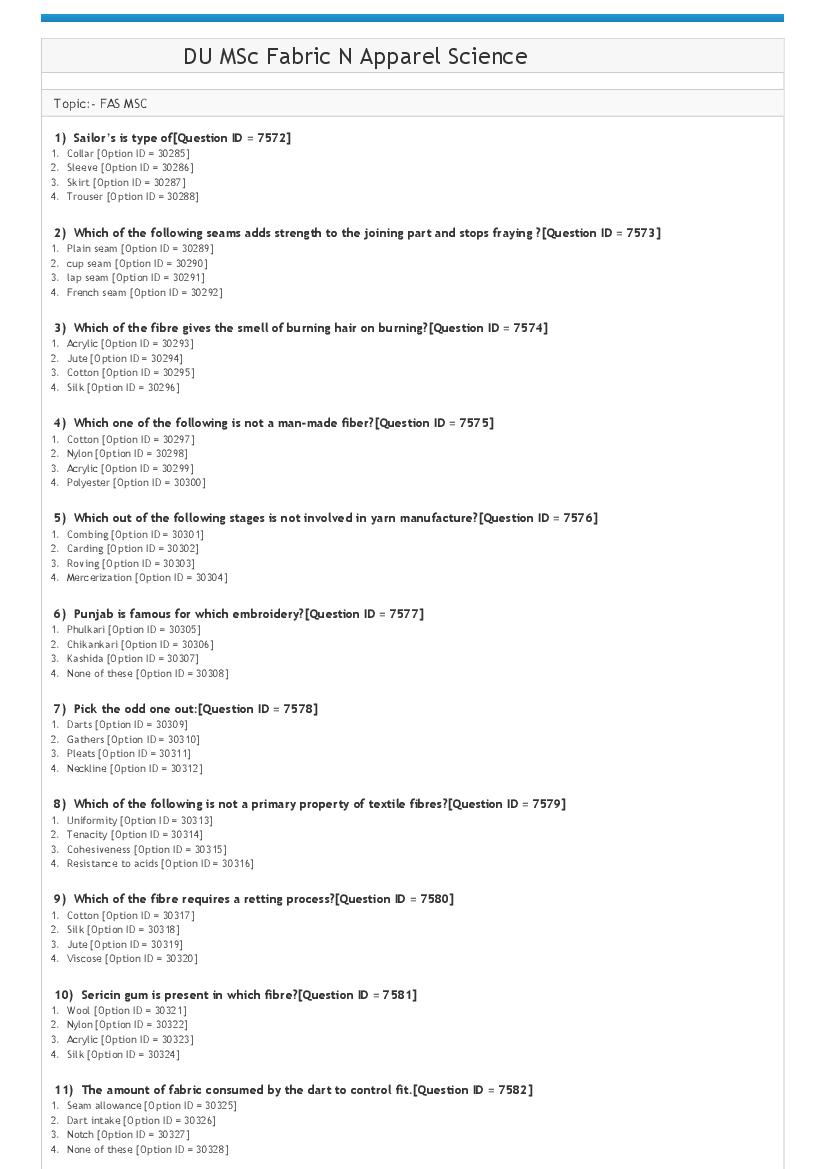
Topic:‐ FAS MSC
1) Sailor’s is type of[Question ID = 7572]
1. Collar [Option ID = 30285]
2. Sleeve [Option ID = 30286]
3. Skirt [Option ID = 30287]
4. Trouser [Option ID = 30288]
2) Which of the following seams adds strength to the joining part and stops fraying ?[Question ID = 7573]
1. Plain seam [Option ID = 30289]
2. cup seam [Option ID = 30290]
3. lap seam [Option ID = 30291]
4. French seam [Option ID = 30292]
3) Which of the fibre gives the smell of burning hair on burning?[Question ID = 7574]
1. Acrylic [Option ID = 30293]
2. Jute [Option ID = 30294]
3. Cotton [Option ID = 30295]
4. Silk [Option ID = 30296]
4) Which one of the following is not a man‐made fiber?[Question ID = 7575]
1. Cotton [Option ID = 30297]
2. Nylon [Option ID = 30298]
3. Acrylic [Option ID = 30299]
4. Polyester [Option ID = 30300]
5) Which out of the following stages is not involved in yarn manufacture?[Question ID = 7576]
1. Combing [Option ID = 30301]
2. Carding [Option ID = 30302]
3. Roving [Option ID = 30303]
4. Mercerization [Option ID = 30304]
6) Punjab is famous for which embroidery?[Question ID = 7577]
1. Phulkari [Option ID = 30305]
2. Chikankari [Option ID = 30306]
3. Kashida [Option ID = 30307]
4. None of these [Option ID = 30308]
7) Pick the odd one out:[Question ID = 7578]
1. Darts [Option ID = 30309]
2. Gathers [Option ID = 30310]
3. Pleats [Option ID = 30311]
4. Neckline [Option ID = 30312]
8) Which of the following is not a primary property of textile fibres?[Question ID = 7579]
1. Uniformity [Option ID = 30313]
2. Tenacity [Option ID = 30314]
3. Cohesiveness [Option ID = 30315]
4. Resistance to acids [Option ID = 30316]
9) Which of the fibre requires a retting process?[Question ID = 7580]
1. Cotton [Option ID = 30317]
2. Silk [Option ID = 30318]
3. Jute [Option ID = 30319]
4. Viscose [Option ID = 30320]
10) Sericin gum is present in which fibre?[Question ID = 7581]
1. Wool [Option ID = 30321]
2. Nylon [Option ID = 30322]
3. Acrylic [Option ID = 30323]
4. Silk [Option ID = 30324]
11) The amount of fabric consumed by the dart to control fit.[Question ID = 7582]
1. Seam allowance [Option ID = 30325]
2. Dart intake [Option ID = 30326]
3. Notch [Option ID = 30327]
4. None of these [Option ID = 30328]
Page 2
1. Kasuti [Option ID = 30329]
2. Kantha [Option ID = 30330]
3. Ikat [Option ID = 30331]
4. Phulkari [Option ID = 30332]
13) One of the stitch used in kasuti embroidery is known as:[Question ID = 7584]
1. Menthi [Option ID = 30333]
2. Darning [Option ID = 30334]
3. HerringBone [Option ID = 30335]
4. Sindhi Taropa [Option ID = 30336]
14) Which of the following is not an example of decorative weaves?[Question ID = 7585]
1. Dobby [Option ID = 30337]
2. Leno [Option ID = 30338]
3. Twill [Option ID = 30339]
4. Jacquard [Option ID = 30340]
15) Long length fibers are known as [Question ID = 7586]
1. Filament fibers [Option ID = 30341]
2. Staple fibers [Option ID = 30342]
3. Blended fibers [Option ID = 30343]
4. Cotton Fibre [Option ID = 30344]
16) Vat dye is used for dyeing………..fabric.[Question ID = 7587]
1. Polyester [Option ID = 30345]
2. Silk [Option ID = 30346]
3. Cotton [Option ID = 30347]
4. All of these [Option ID = 30348]
17) Cross Bar Dimity is an example of which type of weave construction?[Question ID = 7588]
1. Double cloth [Option ID = 30349]
2. Warp pile [Option ID = 30350]
3. Plain weave [Option ID = 30351]
4. Weft pile [Option ID = 30352]
18) ………..type of knit stitch.[Question ID = 7589]
1. Screen [Option ID = 30353]
2. Twill [Option ID = 30354]
3. Dobby [Option ID = 30355]
4. Jersey [Option ID = 30356]
19) Xanthation is a process involved in production of which fibre?[Question ID = 7590]
1. Viscose [Option ID = 30357]
2. Nylon [Option ID = 30358]
3. Acrylic [Option ID = 30359]
4. Polyester [Option ID = 30360]
20) Which of the following is not a part of loom?[Question ID = 7591]
1. Shuttle [Option ID = 30361]
2. Warp beam [Option ID = 30362]
3. Reed [Option ID = 30363]
4. Spinnerette [Option ID = 30364]
21) Which of the following fabrics is suitable for making an evening gown?[Question ID = 7592]
1. Satin [Option ID = 30365]
2. Flannel [Option ID = 30366]
3. Gabardine [Option ID = 30367]
4. Tweed [Option ID = 30368]
22) Which of the following fibres cannot be dope/solution dyed?[Question ID = 7593]
1. Acrylic [Option ID = 30369]
2. Rayon [Option ID = 30370]
3. Cotton [Option ID = 30371]
4. Polyester [Option ID = 30372]
23) Which of the following is not an element of design?[Question ID = 7594]
1. Emphasis [Option ID = 30373]
2. Colour [Option ID = 30374]
3. Line [Option ID = 30375]
4. Shape [Option ID = 30376]
24) Outline of the garment is called………….[Question ID = 7595]
Page 3
2. Texture [Option ID = 30378]
3. Silhouette [Option ID = 30379]
4. None of above [Option ID = 30380]
25) ‐‐‐‐‐‐‐‐‐‐‐‐‐‐‐‐‐‐‐‐‐‐refers to the amount of roominess in a garment.[Question ID = 7596]
1. Grain line [Option ID = 30381]
2. Dart [Option ID = 30382]
3. Ease [Option ID = 30383]
4. Tuck [Option ID = 30384]
26) Designs which are copied from most expensive garments are[Question ID = 7597]
1. Knock off [Option ID = 30385]
2. Fad [Option ID = 30386]
3. Staple [Option ID = 30387]
4. Classic [Option ID = 30388]
27) A research paper is a brief report of research work based on[Question ID = 7598]
1. Primary Data only [Option ID = 30389]
2. Secondary Data only [Option ID = 30390]
3. Both Primary and Secondary Data [Option ID = 30391]
4. None of the above [Option ID = 30392]
28) Static charges develop in[Question ID = 7599]
1. Linen [Option ID = 30393]
2. Jute [Option ID = 30394]
3. Polyester [Option ID = 30395]
4. Wool [Option ID = 30396]
29) ‘Wrap and projection’ is a type of[Question ID = 7600]
1. Seam [Option ID = 30397]
2. Yoke [Option ID = 30398]
3. Pocket [Option ID = 30399]
4. Placket [Option ID = 30400]
30) Lightness and darkness of color is called……………[Question ID = 7601]
1. Value [Option ID = 30401]
2. Line [Option ID = 30402]
3. Shape [Option ID = 30403]
4. Complementary colors [Option ID = 30404]
31) A primary property of a textile fiber which refers to adequate strength is[Question ID = 7602]
1. Cohesiveness [Option ID = 30405]
2. Density [Option ID = 30406]
3. Flexibility [Option ID = 30407]
4. Tenacity [Option ID = 30408]
32) Egg stain is a[Question ID = 7603]
1. Grease Stain [Option ID = 30409]
2. Vegetable Stain [Option ID = 30410]
3. Protein Stain [Option ID = 30411]
4. Mineral Stain [Option ID = 30412]
33) Which of the following embroidery stitches produces an embossed effect in chikankari?[Question ID = 7604]
1. Menthi [Option ID = 30413]
2. Negi [Option ID = 30414]
3. Taipichi [Option ID = 30415]
4. Murri [Option ID = 30416]
34) A method of pattern making through which a two‐dimensional fabric is shaped around a dress form to create a three‐
dimensional garment prototype:[Question ID = 7605]
1. Draping [Option ID = 30417]
2. Drafting [Option ID = 30418]
3. Flat pattern making [Option ID = 30419]
4. Commercial pattern making [Option ID = 30420]
35) Grain having maximum stretch is known as[Question ID = 7606]
1. Dart [Option ID = 30421]
2. True Bias [Option ID = 30422]
3. Off grain [Option ID = 30423]
4. On grain [Option ID = 30424]
36) A pocket which is not made giving a slash in the garment:[Question ID = 7607]
Page 4
2. Patch pocket [Option ID = 30426]
3. Bound pocket [Option ID = 30427]
4. Double welt [Option ID = 30428]
37) ………….is resist style of printing.[Question ID = 7608]
1. Dabu [Option ID = 30429]
2. Tie and dye [Option ID = 30430]
3. Patola [Option ID = 30431]
4. Baluchari [Option ID = 30432]
38) The hand painted textiles of India with mythological figures is called…………[Question ID = 7609]
1. Ikat [Option ID = 30433]
2. Srikalahasti Kalamkari [Option ID = 30434]
3. Patola [Option ID = 30435]
4. Kantha [Option ID = 30436]
39) Which one is not a popular name for Jamdani[Question ID = 7610]
1. Mulmulkhas [Option ID = 30437]
2. Darshandwar [Option ID = 30438]
3. Abrawan [Option ID = 30439]
4. Shabnam [Option ID = 30440]
40) Which of the following is non‐probability sampling?[Question ID = 7611]
1. Snowball [Option ID = 30441]
2. Random [Option ID = 30442]
3. Cluster [Option ID = 30443]
4. Stratified [Option ID = 30444]
41) SPI Stands for[Question ID = 7612]
1. Stitches per inch [Option ID = 30445]
2. Standard pitch indicator [Option ID = 30446]
3. Sampling production inputs [Option ID = 30447]
4. Stitches per seam [Option ID = 30448]
42) Which of the following is a term for ready to wear garment?[Question ID = 7613]
1. Haute couture [Option ID = 30449]
2. Prêt‐e‐porter [Option ID = 30450]
3. Avant garde [Option ID = 30451]
4. None of the above [Option ID = 30452]
43) A slanting or diagonal line cut or sewn across the weave of the cloth is called...................[Question ID = 7614]
1. Selvedge [Option ID = 30453]
2. Bias [Option ID = 30454]
3. Bowing [Option ID = 30455]
4. Muslin [Option ID = 30456]
44) Which class of dyes requires mordanting?[Question ID = 7615]
1. Direct dyes [Option ID = 30457]
2. Acid dyes [Option ID = 30458]
3. Natural dyes [Option ID = 30459]
4. Azoic dyes [Option ID = 30460]
45) Thread used for phulkari embroidery is ______________.[Question ID = 7616]
1. Kalabattun [Option ID = 30461]
2. Pat [Option ID = 30462]
3. Twisted silk thread [Option ID = 30463]
4. Cotton threads [Option ID = 30464]
46) Carbonising is a finish used in wool for ______________.[Question ID = 7617]
1. Making fabric lustrous [Option ID = 30465]
2. Removal of vegetable matter [Option ID = 30466]
3. Bleaching [Option ID = 30467]
4. Resiliency [Option ID = 30468]
47) Bandhani is a type of resist dyeing technique mainly practiced in one of the following states[Question ID = 7618]
1. Punjab [Option ID = 30469]
2. Rajasthan [Option ID = 30470]
3. Lucknow [Option ID = 30471]
4. Kashmir [Option ID = 30472]
48) Which stitch is most commonly used in Kantha Embroidery ?[Question ID = 7619]
1. Satin [Option ID = 30473]
Page 5
3. Running [Option ID = 30475]
4. Chain [Option ID = 30476]
49) Horizontal lines in garments will suit _____________.[Question ID = 7620]
1. Thin woman [Option ID = 30477]
2. Tall and obese woman [Option ID = 30478]
3. Obese woman [Option ID = 30479]
4. None of the above [Option ID = 30480]
50) What is the purpose of doing research?[Question ID = 7621]
1. To identify problem [Option ID = 30481]
2. To find the solution [Option ID = 30482]
3. Both 1 and 2 [Option ID = 30483]
4. None of these [Option ID = 30484]
51) Which method of fabric decoration could produce a decorative design with a raised surface?[Question ID = 7622]
1. Heat‐transfer printing [Option ID = 30485]
2. Yarn dyeing [Option ID = 30486]
3. Digital printing [Option ID = 30487]
4. Hand embroidery [Option ID = 30488]
52) ____________ is used to produce Nylon 6.[Question ID = 7623]
1. Terephthalic acid [Option ID = 30489]
2. Adipic acid [Option ID = 30490]
3. Caprolactam [Option ID = 30491]
4. Glycerin [Option ID = 30492]
53) Mass per unit length or length per unit mass of yarn indicates.[Question ID = 7624]
1. Yarn count [Option ID = 30493]
2. Yarn strength [Option ID = 30494]
3. Yarn twist [Option ID = 30495]
4. Evenness of yarn [Option ID = 30496]
54) Singeing removes _____________.[Question ID = 7625]
1. Protein fibers [Option ID = 30497]
2. Vegetable matter [Option ID = 30498]
3. Protruding fibers [Option ID = 30499]
4. Entangled yarns [Option ID = 30500]
55) Double ended darts are used for ________ and __________.
A. Skirt
B. Fitted shirts
C. Shift dress
D. Saree Blouse
[Question ID = 7626]
1. C and D only
[Option ID = 30501]
2. B and C only
[Option ID = 30502]
3. C and D only
[Option ID = 30503]
4. A and B only
[Option ID = 30504]
56) Which of the following TWO finishing techniques are most appropriate for a fabric to be used on the seats in a movie
theatre?
A. Sanforised
B. Mercerised
C. Soil‐resistant
D. Fire‐retardant
[Question ID = 7627]
1. B and D only
Page 6
2. A and B only
[Option ID = 30506]
3. A and D only
[Option ID = 30507]
4. C and D only
[Option ID = 30508]
57) Which of the following are examples of functional finishes?
A. Anti wrinkle
B. Water Repellency
C. Basket
D. Flame retardant finish
[Question ID = 7628]
1. A, C and D only
[Option ID = 30509]
2. A. B and C only
[Option ID = 30510]
3. A, B and D only
[Option ID = 30511]
4. B, C and D only
[Option ID = 30512]
58) Examples of Warp knit fabrics are:
A. Milanese
B. Tricot
C. Jersey
D. Velvet
[Question ID = 7629]
1. C and D only
[Option ID = 30513]
2. B and C only
[Option ID = 30514]
3. B and D only
[Option ID = 30515]
4. A and B only
[Option ID = 30516]
59) Two types simple yarns are:
A. Boucle
B. Cord
C. Ply
D. Chenille
[Question ID = 7630]
1. B and C only
[Option ID = 30517]
2. B and D only
[Option ID = 30518]
3. A and D only
[Option ID = 30519]
4. C and D only
[Option ID = 30520]
Page 7
A. Discharge
B. Screen
C. Resist
D. Block
[Question ID = 7631]
1. A and C only
[Option ID = 30521]
2. B and D only
[Option ID = 30522]
3. A and D only
[Option ID = 30523]
4. C and D only
[Option ID = 30524]
61) Various types of plackets found in garments are:
A. Even hem placket
B. Welt placket
C. Wrap over projection placket
D. Continuous wrap placket
[Question ID = 7632]
1. A, C and D only
[Option ID = 30525]
2. A, B and C only
[Option ID = 30526]
3. A, B and D only
[Option ID = 30527]
4. B, C and D only
[Option ID = 30528]
62) Which of the following are the examples of pile weave fabrics?
A. Terry towel
B. Denim
C. Tapestry
D. Corduroy
[Question ID = 7633]
1. A and C only
[Option ID = 30529]
2. B and D only
[Option ID = 30530]
3. A and D only
[Option ID = 30531]
4. C and D only
[Option ID = 30532]
63) Dimensions of color are:
A. Gradation
B. Intensity
C. Hue
D. Emphasis
Page 8
1. A and C only
[Option ID = 30533]
2. B and C only
[Option ID = 30534]
3. A and D only
[Option ID = 30535]
4. C and D only
[Option ID = 30536]
64) Which of the following are parts of a loom?
A. Bed plate
B. Needle bed
C. Reed
D. Harness
[Question ID = 7635]
1. A and C only
[Option ID = 30537]
2. A and C only
[Option ID = 30538]
3. B and C only
[Option ID = 30539]
4. C and D only
[Option ID = 30540]
65) Steps involved in manufacturing of rayon are:
A. Xanthation
B. Carding
C. Steeping
D. Shredding
[Question ID = 7636]
1. A, B and D only
[Option ID = 30541]
2. A, C and D only
[Option ID = 30542]
3. A, B and C only
[Option ID = 30543]
4. B, C and D only
[Option ID = 30544]
66) Following are the operations involved in production of non‐woven fabrics
A. Web bonding
B. Web formation
C. Selection and preparation of fibers
D. Roving
[Question ID = 7637]
1. A, B and D
[Option ID = 30545]
2. A, B and C only
[Option ID = 30546]
3. B, C and D only
[Option ID = 30547]
4. A, C and D only
Page 9
67) Which of the following are traditional motifs of Kasuti Embroidery.
A. Gopuram
B. Anar Ka Phool
C. Tulsikatti
D. Bhashinga
[Question ID = 7638]
1. A, C and D only
[Option ID = 30549]
2. A, B and C only
[Option ID = 30550]
3. A, B and D only
[Option ID = 30551]
4. B, C and D only
[Option ID = 30552]
68) Two distinctive styles of Kalamkari are:
A. Dabu style
B. Srikalahasti
C. Masulipatnam
D. Ajrak
[Question ID = 7639]
1. A and C only
[Option ID = 30553]
2. A and B only
[Option ID = 30554]
3. B and C only
[Option ID = 30555]
4. A and D only
[Option ID = 30556]
69) Which of the following are types of wedding Phulkaris
A. Chope
B. Suber
C. Lep
D. Chakla
[Question ID = 7640]
1. A and D only
[Option ID = 30557]
2. A and C only
[Option ID = 30558]
3. A and B only
[Option ID = 30559]
4. B and C only
[Option ID = 30560]
70) Which are types of Gujarat Embroidery?
A. Mochi bharat
B. Menthi
C. Sindhi taropa
D. Heer bharat
Page 10
1. A, B and C only
[Option ID = 30561]
2. A, C and D only
[Option ID = 30562]
3. A, B and D only
[Option ID = 30563]
4. B, C and D only
[Option ID = 30564]
71) Which of the following are preparatory finishes?
A. Scouring
B. Desizing
C. Bleaching
D. Mothproofing
[Question ID = 7642]
1. A, B and C only
[Option ID = 30565]
2. A, C and D only
[Option ID = 30566]
3. A, B and D only
[Option ID = 30567]
4. B, C and D only
[Option ID = 30568]
72) Select any two common resist printed textiles
A. Kalamkari
B. Madhubani
C. Dabu
D. Ajrakh
[Question ID = 7643]
1. A and C only
[Option ID = 30569]
2. A and B only
[Option ID = 30570]
3. A and C only
[Option ID = 30571]
4. C and D only
[Option ID = 30572]
73) Mercerization is a chemical finish applied on cellulosic textiles to improve
A. Tenacity
B. Elasticity
C. Lustre
D. Absorbency
[Question ID = 7644]
1. A, B and C only
[Option ID = 30573]
2. B, C and D only
[Option ID = 30574]
3. A, C and D only
[Option ID = 30575]
Page 11
[Option ID = 30576]
74) Stitches used in Kasuti embroidery are:
A. Murgi
B. Menthi
C. Negi
D. Ari
[Question ID = 7645]
1. A, B and C only
[Option ID = 30577]
2. A, C and D only
[Option ID = 30578]
3. A, B and D only
[Option ID = 30579]
4. B, C and D only
[Option ID = 30580]
75) Some common pleats are
A. Overcasting
B. Box
C. Knife
D. Inverted box
[Question ID = 7646]
1. A, B and C only
[Option ID = 30581]
2. A, C and D only
[Option ID = 30582]
3. A, B and D only
[Option ID = 30583]
4. B, C and D only
[Option ID = 30584]
76) Following are types of looms
A. Rapier
B. Water jet
C. Circular
D. Flat bed
[Question ID = 7647]
1. A and C only
[Option ID = 30585]
2. B and C only
[Option ID = 30586]
3. A and B only
[Option ID = 30587]
4. C and D only
[Option ID = 30588]
77) Which are the two correct theories of Fashion Adoption
A. Trickle‐ Up
B. Trickle ‐Fashion
C. Trickle‐ Trickle
Page 12
[Question ID = 7648]
1. A and B only
[Option ID = 30589]
2. A and C only
[Option ID = 30590]
3. B and C only
[Option ID = 30591]
4. A and D only
[Option ID = 30592]
78) Following are the commonly used methods of texturization
A. Knit‐deknit
B. Air jet
C. Crumpling
D. Knife edge
[Question ID = 7649]
1. A, B and C only
[Option ID = 30593]
2. A, C and D only
[Option ID = 30594]
3. A, B and D only
[Option ID = 30595]
4. B, C and D only
[Option ID = 30596]
79) Which of the following are not types of sleeves
A. Flared
B. Peter pan
C. Bishop
D. Stand and fall
[Question ID = 7650]
1. B and C only
[Option ID = 30597]
2. A and B only
[Option ID = 30598]
3. A and C only
[Option ID = 30599]
4. B and D only
[Option ID = 30600]
80) Few traditional textiles of West Bengal are
A. Kantha
B. Jamdani
C. Baluchari
D. Kasuti
[Question ID = 7651]
1. A, B and C only
[Option ID = 30601]
2. B, C and D only
[Option ID = 30602]
3. A, C and D only
Page 13
4. A, B and D only
[Option ID = 30604]
81) Important methods of chemical spinning are
A. Melt spinning
B. Dry spinning
C. Cotton spinning
D. Wool spinning
[Question ID = 7652]
1. A and D only
[Option ID = 30605]
2. B and C only
[Option ID = 30606]
3. A and B only
[Option ID = 30607]
4. B and D only
[Option ID = 30608]
82) Following are types of knitting needles
A. Spring beard needles
B. Long and short needles
C. Crochet needles
D. Compound needles
[Question ID = 7653]
1. A and C only
[Option ID = 30609]
2. A and B only
[Option ID = 30610]
3. B and C only
[Option ID = 30611]
4. A and D only
[Option ID = 30612]
83) Two synthetic fibres from below are
A. Wool
B. Silk
C. Nylon
D. Polyester
[Question ID = 7654]
1. A and C only
[Option ID = 30613]
2. A and B only
[Option ID = 30614]
3. C and D only
[Option ID = 30615]
4. B and D only
[Option ID = 30616]
84) Twill weave is found in
A. Denim
B. Velvet
Page 14
D. Poplin
[Question ID = 7655]
1. A and B only
[Option ID = 30617]
2. A and D only
[Option ID = 30618]
3. B and D only
[Option ID = 30619]
4. A and C only
[Option ID = 30620]
85) Given below are two statements, one is labelled as Assertion A and the other is labelled as Reason R
Assertion A: Tucks are small even folds of fabric that lies flat against the garment, but can be lifted.
Reason R: They are usually most effective when they follow the bias of the fabric.
In light of the above statements, choose the most appropriate answer from the options given below
[Question ID = 7656]
1. Both (A) and (R) are correct
[Option ID = 30621]
2. Both (A) and (R) are incorrect
[Option ID = 30622]
3. (A) is correct, but (R) is incorrect
[Option ID = 30623]
4. (A) is incorrect, but (R) is correct
[Option ID = 30624]
86) Given below are two statements, one is labelled as Assertion A and the other is labelled as Reason R
Assertion (A): A properly functioning feed dog is important for correct stitch length.
Reason (R): Feed dog is responsible for pushing the fabric ahead while stitching.
In light of the above statements, choose the most appropriate answer from the options given below
[Question ID = 7657]
1. Both (A) and (R) are correct
[Option ID = 30625]
2. Both (A) and (R) are incorrect
[Option ID = 30626]
3. (A) is correct, but (R) is incorrect
[Option ID = 30627]
4. (A) is incorrect, but (R) is correct
[Option ID = 30628]
87) Given below are two statements, one is labelled as Assertion A and the other is labelled as Reason R
Assertion (A): Brocade, Huckaback, Jacquard, and tapestry can be classified under the same category.
Reason (R): All can be made on the Jacquard loom.
In light of the above statements, choose the most appropriate answer from the options given below
[Question ID = 7658]
1. Both (A) and (R) are incorrect
[Option ID = 30629]
2. Both (A) and (R) are correct
[Option ID = 30630]
3. (A) is correct, but (R) is incorrect
[Option ID = 30631]
4. (A) is incorrect, but (R) is correct
[Option ID = 30632]
88) Given below are two statements, one is labelled as Assertion A and the other is labelled as Reason R
Assertion (A): Wool fibers possess the property of felting.
Page 15
In light of the above statements, choose the most appropriate answer from the options given below
[Question ID = 7659]
1. Both (A) and (R) are correct
[Option ID = 30633]
2. Both (A) and (R) are incorrect
[Option ID = 30634]
3. (A) is correct, but (R) is incorrect
[Option ID = 30635]
4. (A) is incorrect, but (R) is correct
[Option ID = 30636]
89) Given below are two statements, one is labelled as Assertion A and the other is labelled as Reason R
Assertion (A): Lining provides extra body, shape, and support, making the garment look smoother.
Reason (R): It is nearly a replica of the garment constructed of lightweight fabric.
In light of the above statements, choose the most appropriate answer from the options given below
[Question ID = 7660]
1. Both (A) and (R) are correct
[Option ID = 30637]
2. Both (A) and (R) are incorrect
[Option ID = 30638]
3. (A) is correct, but (R) is incorrect
[Option ID = 30639]
4. (A) is incorrect, but (R) is correct
[Option ID = 30640]
90) Given below are two statements, one is labelled as Assertion A and the other is labelled as Reason R
Assertion (A): The first step in the production of a non‐woven is the selection of fiber(s).
Reason (R): Only staple fibers can be used in the production of non‐woven fabrics.
In light of the above statements, choose the most appropriate answer from the options given below
[Question ID = 7661]
1. Both (A) and (R) are correct
[Option ID = 30641]
2. Both (A) and (R) are incorrect
[Option ID = 30642]
3. (A) is correct, but (R) is incorrect
[Option ID = 30643]
4. (A) is incorrect, but (R) is correct
[Option ID = 30644]
91) Given below are two statements, one is labelled as
Assertion A and the other is labelled as Reason R
Assertion (A): Each Kantha piece appears different from the other.
Reason (R): The craftsmen embroidered on products for ceremonies connected with marriage.
In light of the above statements, choose the most appropriate answer from the options given below
[Question ID = 7662]
1. Both (A) and (R) are correct
[Option ID = 30645]
2. Both (A) and (R) are incorrect
[Option ID = 30646]
3. (A) is correct, but (R) is incorrect
[Option ID = 30647]
4. (A) is incorrect, but (R) is correct
[Option ID = 30648]
92) Given below are two statements, one is labelled as Assertion A and the other is labelled as Reason R
Page 16
Reason (R): Its highly amorphous nature makes it hydrophobic.
In light of the above statements, choose the most appropriate answer from the options given below
[Question ID = 7663]
1. Both (A) and (R) are correct
[Option ID = 30649]
2. Both (A) and (R) are incorrect
[Option ID = 30650]
3. (A) is correct, but (R) is incorrect
[Option ID = 30651]
4. (A) is incorrect, but (R) is correct
[Option ID = 30652]
93) Given below are two statements, one is labelled as Assertion A and the other is labelled as Reason R
Assertion (A): Ikats are the traditional resist‐dyed textiles of India
Reason (R): They are called resist‐dyed because certain areas of yarns are resisted from the entry of dyes.
In light of the above statements, choose the most appropriate answer from the options given below
[Question ID = 7664]
1. Both (A) and (R) are correct
[Option ID = 30653]
2. Both (A) and (R) are incorrect
[Option ID = 30654]
3. (A) is correct but (R) is incorrect
[Option ID = 30655]
4. (A) is incorrect but (R) is correct
[Option ID = 30656]
94) Match the items in Column I to the appropriate entries in Column II
Column I Column II
A. Classic I. Peg silhouette
B. Fad II. Adherence to clothing norm
C. Style III. Blue denims
D. Conformity IV. Neon colors
V. High fashion
Choose the correct answer from the options given below
[Question ID = 7665]
1. A ‐ I, B ‐ II, C ‐ III, D ‐ IV [Option ID = 30657]
2. A ‐ III, B ‐ IV, C ‐ I, D ‐ II [Option ID = 30658]
3. A ‐ II, B ‐ I, C ‐ III, D ‐ IV [Option ID = 30659]
4. A ‐ III, B ‐ V, C ‐ I, D ‐ IV [Option ID = 30660]
95) Match the fabrics in Column I to the embroideries traditionally done on them in Column II
Column I Column II
A. Wool I. Kasuti
B. Discarded sari or dhoti II.Kantha
C. Mulmul III. Zalakdozi
D. Khaddar IV. Chikankari
V. Phulkari
Choose the correct answer from the options given below
[Question ID = 7666]
1. A ‐ I, B ‐ II, C ‐ III, D ‐ IV [Option ID = 30661]
2. A ‐II, B ‐ III, C‐ IV, D ‐ I [Option ID = 30662]
3. A ‐ III, B ‐ II, C ‐ IV, D ‐ V [Option ID = 30663]
4. A ‐IV, B ‐ I, C ‐ V, D ‐ III [Option ID = 30664]
96) Match the items in Column I to the appropriate entries in the Column II
Column I Column II
A. Soft trims I. Decorative zippers
B. Hard trims II. Accordion Pleats
C. Fabric and Stitchery trims III. Laces
D. Structural trims IV. Ruffles
Page 17
Choose the correct answer from the options given below
[Question ID = 7667]
1. A‐ II, B ‐ III, C ‐ IV, D ‐ I [Option ID = 30665]
2. A‐ V, B ‐ III, C ‐ IV, D ‐ I [Option ID = 30666]
3. A ‐ III, B ‐ I, C ‐ IV, D ‐ II [Option ID = 30667]
4. A ‐IV, B ‐ I, C ‐ II, D ‐ V [Option ID = 30668]
97) Match the items in Column I to the appropriate entries in the Column II
Column I Column II
A. Lapel from neckline to roll line I. Collar part that stands
B. Break point lapel II. Point at which collar turns back to form
C. Collar edge line III. Depth of collar from style line to roll
D. Collar stand IV, Part of coat that falls back on chest
V. Outer edge of collar
Choose the correct answer from the options given below
[Question ID = 7668]
1. A ‐ II, B ‐ III, C ‐ IV, D ‐ I [Option ID = 30669]
2. A ‐ V, B ‐ III, C ‐ IV, D ‐ I [Option ID = 30670]
3. A ‐ III, B ‐ I, C ‐ IV, D ‐II [Option ID = 30671]
4. A ‐ IV, B ‐ II, C ‐ V, D ‐ I [Option ID = 30672]
98) Match the traditional textile art in Column I with the state they belong to in Column II
Column I Column II
A. Mochi Bharat I. Uttar Pradesh
B. Jamdani II. Orissa
C. Chikankari III. West Bengal
D. Bandhas IV. Gujarat
[Question ID = 7669]
1. A ‐ II, B ‐ III, C ‐ I, D ‐ IV [Option ID = 30673]
2. A ‐ IV, B ‐ III, C‐ I, D‐ II [Option ID = 30674]
3. A‐ I, B ‐ III, C ‐ IV, D ‐ II [Option ID = 30675]
4. A ‐ III, B ‐ IV, C ‐ I, D ‐ II [Option ID = 30676]
99) Match the fabrics given in Column I with the characteristics given in Column II.
Column I Column II
A. Twill I. Cut and Uncut
B. Satin II. Wales
C. Knit III. Floats
D. Pile IV. Diagonal lines
[Question ID = 7670]
1. A‐ III, B ‐ IV, C ‐ II, D ‐ I [Option ID = 30677]
2. A ‐ II, B ‐ IV, C ‐ I, D‐ III [Option ID = 30678]
3. A ‐ III, B ‐ II, C ‐ I, D ‐ IV [Option ID = 30679]
4. A ‐ IV, B ‐ III, C ‐ II, D ‐ I [Option ID = 30680]
100) Match the instrument given in Column I with the property tested given in Column II
Column I Column II
A. Pick glass I. Wash fastness
B. Spectrophotometer II. Colour strength
C. Launderometer III. Thread count
D. Tensile tester IV. Fabric strength
Choose the correct answer from the options given below
[Question ID = 7671]
1. A ‐ I, B ‐ IV, C ‐ III, D ‐ II [Option ID = 30681]
2. A ‐ II, B ‐ I, C ‐ IV, D ‐ III [Option ID = 30682]
3. A ‐ III, B ‐ II, C ‐ I, D ‐ IV [Option ID = 30683]
4. A ‐ IV, B ‐ III, C ‐ II, D ‐ I [Option ID = 30684]
Document Details
| Board / Org | NTA |
| Exam | DUET |
| Type | Question Paper |
| Pages | 18 |
| Language | english |
| Updated | 30 Apr 2026 |