Tamil Nadu 11th Std Model Question Paper 2026 Microbiology
Finished viewing? Save it for later —
Download Tamil Nadu 11th Std Model Question Paper 2026 Microbiology (PDF · 11 pages)About Tamil Nadu 11th Std Model Question Paper 2026 Microbiology
Tamil Nadu 11th Std Model Question Paper 2026 Microbiology is available here for free download. Published by Tamil Nadu Board for Class 11, this sample paper can be viewed online or downloaded as a PDF (11 pages). Candidates preparing for Class 11 can use Tamil Nadu 11th Std Model Question Paper 2026 Microbiology to understand the exam pattern, the type of questions asked, and the overall difficulty level.
Frequently Asked Questions
How can I download Tamil Nadu 11th Std Model Question Paper 2026 Microbiology?
Open this page and click the Download button to save Tamil Nadu 11th Std Model Question Paper 2026 Microbiology as a PDF. It is completely free on AglaSem Docs.
Is Tamil Nadu 11th Std Model Question Paper 2026 Microbiology free to download?
Yes. Tamil Nadu 11th Std Model Question Paper 2026 Microbiology can be viewed online and downloaded as a PDF free of cost on AglaSem Docs.
How many pages does Tamil Nadu 11th Std Model Question Paper 2026 Microbiology have?
Tamil Nadu 11th Std Model Question Paper 2026 Microbiology contains 11 pages, which you can read online or download together as a single PDF.
Where can I find more Class 11 study material?
You can find more Class 11 question papers, sample papers, syllabus, and answer keys on AglaSem Docs.
Tamil Nadu 11th Std Model Question Paper 2026 Microbiology – Text
Read the full text of this sample paper below — useful to quickly search, copy and reference the content online without downloading the PDF.
📄 View text version (11 pages)
Page 1
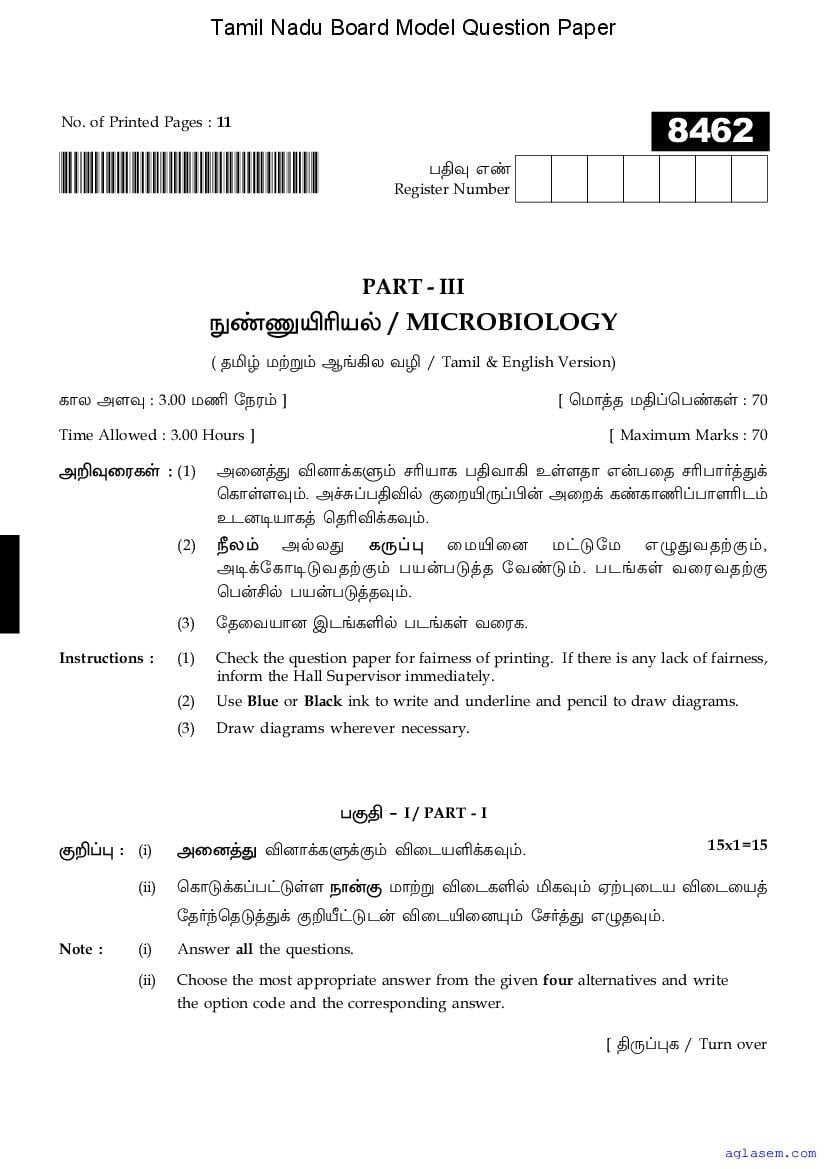
No. of Printed Pages : 11
8462
!8462IstYearMicrobiology! £vÄ Gs
Register Number
PART - III
~sq°›¯À / MICROBIOLOGY
( uªÌ ©ØÖ® B[Q» ÁÈ / Tamil & English Version)
Põ» AÍÄ : 3.00 ©o ÷|µ® ] [ ö©õzu ©v¨ö£sPÒ : 70
Time Allowed : 3.00 Hours ] [ Maximum Marks : 70
AÔÄøµPÒ : (1) AøÚzx ÂÚõUPЮ \›¯õP £vÁõQ EÒÍuõ Gߣøu \›£õºzxU
öPõÒÍÄ®. Aa_¨£vÂÀ SøÓ°¸¨¤ß AøÓU PsPõo¨£õÍ›h®
EhÚi¯õPz öu›ÂUPÄ®.
(2) }»® AÀ»x P¸¨¦ ø©°øÚ ©mk÷© GÊxÁuØS®,
AiU÷PõikÁuØS® £¯ß£kzu ÷Ásk®. £h[PÒ ÁøµÁuØS
ö£ß]À £¯ß£kzuÄ®.
(3) ÷uøÁ¯õÚ Ch[PÎÀ £h[PÒ ÁøµP.
Instructions : (1) Check the question paper for fairness of printing. If there is any lack of fairness,
inform the Hall Supervisor immediately.
(2) Use Blue or Black ink to write and underline and pencil to draw diagrams.
(3) Draw diagrams wherever necessary.
£Sv & I / PART - I
SÔ¨¦ : (i) AøÚzx ÂÚõUPÐUS® Âøh¯ÎUPÄ®. 15x1=15
(ii) öPõkUP¨£mkÒÍ |õßS ©õØÖ ÂøhPÎÀ ªPÄ® Hئøh¯ Âøhø¯z
÷uº¢öukzxU SÔ±mkhß Âøh°øÚ²® ÷\ºzx GÊuÄ®.
Note : (i) Answer all the questions.
(ii) Choose the most appropriate answer from the given four alternatives and write
the option code and the corresponding answer.
Page 2
1. RÌUPsh AÔ¯À ÁÀ¾|ºPÎÀ vhÁͺuÍzøuU Psk¤izuÁº ¯õº ?
(A) GmÁºk öáßÚº (B) µõ£ºm PõU
(C) ¿° £õ´a\º (D) ÷©ØTÔ¯ GÁ¸ªÀø»
Among the following scientists, who discovered solid medium ?
(a) Edward Jenner (b) Robert Koch
(c) Louis Pasteur (d) None of them
2. RÌUPshÁØÔÀ Gx •¨£›©õn ¤®£zøu E¸ÁõUSQÓx ?
(A) ì÷PÛ[ G»Umµõß ~s÷nõUQ
(B) ÷£ì&Põßmµõìm ~s÷nõUQ
(C) ¦Ñµ\ßì ~s÷nõUQ
(D) iµõßìªåß G»Umµõß ~s÷nõUQ
Which of the following produce three dimensional image ?
(a) Scanning Electron Microscope
(b) Phase Contrast Microscope
(c) Fluorescence Microscope
(d) Transmission Electron Microscope
3. Qµõ® \õ¯÷©ØS® •øÓ°À __________ {Ó® {Özv¯õP £¯ß£kzu¨£kQÓx.
(A) ö©zv¼ß ¦Ñ (B) A÷¯õiß
(C) \õ¨µÛß (D) Q›ìhÀ øÁ»m
__________ is used as a mordant in Gram Staining techniques.
(a) Methylene blue (b) Iodine
(c) Safranin (d) Crystal violet
Page 3
4. RÌUPshÁØÔÀ G¢u •øÓ Gs÷hõì÷£õøµU öPõÀ¾ÁvÀø» ?
(A) öÁ¨£U PõØÖ Ak¨¦ (B) ªßöÁ¨£ \©{ø» Ak¨¦
(C) £õìiøµ÷\åß (D) G›zxa \õ®£»õUSuÀ
Which of the following does not kill endospores ?
(a) Hot air oven (b) Autoclaving
(c) Pasteurization (d) Incineration
5. ¤›zuÔ FhPzvØS Kº GkzxUPõmk :
(A) Cµzu APõº (B) EMB APõº
(C) ìkÁõºm FhP® (D) (A) ©ØÖ® (B)
__________ is an example for differential media.
(a) Blood agar (b) EMB agar
(c) Stuart’s medium (d) Both (a) and (b)
6. Áͺa] ÁøÍÂß, G¢u {ø»°À, CÚ¨ö£¸UP {ø» CÓ¨¦ {ø»USa \©©õP
C¸US® ?
(A) ©h[S ö£¸SuÀ {ø» (B) {ø»¯õÚ Pmh {ø»
(C) _nUP {ø» (D) CÓ¨¦ {ø»
The phase of growth in which the growth rate is equal to the death rate is __________.
(a) Exponential phase (b) Stationary phase
(c) Lag phase (d) Death phase
Page 4
7. ö©mhõS÷µõ÷©iU xPÒPÒ __________ £õUj›¯õÂÀ EÒÍÚ.
(A) `÷hõ÷©õÚõì H÷µõâ÷Úõ\õ
(B) Gèö\›æ¯õ ÷Põø»
(C) £õ]À»ì B¢zµõ]ì
(D) Põ›Û£õUj›¯® i¨w›÷¯
The metachromatic granules are seen in the bacteria __________.
(a) Pseudomonas aeroginosa
(b) Escherichia coli
(c) Bacillus anthracis
(d) Corynebacterium diphtheriae
8. \›¯õÚ Cønø¯z ÷uº¢öukUPÄ®.
(A) ö©õÛµõ & ¦÷µõ÷P›÷¯õmPÒ
(B) uõÁµ E»P® & ¤Ó\õº¦
(C) §gø\PÒ & JÎa\õº¦
(D) »[S»P® & ö£¸®£õ¾® J¸ ö\À E°›PÒ
Select the correct pair :
(a) Monera - Prokaryotes
(b) Plantae - Heterotrophic
(c) Fungi - Phototropic
(d) Animalia - Most are single cell organisms
9. AvP ©øǨö£õÈÄ EÒÍ Ch[PÎÀ G¢u P»¨¦ Eµ® u¯õ›¨¦ •øÓ
£¯ß£kzu¨£kQÓx ?
(A) Cslº •øÓ (B) S¯À •øÓ
(C) ö£[PѺ •øÓ (D) SÈ •øÓ
Which compost method is employed in the regions with heavy rainfall ?
(a) Indore method (b) Heap method
(c) Bangalore method (d) Pit method
Page 5
10. ö£õ¸zxP :
©s ~sq°›PÒ GkzxUPõmkPÒ
(1) £õUj›¯õ (i) ÷|õUPõºi¯õ
(2) BUi÷Úõø©^mì (ii) Bìö£ºâÀ»ì
(3) §gø\PÒ (iii) |õìhõU
(4) ©s BÀPõ (iv) `÷hõ÷©õÚõì
(A) (1) - (iii), (2) - (iv), (3) - (i), (4) - (ii)
(B) (1) - (ii), (2) - (iii), (3) - (iv), (4) - (i)
(C) (1) - (i), (2) - (ii), (3) - (iii), (4) - (iv)
(D) (1) - (iv), (2) - (i), (3) - (ii), (4) - (iii)
Match the following :
Soil micro-organisms Examples
(1) Bacteria (i) Nocardia
(2) Actinomycetes (ii) Aspergillus
(3) Fungi (iii) Nostoc
(4) Soil algae (iv) Pseudomonas
(a) (1) - (iii), (2) - (iv), (3) - (i), (4) - (ii)
(b) (1) - (ii), (2) - (iii), (3) - (iv), (4) - (i)
(c) (1) - (i), (2) - (ii), (3) - (iii), (4) - (iv)
(d) (1) - (iv), (2) - (i), (3) - (ii), (4) - (iii)
11. £õUj›¯õUPÍõÀ £õì÷£m PøµuÀ Gߣx __________ EØ£zv¯õÀ |k{ø»¨&
£kzu¨£kQÓx.
(A) £õì£õ›U Aª»® (B) BºPõÛU Aª»[PÒ
(C) ø£m÷hìPÒ (D) £õì£÷hì
Phosphate solubilisation by bacteria is mediated by the production of __________.
(a) phosphoric acid (b) organic acids
(c) phytases (d) phosphatases
Page 6
12. RÌUPõs£øÁPÐÒ Gx ö£Ó¨£mh ÷|õ´zuk¨¤ß •UQ¯ £s¦ CÀø» ?
(A) _¯ ©ØÖ® _¯® AÀ»õuøÁPøÍ ÷ÁÖ£kzxuÀ
(B) {øÚÄ
(C) ÷£÷Põø\m÷hõ]ì
(D) SÔ¨¤mh ußø©
Which of the following is not the important feature of acquired immunity ?
(a) Discrimination between self and non-self
(b) Memory
(c) Phagocytosis
(d) Specificity
13. ÷á \[Q¼ ¤ßÁ¸® G¢u ÷|õ´ uk¨£õØÓ¼Ýhß öuõhº¦øh¯ J¸
QøÍU÷Põö£¨øhm \[Q¼ ?
(A) IgD (B) IgA
(C) IgE (D) IgG
J chain is a glycopeptides chain associated with which of the following immunoglobulins ?
(a) IgD (b) IgA
(c) IgE (d) IgG
14. J¸ Cµmøh _ÇÀ i.Gß.H&ÂÀ AiøÚß ©ØÖ® øuªÝUS Cøh°À __________
¤øn¨¦ C¸US®.
(A) Áõshº ÁõÀì (B) øímµáß
(C) ‰ßÖ øímµáß (D) Cµmøh øímµáß
The bond between adenine and thymine in a DNA double helix is :
(a) Vander Waal’s (b) Hydrogen
(c) Triple hydrogen (d) Double hydrogen
Page 7
15. TØÖ A : Põº£ß _ÇØ]°À ‰ßÖ {ø»PÒ EÒÍÚ.
TØÖ B : P¢uP® SøÓzuÀ {PÌÄ Põº£ß _ÇØ]°À |øhö£ÖQÓx.
(A) TØÖ "A' ©ØÖ® "B' Cµsk® \›
(B) TØÖ "A' ©mk® \›
(C) TØÖ "A' ©ØÖ® "B' Cµsk® uÁÖ
(D) TØÖ "B' ©mk® \›
Statement A : There are three stages involved in carbon cycle.
Statement B : Sulphur reduction process occurs in carbon cycle.
(a) Both Statements A and B are correct
(b) Statement A only correct
(c) Both Statements A and B are wrong
(d) Statement B only correct
£Sv & II / PART - II
SÔ¨¦ : GøÁ÷¯Ý® BÖ ÂÚõUPÐUS Âøh¯ÎUPÄ®. ÂÚõ Gs 24 &US
Pmhõ¯©õP Âøh¯ÎUPÄ®. 6x2=12
Note : Answer any six questions. Question No. 24 is Compulsory.
16. ©soÀ ~sq°›PÎß GsoUøPø¯¨ £õvUS® PõµoPÒ ¯õøÁ ?
What are the factors influencing microbial population in soil ?
17. ~sq°º }UP® GßÓõÀ GßÚ ?
What is Sterilization ?
18. ö»ß]ß {³ö©›UPÀ Aö£ºa\øµ } GÆÁõÖ AvP¨£kzxÁõ´ ?
How will you increase the numerical aperture of lens ?
19. E°º §a]UöPõÀ¼PÒ GßÓõÀ GßÚ ?
What are Biopesticides ?
Page 8
20. \õn G›Áõ²Âß £¯ßPÒ ¯õøÁ ?
What are the uses of Biogas ?
21. PßöáÛmhÀ ÷|õ´zöuõØÖ – Áøµ¯Ö.
Define - Congenital infection.
22. PõUQß uzxÁ[PÐUS Pmk¨£hõu Cµsk E°›Ú[PÒ GøÁ ?
What are the two organisms that do not obey Koch’s Postulates ?
23. Â.H.G®. – GßÓõÀ GßÚ ?
What is VAM ?
24. Âm÷hUPº ÁøP£õk G¢öu¢u £s¦PÎß Ai¨£øh°À Aø©¢xÒÍx ?
Whittaker’s system of classification is based on which characteristics ?
£Sv & III / PART - III
SÔ¨¦ : GøÁ÷¯Ý® BÖ ÂÚõUPÐUS Âøh¯ÎUPÄ®. ÂÚõ Gs 33 &US
Pmhõ¯©õP Âøh¯ÎUPÄ®. 6x3=18
Note : Answer any six questions. Question No. 33 is Compulsory.
25. Ai¨£øh FhP® GßÓõÀ GßÚ ? GkzxUPõmk u¸P.
What is Basal medium ? Give an example.
26. ~s÷nõUQ°ß £õP[PÒ GøÁ÷¯Ý® BÔøÚ GÊxP.
Write any six parts of Microscope.
Page 9
27. GßÚ ÷|õUPzvØPõP }[PÒ ¤ßÁ¸® \õ¯[Pøͨ £¯ß£kzxúPÒ ?
(i) Gί \õ¯®
(ii) Gvº©øÓ \õ¯®
(iii) Aª» vh \õ¯®
For what purpose would you use each of the following ?
(i) Simple stain
(ii) Negative stain
(iii) Acid-fast stain
28. £õUj›¯õÂß ö£õxÁõÚ Aø©¨ø£ £h® Áøµ¢x £õP[PøÍU SÔUP.
Draw and mark the parts of General Structure of Bacteria.
29. \Uv, G»Umµõß ©ØÖ® Põº£ß QøhUS® Ch[PÎß Ai¨£øh°À ~sq°›PøÍ
AmhÁøn¨£kzxP.
Tabulate micro-organisms based on energy, electron and carbon source.
30. ¤ßÁ¸® ÁõºzøuPøÍ Áøµ¯Ö :
(i) £õUj›ª¯õ
(ii) ö\¨i^ª¯õ
(iii) ø£±ª¯õ
Define the following terms :
(i) Bacteremia
(ii) Septicemia
(iii) Pyemia
31. GºÂß \õºPõL¨ Âvø¯ J¸ \©ß£õk ‰»® ÁøµP.
Depict Erwin Chargaff’s rule by an equation.
Page 10
32. £÷¯õÁõº, ^÷µõÁõº ©ØÖ® ©õº÷£õÁõºPÐUS Cøh÷¯¯õÚ ÷ÁÖ£õk GßÚ ?
What is the difference between biovars, serovars and morphovars ?
33. •uÀ {ø» {n}º EÖ¨¦PÒ ©ØÖ® Cµshõ® {ø» {n}º EÖ¨¦PøÍ
÷ÁÖ£kzxP.
Differentiate Primary lymphoid organs and Secondary lymphoid organs.
£Sv & IV / PART - IV
SÔ¨¦ : AøÚzx ÂÚõUPÐUS® Âøh¯ÎUPÄ®. 5x5=25
Note : Answer all the questions.
34. (A) Qµõ® \õ¯÷©ØS® •øÓ°ß Ai¨£øhz uzxÁzøu ÂÍUSP.
AÀ»x
(B) £µÄ® umk •øÓø¯ ÂÁ›.
(a) Explain the principle of Gram’s Staining.
OR
(b) Explain Spread Plate method.
35. (A) AÊzuzvß RÌ {øÓÄØÓ }µõÂø¯ £¯ß£kzv ~sq°º }UP® ö\´²®
•øÓ°øÚ ÂÍUSP.
AÀ»x
(B) öÁ¨£÷uøÁ Ai¨£øh°À ~sq°›Pøͨ ¤›¨£x GÆÁõÖ ?
(a) Describe the method of sterilization which uses steam under pressure.
OR
(b) Classify micro-organisms based on their temperature requirement.
Page 11
36. (A) Qµõ® £õ]iÆ ©ØÖ® Qµõ® ö|PiÆ £õUj›¯õUPÐUS Cøh÷¯¯õÚ
÷ÁÖ£õkPøÍ GÊxP.
AÀ»x
(B) ~sq°›PÐUS Cøh÷¯¯õÚ |ßø© u¸® öuõhº¦PøÍ ÂÁ›.
(a) Write the differences between Gram positive and Gram negative bacteria.
OR
(b) Explain the beneficial interactions of micro-organisms.
37. (A) C®³÷ÚõS÷Íõ¦¼Ûß Aø©¨ø£ £hzxhß ÂÁ›.
AÀ»x
(B) i.Gß.H. Cµmizu¼À Dk£k® ö|õvPøͲ® AÁØÔß ö\¯À£õkPøͲ®
AmhÁøn¨£kzxP.
(a) Explain the structure of immunoglobulin with diagram.
OR
(b) Tabulate the enzymes involved in DNA replication with their functions.
38. (A) uõ÷Ú ÷uõßÔ¯ uø»•øÓU ÷Põm£õkPÒ GÆÁõÖ ©ÖUP¨£kQßÓÚ ?
AÀ»x
(B) ³iµõ¤÷Påß GßÓõÀ GßÚ ? Auß ÂøÍÄPøÍ ÂÁ›.
(a) How was spontaneous generation theory disproved ?
OR
(b) What is Eutrophication ? Explain the effects of Eutrophication.
-oOo-
Document Details
| Board / Org | Tamil Nadu Board |
| Exam | Class 11 |
| Type | Sample Paper |
| Pages | 11 |
| Updated | 24 Sep 2026 |