Finished viewing? Save it for later —
Download CBSE Class 11 Syllabus 2022-23 Indian Classical Dances (PDF · 12 pages)About CBSE Class 11 Syllabus 2022-23 Indian Classical Dances
CBSE Class 11 Syllabus 2022-23 Indian Classical Dances is available here for free download. Published by CBSE for Class 11, this syllabus can be viewed online or downloaded as a PDF (12 pages). Candidates preparing for Class 11 can use CBSE Class 11 Syllabus 2022-23 Indian Classical Dances to understand the exam pattern, the type of questions asked, and the overall difficulty level.
Frequently Asked Questions
How can I download CBSE Class 11 Syllabus 2022-23 Indian Classical Dances?
Open this page and click the Download button to save CBSE Class 11 Syllabus 2022-23 Indian Classical Dances as a PDF. It is completely free on AglaSem Docs.
Is CBSE Class 11 Syllabus 2022-23 Indian Classical Dances free to download?
Yes. CBSE Class 11 Syllabus 2022-23 Indian Classical Dances can be viewed online and downloaded as a PDF free of cost on AglaSem Docs.
How many pages does CBSE Class 11 Syllabus 2022-23 Indian Classical Dances have?
CBSE Class 11 Syllabus 2022-23 Indian Classical Dances contains 12 pages, which you can read online or download together as a single PDF.
Where can I find more Class 11 study material?
You can find more Class 11 question papers, sample papers, syllabus, and answer keys on AglaSem Docs.
CBSE Class 11 Syllabus 2022-23 Indian Classical Dances – Text
Read the full text of this syllabus below — useful to quickly search, copy and reference the content online without downloading the PDF.
📄 View text version (12 pages)
Page 1
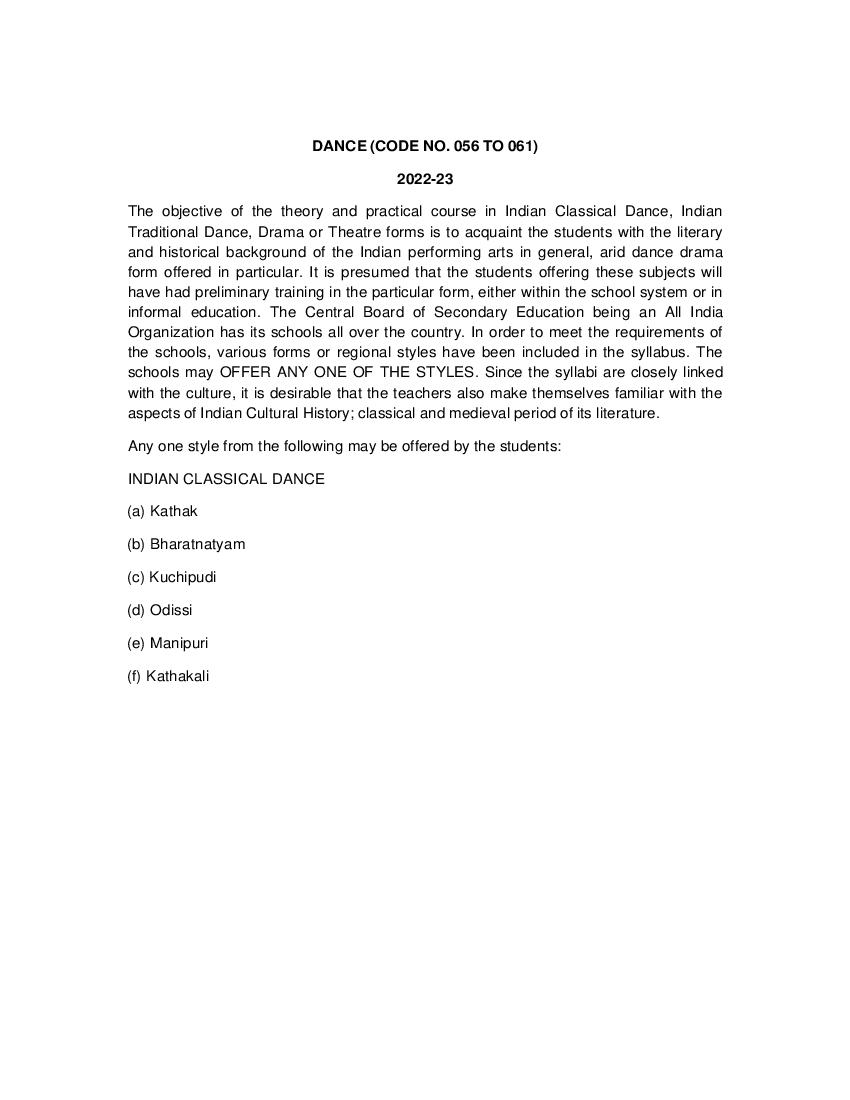
2022-23
The objective of the theory and practical course in Indian Classical Dance, Indian
Traditional Dance, Drama or Theatre forms is to acquaint the students with the literary
and historical background of the Indian performing arts in general, arid dance drama
form offered in particular. It is presumed that the students offering these subjects will
have had preliminary training in the particular form, either within the school system or in
informal education. The Central Board of Secondary Education being an All India
Organization has its schools all over the country. In order to meet the requirements of
the schools, various forms or regional styles have been included in the syllabus. The
schools may OFFER ANY ONE OF THE STYLES. Since the syllabi are closely linked
with the culture, it is desirable that the teachers also make themselves familiar with the
aspects of Indian Cultural History; classical and medieval period of its literature.
Any one style from the following may be offered by the students:
INDIAN CLASSICAL DANCE
(a) Kathak
(b) Bharatnatyam
(c) Kuchipudi
(d) Odissi
(e) Manipuri
(f) Kathakali
Page 2
CLASS–XI(2022-23)
Total Marks: 100
Theory Marks:30
Time: 2 Hours
30 Periods
1. A brief history of Indiandance.
2. Acquaintance with the themes of Ramayana,Mahabharataa, Bhagvata Purana
and Gita Govinda in context of Kathak. Acquaintance with other myths and
legends pertinent to the dance drama or gat bhaav like Kalia daman, Govardhan
lila, Panghatlila, Draupadi cheer haran, Makhan chori, Marich vadh, Bhasmasur
vadh, Madan dahan,etc.
3. A brief history of Kathakdance.
(a) Reference from ancient text (vedic, puranic, epics and other scriptures).
evolution of Kathak dance in Pracheen kal/Mandir kal (kathavachak and Rasdhar
tradition, etc.) Madhya kal/ Darbarkal, Adhunik kal covering British and post
independent era till the presenttime.
4. Acquaintance with itsrepertoire.
Rang pravesh / invocation, compositions (Bandish) from traditional technical
dance part of kathak. Literary contents - abhinay, bhajans, thumri, dadra, ghazals,
dhrupad, kavit, etc. Rhythmic musical composition like Tarana, Tirvat,
Chaturang,etc.
5. Distinctive aspects of Kathak (using of ghungrus, chakkars, upaj, costume,etc.
6. Ability to write notation of teental and jhaptal (thah, dugun,chaugun).
7. Definition and short explanation: Nritta, Nritya, Natya, Tandava, Lasya, Anga,
Upanga,Pratyanga.
Page 3
PracticalPaper Marks:70
100 Periods
1. Practice of basic standing position and various patterns ofTatkar.
2. Practice of exercise of different parts of the human body particularly anga, pratyanga,
upanga.
3. Practice of exercise of ten different movement {hastak} chakkars in teen taal in thah,
dugun, chaudganlaya.
4. Prahant of teentaal, jhap taal with hast kriya in thah, dugun,chaugun.
5. Practice of tatkar set to teental in a slower tempo (thah laya) and in its double
(dugun) and four times(chaugun).
6. The student should know the following compositions:
(a) Thaat 1
(b) Aamad 2
(c) Fast Aamad (tez aamad) 2
(d) Vandana 1
(e) Tukra/Toda 4
(f) Natwari ka tukra 4
(g) Gatnikaas 3
(h) Gatbhaav 1
(i) Paran 4
(j) Tihaayi 4
(k) Ladi/laya Baant 2
(l) Parhant of tukda /toda with hasta kriya 2
Page 4
CLASS–XI (2022-23)
Total Marks: 100
Theory Marks:30
Time-2 Hours
30 Period
1. A brief history of IndianDance.
2. Acquaintance with the themes of RAMAYANA-names of all Kandas, (Sita
swayamvaram, Rama vanagamanam, Surpanakha prasangam, Sita haranam,
Choodamani pradanam).BHAGAVATA PURANA - names of all Skandas
(Sadhana Skanda Dashavatar, Purushartha Skanda - Daksha, Dhruva, Sthiti
Skanda - The story of Manu and the description of the world, Vasan Skanda -
Prahlada and Nirodha Skanda - Birth and life of Krishna). GITA GOVINDA -
(Samoda Damodaram - Lalita lavangalata, Haririha, Aklesha Keshava - Rase
harim iha, Mugdha Madhusudana - hari hari hatadarataya Vilakshya Lakshmipatih
- yahi madhava Chatura Chaturbhuja - priye charushile: Sanjeevani ashtapadi).
Acquaintance with other myths and legends pertinent to the Dance form, The
Cosmic dance of Siva and significance of Nataraja, The story of Mahishasura
Mardini, The legend ofGanesha.
3. A history of Bharatanatyam: Mythological reference from the Natyotpatti in the
Abhinaya Darpanam, evolution of the different schools of Bharatanatyam -
Tanjavur, Pandanallur and Vazhuvur, contribution of the Tanjore quartet and the
present repertoire structure of the danceform.
4. Acquaintance with its repertoire and literary contents: Definition of the musical
terms used in dancePushpanjali, Mallari, Kautuvam, Alaripu, Jatiswaram,
Shabdam, Varnam, Keertanam, Padam, Ashtapadi, Javali and Thillana.
5. Distinctive aspects of Bharatanatyam: Costume and jewelry, Language and music
style, Technical aspects of performance, Basicposture.
Page 5
Practical Marks:70
100 Periods
1. Practice of basic standing and sitting positions: Pada and mandalabhedas.
2. Practice of stretching, rotation and flexing of different parts of the body-head,
neck, shoulders, arms, waist, hips, knees, ankles,feet.
3. Practice of different movement of the head, eyes and neck: Shiro, Drishti and
Greevabheda.
4. Adavus in Trikala:
(i) Tattu adavus 8
(ii) Nattu adavus 8
(iii) Ta tei tei ta adavus 4
(iv) Kudittu mettu adavus 4
(v) Tei ya teiyi standing adavus 2
(vi) Tat tei ta ha adavus 4
(vii) Tat tei Tarn adavus 4
(viii) Kattu adavu and allied utplavanaadavus 4
(ix) Tadhinginatom
(x) Kitatakatarikitatom
(xi) Mandiadavu 2
(xii) Sarukkai adavu 2
(xiii) Simple Korvais (knitting together of adavus in sequence with an aradhi or
finish) in Adi talam for 1-2avartana
(xiv) Simple forward and backward gaits in Tisra and Chatusra (count of 3 and4)
(xv) Alarippu-Tisra EkaTalam
(xvi) Tala-Adi talam and Rupaka talam with hastakriya and ability to repeat the
adavu syllabi in Trikala in the appropriatetalam.
Page 6
XI (2022-23)
Total Marks: 100
Theory Marks:30
Time-2 Hours
30 Periods
1. A history of the KuchipudiDance.
2. Distinctive features of Kuchipudi- Structure andFormat.
3. Repertoire and literary content ofKuchipudi.
CLASS–XI
Practical Marks:70
100 Periods
1. Practice of basic standing, sittingpositions.
2. Practice of exercise of different parts of the human body particularly head, neck,
shoulders, arms, chest, waist, hips, thighs, knees, shanks, ankles,feet.
3. Practice of different movements of the eyes, hands andface.
4. Practice of the following adugus inTrikala:
(i) Mandikoppu
(ii) VontiAdugu
(iii) VenukaNaatu
(iv) PrakkaNaatu
(v) KetteraNaatu
(vi) ChuttuNaatu
(vii) Prakka KuppiNaatu
5. Teermanams in five Jaatis Note: Ability to recite Teermanam withTala.
Page 7
CLASS–XI(2022-23)
Total Marks: 100
Theory Marks:30
Time-2 Hours
30 Periods
1. A brief history of Indiandance.
2. Short notes on myths related to: Kaliya Daman, Dashavatar, Vastra haran, the
concept of Nataraja, Draupadi Cheer haran, Neuni Chura (MakhanChor).
3. Definition of theterms:
a) Nritta, Nritya andNatya
b) Matra, Laya, Taal, Avartana, Vibhaga(Anga)
c) Tandava andLasya
d) Natyadharmi andLokdharmi
e) Devadasi andMahari
4. Brief explanation of the five segments of the basic repertoire ofOdissi:
a) Mangalacharan,
b) Batu orSthayi,
c) Pallavi,
d) Abhinaya,
e) Moksha/ or any TandavDance,
Page 8
Practical Marks:70
100 Periods
1. Ability to demonstrate the elementary steps: Ten steps each in Chauk and
Tribhanga position set to Ektali in three speeds ofEkgun, Dugun and Chaugun.
2. Learning of one Arasas in chaturasra Jaati is abilty to recite the Sthayi Ukuta of
the Arasa by showing the matras by hands.
3. Learning ofMangalacharan:
a) Demonstration of theitem
b) Recitation with hands of the ukutas of theitem
c) Naming the raga and tala the item is composedto
d) Identification of the hastasused
e) Identification and demonstration of the various components of theitem:
*Mancha Pravesha,
* Pushpanjali
* BhumiPranam
* IshtaDeva
* Vandana and Trikhandi/SabhaPranam
f) Explanation/meaning of the slôka in the Ishta DevaVandanaa
4. Asamyuta Mudra from the AbhinayaDarpana.
Page 9
CLASS–XI(2022-23)
Total Marks: 100
Theory Marks:30
Time-2 Hours
30 Periods
1. Brief history of Indian Dance and TraditionalDance/Drama.
2. Acquaintance with themes of thepuranas
* From Ramayana: - Lanka dahan by Hanuman, Seeta Haran,
* From Shrimad Bhagavat:- Makhan Chori, Udukal Leela (when Yashoda ties
up Krishna to the pounding block), KaliyaDaman.
* From Gita Govinda:- Dashavatar, any suitablepoem.
* From local legend: - Nongpok Ningthou andPanthoibi
3. History of ManipuriDance
a) Prayer dances of early times beyond recorded history. Dance was always
a necessary part of worship. LaiHaraoba.
b) Beginning of compositions based on Hindu Gods as people started
worshipping Vishnu in 15thcentury.
c) Birth of Ras Leela and Sankirtana in 18th century during the reign of
Maharaja Bhagyachandra leading to cultural chainreaction.
d) Birth of Goshtha Leela during the reign of MaharajaChandrakirti.
4. Acquaintance with its repertoire and literary contents. Edited versions of Ras
leelas, Krishna Abhisar, Radha Abhisar. Krishna Nartan, Radha Nartan,,
Punglon Jagoi, - Dashavatar, Shreeta Kamala Kucha Mandala, Lalita Lavanga
Lata, Chandana Charchita, Rajanijanitaguru, Pung Cholom and Kartal Cholom.
5. Distinctive aspects of Manipuridance.
The style is rich both in Lasya and Tandava modes.
*Footwork in Manipuri.
*Sarvanga Abhinaya.
Page 10
Practical Marks:70
100 Periods
1. Practice of basic postures movements and footwork in TanchapTala.
2. Practice of hand movements specially flexibility of wrists, Chali, Champra Okpi
and KhujengLeibi.
3. Chali for both feminine and masculine, including ChaliAreibi.
4. Acquaintance with Matras and Talas of Manipur Pung in Talas Tanchap,
Menkup,l.
5. Lai Haraoba both Lasya and Tandava (Khamba Thoibi). Thougal Jagoi, Maibi
Jagoi – Lai Ikouba and LaichingJagoi.
6. Folk dances: Thabal Chongbi, Keetlam andChaplam.
Page 11
CLASS–XI(2022-23)
Total Marks: 100
Theory Marks:30
Time-2 Hours
30 Periods
1. A brief history of Indian Classical Dance and Indian TraditionalDance-Drama.
2. Acquaintance with the themes of Ramayana, Mahabharataa, and Bhagavata
Purana.
3. History of the Kathakali (OriginDevelopment).
4. Acquaintance with its repertoire and literary content – Aattakathas, its language
and influence of SopanaSangeetha.
5. Distinctive aspects ofKathakali.
6. Slokas from Hasthalakshanadeepika describing about the 24 basic hand
gestures.
Page 12
Practical Marks:70
100 Periods
1. Tozhutu Kumpital (Namaskara Panchakam) – Traditionalsalutation.
2. Chattam (Different types ofleaps)
3. Meyyarappu (Basic body exercises)
4. Kannu Saadhakam and Mukha Saadhakam (Exercise of eyes and facial
muscles)
5. Kaal Saadhakam (Basic footworks)
a) KaalSaadhakam
b) Irrativattam
c) Kutthukaal
d) Parinthukaal
e) Dheevattam
6. Seven types of Chuzhippu (Syncronised movements of eye, hand, body in
differentpostures.
7. Twenty - four types of basic handgestures
8. Thodayam
9. Recite basic thaalams ofKathakali
Document Details
| Board / Org | CBSE |
| Exam | Class 11 |
| Type | Syllabus |
| Pages | 12 |
| Language | english |
| Updated | 15 Jul 2026 |